Goa, Nov 23: Long before Chandigarh emerged as one of independent India’s most celebrated experiments in modern urban planning, an ambitious architectural vision was taking shape in the mind of a relatively forgotten figure—Maciej Nowicki. A new documentary, Nirmanjali: The Chandigarh of Maciej Nowicki, screened at the 57th International Film Festival of India (IFFI), seeks to restore the architect’s place in the story of the city’s making.
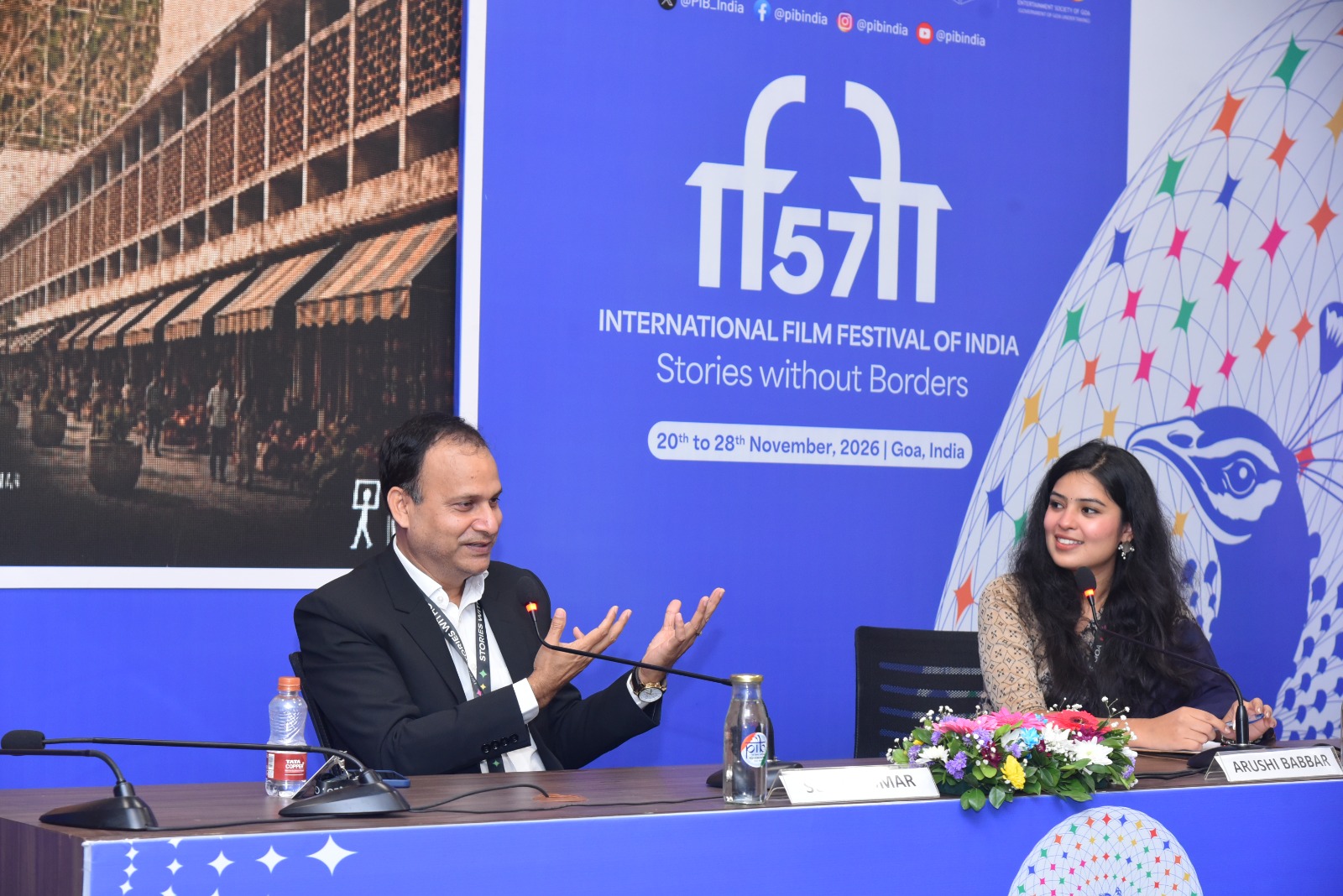
At a press conference organised by the Press Information Bureau in Goa on Sunday, National Award-winning filmmaker Suraj Kumar discussed how his non-feature documentary traces Nowicki’s contribution to Chandigarh’s original architectural imagination, including ideas reflected in its distinctive jaali facades, neighbourhood markets and residential planning.
The film brings attention to an architect whose ideas were cut short by an untimely death but continued to influence the city through the drawings and designs he left behind.
A city imagined around people and climate
Nowicki’s approach to Chandigarh was markedly attentive to India's climate and community life. Instead of relying solely on monumental buildings, he envisioned an urban environment shaped around everyday needs, neighbourhood interaction and climatic sensitivity.
Among his ideas was an artificial water reservoir that later took shape as Sukhna Lake. He also proposed self-contained residential ‘superblocks’, integrating schools, parks, markets and community spaces so that essential facilities would remain accessible within neighbourhoods.
But Nowicki never got the opportunity to see his vision implemented. In 1950, while preparing to return to India to take forward his plans, he died in a plane crash.
His architectural ideas, however, did not disappear. Swiss architect Pierre Jeanneret recognised the value of his surviving drawings and incorporated elements of the vision into the development of Chandigarh’s Sectors 7 and 8.
An international search to recover a forgotten legacy
For filmmaker Suraj Kumar, reconstructing this chapter of Chandigarh’s history meant going well beyond the limited material available in India.
Only around 20 to 25 of Nowicki’s works are preserved at the Chandigarh Architecture Museum. To build a fuller account, Kumar pursued archival references through vintage editions of The Tribune and digitised design notes at North Carolina State University in the United States, where Nowicki had headed the Department of Architecture.
The research also received support from the Embassy of Poland and the Polish Institute, following a suggestion from the Ambassador of Poland.
Through these scattered archival records, Nirmanjali attempts to piece together the contribution of an architect whose role in shaping Chandigarh’s early vision has received relatively little public attention.
75-year-old blueprints, lessons for today's cities
Kumar said Nowicki’s blueprints, dating back around 75 years, hold important lessons for contemporary urban planning, particularly as Indian cities face growing challenges from heat stress and uncontrolled urban expansion.
The filmmaker emphasised that architecture must respond to local climatic conditions and human requirements rather than follow a uniform model of development.
The documentary thus connects a largely forgotten episode in India's architectural history with present-day debates on sustainable, climate-sensitive and community-oriented urban design.
A film shaped by research and collaboration
Produced by Johnsons Suraj Films International (JSFI), led by Suraj Kumar and Dr Garima Singh, the documentary features a screenplay by Murtaza Ali Khan, cinematography by Rakesh Rana and editing by Amit Roy. Its music has been composed by Subhendra Rao and Saskia Rao-de Haas, while veteran actor Victor Banerjee also appears in the film.
An alumnus of the Indian Institute of Mass Communication, Kumar brings 27 years of experience in documentary and feature filmmaking. His earlier work includes more than 500 documentaries and films such as Thinking of Him and Piplantri.
The PIB press conference was moderated by Arushi Babbar.
Rewriting the story behind Chandigarh
At a festival celebrating cinema and stories across borders, Nirmanjali offers more than an account of an architect's unfinished project. It reopens a chapter of Chandigarh’s history and draws attention to the international ideas and collaborations that shaped the early imagination of modern India.
By bringing Nowicki’s drawings and design philosophy back into public discussion, the documentary raises a timely question: how might Indian cities have evolved—and what can they still learn—if urban planning places climate, community and everyday life at its centre?
Sometimes, a city outlives the architect who imagined it. Nirmanjali sets out to ensure that the imagination itself is not forgotten.