


27, Oct 2026
MEXC and Hacken Launch AI Trading Safety Handbook to Promote Safer AI Adoption
MUTSAMUDU, Comoros, Oct. 27, 2026 /PRNewswire/ — MEXC, a pioneer in 0-fee digital asset trading, and blockchain security, compliance, and regulatory assurance partner Hacken, have released the MEXC × Hacken AI Trading Safety Handbook, providing practical guidance on how users and platforms can use and deploy AI-assisted and automated trading tools more safely, from research and decision support through trade execution.

The handbook follows the recent MEXC AI Trading Report, which found strong interest in AI alongside clear demand for greater control. In MEXC’s 2026 survey, willingness to use automated trading rose from 55% to 71.8% when limits on funds, positions, leverage and losses were introduced.
As AI takes a more active role in trading, the handbook emphasizes that safety cannot rely on the AI model alone. AI-facilitated actions should be checked against separate permissions, financial limits and risk controls before execution. It covers risks including credential exposure, excessive permissions, manipulated data and unintended execution, while outlining practical safeguards for both users and platforms.
For users, the handbook sets out five safety checks: Ask, Verify, Limit, Control and Review. For platforms, it outlines five principles: Guard, Limit, Approve, Controls and Test. Together, they provide a practical framework for expanding the use of AI while keeping appropriate controls in place.
“AI can make trading more accessible and efficient, but greater capability should come with stronger safeguards,” said Vugar Usi Zade, CEO of MEXC. “At MEXC, we want users to benefit from innovation, while taking a measured approach to AI adoption. Our People First principle means giving users access to new capabilities without losing sight of control, transparency and risk.”
“AI agents will soon place more orders than people do. Trust in them should be earned the way smart contracts earned it: through independent controls, continuous red-teaming and evidence anyone can verify,” said Dyma Budorin, CEO and co-founder of Hacken. “This handbook is intended to raise awareness of those risks and provide practical support for both users and platforms. As adoption grows, platforms will need to test these safeguards continuously and strengthen them as new risks emerge.”
MEXC and Hacken hope the handbook can serve as a practical reference for users and platforms as AI becomes more deeply integrated into trading, helping raise risk awareness and support safer, more responsible adoption across the industry.
About MEXC
Founded in 2018, MEXC is a leading global multi-asset trading platform built as your 0-fee gateway to infinite opportunities. Serving users across 170+ markets, MEXC provides simple and efficient access to crypto, stocks, tokenized assets, derivatives, and a growing range of TradFi-linked opportunities through one account and one gateway.
With 0 trading fees, deep liquidity, broad asset coverage, and a high-performance trading experience, MEXC is designed for retail users who want to discover earlier, act faster, and trade with fewer barriers. As crypto and traditional finance continue to converge, MEXC is committed to making global opportunities more accessible, helping users trade freely and MEXCmize every opportunity.
MEXC Official Website| X | Telegram |How to Sign Up on MEXC
About Hacken
Hacken is a security and assurance partner for financial institutions and the infrastructure they rely on: exchanges, ecosystems, custodians, banks, asset managers, and tokenization platforms. Hacken’s AI security work includes AI agent security audits and red-teaming of AI systems.
Founded in 2017, Hacken has 60+ engineers and more than 1,500 clients across industries, including the European Commission, ADGM, Ethereum Foundation, Societe Generale-Forge, MetaMask, and Bybit.
Hacken website | X | LinkedIn

 View original content to download multimedia:https://www.prnewswire.co.uk/news-releases/mexc-and-hacken-launch-ai-trading-safety-handbook-to-promote-safer-ai-adoption-302920502.html

- 0
- By Sai Krishna

27, Oct 2026
EDC and EFA sign Memorandum of Understanding to deepen Canada-Australia trade and investment ties
Partnership between Canada and Australia’s export credit agencies opens opportunities for businesses in both countries
SYDNEY, Oct. 27, 2026 /PRNewswire/ — Export Development Canada (EDC) and Export Finance Australia (EFA) have signed a Memorandum of Understanding (MoU) to strengthen cooperation between the two organizations. The agreement establishes a framework for collaboration on strategic financing opportunities and investment projects that support economic growth, energy security, supply chain resilience and sustainable development.
Through the partnership, EDC and EFA will explore opportunities for co-financing, transaction facilitation, joint outreach and knowledge sharing, while helping connect Canadian and Australian companies and investors to pursue opportunities in areas of mutual interest.
Canada and Australia share a longstanding trade and investment relationship built on strong commercial ties and common economic interests. In 2025, bilateral merchandise trade between the two countries totalled CAD$7.3 billion, with Canadian exports exceeding CAD$3 billion. Since the Comprehensive and Progressive Agreement for Trans-Pacific Partnership (CPTPP) entered into force in 2018, bilateral merchandise trade has grown at an average annual rate of eight per cent.
Australia is the largest destination in the Asia-Pacific region for Canadian direct investment abroad, with Canadian direct investment in Australia reaching CAD$50.1 billion in 2025, while Australia’s direct investment in Canada totalled CAD$36.4 billion. Key areas of opportunity for Canadian and Australian companies include infrastructure, energy and energy transition, mining and critical minerals, agri-food and agtech, digital technologies, defence and aerospace.
Quotes
“Canada and Australia are trusted partners with a growing economic relationship that creates opportunities for workers and businesses in both countries. This past year, bilateral merchandise trade reached $7.3 billion, with Canadian exports exceeding $3 billion and two-way direct investment totalling more than $86 billion. This agreement between EDC and Export Finance Australia will help connect companies, attract investment and unlock opportunities in priority sectors that support long-term economic growth and resilience.”
The Honourable Maninder Sidhu, Canada’s Minister of International Trade
“Canada and Australia have built one of the strongest commercial relationships in the Asia-Pacific region, underpinned by significant two-way investment and complementary economic strengths. This agreement creates new opportunities for EDC and EFA to connect businesses, share expertise and support Canadian and Australian companies as they pursue growth opportunities abroad.”
Alison Nankivell, President and CEO, Export Development Canada
“This collaboration will deepen co-operation with an important likeminded partner, further strengthening our investment capabilities. We both have a shared interest in a secure and prosperous Indo-Pacific, and bringing our two export credit agencies closer together will create more opportunities for Aussie businesses and local jobs.”
Senator the Hon. Don Farrell, Minister for Trade and Tourism
“Australia and Canada have a shared interest in strengthening economic security and creating new opportunities across the Indo-Pacific, and the scale of investment required across infrastructure, critical minerals and the energy transition means collaboration between like-minded partners is increasingly important. This agreement gives EFA and EDC a practical framework to continue to work together, share expertise and explore opportunities where our combined capabilities can make a real difference to Australian and Canadian businesses.”
John Hopkins, Managing Director and CEO, Export Finance Australia
About Export Finance Australia
EFA is the Australian Government’s trade and strategic finance agency, backing Australian exporters, supply chains and overseas investment. EFA helps Australian businesses win work overseas, expand into new markets and participate in global supply chains. EFA also deploys finance to deliver national priorities that strengthen Australia’s economic security and regional partnerships. For more information visit www.exportfinance.gov.au.
About EDC
Export Development Canada (EDC) is a financial Crown corporation dedicated to helping Canadian businesses make an impact at home and abroad. EDC has the financial products and knowledge Canadian companies need to confidently enter new markets, reduce financial risk and grow their business as they go from local to global. Together, EDC and Canadian companies are building a more prosperous, stronger and sustainable economy for all Canadians. For more information and to learn how we can help your company, call us at 1-800-229-0575 or visit www.edc.ca.

27, Oct 2026
Healthware partners with Fujifilm to expand access to precision surgical imaging across India
- Collaboration combines Healthware’s pan-India market reach with Fujifilm’s advanced intra-operative and robotic ultrasound portfolio to empower clinical decision-making.
- Targeting corporate chains, government institutions, and specialized clinics, the partnership seeks to elevate real-time visualization in complex surgical workflows.
HYDERABAD, India, Oct. 27, 2026 /PRNewswire/ — In a significant development for India’s medical technology sector, Healthware, a premier provider of advanced medical devices, has announced a strategic collaboration with Fujifilm, a global leader in diagnostic and optical innovation. This alliance aims to scale up the availability of Fujifilm’s state-of-the-art intra-operative ultrasound systems across healthcare institutions nationwide, addressing critical clinical needs in complex surgical environments.

With 37 years of experience in establishing new medical technologies with focus on efficient patient care, Healthware brings an extensive pan-India network supported by dedicated service and clinical application teams. The partnership addresses a diverse healthcare ecosystem spanning government institutions, corporate hospital chains, large hospitals, individual practitioners, and specialized nursing homes and clinics.
Fujifilm’s advanced intra-operative ultrasound portfolio is engineered to transform real-time surgical visualization. Technological innovations integrate seamlessly into existing surgical workflows, enabling precise anatomical identification, accurate tumour boundary assessment, and confident intra-operative navigation.
Commenting on the strategic partnership, K. Tarun Narayan, Director, Healthware, said, “For 37 years, Healthware has been about one thing: bringing world-class medical technology to Indian clinicians and standing behind it every day. Partnering with Fujifilm, a name synonymous with imaging excellence, lets us bring real-time surgical ultrasound to more operating rooms across India, and that is a responsibility we take seriously.”
Echoing this sentiment, Koji Wada, Managing Director, Fujifilm India, said, “At Fujifilm, we believe that meaningful innovation is driven by collaboration and a shared commitment to improving patient care. Our partnership with Healthware marks an important step towards advancing surgical ultrasound solutions in India, bringing real-time imaging closer to the operating room. By combining technological innovation with clinical expertise, we aim to empower healthcare professionals with greater confidence in decision-making and contribute to better patient outcomes. Together, we aspire to make quality healthcare more accessible and create MORE SMILES across India.”
By integrating state-of-the-art surgical technologies into domestic healthcare infrastructure, this strategic alliance opens new business horizons for healthcare providers while reinforcing India’s growing stature as a premier global hub for medical tourism. Empowering clinicians with advanced, modern healthcare solutions directly translates to profound patient-centric benefits minimizing surgical risks, shortening recovery times, and driving sustainable growth within the nation’s healthcare economy.
For clinicians, the partnership brings Fujifilm’s real-time intra-operative ultrasound closer to the operating room across India, supporting precise anatomical identification, accurate tumour boundary assessment and confident intra-operative navigation, while integrating into existing surgical workflows. With Healthware’s pan-India network and its dedicated service and clinical application teams behind it, healthcare professionals gain greater confidence in decision-making. For patients, this means minimised surgical risk, shorter recovery times and better patient outcomes, helping make quality healthcare more accessible across the country.
For more information, please visit: www.healthwareindia.com
 View original content to download multimedia:https://www.prnewswire.com/in/news-releases/healthware-partners-with-fujifilm-to-expand-access-to-precision-surgical-imaging-across-india-302920561.html

27, Oct 2026
Paul & Shark Redefines Its Presence in New Delhi
A renewed expression of the brand’s Italian craftsmanship and Sense of Journey

Oct 27: Every journey is marked by new destinations. As the path unfolds, each new chapter brings moments of renewal and discovery, while remaining rooted in the values that have shaped the brand over time.
For Paul & Shark, the reopening of its boutique at the prestigious luxury mall DLF Emporio in New
Delhi represents one of these moments: a renewed expression of the brand’s presence in India, a market that has played an important role in its history for many years and continues to hold a significant place in its international growth.
The new space embodies Paul & Shark’s spirit of evolution and discovery, while remaining rooted in its Italian craftsmanship.
The boutique introduces Paul & Shark’s latest retail concept, inviting visitors to immerse themselves in the brand’s universe. Fluted oak wall panelling, natural stone and marble are combined with blue velvet, ceramics and bespoke furnishings to create an environment that feels both sophisticated and distinctive.
A palette of cream, sand and different shades of blue brings contemporary elegance while echoing Paul & Shark’s distinctive visual codes. Every element reflects the brand’s spirit of research, innovation and attention to detail. More than simply a retail destination, the boutique embodies Paul & Shark’s philosophy of continuous discovery and refinement. The design encourages visitors to explore the space and experience the values at the heart of the brand, while the quality of the materials and precision of every detail offer a contemporary interpretation of the craftsmanship that has distinguished Paul & Shark throughout its journey.
The result is a space that brings the Sense of Journey to life. Rooted in the brand’s DNA and driven by curiosity, discovery and continuous evolution, it reflects an attitude towards life: a desire to explore new places, experiences and perspectives, shared by men and women whose lives are constantly in motion and whose style accompanies them across destinations and occasions.
In the same way, craftsmanship can be experienced throughout the space, echoing the qualities of Paul & Shark’s collections. Every element is the result of meticulous research, technical expertise and savoir-faire refined over decades, where innovation and technical know-how meet an enduring respect for quality.
Craftsmanship becomes tangible through the materials, proportions, finishes and design of the space.
The renewed Paul & Shark boutique at DLF Emporio was unveiled on 14 October with an exclusive event that brought together the local community. Guests had the opportunity to meet Mr Dini, CEO of Paul & Shark and representative of the Dini family, which has guided the brand for fifty years, preserving its heritage, values and aspirations while leading its continued evolution.
The evening marked the beginning of a new chapter for Paul & Shark in New Delhi, inviting guests to discover the new space and celebrate the brand’s enduring presence in India.
27, Oct 2026
ABB turns aging drives into a second life at ACC’s Jamul plant, without stopping production
- To date, on-site drive reconditioning has preserved capital and material value, avoided ~16 metric tons of CO₂ emissions, and maintained continuity, delivering environmental, economic, and operational value in one decision.
- Asset health assessment by ABB helped the major Indian cement producer choose a tailored, multi-year ABB Motion OneCare agreement, for enhanced reliability, uptime, and cost predictability.
- ACC Limited is set to benefit from energy appraisals, scheduled drive reconditioning, and digital monitoring to shift maintenance from reactive to predictive.
BENGALURU, India, Oct. 27, 2026 /PRNewswire/ — ABB has signed a multi-year ABB Motion OneCare service agreement with ACC Limited, a major cement producer in the Adani Group, to improve the operational reliability of ACC’s Jamul cement plant in Chhattisgarh, India. The comprehensive maintenance framework, shaped around ACC’s needs, encompasses scheduled reconditioning, digital monitoring, and energy appraisals, with the latter extending the program’s scope from restoration into ongoing performance enhancement.

Phase one, completed in April 2026, reconditioned 25 ABB ACS800 variable speed drives on site without a major shutdown. By retaining the existing cabinets and reconditioning equipment rather than replacing complete panels, the project avoided approximately 16 tonnes of CO₂ emissions.
A second phase covering the reconditioning of an additional 25 ACS800 drive modules is planned for Q4 2026. As part of the agreement, ACC also began using ABB Ability™ Digital Powertrain Insights, setting the foundation to shift from reactive to predictive maintenance.
A fleet that delivered — and a clear signal to act
The ABB ACS800 drives at Jamul — installed in 2010 — had maintained a strong reliability record across well over a decade of near-continuous operation in one of the most demanding industrial environments. Over time, however, the cumulative effects of electrical aging reached a point where trip event patterns were no longer in line with the plant’s operational requirements — a natural inflection point for a fleet that had been running full steam since installation, and a clear signal that the time had come to act.
Rather than defaulting to full replacement, ACC engaged ABB’s certified engineers for a structured asset health assessment. The finding was clear: the drives’ cabinets and enclosures remained structurally sound. Targeted reconditioning was both the technically right and most cost-effective route to extended lifetime and sustained reliability.
Expertise brought to the plant
Two decades of working knowledge of ACC’s equipment and operational calendar shaped the approach. ABB developed a service plan tailored to ACC’s shutdown windows and budget cycle. The multi-year ABB Motion OneCare agreement includes scheduled drive reconditioning, ABB Ability™ Digital Powertrain Insights, and energy appraisals. To start, ABB brought its reconditioning expertise directly to Jamul. Earlier this year, 25 ACS800 drives were restored to factory specification without interrupting production, with the original enclosures retained. Phase two is in planning: an additional 25 ACS800 modules are scheduled for on-site reconditioning in the last quarter of 2026.
In addition, with ABB Ability™ Digital Powertrain Insights now active across the fleet, ACC’s teams gain continuous visibility into temperature, current, vibration, and fault patterns — the intelligence to act on emerging issues before they become failures. Energy appraisals, built into the later phase of the program, will extend its scope from restoration into systematic performance improvement. “We know what unchecked wear costs over time: a small inefficiency that eats away at ROI for years. At Jamul, the evidence pointed clearly to assets with productive life still in them,” said Amit Gupta, Local Division Manager, Motion Services, ABB India. “Our job was to restore them properly and give the team the tools to stay ahead of the next problem. At ABB, we don’t just fix what fails. We want to protect what works.”
Circularity as the operating logic
The program reflects the competitive logic of industrial circularity. Restoring what was installed rather than replacing it kept material and economic value in productive use, and protected continuity — all in one decision. ABB data indicates reconditioning reduces drive lifecycle emissions by 50 to 80% versus full replacement. Digital monitoring gives ACC’s teams real-time intelligence: now they know exactly what to fix, and exactly when to fix it, for maximum uptime.
“Moving from reactive firefighting to a structured maintenance plan was exactly what this operation needed. That kind of peace of mind doesn’t come easily. It comes from a partner that understands how your business runs,” added Vinod Bahety, CEO – Cement Business, Adani Group. “We didn’t need a full system overhaul; we needed expert support, actionable insights, and a plan we could execute around our schedule. That’s what we got.”
ABB is a global technology leader in electrification and automation, enabling a more sustainable and resource-efficient future. By connecting its engineering and digitalization expertise, ABB helps industries run at high performance, while becoming more efficient, productive and sustainable so they outperform. At ABB, we call this ‘Engineered to Outrun’. The company has over 140 years of history and around 110,000 employees worldwide. ABB’s shares are listed on the SIX Swiss Exchange (ABBN) and Nasdaq Stockholm (ABB). www.abb.com
ABB Motion, a global leader in motors and drives, is at the core of accelerating a more productive and sustainable future. We innovate and push the boundaries of technology to contribute to energy efficient, decarbonizing and circular solutions for customers, industries and societies. With our digitally enabled drives, motors and services we support our customers and partners to achieve better performance, safety and reliability. To help the world’s industries outrun – leaner and cleaner, we deliver motor-driven solutions for a wide range of applications in all industrial segments. Building on over 140 years of domain expertise in electric powertrains, our more than 23,000 employees across 100 countries learn and improve every day. go.abb/motion
ACC Limited, a subsidiary of Ambuja Cements and part of the diversified Adani Group, is one of India’s most trusted building materials and concrete solutions company. With a legacy of nearly nine decades, ACC operates 20 cement manufacturing sites, 119 ready-mix concrete plants, and a nationwide network of channel partners, serving its customers. ACC is actively advancing its sustainability roadmap with a strong focus on green energy, circular economy, and digital transformation. The Company alongside Ambuja Cements is among the fourth large-scale building materials company in the world committed to net-zero by 2050, with its near-term and science-based net-zero targets validated by the Science Based Targets initiative (SBTi). ACC continues to drive operational excellence through synergies with the Adani Group in logistics, power, project execution, and digital infrastructure. ACC has been recognised India’s Most Sustainable Company 2026 in the Cement Sector by Business Today. Its blended cement products are GreenPro certified, and its innovative products are listed in the GRIHA product catalogue. ACC has been recognised as one of ‘India’s Most Trusted Cement Brands’ by TRA Research and among the ‘Iconic Brands of India 2025’ by The Economic Times for the third consecutive year. https://www.acclimited.com/
 View original content to download multimedia:https://www.prnewswire.com/in/news-releases/abb-turns-aging-drives-into-a-second-life-at-accs-jamul-plant-without-stopping-production-302920411.html

27, Oct 2026
XCMG Deploys Heavy Equipment to Support Nairobi Building Collapse Rescue
XUZHOU, China, Oct. 27, 2026 /PRNewswire/ — XCMG Group joined rescue operations and helped local emergency teams rescue two people after a building under construction collapsed in Nairobi on Oct. 23, according to an Oct. 25 report by Xinhua News Agency.

The 18-story building collapsed on the afternoon of Oct. 23 in the Kenyan capital’s Eastleigh neighborhood. Ground-floor shops were open and construction workers were on site at the time. Following the collapse, the Kenya Defence Forces, the Red Cross and police rushed to the site to conduct search and rescue operations. The large volume of rubble and thick layers of collapsed concrete slabs created an urgent need for heavy lifting and demolition equipment.
XCMG’s Kenya office activated its emergency response procedures upon learning of the collapse. Its team went to the site to coordinate with Kenya’s National Disaster Operations Centre and police rescue personnel. Following a request for assistance, XCMG dispatched an excavator to the site that day, followed by a 25-tonne crane the next day. All equipment and personnel worked under the direction of the on-site rescue team to help rescue people trapped beneath the rubble and clear access routes.
William Sifuna Watitwa, a police personnel officer for the Nairobi North sub-region, told Xinhua that the excavator was crucial to freeing the two survivors. He said the crane enabled crews to lift heavy wreckage from above, reducing the weight of debris and improving access to areas where survivors might be located.
“As a Chinese company that has operated in Kenya for many years, we are part of the local community and stand with it in times of need,” said Fredrick Nyasani, an administrator at XCMG’s Kenya office. “In an emergency like this, XCMG has both a responsibility and a duty to use our specialized equipment and technical personnel to make every effort to support Kenyan rescue teams in saving lives.”
As of Oct. 25, government officials said five people were still missing and four were receiving hospital treatment.
XCMG’s rescue team will continue supporting local rescue operations and remain at the site until its work is complete.

 View original content to download multimedia:https://www.prnewswire.co.uk/news-releases/xcmg-deploys-heavy-equipment-to-support-nairobi-building-collapse-rescue-302920424.html

27, Oct 2026
India Clears Regulatory Path for E100 Fuel in Flex-Fuel Vehicles: Key Changes Explained
New Delhi, Oct 27: India has taken a significant step towards expanding the use of ethanol-based fuels, with the Ministry of Road Transport and Highways (MoRTH) amending the Central Motor Vehicles Rules, 1989, to include E100 fuel in the regulatory framework for compatible flex-fuel vehicles.
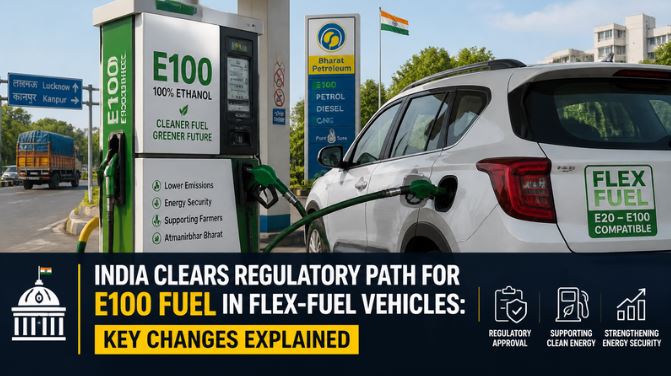
Representational Image
The amendment, notified through GSR 911(E) dated October 23, 2026, updates existing emission-related provisions to recognise vehicles designed to operate on E100, a fuel comprising 100 per cent ethanol. The move establishes a regulatory basis for vehicles capable of running on nearly pure ethanol, although it does not announce a nationwide rollout of E100 at petrol pumps.
What Is E100 Fuel?
E100 is an ethanol-based fuel containing 100 per cent ethanol, while E85 contains approximately 85 per cent ethanol. Ethanol can be produced from agricultural feedstocks such as sugarcane and other biomass sources.
Until this amendment, the relevant emission-rule references for flex-fuel vehicles primarily mentioned E85. The revised provisions explicitly add E100 alongside E85, creating a clearer regulatory framework for vehicles engineered to use higher concentrations of ethanol.
Flex-fuel vehicles are designed to operate on different proportions of petrol and ethanol, depending on their engineering specifications and certification.
E100 Is Not for Every Petrol Vehicle
One of the most important aspects of the new rules is the restriction on vehicle compatibility.
According to the notification, E85 and E100 are intended for vehicles designed by original equipment manufacturers (OEMs) as flex-fuel vehicles.
This means conventional petrol cars and motorcycles cannot automatically use E100. Even vehicles compatible with E20 petrol should not be filled with E100 unless the manufacturer has specifically approved the vehicle for that fuel.
Using an incompatible fuel can damage engine and fuel-system components. Vehicle owners should follow the manufacturer’s fuel specifications and safety guidance.
Key Changes to the Central Motor Vehicles Rules
The amendment introduces several technical updates to the existing regulatory framework.
1. E100 added to emission provisions: References to E85 in relevant sections of Rule 115 have been updated to read “E85 or E100”, extending the provisions to vehicles designed for both fuel types.
2. Revised vehicle weight threshold: The gross vehicle weight threshold in the relevant emission-standards table has been increased from 3,000 kg to 3,500 kg.
3. Updated technical reference: Rule 115E now refers to Annexure SA instead of Annexure S for E100 vehicles, as specified in the notification.
4. Biodiesel reference revised: A fuel entry in the relevant table has been changed from B10 to B100.
The notification also includes technical and editorial corrections to certain fuel classifications, emission-table headings, measurement units and related provisions.
How Were the New Rules Finalised?
The government had published the draft amendment in the Gazette of India on April 27, 2026, inviting objections and suggestions from stakeholders within the prescribed 30-day period.
Following consideration of the feedback received, the ministry issued the final notification on October 23, 2026. The rules take effect from the date of publication in the Official Gazette, as stated in the notification.
Will E100 Be Available at Petrol Pumps Soon?
Despite the regulatory approval, the notification does not specify a nationwide launch date for E100 fuel or confirm widespread availability at retail fuel stations.
The amendment primarily establishes the regulatory provisions for E100-compatible flex-fuel vehicles. Wider adoption will depend on factors such as vehicle development, certification, fuel production, distribution infrastructure and commercial availability.
For automobile manufacturers, the revised framework offers a clearer basis for developing and certifying vehicles capable of using high-ethanol fuels. For consumers, however, the practical benefits will depend on the availability of compatible vehicles and fuel stations.
What Does This Mean for India’s Fuel Future?
The move supports India’s broader efforts to diversify its energy mix, promote domestic biofuel production and reduce dependence on imported crude oil.
Greater use of ethanol could also create opportunities for agricultural producers and biofuel manufacturers. However, the overall economic and environmental benefits will depend on production methods, fuel pricing, vehicle efficiency and the sustainability of feedstock supplies.
For now, the E100 amendment represents a regulatory step towards expanding India’s alternative-fuel options rather than an immediate replacement for conventional petrol.
The bottom line: E100 has received a place in India’s regulatory framework for compatible flex-fuel vehicles, but ordinary petrol vehicles cannot automatically use it, and nationwide availability has not yet been announced.
27, Oct 2026
Zen Technologies Launches Africa’s First AI-Enabled Combat Training Centre (CTC) at AFRIDEX 2026 in Lagos, Nigeria
- A fully integrated combat training hub with multiple simulators for realistic combat training for soldiers
- The CTC will enhance weapon training, tactical drills, Force-on-Force combat exercises and mission rehearsals, with high fidelity simulation systems
MUMBAI, India, Oct. 27, 2026 /PRNewswire/ — Zen Technologies, a global leader in defence training simulation and counter-drone solutions, today launched Africa’s First AI-Enabled Combat Training Centre (CTC) at AFRIDEX 2026 in Lagos, Nigeria.
The Readiness Gap Facing African Forces: Across the continent, African armed forces are confronting an increasingly complex and asymmetric threat environment: counter-insurgency campaign, urban counter-terrorism operations, and the rising pressure of border instability and internal security threats. Yet defence spending across Africa, have historically been weighted toward equipment and platforms rather than the training infrastructure needed to operationalise that equipment effectively. The result is a persistent gap between battlefield-ready hardware and battlefield-ready soldiers, a gap that live-fire ranges and conventional drills alone struggle to close, particularly given the cost, safety constraints and limited repeatability of traditional training methods.
Zen Technologies’ Combat Training Centre (CTC) is built to directly address this gap. The Combat Training Centre (CTC) is an integrated training ecosystem that combines live-fire ranges, force-on-force engagement systems, simulator-based marksmanship training, and a Shoot House for close-quarters combat drills, all unified under a single Common Operating Picture. Designed to train forces from platoon to brigade level, the CTC supports both conventional warfare preparation and Militarized Operations in Urban Terrain (MOUT) / counter-terrorism training. Central to the CTC’s value proposition is Zen’s proprietary Combat Readiness Score (CRS), an AI-derived metric, unique to Zen Technologies, that analyses data captured during training sessions to objectively measure and track the combat preparedness of forces over time.
Key features of the Combat Training Centre (CTC):
- AI-derived Combat Readiness Score (CRS) — analyzes training-session data to objectively measure and track combat preparedness over time, replacing subjective assessment
- Smart live-fire shooting ranges — STS® and MFTS® systems for precision hit detection and reflex shooting training
- Force-on-force engagement training — Zen TacSim® and ACTS, an Instrumented Tactical Systems (ITS) simulating opposed-fire combat scenarios
- Shoot House — dedicated facility for room-clearing and close-quarters battle (CQB) drills
- Simulator-based training — covers infantry weapons, machine guns, and automatic grenade launchers for marksmanship and judgmental shooting skills
- Central Control Room — enables real-time monitoring of all training activity and After Action Review (AAR) for post-exercise analysis
- Common Operating Picture — unifies live, virtual, and constructive training elements under a single integrated system
- Scalable training levels — supports forces from platoon to brigade level
- Dual-mode readiness — designed for both conventional warfare preparation and MOUT/counter-terrorism operations
Zen Technologies’ Combat Training Center (CTC) also features an integrated Naval Training Centre equipped with advanced Naval simulation and training systems. The portfolio includes Bridge Operations, Fast Attack Craft (FAC), Action Speed Tactical Trainer (ASTT), Combat Information Centre (CIC), Submarine Operations, Deep Submergence Rescue Vehicle (DSRV), and Machinery Operations Simulators, alongside other specialised training solutions. These systems are designed to deliver realistic, immersive, and mission-oriented training across diverse naval operational scenarios. The integrated Naval Training Centre will enhance the CTC’s multi-domain training capabilities, helping naval personnel develop operational skills, decision-making capabilities, and combat readiness in a controlled, simulation-based environment.
About Zen Technologies
Founded in 1993 and headquartered in Hyderabad, India, Zen Technologies is a pioneer and global leader in Defence Training Simulators and Counter-Drone Solutions. With a portfolio of over 50 products, more than 200 patents filed, and over 10,000 systems shipped worldwide, Zen Technologies has more than 30 years of experience equipping armed forces, police and paramilitary organisations with realistic, combat-proven training and force-protection systems.
Website: www.zentechnologies.com
 View original content:https://www.prnewswire.com/in/news-releases/zen-technologies-launches-africas-first-ai-enabled-combat-training-centre-ctc-at-afridex-2026-in-lagos-nigeria-302920329.html

27, Oct 2026
Limca Launches Haryana Special Can, Celebrating the State’s Culture, Sporting Spirit and Contemporary Energy
- Homegrown brand Limca celebrates the distinctive spirit of India’s cities and states through limited-edition Special Cans.
NEW DELHI, Oct. 27, 2026 /PRNewswire/ — Limca, Coca-Cola India’s iconic beverage, has unveiled its first-ever Limca Haryana Special Can, a limited-edition collectible that brings the unmistakable spirit of Haryana to life. Created under the idea ‘One State, One Can: Crafted for Collection’, the special edition transforms the everyday Limca can into a canvas of local pride, bringing together Haryana’s culture and heritage. From folk dance and traditional tractors to the state’s celebrated sporting legacy across kushti, boxing, javelin and running, the design captures the many facets that make Haryana unique.

More than a refreshing beverage, the Haryana Special Can is a visually striking keepsake, introducing a new collectible experience for consumers. Created as a limited-edition release, it is designed to inspire discovery, sharing and collectability, while offering young, urban consumers a fresh way to celebrate the city they call home.
The launch also brings the Special Can idea to life through a consumer-led social activation on Instagram featuring Bollywood actor Ananya Panday. The activation will further bring artists and creators into the conversation, encouraging them to share their own interpretations of the city’s culture, landmarks and everyday experiences. Together, these voices invite consumers to engage with the Special Can beyond the product and celebrate the many elements that make the state uniquely their own.
Pankaj Sinha, Senior Director, Integrated Operations, North India, Coca-Cola India, said, “As a loved homegrown brand, Limca brings the character of Haryana to life in a format that consumers can experience, share and make their own. The can is an extension of our approach to building deeper connections, bringing together the city’s vibe and energy. Through our expansive retail network, we are bringing this special edition closer to consumers and placing a piece of Haryana’s identity in their hands.”
Ravinder Pal Singh Bhatia, CEO, Kandhari Global Beverages Pvt Ltd, said, “Limca has an opportunity to connect with consumers through initiatives that are rooted in the character of each market. Haryana is an important market for us, and we are proud to bring this distinctive consumer proposition to life through our distribution capabilities, strong understanding of the region and the communities we serve. We look forward to seeing consumers engage with and make this limited-edition offering their own.”
The Limca Haryana Special Can is now rolling out across Haryana, giving consumers an opportunity to collect a special edition that celebrates the capital’s unique character.
About Coca-Cola:
Coca-Cola in India is one of the country’s leading beverage companies, offering a range of high-quality and refreshing beverage options to consumers. The company, in line with its vision of ‘Beverages For Life’ offers a wide portfolio of products which includes hydration, sports, sparkling, coffee, tea, nutrition, juice and dairy based products. In India its beverage range includes Coca-Cola, Coca-Cola Zero Sugar, Diet Coke, Thums Up, Thums Up XForce, Charged, Fanta, Limca, Sprite, Sprite Zero, Kinley Soda, Rimzim, Maaza, Minute Maid range of juices and Honest Tea. The Company also offers hydration beverages including Limca GlucoCharge, Smartwater, Kinley, Kinley Copper, Dasani and Bonaqua packaged drinking water. Premium products constitute Schweppes’ range and Smartwater. In addition, it offers a Costa Coffee range of tea and coffee. The Company is constantly transforming its portfolio, from reducing sugar in its drinks to bringing innovative new products to market.
The Company along with its owned bottling operations and franchise bottling partners has a strong network of over six million retail outlets through which it refreshes millions of consumers across the country. It seeks to positively impact people’s lives, communities, and the planet through water and packaging initiatives, sustainable agriculture and emission reductions across its value chain.
Globally together with its bottling partners, The Coca-Cola Company employs more than 700,000 people, helping to bring economic opportunity to local communities worldwide. Learn more at www.cocacolacompany.com and follow us on Twitter, Instagram, Facebook and LinkedIn.

 View original content to download multimedia:https://www.prnewswire.com/in/news-releases/limca-launches-haryana-special-can-celebrating-the-states-culture-sporting-spirit-and-contemporary-energy-302920349.html

27, Oct 2026
XCMG Advances Belt and Road Talent Cooperation with Launch of Joint Education Programs for Students from Uzbekistan and Indonesia
XUZHOU, China, Oct. 27, 2026 /PRNewswire/ — XCMG Group recently held opening ceremonies in Xuzhou for joint education programs for students from Uzbekistan and Indonesia, advancing youth talent development in Belt and Road partner countries through international education partnerships. Combining language and academic study with technical training and workplace practice, the programs support local workforce development and XCMG’s overseas operations.
The Uzbekistan program opened on Oct. 13 at Xuzhou University of Technology, where an XCMG construction machinery training base was unveiled.
Jointly developed by XCMG, Xuzhou University of Technology and Urgench State University, the Uzbekistan program follows a phased “2+1+1” model for undergraduate students. Urgench State University selects students and provides their initial education, while Xuzhou University of Technology delivers academic and language instruction. XCMG’s Global Learning and Education Center works with the company’s Uzbekistan operations to develop industry-specific courses and provide internship placements.
The Indonesian program recently opened at Xuzhou College of Industrial Technology. The program follows a phased “1.5+0.5+1” model, connecting language learning, skills training and workplace experience in overseas operations. It is designed to develop versatile technical professionals equipped to meet local business needs.
These training efforts support XCMG’s expanding business presence in Indonesia, where the company has operated for more than 30 years. Its local capabilities span R&D, manufacturing, supply, sales, service and financing. This year, XCMG commissioned its Indonesia New Energy Manufacturing Base and broke ground on the XCMG Indonesia Remanufacturing Center, extending its business from product exports to integrated local operations. Local employees make up nearly 80% of XCMG’s workforce in the country, as the company continues to create local jobs and develop skilled professionals.
To meet local workforce needs across its overseas markets, XCMG has adopted the GEMS framework, whose name combines Global with three talent categories: Executive Functional Staff, Management & Sales Backbone and Skilled Service Specialists. Through partnerships between Chinese and overseas educational institutions, the framework develops local talent, helping its overseas operations meet staffing needs locally and run leaner, more cost-effective operations.
So far, XCMG’s joint education initiatives for students from Uzbekistan and Indonesia have reached three cohorts involving nearly 60 students.
XCMG will continue to expand education partnerships, offering young people worldwide opportunities for academic study, industry practice and cross-cultural exchange while strengthening local talent pipelines for its overseas operations.
 View original content:https://www.prnewswire.co.uk/news-releases/xcmg-advances-belt-and-road-talent-cooperation-with-launch-of-joint-education-programs-for-students-from-uzbekistan-and-indonesia-302920362.html