


2, Oct 2026
FPT Lands At The Genoa International Boat Show With As Labruna, Bimotor, And Naval Motor Botti
Oct 02: FPT, the Iveco Group company dedicated to the design, production, and sale of powertrains and solutions for on- and off-road vehicles, as well as marine and power generation applications, will be exhibiting at the 66th edition of the Genoa International Boat Show, scheduled for October 1 to 6, 2026, one of the world’s premier yachting events and a true showcase for Italian excellence.

To highlight the importance that this event and the recreational segment of marine engines hold for the Brand, FPT will be participating alongside all its Italian distributors for the segment: AS Labruna, Bimotor, and Naval Motor Botti.
FPT’s growth strategy in the recreational segment is built on six decades of experience and a well-established reputation in the commercial marine sector. Today, the Brand engines power a wide range of vessels: patrol boats, passenger ferries, workboats, and charter boats, serving customers all around the world. The Brand is also a trusted partner of institutional operators responsible for safety and security at sea, including coast guards, customs and law enforcement authorities, and fire and rescue services. The demanding requirements of these specific applications have contributed to shaping the core strengths that distinguish the marine offering: proven reliability, long-lasting durability, high performance, and operational efficiency.
Building on this solid foundation, FPT is further strengthening its presence in the recreational market, bringing the same engineering excellence and proven technologies that have earned the trust of commercial operators and leading shipyards worldwide.
This commitment is also reflected in FPT’s recent entry into Confindustria Nautica, the Italian Marine Industry Association, and in its growing focus on collaborations with new shipyards, as part of a broader strategy aimed at fostering long-term partnerships across the marine industry and supporting the continued growth of the recreational boating segment.
Visitors to the stand YP65 will be greeted by a remarkable innovation: the C16 1000 presented for the first time with the exclusive top cover by Van Orton, the renowned Italian creative duo whose vibrant, impactful pop style is globally recognized. Launched at Agritechnica 2025, the partnership between FPT and Van Orton is thus now expanding to marine engines as well.

Operating in the marine propulsion sector since 1965, FPT offers a comprehensive range of best-in-class engines spanning 3 to 15.9 liters in displacement, with power outputs from 85 to 1,000 hp. Built to power 25-to-80 ft vessels, FPT’s marine portfolio caters to a wide range of applications, from pleasure craft to light-, medium-, and heavy-duty commercial boats.
Every day in Italy, two new boats powered by FPT marine engines are launched. FPT supports its customers worldwide through a network of 375 marine service points, more than 200 of which are located in the Mediterranean region and over 80 in North America, with the remaining sites covering key marine markets across the rest of the world. This extensive service footprint ensures prompt response times, minimizes downtime and provides customers with continuous, reliable support wherever they operate.
Last but not least, starting from the Genoa International Boat Show 2026, FPT makes available a free-of-charge five-year warranty for its marine engines dedicated to pure recreational applications. The warranty extension is a great example of the trust that the Brand places in its engines and the respect it has for its customers. The warranty is available for customers across the EMEA region and provides global coverage.
CURSOR 16 1000 – The record-breaking engine delivering top reliability and durability
Winner of the world water speed record for a diesel-powered vessel, a record that remains unbeaten to this day, the CURSOR 16 continues its strong momentum across global markets. Marine professionals rely on this engine for its straightforward maintenance and exceptional efficiency, which translate into highly competitive operating costs. Delivering power outputs from 815 to 1,000 hp, it guarantees smooth installation, outstanding performance, quiet operation, and best-in-class, long-term reliability. These qualities have made the CURSOR 16 the ideal choice to power planing motor yachts and sport-fishing vessels up to 70 feet for almost 10 years.
C16 1000 – Van Orton cover limited edition
The new fruit of FPT’s collaboration with Van Orton is a striking engine cover, made by employing their peculiar, kaleidoscopic perspective to create a unique visual narrative, inspired by the groundbreaking Pop Art movement of artists such as Andy Warhol and Roy Lichtenstein. The result masterfully blends precision engineering with artistic vision, giving the usually “undercover” FPT engines one more reason to be admired.
CURSOR 16 1000 – Technical Specifications
Cylinder layout: 6L
Turbocharger: TCA
Displacement [liters]: 15.9
Injection system: Common Rail
Max power [hp @ rpm]: 1000 @ 2300
Dry weight [kg]: 1640
Full specifications are available on the FPT website.
N67 570 EVO – Best-in-class performance
With its 6.7-liter displacement, the N67 570 EVO marine engine generates up to 570 hp, delivering maximum torque at low RPMs and rapid load response to lead performance benchmarks in its category. Purpose-built for marine applications, its architecture features engine and turbocharging cooling systems tailored specifically for maritime operations. To simplify installation, key components – including the oil cooler, oil pump, water pump, and blow-by system – are fully integrated into the engine design. Maintenance is made straightforward via advanced diagnostics, while extended oil and filter service intervals of up to 300 hours significantly reduce downtime.
N67 570 EVO – Technical Specifications
Cylinder layout: 6L
Turbocharger: TCA
Displacement [liters]: 6.7
Injection system: Common Rail
Max power [hp @ rpm]: 570 @ 3000
Dry weight [kg]: 721
- 0
- By Neel Achary

2, Oct 2026
Use.ai reaches 1 million monthly active users less than a year after launch
The all-in-one AI workspace gives consumers access to more than 10 major AI models, including GPT, Claude, Gemini, Grok and DeepSeek, through a single subscription and interface.
San Francisco, CA – Oct 02; Every new AI model creates another reason to switch. For users who have already built up months or years of conversations, preferences, files and personal context inside one platform, moving to a better model can also mean starting again.
Use.ai was built around the idea that people should be able to switch between the intelligence they use without changing the interface or losing their context. Less than a year after launch, the all-in-one AI workspace has reached one million monthly active users, giving consumers access to more than 10 leading AI models, including GPT, Claude, Gemini, Grok and DeepSeek, all within a single conversation.
The origin
Use.ai grew out of Co-Founder Ihor Herasymov’s own frustration with jumping between AI platforms. A former M&A and tech investment banker, Herasymov went on to launch seven businesses before building a tech company to 100+ employees and $3 million in annual revenue within two years. After ChatGPT was released, AI quickly became central to how he researched, analyzed and made decisions. He began testing models obsessively and quickly found that each built up context he didn’t want to lose.
“I pay around $1,000 a month for premium subscriptions because those accounts hold years of my history. My preferences, my work, my life. I don’t want to lose that context whenever a better model appears,” said Ihor Herasymov, Co-Founder of Use.ai. “That’s where Use.ai began: one account, leading AI models, and context that stays with you.”
The core offering
Use.ai turns a fragmented AI landscape into one workspace. Instead of juggling separate subscriptions, users can access all of them in a single consumer workspace and switch between them mid-conversation. Research, writing, planning and creation all happen in the same thread, with users able to pull in different models as the task evolves.
At the heart of Use.ai’s offering is its free Answer Engine, built on open-weights models that the company configures and optimizes. More advanced frontier models are available under a paid subscription when a task calls for deeper reasoning or more advanced capabilities.
The bigger ambition is to make choosing a model disappear entirely. Use.ai is building automatic orchestration that can route each task to the most suitable intelligence, alongside tools that allow the platform to understand more of a user’s world over time. Instead of asking people to follow model launches, study benchmarks or decide which AI belongs to which task, Use.ai wants them to focus on one thing: what they want to get done.
“We build for consumers, not developers”, said Herasymov. “Our users shouldn’t need to follow model releases, compare benchmarks or decide which model is best for every task. That’s our job.”
Why model choice matters
As people use AI more, the context trapped inside each platform becomes more valuable and harder to leave behind. Use.ai’s research suggests users already want the freedom to move between models: in a survey of more than 5,000 users, 42% said they switch for better quality or deeper reasoning, while 36.5% switch depending on the task. One user even compared the same investment question across four models, using where they agreed and disagreed to decide what needed more research.
Use.ai is betting that the biggest opportunity is still ahead. In a separate survey of more than 30,000 users, 54% said they were either using AI for the first time or had only tried it a few times. With the company estimating that roughly four billion more people could become regular AI users over the next decade, its aim is to become the place where those users build their AI context from day one.
Looking ahead
Use.ai’s next phase is about moving from answers to action. The goal is a personal assistant that understands a user’s preferences, routines, schedule and context, then coordinates models and connected apps to get things done.
That could be as simple as saying, “Book me a haircut next week.” With permission to access the user’s calendar, the assistant could know their usual salon, check available appointments against their schedule, make the booking, add it to the calendar and set a reminder.
The same approach could apply to shopping. A user looking for new running shoes could ask Use.ai to research suitable models based on their preferences and training habits, compare prices and availability across retailers and, eventually, complete the purchase once the user confirms.
Over time, that could mean finding and booking appointments, researching products, comparing prices and availability, and completing purchases with confirmation. The underlying idea is that users should be able to describe an objective while Use.ai handles more of the research, coordination and model selection required to complete it.
“Our goal is to minimize the effort between ‘I need something done’ and ‘it’s done,’” said Herasymov. “We want Use.ai to be where your AI relationship begins and where it stays, regardless of which model wins next.”
1, Oct 2026
Cyolo’s AI Alerts for Risky Activity Set New Standard for Real-time Oversight of Remote Sessions in OT
New AI-powered capability helps OT defenders keep pace with AI-driven threats by monitoring active remote sessions, identifying security and operational risk in context, and alerting teams in real time so they can intervene before incidents escalate or disrupt operations.
Miramar, FL, Oct 01 — Cyolo, the leading provider of secure connectivity for critical infrastructure and operational technology (OT), today announced Live Risk Detection, a first-of-its-kind AI capability that sets a new standard for remote session supervision.
Live Risk Detection brings real-time, context-aware detection and response to active OT sessions by identifying cyber threats, operational risks, and unexpected behavior as they occur. When potential risk is detected, Live Risk Detection alerts teams within seconds, enabling them to investigate and respond while the session is still active and before operations are impacted.
As remote connectivity continues to expand, employees, vendors, and OEMs are performing more critical OT work remotely. At the same time, AI-enabled threats are increasing the speed and effectiveness of malicious activity. But 1:1 monitoring of every session is not practical at scale, meaning potentially risky sessions may go unsupervised. Live Risk Detection removes this bottleneck by adding AI supervision to every session and directing human attention to activity that may require intervention.
In contrast to approaches that evaluate individual actions against predefined allow or block criteria, Live Risk Detection uses context-aware AI to assess activity across the full session. It identifies activity that is inherently malicious or unsafe, as well as mistakes that could lead to downtime or other operational disruptions. It can also recognize when a sequence of individually legitimate actions may indicate that an attack is underway or, conversely, when activity that may appear risky in isolation is benign in the context of the session.
Crucially, Live Risk Detection never acts autonomously. It flags potential risk and alerts relevant teams, always keeping a human in the loop to decide whether to observe, join, or terminate the session. This human-controlled approach is essential in OT and critical infrastructure environments, where digital actions can have physical consequences.
“Zero Trust doesn’t end at login,” said Almog Apirion, CEO and co-founder of Cyolo. “Getting the right person connected to the right system is key, but that’s just the beginning of the story. Risk can emerge even after a session is underway. Live Risk Detection gives teams another set of eyes, helping them spot risk while there’s still time to intervene—and without taking control away from the people who know the environment best.”
Live Risk Detection helps security and operations teams:
· Identify cyber and operational risk: Detect malicious activity as well as mistakes, unsafe actions, or configuration changes that could disrupt equipment, processes, or production, including during third-party vendor sessions.
· Understand risk in context: Assess activity across the broader session, including user intent, to identify when otherwise legitimate actions combine to create risk and help contain AI-enabled threats faster.
· Respond while the session is active: Alert the right security and operations stakeholders in real time so they can assess the situation and, if necessary, intervene or terminate the session before risk escalates.
· Scale session oversight: Reduce the bottleneck of 1:1 manual monitoring by directing attention to the sessions and activities most likely to require review.
· Keep humans in control: Use AI to flag potential risk and provide context without taking autonomous action, leaving response decisions to human experts.
Agentless by design, Live Risk Detection requires no software downloads or changes on the remote user’s device and works seamlessly across RDP, VNC, and more. Teams can adjust risk sensitivity and set notification thresholds by severity level, with alerts providing the risk level, activity details, and user identity needed for investigation. Alerts and activity logs can also feed into existing security workflows, including SIEM platforms.
This launch builds on Cyolo’s wider effort to help OT defenders scale visibility and respond faster to both AI-enabled and conventional cyber threats. Live Risk Detection complements Session Intelligence, introduced earlier this year to turn session recordings into searchable operational insights, by bringing AI-powered intelligence into the active session itself.
Live Risk Detection is available as a capability for the Cyolo PRO (Privileged Remote Operations) remote access solution and is part of Cyolo’s full-stack Secure Connectivity Platform for OT and critical infrastructure.
1, Oct 2026
Home Appliance Prices Set to Rise as Festive Shopping Season Begins
Oct 1: Consumers planning to purchase air-conditioners, televisions, refrigerators and washing machines during the festive season may face higher prices as manufacturers respond to rising raw-material and production costs.
According to a recent report, several consumer durable and appliance makers are raising prices from October as higher costs of key inputs such as copper, aluminium and steel, along with freight and currency-related pressures, weigh on manufacturers.
Air-conditioners are expected to see some of the most significant price increases, with industry reports indicating hikes of around 5–8 per cent in some cases. Prices of televisions, refrigerators and washing machines are also being revised by some manufacturers.
The timing of the price increases comes as India’s biggest festive shopping period gets underway. Consumers traditionally step up purchases of home appliances around Dussehra and Diwali, encouraged by discounts, exchange offers, festive promotions and easy financing options.
Higher Input Costs Behind the Move
According to the report, rising commodity prices are a major reason behind the latest revisions. Copper has emerged as a particular cost concern for air-conditioner manufacturers, while higher prices of steel, aluminium, plastics and other inputs are also adding to production expenses.
The latest increase is also being described as another round of price adjustments for the consumer durables industry this year, highlighting the continued pressure manufacturers are facing on production costs.
Festive Offers Could Cushion the Impact
Despite higher prices, consumers may still find attractive festive deals in the market. Industry executives have indicated that retailers and distributors continue to hold inventory purchased before the latest price revisions.
This means some products may continue to be available at earlier prices for a limited period, depending on the brand, model and retailer.
For manufacturers, the festive season will be an important period to balance higher costs with consumer demand. For shoppers, comparing prices, checking existing inventory and looking at festive discounts could help them make more informed purchasing decisions.
As India’s festive shopping season gathers momentum, the home-appliance market is therefore entering a period where rising input costs and strong consumer demand will have to move together.
30, Sep 2026
Liquibase Secure 6.0 Brings Database Change Governance to Enterprise Scale
New release gives enterprises one place to see database change, govern how it happens, and control who can change the rules as human and AI-driven development accelerates
AUSTIN, Texas, September 30, 2026 – Liquibase, the leader in Database Change Governance, today announced the general availability of Liquibase Secure 6.0, a major release that makes it easier for enterprises to automate and govern database change across mission-critical applications, data products, and AI initiatives.
The way enterprises build and deliver technology is changing quickly. Application and data teams are releasing more often, developers have more autonomy, and AI is dramatically increasing the volume of code and database change enterprises produce. But the controls around database change have not kept pace. Policies are still often scattered across pipelines, configuration files, repositories, and teams, making them difficult to manage consistently as organizations scale.
Liquibase Secure 6.0 changes that model by moving database change governance from pipeline-by-pipeline configuration to enterprise scale. Organizations can see database change across the enterprise, understand and remediate issues when they occur, define and manage policies from one place, set governed exceptions when they are needed, and control who has the authority to manage those policies. It gives enterprises a simpler way to answer three questions that become harder as the volume of change grows: What changed? Was it allowed? Who controls the rules?
“AI is dramatically increasing the volume of application and database change enterprises produce. Governance has to become a force multiplier for that innovation, not the thing that slows it down,” said Pete Pickerill, Co-Founder at Liquibase. “With Liquibase Secure 6.0, organizations can establish the rules once, automate how they are enforced, and give teams more freedom to move quickly because the right controls are already in place.”
Change Intelligence Turns Database Change Visibility Into Action
At the center of Liquibase Secure 6.0 is Change Intelligence, a completely new capability that gives enterprises a clearer picture of database change across applications, pipelines, teams, and environments.
Database teams have historically had to reconstruct what happened from pipeline logs, tickets, screenshots, and other disconnected sources. That becomes especially painful when something goes wrong. Teams need to understand what changed, where it failed, whether environments have drifted, what risk was introduced, and what they should do next.
Change Intelligence brings deployment activity, environment status, drift, policy outcomes, failures, and change history together in one place. Teams can understand how changes are moving across environments, identify where risk is building, and see what needs attention without manually piecing together the story across individual pipelines and tools.
More importantly, Change Intelligence helps teams move from visibility to action. When a deployment fails, AI-driven analysis helps teams understand what happened and provides remediation guidance to resolve the issue faster. Change Intelligence also centralizes audit evidence, giving engineering, security, and compliance teams a structured record of database change throughout the delivery lifecycle.
For executives and operators alike, Change Intelligence helps enterprises understand what is happening across the database estate, identify problems faster, and determine what to do next.
Making Enterprise Database Change Governance Easier
Governance has traditionally come with a tradeoff. Enterprises want consistent standards and stronger controls but they don’t want to create another layer of process that slows down delivery.
Liquibase Secure 6.0 also introduces a new graphical interface for policy management that makes governing database change much easier. Teams can create, organize, apply, and manage policies from one place instead of relying on pipeline-by-pipeline configuration or specialized command-line knowledge.
The new experience includes 50+ prebuilt policy rules based on years of working with some of the world’s largest and most complex enterprises. Teams can start with proven controls, organize them into reusable policy packages, and apply them across the applications and environments where they are needed.
The new experience also makes exceptions part of the governance model rather than something teams have to work around. When a legitimate exception is needed, teams can scope where it applies, document why it exists, control who can make it, and retain the decision in the audit history. Organizations can maintain consistent standards without pretending every application, data product, team, or database operates exactly the same way.
Controlling Who Can Change the Rules
As database change governance moves from individual pipelines to the enterprise, organizations also need control over who owns and manages those standards.
Liquibase Secure 6.0 introduces role-based access control that determines who can manage policies, assignments, exceptions, and governed assets. Organizations can separate ownership of governance from application and data delivery, creating clear responsibilities around who defines the rules and who works within them.
This allows enterprises to maintain separation of duties without taking autonomy away from development teams. Developers can continue moving quickly inside established boundaries, while database, platform, security, and compliance teams maintain control over the standards that protect the organization.
Together, Change Intelligence, centralized policy management, and role-based access control create a new operating model for database change. Enterprises can see what changed, govern what is allowed, and control who owns the rules from one platform rather than stitching together controls across individual pipelines.
Governance as a Force Multiplier for AI
AI is increasing how quickly enterprises can build and deliver applications and data products. But that advantage erodes if every increase in development speed creates a corresponding increase in manual review, operational risk, and governance overhead.
That is why governance becomes a force multiplier for AI. When database standards are defined up front and enforced automatically, enterprises can move faster with AI without requiring a human to review every database change it helps create. Whether a change is written by a developer or generated with AI assistance, the same policies and controls can be applied before it reaches production.
The goal is not to slow AI down so existing governance processes can keep up. Liquibase Secure 6.0 makes it possible for governance to operate at the speed of development, giving teams the freedom to increase the speed and volume of change while maintaining the controls the enterprise requires.
That model extends beyond AI. Liquibase Secure supports more than 65 database platforms, giving organizations a consistent governance layer across heterogeneous database environments. Platform and DevOps teams can scale database self-service without scaling governance overhead, database teams can spend less time rebuilding controls and reviewing routine changes, and security and compliance teams can put controls and evidence closer to the point of change.
As mission-critical applications, data products, and AI initiatives increase the speed, volume, and sources of database change, Liquibase Secure 6.0 gives enterprises one place to see that change, govern how it happens, and control who can change the rules, whether the change comes from a human or AI.
Liquibase Secure 6.0 is generally available September 30, 2026. The release includes Change Intelligence, the new graphical interface for centralized policy management, role-based access control, governed exception management, and 50 prebuilt policy rules.
For more information about Liquibase Secure 6.0, visit www.liquibase.com/liquibase-
30, Sep 2026
VISION 2026 Sets the Stage for AAEON to Demonstrate AI in Action

Taipei, Taiwan – Sept 30 AAEON (Stock Code: 6579), a leading provider of Edge AI and machine vision solutions, will present a range of live application demonstrations and static product introductions at Booth #8C19 of VISION 2026, held from October 6 to October 8, 2026.
Date: October 6 – October 8, 2026
Booth: #8C19
Venue: Messe Stuttgart, Germany
AAEON, which will be among a record number of exhibitors at this year’s show, will open its live demonstrations with a collaboration with partner Awentia, whose AVT Physical AI Core will be used with AAEON’s modular MEX-BTS System Box. The demonstration will show how machine vision is moving beyond smart cameras and into the realm of physical AI as a means of contextualizing the physics of materials inspected within AI-driven quality control systems.
AAEON will also present a scalable Al video management and analytics platform powered by Network Optix Nx Meta on the AION-S34-Q670A-A10-2L AI Workstation, built on the MAX-Q670A Micro-ATX motherboard. Using real-world video scenarios, this demonstration will illustrate how Al-powered analytics can enhance situational awareness, security monitoring, and operational efficiency across distributed environments.
From AAEON’s line of Compact Fanless Embedded AI Systems featuring NVIDIA Jetson Orin series modules, the BOXER-8652AI will be used to run Isarsoft Perception, an Al-powered video analytics solution for real-time road traffic measurement. Meanwhile, rounding off AAEON’s live demonstrations will be a contactless heart rate monitor comprised of the Intel Core Ultra-powered UP Xtreme i14 and a MIPI camera, which combines remote photoplethysmography (rPPG) with Edge Vision Al to measure visitors’ real-time heart rates without physical contact or a wearable device.
Throughout the show, AAEON will host a static lineup of products from across its single-board computer, embedded AI system, and developer board ranges, with a particularly notable inclusion being the MIX-PTLWV1, the company’s first Mini-ITX motherboard featuring Intel Core Ultra Series 3 Processors. Another AAEON first featuring the Panther Lake series will be the COM-PTHB6 COM Express Type 6 module, expected to enter mass production in H1, 2027.
Visitors are encouraged to join AAEON at Booth #8C19, where representatives will be available to discuss AAEON’s product roadmap and provide details of the demonstrations on display.
For more information about VISION 2026, or to register to attend, please visit the official exhibition website.
30, Sep 2026
“Boring” B2B Videos Beat Almost Every B2C Ad With 28.7% Hook Rate
Marketers assumed B2B products were too dry for social video. Billo’s analysis of 88,000+ Meta ads shows the category outperformed nearly every consumer group.
September 30, 2026. A new analysis by social media marketing company Billo shows that B2B ads are often more watched than B2C ones. In an analysis of more than 88K Meta video ads, B2B posted a 28.7% hook rate (the share of viewers who kept watching past an ad’s opening seconds). The only category that showed better results was Toys & Games (28.8% hook rate).
Furthermore, in March, the B2B category hit 33%, the highest monthly hook rate any category recorded.
“B2B being too dry for social video is one of the most expensive assumptions in marketing, and the data just doesn’t back it up. B2B ads held attention better than almost every consumer category we tracked this year. It just takes a longer time for B2B videos to convert. B2B clients watch ads and come back weeks later once the budget clears, or a team signs off. And brands that misread this as a failure are missing their opportunities to earn,” said Donatas Smailys, co-founder and CEO of Billo.
Most visual categories fell behind
The product types traditionally seen as most suited to video were not the ones that held attention best. Apparel & Accessories and Electronics, two of the most visual categories in the dataset, stayed below the cross-industry average (25.44%) in all six months, at 22.9% and 22.2%.
Categories with little to put on screen moved the other way. B2B stayed above the cross-industry average every month, and in March it reached 33%, the highest any category reached in any month.
“Being easy to film isn’t the same as being worth watching. When every ad in a category opens on the same product shot, viewers scroll past all of them. B2B brands can’t lean on the product, so they have to open on the problem or the person, and this year that paid off,” said Smailys.
What B2B businesses can do
Treat video as a format that can earn attention, not one to skip. A few practical starting points:
- Show a real person, not only the product. B2B video requires less unboxing and demonstrating than consumer video, so the presenter often leads.
- A good hook still needs a good hold. The hook rate shows who stops scrolling, whereas the hold rate shows who continues watching after the video starts, a better indicator of whether the message is actually getting through.
- Skip the internal jargon. If the hook is built on an inside term or acronym, anyone outside the category loses interest within three seconds.
- Speak to more than one buyer. A B2B purchase usually needs sign-off from several people, so the video has to hold up even when it’s forwarded to someone who never saw the original pitch.
- Keep the message consistent from hook to landing page. Having a strong opening gets attention, but if the offer or message changes once someone clicks through, the trust built in those first seconds is quickly destroyed.
Methodology
The findings are drawn from 88,329 sales-objective Meta video ads that ran between January and June 2026, each with more than 1,000 impressions. The dataset spans $122 million in ad spend and $212 million in purchase value across 14 categories defined by advertiser product type. More: https://billo.app/blog/h1-
29, Sep 2026
AAEON Breaks Down Thermal Barriers with the New UP Xtreme PTL Edge Air
With AirJet® solid-state active cooling technology, the UP Xtreme PTL Edge Air is 35% thinner and 43% lighter while delivering Intel® Core™ Ultra Series 3 performance.

Taipei, Taiwan – Sept 29: AAEON (Stock Code: 6579) today announced the release of the UP Xtreme PTL Edge Air, a Panther Lake-powered Mini PC featuring Frore Systems’ AirJet® solid-state active cooling technology. With this innovative thermal management, the Mini PC replaces conventional fan-based cooling with ultrasonic-frequency membrane vibration technology to generate high-speed pulsating airflow to provide high-capacity heat dissipation without the added height that comes with a heatsink.
Of particular note to developers and integrators alike will be the fact that because of the reduced space taken up by thermal management components, the UP Xtreme PTL Edge Air is 35% slimmer and 43% lighter than the fan-cooled UP Xtreme PTL Edge, released earlier this year. Specifically, the new system’s height is listed as just 35.8mm and weighs in at 1.57 lb.
AAEON has positioned the system as an ultra-slim Mini PC suited for integration in space-constrained applications such as ultra-thin kiosk setups, low-clearance AMR housing, and compact mobile healthcare units. One feature that stands out for each of these verticals is its elimination of fan-induced vibration.
AAEON note that the UP Xtreme PTL Edge Air operates at less than 21 dBA, resulting in it being a quieter, more stable platform for robotic controllers, actuators, sensors, and cameras. For robotics applications, AAEON state that combined, these features can reduce torque around moving joints and minimize mechanical disturbance for precision sensing equipment.
Like its counterpart, the UP Xtreme PTL Edge Air is available with a choice of the Intel® Core™ Ultra X7 processor 358H, Intel® Core™ Ultra 7 processor 356H, or Intel® Core™ Ultra 5 processor 325 from the Intel® Core™ Ultra Series 3 processors lineup (formerly Panther Lake). Users will therefore be able to leverage the series’ integrated 12 Xe-core Intel® Arc™ GPU and Intel NPU 5.0 for up to 180 TOPs of AI performance.
Despite its unique design, the UP Xtreme PTL Edge Air sacrifices very little as a trade-off, with a 6% increase in power consumption and a narrower operating temperature range of -10°C to 45°C being the only downsides. However, the PC does provide the same I/O as its predecessor, comprised of four USB ports (two Type-C ports with USB 4.0 and two Type-A ports with USB 3.2 Gen 2 signals), dual 2.5GbE LAN ports, and two COM ports offering RS-232/422/485. Alongside these, the system provides two HDMI 2.1 ports and two DP 2.1 via its USB Type-C ports for four simultaneous displays.
Where expansion is concerned, the UP Xtreme PTL Edge Air offers two M.2 2280 M-Key slots for NVMe, an M.2 2230 E-Key slot for Wi-Fi, as well as the 40-pin GPIO that has become synonymous with UP products.
“This is a very exciting product for us, particularly because it addresses real challenges that our customers have in integrating high-performance edge AI hardware into applications with space constraints,” said Irene Lin, Senior Product Manager from AAEON’s UP division. “I really believe that this will be a gamechanger for solution builders, and look forward to seeing the impact the UP Xtreme PTL Edge Air has on projects going forward,” Lin added.
29, Sep 2026
Rohde & Schwarz Expands FSWX Analyzer With New Multi-Channel Pulse Analysis
The new R&S FSWX-KM700 pulse analysis option extends the multi-channel signal and spectrum analyzer, for example, into a workstation for testing how Digital Radio Frequency Memory (DRFM) jammers capture, reproduce and manipulate radar pulses. It measures key pulse parameters, evaluates pulse trains and extracts capture vs. time, pulse result/statistics tables, magnitude/phase/frequency vs. time, and parameter trends including channel parameter delta information.
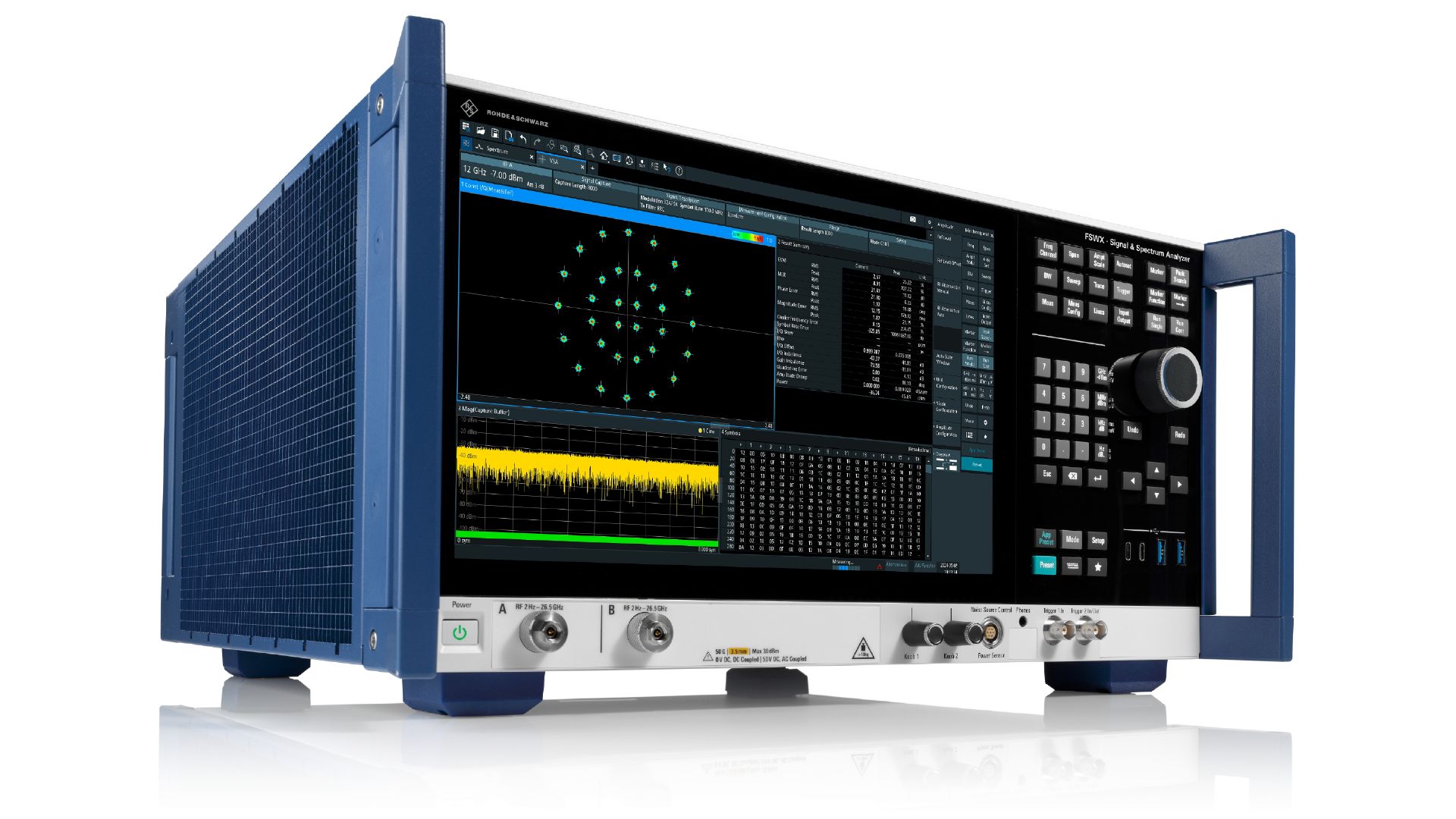
Sept 29: DRFM jammers support deception, spoofing and jamming by capturing radar emissions, digitizing them and reproducing them with controlled delay, phase and frequency. As radars become more agile and use more complex waveforms, test systems must measure pulse shape, timing, modulation and repeatability. The FSWX signal and spectrum analyzer addresses this test environment with its innovative dual-channel, phase-coherent architecture. With the R&S FSWX-KM700 pulse analysis option, Rohde & Schwarz adds a software extension for dedicated pulsed signal work and DRFM analysis.
The option measures pulse width, amplitude, rise time, fall time, pulse repetition interval, duty cycle, shape and overshoot. These measurements allow engineers to check whether a jammer reproduces the envelope of the original radar burst with the required accuracy, since small changes in timing or amplitude behavior can affect the credibility of a deception signal.
The analysis also covers complete pulse trains. The option extracts pulse repetition frequency spectra and pulse-to-pulse variation data, allowing engineers to verify complex pulse sequence behavior and timing patterns. R&S FSWX-KM700 supports chirped pulses, pulse width modulation, pulse position modulation and phase-modulated waveforms. Engineers can use these measurements to check whether a device handles modulation schemes used by modern radar systems, including both the pulse envelope and modulation content.
The system can trigger on amplitude, pulse width, pulse repetition interval or user-defined patterns. This helps engineers isolate selected events inside a pulse train and focus the measurement on the relevant parts of the signal. For longer measurements, R&S FSWX-KM700 aggregates results from many captured pulses. This provides information about repeatability and consistency over time and helps engineers assess whether timing or modulation errors occur only under certain conditions.
The option comes with the following displays: parameter trend for DRFM electronic attack technique analysis, capture vs. time to measure jammer response time and latency between stimulus and response, individual pulse parameter display such as pulse amplitude, frequency, and phase to make sure there are no distortions introduced by the jammer. These measurements connect pulse analysis with the behavior of the jammer under test.
With the new R&S FSWX-KM700 option, the FSWX signal and spectrum analyzer gains a more specialized role in DRFM test workflows. It combines phase coherent multi-channel analysis with pulse, pulse train, modulation and segmented capture functions in one instrument, supporting verification of signal fidelity, timing behavior and consistency in agile electronic warfare scenarios.
Rohde & Schwarz showcases the new R&S FSWX-KM700 pulse analysis option at EuMW 2026 at booth B10 at Excel London from October 6 to 8, 2026.
27, Sep 2026
ACI Worldwide and Cognizant Demonstrate Strong Card Processing Performance on Amazon Web Services, Inc. (AWS)


