


27, Oct 2026
CYPHER Agent Brings On-the-Job Answers, Coaching and Practice Into Frontline Work
Workers can ask questions, rehearse customer conversations and get step-by-step guidance from approved company knowledge.
DALLAS, Oct. 27, 2026 — CYPHER Learning, the AI-native platform that puts company knowledge to work, today announced the next generation of CYPHER Agent will go where the learning management system never could: into the work itself. Using company knowledge, CYPHER Agent will answer on-the-job questions, coach people through live situations, build personalized training, help them practice, and assess who is ready to perform.
For more than two decades, the LMS has worked the same way: experts write courses, people take them, and learning and development (L&D) reports completions. That model breaks down at the moments knowledge matters most — when a server learns a guest has a food allergy, a technician opens an unfamiliar repair, or an insurance agent fields a question about a new state rule. No one has time to search a course catalog or handbook. CYPHER Agent will put the answer, the coaching and the practice into a conversation anyone can start, whenever they need it, in their own language.
“The traditional LMS, built only to deliver and manage courses, is now outdated technology,” said John Mazur, CEO of CYPHER Learning. “Work doesn’t happen in courses. A server in the middle of a dinner rush or a contractor on a job site needs the right next step now, a chance to practice before it counts, and a manager who knows whether they’re ready. CYPHER Agent will do all of that from knowledge a company already has. It’s the most significant change in how organizations build capability since training moved online.”
From course catalog to coach
CYPHER Agent will replace menus, catalogs, and search bars with a conversation. Learners, managers, subject matter experts and L&D teams can say or type what they need, and the agent will respond from approved company knowledge.
-
Answers people can trust. Organizations upload handbooks, product guides, and compliance rules once. Every answer cites its source, and built-in escalation rules tell workers when to stop and get a manager — for example, when a guest reports an allergy.
-
Coaching in the moment of need. Beyond answering questions, CYPHER Agent will guide people through a live situation one step at a time, including by voice, asking what happened and adjusting each instruction to match.
-
Practice out loud. Workers can rehearse real conversations, such as calming an upset customer, by speaking with an AI role-play partner. Afterward, the agent will show which steps they covered and which they missed, with references back to the guide.
-
Build by asking. Managers and experts can create refreshers, step-by-step skills and full courses by describing what they need. A one-hour course with gamification, assessments, visual media, and translation into more than 50 languages takes 10 to 15 minutes to build, and creators review and edit every section before it is published.
-
Readiness, not just completion. Managers can ask “Who on my team is behind?” and see overdue training, stalled learners, and practice activity at a glance, so they know who is ready to perform, not only who finished a course.
From a manager’s request to a server’s next step in minutes
During a recent preview, a major restaurant chain asked CYPHER Agent to create a skill for handling guest complaints, test it, and publish it to every server in under two minutes. Moments later, a server asked what to do about an overcooked steak. The agent walked her through each step, from thanking the guest to alerting the kitchen to checking back that the replacement was right.
One source of knowledge, tailored to every role
The same approach works anywhere knowledge has to reach many people, in many roles, fast. A restaurant franchise rolling out new menu items can give managers, chefs, and servers guidance specific to each role. An auto dealership can quickly prepare its technicians for a new recall repair. An insurer can bring agents in different states up to date on new compliance requirements. Because CYPHER Agent works from a single, governed source of knowledge, every role, region and contractor network will get tailored guidance while L&D keeps control of what is published.
Preview CYPHER Agent at DevLearn
CYPHER Learning will preview the new CYPHER Agent at DevLearn 2026, Nov. 4–6 at the MGM Grand in Las Vegas, at Booth #362, with general availability slated for Q1 2027. On Wednesday, Nov. 4 at 9:15 a.m. PT, Gwen O’Neil, director of U-Haul University, and Mark Schuster, product lead at CYPHER Learning, will take the DevLearn Expo Stage to discuss how U-Haul is modernizing its approach to learning and where AI can support an established learning ecosystem today.
To learn more, visit www.cypherlearning.com.
- 0
- By Neel Achary

27, Oct 2026
AMPERA AND IMPERIAL COLLEGE LONDON PARTNER TO DEVELOP PHYSICS-GROUNDED AI PLATFORM FOR ADVANCED ENERGY SYSTEMS
Proprietary NeuralTwin™ technology platform designed to accelerate engineering and optimize performance
PALM BEACH GARDENS, Fla., Oct. 27, 2026 — Advanced energy company AMPERA today announced a strategic ~$9 million / £7 million multi-year partnership with global research leader Imperial College London to develop a physics-grounded, digital twin platform known as NeuralTwin.
The collaboration brings together AMPERA’s technology platform and Imperial College London’s world-class expertise in AI, engineering, computational science and research. Together, the organizations will explore new approaches to creating intelligent digital representations that can learn from data, model dynamical systems and generate real-time insights. The program addresses methods to design, assess, optimize and validate energy systems to support faster, more cost-effective rapid deployment.
Unlike conventional digital twins, which can depend heavily on predefined models and computationally intensive simulations, NeuralTwin combines first-principles physics with AI-based surrogates to accelerate engineering, optimize performance, improve safety, support licensing and ultimately enable increasingly predictive, autonomous operation.
“This collaboration will supercharge every aspect of our technology development,” said AMPERA Founder and CEO Brian Matthews. “Imperial College London is a world-leading university, and the technology has the potential to transform how complex systems are understood, monitored, optimized and managed. From licensing to engineering analysis to autonomous operations, we see NeuralTwin as being a marketplace differentiator.”
The collaboration will provide a platform for continued research into the convergence of AI, advanced modeling, and real-time computational systems. The wider impact will reduce time, cost and technical risk associated with moving from initial concept to deployable, manufacturable and licensable energy systems.
“We are passionate about translating cutting-edge academic research into the commercial sector where it can accelerate the development of next-generation energy systems,” said Professor Christopher Pain, at Imperial College London. “This collaboration brings together two organizations focused on neural physics for processing, analyzing and executing ultra-complex operations in the safest, quickest way possible.”
“NeuralTwin reflects an important next step in bringing together scientific machine learning, digital twins, and high-fidelity computational methods,” said Dr. Jiansheng Xiang, Co-Investigator at Imperial College London.
27, Oct 2026
Cyclone Arnab: Bhubaneswar Airport Keeps Flights Operating, Director Assures Full Preparedness
Bhubaneswar, Oct 27: Flight operations at Biju Patnaik International Airport (BPIA) in Bhubaneswar continued normally on Tuesday, with no cancellations reported as Cyclone Arnab approached the Odisha coast. Airport authorities have completed precautionary preparations and are closely monitoring weather conditions to ensure passenger safety.
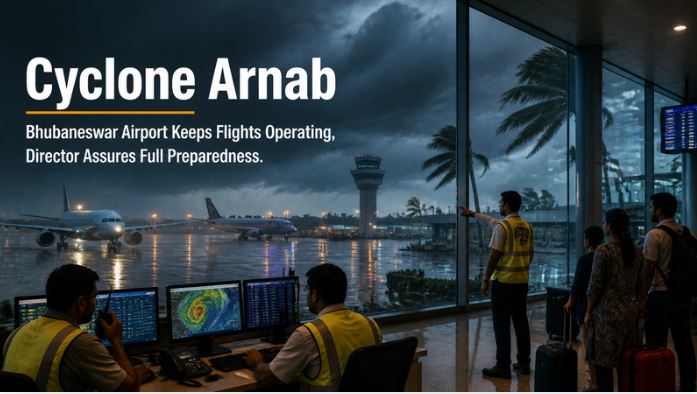
Representational Image
BPIA Director Prasanna Pradhan said the airport was operating as usual, as the prevailing weather forecast did not indicate conditions severe enough to warrant a shutdown. However, he clarified that officials remain on alert and any operational decisions would depend on changes in the weather and prevailing safety requirements.
Airport Completes Pre-Cyclone Preparations
According to Pradhan, the airport has implemented its prescribed Standard Operating Procedures (SOPs), technical instructions and operational guidelines to prepare for the potential impact of the cyclone.
A coordination meeting with relevant stakeholders was also held to review preparedness and ensure that necessary arrangements were in place to respond to changing weather conditions.
“We have completed our pre-cyclonic preparedness measures. Based on the forecast from the Meteorological Department, Bhubaneswar is not impacted severely enough to warrant a shutdown of flight operations. However, we are fully alert for any situation. If required, we will make a decision at that time,” Pradhan said.
Flight Safety Remains the Priority
The airport director said flight operations would continue as long as weather conditions remained suitable for safe flying. In the event of rain or other weather-related challenges, decisions would be taken by pilots and relevant authorities in accordance with established safety procedures.
Airport officials are also prepared to manage possible flight delays or diversions if conditions deteriorate. The arrangements are intended to maintain operational safety while minimising inconvenience to passengers.
Cyclone Arnab has intensified into a severe cyclonic storm and is moving at a reported speed of around 20 kmph. Rain and strong winds have been reported in parts of Odisha, while further deterioration in weather conditions was expected on Tuesday night, according to the report.
Passengers Urged to Check Flight Status
With weather conditions potentially changing at short notice, Pradhan has advised air travellers to remain calm and verify their flight status before leaving for the airport.
“Please do not panic. Just check your flight status before leaving home. That is my advice. Please check your flight status before coming to the airport,” he said.
Passengers are advised to check updates directly with their respective airlines and allow sufficient time for their journeys. Although flight services were operating normally at the time of the statement, schedules could be affected if weather conditions worsen.
Airport authorities will continue to assess the situation and take necessary measures in line with official weather forecasts and aviation safety requirements as Cyclone Arnab approaches the Odisha coast.
27, Oct 2026
From Amazon to the ICC: Odisha’s Kajal Pradhan Turns Her Makeup Passion into a Global Opportunity
Berhampur, Oct 27: In a story of courage, determination and following one’s passion, Kajal Pradhan from Berhampur in Odisha has carved out a place for herself in the beauty industry after leaving her job at Amazon. Today, she is reported to be working as the official makeup artist for ICC men’s and women’s cricket events, marking a significant milestone in her professional journey.

Pradhan’s journey from the technology sector to the world of makeup artistry highlights how pursuing a passion can open doors to unexpected opportunities, even when the decision involves leaving behind a stable career.
From a Corporate Career to Makeup Artistry
Kajal previously worked at Amazon, but her growing interest in makeup and beauty eventually prompted her to take a different professional path. Leaving behind the security of a corporate job, she stepped into the competitive world of makeup artistry to pursue what she truly loved.
She began her journey as a freelance makeup artist in Pune before gradually building her professional network and establishing herself in Mumbai, a major centre for India’s entertainment and beauty industries.
Over time, she reportedly gained opportunities to work with celebrities and professionals from the film and television industries, helping her strengthen her portfolio and expand her presence in the field.
Overcoming Criticism and Challenges
The transition was not without difficulties. According to a social media post by X user Satya Nayak, Pradhan faced criticism and discouragement from people who questioned her decision to leave a stable technology job for a career in makeup.
However, she continued to work towards her goal, demonstrating persistence in an industry where building credibility, gaining clients and establishing professional connections can take considerable time.
Her reported association with International Cricket Council (ICC) men’s and women’s cricket events represents another important step in her career, taking her work beyond the conventional beauty and entertainment sectors.
Ambitions Beyond India
Pradhan is also reportedly looking to expand her professional horizons internationally, with aspirations to explore opportunities in Western markets. She is interested in using technology to develop her work and create more engaging experiences.
Despite her growing professional profile, she has maintained a connection with her home state, Odisha. According to Nayak’s post, she remains willing to support promotional initiatives related to the state and offer guidance to young women seeking advice on pursuing careers in makeup artistry.
An Inspiration for Aspiring Women
Kajal Pradhan’s journey offers an encouraging message for those who wish to pursue a career outside their conventional professional background. Her experience illustrates the importance of developing skills, gaining practical experience and staying committed to a chosen field despite criticism and uncertainty.
For aspiring makeup artists, particularly young women from smaller cities, her reported achievements demonstrate how talent, perseverance and professional growth can create opportunities in competitive industries.
Note: This story is based on the information provided in the original report, including claims attributed to a social media post by Satya Nayak. The details of Pradhan’s professional association with ICC events and other claims have not been independently verified.
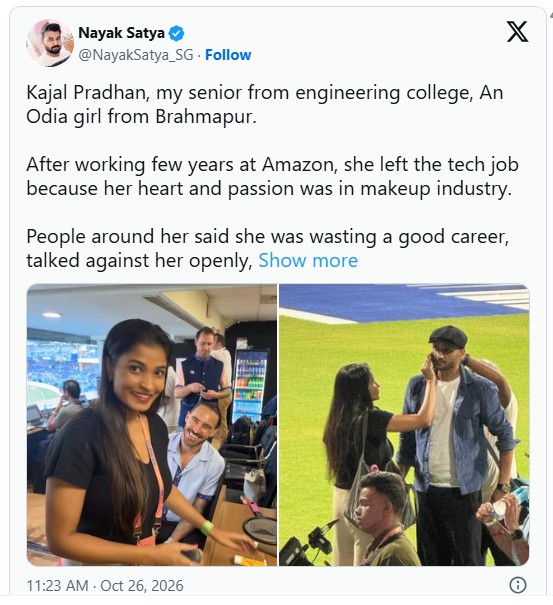
Kajal Pradhan, my senior from engineering college, An Odia girl from Brahmapur. After working few years at Amazon, she left the tech job because her heart and passion was in makeup industry. People around her said she was wasting a good career, talked against her openly, humiliated her many times before her big success. A girl from a small town shouldn’t leave a stable job for something like this. She heard it all and still started freelancing in Pune. Slowly she built her name in Mumbai. Worked with celebrities, film and TV people. Then came the big one , she became the official makeup artist for ICC men’s and women’s cricket events. From Brahmapur to those stages, standing with cricketers and stars. This is beyond a typical success. She was a lone girl holding a clear vision and a solid approach in a crowded industry full of big established names. She worked day and night, quietly, with no shortcuts, and still rose to shine on the biggest stages. With her pure talent, solid energy and determination from Odisha to international fame, she did it her way. Last week when we spoke, I could see how deeply passionate she is about this industry. She doesn’t just want to stay where she is. She is already looking beyond India targeting international forums and even the Western ecosystem. She wants to scale her passion properly, use technology, and make the whole thing more engaging and meaningful. Even after all that, she never says no when Odisha needs her. Any promotion, any young girl asking for guidance, she helps without thinking twice. Kajal didi, so proud of you. Keep going higher. Odisha needs more like you. Image copyright and credit- Kajal Pradhan ( her Instagram page muakajalpradhan)
— Nayak Satya (@NayakSatya_SG) October 26, 2026
27, Oct 2026
Paul & Shark Redefines Its Presence in New Delhi
A renewed expression of the brand’s Italian craftsmanship and Sense of Journey

Oct 27: Every journey is marked by new destinations. As the path unfolds, each new chapter brings moments of renewal and discovery, while remaining rooted in the values that have shaped the brand over time.
For Paul & Shark, the reopening of its boutique at the prestigious luxury mall DLF Emporio in New
Delhi represents one of these moments: a renewed expression of the brand’s presence in India, a market that has played an important role in its history for many years and continues to hold a significant place in its international growth.
The new space embodies Paul & Shark’s spirit of evolution and discovery, while remaining rooted in its Italian craftsmanship.
The boutique introduces Paul & Shark’s latest retail concept, inviting visitors to immerse themselves in the brand’s universe. Fluted oak wall panelling, natural stone and marble are combined with blue velvet, ceramics and bespoke furnishings to create an environment that feels both sophisticated and distinctive.
A palette of cream, sand and different shades of blue brings contemporary elegance while echoing Paul & Shark’s distinctive visual codes. Every element reflects the brand’s spirit of research, innovation and attention to detail. More than simply a retail destination, the boutique embodies Paul & Shark’s philosophy of continuous discovery and refinement. The design encourages visitors to explore the space and experience the values at the heart of the brand, while the quality of the materials and precision of every detail offer a contemporary interpretation of the craftsmanship that has distinguished Paul & Shark throughout its journey.
The result is a space that brings the Sense of Journey to life. Rooted in the brand’s DNA and driven by curiosity, discovery and continuous evolution, it reflects an attitude towards life: a desire to explore new places, experiences and perspectives, shared by men and women whose lives are constantly in motion and whose style accompanies them across destinations and occasions.
In the same way, craftsmanship can be experienced throughout the space, echoing the qualities of Paul & Shark’s collections. Every element is the result of meticulous research, technical expertise and savoir-faire refined over decades, where innovation and technical know-how meet an enduring respect for quality.
Craftsmanship becomes tangible through the materials, proportions, finishes and design of the space.
The renewed Paul & Shark boutique at DLF Emporio was unveiled on 14 October with an exclusive event that brought together the local community. Guests had the opportunity to meet Mr Dini, CEO of Paul & Shark and representative of the Dini family, which has guided the brand for fifty years, preserving its heritage, values and aspirations while leading its continued evolution.
The evening marked the beginning of a new chapter for Paul & Shark in New Delhi, inviting guests to discover the new space and celebrate the brand’s enduring presence in India.
27, Oct 2026
India Clears Regulatory Path for E100 Fuel in Flex-Fuel Vehicles: Key Changes Explained
New Delhi, Oct 27: India has taken a significant step towards expanding the use of ethanol-based fuels, with the Ministry of Road Transport and Highways (MoRTH) amending the Central Motor Vehicles Rules, 1989, to include E100 fuel in the regulatory framework for compatible flex-fuel vehicles.

Representational Image
The amendment, notified through GSR 911(E) dated October 23, 2026, updates existing emission-related provisions to recognise vehicles designed to operate on E100, a fuel comprising 100 per cent ethanol. The move establishes a regulatory basis for vehicles capable of running on nearly pure ethanol, although it does not announce a nationwide rollout of E100 at petrol pumps.
What Is E100 Fuel?
E100 is an ethanol-based fuel containing 100 per cent ethanol, while E85 contains approximately 85 per cent ethanol. Ethanol can be produced from agricultural feedstocks such as sugarcane and other biomass sources.
Until this amendment, the relevant emission-rule references for flex-fuel vehicles primarily mentioned E85. The revised provisions explicitly add E100 alongside E85, creating a clearer regulatory framework for vehicles engineered to use higher concentrations of ethanol.
Flex-fuel vehicles are designed to operate on different proportions of petrol and ethanol, depending on their engineering specifications and certification.
E100 Is Not for Every Petrol Vehicle
One of the most important aspects of the new rules is the restriction on vehicle compatibility.
According to the notification, E85 and E100 are intended for vehicles designed by original equipment manufacturers (OEMs) as flex-fuel vehicles.
This means conventional petrol cars and motorcycles cannot automatically use E100. Even vehicles compatible with E20 petrol should not be filled with E100 unless the manufacturer has specifically approved the vehicle for that fuel.
Using an incompatible fuel can damage engine and fuel-system components. Vehicle owners should follow the manufacturer’s fuel specifications and safety guidance.
Key Changes to the Central Motor Vehicles Rules
The amendment introduces several technical updates to the existing regulatory framework.
1. E100 added to emission provisions: References to E85 in relevant sections of Rule 115 have been updated to read “E85 or E100”, extending the provisions to vehicles designed for both fuel types.
2. Revised vehicle weight threshold: The gross vehicle weight threshold in the relevant emission-standards table has been increased from 3,000 kg to 3,500 kg.
3. Updated technical reference: Rule 115E now refers to Annexure SA instead of Annexure S for E100 vehicles, as specified in the notification.
4. Biodiesel reference revised: A fuel entry in the relevant table has been changed from B10 to B100.
The notification also includes technical and editorial corrections to certain fuel classifications, emission-table headings, measurement units and related provisions.
How Were the New Rules Finalised?
The government had published the draft amendment in the Gazette of India on April 27, 2026, inviting objections and suggestions from stakeholders within the prescribed 30-day period.
Following consideration of the feedback received, the ministry issued the final notification on October 23, 2026. The rules take effect from the date of publication in the Official Gazette, as stated in the notification.
Will E100 Be Available at Petrol Pumps Soon?
Despite the regulatory approval, the notification does not specify a nationwide launch date for E100 fuel or confirm widespread availability at retail fuel stations.
The amendment primarily establishes the regulatory provisions for E100-compatible flex-fuel vehicles. Wider adoption will depend on factors such as vehicle development, certification, fuel production, distribution infrastructure and commercial availability.
For automobile manufacturers, the revised framework offers a clearer basis for developing and certifying vehicles capable of using high-ethanol fuels. For consumers, however, the practical benefits will depend on the availability of compatible vehicles and fuel stations.
What Does This Mean for India’s Fuel Future?
The move supports India’s broader efforts to diversify its energy mix, promote domestic biofuel production and reduce dependence on imported crude oil.
Greater use of ethanol could also create opportunities for agricultural producers and biofuel manufacturers. However, the overall economic and environmental benefits will depend on production methods, fuel pricing, vehicle efficiency and the sustainability of feedstock supplies.
For now, the E100 amendment represents a regulatory step towards expanding India’s alternative-fuel options rather than an immediate replacement for conventional petrol.
The bottom line: E100 has received a place in India’s regulatory framework for compatible flex-fuel vehicles, but ordinary petrol vehicles cannot automatically use it, and nationwide availability has not yet been announced.
27, Oct 2026
MFTA Announces the Fifth Edition of the MFTA Awards 2026 in Strategic Collaboration with ADGM During Abu Dhabi Finance Week
The flagship awards programme will convene the fintech ecosystem to recognise excellence, celebrate transformative innovation, and strengthen the MENA region’s position within the global financial technology landscape. Nominations open.

Abu Dhabi, UAE | Oct 27- The MENA Fintech Association (MFTA) announces the fifth edition of the MFTA Awards 2026, taking place in strategic collaboration with Abu Dhabi Global Market (ADGM) during Abu Dhabi Finance Week (ADFW). Building on the legacy of previous editions, the awards continue to serve as a platform for recognising outstanding achievements, advancing industry excellence, and strengthening the connections shaping the future of financial technology across the Middle East and North Africa and beyond.
As the fintech industry undergoes rapid transformation, the MFTA Awards 2026 will spotlight the companies, innovators, and ecosystem leaders driving meaningful progress across financial services. The awards reflect the growing strategic importance of fintech in enabling economic growth, accelerating digital transformation, fostering cross-border collaboration, and advancing the evolution of financial markets.
The fifth edition represents a continued commitment by the MENA Fintech Association to convening the region’s fintech community, elevating industry-leading initiatives, and strengthening the MFTA network across key markets. Through its collaboration with ADGM and alignment with Abu Dhabi Finance Week, the awards will bring greater visibility to the region’s fintech capabilities while reinforcing connections between regional innovators, international institutions, investors, regulators, and strategic industry stakeholders.
A Strategic Platform for Recognition and Ecosystem Development
The MFTA Awards have become a key initiative within the Association’s broader mission to connect stakeholders, foster collaboration, and advance the regional fintech ecosystem. The 2026 edition will recognise organisations demonstrating excellence, innovation, measurable impact, and strategic execution in shaping the future of financial services.
Beyond recognition, the awards aim to strengthen the MFTA network, foster strategic partnerships between established financial institutions and emerging innovators, and enhance the visibility of regional fintech leaders within the global financial technology landscape.
27, Oct 2026
Cyclone Arnab: South Coast Railway Cancels 8 Trains, Short-Terminations Announced for 2 More; Check Full Schedule
Koraput, Oct 27: In view of Cyclone Arnab over the Bay of Bengal, the South Coast Railway (SCoR) has announced the cancellation of eight trains and changes to the originating and terminating stations of two others, affecting services connecting Visakhapatnam, Koraput, Kirandul, Bhubaneswar and Jagdalpur.
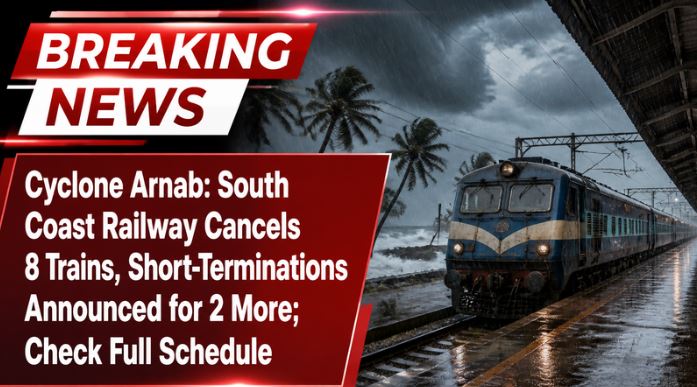
Representational Image
According to an official bulletin issued by the South Coast Railway headquarters in Visakhapatnam, the decision has been taken as a precautionary measure amid the prevailing cyclonic conditions. Passengers travelling along the affected routes have been advised to check the latest train updates before commencing their journeys.
List of Cancelled Trains
The following train services will remain cancelled on the specified dates:
Visakhapatnam–Kirandul Night Express (18515): Cancelled from October 29 to November 4.
Kirandul–Visakhapatnam Night Express (18516): Cancelled from October 29 to November 4.
Visakhapatnam–Koraput Passenger (58538): Cancelled from October 27 to October 30.
Koraput–Visakhapatnam Passenger (58537): Cancelled from October 28 to October 31.
Visakhapatnam–Koraput Intercity Express (18512): Cancelled on October 30.
Koraput–Visakhapatnam Intercity Express (18511): Cancelled on October 31.
Visakhapatnam–Kirandul Passenger (58501): Cancelled from October 27 to October 30.
Kirandul–Visakhapatnam Passenger (58502): Cancelled from October 27 to October 30.
Two More Trains to Be Short-Terminated or Short-Originated
Apart from the cancellations, railway authorities have announced operational changes to two services connecting Bhubaneswar and Jagdalpur.
Train No. 18447, Bhubaneswar–Jagdalpur Express: The train will terminate at Rayagada instead of completing its journey to Jagdalpur from October 27 to October 30.
Train No. 18448, Jagdalpur–Bhubaneswar Express: The train will originate from Rayagada instead of Jagdalpur from October 28 to October 31.
These changes mean that passengers travelling to or from stations beyond Rayagada may need to make alternative arrangements during the affected period.
Passengers Advised to Check Train Status
With cyclone-related disruptions expected to affect railway operations, passengers are advised to verify their train schedules, cancellation status and boarding or termination stations through official railway channels before travelling.
Travellers should also check for further advisories from South Coast Railway, as additional operational changes may be announced depending on weather conditions.
27, Oct 2026
Odisha on High Alert as Cyclone Ornab Intensifies; Heavy Rain Forecast for Three Days
Bhubaneswar, Oct 27: Odisha has stepped up its disaster preparedness as Cyclone Ornab intensifies over the sea, with heavy to extremely heavy rainfall and strong winds forecast across several districts between October 27 and 29.

Representational Image
According to the India Meteorological Department (IMD), the very severe cyclonic storm is expected to make landfall near Kakinada in Andhra Pradesh on October 28. The system is forecast to bring sustained winds of 115–125 kmph, with gusts reaching up to 140 kmph.
Although Odisha is not expected to experience a direct landfall, southern parts of the state could face adverse weather, including intense rainfall, strong winds and possible disruptions to normal life.
Red Alert Issued for Five Districts
The IMD has issued a Red Alert for Rayagada, Malkangiri, Ganjam, Gajapati and Koraput for October 28, warning of extremely heavy rainfall and strong winds.
On October 27, heavy to very heavy rainfall is likely in Rayagada, Koraput, Malkangiri, Gajapati, Ganjam and Puri. Rain is expected to continue in several parts of the state on October 29, with western and interior districts, including Sundargarh, Jharsuguda and Bargarh, likely to receive significant rainfall.
Authorities have urged residents in vulnerable areas to remain alert and follow official weather advisories as the cyclone approaches the coast.
Disaster Response Teams Deployed
The Odisha government has mobilised emergency response personnel to strengthen preparedness in areas likely to be affected. According to the information released, 60 Odisha Disaster Rapid Action Force (ODRAF) teams, nine National Disaster Response Force (NDRF) teams and 225 fire service teams have been deployed.
The Army, Navy, Air Force and Indian Coast Guard have also been placed on standby to assist with rescue, evacuation and relief operations if required.
As a precautionary measure, schools, colleges and Anganwadi centres in Rayagada, Nabarangpur, Malkangiri, Gajapati and Koraput will remain closed until October 29. Educational institutions in Ganjam district will remain closed until October 30.
Revenue and Disaster Management Minister Suresh Pujari has appealed to the public not to panic, assuring residents that the state government is prepared to respond to the situation.
Southern Odisha Faces Strong Winds
Meteorologist Dr Sarat Chandra Sahu has warned that parts of southern Odisha could experience wind speeds of 80–110 kmph between late Tuesday night and Wednesday morning, accompanied by heavy to extremely heavy rainfall.
The forecast has prompted heightened vigilance, particularly in districts vulnerable to flooding, waterlogging, damage to infrastructure and disruptions to transport and electricity services.
Residents have been advised to avoid unnecessary travel during severe weather, stay away from vulnerable structures and trees, and follow instructions issued by local authorities.
With the cyclone’s movement and intensity remaining key factors in determining its impact, the state administration is continuing preparations to minimise risks and ensure the safety of people in vulnerable areas.
27, Oct 2026
Guwahati Hotel Shootout: Property Dispute Suspected in Killing of Five, Accused Arrested
Guwahati, Oct 27: A suspected property dispute is believed to have triggered a deadly shooting at a hotel in Guwahati, leaving five people dead, including four members of the same family, and another person injured on Monday night.

The incident took place at Hotel Bilas Inn in the busy Bora Service area of the city at around 9 pm. Police arrested the accused, identified as Ghanakanta Gogoi, within an hour of the shooting, according to Guwahati Police Commissioner Dr Partha Sarathi Mahanta.
Police have recovered a licensed .32-bore pistol allegedly used in the attack. Investigators are now examining the circumstances surrounding the incident and the events that led to the fatal confrontation.
Five Killed, One Injured
The deceased have been identified as hotel owner Helena Bharali, her brother Bhudev Bharali, her son Devarshi Kashyap, her daughter-in-law Riniki Kashyap and their driver, Narayan Das.
Four of the victims belonged to the same family, while Das was reportedly from their village.
The injured survivor, identified as Satyen Pathak, worked as the hotel caretaker. He sustained gunshot injuries and was admitted to Gauhati Medical College and Hospital, where doctors said his condition was stable.
According to the police commissioner, six people were shot during the incident. Five subsequently died, while Pathak survived with injuries.
Lease Dispute Under Investigation
Preliminary police findings suggest that a dispute over the lease agreement for Hotel Bilas Inn may have been the motive behind the shooting. The accused had reportedly taken the property on lease around a year ago.
However, investigators have yet to establish the precise sequence of events or confirm the circumstances that led to the alleged firing.
Police are questioning Gogoi to determine the nature of the dispute, the events preceding the shooting and whether any other factors contributed to the violence.
Commissioner Mahanta said a thorough and scientific investigation was underway to establish the facts. The bodies of the deceased are being sent for post-mortem examinations as part of the investigative process.
Assam Congress Questions Law and Order
The shooting has also prompted a political reaction, with the Assam Congress expressing concern over public safety and the law-and-order situation in Guwahati.
In a post on X, the party conveyed condolences to the bereaved families and urged the state government to take immediate action and ensure accountability.
The incident has raised fresh concerns about urban security, while police continue their investigation into one of the city’s deadliest recent shooting incidents.
Further details regarding the suspected motive and the circumstances surrounding the killings are expected to emerge as the investigation progresses.


