


7, Jul 2026
Sambalpur University Researchers Develop Promising Herbal Anti-Cancer Formulation from Gandhamardan Medicinal Plants
Bhubaneswar, July 7 (UDN): Researchers at Sambalpur University have reported a significant breakthrough in cancer research after developing a polyherbal anti-cancer formulation derived from medicinal plants found in Odisha’s Gandhamardan Hills. The formulation has demonstrated encouraging results in pre-clinical animal studies, paving the way for the next phase of human clinical trials.
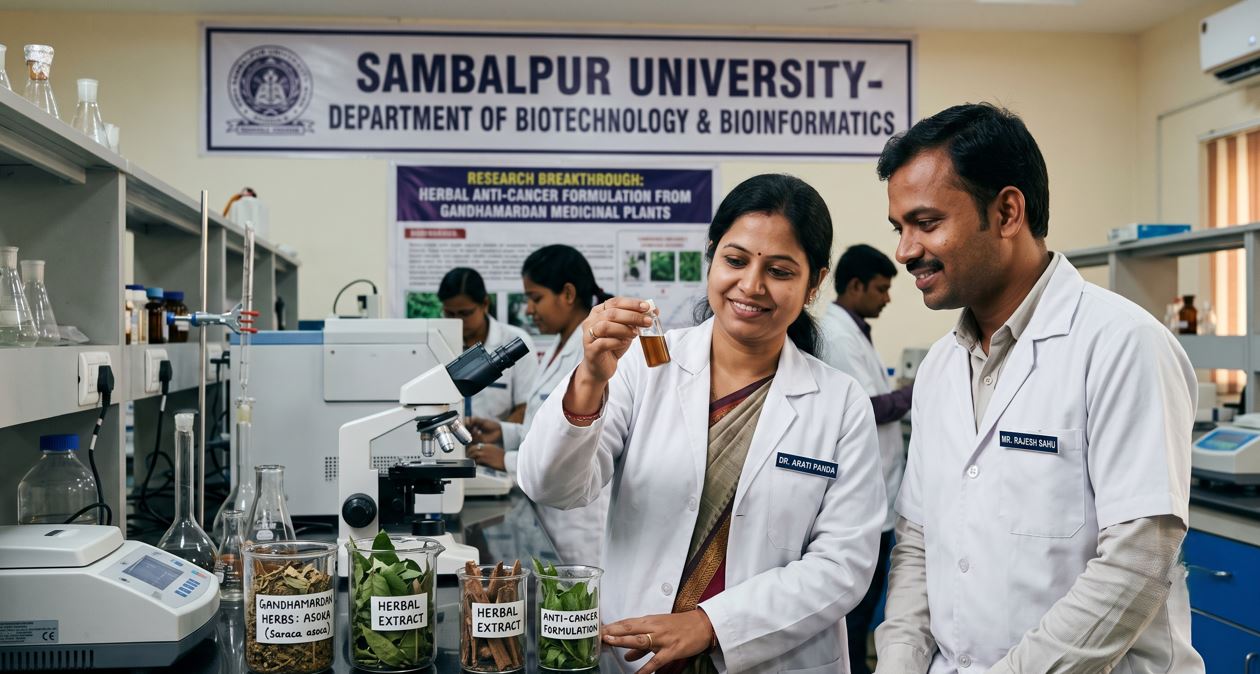
Representational image
The research, undertaken by the Department of Biotechnology and Bioinformatics in collaboration with the University’s Research Centre of Excellence, began in 2019 with an extensive scientific investigation into the medicinal properties of plants traditionally used in Ayurvedic and indigenous healthcare systems. Nearly 50 medicinal plant species native to the Gandhamardan hills were screened before researchers shortlisted five plants with the most promising anti-cancer properties to develop the formulation.
According to the research team, laboratory experiments and animal studies yielded highly encouraging outcomes. In pre-clinical trials, laboratory mice with experimentally induced tumours were treated with the herbal formulation for around 35 days, resulting in the complete disappearance of the tumours. Researchers also observed that, unlike conventional chemotherapy, the formulation did not produce any significant adverse effects during the study.
Head of the Department of Biotechnology and Bioinformatics, Prof. Pradeep Nayak, said the successful pre-clinical findings have laid the foundation for human clinical evaluation.
“An MoU has been signed with the Central Council for Research in Ayurvedic Sciences (CCRAS). The formulation will now undergo clinical trials on cancer patients. If the outcomes are successful, it could mark a major advancement in cancer treatment,” he said.
The upcoming clinical studies are expected to be conducted jointly with the Central Council for Research in Ayurvedic Sciences (CCRAS) under the Ministry of AYUSH and the All India Institute of Medical Sciences (AIIMS), Bhubaneswar. Researchers stressed that the formulation’s safety and therapeutic effectiveness can only be scientifically established after rigorous human clinical trials.
The project was carried out using advanced laboratory facilities at Sambalpur University with active participation from doctoral scholars and research scientists. Cancer cell lines required for the study were sourced from the National Centre for Cell Science (NCCS), Pune, enabling detailed laboratory investigations into the formulation’s anti-cancer activity.
Explaining the research methodology, PhD scholar Isara Nayak said the team selected the final five medicinal plants after evaluating their ability to destroy cancer cells while preserving healthy cells. Another researcher, Sekh Abdul, noted that multiple cancer cell samples obtained from NCCS have supported further laboratory validation of the formulation.
Researchers believe the herbal formulation has the potential to address one of the major limitations of existing cancer therapies. Unlike chemotherapy and radiation, which often damage healthy tissues along with cancer cells, the new formulation is expected to selectively target cancerous cells while minimising harmful side effects. However, they cautioned that these findings must be confirmed through comprehensive clinical studies.
If the forthcoming human trials prove successful, the polyherbal formulation could emerge as an affordable and effective complementary option for cancer treatment, while highlighting the immense medicinal value of the biodiversity-rich Gandhamardan Hills and the growing contribution of Odisha’s scientific community to healthcare innovation.
- 0
- By Neel Achary



