


13, Mar 2025
A Festive Day Turns Risky as Sakhi’s Stalker Crashes Holi Celebration in Wagle Ki Duniya on Sony SAB
Mumbai, March 13, 2025: Sony SAB’s Wagle Ki Duniya – Nayi Peedhi Naye Kissey continues to deliver thrilling twists as Sai Darshan Society gears up for a grand Holi celebration. The society comes together to help Dakshesh (Deepak Pareek) in his ill-fated magic trick, thanks to the intervention of the original magician who wrote the spell book. With a tribute to the fading world of magicians, normalcy returns to Sai Darshan, or so it seems.
This week, the Wagles find themselves caught in a web of trust and deception as Sakhi’s (Chinmayi Salvi) stalker, Sushant (Shikar Patel) , makes a surprising return. Claiming to have changed his ways, he visits the Wagle home and earns their trust after bringing back Radhika (Bharati Achrekar) , who had briefly gone missing. Rajesh (Sumeet Raghvan) , unaware of his true identity, welcomes Sushant with open arms, praising his good deed. However, Sakhi is left stunned by the turn of events but chooses to stay silent, allowing him a second chance. Meanwhile, Vivan (Namit Shah) remains suspicious, keeping a watchful eye on Sushant’s every move. As the festive zeal intensifies, the lines between redemption and hidden motives blur. They culminate in a shocking moment when Sushant infiltrates the Sai Darshan Holi celebration in disguise.

Can Sakhi trust Sushant, or is she making a dangerous mistake? Is Vivan’s intuition correct? What will happen when the Wagles discover the truth?
Sumeet Raghvan, who essays the role of Rajesh Wagle, said, “Rajesh is someone who always wants to believe the best in people. He trusts easily, sometimes even when he shouldn’t. This track is interesting because it puts that very trust to the test. Holi is a time of celebration, but for the Wagles, it takes a suspenseful turn. Rajesh welcomes someone into his home with open arms, unaware of the hidden danger to his own daughter. The way the story unfolds and the tension rises will keep the audience hooked. What starts as a joyous festival soon takes an unexpected twist, making this Holi one filled with shock and revelation.”
- 0
- By Team

13, Mar 2025
ESCP Business School Explores Collaborative Opportunities with Indian Scientific Institutions
As the European Union strengthens its ties with India, ESCP Business School, is poised to expand its partnerships in India. This strategic initiative aligns with the recent visit of European Commission President Ursula von der Leyen to India on February 27-28, 2025, which highlighted opportunities for enhanced cooperation in areas such as trade, technology, and security.
ESCP Business School, with its rich history dating back to 1819 in Paris, is well-positioned to leverage this momentum. The school operates six urban campuses across Europe (Paris, Berlin, London, Madrid, Turin, and Warsaw) and a branch campus in Dubai, offering a unique multi-campus experience to its community of over 11,000 students from 136 different nationalities. Through its extensive network of over 150 academic alliances in 50 countries, ESCP is committed to fostering global collaboration and innovation.
In India, ESCP has established robust relationships with top institutions, including exchange and dual degree programs with eight prestigious Indian establishments: IIM Ahmedabad, IIM Bangalore, IIM Calcutta, IIM Kozhikode, IIM Lucknow, IIM Udaipur, MDI Gurgaon, and SPJIMR. The number of Indian students at ESCP Business School has been steadily increasing, with 608 students enrolled in the 2024-2025 academic year, marking a 16% rise over three years. India now represents the third country of origin of students at ESCP Business School, after France and Italy.
Building on this foundation, ESCP Business School is particularly interested in exploring opportunities in emerging technologies, such as Artificial Intelligence (AI), which is a key area of focus for both India and France. The recent AI Action Summit in Paris, co-chaired by President Macron and Prime Minister Modi, underscored the shared commitment to harnessing AI for mutual benefit. This priority supports ESCP’s strategic initiatives in AI, including its partnership with OpenAI, signed in October 2024, to introduce ChatGPT Edu, an innovative platform designed to enhance learning experiences and drive AI-driven research.

“ESCP Business School is committed to exploring new partnerships in India, particularly with top scientific universities, to foster cross-disciplinary innovation and collaboration,” said Professor Léon Laulusa, Executive Director and Dean of ESCP Business School. Professor Laulusa will be visiting India during the last week of March 2025. “I look forward to my visit to India to explore new knowledge avenues. The shared focus on AI with India and France presents a unique opportunity to leverage advanced technologies for mutual benefit and global impact,” he added.
13, Mar 2025
SSC NASSCOM Joins Forces with School of Design Thinking for a Groundbreaking 50-Hour Design Spark Challenge
March 14, 2025,India: School of Design Thinking (SoDT), India’s leading organisation for promoting Design Thinking as a mindset for problem-solving and innovation, in partnership with Sector Skills Council (SSC) NASSCOM, proudly inaugurated the “Design Spark Challenge”, a 50-hour non-stop innovation challenge dedicated to the transformative power of Design Thinking.
A one-of-its-kind innovation challenge hosted in India, Design Spark Challenge 2025 will be driven by Design Thinking principles and leveraging AI tools. The competition commenced today (7th March 2025) at Intellect Design Arena’s global headquarters in Chennai, marking a significant milestone in fostering a culture of innovation among students.
The challenge brought together 75 students pursuing diverse education streams from 15 renowned colleges, all vying to push the boundaries of creativity and problem-solving using Design Thinking principles. Each group comprising five students was paired with a faculty mentor from the respective colleges to provide guidance and support throughout the competition. This initiative not only emphasised collaboration and innovation but also aimed to prepare the next generation of problem solvers for real-world challenges in healthcare, education, rural empowerment, agriculture, and the gig economy, among other sectors.
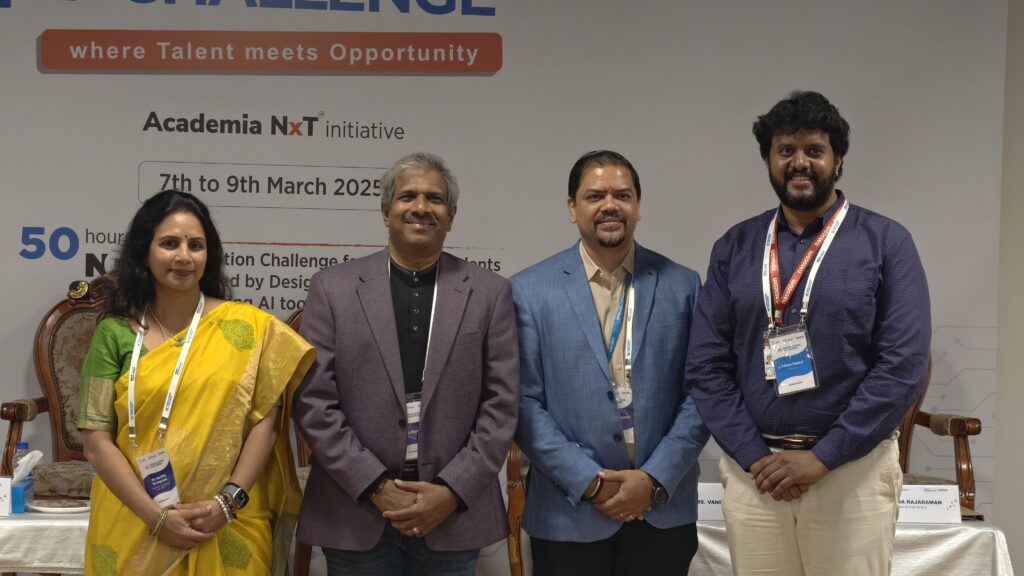
The inauguration ceremony featured Udaya Sankar, National Lead – Academia & Government Relations at NASSCOM, as the Chief Guest, Vanitha Venugopal, Chief Executive Officer of Tamil Nadu Technology (iTNT) Hub, as the Guest of Honour, along with Dr. Anbu Rathinavel, Co-Founder & Head of School of Design Thinking and Chief Design Officer of Intellect Design Arena; and Krishna Rajaraman, Chief Technology Officer of Intellect.
Design Spark Challenge encouraged participants to engage deeply with the problem, fostering a sustainable, holistic approach to design rather than mere problem-solving. It emphasised the importance of understanding the end user, which leads to falling in love with the problem instead of jumping to the solution. The structure was designed to enhance collaboration and a rich learning environment to nurture their thinking for addictive product and service design.
The competition had a timeline that started on Friday and ended on Sunday. As the students embarked on this intensive innovation journey, they had access to mentorship from industry leaders & experts from SoDT and the chance to present their groundbreaking solutions for the problem statements to a panel of esteemed judges at the end of the competition.
Udaya Sankar, National Lead-NASSCOM, said, “In an era of rapid technological evolution, equipping students with critical thinking, collaboration, and a mindset of continuous learning are key to solving real-world challenges. Design Spark Challenge 2025 redefines how educational institutions approach innovation and problem-solving, empowering students to create meaningful solutions. At SSC NASSCOM, we are committed to fostering industry-relevant skills and ethical values to drive sustainable innovation and build a resilient future workforce. This is the future of learning – immersive, hands-on, and impact-driven.”
During her address, Vanitha Venugopal, CEO-iTNT Hub, said, “Innovation is the key to shaping the future, and platforms like Design Spark Challenge play a crucial role in empowering young minds to think beyond conventional boundaries. This one-of-its-kind inter-college competition fosters holistic yet creative problem-solving while aligning with Tamil Nadu’s vision of becoming a hub for deep tech-driven advancements. At iTNT Hub, we are committed to nurturing an ecosystem where technology and innovation fuel progress, ensuring that Tamil Nadu remains at the forefront of cutting-edge solutions with real-world impact.”
“Design Thinking is not just a methodology; it’s a mindset that empowers individuals to challenge norms and innovate beyond boundaries,” said Dr. Anbu Rathinavel, Head-School of Design Thinking. “The idea to host the Design Spark Challenge was fostered from our previous experience with a similar innovation challenge for Intellect associates worldwide in 2023. We thought now is the right time to extend this opportunity to college students. This 50-hour-long competition embodies this spirit, stimulating a collaborative environment where young minds can explore new ideas and solutions. We are proud to partner with SSC NASSCOM to seed this initiative and make this a country-wide movement in the future.”
Krishna Rajaraman, CTO-Intellect, highlighted the importance and impact of integrating AI into the Design Thinking process. “Leveraging AI tools and advanced technologies in this challenge allows participants to explore cutting-edge innovations, enhancing their creative output and providing real-time data analytics that inform and optimise their design processes. Prior to the commencement of the 50-hour challenge, we conducted an orientation session for all participants on how Design Thinking principles combined with these technologies can effectively tackle real-world challenges and drive impactful solutions,” he stated.
13, Mar 2025
Rising Glaucoma Cases Causing Irreversible Blindness in India: Experts Push for Timely Eye Exams
Bengaluru, 13 March 2025: Glaucoma continues to be a growing public health challenge globally, and particularly in India with over 12 million people affected in the country. The chronic eye disease progressively damages the optic nerve, often without noticeable symptoms, resulting in vision loss and can eventually cause blindness if left untreated.
As per studies, Asia is expected to witness the growing burden of glaucoma with 27.8 million additional glaucoma cases by 2040, with India and China to witness a steep rise in the prevalence. Alarmingly, several studies state around 90% of glaucoma cases in India remain undetected and untreated, leading to irreversible blindness each year due to lack of awareness.
The asymptomatic nature of glaucoma is a major challenge for timely diagnosis. Patients often perceive their vision as normal, even as optic nerve damage progresses. The lack of perceived symptoms leads to delay in seeking medical attention at the right time. Glaucoma prevalence is higher among adults aged 40 and above, affecting 2.7% to 4.3% of the elderly population, as reports suggest. The glaucoma-related blindness in India is concerning, affecting approximately 1.2 million people, and accounting for 5.5% of all blindness cases nationwide.
Dr. Asha M S, Senior consultant and Glaucoma specialist at Nethradhama Super Speciality Eye Hospital emphasizes that patients are often unaware they have the disease until substantial damage has occurred, stating, “Patients often have no idea that they have glaucoma, until significant damage has been caused. Sometimes patients also question the necessity of tests even when their vision feels fine. Most of these cases are detected through routine eye check-ups. That is the insidious nature of glaucoma —it is a silent thief of sight. This silent progression needs immediate medical intervention. Hence, it makes awareness and early detection essential. Routine check-ups are vital for early detection and preventing irreversible sight loss.”
This underscores the importance of early detection and regular checkups through the urgent need for increased awareness and proactive screening initiatives. While intraocular pressure (IOP) is the only modifiable risk factor, early detection of increased pressure allows timely medical intervention, preventing or slowing down the progression.
By the time one faces visual impairments, such as peripheral vision loss, the damage is often irreversible. This is particularly concerning as many people begin to experience age-related changes in their vision in their 40s – a crucial window for glaucoma screening.
“We need to have awareness campaigns and spread the message regarding the importance of regular eye checkups, especially for people aging over 40s. Older adults living alone often face challenges in accessing healthcare due to social isolation, hindering timely glaucoma diagnosis and treatment. Hence, it is important to take proactive measures to prevent the progression and mitigate the damaging consequences of glaucoma,” Dr. Asha M S adds further highlighting the challenges faced by the elderly population in accessing healthcare services.
“There is an urgent need for widespread awareness campaigns, educating the public about the importance of regular comprehensive eye examinations, including intraocular pressure measurement, visual field testing, and optic nerve imaging. These are crucial for people aging over 40, and ones with a family history of glaucoma, diabetes, or high myopia. Medical advancements, such as optical coherence tomography (OCT) with retinal nerve fiber layer (RNFL) analysis, enable the detection of pre-perimetric glaucoma, identifying nerve damage before visual field loss occurs,” states Dr. Asha M S .
13, Mar 2025
Breaking ground: How Women Are Changing The Face of Indian Real Estate

By-Anjana Sastri, Director – Marketing, Sterling Developers
Real Estate in the context of India, has transformed in recent times, driven by innovation, investment and evolving consumer trends. In addition to this, the most noteworthy development is the remarkable rise in the number of women who are making a mark in the real estate sector with their visionary approach and strong business acumen. Real estate has undergone a sea of change in the country with changes in gender diversity, putting to rest the earlier norm of real estate being a male-dominated industry. From property consultants, channel partners and agents to engineers, architects and leaders of multinational real estate development firms, women are leading the Indian realty sector to scale new heights. Dynamic and adaptable, the sector has exhibited a strong growth trend that has gained from women taking up more active roles. Hence the International Women’s Day theme, “Accelerate Action”, is a vital key in women’s progress.
Traditional roles are no longer roadblocks
Women in real estate are redefining leadership, proving that traditional homemaking roles are no longer barriers to professional success. With remarkable adaptability, they’ve shattered old myths and stepped into previously male-dominated spaces. Balancing both personal and professional spheres with exceptional multitasking skills, they continue to excel. Recognizing their talent, real estate companies are adapting policies to support and empower women, unlocking their full potential in the industry.
Real estate bodies are pushing diversity
Real estate companies through industry bodies like the Confederation of Real Estate Developers’ Associations of India (CREDAI) have made a significant push to encourage gender diversification and inclusivity within the sector. These bodies play a major role in getting companies to make gender sensitivity a priority. Complementing the companies’ approach, women employees are exhibiting great talent and ambition to rise in ranks based on their merit alone. The roles that they are taking are varied and diverse in various domains like sales and marketing, finance, engineering, administration and human resource management, thereby enabling women to play greater professional roles.
MNCs are bringing in gender neutrality
The entry of multinational companies into the Indian realty market is another reason for its increasing gender neutrality. These companies work on an equal opportunity principle and have been offering greater avenues for growth. Given their excellent reasoning and empathetic outlook, women have been an asset to real estate companies. Some of the work principles of many international firms are being adopted in Indian companies too to make them more democratic. Corporate history in India has been dominant over the last decade and has opened up opportunities for women to meet people from varied domains and countries across the globe to experience how companies work and what can be adopted in the Indian real estate sector.
Women have a more customer centric approach
Women’s intuitive thinking and customer-centric approach drive real estate companies to tailor products with precision. In an industry catering to diverse needs, their natural ability to balance perspectives makes them invaluable in understanding and fulfilling customer expectations. With a sharp sense of execution, women accelerate decision-making and optimize customer relations. Their collaborative mindset and strong communication skills further propel the industry forward, proving that when women lead, action follows at an accelerated pace.
Women are driving change across industries, and real estate is no exception. The sector’s future growth depends on harnessing their immense talent, as they bring trust, responsibility, and decisive action to the table. As more women step into leadership roles, they are accelerating action toward gender parity, championing progress, and creating platforms for change. Real estate is realizing that diversity isn’t just about equality – it’s about innovation and success. With women at the forefront, the industry’s future is more dynamic than ever.
13, Mar 2025
myBiz by MakeMyTrip: Women Make Up 15.8Percentage of Corporate Flyers in 2024
Gurugram, 13th March 2025: The share of women in flight bookings was approximately 15.8% in the calendar year 2024, meaning that every sixth corporate flyer was a woman. This data is based on an analysis of corporate flyers by myBiz, the SaaS-based corporate booking platform of MakeMyTrip. myBiz serves more than 64,000 corporate clients and has analysed all flight bookings made by nearly 3,000 corporates, each with more than 200 employees and an annual travel expenditure exceeding ₹1 crore.
The sectoral analysis of corporate travellers provides deeper insights into the representation of women among corporate flyers. In 2024, the education sector recorded the highest share of women in corporate travel at 28%, followed by media and entertainment (25%), and consulting (22%).
The representation of women in manufacturing, chemicals, electronics, energy, textiles, and pharmaceutical industries was around 10%.
Among cities, Mumbai leads all metros, with nearly 19% of its corporate flyers being women, followed by Delhi (18%) and Bengaluru (17%). Hyderabad (13%), Kolkata and Ahmedabad (12%), and Chennai and Pune (11%) complete the list. Not surprisingly, the Mumbai-Bengaluru, Delhi-Bengaluru, and Mumbai-Delhi routes saw the strongest representation of women travellers.
“As one of the fastest-growing corporate travel platforms, myBiz powers travel for thousands of enterprises, offering a unique lens into shifting business travel trends,” said, Raj Rishi Singh, CMO and CBO- Corporate, MakeMyTrip. “By offering real-time insights and integrated travel solutions, we help enterprises make informed decisions that align with their workforce travel needs and policies.”
13, Mar 2025
Innovative Ideas Take Center Stage at FORE School of Management’s Inspiring TEDx Event
New Delhi, 13th March 2025 – FORE School of Management successfully hosted an engaging and thought-provoking TEDx event, bringing together visionary speakers and changemakers to share their insights on Shunya to Infinity. The event witnessed an enthusiastic audience, comprising students, industry professionals, and thought leaders, who were captivated by powerful talks and inspiring discussions.
The TEDx event, held at FORE School of Management, featured a distinguished lineup of speakers from diverse backgrounds, each offering unique perspectives on innovation, leadership, and societal transformation. The event aimed to spark meaningful conversations and inspire actionable ideas among attendees.
Manan Kathuria emphasised the power of creativity and self-driven efforts, stating, “When you have a pencil, create something. In the absence of opportunities, we must become the architects of our own destiny.” His talk highlighted the importance of taking initiative and leveraging one’s abilities to shape the future.

Rohit Bhardwaj spoke about the significance of authenticity and self-acceptance, urging individuals to embrace their true selves rather than conform to societal expectations. He remarked, “The hardest role you’ll ever play is yourself. Success is not about conforming but about embracing your true self.” His address resonated with attendees, inspiring them to stay genuine in both their personal and professional lives.
Devesh Mirchandani highlighted the evolving nature of talent and the importance of continuous learning. He stated, “Embrace your individuality, for how you see yourself shapes how the world sees you. Talent is not fixed, and learning has no age—growth is a continuous journey.” His message reinforced the idea that one’s potential is determined by the willingness to learn and adapt.
Asmita Chakraborty explored the impact of self-perception and its influence on success, explaining, “Shunya is the beginning of transformation. Image management is not just about looks; it reflects how you perceive yourself and the energy you project.” Her insights shed light on the deeper meaning of personal branding and confidence.
Dr. Rakhi Tripathi addressed the importance of acknowledging privilege and taking meaningful action toward societal change. She stated, “Understand your privilege—recognizing one’s advantages is the first step toward meaningful change. True impact comes from actively raising one’s voice against social injustices.” Her talk served as a call to action, urging individuals to contribute toward a more equitable world.
Ishan Suri focused on the power of discipline and perseverance, highlighting that success is built on consistent effort rather than innate talent. He remarked, “Talent is overrated; consistency wins the race. A monk-like focus and discipline can outshine distractions—hard work always beats talent.” His speech reinforced the value of dedication and resilience in achieving long-term goals.
Janet Vidhi shared her perspective on persistence and resilience, reflecting on the unpredictable nature of success. She noted, “Success isn’t linear, so keep showing up every day. Life unfolds not as we expect, but as it needs to.” Her message encouraged attendees to remain committed to their journey, embracing challenges as opportunities for growth.
The event was a testament to FORE School of Management’s commitment to fostering an environment of intellectual curiosity and knowledge sharing. Reflecting on the event, Prof. Subir Verma, remarked, “We are honoured to have hosted such an inspiring TEDx event at FORE School of Management. The exchange of ideas and perspectives showcased today aligns with our mission to cultivate thought leadership and drive positive change.”
13, Mar 2025
Emirates wishes customers Holi Hai
India, 13 March 2025: On 13 and 14 March, Emirates will be celebrating the most colourful festival in the world, wishing customers a happy Holi onboard select flights to India with refreshing Thandai drinks and sweet Holi treats.
Emirates’ customers travelling to and from seven destinations in India – Ahmedabad, Bengaluru, Chennai, Delhi, Hyderabad, Kolkata, and Mumbai, will enjoy the much-loved Indian sweet Kesar Gujiya, alongside their meal for breakfast, lunch or dinner. The deep-fried dumpling stuffed with solidified milk and dried fruits will be served in a specially designed box, reminiscent of the colourful festival of Holi. On the 14 March, First and Business Class customers will be warmly welcomed with cold Thandai – a festive drink made from milk and nuts, flavoured with fragrant saffron and rose petals.

Customers can get into the holiday spirit with up to 180 Indian movies including new titles, classic Bollywood and regional Indian movies. Movies include new hits like Salaar: Part 1 – Ceasefire, Patna Shuklla, Shaitaan and many more. There is also a special collection of Yash Raj Films, Bollywood’s ‘father of romance.’ Customers can also enjoy a variety of Indian TV shows, plus over 40 albums and playlists of Indian music including the latest Spotify playlists Desi Hits, Desi Pop, and Desi Hip Hop Mixtape.
Emirates’ celebration of Holi underscores the airline’s enduring connection with India, spanning 38 years of shared history and cultural affinity. Serving nine destinations in India with 167 weekly flights, Emirates connects millions of customers travelling to India from Dubai and from across its global network each year.
13, Mar 2025
March 2025 Patch Tuesday: Comment from Satnam Narang, Sr. Staff Research Engineer, Tenable

By-Satnam Narang, Sr. Staff Research Engineer, Tenable
“The March 2025 Patch Tuesday release matched one of the highest number of zero-day vulnerabilities reported in a month at seven. This happened twice in 2024. In September 2024, five zero days were exploited in the wild and two were publicly disclosed before patches were available. This month is an exact match to August 2024, when six zero days were exploited in the wild and one was publicly disclosed before patches were available.
“Also worth noting, the six zero days reported as exploited in the wild this month exceed what we’ve seen so far in 2025 (five total across January and February).
“CVE-2025-26633 is a security feature bypass in the Microsoft Management Console (MMC). An attacker needs to convince a potential target that is either a standard user or has admin privileges to open a malicious file to exploit this vulnerability, and social engineering is certainly one of the easiest ways to make this happen. This is the second zero day in MMC to be exploited in the wild as a zero day, as Microsoft patched CVE-2024-43572 in October 2024.
“The last time we saw a vulnerability in the Windows Fast FAT File System Driver was in March 2022 with CVE-2022-23293. Not only is CVE-2025-24985 the first Windows Fast FAT File System Driver flaw in three years, it is also the first one to be exploited in the wild as a zero day. It was reported anonymously, so we don’t have any specific details around it.
“Microsoft patched three vulnerabilities in the file system for Windows called NTFS, including two information disclosure bugs (CVE-2025-24984, CVE-2025-24991) as well as a remote code execution flaw (CVE-2025-24993), which is the most severe of the trio. All three bugs were exploited in the wild as zero days. They require an attacker to convince a target to mount a specially crafted virtual hard disk (VHD). Depending on the flaw used, the attacker could execute code arbitrarily on the system or be able to read parts of the memory, which might disclose sensitive information.
“In an unusual twist, there was only one elevation of privilege zero day in this release. CVE-2025-24983 is a Windows Win32 Kernel Subsystem privilege escalation flaw. An attacker would need to have authenticated to a system prior to exploiting this bug through some other means (initial access vulnerability, phishing) with the goal of gaining SYSTEM privileges. However, unlike most privilege escalation bugs, this one doesn’t appear to be that easy to exploit as it requires an attacker to win a race condition first.”
13, Mar 2025
Rajarishi Modi Offers a Regal Touch to the Maha Kumbh with Extraordinary Hospitality

When it comes to grandeur and royal hospitality for his guests, industrialist Rajarishi Modi, a Singaporean billionaire business leader and founder-chairman of the Smart Group of Companies, truly set a new standard. Popularly known as Dr. M, he is not only a visionary entrepreneur but also a deeply spiritual man with close ties to the Shankaracharyas. Having recently returned to India, he welcomed overseas guests, former royal families, industrialists, saints. spiritual leaders to his palace at the sacred gathering of the Kumbh Mela.
His 15-room palace, sprawling across 1.5 acres, stood as a testament to regal elegance, seamlessly blending tradition with luxury. Rajarishi Modi’s vision was to revive the age-old role of royalty as patrons of religion, fostering meaningful interactions between the nobility and spiritual leaders. This temporary palace, a symbol of opulence and devotion, offered guests exclusive amenities, including a private ghat, personal boats, and a dedicated hospitality team, ensuring an experience of unmatched comfort and spirituality.
Designed by renowned Australian architects, the palace was equipped with state-of-the-art modern amenities, offering an unmatched experience of comfort and tradition. Speaking about his vision, Dr. Modi shared, “Over the entire period, I hosted over 7200 people at the Kumbh. For me, it was a great opportunity to bring the focus back on Adi Shankaracharya and his Advaita philosophy, which united people under the umbrella of Sanatana Dharma. My attempt was to continue his legacy and take it forward.” “Kumbh is not just an event; it is a global spiritual phenomenon that connects humanity to its deeper purpose. My Palace offered an environment where seekers could experience the essence of Kumbh while embracing wellness, mindfulness, and personal transformation in a world class infrastructure and services,” India is not only about spirituality and centuries old wisdom but also about hospitality “Atithi Devo Bhava”said Rajarishi Modi.
I was also privileged to have received the blessings of all four Shankaracharyas—Shankaracharya Swami Nischalananda Saraswati, Shankaracharya Swami Avimukteshwaranand, Shankaracharya Swami Sadanand Saraswati, and Shankaracharya Bharati Teerth—during a significant gathering at the Maha Kumbh 2025. During my time at the sacred event, I engaged in deep discussions with the Shankaracharyas, exploring insights on the interconnectedness of humanity. Their conversations focused on fostering a shared understanding of human unity, inspiring global peace, and encouraging coexistence.


