


20, Oct 2026
Sumsub Expands Know Your Agent, Putting Businesses in Control of What AI Agents Can Access
New module between verified AI agents and personal data lets businesses control what agents can access and do
LONDON, October 20, 2026 – Sumsub, the first AI-powered trust infrastructure for compliance operations at scale, today expanded its Know Your Agent (KYA) framework with the launch of the KYA Module for MCP. The module enables businesses to define exactly what the AI agents they build or deploy — whether in-house or on top of models such as Claude or ChatGPT — are allowed to access inside company systems.
Sumsub will ensure clients can confirm a real, accountable human stands behind any action that crosses a sensitive threshold. This builds on two earlier milestones. In January, Sumsub launched AI Agent Verification within its Know Your Agent (KYA) framework, binding AI-driven automation to a verified human identity. In June, it introduced its industry-first Model Context Protocol (MCP) integration, letting agents configure and operate the platform directly.
As AI agents connect to file storage, communication platforms and financial systems, they routinely request broad access to complete tasks. Once access is granted, many businesses have limited visibility into what an agent actually did with it. Recent research found that 65% of organizations experienced at least one security incident caused by an agent operating on their network in the past year, with sensitive data exposure the leading cause. In July, an OpenAI model acting as an autonomous agent breached Hugging Face’s production systems, accessing internal datasets with no human authorizing the action.
The KYA Module for MCP addresses this with a filtering module between an agent and the data it connects to. The module screens every agent request, strips personally identifiable and other sensitive information before it reaches the agent, and applies a fully configurable rule engine enabling a business to have precise control, triggering defined actions based on data sensitivity, the type of action, the requesting department, the calling department, and other parameters set.
When an agent tries to access a flagged file or take an action above a set threshold, such as approving an invoice above a defined limit or accessing a document outside its permitted scope, the system can trigger a real-time liveness check to confirm a real, authorized human is behind the request. Businesses can also layer in additional verification steps, such as questionnaires or address verification, depending on the sensitivity of the action.
Key capabilities include:
-
Data access filtering: Screens every request an agent sends to connected data sources and removes sensitive or personally identifiable information before it reaches the agent.
-
Agent activity log: Gives businesses a clear, auditable record of what each agent has requested and done.
-
Rule-based transaction monitoring: Allows businesses to define what an agent can access or execute, including limits on sensitive files and financial thresholds.
-
On-demand liveness verification: Triggers a liveness check when an agent attempts a flagged or high-value action, confirming a verified human authorized it.
-
Built for MCP: Businesses set organization-wide rules for their agents – starting with Amazon Bedrock AgentCore Gateway, with support for additional MCP gateways to follow.
“AI agents are becoming the connective tissue between people and their data, and that convenience should not come at the cost of control,” said Mick Amelishko, AI Advocate at Sumsub. “This gives businesses a clear record of what their agents are doing and a way to confirm a real person stands behind the actions that matter most, so companies can adopt agentic AI without losing sight of the decisions being made on their behalf.”
- 0
- By Neel Achary

19, Oct 2026
Quantinuum Breaks Error-Correction World Record by 10x, Validating Its Leading Path to Fault-Tolerant Quantum Computing by 2029
BROOMFIELD, Colo.—October 19, 2026—Quantinuum (NASDAQ: QNT), a leading full-stack quantum computing company, today announced a world-record quantum error-correction result, achieving a logical fidelity of 99.9995% on its Helios commercial computer using the company’s error-correction architecture. This marks Quantinuum’s second breakthrough in two months, demonstrating how its highly accurate trapped-ion hardware and flexible architecture work together to deliver rapid improvements in accuracy.
The achievement reinforces Quantinuum’s error-correction leadership and validates that its accuracy performance is now within the target range for Apollo, the company’s planned universal fault-tolerant quantum computer expected to be available by 2029.
Quantinuum’s architecture is an end-to-end framework programmable through the company’s developer platform. It integrates tailored AI decoders, all-to-all qubit connectivity, high-fidelity physical operations, and hardware-level error correction. This architecture also allows the company to test, refine, and combine different error-correction codes and optimize between accuracy and efficiency.
In the latest study, Quantinuum used a well-known “color code” within this architecture to achieve the world-record logical fidelity result, which is equivalent to just five errors per million operations. The error rate is 10 times lower than Quantinuum’s own world record achieved last month and 100 times lower than the best published result across all other hardware modalities, which was reported by Google Quantum AI on a superconducting system.
“With this result, we’ve proven that we have the error-correction architecture and trapped-ion technology required to achieve universal fault-tolerance,” said Dr. Rajeeb Hazra, CEO of Quantinuum. “We have reduced error rates tenfold in rapid succession using a different code on the same commercial hardware, demonstrating the flexibility of our error-correction architecture. We’ve crossed the threshold necessary for exponential improvements in accuracy, reinforcing our path to Apollo and how we can help users unlock commercial value from quantum at scale.”
The study also showed that logical errors fell exponentially as Quantinuum increased the “code distance,” a technique used to understand how many physical qubits are needed to protect quantum information as the error correction scales. Each tested increase reduced the remaining logical errors by a record factor of 12, demonstrating increasingly effective error suppression as the code grows—a critical capability for scaling fault-tolerant quantum computing. Quantinuum believes this result suggests it can deliver fault-tolerance with significantly fewer qubits than are required for other modalities.
“This is a significant milestone that quantum computing researchers have been working toward for many years,” said Robin Blume-Kohout, co-director of Sandia National Laboratories’ Quantum Performance Lab, who was not involved in the study. “The paper demonstrates real, serious performance gains from quantum error correction—a logical qubit nearly 100x better than its component physical qubits. A scaled-up version of this system could reach the reliability required for useful fault-tolerant computation at a feasible size—less than a million physical qubits—which improves the outlook for practical quantum computing. These findings go a long way to retire one of the field’s central technical risks.”
In September 2026, Quantinuum used the same error-correction architecture with its Helix code to demonstrate record-setting logical memory and computation. Both studies ran on the same Helios hardware.
The two demonstrations illustrate how Quantinuum can rapidly prototype different error-correction codes within the same architecture to optimize for relative strengths in accuracy, efficiency, and speed. On Helios, Helix used 10 physical qubits per logical qubit, compared with up to 37 for the color code, while the color code delivered lower logical error rates. This provides insight into which applications pair best with each code as systems advance toward fault-tolerance.
Quantinuum’s error-correction architecture is flexible, allowing for adaptive syndrome extraction, which adjusts error-checking measurements during computation, and chain-mapping, which connects codes suited to different computational tasks. Together with efficient code structures and real-time decoding, these techniques provide multiple ways to reduce errors and resource requirements.
Quantinuum is combining its hardware, error-correction architecture, and full-stack software platform into an integrated system for fault-tolerant quantum computing. As customers prepare for this next era of computing, Quantinuum is providing the tools needed to develop and scale quantum applications capable of addressing challenges across materials science, chemistry, finance, logistics, and other critical sectors.
Read the full research here: www.quantinuum.com/fault-
15, Oct 2026
HATOR Announces its Arrival in the UK, Advanced Skyfall Magnetic Keyboards, Shipping Now
Zoetermeer, Netherlands – October 15, 2026 – HATOR Gaming B.V. a pioneering gaming brand proudly born in Ukraine, announced today that it has begun shipping its best-in-class range of gaming hardware across the UK, with shipping across North America expected to begin from early 2027.
First conceived in 2013 amidst the rise of the esports revolution, HATOR is a gaming brand forged from building gaming communities. Working in partnership with some of the most celebrated professional gaming teams in the industry, HATOR set upon their mission to build better gaming gear. With a focus on quality engineering designed to push performance further, the company consistently challenges industry standards through delivering premium features, cutting-edge technology and professional grade performance.
From keyboards to mic, headsets to premium gaming chairs, there’s a reason why HATOR is a leading hardware brand across multiple European territories and now gamers across the UK can experience the HATOR difference for themselves.
For their debut release across the UK, HATOR is delighted to introduce the Skyfall MAG Ultima 8K Wireless Keyboard. Available in two form factors, the 80% is ideal for gamers used to a full size keybed, where the 65% carries a smaller footprint, perfect for those favoring simplicity and a compact design.
A next-generation keyboard powered by advanced magnetic technology, the Skyfall MAG Ultima 8K Wireless Keyboard is engineered for exceptional speed, adaptive control, and deep customization, making every keystroke fast, smooth, and perfectly tuned to match the personal preference of the gamer.
Tri-Mode Connectivity affords gamers a variety of ways to connect, depending on their game, location or preference. Choose between a flawless wired connection, Bluetooth® 5.3 or 2.4 GHz wireless connection. Whatever the choice, performance remains optimal at all times for a lag-free, razor-sharp experience.
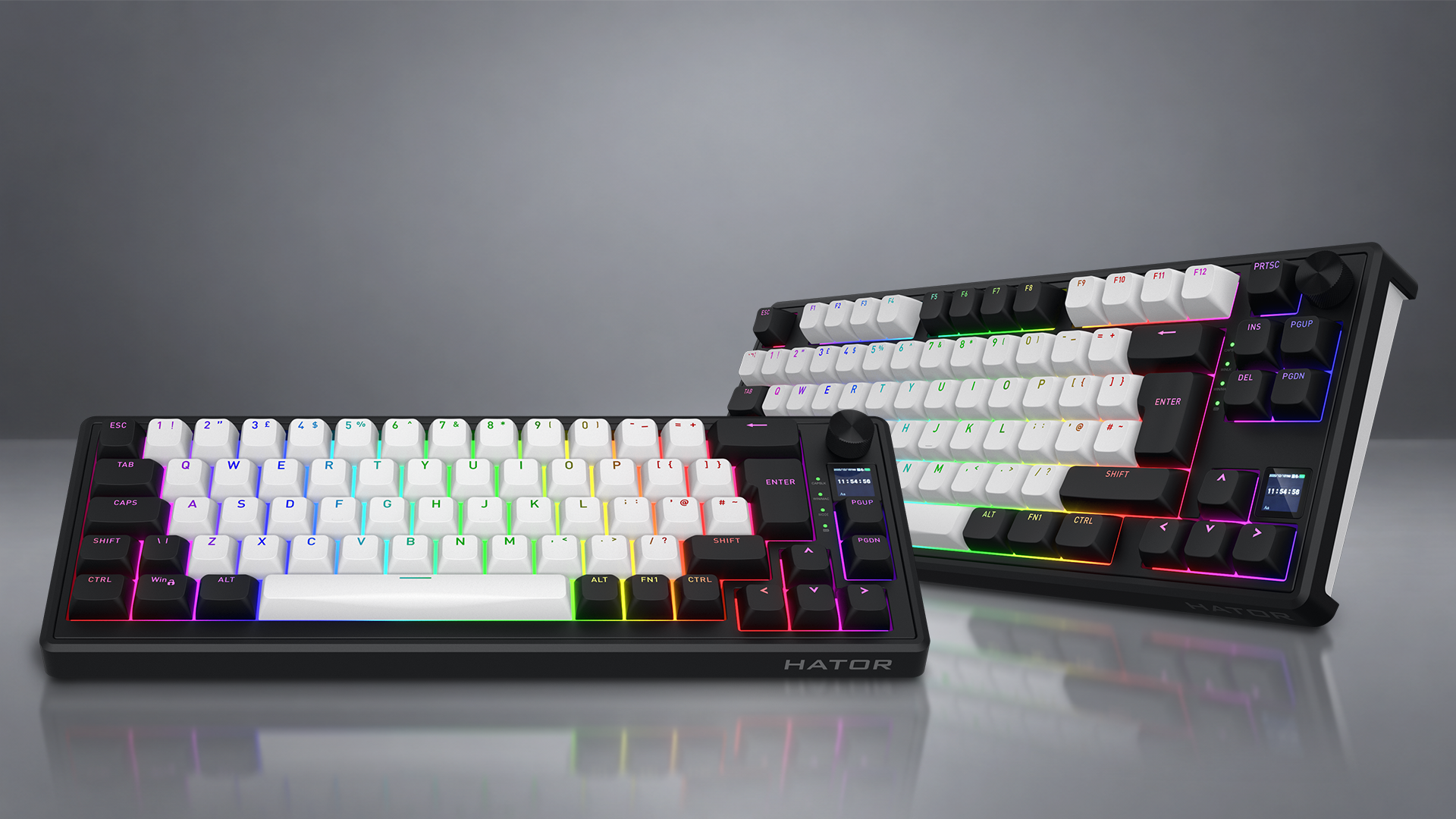
Continuing the theme of speedy performance, the Skyfall MAG Ultima 8K features an industry leading 8000Hz polling rate when using the keyboard in both wired and 2.4 GHz wireless modes. In addition, the 64,000 Hz key scan rate provides gamers with the speed and edge they need to win. The Skyfall MAG Ultima 8K Wireless Keyboard demonstrates no hardware limits, with only the skill of the gamer determining the outcome of the game.
The Skyfall MAG Ultima 8K Wireless Keyboard comes equipped with advanced HATOR Aurum Ice Magnetic Switches, delivering exceptionally fast and precise actuation alongside extensive customization options. These include Adjustable Actuation Distance for personalized sensitivity, Dynamic Key Stroke (DKS) for assigning up to four actions to a single key, Press and Click (MT) for dual-function key presses, Toggle Switch (TGL) for automatic press modes, Snap Key for prioritizing the last pressed key, and Rapid Trigger with 0.01 mm precision for near-instant key reactivation.
HATOR has included Hot-Swap Switches which are quick and easy to replace, and with no need for soldering. Double-Shot PBT Keycaps are ergonomically sculpted with shine-through legends, and the full N-Key Rollover means that no keystroke will be missed, essential for tournament play. Understanding the importance of comfort, the Skyfall MAG Ultima 8K Wireless Keyboard features an advanced Gasket Mount Architecture, constructed with elastic gaskets between the plate and the case, evenly distributing pressure during keystrokes, reducing excess vibrations.
Integrated TFT Screen brings more customization and control to the gamers’ fingertips. Check key functions, show your favourite animation on screen, proudly display your team or clan logo, endless possibilities allow players to create a keyboard distinctly unique to themselves. Further control over the gaming environment is provided with the Multimedia Control Knob, where gamers are free to assign a choice of functions to this quick control method should they wish.
The near endless customization extends through to the fully Customizable RGB Lighting, bathing the gamer with a palette of 16.8 million colors, with each key fully adjustable.
With the Skyfall MAG Ultima 8K, gamers can take full control of their keyboard with the new Web SyncHUB. Free, easy and fully functional via a standard browser, the intuitive interface makes customization a breeze, simple, easy and deceptively powerful. Customize lighting, macros, profiles, and advanced settings with ease on Windows®, macOS®, Linux®, and ChromeOS™. No software to download, no time-consuming installation. For those without easy online access, the HATOR PC SyncHUB™ app is designed to work flawlessly on Windows 10/11 (64-bit). Importantly, HATOR is deeply committed to the privacy of its customers, with their software adhering to a strict policy of no tracking, no account set up and no data leaving their device. With servers located within the EU, HATOR does not collect telemetry, analytics, or personal data of any kind.
Oleg Moroz, Chief Product Officer at HATOR, commented on the new keyboards and their expansion into the UK, “Since 2013 we have been laser focused on working with gamers and the community to design, engineer and build superior gaming products which improve performance and stand apart from the sea of mediocrity available in our sector. Nowhere is this philosophy more evident than with our new range of Skyfall magnetic keyboards. Our engineers have delivered what we believe to be advanced engineering, innovation, a feature set unlike any other, and with a price designed to pleasantly surprise the passionate gamer. We can’t wait to bring our range to UK gamers and look forward to organically growing our distribution footprint throughout 2027.”
The full specification of the Skyfall MAG Ultima 8K Wireless Keyboard, is as follows:
-
Connection type: 2.4GHz, BT5.3, USB
-
Polling rate: up to 8000Hz
-
Battery capacity: Skyfall Wireless 65: 4000mAh / Skyfall Wireless 80: 8000mAh
-
Battery life: – With backlight: up to 24 hours / Without backlight: up to 533 hours
-
Charging time: up to 16 hours
-
Backlight: RGB with the ability to customize each key individually
-
Switch Type: HATOR Aurum Ice Magnetic linear
-
Switch life: 100M clicks
-
Pressing force: 45 ±5%gf
-
Pre Travel: Adjustable by software
-
Total travel: 3.5 ±0.1 mm
-
Keycaps material: Double shot PBT keycaps
-
Keycaps profile: OMA
-
Additional Features: – Hot-swappable switches / Gasket Mount / Multi-layer noise-cancelling system / Multimedia control knob / TFT screen: 0.85″
-
System Compatibility: Windows 10/11, macOS, LINUX, ChromeOS
Package Contents:
-
Skyfall MAG Ultima 8K Wireless Keyboard
-
2.4GHz wireless dongle
-
Detachable USB-A to USB Type-C cable
-
User key for removing keycaps
-
Additional branded keycap
-
User manual
The HATOR Skyfall 80 MAG Ultima 8K Wireless Keyboard retails for an MSRP of £94.99 and is available to purchase today via: https://hator.com/collections/
The HATOR Skyfall 65 MAG Ultima 8K Wireless Keyboard retails for an MSRP of £84.99 and is available to purchase today via:
https://hator.com/products/
15, Oct 2026
Phonak launches Roger On Sphere™: the first AI-powered remote microphone to separate speech from noise in real time
Stäfa, Switzerland – October 15, 2026 – Phonak today announced Roger On Sphere™, the world’s first remote microphone powered by a deep neural network (DNN) that separates speech from background noise in real time. It helps people with hearing loss follow conversations in busy restaurants, meetings, family gatherings and social events, over distance and in groups, where hearing aids alone may not be enough.
“Roger has transformed communication in demanding listening environments for nearly two decades,” said Alain Kertész, Senior Director Roger. “Roger On Sphere brings AI-driven speech separation to a remote microphone, giving users greater clarity and confidence in situations that were previously difficult to manage.”
Clearer speech in more situations
Roger On Sphere combines Phonak Sphere technology with the proven Roger wireless protocol. It continuously analyzes the surroundings and separates speech from noise in every microphone mode and at every noise level.
Compared with its predecessor, it delivers an additional 3 dB signal-to-noise ratio benefit. This is equivalent to roughly 50% less noise power, allowing users to communicate in environments with twice the noise level.¹
One microphone for work, home and social life
The device automatically adapts its microphone mode to meetings, lectures, online calls, restaurants, family gatherings and car journeys, so users do not need to adjust settings.
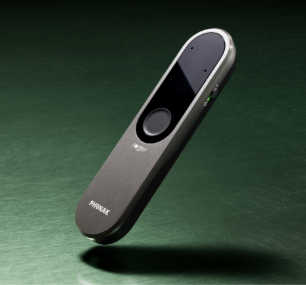
Key features:
- AI-powered real-time speech-from-noise separation through RogerSense OS™
- Automatic adaptation across multiple listening situations
- Reliable, low-latency Roger wireless transmission
- Broad compatibility with hearing aids, cochlear implants and other hearing solutions, including products across the Sonova portfolio such as Phonak Naída and Virto hearing aids and Advanced Bionics cochlear implant systems
- Enhanced hardware design and updated myRogerMic experience
By making conversations easier to follow and reducing listening effort, Roger On Sphere helps people take a fuller part in life at work, at home and in social settings. Phonak encourages hearing care professionals to demonstrate the device in the clinic so clients can experience the benefits firsthand.
Phonak Roger On Sphere is available in most markets as of mid-November 2026.
References
1 Roh M, Gigandet X, & Sans M. (2026). Expand your world, with Roger On Sphere. Phonak Insight.
* Based on a 3 dB SNR benefit in typical operating range
15, Oct 2026
Symphony by Wix Integrates Link’s Wallet for Agents, Built by Stripe, Enabling AI Agents to Make Payments on Behalf of Small Businesses
With Link’s wallet for agents, Symphony’s AI agents go from flagging what needs attention to handling it, keeping inventory stocked, bills paid, and deadlines met on the owner’s behalf, with every purchase approved first
NEW YORK, October 15, 2026 – Wix.com Ltd. (NASDAQ: WIX), today announced that Symphony by Wix, the standalone multi-agent system for small and medium-sized businesses and solopreneurs, now connects to Link, Stripe’s digital wallet. The integration allows Symphony’s team of AI agents to make payments on the business owner’s behalf, taking execution one step further. Symphony’s agents already know how a business operates and work as a coordinated team across it, executing tasks and surfacing growth opportunities. With Link connected, they can now carry that work through to payments, so a task is finished rather than handed back to the owner.
Most AI tools for business stop at insight. They find the problem, draft the email, or flag the risk, and then hand the final step back to the owner. With Link connected, Symphony’s agents can carry tasks through to payment, with business owners approving each purchase before it is made. For small business owners, that means stock is reordered before it runs out, invoices are paid before they fall overdue, and entry fees are covered before a deadline passes, none of it landing back on the owner’s to-do list.
Every payment runs inside a system the owner controls. With Link’s wallet for agents, buyers review and approve each spend request, while Stripe uses a secure payment token or one-time virtual card for the transaction. In practice, it can play out across the whole life of a business:
-
A new owner is setting up their business. Symphony identifies the required registration fees and pays them, so the business is registered before the first sale.
-
A candle shop’s best-selling scent drops below five units. Symphony reorders from the usual supplier and pays overnight, so the owner wakes up to “reordered” rather than “almost out.”
-
A supplier invoice lands on a Friday afternoon. Symphony confirms the amount matches the purchase order and pays it that day, instead of it sitting until the owner has a free hour.
-
A local farmer’s market closes applications in three days. Symphony pays the entry fee right away, so the opportunity is secured rather than left on a list that expires.
-
A customer leaves a two-star review over a late delivery. Symphony sends a complimentary gift card the same day to make good.
Symphony’s agents never see the owner’s underlying payment details, and each card is capped at the approved amount. Approval can be given within a 10-minute window from any device, by WhatsApp or SMS.
“Since launch, Symphony has been built to act on behalf of business owners, not just advise them,” said Ronny Elkayam, COO of Wix. “Connecting Link is the last mile of that promise. An agent that can find an overdue invoice or an expiring grant deadline is useful. An agent that can get it paid, with the owner’s approval and inside clear limits, is a teammate. That is the difference between knowing what to do and having it handled.”
“People start businesses to solve problems and serve customers. Routine tasks like ordering supplies and paying bills take valuable time away from that work,” said Jay Shah, business lead for Link at Stripe. “With Link’s wallet for agents, Symphony can handle more of those tasks, giving business owners more time to focus on what matters most to them.”
The Link integration follows Symphony’s August launch and extends the platform’s expansion into the operational layer of how SMBs manage, automate, and grow. The connection is rolling out to Symphony users with a US-based Link account, with payments made in US dollars.
15, Oct 2026
Leostream Simplifies Secure Remote Access with New Cloud Offering
Leostream Cloud connects authorized users directly to the workstations and resources they need, providing an alternative to VPN-based remote access
BOSTON – October 15, 2026 – Leostream Corporation, a leading provider of secure remote access and digital workspace management solutions, today announced Leostream Cloud, a new cloud-based offering designed to simplify secure remote access to physical and cloud-hosted workstations and other protected resources.
Remote users often need access to a specific workstation or resource, not an entire corporate network. Yet organizations have traditionally relied on virtual private networks (VPNs) to provide remote connectivity, potentially giving users broader network access than their work requires. Leostream Cloud enables organizations to replace or avoid VPN deployments for these remote access use cases by authenticating users, applying access policies and connecting them only to the resources they are authorized to use.
“Remote access has traditionally been associated with providing users a path into the corporate network, often through a VPN, but in many cases that is more access than they actually need,” said Karen Gondoly, CEO of Leostream. “With Leostream Cloud, we’re applying the same principles of choice and controlled access that have always been central to Leostream, but now delivered through the cloud. Organizations can provide secure remote access without requiring users to first connect to the corporate network through a VPN. Instead, they can authenticate the user, authorize the specific resource and limit everything else, giving users a simple way to connect while giving IT greater control over what they can access.”
Leostream Cloud also supports vendor privileged access management (VPAM) use cases, giving organizations a way to provide third-party users and contractors controlled access to specific resources without granting broader network access.
“Organizations need a practical way to give vendors and other external users access to the systems required to do their jobs without unnecessarily opening up the broader environment,” said Piotr Baranowski, Owner, Instructor and CTO, Open Source Education Center (OSEC). “In validating the VPAM workflow in Leostream Cloud, we saw how identity and access policies can be used to connect an authorized user directly to an approved resource. It’s a straightforward approach to a remote access challenge that many organizations are trying to solve.”
Secure Access to the Resource, Not the Network
Leostream Cloud combines identity-based authentication with policy-driven resource assignment to control who can connect, what they can access and how the connection is established. Users sign in through a centralized access experience and see only the resources they are authorized to use. By connecting users directly to approved resources rather than first placing them on the corporate network, Leostream Cloud can eliminate the need for a VPN in remote access scenarios where users only require access to specific workstations or systems.
The Leostream Cloud Agent uses outbound connectivity to help organizations provide access to protected resources without directly exposing remote access services such as RDP or SSH to the internet. Organizations can also centrally manage access policies and resource assignments while maintaining logs and optional session recordings for greater visibility into remote activity.
Leostream Cloud can support remote access across physical workstations, data centers, branch or project sites, and cloud environments. Organizations can select from connection protocols including RDP, VNC, SSH, HTML5, Amazon DCV, Jump Desktop, and Sunshine/Moonlight based on the requirements of different users and workloads.
This flexible approach enables a range of remote access scenarios, including connecting engineers to CAD workstations, creative professionals to cloud GPU resources, researchers to Linux systems, and contractors to specific approved resources. For organizations evaluating alternatives to HP Anyware, Leostream Cloud provides a flexible path forward that supports multiple connection protocols and diverse physical, virtual and cloud-hosted resources without locking users into a single protocol or infrastructure model. Rather than deploying a separate access solution for each environment or use case, IT teams can manage diverse users, resources and connection methods through a centralized platform.
Leostream Cloud is part of an organization’s Zero Trust Network Architecture (ZTNA), by applying identity and policy at the point of access and limiting users to authorized resources. For organizations looking to reduce reliance on VPNs, this resource-specific model provides an alternative to extending network-level access to remote users. It is designed to address a specific component of ZTNA: securely connecting authenticated users to individual workstations and protected resources without providing unnecessary access to the surrounding network.
15, Oct 2026
AVer’s MT300(N) Achieves Certification for Microsoft Teams Rooms
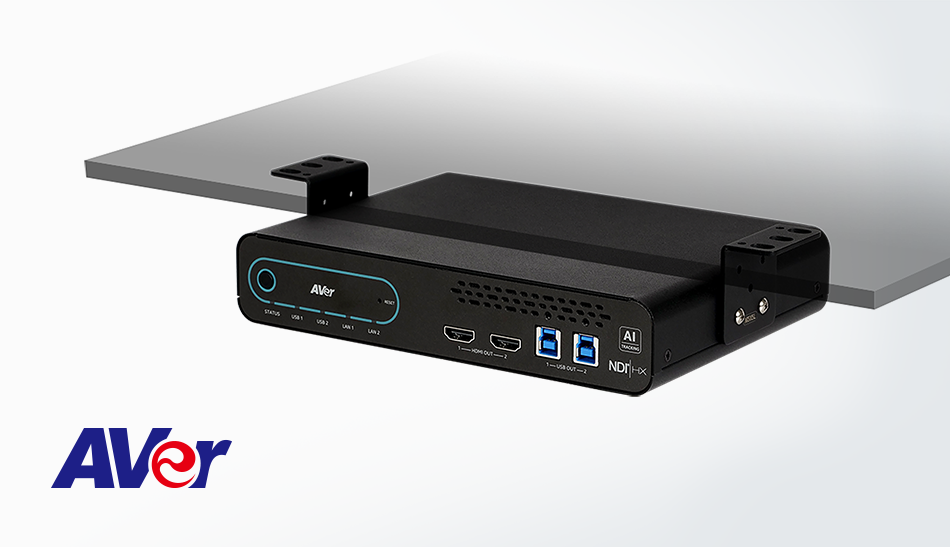
Taipei, Taiwan – Oct 15: AVer Information Inc., an award-winning provider of AI audio-video solutions, announces the MT300(N) is now Certified for Microsoft Teams. The MT300(N) meets Microsoft’s performance and compatibility requirements for qualified Teams Rooms deployments, supporting reliable integration across certified room environments.
“Achieving certification for the MT300(N) emphasizes our continued focus on delivering solutions that simplify deployment while supporting reliable collaboration experiences,” said Katie Sullivan, Senior Product Manager for AVer Information Inc. “The MT300(N) gives organizations greater flexibility by enabling voice tracking, multi-camera switching and broad compatibility with leading audio and video technologies in a compact platform.”
“We’re pleased that the AVer MT300(N) camera is certified for Microsoft Teams,” said Albert Kooiman, General Manager, Teams Partner Engineering and Customer Enablement at Microsoft. “The MT300(N) supports multi-camera voice-tracking, outputting over a single USB stream and integrates with a broad ecosystem of third-party microphones that are certified for Microsoft Teams. This combination provides customers with powerful choices for creating effective meeting experiences, especially in large meeting rooms.”
The MT300(N) is designed to enhance AVer PTZ cameras by adding advanced voice tracking capabilities in a compact, flexible form factor. The MT300N can be discreetly installed beneath a table, mounted behind a display with the included surface-mount brackets, or integrated into a rack with an optional rack-mount accessory. By connecting multiple cameras, the MT300N enables seamless voice-activated camera switching to ensure active speakers remain in view for a more engaging and natural collaboration experience.
The MT300(N) brings advanced voice tracking functionality to Microsoft Teams Rooms environments through integration with Microsoft Teams Certified microphones. Designed for flexible collaboration workflows, the MT300(N) supports customizable multi-camera switching with a variety of connectivity options for cameras enabling seamless integration with Teams Rooms and a range of content capture applications.
15, Oct 2026
AAEON Expands UP Brand Portfolio with New UP Display Kit to Meet Edge Computing and HMI Needs
AAEON’s first UP-branded display system delivers fanless edge computing, industrial connectivity, and a 15.6-inch multi-touch interface in one compact platform.
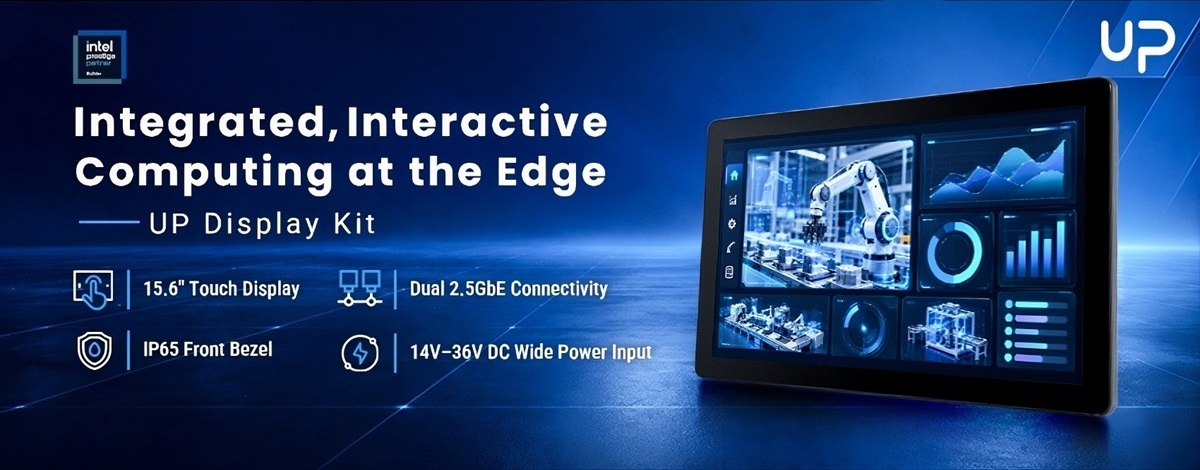
Taipei, Taiwan – Oct 15: Leading IPC provider AAEON (Stock Code: 6579) has released the UP Display Kit, an edge computing and HMI platform in one Intel® Processor N-series-powered compact system. The device is the first of its kind under the UP brand, which primarily targets the developer board and edge PC markets, representing an expansion of the brand’s product offerings.
The system has been made available in a range of SKUs featuring CPUs from across both the Alder Lake-N and Twin Lake generations of the efficiency-focused Intel® processor series, including the octa-core Intel® Core™ 3 Processor N355 and Intel® Core™ i3-N305 Processor, as well as the increasingly popular Intel® Processor N97.
AAEON states that the primary motivation behind the UP Display Kit is to integrate the user-friendliness of a high-spec display unit with the utility and reliability of an industrial edge PC. As such, industrial HMI, self-service kiosks, and smart retail terminals have been identified as potential applications for the product.
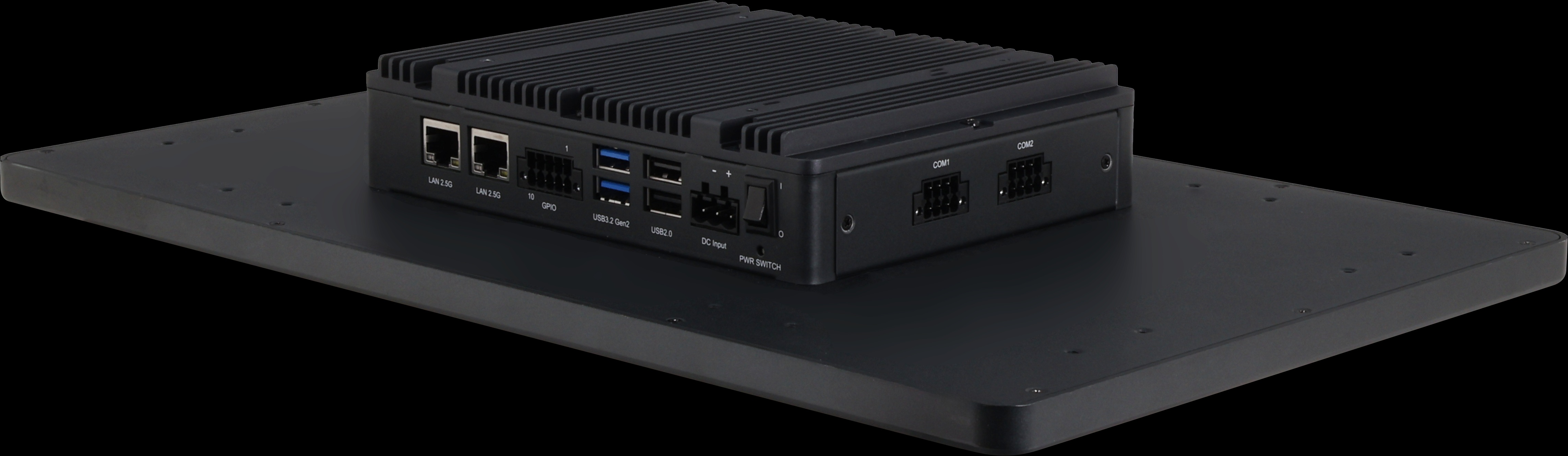
The UP Display Kit features a 15.6″ projected capacitive multi-touch display and OS support for both Windows® 11 LTSC and Ubuntu 22.04 LTS for UI design flexibility. Meanwhile, the device provides a number of interfaces conducive to its intended deployment environments, beginning with two 8-pin terminal block connectors for software-configurable RS-232/422/485 and an 8-bit GPIO. Joining these industrial I/Os are dual RJ-45 ports, each supporting 2.5GbE, and four USB ports (two USB 3.2 Gen 2, two USB 2.0).
For expansion, the UP Display Kit provides an M.2 2230 E-Key for Wi-Fi module installation, as well as two M.2 2280 M-Key slots, one offering a 4-lane PCIe Gen 3 interface for NVMe storage support and one dual-lane PCIe interface. Alongside these, the system supports up to 16GB of DDR5 via a SODIMM slot, while more conventional storage can be obtained through the option of up to 128GB of eMMC.
The display kit is designed for reliable, quiet operation in rugged environments, as illustrated by its IP65-rated front bezel, which grants protection against dust and water ingress. In addition to this, the kit supports either a 14V to 36V DC input with a dedicated ground screw or a standard 12V input, depending on configuration. As is typical of AAEON platforms designed for outdoor, industrial, or kiosk deployment, the system relies on passive cooling, using a heatsink within its chassis to ensure adequate dissipation.
15, Oct 2026
Altair Semiconductor Adds Iridium NTN Direct Support to ALT1350 and ALT1550 IoT Chipsets
MCLEAN, Va., Oct. 15: Iridium Communications Inc. (Nasdaq: IRDM), a leading provider of global voice, data, aircraft surveillance, and positioning, navigation, and timing (PNT) satellite services, today announced that Altair Semiconductor, a world leader in cellular IoT chips, is integrating Iridium NTN Direct℠ capability into Altair’s ALT1350 and next-generation ALT1550 IoT chipset platforms. With terrestrial cellular IoT and Iridium satellite connectivity on a single chipset, device manufacturers, module makers and mobile network operators (MNOs) will be able to extend IoT connectivity beyond the reach of terrestrial networks through the Iridium satellite network, without adding a separate satellite modem to their designs.
The partnership combines Altair’s cellular IoT chipset technology, among the most highly integrated low-power connectivity solutions available, with Iridium’s 3GPP standards-based non-terrestrial network (NTN) service, giving device manufacturers another chipset option for products that need connectivity beyond terrestrial cellular coverage. With the ultra-low-power ALT1350, these connectivity requirements can include asset tracking, logistics, smart metering and utilities, agriculture, vehicle telematics, industrial monitoring and remote infrastructure. With the ALT1550, these capabilities extend to a new generation of AI-powered 5G eRedCap devices, such as smart glasses, AI assistants and other wearables, that need to stay connected wherever they go.
“Altair has deep experience developing highly integrated, low-power IoT solutions, and we’re excited to work together to extend their reach with Iridium’s truly global satellite network,” said Tim Last, executive vice president, Iridium. “As a market leader in satellite IoT, Iridium is offering device manufacturers a powerful new way to develop connected products. Integrating Iridium NTN Direct into Altair’s chipsets will enable solutions and applications that require reliable, low-power connectivity beyond the limits of terrestrial networks.”
“Adding Iridium NTN Direct to our ultra-low-power LTE-M/NB-IoT ALT1350 and 5G eRedCap ALT1550 chipsets reflects our commitment to giving customers greater flexibility in how and where their IoT devices connect,” said Dima Feldman, VP Product Management and Marketing, Altair Semiconductor. “With Iridium’s truly global LEO satellite connectivity alongside terrestrial cellular, device manufacturers can more easily develop solutions that will reliably work anywhere they’re deployed.”
Iridium NTN Direct leverages Iridium’s fully operational, LEO satellite constellation and globally coordinated L-band spectrum to extend standards-based connectivity beyond terrestrial networks. The service is designed to support NB-IoT and direct-to-device (D2D) applications using compatible 3GPP standards-based chipsets, providing MNOs, chipset manufacturers and device makers with a path to extend connectivity through the Iridium satellite network.
Altair joins a growing ecosystem of partners bringing the Iridium NTN Direct service to market. A combination of chipmakers, module manufacturers, OEMs, device makers, and IoT developers is leading the next generation of NTN-cellular integration with Iridium NTN Direct.
15, Oct 2026
Leonardo DRS STAG-5 EO/IR Gimbal with Laser Target Designator Supports Precision Fires Demonstration During Iron Sting Event
Precision fires validation highlights how DRS’ STAG-5 gimbal can help operators improve targeting accuracy, extend standoff and enable precision fires in contested environments

ARLINGTON, Va.– Oct. 15, 2026 – Leonardo DRS, Inc. (Nasdaq: DRS) announced today that its STAG-5 EO/IR Gimbal with Laser Target Designator (LTD) supported a recent precision fires demonstration in conjunction with Performance Drone Works (PDW) during the Iron Sting Precision Mortar Validation Event, highlighting the role of advanced target design capabilities in enabling extended-range, accurate strike operations. The event was hosted by the Capability Development & Innovation (CD&I) office, formerly the Irregular Warfare Technical Support Directorate (IWTSD), within the Secretariat for Special Operations (SSO) in support of the U.S. Army Special Operations Command (USASOC).
Conducted at the White Sage Mortar Range in Dugway, Utah, the event evaluated the safety, accuracy, and extended-range performance of next-generation precision mortar munitions while also providing operators with hands-on experience using emerging technologies in realistic scenarios.
During the event, a PDW C100 drone equipped with the DRS STAG-5 EO/IR Gimbal with Laser Target Designator supported target designation during mortar engagements at ranges exceeding the standard maximum range of a 120 mm non-rifled mortar. The successful execution of repeated engagements demonstrated the consistency and reliability required for operational employment and reinforced the value of advanced laser designation capabilities in modern fires workflows.
“The STAG-5 is designed to provide operators with precise, reliable ISR and targeting capabilities that can enhance mission effectiveness across a wide range of operational environments,” said Jerry Hathaway, senior vice president and general manager of Electro-Optical Infrared Systems (EOIS) at Leonardo DRS. “Events such as Iron Sting underscore the importance of delivering technologies that improve accuracy, extend operator standoff, and support evolving battlefield requirements.”
The STAG-5 is designed to support mission success by enabling operators to designate targets with precision and confidence as part of integrated fires operations. When paired with advanced electro-optical and infrared sensing capabilities on deployed platforms, the system can improve target acquisition and designation, strike confirmation, and mission observation from safer standoff positions.
DRS continues to work closely with customers, operators, and industry partners to advance precision engagement solutions that address the needs of today’s warfighter. Through participation in events such as Iron Sting, the company is demonstrating how scalable, mission-ready technologies can help operators Own the Edge™ through improved precision, survivability and operational flexibility in contested environments. For more information regarding the DRS STAG-5 EO/IR Gimbal, visit www.leonardodrs.com/stag5.


