Vijayawada, Jan 09: Heartfulness, in collaboration with the Government of Andhra Pradesh, today launched a landmark Net-Zero Residential School pilot project at the APSWREIS Residential School in Kuntamukkala, near Vijayawada. The initiative emerged from discussions between Hon’ble Chief Minister Sri Nara Chandrababu Naidu and Reverend Daaji, Global Guide of Heartfulness, reflecting a shared vision for sustainable and environmentally responsible education and aims to serve as a scalable model of an Integrated Ecological Campus.
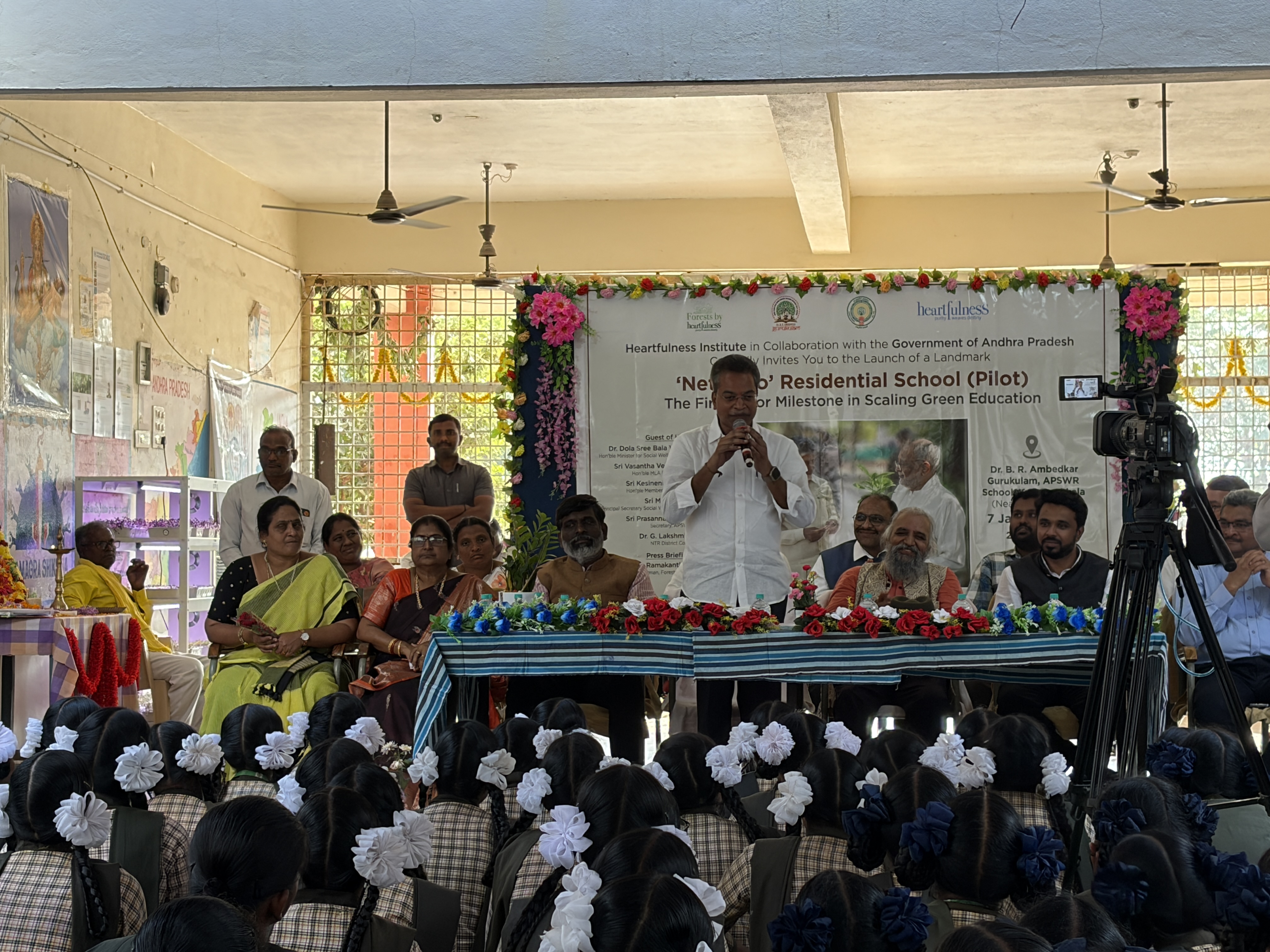
The campus will include green belts, a rainforest, wetlands, and microgreens, thereby closing the Net-Zero loop. It seeks to create an environment conducive to learning while grooming students to take responsibility for ecology through student-led green governance, with scope for scaling across Andhra Pradesh.
The launch was graced by Sri Vasantha Venkata Krishna Prasad, MLA, Mylavaram, NTR District; Sri Prasanna Venkatesh V., IAS, Secretary, APSWREIS; Dr Ramakantha, Chairman, Forests by Heartfulness; and Mr Saravanan Subramanian, Director, Forests by Heartfulness. This initiative is based on the discussions Hon CM Sri Nara Chandrababu Naidu had with Reverend Daaji, Global Guide, Heartfulness. The event was marked by a mass plantation drive, with green enthusiasts coming together to set a new national benchmark for climate-positive educational infrastructure.
The need for the pilot project was identified as a long-term, low-energy, sustainable solution for residential schools, where there is higher resource usage, increased water consumption, and significant wastewater generation. Larger campuses offer scope for ecological regeneration, development of Net-Zero and water-positive campuses, creation of carbon assets, and integration of sustainability into daily student life. The project also aims to develop a scalable model for Andhra Pradesh while helping students identify their role in environmental stewardship.
Sri Vasantha Venkata Krishna Prasad, MLA, Mylavaram, shared his thoughts:
“Andhra Pradesh will become a hub of environmentally aware youth through initiatives like this. With the support of our Government and inspired by the guidance of Revered Daaji, we hope this pilot project will have a ripple effect throughout the state by introducing the Net-Zero concept in residential schools.”
“The seven-year project aims to achieve negative carbon emissions, improve soil health and biodiversity, and reduce freshwater usage. When sustainability becomes a way of life in residential schools, it becomes a lifelong habit. This is a commendable initiative by the Government of Andhra Pradesh and Heartfulness,” said Sri Prasanna Venkatesh V., IAS, Secretary, APSWREIS.
Dr Ramakantha, Chairman, Forests by Heartfulness, added,
“We are delighted to partner with the Government of Andhra Pradesh. This pilot project will not only help raise environmentally conscious leaders but also create a replicable and sustainable model for schools that will have long-term impact.”
Mr Saravanan Subramanian, Director, Forests by Heartfulness, said,
“By planting a tree and caring for it over time, each student nurtures life itself. This is the most beautiful aspect of the initiative. We are confident that this pilot will succeed in creating a beautiful, conducive, and spiritually enriched environment for students.”
The Integrated Campus Zoning concept includes a small rainforest; one ‘Sandalwood Legacy’ tree per student; dense plantations for boundary protection and carbon sequestration; wind and sound buffers for hostel comfort; a pollinator garden for biodiversity learning; a herbal garden for traditional knowledge; and microgreens with Net-Zero nutrition for low-water food production, skill development, and health—spread across seven distinct zones.
Student Green Clubs have also proposed to monitor trees, wetlands, and waste systems; promote daily sustainability practices in residential life; conduct quarterly reporting and audits; manage microgreens; integrate kitchen waste composting; and oversee recycled water usage.
Aligned with ESG (Environmental, Social, and Governance) and CSR (Corporate Social Responsibility) goals, the pilot project is expected to deliver a Net-Zero carbon campus within 5–7 years, achieve a 40–70% reduction in freshwater usage, enhance biodiversity and soil health, and nurture environmentally responsible residential students. Over the seven-year project phase, the Net-Zero pathway is projected to transition from a +180 high carbon emission level to a carbon-negative status by the seventh year through interventions such as wetlands, sustainable food systems, composting, biochar, rainforest development, boundary plantations, sandalwood cultivation, canopy growth, soil carbon build-up, mature tree cover, solar power, and LED lighting.
The Net-Zero Residential School pilot is scientifically robust and financially transparent, serving as a Detailed Project Report (DPR) for long-term ecological and educational assets, with pilot implementation followed by district-wise scaling.