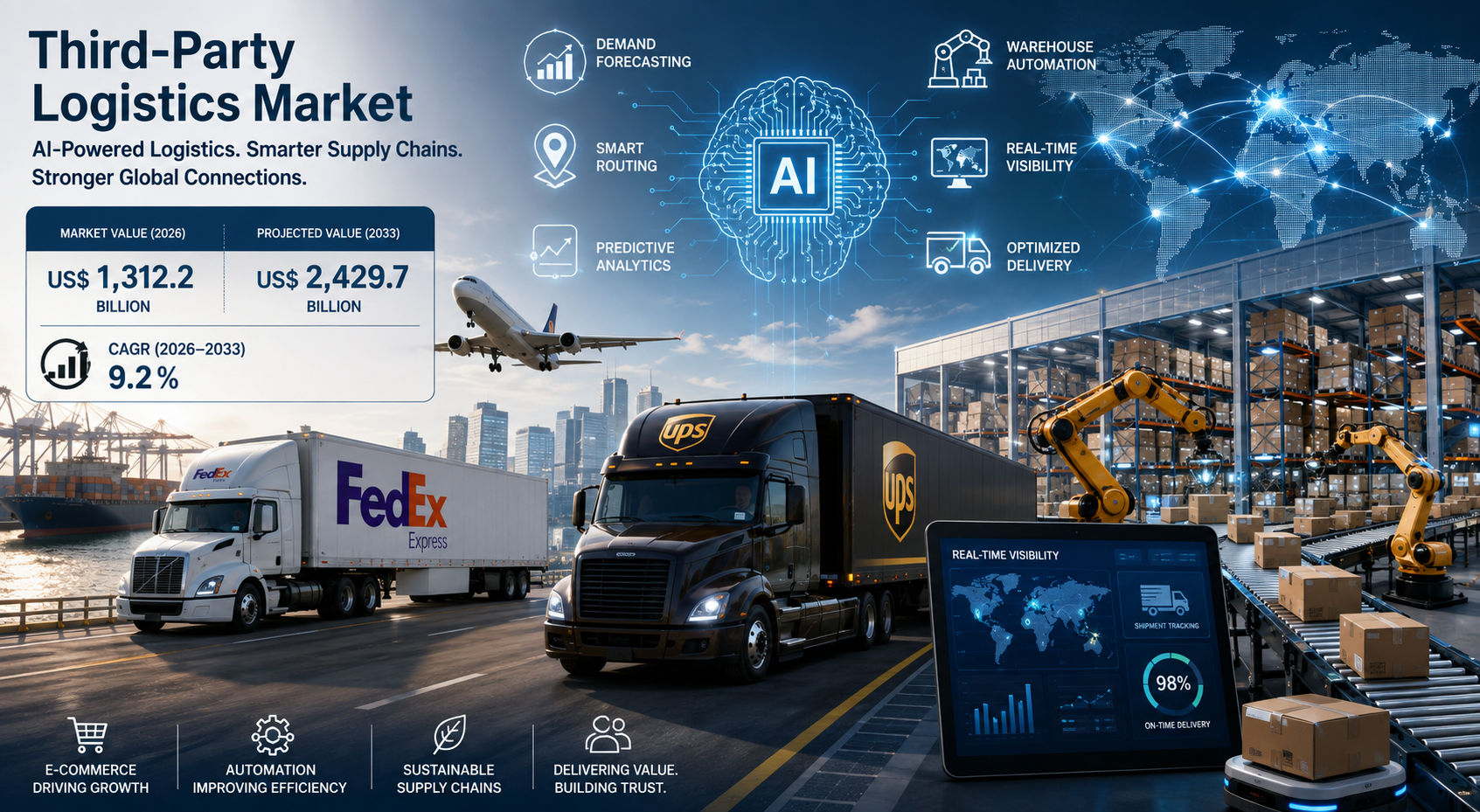
The global logistics industry is undergoing one of its biggest transformations in decades. Rising e-commerce demand, increasing customer expectations, supply chain disruptions, and advances in artificial intelligence (AI) are redefining how goods move across the world. At the center of this evolution are logistics leaders such as FedEx and UPS, both of which are investing in digital technologies to improve operational efficiency, shipment visibility, and customer experience.
AI is no longer an emerging technology for logistics providers—it has become a strategic tool that helps companies optimize routes, predict demand, automate warehouse operations, and improve delivery accuracy. As businesses increasingly outsource their logistics operations, third–party logistics (3PL) providers are adopting AI-driven solutions to remain competitive in an expanding global market.
According to Persistence Market Research, the global third–party logistics (3PL) market is valued at US$ 1,312.2 billion in 2026 and is projected to reach US$ 2,429.7 billion by 2033, growing at a compound annual growth rate (CAGR) of 9.2% between 2026 and 2033. These figures highlight the growing importance of 3PL providers in enabling efficient, technology-driven supply chains.
AI Is Becoming the Backbone of Modern Logistics
Artificial intelligence has moved beyond experimental projects and is now embedded in many logistics operations. Companies are using AI to analyze massive amounts of shipment data, identify potential disruptions, recommend optimal delivery routes, and improve inventory planning.
Machine learning algorithms can evaluate traffic conditions, weather forecasts, fuel consumption, and customer delivery preferences in real time. This enables logistics providers to make informed decisions that reduce transportation costs while improving delivery performance.
Warehouse operations are also becoming smarter through AI-powered robotics and automation. Automated sorting systems, predictive maintenance, and intelligent inventory management reduce manual work and increase operational efficiency.
These capabilities are especially valuable for third–party logistics providers, which manage complex supply chains for manufacturers, retailers, healthcare companies, and e-commerce businesses.
FedEx Is Expanding AI Across Its Logistics Network
FedEx has publicly identified AI, automation, and advanced data analytics as important components of its long-term logistics strategy. The company has highlighted how intelligent technologies can improve shipment visibility, optimize transportation networks, and help customers make faster business decisions.
FedEx’s digital initiatives focus on transforming logistics into a more connected ecosystem where businesses receive actionable insights instead of simply tracking packages. By combining operational data with predictive analytics, the company aims to improve delivery reliability while helping customers better manage inventory and supply chain risks.
The company’s outlook reflects a broader shift within the logistics industry, where digital intelligence is becoming just as valuable as physical transportation infrastructure.
UPS Continues to Modernize Through Technology
UPS is also investing in technologies that improve operational efficiency and strengthen its logistics network. The company continues to optimize its transportation network while expanding automation across distribution centers and focusing on higher-value logistics services, including healthcare logistics.
Recent company updates indicate that UPS remains committed to improving productivity through technology-driven initiatives. Network optimization, intelligent planning tools, and digital logistics capabilities are helping the company streamline operations while responding to changing customer demands.
Although each logistics company follows its own technology strategy, both FedEx and UPS recognize that AI and automation are becoming essential for maintaining competitiveness in an increasingly complex supply chain environment.
E-Commerce Continues to Drive 3PL Demand
The rapid expansion of online shopping has fundamentally changed the logistics industry. Consumers expect faster deliveries, real-time shipment tracking, flexible return options, and consistent service across multiple channels.
Meeting these expectations requires sophisticated logistics capabilities that many businesses cannot build internally. As a result, companies increasingly partner with third–party logistics providers that offer warehousing, transportation management, inventory control, customs support, and last-mile delivery services.
AI enhances these capabilities by helping logistics providers forecast demand, optimize warehouse capacity, and improve delivery planning. This allows businesses to scale operations without significantly increasing logistics costs.
Small and medium-sized enterprises are also turning to 3PL providers because outsourcing logistics enables them to focus on product development, customer service, and business growth.
Automation Is Creating Smarter Supply Chains
Automation is becoming a defining characteristic of modern supply chains. From autonomous warehouse equipment to AI-assisted planning software, technology is improving nearly every stage of logistics operations.
Predictive analytics helps identify potential supply chain disruptions before they occur, allowing companies to adjust transportation plans proactively. Intelligent warehouse systems improve inventory accuracy, while automated order processing reduces fulfillment times.
Digital visibility platforms also provide businesses with real-time insights into shipment locations, inventory levels, and delivery performance. These capabilities improve customer satisfaction while supporting more resilient supply chain operations.
As AI technologies continue to mature, logistics providers are expected to expand their use of intelligent decision-making systems that enhance efficiency across global transportation networks.
Sustainability Is Shaping Logistics Innovation
Sustainability has become another major priority for logistics companies. Businesses are under increasing pressure to reduce emissions while maintaining efficient operations.
AI contributes to sustainability by optimizing delivery routes, minimizing unnecessary mileage, improving vehicle utilization, and reducing fuel consumption. Better forecasting also helps decrease inventory waste and warehouse inefficiencies.
Many logistics providers are combining digital technologies with sustainability initiatives to create supply chains that are both environmentally responsible and economically efficient.
These efforts align with broader industry goals of reducing operational costs while meeting evolving regulatory and customer expectations.
The Future of the Third–Party Logistics Market
The third–party logistics market is entering a new phase driven by digital transformation, AI adoption, automation, and global trade expansion. Businesses increasingly view logistics not merely as a transportation function but as a strategic advantage that directly influences customer satisfaction and operational resilience.
With the market expected to expand significantly over the coming years, technology will remain a primary driver of competitive differentiation. Companies capable of combining intelligent software, advanced analytics, automation, and efficient transportation networks will be better positioned to meet the growing demands of global commerce.
As FedEx, UPS, and other logistics leaders continue modernizing their operations, AI is expected to play an even greater role in shaping the future of supply chains. For businesses seeking scalable, efficient, and data-driven logistics solutions, the evolution of the 3PL industry represents one of the most significant opportunities of the decade.