


31, Aug 2026
The Girl Who Wants to Make Clean Air a Right on Every Construction Site
New Delhi, Aug 31: When Aarna Gupta was growing up in South Delhi, pollution was something she could see, hear about and occasionally struggle to escape. But it became something far more personal when her grandfather developed lung scarring.
During the COVID-19 pandemic, as her family made repeated trips to the hospital, Aarna began to see environmental inequality differently. She realised that the burden of polluted air is not shared equally—and that for millions of people, exposure to harmful air is not something they can simply choose to avoid.
That realisation eventually took her beyond her own neighbourhood.
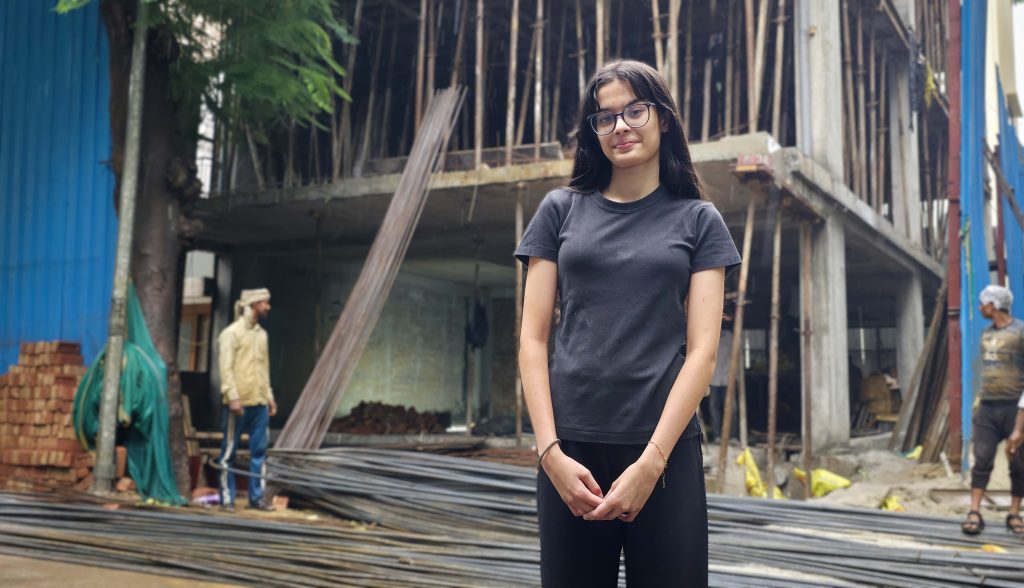
Aarna began spending time observing construction sites and speaking with workers and children who live around them. What stayed with her was the everyday exposure: workers spending long hours surrounded by dust and debris, often without masks or adequate protection, while children living around construction sites were breathing the same air.
She also noticed another consequence that rarely makes it into conversations about construction pollution: children missing school because of health problems.
“For me, it became about understanding how environmental inequality impacts people who are out there every day,” Aarna says.
At just 17, that question has led her to Aeroshield, a prototype designed to turn one of the most familiar features of a construction site—the scaffold net—into an active layer of protection against airborne pollutants.
The idea has also taken Aarna into the Top 40 of Samsung Solve for Tomorrow, Samsung’s flagship CSR programme that gives young innovators a platform to develop solutions to real-world problems through mentorship, resources and access to an innovation ecosystem. For Aarna, the programme is an opportunity to take Aeroshield beyond an idea and work towards making it viable at scale.
A scaffold net that does more than contain debris
Construction activity contributes nearly 30% of urban emissions and generates large quantities of airborne particulate matter. Conventional dust-control measures can be temporary, resource-intensive and difficult to maintain under the harsh conditions of active construction sites.
Aeroshield takes a different approach.
Instead of simply containing debris, the proposed low-cost net is designed to capture and degrade pollutants. A starch-based superabsorbent polymer (SAP), synthesised through graft copolymerisation, is designed to trap airborne particles through capillary absorption and electrostatic forces.
The captured pollutants are then targeted for degradation using photocatalytic materials engineered with oxygen deficiencies. When exposed to sunlight, these materials generate reactive oxygen species , creating a pathway to break down trapped pollutants and potentially contribute to the degradation of certain greenhouse gases.
The result is intended to be a construction net that does not merely stand between a construction site and the surrounding environment—but actively works to reduce the pollutants passing through it.
Importantly, Aarna says the ambition is not to create another complicated system that construction sites would struggle to adopt.
Aeroshield is being designed around existing construction infrastructure, with roller-line manufacturing envisioned to make the solution scalable while reducing water use and keeping production costs low.
The prototype is now ready.
A teenager thinking beyond the prototype
For Aarna, however, the technology is only one part of the ambition.
Her larger goal is to see protection for construction workers become part of a broader regulatory shift.
She wants basic protection from construction-related air pollution to become something workers can expect—not something they have to ask for.
“If a labourer feels safe, productivity improves,” she says.
That belief has shaped the way she thinks about Aeroshield. The objective is not innovation for innovation’s sake, but commercial viability: a solution that can be affordable, manufactured at scale and integrated into the way construction already works.
Her journey has also been shaped by the people closest to her.
When Aarna found herself unable to spend as much time outdoors because of pollution, her parents encouraged her to channel her curiosity into science. Her mother, who ran an education centre for children with special needs, also gave her an early understanding of how differently people experience the same environment—and how important it is to design solutions around those who are most vulnerable.
That combination of personal experience, scientific curiosity and social observation has become the foundation of her work.
Aeroshield began with a question about pollution.
It has evolved into a much bigger question about who gets protected from it.
From one girl’s observation to a larger vision for India
Aarna’s journey reflects a larger shift in how India’s young innovators are approaching environmental challenges: not simply asking how to make technology more sophisticated, but how to make it useful, accessible and capable of changing systems.
For Aarna, the answer lies somewhere between the laboratory and the construction site.
The cloth she first imagined has evolved into a technology designed to harness sunlight and accelerate the breakdown of pollutants. The problem she first saw through her grandfather’s illness has expanded into a concern for workers and children exposed to polluted air every day. And the prototype she has built is only the beginning of what she hopes will eventually become a commercially viable product and, ultimately, part of a change in construction-site safety standards.
At 17, Aarna is not claiming that one invention can solve India’s air-pollution crisis.
Her ambition is more focused.
She wants to make sure that the people who build India’s cities do not have to sacrifice their health to build them.
Because sometimes, a solution to a massive environmental problem begins not in a boardroom or a research institute, but with one young person noticing something everyone else has learned to live with—and refusing to accept it as normal.
- 0
- By Neel Achary



