


10, Sep 2026
NABARD Uses AI to Make Kisan Credit Card Loans Faster and More Accessible for Farmers
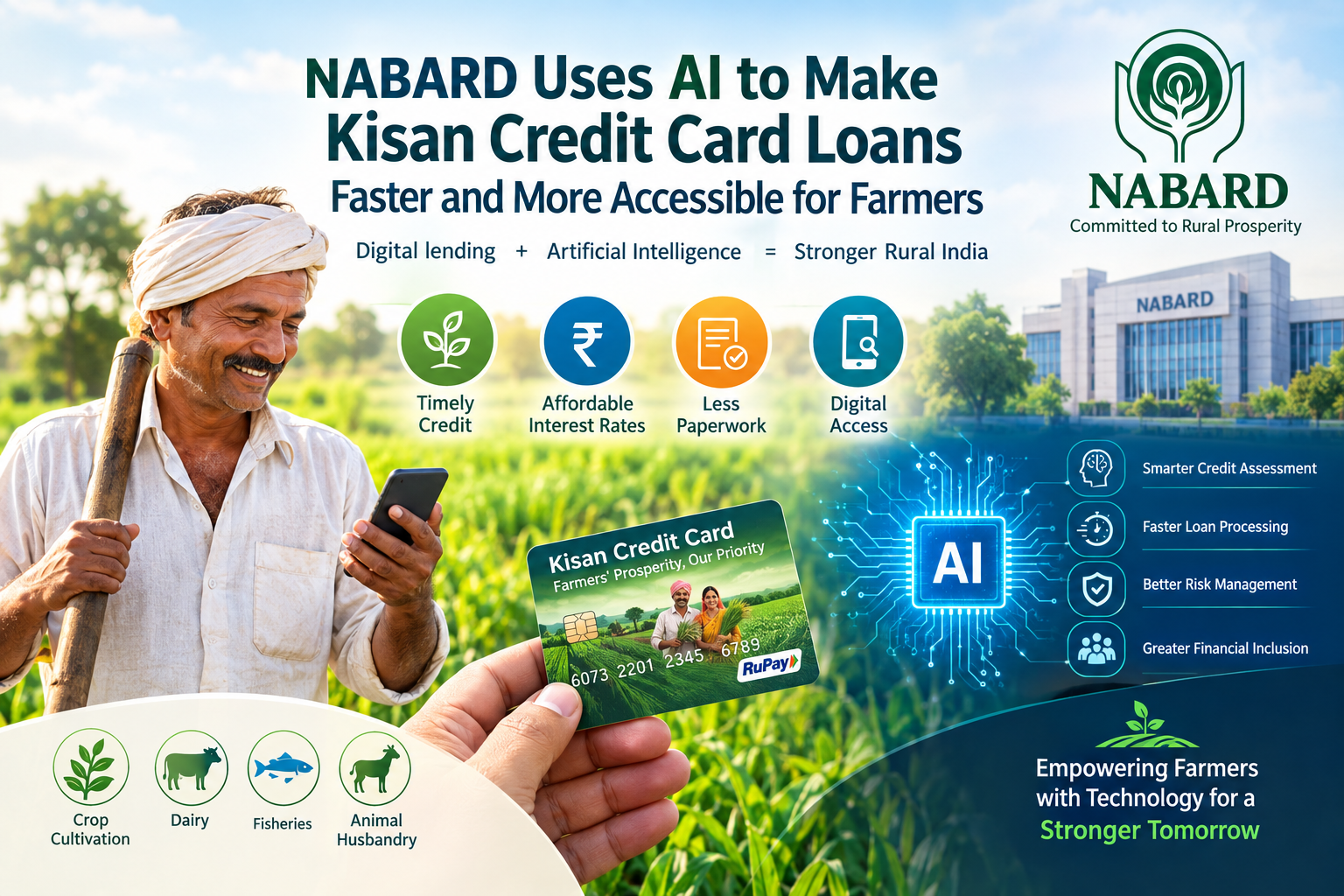
Kisan Credit Card (KCC) is one of India’s key agricultural credit initiatives, designed to provide farmers with timely and affordable loans for crop cultivation and other farming-related needs. The scheme helps farmers access formal credit without having to depend heavily on informal lenders. Over the years, KCC has also been extended to allied activities such as dairy, fisheries and animal husbandry.
Now, the Kisan Credit Card ecosystem is moving into a more digital phase, with the National Bank for Agriculture and Rural Development (NABARD) developing artificial intelligence-based models that could help farmers access credit on demand.
NABARD develops AI models for Kisan Credit Card loans
NABARD Chairman Shaji Krishnan V said the institution is working on AI models aimed at enabling more convenient and on-demand Kisan Credit loans as rural lending increasingly adopts digital technologies.
The move could significantly change the way farmers access agricultural credit by making the loan process faster, more data-driven and potentially more responsive to their financial requirements.
Instead of relying only on traditional paperwork and physical banking processes, digital lending models can help financial institutions assess relevant information more efficiently and improve the speed of credit decisions.
How AI can transform Kisan Credit Card lending
The use of AI in agricultural lending could help banks and financial institutions process large amounts of information more efficiently. For farmers, this could translate into quicker access to credit when funds are needed for seeds, fertilisers, farm equipment, irrigation, harvesting and other agricultural expenses.
AI-based models can also support more data-driven credit assessment, particularly in rural areas where traditional credit histories may not always provide a complete picture of a farmer’s financial activity.
The larger objective is to make formal agricultural credit more accessible while improving the efficiency of rural lending.
Kisan Credit Card can support affordable farm credit
The Kisan Credit Card scheme was introduced to provide farmers with adequate and timely credit for agricultural operations. Government support through interest subvention and incentives for timely repayment has helped make eligible short-term agricultural loans more affordable.
According to government information, short-term agricultural loans under the scheme are available at a 7 per cent interest rate, with an additional 3 per cent incentive for timely repayment, bringing the effective rate to 4 per cent for eligible loans. The collateral-free credit limit has also been increased to Rs 2 lakh per borrower from January 1, 2025.
These measures are important for small and marginal farmers because timely access to affordable credit can reduce dependence on costly informal borrowing.
Digital lending can strengthen rural financial inclusion
The shift towards digital Kisan Credit Card loans comes at a time when India’s rural financial ecosystem is becoming increasingly technology-driven.
Digital platforms can reduce paperwork, improve access to banking services and make it easier for farmers to interact with formal financial institutions. This can be particularly useful for farmers living in areas where access to traditional bank branches remains limited.
The development of AI-based lending models could therefore become an important part of India’s broader push towards digital financial inclusion in rural India.
Kisan Credit Card and the future of agriculture finance
The future of agricultural lending is likely to depend increasingly on technology, data and faster digital services. NABARD’s AI initiative signals a move towards a system where farmers could potentially receive credit more quickly based on their actual financial and agricultural requirements.
This could help farmers manage seasonal expenses more effectively and reduce delays in accessing working capital.
The development is also significant for banks because improved digital assessment and processing can help lenders manage rural credit more efficiently while expanding their reach.
AI can create wider economic benefits for rural India
Faster access to agricultural credit can have an impact beyond individual farmers. When farmers receive funds on time, they can purchase agricultural inputs, invest in equipment, maintain livestock and improve farm productivity.
Higher agricultural activity can increase demand for seeds, fertilisers, machinery, transportation, storage and other rural services. This creates business opportunities across the wider rural economy.
A stronger digital lending ecosystem can therefore support not only farmers and Kisan Credit Card borrowers, but also rural businesses, agricultural supply chains and employment.
What NABARD’s AI push means for farmers
The development of AI-based Kisan Credit Card lending models represents a broader shift from traditional rural banking towards technology-enabled finance.
If implemented effectively, such systems could make agricultural credit more accessible, reduce processing time and improve the overall borrowing experience for farmers.
At the same time, responsible use of AI, data security, transparency and proper safeguards will remain important as financial institutions expand the use of technology in rural lending.
Conclusion
NABARD’s move to develop AI models for on-demand Kisan Credit Card loans highlights how technology is becoming an important part of India’s rural finance ecosystem.
For farmers, faster and more convenient access to formal credit can support timely investment in agriculture and allied activities. For banks and rural businesses, digital lending can improve efficiency and expand the reach of financial services.
As India’s agriculture sector becomes increasingly connected to digital platforms, the combination of Kisan Credit Card, AI and digital banking could play an important role in strengthening rural financial inclusion and supporting long-term agricultural growth.
- 0
- By Neel Achary



