


15, Sep 2026
AI to Transform Highway Emergency Support, Making 1033 Helpline Faster and Smarter
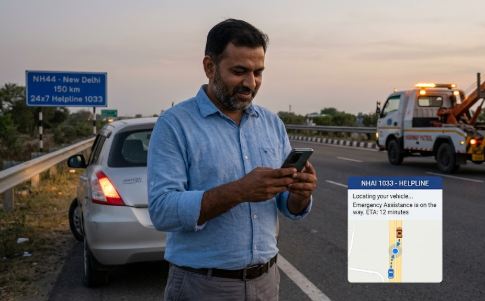
Representational Image
New Delhi, Sep 15: A roadside breakdown, accident or medical emergency can quickly become frightening when a traveller is far from a familiar location. Finding help can be even more difficult when the person is unable to clearly describe where they are. The National Highways Authority of India (NHAI) is now looking to make emergency assistance faster and more efficient by upgrading its 1033 National Highway helpline with artificial intelligence and real-time location technology.
The proposed upgrade is aimed at making it easier for travellers to get the right assistance without spending too much time explaining their location or the nature of the emergency. AI-enabled systems could help operators process calls faster, understand requests in different Indian languages and coordinate assistance more efficiently.
The 1033 helpline has been serving highway users since 2018 and operates 24 hours a day, seven days a week. It provides support during medical emergencies, accidents and vehicle breakdowns, including access to ambulances, cranes and highway patrol services.
One of the most important improvements will be more accurate location identification. On long highways, travellers may not know the nearest town, kilometre marker or exit. In an emergency, this can delay assistance. Real-time location technology could allow the system to identify where the caller is and help response teams reach the right spot more quickly.
The technology could be particularly valuable during road accidents. When people are injured or under stress, communicating detailed information may be difficult. AI can assist in capturing essential information from a call, while trained operators can assess the situation and coordinate the appropriate emergency response.
Language support is another area where AI could make a difference. With travellers from different parts of India using the National Highway network, the ability to understand calls in multiple Indian languages could make the service more accessible. Better communication can help operators understand the problem and provide appropriate instructions while assistance is being arranged.
The upgraded system could also improve coordination between the helpline and field teams. Once a request is received, relevant information can be quickly shared with ambulances, patrol vehicles or recovery teams, helping reduce delays in dispatching assistance.
However, the introduction of AI does not mean that human support will disappear. Human operators will continue to play an important role, particularly when an emergency requires judgement, reassurance or detailed communication. The most effective system is likely to be one where AI handles routine information and location-related tasks while trained personnel take decisions in complex situations.
The scale of the 1033 service makes the planned modernisation significant. The helpline currently supports more than 1.46 lakh kilometres of National Highways and receives around 15,000 calls every day. Even a small improvement in response time could make a meaningful difference for a large number of motorists.
For ordinary travellers, the biggest advantage could be faster access to help when it matters most. A person whose vehicle breaks down at night on an isolated highway, for instance, may not know exactly where they are. If the system can identify their location and quickly direct the appropriate support vehicle, the situation can be handled more safely.
The upgrade also reflects the growing use of AI in public infrastructure. Technology is increasingly being used not only for convenience but also to improve essential services, emergency response and public safety.
For the system to deliver its full potential, AI will need to work alongside reliable communication networks, accurate digital mapping, trained operators and well-coordinated emergency teams. Technology can speed up the process, but effective response ultimately depends on people and services working together.
If successfully implemented, the upgraded 1033 helpline could turn highway emergency assistance into a more connected and responsive service, giving travellers greater confidence that help can be located and dispatched quickly when they need it most.
- 0
- By Neel Achary



