


25, Sep 2026
India’s Pharma and MedTech Industries Gain New Momentum from PLI Push
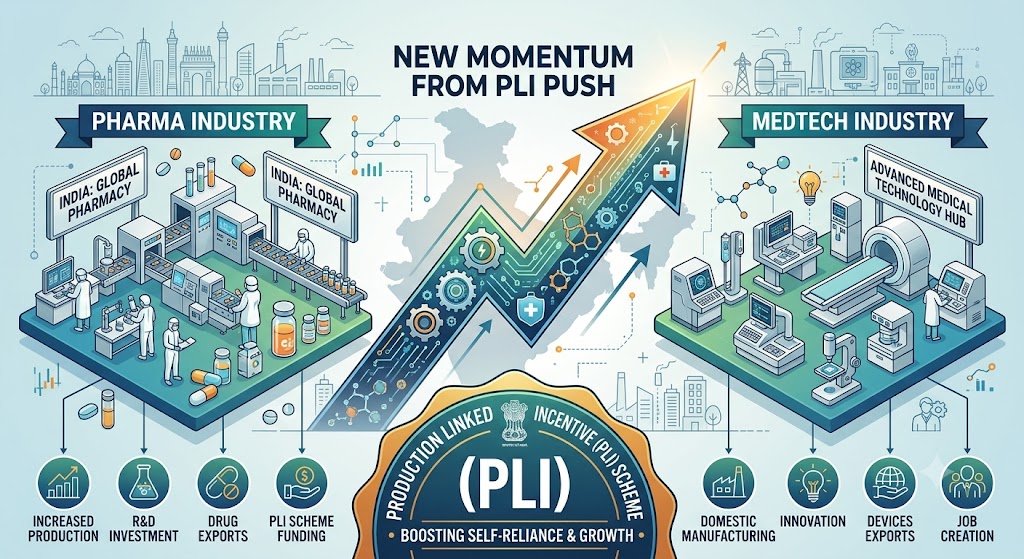
India’s pharmaceutical and medical technology sectors are entering a new phase of growth, driven by rising domestic manufacturing, fresh investments and a stronger push towards innovation.
At the centre of this transformation is the government’s Production Linked Incentive (PLI) programme, which is encouraging manufacturers to increase capacity, adopt modern technologies and develop products that were previously heavily dependent on imports.
The impact is becoming visible across the healthcare value chain. Pharmaceutical companies are expanding production of medicines and critical ingredients, while medical-device manufacturers are increasingly producing sophisticated equipment and implants within the country.
From volume to value in pharma
India has long been a major global supplier of medicines, but the next stage of growth is increasingly focused on moving up the value chain.
The pharmaceutical PLI scheme is supporting investments in areas such as complex medicines, high-value products and critical pharmaceutical ingredients. Government data show that the pharmaceutical drugs segment had attracted Rs 45,158 crore in cumulative investment by March 2026, while the bulk-drug segment recorded around Rs 5,070 crore in investment.
The significance goes beyond production numbers. Greater domestic capacity for critical ingredients can make pharmaceutical supply chains more resilient and reduce exposure to disruptions in international markets.
For Indian companies, it also creates room to expand manufacturing capabilities and compete for a larger share of global pharmaceutical demand.
Medical devices emerge as a new manufacturing opportunity
India’s medical-device industry is undergoing a similar transformation.
Under the Medical Devices PLI scheme, 27 projects have been approved, including 14 involving MSMEs, with actual investment of around Rs 1,153 crore.
Manufacturing is expanding into products such as MRI and CT equipment, mammography systems, C-arms, ultrasound equipment, radiotherapy systems, heart valves and stents.
This represents an important shift for India’s healthcare sector. Medical equipment has traditionally been an area where imports have played a significant role. Increasing local production can strengthen supply chains while giving domestic manufacturers an opportunity to develop technology and scale up.
Innovation becomes the next frontier
The government’s approach is also moving beyond factories and production lines.
The Rs 5,000-crore Promotion of Research and Innovation in Pharma MedTech (PRIP) scheme is designed to support research and development in new medicines, complex generics, biosimilars and innovative medical devices.
Emerging technologies such as AI, machine learning, robotics and advanced diagnostics are also becoming part of this innovation push.
This could create a larger role for startups, research institutions and MSMEs in India’s healthcare technology ecosystem, rather than limiting the sector’s growth to large manufacturers.
More investment, more specialised jobs
The expansion of healthcare manufacturing can have a wider economic impact. New production facilities require engineers, technicians, researchers, quality specialists and other skilled professionals.
At the same time, the growth of pharma and MedTech manufacturing can create opportunities for supporting industries involved in components, electronics, packaging, testing, logistics and specialised services.
This makes healthcare manufacturing an important link between industrial policy and employment generation.
Strengthening India’s healthcare supply chain
The PLI programme is also changing the conversation around healthcare security.
A stronger domestic manufacturing base can help India respond more effectively to disruptions in global supply chains and maintain access to essential medicines and equipment.
For hospitals and healthcare providers, a wider domestic supplier base could eventually provide more options for sourcing medical equipment and components. For manufacturers, it offers an opportunity to develop products suited to Indian requirements while building export capabilities.
The road ahead
The larger opportunity for India lies in combining manufacturing scale with research, technology and innovation.
PLI incentives have helped create an investment framework, but long-term growth will also depend on companies developing globally competitive products, improving quality, investing in R&D and building skilled talent.
As pharmaceutical and medical-device manufacturing expands, India’s healthcare industry could increasingly move from being primarily a large consumer market to becoming a stronger global production and innovation hub.
The PLI push is therefore not just about increasing factory output. It is helping reshape India’s healthcare manufacturing ecosystem around domestic capability, technology, investment and global competitiveness.
- 0
- By Neel Achary



