


29, Sep 2026
CAG Flags Financial And Procedural Lapses Across Odisha Government Departments
Bhubaneswar, Sept. 29 (UDN): The Comptroller and Auditor General of India (CAG) has flagged a series of financial, procedural and implementation lapses across key Odisha government departments, including irrigation, mining, fisheries, forests and public works.
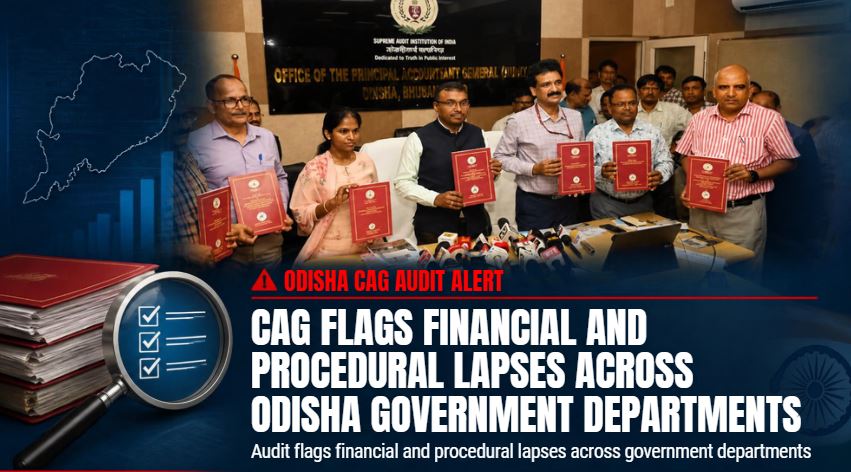
The findings form part of the CAG Compliance Audit Report for the year ended March 31, 2024, covering the Fisheries and Animal Resources Development, Forest, Environment and Climate Change, Steel and Mines, Water Resources and Works departments.
The report, prepared for submission to the Governor under Article 151 of the Constitution, highlights unfruitful expenditure, non-recovery of government dues, project delays and instances where prescribed clearances were allegedly not obtained before execution of works.
Rs 91.57 Crore Spent On Incomplete Irrigation Projects
In the Water Resources Department, the audit found that 38 Minor Irrigation Projects were awarded without completing land acquisition and obtaining forest clearances.
As a result, headworks and distribution systems remained incomplete, rendering expenditure of Rs 91.57 crore unfruitful, according to the CAG.
The audit also pointed to unrealistic budgeting and underutilisation of funds between 2021 and 2024, resulting in the surrender of Rs 520.60 crore.
Other findings included an inadmissible payment of Rs 6.49 crore towards contingency charges to OCCL and non-recovery of Rs 67.54 crore in interest on advances totalling Rs 510.19 crore released to the organisation.
Pipeline Works Leave Nearly 19,291 Hectares Without Irrigation
The CAG also highlighted delays in 64 Underground Pipeline works.
According to the report, the delays left 19,290.951 hectares of cultivated command area without irrigation as of March 2025.
In another finding, the audit said seven check dams on which Rs 4.26 crore was spent between April 2023 and January 2025 appeared, based on geo-spatial verification, to have existed before the agreements were executed.
The CAG said the possibility of fraudulent payment could not be ruled out and recommended examination of the matter.
Mining Dues Worth Crores Flagged
The Steel and Mines Department also came under the auditor’s scanner.
The CAG detected short levy of Rs 92.38 crore in royalty and other mining dues due to the exclusion of sizing charges from the Run-of-Mine coal price while calculating royalty.
It further found that Rs 69.53 crore in interest on delayed payment of mining dues had not been levied and realised.
The audit also identified instances of mineral production beyond permitted limits or without the required Consent to Operate and environmental clearance, resulting in liabilities running into several crores.
In one case involving two coal mines, production of 1,17,96,540 tonnes beyond or without the prescribed environmental clearance attracted a reported liability of Rs 975.57 crore.
Fisheries, Forest Departments Also Flagged
In the Fisheries and Animal Resources Development Department, the CAG found that 494 incinerators could not be installed or put to use because three-phase electricity was unavailable.
This resulted in wasteful expenditure of Rs 16.60 crore, according to the report.
The Forest Department, meanwhile, suffered non-realisation of Rs 25.90 lakh due to delays in disposing of seized timber, poles and firewood.
Works Sector Sees Cost Overruns, Blocked Funds
The audit also pointed to several lapses in the Water Resources and Works departments.
These included an avoidable additional expenditure of Rs 3.86 crore due to the use of higher-grade cement concrete in canal lining, besides alleged undue benefits to contractors through transportation and dewatering provisions.
A bridge project in Keonjhar also resulted in Rs 4.07 crore of funds remaining blocked due to its incomplete status.
The CAG clarified that while the principal audit period was 2023-24, instances from earlier years and matters relating to subsequent periods were also included wherever considered relevant.
The findings underline the need for stronger financial controls, timely execution of projects and compliance with statutory requirements across the departments examined.
- 0
- By Neel Achary



