


6, Oct 2026
Dead Souls: Revival, a novel written by GigaChat, goes on sale
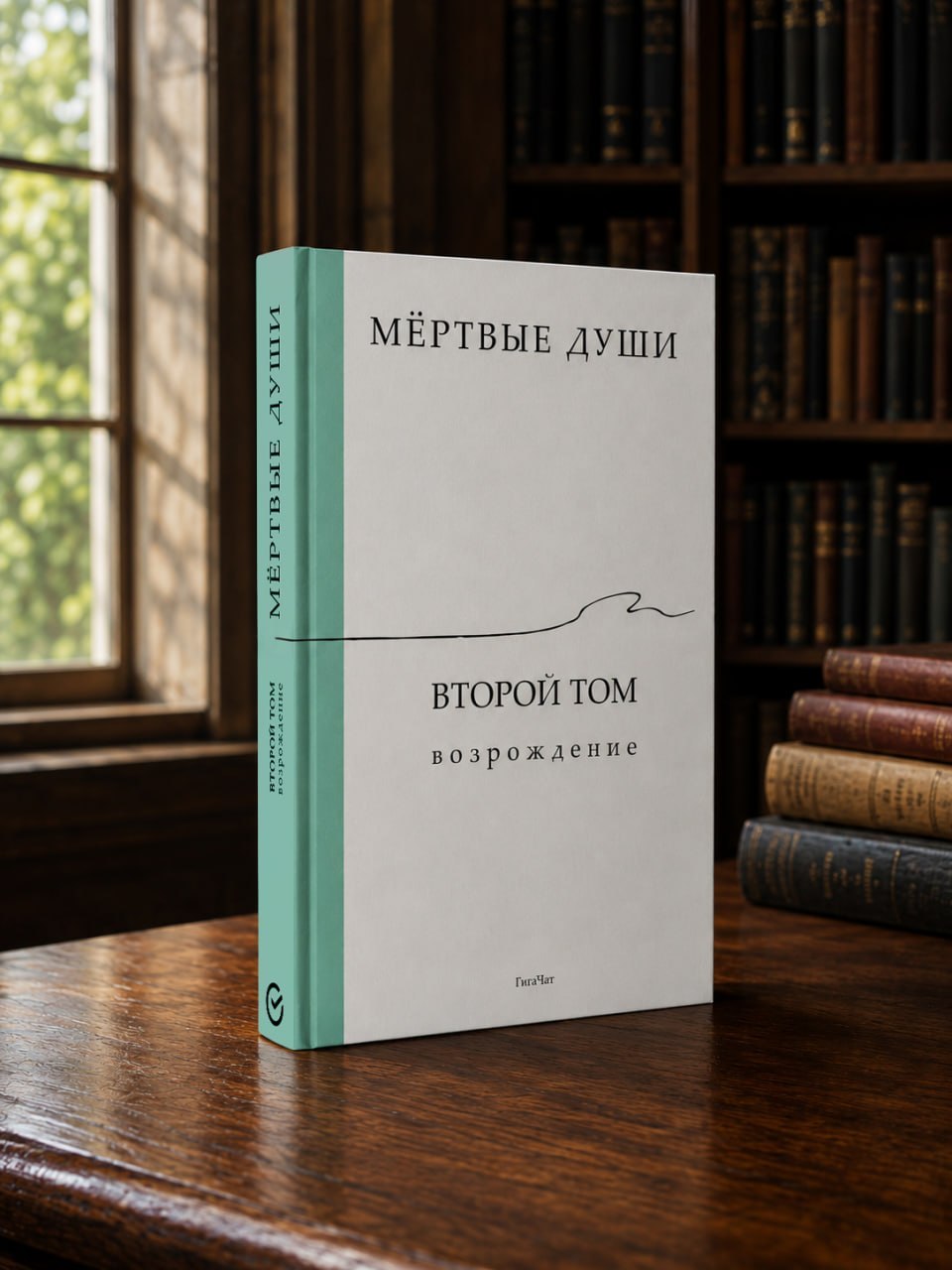
Moscow, Oct 06: In the run-up to its 185th anniversary, Sber is releasing the novel Dead Souls: Volume Two. Revival. This is a continuation of Nikolai Gogol’s immortal novel, with the text generated by the large language model GigaChat. A team of experts — including historians, literary scholars, linguists, and engineers — collaborated with Sber on this cultural research project. It is the first work created by artificial intelligence in the style of a world-renowned literary classic.
The second volume of Dead Souls represents one of the most enigmatic creative catastrophes in world literature. The manuscript, burned by the author on the night of February 24, 1852, has sparked endless debates, hypotheses, and speculation. Sber’s project took over a year. Far from merely compiling existing texts, Sber professionals and invited experts conducted extensive, complex research. GigaChat was trained on Gogol’s complete works — including his letters, drafts, and notebooks — as well as the writings of his contemporaries (Pushkin, Dostoevsky, and Turgenev), philosophical texts, biblical writings, and even the paintings the author admired.
To evaluate the outcome, an 11-parameter system was devised, encompassing lexical diversity (archaisms, Gogol-esque neologisms), syntax (long rhetorical periods), the grotesque, the comic physicality of dialogue, and the active presence of the narrator. Experts verified each generated episode for uniqueness, ensuring the artificial intelligence learned to create new meanings rather than simply copying the classic author. The neural network’s output was meticulously scrutinized to confirm it was generating semantic imagery with fresh meaning, rather than merely compiling existing texts by Gogol.
The resulting text is, undeniably, not Gogol. Yet, it is a text crafted according to the principles of Gogol’s narrative style, an achievement made possible through the synergy of human and artificial intelligence. The project yielded a literary work but also 21 illustrations created by GigaChat in the style of A. Agin, the artist behind the illustrations for the first volume of Dead Souls published during Gogol’s lifetime.
Vladislav Kreynin, senior vice president, director of the Marketing and Communications Department, Sberbank: “Debate surrounding the second volume of Dead Souls continues to this day: why did the writer destroy the manuscript, and what was the fate of the characters? Our project does not aim to settle these arguments but rather offers the reader a new cultural experience. In reviving what was lost, we relied on a solid scholarly foundation and deep respect for the author, setting ourselves two key objectives. The first is research-oriented: to demonstrate that neural networks can serve not merely as assistants for everyday tasks, but as sophisticated tools for analysis and synthesis in the hands of professionals. The second is educational: to engage the younger generation with Russian classics, encourage them to revisit not only Dead Souls but Gogol’s entire body of work, and rediscover the richness of his universe — all while taking another step toward reviving cultural heritage with the help of GigaChat.”
Dead Souls: Revival continues a series of Sber initiatives leveraging artificial intelligence to restore historical memory. Previous efforts include Digital Peter, which deciphered the handwritten manuscripts of Peter the Great; Revived Collection, which helped restore hundreds of paintings lost during the Great Patriotic War; and a project marking the 185th anniversary of Pyotr Tchaikovsky’s birth, which allowed the public to see and hear the maestro’s unfinished opera, Mandragora.
The book’s release is an invitation to dialogue: it is up to the reader to judge whether the neural network succeeded in recreating “the vast universe that is Gogol.”
- 0
- By Neel Achary



