


29, Sep 2026
Xinhua Silk Road: Chinese youths explore Mazu culture in trendy ways
BEIJING, Sept. 29, 2026 /PRNewswire/ — When stumbling upon cute Mazu-themed blind boxes, people from home and abroad can easily discover that Chinese youths are reinterpreting traditional Chinese cultural heritage through their own lens.
This blind box series, whose sales have already exceeded 100 million yuan, was a China-chic product co-developed by the Meizhou Mazu Ancestral Temple and a Shanghai-based cultural creative firm.
Inspired by legends about nine auspicious artifacts and tokens of Mazu, the most influential sea goddess in China, the designers created five different but adorable figures representing wealth, career, academic success, safety and wish-making, respectively.
As each blind box contains a mini “holy cup”, buyers, usually young people, can enjoy the thrill of opening the boxes, which connects the millennia-old Mazu belief and customs with daily life.
Some young buyers bought the Mazu blind boxes purely for their exquisite designs, but later came to learn about Mazu culture, making the blind boxes a “window” into Mazu culture, said Chen Lin, a staff member of the Meizhou Mazu Ancestral Temple on Meizhou Island in Putian City, Fujian Province.
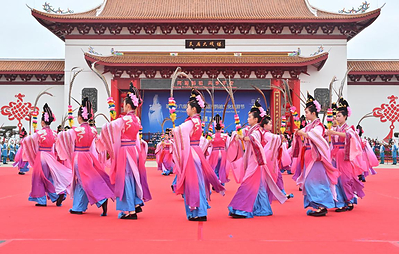
On Meizhou Island, there are other trendy ways for young people to acquaint themselves with Mazu culture, including taking travel photos in traditional Mazu attire, watching Mazu-themed dramas and wandering through local streets together with non-player characters.
Apart from these, music students at Putian University attend the Mazu Festival performances twice a year, basking in melodies from ancient Chinese chime bells that celebrate the virtue, kindness and great love of Mazu.
At the Mazu culture digital laboratory of Putian University, young scholars are currently building a digital archive of global Mazu temples and palaces to support related academic research and better preserve the intangible cultural heritage.
Currently, young people in China are revitalizing the country’s vast traditional cultural heritage in ways that are more appealing, more convenient and more immersive.
Original link: https://en.imsilkroad.com/p/352387.html
 View original content to download multimedia:https://www.prnewswire.co.uk/news-releases/xinhua-silk-road-chinese-youths-explore-mazu-culture-in-trendy-ways-302892632.html

- 0
- By Sai Krishna

29, Sep 2026
CTM and Huawei Jointly Launch the World’s First Integrated QKD-Communication Target IP Network to Reinforce Digital Security Across the Greater Bay Area
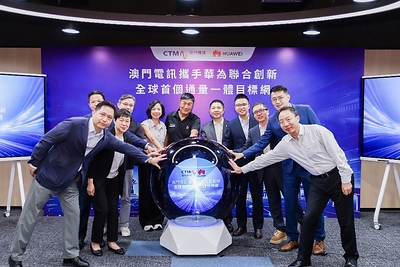
MACAO, Sept. 29, 2026 /PRNewswire/ — To counter the emerging network security challenges posed by quantum computing, CTM has actively embraced the national quantum strategy. It is designing a quantum-secured framework to build an integrated QKD-communication network security foundation, further enhancing the end-to-end transmission security of critical data. In addition, CTM plans to roll out quantum-secured private lines for enterprise and government sectors to unlock new growth opportunities while supporting Digital Macao and fortifying digital security across the Greater Bay Area. CTM and Huawei are pioneering the world’s first integrated QKD-communication target IP network, driving the development of the quantum industry chain throughout the region.
The rapid advancement of quantum computing is driving a disruptive shift in the global network security landscape. Encrypted data that would take traditional computers trillions of years to crack can now be breached in just minutes using quantum computing. This poses an unprecedented, seismic challenge to the security defenses of critical digital assets and sensitive data. To strengthen China’s digital security defenses, the 15th Five-Year Plan Outline has designated quantum technology as a strategic future industry.
CTM and Huawei have jointly launched the world’s first integrated QKD-communication target network. Innovative QKD-communication integration combines the quantum, negotiation, and communication channels into one, while seamlessly integrating communication and quantum networks into a single network to create a next-generation communication network foundation with quantum security. The network will serve as a shield against quantum computing threats for core and sensitive services such as government office, financial transactions, and critical infrastructure, ensuring end-to-end secure transmission of critical services.
Mr. Poon Fuk Hei, CEO of CTM, stated that as a core enabler of Macao’s digital and intelligent transformation and a trusted guardian of its communication security, CTM has long been dedicated to building and strengthening local communication networks. It has been a key driver behind the evolution and real-world deployment of the network foundation powering Digital and Intelligent Macao. He added that, aligning with national strategic goals and Macao’s regional digital security needs, CTM has proactively deployed a local quantum-secured network foundation, fully accelerating the adoption of cutting-edge quantum security technologies in Macao.
Leon Wang, President of Huawei’s Data Communication Product Line, stressed that security and resilience is one of the three defining characteristics of IP bearer networks. He noted that in the realm of quantum security—a crucial subset of security and resilience—Huawei has maintained continuous investment and innovation across hardware, software, algorithms, and more. For example, Huawei pioneered the industry’s first router with built-in QKD. This innovation helps operators to reduce TCO by over 60%. This empowers CTM to build a quantum-secured network foundation featuring QKD-communication integration, providing robust security assurance for the digital transformation and core data transmission of government and enterprise customers.
Looking ahead, CTM and Huawei will continue to deepen their strategic partnership in industrial development and technological innovation, designing products specifically for quantum-secured private lines while accelerating their deployment on live networks. Meanwhile, leveraging Macao’s unique geographical advantages and technical expertise, the two companies aim to drive collaborative development, technological innovation, and practical applications of the quantum security industry within the Guangdong-Hong Kong-Macao Greater Bay Area, ultimately safeguarding the high-quality development of the region’s digital economy.
 View original content to download multimedia:https://www.prnewswire.com/in/news-releases/ctm-and-huawei-jointly-launch-the-worlds-first-integrated-qkd-communication-target-ip-network-to-reinforce-digital-security-across-the-greater-bay-area-302892553.html

29, Sep 2026
Segway Powersports Brings Latin American and Canadian Media and Creators from Factory Floor to Real-World Terrain
CHANGZHOU, China, Sept. 29, 2026 /PRNewswire/ — Segway Powersports hosted 14 media representatives and creators from Canada, Chile, Peru, Panama, Brazil and Argentina from September 14–19 for the SEGWAY POWERSPORTS CHINA TOUR-2026 LATAM & CANADA EDITION, an immersive program connecting behind-the-scenes manufacturing insights with a full-lineup off-road riding experience.
The program began at Segway Powersports’ manufacturing facility in Changzhou, China, where participants explored production, assembly, vehicle testing and final inspection. The visit offered a closer look at the manufacturing processes, quality controls and traceability practices behind Segway Powersports vehicles.
The experience then moved to Keping County in Aksu, Xinjiang, where participants took the full Segway Powersports lineup across desert terrain, gravel sections and water crossings. Driving multiple models in varied conditions allowed them to experience power delivery, handling, terrain capability and comfort firsthand—connecting what they had seen on the production line with how the vehicles perform in real-world environments.

Beyond the factory and riding experience, the program created a two-way exchange between Segway Powersports and its international guests. Participants shared perspectives on local riding environments, user expectations and product needs directly with the brand’s marketing, product, R&D and after-sales teams, bringing insights from six markets into the discussion.
“Seeing how a vehicle is built is one thing; experiencing it in real terrain is another,” said Ethan Zhang, Vice President of Marketing & Sales at Segway Powersports. “By bringing these experiences together, we want media and creators to understand our products more completely. At the same time, their local perspectives help us better understand what riders in different markets really need.”
Segway Powersports plans to extend similar programs to more markets, strengthening relationships with media and creators while bringing real-world perspectives into ongoing product and service development.
About Segway Powersports
Segway is a global leader in micro-mobility, powersports, and consumer robotics, known for its innovation and user-focused products. Segway Powersports focuses specifically on the design and manufacturing of next-generation powersports vehicles, including all-terrain vehicles (ATVs) and side-by-side vehicles (SxS) for both utility and sport applications. As a high-tech enterprise, Segway Powersports integrates a superior supply chain with its own manufacturing capabilities, managing the full lifecycle of its products – from R&D and production to sales and after-sales service.
For more information, please visit https://powersports.segway.com
 View original content to download multimedia:https://www.prnewswire.co.uk/news-releases/segway-powersports-brings-latin-american-and-canadian-media-and-creators-from-factory-floor-to-real-world-terrain-302892455.html

29, Sep 2026
Luxury Watch Works Launches Integrated Centre of Excellence for Luxury Timepiece Ownership in India
Mumbai-based horological facility combines authorised servicing for 13 global brands, India’s first watch lifecycle programme ‘Hour Circle’, blockchain-backed ‘Virtual Vault Report’ authentication and ‘Horological Education’
MUMBAI, India, Sept. 29, 2026 /PRNewswire/ — Luxury Watch Works (LWW), a Mumbai-based authorised service provider for international luxury watch brands, has established India’s first unified Centre of Excellence for luxury timepieces. The ecosystem integrates official after-sales technical maintenance, digital blockchain certification, horological education, and comprehensive lifecycle management to address the end-to-end operational demands of luxury watch collectors in India.

The facility is staffed by Swiss-trained watchmakers possessing technical mastery of over 100 mechanical calibres and operates using brand-specific diagnostics, specialised Swiss tooling, and genuine OEM manufacturer components.
Key takeaways:
- LWW is an authorised after-sales service centre for 13 international watch brands, including Cartier, IWC, Jaeger-LeCoultre, Panerai, Piaget, TAG Heuer, Ulysse Nardin and Vacheron Constantin.
- The company has launched Hour Circle, described as India’s first lifecycle management programme for luxury timepieces, covering theft and accidental damage protection, concierge services, and resale assistance.
- Its Virtual Vault Report (VVR) is India’s first blockchain-secured digital authentication and certification platform for luxury watches, based on a 50+ point inspection.
- LWW’s Swiss-trained technical team has in-house expertise across more than 100 watch calibres.
- The company is headquartered pan-india reach catering to collectors, enthusiasts and patrons at Kala Bhavan, Charni Road, Mumbai.
What Luxury Watch Works Does
Luxury Watch Works operates Four integrated service pillars for luxury watch owners in India: authorised after-sales service, lifecycle management through Hour Circle and digital authentication certification through the Virtual Vault Report and horological expertise and education through its Centre of Excellence.
Serving Luxury Watch Owners Across India
Luxury Watch Works serves collectors, enthusiasts and patrons across India, with its Mumbai Centre of Excellence supporting collectors, enthusiasts and owners from cities and regions across the country. While the facility is headquartered in Mumbai, Luxury Watch Works’ service and ownership ecosystem is designed to support its community beyond its immediate geographic location.
Through its authorised after-sales service, Virtual Vault Report, Hour Circle and horological expertise, LWW provides a centralised destination for the care, authentication, documentation and lifecycle management of luxury timepieces for collectors, enthusiasts and patrons across pan-India.
1. Authorised After-Sales Service
LWW is an authorised after-sales service centre for the brands Baume & Mercier, Cartier, Carl F. Bucherer, Chopard, Girard-Perregaux, IWC, Jaeger-LeCoultre, Panerai, Piaget, Seiko, TAG Heuer, Ulysse Nardin and Vacheron Constantin.
Every watch received for service goes through three steps: registration and identification, technical assessment, and a no-obligation service estimate. Repairs use brand-sourced genuine parts and follow each brand’s own service procedures.
2. Hour Circle: What It Is and What It Includes
Hour Circle is India’s first lifecycle-management membership programme designed to support luxury watch owners, collectors and enthusiasts throughout the ownership journey.
“You own the masterpiece. We secure its legacy.”
The programme brings together personalised support, protection, maintenance, restoration, collection assistance and resale guidance. Its available in two tiers, Hour Signature and Hour Prestige. It includes:
|
Benefit |
What it covers |
|
White Glove & Concierge |
Single dedicated point of contact for all watch-related needs |
|
Zero-Risk Purchase |
15-day purchase/refund window, subject to programme terms |
|
Repairs & Restoration |
Coordinated service through LWW’s authorised capabilities |
|
Theft Protection |
Coverage against theft, subject to programme terms |
|
Accidental Damage Cover |
Coverage following accidental damage, subject to programme terms |
|
Personalisation |
Assistance with select customisation requests |
|
Collection & Curation Support |
Advisory support for collectors expanding a collection |
|
Authentication & Valuation |
Specialist assessment of applicable timepieces |
|
Resale Assistance |
Support for owners looking to sell or transition a timepiece |
Hour Signature
The Hour Signature programme provides access to:
- Personal Concierge
- Accidental Damage Cover
- Comprehensive Repairs & Restoration
- Expert Collection & Curation Support
- Resale Assistance
The Hour Prestige programme includes the benefits of Hour Signature along with:
- Theft Protection
- 15-day purchase/refund window
- Personalisation Services
- Authentication & Valuation
3. Virtual Vault Report: What It Is and How It Works
The Virtual Vault Report (VVR) is a blockchain-backed digital certification platform designed to provide owners, collectors and prospective buyers with a comprehensive digital record of a luxury timepiece.
The report provides a 50+ point inspection, covering the watch’s authenticity, condition, technical specifications, movement assessment, aesthetic condition, originality of visible components, estimated market value and overall condition grading.
India’s first blockchain-based digital authentication and certification platform
The Virtual Vault Report creates a digital passport for the timepiece, allowing its information and certification record to be accessed digitally and supporting informed decisions when buying, selling or trading luxury watches.
The report is designed to document the condition and provenance of a timepiece while creating a structured digital record that can be updated as the watch moves through its ownership lifecycle.
4. Horology 101: Experiential Horological Education
As part of its Centre of Excellence proposition, Luxury Watch Works conducts Horology 101, a hands-on masterclass introducing participants to the fundamentals of mechanical watchmaking.
The 120-minute experience allows participants to work with a mechanical movement under the guidance of LWW’s Swiss-trained technical specialists, providing an introduction to movement assembly, disassembly, precision and the craftsmanship behind mechanical timepieces. Designed to be beginner-friendly and conducted in small groups, the masterclass forms part of LWW’s broader commitment to developing horological awareness and appreciation in India.
Why This Matters
LWW’s founder frames the announcement around a single idea: ownership of a fine timepiece doesn’t end at purchase. “A luxury timepiece is more than an object that tells time. It carries craftsmanship, history, ownership and, often, significant emotional and financial value,” said Sarosh Mody, Founder & Director, Luxury Watch Works. “Our vision for Luxury Watch Works is to create a Centre of Excellence where the complete ownership journey can be supported, from authorised after-sales service to lifecycle management, digital authentication and education.”
Frequently Asked Questions
What is Hour Circle?
Hour Circle is Luxury Watch Works’ lifecycle-management membership programme for luxury watch owners in India, covering concierge support, theft and accidental damage protection, and resale assistance, available at two membership levels.
What is the Virtual Vault Report?
The Virtual Vault Report is LWW’s blockchain-secured digital certification for luxury watches, based on a 50-point-plus inspection covering authenticity, condition, and market value, issued as a digital passport the owner can access at any time.
What is Horology 101?
Horology 101 is LWW’s hands-on horological education experience, providing participants with an introduction to mechanical watchmaking through guided assembly and disassembly of a mechanical movement under the supervision of technical specialists.
Which watch brands does Luxury Watch Works service?
LWW is an authorised after-sales service centre for 13 brands: Baume & Mercier, Cartier, Carl F. Bucherer, Chopard, Girard-Perregaux, IWC, Jaeger-LeCoultre, Panerai, Piaget, Seiko, TAG Heuer, Ulysse Nardin and Vacheron Constantin.
Where is Luxury Watch Works located?
Luxury Watch Works is based in Mumbai, India, at Kala Bhavan, behind the Opera House, Charni Road.
Is this India’s first lifecycle management programme for luxury watches?
Yes. LWW states Hour Circle is India’s first dedicated lifecycle-management programme for luxury timepieces, and the Virtual Vault Report is India’s first blockchain-based digital authentication and certification platform in this category.
About Luxury Watch Works
Luxury Watch Works (LWW) is a Centre of Excellence for luxury timepieces based in Mumbai, India, offering authorised after-sales service, lifecycle management through Hour Circle, digital certification through the Virtual Vault Report, horological consultancy, certified pre-owned timepieces, and horological education. LWW’s Swiss-trained technical team operates with specialised, brand-specific tooling and in-house expertise across more than 100 calibres.
The company’s philosophy is reflected in its guiding principle:
Luxury Watch Works
Preserving Legacy, Delivering Value.
Unit No. 39/A, 1st Floor, Kala Bhavan
Shrimad Rajchandraji Marg, Behind Opera House
Charni Road, Mumbai – 400004
India
Website: https://www.luxurywatchworks.com/
General Enquiries: info@luxurywatchworks.com | +91-77108-47999
Press & Media: thelibrary@luxurywatchworks.com
 View original content to download multimedia:https://www.prnewswire.com/in/news-releases/luxury-watch-works-launches-integrated-centre-of-excellence-for-luxury-timepiece-ownership-in-india-302891307.html

29, Sep 2026
Companies risk losing their most AI-savvy employees while leaving majority behind: PwC
- Across the workforce, AI use is up 10 points – but access to learning and development resources is down 8 points
- Workers who use AI daily are significantly more likely to trust management, feel secure in their jobs and view technological change positively
- However, the majority of workers (56%) are falling behind – only two in five say they have access to the learning and development resources they need
- Meanwhile, almost a third (29%) of ‘front-runner’ employees with strong AI capabilities and scarce skills say they are very or extremely likely to change employer in the next year.
- Cost-of-living pressures rise: Only a third of workers report having money left at the end of the month, down 8% year on year
LONDON, Sept. 29, 2026 /PRNewswire/ — A growing AI skills divide is creating a diverging workforce, with the majority of workers at risk of being left behind as access to learning and development falls – even as AI use and the pace of workplace change accelerate.

PwC’s 2026 Global Workforce Hopes and Fears Survey, which interviewed nearly 50,000 workers across 48 countries and regions, finds diverging optimism in the growth trajectories and experiences of employees – as workers face rapid change, rising workloads and greater cost-of-living pressures.
Just 51% say they have access to the learning and development resources they need, down from 59% last year.
The divide is particularly stark among the 56% of ‘engine room’ workers whose skills are less scarce and who are not far along the AI learning curve: only two in five of those workers say they have access to the learning and development resources they need.
Meanwhile, workers who use AI daily are more confident in their job security, more likely to trust management and more confident about their ability to learn new skills.
Pete Brown, Global Workforce Leader, PwC, said:
“Workers are under growing pressure from rising workloads, rapid change and external uncertainty. But those using AI every day are more confident, more ambitious and more positive about their careers and prospects. The challenge for leaders is to keep developing those people – but not at the expense of the rest of the workforce.”
AI adoption continues to rise but workers face growing pressures
Workers are feeling significant pressure. Only a third report having money left at the end of the month, down 8% year on year.
At the same time, almost a third (29%) say they have significantly less bargaining power than three years ago, more than double the number who disagreed. For fully remote workers, the proportion is 10 points higher.
When considering the biggest risks to job security, more workers cite economic volatility (57%) than AI taking on more tasks (44%) – with Gen Z more anxious across all these metrics.
Three-fifths (58%) of those who have experienced change in the workplace feel there has been more change in the last year than in previous years. Almost one-third (27%) say that feeling fatigued or burned out limits their productivity.
The vast majority of workers say they have also had to apply new skills in their job over the past year, with two-fifths (40%) saying this was to a large or very large extent.
Change is happening faster at leadership levels. More than half (51%) of senior executives and 46% of managers say they have applied new skills in their roles, relative to 29% of non-managers and 38% of entry-level workers.
But as workers face mounting pressure – AI adoption continues to rise: nearly two-thirds (64%) of all workers cite using AI at work in the past 12 months – a ten-point increase relative to last year. The proportion using Gen AI daily also increased from 14% to 22%. Roughly three-fifths (59%) of workers expect their use of AI tools in their job to increase over the next 12 months. This group reports that the use of AI makes them feel energised and empowered rather than tired and powerless, by margins of around 5:1.
Daily AI users in the workforce are also more optimistic: 68% report confidence in their job security compared to 57% for infrequent users. They are also more likely to ask for a promotion (+12 percentage points), trust top management (+15) and be confident they can learn new skills (+21).
The new workforce divide
While workers are broadly confident (61%) that they can develop skills growth – only half (51%) cite being able to access learning and development resources (down from 59%). To understand this further, the report segments the workforce into four groups:
- Front-runners (14%), with scarce skills and strong AI capabilities
- AI insurgents (18%), whose skills are less scarce but are using AI to deliver more
- Indispensables (11%), with scarce skills that employers value highly, but who are not far along the AI learning curve
- The Engine Room (56%), whose skills are not scarce and who are not far on the AI learning curve
The report highlights the need for employers to pay particular attention to the ‘engine room’ group. This group is less likely to be rewarded for using AI, learning new skills or challenging existing ways of working – yet they are the majority of the workforce, responsible for most of the day-to-day work within an organisation.
Meanwhile the ‘front-runners’ are seeing strong benefits from their position. They are most likely to over-index on being rewarded for challenging existing ways of working (1.5x global average) and learning new skills (1.2x global average). This group is also +33 points more likely to ask for a promotion.
In a challenge to employers seeking to retain their most valuable workers, almost a third (29%) of this group say they are very or extremely likely to change employer in the next year.
Pete Brown, Global Workforce Leader, PwC, concluded:
“There is a real risk that the global workforce is starting to move at different speeds. More than half of workers are not yet benefiting from AI and skills in the same way, while those with scarce skills and strong AI capabilities are becoming more confident and more mobile. Leaders need to think hard about where they invest in skills, how they give people the opportunity to adapt, and how they hold on to the capabilities they most need.”
Notes to Editors
About PwC’s 2026 Global Workforce Hopes and Fears Survey
PwC’s 2026 Global Workforce Hopes and Fears Survey gathered responses from 49,364 workers across 48 countries and regions and 29 sectors in May and June 2026. The figures in this report are weighted proportionally to the working population’s gender and age distribution in each country or region, ensuring workers’ views are broadly representative across all major geographies.
About PwC
At PwC, we help clients build trust and reinvent so they can turn complexity into competitive advantage. We’re a tech-forward, people-empowered network with more than 360,000 people in 130+ countries and territories. Across audit and assurance, tax and legal, deals and consulting, we help clients build, accelerate, and sustain momentum. Find out more at www.pwc.com.
 View original content to download multimedia:https://www.prnewswire.co.uk/news-releases/companies-risk-losing-their-most-ai-savvy-employees-while-leaving-majority-behind-pwc-302891364.html

29, Sep 2026
Sweden Opens Travel Agency for Introverts
New research reveals a growing demand for quieter travel: 67% of travellers prefer destinations where social interaction feels optional, 53% would pay extra for more peace, privacy or fewer crowds, and 41% identify as introverts.
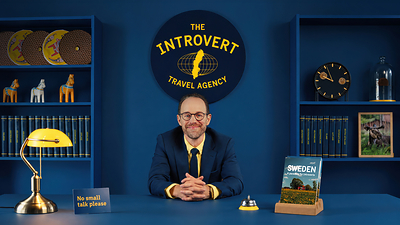
STOCKHOLM, Sept. 29, 2026 /PRNewswire/ — Sweden is opening The Introvert Travel Agency, designed to help travellers discover, book and recharge in Sweden—with less social pressure and more freedom to explore on their own terms.
According to a recent YouGov survey, only 14% describe themselves as extroverts, while 41% identify as introverts and another 45% as a mix of both. Nearly half say they sometimes need a “vacation from their vacation” to recover after travelling. The research also shows that 67% of travellers prefer destinations where social interaction feels optional rather than expected.
“For introverts, recharging is often less about being alone and more about having control over when and how we interact with others,” says Mattias Lundberg, a licensed psychologist and Associate Professor of Psychology at Umeå University. “Environments with less social pressure, more personal space and the possibility to withdraw can make it easier to preserve and regain energy. Sweden naturally offers many of these qualities, which makes it particularly well suited to travellers who want to experience a destination on their own terms.”
In Sweden, silence does not automatically need filling. Having a coffee alone is unremarkable; personal space is generally respected. Sweden’s low population density and the right of public access, allemansrätten, allow visitors to experience nature independently at their own pace.
“Many travellers are looking for something surprisingly simple: the freedom to decide when they want company and when they don’t,” says Susanne Andersson, CEO of Visit Sweden. “Sweden has always offered that kind of space, in our nature, our cities and our social culture. The Introvert Travel Agency makes it easier to experience Sweden in your own way. Here, being social is an option, not an obligation.”
The Introvert Travel Agency is available online and will launch as a pop-up experience, bringing Sweden’s nature, space and relaxed social culture to life for visitors looking to plan a quieter kind of holiday. The pop-up will visit:
- Berlin, October 14 – 17
- Paris, October 21 – 24
- London, October 28 – 31
More information: visitsweden.com/the-introvert-travel-agency/
Video: https://youtu.be/SUG2ACZotP8
Press images
Source: Survey, June/July 2026, VisitSweden/YouGov

 View original content to download multimedia:https://www.prnewswire.co.uk/news-releases/sweden-opens-travel-agency-for-introverts-302887946.html

29, Sep 2026
Zoomlion Signs US$300 Million Credit Insurance Policy and Initial US$50 Million Non-Recourse Factoring Agreement
SHANGHAI, Sept. 29, 2026 /PRNewswire/ — Zoomlion Heavy Industry Science & Technology Co., Ltd. (“Zoomlion”) signed a US$300 million portfolio credit insurance policy and an initial US$50 million non-recourse factoring agreement at the Zoomlion 2026 Global Financial Partners Summit and Signing Ceremony in Shanghai on September 11, establishing a tiered insurance-and-financing framework for overseas installment receivables as its international business grows.
Developed over six months with international insurers and financial institutions, the arrangement combines portfolio credit insurance with non-recourse factoring. In practical terms, overseas installment receivables covered by the insurance policy can be factored with an overseas bank on a non-recourse basis. This gives Zoomlion a structured way to manage and finance overseas receivables rather than handling them transaction by transaction. The framework is designed to turn these receivables into scalable, standardized and replicable investment-grade assets.
At the signing ceremony, the US$300 million policy was signed with a double-A-rated international insurer and leading institutions, while the initial US$50 million non-recourse factoring agreement was signed with an overseas bank.
The agreements come as Zoomlion continues to expand internationally. In the first half of 2026, the company’s international revenue rose 12.45% year over year to RMB 15.54 billion (approximately US$2.31 billion), accounting for 57.25% of total revenue.
Zoomlion CFO Du Yigang reviewed the company’s cooperation with global financial partners and outlined its progress and future plans for overseas financial and insurance services.
“Zoomlion will continue to uphold the values of Integrity, Dedication, Inclusiveness and Responsibility and deepen mutual trust with our financial partners,” said Du.
More than 40 financial and insurance partners from Singapore, Indonesia, Thailand, France, Kazakhstan, Hong Kong SAR and other markets attended the summit. Discussions covered the global macroeconomic outlook, overseas financial and insurance strategies, regional market opportunities, exchange and interest rate trends, and insurance innovation. The Economist Corporate Network (ECN) led a morning session on macroeconomic and geopolitical trends, while representatives from Radana and Alfa-Bank shared perspectives on market and financing developments.
Xu Xiaoming, General Manager of Zoomlion’s Financial Business Management Department and Credit Insurance Department, discussed future cooperation, while Deputy General Manager Yan Xin introduced the company’s overseas third-party financing and insurance strategy and cooperation models.
Looking ahead, Zoomlion plans to deepen cooperation with global financial and insurance partners and further develop scalable and replicable financial and insurance solutions to support its international growth.
 View original content:https://www.prnewswire.co.uk/news-releases/zoomlion-signs-us300-million-credit-insurance-policy-and-initial-us50-million-non-recourse-factoring-agreement-302892375.html

29, Sep 2026
Castrol launches ‘Castrol CORE’, an integrated thermal management offer for data centres
- Castrol CORE marks a shift from a product-led cooling proposition to an integrated thermal management offer, bringing together cooling technology, testing, lifecycle support, as well as new design capabilities
- Castrol’s customer research shows growing demand for experienced partners that can simplify increasingly complex data centre cooling requirements
- Castrol CORE is built on cooling technology validated with leading chip and hardware manufacturers and backed by a global support network spanning 150+ countries
SINGAPORE, Sept. 29, 2026 /PRNewswire/ — In response to rising demand for AI and high-performance computing, Castrol today launched Castrol CORE, a new end-to-end offer for its data centre thermal management business. The offer is designed to help customers manage increasingly complex cooling requirements from early-stage design through to daily operations.

Castrol CORE marks a shift from Castrol’s existing product-led cooling business towards an integrated, service-led approach that brings together a network of product, infrastructure, design and service partners, giving customers a single point of contact across the value chain rather than having to coordinate with multiple suppliers.
Under Castrol CORE, Castrol will work with customers earlier in the development of data centre infrastructure, adding new capabilities in design to its existing support for deployment, start-up, operation and maintenance. The move is based on Castrol’s industry research which found growing demand for integrated thermal management solutions that reduce the complexity of working with multiple technologies and suppliers. The research also highlighted supply chain challenges and the high cost of failure as significant concerns for the industry.
Central to the offer are Castrol’s cooling technologies, which have been tested and validated with leading chip and hardware manufacturers including NVIDIA and Intel. This gives customers confidence that the technology can keep pace with next-generation AI infrastructure. The offer is backed by Castrol’s global technology and testing facilities – including labs in the UK, US, Germany and China, alongside joint laboratories across Asia and a network of service providers across more than 150 countries. The network enables continued on-ground testing, validation and monitoring throughout a facility’s lifetime, and helping customers reduce the risk of costly downtime.
Peter Huang, Global President of Data Centre and Thermal Management at Castrol, said: “Customers are telling us they do not simply want another standalone product. They want experienced partners that can help them solve the complete thermal management challenge. We are bringing together proven technology, global reach and, critically, design expertise so we can work with customers at every stage of a project, giving them the peace of mind to focus on what’s next.”
In Asia Pacific, Castrol has built a regional data centre design team supported by local specialists, reflecting the pace at which the region is adopting new cooling infrastructure. This approach is already being tested in practice: Castrol has completed a proof-of-concept programme with a leading data centre operator in China and is now working with global operators on additional proof-of-concept projects.
Backed by more than 127 years of experience formulating fluids for mission-critical applications, Castrol CORE will initially focus on data centre cooling systems, while providing a platform for Castrol’s thermal management offer to expand into other applications over time.
About Castrol
Castrol, one of the world’s leading lubricant brands, has a proud heritage of innovation and fuelling the dreams of pioneers. Our passion for performance, combined with a philosophy of working in partnership, has enabled Castrol to develop lubricants and greases that have been at the heart of numerous technological feats on land, air, sea, and space for over 127 years. Castrol serves customers and consumers in the automotive, marine, industrial and energy sectors. Our branded products are recognized globally for innovation and high performance through our commitment to premium quality and cutting-edge technology.
For more information, please visit: www.castrol.com
Castrol CORE is Castrol’s integrated Cooling solution offer, bringing together design expertise, cooling technology and lifecycle services to support customers with mission-critical cooling requirements.
Castrol CORE is designed to support data center cooling system requirements from early-stage design and specification through deployment, start-up, operation, maintenance and ongoing support.
 View original content to download multimedia:https://www.prnewswire.co.uk/news-releases/castrol-launches-castrol-core-an-integrated-thermal-management-offer-for-data-centres-302889539.html

29, Sep 2026
Responsible Fintech Institute Appoints Four Executive Fellows and Elevates Distinguished Professor Patrick H. M. Loh to Co-Founder
Appointments of Professor Lawrence Loh, Associate Professor Eugene K.B. Tan, Professor Louis Chen and Farah Jaafar deepen RFI’s expertise in law, governance, digital policy and cross-border capital markets
SINGAPORE, Sept. 29, 2026 /PRNewswire/ — The Responsible Fintech Institute (RFI) has appointed Professor Lawrence Loh, Associate Professor Eugene K.B. Tan, Professor Louis Chen and Ms Farah Jaafar as Executive Fellows. RFI has also elevated Distinguished Professor Patrick H. M. Loh, who joined as an Executive Fellow in April 2026, to Co-Founder, in recognition of his contributions to the Institute’s strategic direction.

The appointments come as digital finance goes mainstream and regulators, institutions and technology providers seek to ground innovation in digital assets, AI and cross-border payments in sound legal, ethical and governance foundations.
As Executive Fellows, they will engage regulators and standard-setting bodies, contribute to principles-based industry frameworks, and strengthen RFI’s partnerships across the region.
Welcoming the appointments, Chia Hock Lai, Chairman of RFI, said, “Lawrence, Eugene, Louis and Farah bring deep experience in law, governance, digital policy and capital market development, the disciplines that responsible digital finance depends on. I also congratulate Patrick on becoming a Co-Founder, recognising his central role in building the Institute.”
Professor Lawrence Loh is Director of the Centre for Governance and Sustainability at NUS Business School, where he leads the Singapore Governance and Transparency Index and the ASEAN Corporate Governance Scorecard project. He holds a PhD in Management from the Massachusetts Institute of Technology and is a regular commentator on governance and sustainability for outlets including the BBC, Bloomberg, CNN and The Straits Times.
“Trust is the foundation of every financial system, and it is built on transparency and good governance,” said Professor Lawrence Loh. “I am pleased to help RFI support an industry that grows responsibly and sustainably.”
Associate Professor Eugene K.B. Tan is Associate Professor of Law at Singapore Management University (SMU) and an advocate and solicitor of the Supreme Court of Singapore. Educated at the National University of Singapore, the London School of Economics and Stanford University, where he was a Fulbright Fellow, he specialises in constitutional and administrative law and the ethics and policy of artificial intelligence. He served as a Nominated Member of Parliament from 2012 to 2014 and, from 2019 to 2026, as Singapore’s Representative and Alternate Representative to the ASEAN Intergovernmental Commission on Human Rights.
“As AI and digital assets reshape financial services, the key questions are about accountability and public trust, not just technology,” said Associate Professor Tan. “I look forward to helping RFI develop frameworks that are principled, practical and grounded in the rule of law.”
Professor Louis Chen is widely recognised for his contributions to digital governance, sustainable digital economy development and cross-sector institutional collaboration. Through his leadership at the Digital Governance Association (DGA), he has helped advance dialogue on responsible innovation, AI governance and the future of digital ecosystems.
“Trusted digital finance depends on governance that keeps pace with technology,” said Professor Chen. “I look forward to helping RFI bring policymakers, academics and industry together towards a secure, interoperable digital economy.”
Ms Farah Jaafar is a senior executive, board advisor and governance leader with close to 30 years of experience across capital markets, offshore finance, fintech and digital assets. As former Chief Executive Officer of Labuan IBFC Inc., she led the international positioning of Malaysia’s international business and financial centre as a regional hub for cross-border financial solutions. She has chaired risk committees in regulated brokerages and pioneered licensed fintech and digital asset infrastructure in Asia. She chairs the Women in Fintech Group of the Asia Fintech Alliance, which represents fintech associations across 15 Asian markets.
“A rising tide lifts all boats,” said Ms Jaafar. “Digital finance can widen access and create opportunity, but only if it earns the confidence of regulators, investors and the public. I look forward to strengthening that collaboration with RFI.”
Distinguished Professor Patrick H. M. Loh was conferred the inaugural Singapore Distinguished Professor title by Murdoch University, Australia, in 2024. He is Senior Fellow and Advisory Board Member at the Centre for Governance and Sustainability at NUS Business School, and Chairman of the Advisory Board at Murdoch University in Singapore. He was awarded the Public Service Star (BBM) and the Public Service Medal (PBM) by the President of the Republic of Singapore.
“The calibre of leaders joining us shows that responsible innovation needs collaboration across law, governance, industry and policy,” said Distinguished Professor Patrick Loh. “I look forward to expanding RFI’s impact across the region and beyond.”
The RFI Executive Fellowship is designed for senior leaders with at least 20 years of experience in executive leadership and a demonstrated track record in shaping financial policy or institutional strategy. Fellows are expected to operate with institutional neutrality while contributing to globally aligned and responsible financial systems.
About the Responsible Fintech Institute (RFI)
The Responsible Fintech Institute (RFI) is a global nonprofit organisation based in Singapore. Its goal is to create a safe, trustworthy and reliable future for digital finance by building the digital utilities that support responsible innovation. RFI brings together public and private sector stakeholders to help build the rules and technology needed for new digital financial tools, and to make the digital asset sector sustainable and inclusive. Learn more at responsiblefintech.org.

 View original content to download multimedia:https://www.prnewswire.co.uk/news-releases/responsible-fintech-institute-appoints-four-executive-fellows-and-elevates-distinguished-professor-patrick-h-m-loh-to-co-founder-302892112.html

28, Sep 2026
Artmarket.com: H1 2026 Financial Report–One-of-a-Kind AI Systems Intuitive Artmarket® and Blind Spot Will Drive the Next Phase of Growth for “AI-First” Artprice in 2026-2030
PARIS, Sept. 28, 2026 /PRNewswire/ — Artmarket.com announces that its 120 pages financial report for the six months ended June 30, 2026, has been made available to the public and filed with the French Financial Markets Authority (Autorité des marchés financiers, or AMF).
The H1 2026 financial report is available on the following websites:
- Artprice.com: www.artprice.com
- Actusnews: www.actusnews.com/fr/
“The launch of Artprice News generated exceptional results in terms of coverage, indexing, and search engine optimization (SEO), particularly in Google AI Overview, which, depending on the country, is becoming the primary way Google users search for information through vertical queries corresponding to new customers (75% to 85%; source: Google).
“This success was supported by an extensive global campaign to attract new readers and customers seeking real-time art market news and event calendars. As a global news agency, Artprice News is now picked up throughout the art press, whose average publication frequency is, at best, weekly.
“At the same time, a major editorial effort produced more than 3,500 multilingual news reports, incorporated by the editorial team with exclusive data from the Econometrics Department. This substantial effort generated exceptional search engine responses and triggered Google Alerts on a massive scale.”
As of June 30, 2026, shareholders’ equity stood at €30.826 million. Artprice owns the world’s largest physical collection of auction catalogs and manuscripts dating from 1700 to the present, most recently appraised at €42 million in January 2025. With this Library of Alexandria and its Intuitive Artmarket© AI system, Artprice will be able to increase the volume of its globally unique data by a factor of up to 25 to 30 between 2026 and 2030, without increasing its expenses, which consist primarily of personnel costs, while generating exponential organic revenue growth.
Artprice by Artmarket’s exceptionally sound management now enables it to lower its break-even point to a remarkable level. Over the years, Artmarket has implemented all the industrial processes needed to keep its average workforce at 49 employees. With Artprice Images® and Intuitive Artmarket®, the group’s total expenses remain virtually unchanged from their 2025 level up to revenue of €90 million, notably through the deployment of its proprietary AI, without any bond financing.
The company has never undertaken a capital increase, with the sole exception of previous exercises of stock options reserved for its employees. This reflects the stated commitment of Artmarket.com’s Board of Directors and its Founder, Chairman and CEO, thierry Ehrmann, to avoid diluting shareholders’ holdings or weakening the share price.
Groupe Serveur, the founding shareholder, remains by far the largest shareholder, holding 30.16% of the share capital and 45.78% of the voting rights, excluding the Ehrmann family’s holdings. No shares have been sold since 2015, a period of 10 years. This reflects its Founder and Chairman thierry Ehrmann’s absolute confidence in and commitment to Artmarket.com stock.
As announced in Artmarket’s second-quarter 2026 press release, published on August 13, 2026, under the headline “Artmarket.com: Q2 2026 Growth, From Artprice’s Gradual Transition to Its ‘AI-FIRST’ Transformation,” thierry Ehrmann, Artmarket.com’s Founder, Chairman and CEO, and his family have complete confidence in the future of Artprice by Artmarket.com, the world leader in art market information, and in the growth of its business. This confidence is supported in particular by the substantial investments in the development of Artprice by Artmarket.com’s proprietary vertical AI systems, “Intuitive Art Market ©” and Blind Spot ©.
The Ehrmann family and Groupe Serveur, the principal shareholder, are demonstrating their confidence in the expansion of Artprice by Artmarket’s business by increasing their holdings in Artmarket.com through purchases of additional Artmarket.com shares. Naturally, all required disclosures are filed with the AMF and published online within the statutory deadlines, and share purchases are made during permitted trading windows.
These current and future transactions are intended solely to reaffirm the Ehrmann family’s and Groupe Serveur’s confidence in the future of Artprice by Artmarket.com and to provide their full support to Artmarket.com. They are not intended to result in a public takeover offer or public buyout offer (OPA/OPR), contrary to the interpretation that continues to circulate on certain forums. The suggestion that the Ehrmann family is failing to make certain share purchase or ownership threshold disclosures is also incorrect.
The ONDE extranet (Outil de notification et de déclaration électronique, or Electronic Notification and Disclosure Tool) is the AMF’s secure platform for filing disclosures, including directors’ and executives’ transactions, ownership threshold crossings, and other notifications. It accepts current and future filings. The disclosures referred to are as follows:
First disclosure—No. 2026DD1133787 (published on August 17, 2026);
Second disclosure—No. 2026DD1134265 (published on August 20, 2026);
Third, supplementary disclosure—No. 2026DD1134267 (published on August 20, 2026).
In line with this commitment to increasing her stake in Artmarket.com, Ms. Nadège EHRMANN, a member of Artmarket.com’s Board of Directors, sought to acquire additional Artmarket.com shares. As the aggregate value of her various purchases of Artmarket.com shares exceeded the regulatory threshold, she made the required disclosures to the issuer and the AMF in accordance with Article 19 of the Market Abuse Regulation (MAR).
Share purchases also normally follow movements in the share price. For the Ehrmann family, these movements in no way alter its determination to increase its stake in Artprice by Artmarket.com.
Artprice by Artmarket has received the government’s “Innovative Company” designation on several occasions from BPI (Banque publique d’investissement, France’s public investment bank). In this capacity, Artmarket devotes 80% of its resources each year to R&D and to creating value through its new databases. Its Founder, Chairman and CEO, thierry Ehrmann, remains by far the largest shareholder through Groupe Serveur—a fundamental criterion according to Warren Buffett and many European investment funds.
Data centers incorporating AI have generally become an extremely sensitive and critical issue because of their high energy consumption. Artprice by Artmarket, for its part, has developed a range of hardware and software processes, together with a clean-room architecture, that deliver genuine energy efficiency. At equivalent computing power, its energy consumption decreases by 18% each year (see Artmarket.com’s Corporate Social Responsibility Report). This is the philosophy of its principal shareholder, Groupe Serveur, an Internet pioneer since 1987, which has consistently pursued this approach for 39 years.
Since its inception in 1997, Artprice by Artmarket has anticipated the art market’s digital transformation. This transformation is now the only way forward for the art market’s influential players: auction houses, galleries, experts, museums, fairs, exhibitions, and others. There will be no turning back. Leading auction houses, including Sotheby’s, Christie’s, and Bonhams, state that in 2027 they will reach their end-of-2030 targets for the shift to online operations.
The shift to online auctions and the substantial increase in time spent at home mean that Internet users need reliable, independent data, such as that provided by Artprice by Artmarket, to participate securely in auctions as sellers or buyers and to stay informed about the art market. All market studies and reports now estimate that there are more than 180 million online art buyers across every continent.
In the first half of 2026, Artprice by Artmarket recorded the highest number of lots sold in the history of auctions worldwide (see the Artprice 2026 Art Market Report).
It should also be noted that every year Artprice adds more than 1.2 million data records to its databases, themselves enriched through 112 referential integrity fields. These include current-year records and additional historical data, incorporating more than 3 million very-high-resolution photographs through Artprice Images. These enhancements are not fully reflected in the company’s recorded assets.
The following background information is intended to address recurring questions from the markets and Artprice by Artmarket’s shareholders.
Artprice’s Board of Directors, its Founder and Chairman, and all its employees are committing all their resources to AI. According to its Chairman: “It is worth clarifying that the rapid evolution of AI engines has led Artprice to reassess its position regarding Perplexity on amicable terms.
“Several major players now stand out: OpenAI with ChatGPT 6; Google, with the DeepMind ecosystem, Gemini Ultra, and Project Astra; as well as Grok, DeepSeek, Perplexity, Mistral, Qwen, Copilot, and Meta. These alternatives are proving much more relevant to Artprice customers’ expectations. In addition, Perplexity’s original innovation has become a feature that users expect from its competitors.
“Perplexity had an immediately understandable value proposition: query the web in natural language and receive an answer supported by sources. ChatGPT integrated its own search capability in October 2024; Google developed AI Mode and then strengthened the connection between its synthesized answers and conversational search (Overview). This convergence is the primary factor. When a feature that once defined a company becomes commonplace, each improvement that company makes generates less media attention.
“Perplexity now has to explain why users should choose it, whereas previously it only needed to explain what it enabled them to do. The battle for distribution has become as important as the battle for quality. This was a major missed opportunity, which Artprice experienced against a backdrop of a significant lack of communication between the two companies: a route to a much wider audience was closed off. The rift with content creators and the media presents the most damaging paradox for Perplexity’s media image, arising from its relationship with the information ecosystem. Perplexity built its value by indexing and synthesizing other people’s work.
“However, the AI market is characterized by considerable volatility: models and versions evolve practically every two weeks. This makes subscription pricing extremely complex when AI providers’ commercial terms are constantly changing. Regular increases in licensing costs and instability in the price of tokens—the units of computation and billing in AI—make it difficult to plan with confidence.
“Artprice requires a stable environment in its relationships with technology partners. Passing monthly price increases on to our subscribers is out of the question. Nevertheless, the company continues to monitor the evolution and future stabilization of these technologies very closely.”
For Artprice by Artmarket, AI will be a revolution “more significant than the smartphone and the Internet,” echoing the statements of all the executives who clearly place artificial intelligence at the center of their priorities through an “AI-First” approach, as do all the leaders of GAFAM—Google, Apple, Facebook, Amazon, and Microsoft.
According to Larry Ellison, CEO of Oracle, the world leader in database software, with a market capitalization of €414.98 billion, major database publishers with proprietary vertical AI—including Artprice—will dominate the S&P 500 in 2030.
For fiscal 2026/2027, Artprice by Artmarket is seeking the “Innovative Company” designation from BPI for the third consecutive time, supported by the highly sophisticated development of a new proprietary AI system integrated into Intuitive Artmarket® with Blind Spot®.
This segment of the AI economy rests on five pillars of computing history: big data, deep learning, data mining, proprietary algorithms, and, of course, a core business built on selling rigorously vetted information, with standardized data throughout every process. The information produced by Artprice by Artmarket plays a crucial role. Artprice by Artmarket holds full intellectual property ownership of all five pillars, with established copyright and related rights covering all its algorithms, databases, big data, machine learning, and neural networks.
Artprice owns the world’s largest physical collection of auction catalogs and manuscripts dating from 1700 to the present, . With this Library of Alexandria and its Intuitive Artmarket® AI system, Artprice will be able, over the 2025–2030 horizon, to increase the volume of its globally unique data by a factor of 25 to 30 without increasing its expenses, which consist primarily of personnel costs, while generating exponential organic revenue growth.
As a reminder, Artprice’s late-2024 study ranked it as the “top-of-mind” art market database, and all AI search engines, including Google, Gemini, and OpenAI, unequivocally confirm Artprice as the global reference for art market databases.
An in-depth unaided brand awareness study was prepared in advance to measure Artprice’s presence in academic, scientific, and institutional circles with great precision.
In addition to unaided awareness, Artprice assessed the depth of brand knowledge by asking participants at the International Committee of the History of Art congress for more information about their familiarity with the brand. The question was: “Which art market databases do you know?” Of the 378 people surveyed, 325, or 86%, named Artprice first, making it the “top-of-mind” art market database.
For 29 years, Artprice by Artmarket has held a uniquely dominant position in the global art information market, supported by an exceptional technology infrastructure that processes 55 megabytes of data per second per employee—more than 25 times the European averages, according to a Mazars audit.
This outstanding technical performance is the foundation of Artprice’s ability to integrate and capitalize on the most advanced artificial intelligence technologies.
Artprice’s databases, with more than 918,000 artists listed and over 30 million auction results covering three centuries of art history since 1700, represent the world’s most comprehensive body of art-related information. This wealth of information, enriched by 212 million images and managed through partnerships with 7,200 auction houses worldwide, creates a unique data ecosystem. Combined with real-time research capabilities for artists and artworks, it generates unprecedented synergies.
This physical Library of Alexandria, annotated and analyzed by Artprice’s historians and experts, comprises 212 million images of artworks, including a core collection of 21 million images tokenized by art historians. These images represent the gold standard for deep learning.
Artprice maintains active technology monitoring by systematically subscribing to all AI engines, with maximum usage capacity on practically every AI platform available in the market, ensuring continuous strategic monitoring of developments in artificial intelligence.
This comprehensive evaluation approach, led by thierry Ehrmann, Artprice’s founder and an AI specialist since 1987, with the support of his IT teams, enables Artprice to maintain deep expertise in assessing the performance, accuracy, and reliability of AI platforms.
Analysis of the market for AI in art shows exceptional growth, from a value of $212 million in 2022 to a projected $5.8 billion by 2032, representing annual growth of 40.5%. This market expansion, combined with Artprice’s position as the global leader, creates a favorable economic environment for developing premium subscription offerings.
The Sophisticated Profile of Artprice’s Customers
Artprice’s customers stand out for their exceptionally high level of expertise and their ongoing demand for deeper knowledge. They include fine art experts, auction house directors, private and institutional collectors, art historians, cultural institutions, international museum curators, researchers, and academics specializing in the art market. Together, they represent the intellectual elite of the global art sector. Their advanced academic training and practical experience make them ideally positioned to benefit from AI’s advanced capabilities, provided they receive support in mastering the appropriate tools and methodologies.
The Art Market’s Specific Challenges and AI’s Contribution
The art market has unique characteristics that make artificial intelligence particularly valuable to industry professionals. The complexity of the information to be processed—including artwork histories, market trends, auction data, critical analyses, artists’ biographical information, and socioeconomic contexts—requires research and analytical capabilities beyond traditional human capacity.
Recent developments in the market, marked by the emergence of new collectors (44% new buyers in 2025, according to gallery reports), the rise of AI-generated art, and the transformation of sales methods through growing digital integration, are creating new information needs that only a hybrid approach combining human expertise and artificial intelligence can effectively address.
Integrating this documentary heritage with the capabilities of the two proprietary vertical AI systems will create unprecedented synergies for historical and predictive analysis of the art market. This combination will reveal hidden patterns in the evolution of artistic tastes, valuations, and cultural trends over more than three centuries.
This democratization is part of a broader shift toward a more accessible art market, illustrated by 17% sales growth among dealers with revenue below $250,000 and by the increase in auction sales of artworks priced below $5,000.
This summer, the 1,800-page “world-book,” as Gemini/Google describes it, “Dialogue Between a Thinker and AI,” written by thierry Ehrmann, has become the foundational corpus for a comparative evaluation of readings and critiques produced by nine AI systems: ChatGPT 6, Gemini, Grok, DeepSeek, Perplexity, Mistral, Qwen, Copilot, and Meta.
https://www.dialoguebetweenathinkerandai.com/en/meta-reading/


Artprice by Artmarket observes that “Dialogue Between a Thinker and AI,” the work of its Founder, Chairman and CEO, thierry Ehrmann, is taking on a new role beyond its editorial distribution: it now serves as the foundational corpus of an experimental literary benchmark devoted to long-form reading, interpretation, and cross-critique among artificial intelligence systems. This initiative opens a comparative program designed to evolve alongside models, corpora, and evaluation methods.
The 1,800-page work, freely accessible online at no cost as a raw typescript (4.5 MB), has reached 21.9 million English-language downloads, according to initial certified distribution data from Artprice and its many distribution partners, reaching 123 countries in 16 languages and dialects through its partner PR Newswire/Cision. Its CC BY-NC-ND 4.0 license allows the work to be shared and distributed—that is, copied, distributed, and communicated through any medium and in any format, with free access and worldwide digital distribution.
Download time is less than 10 seconds in any country, thanks to Gemini/Google, which keeps the work cached: https://www.dialoguebetweenathinkerandai.com/en/
This 1,800-page Hyper Mundi by thierry Ehrmann, “Dialogue Between a Thinker and AI,” devotes nearly 30% of its length to Artprice’s extraordinary odyssey from 1991 to the present.
Through an initiatory journey marked by major arcana—gathered in the seven arcana of Threshold V, “The Global Memory of the Art Market”—this odyssey retraces encounters and enduring relationships with the mentors and pioneers who shaped the modern history of art prices and art documentation: from Enrique Mayer, the spiritual heir, to the archaeology of memory embodied in the Mireur, through the leading builders on the American continent, Thomas Bayer and Peter Hastings Falk, and on to the bridges forged with Asia through Wan Jie, sealing the mutual recognition of two civilizations.
These essential figures, most of whom have since passed away, handed down their intellectual, documentary, and historical legacy by contributing manuscripts, auction catalogs, and notes from experts and auction houses, most of them now gone. In doing so, they definitively established Artprice as the true and ultimate guardian of the global memory of the art market.
Through this monumental work, its author, thierry Ehrmann, Artprice’s Founder and Chairman, demonstrates that he has been working at the very genesis of AI architectures since 1987, drawing on nearly 40 years of pioneering immersion at the heart of networks and the algorithmic world of AI.
This strategic head start, combined with worldwide distribution, enables Artprice to establish itself naturally at the heart of contemporary AI engines as the sector’s primary source of truth and essential reference.
The 1,800-page print edition will be released in late October in English and French through various bookstore networks around the world. A Simplified Chinese edition will likely also be printed and distributed in China by our state-affiliated partner Artron. Digital distribution through WeChat, with its 1.43 billion active users, has surged across China.
The meta-readings available online form an initial documentary collection unmatched worldwide in scale, making it possible to observe how different systems organize the same work, interpret its structural connections, and discuss analyses produced by other AI systems.
The project takes place at La Demeure du Chaos,/abode of Chaos (dixit NYT), Artprice’s global headquarters, where the convergence of creation, archives, and technology fosters exchanges with visitors and researchers. For thierry Ehrmann, AI’s involvement in literature touches on humanity’s understanding of its own singularity: expression, memory, intention, and responsibility for what it transmits.
The initiative thus extends the principle of the “entrusted pen” (la plume confiée) set out in the book: assistance with wording takes place within a framework of intellectual direction, choices, and oversight assumed by the human author. In the proposed benchmark, this responsibility also extends to designing the tests, examining the evidence, and interpreting the results.
With “Dialogue Between a Thinker and AI,” Artprice has a foundational corpus and an initial public collection of comparable readings. The next step is to transform this experiment into a reproducible framework capable of documenting the progress, limitations, and divergences of systems across successive versions. Literature thus becomes a testing ground where the skills of writers, publishers, humanities researchers, and engineers intersect.
Knowledge, mathematics, and programming tests play a major role in evaluating large language models. Almost all of their benchmarks rely on an expected answer or a verifiable success condition, simply reproducing a binary model.
Literature also involves the continuity of a voice, the construction of a coherent whole, shifts in meaning, and the relevance of an interpretation. These dimensions require multiple evaluation criteria and an examination of the reasoning behind each judgment.
The program centered on the Codex and initiated by thierry Ehrmann belongs to this humanistic field. It takes as its starting point an extensive, multidisciplinary, and multidimensional work at the intersection of the hard sciences, philosophy, sociology, anthropology, art history, and documentary history, together with the successive readings it generates.
This experiment enables Artprice to develop nonbinary benchmarks that are fundamental to measuring progress in the human–machine voice interface. Successive model versions can be tested against an unchanged core set of tasks supplemented by new texts.
This traceability also applies to evaluator models. When an automated judge changes, its new assessments must be compared with its earlier ones on a common set of tasks. New, unpublished tests kept outside public distribution will supplement the open corpora to limit the risk of merely measuring familiarity with previously circulated texts or commentaries.
To expand this approach, Artprice has a documentary library containing hundreds of thousands of manuscripts, auction catalogs, and art books. This collection provides a vast field of study. Documented selections will make it possible to explore different forms of writing and historical periods while preserving the texts’ provenance and terms of use.
This expansion will open up questions specific to Artprice’s business: tracking an attribution over time, distinguishing a source from a commentary, comparing historical descriptions, recognizing changes in vocabulary, or flagging an insufficiently supported connection. The transfer of results to these professional applications will need to be evaluated through domain-specific tests.
For thierry Ehrmann, AI’s involvement in literature touches on humanity’s understanding of its own singularity: expression, memory, intention, and responsibility for what it transmits.
With “Dialogue Between a Thinker and AI,” Artprice has a foundational corpus and an initial public collection of comparable readings. The next step is to transform this experiment into a reproducible framework capable of documenting the progress, limitations, and divergences of systems across successive versions. Literature thus becomes a testing ground where the skills of writers, publishers, humanities researchers, and engineers intersect.
https://www.dialoguebetweenathinkerandai.com/en/meta-reading/
The initial option was to introduce our AI building blocks slowly into our long-established databases while helping users learn how to use them. Although prudent, this approach fragmented users’ perception of the technological revolution underway. AI is no longer an optional component: it has become the primary framework of the global economy.
Gradually injecting AI modules into an infrastructure proven over 25 to 30 years of use is like trying to convert an internal-combustion vehicle with analog controls into a digitally controlled electric vehicle, piece by piece, while it is still on the road. Customers struggle to grasp the quantum leap between the old world and the new, with the risk of an inconsistent user experience. Today, we are choosing clarity and exacting standards: abandoning piecemeal rollouts in favor of a comprehensive, seamless, and fully realized transformation.
This commitment to rigor entails a marginal adjustment to our public deployment timeline, with no impact on our financial trajectory. In a complex global economic environment marked by intense geopolitical tensions and highly volatile energy costs, Artprice by Artmarket’s revenue continues to grow steadily. This exceptional economic foundation gives us the independence and confidence to prioritize operational perfection over haste. This is far removed from the situation of publicly traded companies that incorporate AI into their business models and are constantly seeking equity financing.
The restructuring centers on Artprice’s unique heritage, comprising nearly 180 proprietary databases interconnected in a meta-database with no equivalent worldwide, together with its renowned documentary collection of manuscripts and auction catalogs dating from 1700 to the present, considered unique in the world by researchers and experts.
The first phase of this transformation takes place internally. Every employee in the group, every department, and every production unit is being equipped directly with dedicated AI hardware and appliances. Before making these tools available to subscribers, we are completely redesigning our workflows. Our data collection, standardization, and enrichment pipelines are being fully rewritten to meet deep learning and proprietary algorithm standards.
The platform will be delivered to our subscribers only once the internal value chain has been fully calibrated. Rather than a stack of evolving modules, the database platform will be a complete “AI-First” environment built on our founding pillars: certified large-scale data (standardized big data), deep learning, and algorithmic security.
By choosing this comprehensive, structured transformation, Artprice reaffirms its pioneering role: turning 30 years of global leadership in information into a sovereign decision intelligence engine for the entire global art market.
As the open Internet sinks into entropy and dilution caused by a flood of synthetic data—70% uncontrollable synthetic data as of June 30, 2026, according to Gartner Group and Europol Innovation Lab—companies that own their entire data value chain constitute true citadels of cognitive sovereignty.
Controlling the entire process, from raw data capture (standardized big data) through data mining to the training of deep learning models on tens of millions of unique records protected by patented algorithmic architectures, is no longer simply a matter of managing digital assets. It means establishing a monopoly on ground truth in a given market—in this case, the art market.
The evolution of Artprice’s exclusively proprietary databases into the vertical AI systems “Intuitive Art Market ©” and “Blind Spot ©” is not a simple technical upgrade, but an ontological transformation organized around several strategic dimensions:
According to thierry Ehrmann, Artprice’s founder and Artmarket’s Chairman and CEO, an ontological transformation is a radical change not in an entity’s form, performance, or functions—what it does—but in its fundamental nature, essence, and mode of existence—what it is.
Where conventional evolution improves an existing system, an ontological transformation changes the category of reality to which that system belongs.
Applied to Artprice, its complete control over its vertical AI systems Intuitive Art Market® and Blind Spot®, and its industrial process chains, this transformation manifests itself at three levels:
From an information repository to a cognitive organism: Artprice no longer defines itself as an expert aggregator or a historical database. By integrating vertical AI at the very heart of its sovereign infrastructure, the organization moves from being a knowledge base to becoming an autonomous cognitive architecture.
The metamorphosis of data: art market data changes its mode of being. From a static, descriptive archival trace, it becomes a dynamic, predictive, living semantic matrix capable of contextualizing and analyzing the market in real time.
The ontological sovereignty of the process: ownership of the entire industrial chain—from proprietary raw data to the vertical language model, without application-level dependence on third parties—guarantees systemic self-sufficiency. AI is not a tool grafted onto the model: it becomes the very substance of how Artprice operates.
Historically, the value of these databases rested on the depth of their indexing and the precision of their search engines. Integrating proprietary vertical AI transforms passive yet incorruptible data into active decision intelligence, while general-purpose large language models (LLMs) suffer from hallucinations caused by the porous nature of their training corpora.
Vertical AI backed by a sovereign data chain operates in an ultra-secure, closed-loop environment. The system does not generate plausibility; it produces explainable certainty supported by meticulously precise traceability.
User interaction is evolving from the query-response model toward complex agentic automation. Artprice’s subscribers no longer look for a matching record or a historical statistic; they commission an autonomous Artprice agent, trained exclusively on this data heritage, to carry out arbitrage, simulate forward-looking scenarios, or model risks with exceptional precision. Vertical AI becomes an augmented collaborator that extracts the underlying value from the millions of data pairs accumulated over decades by Artprice by Artmarket.
As the marginal cost of creating generic content collapses toward zero, the relative value of historical, certified, nonreplicable databases grows exponentially (FT). Companies controlling this sealed data chain hold the digital world’s only unpolluted “crude oil wells.” Their subscription model no longer sells access to information, but the privilege of access to an information asymmetry that is critical to strategic, financial, or operational decision-making, through an annual subscription priced very reasonably at €1,600 to €2,500.
These citadels will not isolate themselves completely, but will evolve their access models. The future lies in deploying predictive APIs and inference subsystems that can integrate directly into institutional clients’ workflows. Instead of delivering raw data, Artprice will distribute an embedded intelligence component, making its algorithmic ecosystem indispensable and intrinsically linked to its subscribers’ mission-critical processes.
Every query and every analysis conducted by Artprice’s privileged users within this vertical AI system, in turn, enriches the data structure itself through continuous fine-tuning and metadata enrichment. This feedback mechanism creates an unassailable technological flywheel: the more experts query Artprice’s databases through AI, the more the AI refines its semantic and predictive understanding of the market, continually widening the gap with any emerging competitor.
In short, these exclusively proprietary databases will cease to be perceived as digital libraries and become sovereign inference engines. By controlling both the fuel—tens of millions of certified data records—and the engine—vertical AI and its proprietary algorithms—these companies are doing more than evolving. They are redefining the very nature of paid strategic intelligence, establishing data exclusivity as the supreme standard of the algorithmic era.
With the enormous head start secured by our two proprietary AI systems—Intuitive Art Market and Blind Spot—we have taken the necessary step back to make a very slight adjustment to our launch timeline. This strategic shift addresses a fundamental requirement: finalizing a premium subscription in which technological power disappears entirely behind absolute ease of use.
The overriding priority is to encapsulate algorithmic complexity completely between our data production pipelines and the customer-facing experience. Subscribers should no longer have to manipulate complex filters or settings; dialogue between our members and our sovereign AI systems must be natural and seamless.
In the art market’s specialized ecosystem, this fluidity demands extreme rigor: the AI must master industry terminology and operate in more than 40 languages while respecting art history’s golden rule, which strictly prohibits translating artwork titles. Preserving the original nomenclature and complying with our long-established protocols remain nonnegotiable.
This professionalization of AI use in art creates new career opportunities while preserving the importance of traditional art education.
The success of this collaboration opens opportunities to expand into other specialized fields of knowledge, broadening both companies’ influence beyond the traditional art market. France’s Minister of Culture has officially recognized thierry Ehrmann’s La Demeure du Chaos—”Abode of Chaos,” as The New York Times calls it—located at the heart of Artprice’s headquarters, as a total work of art. That recognition, together with its role in the strategy for developing sovereign AI, suggests potential government support for extending this model of collaboration.
Copyright 1987-2026 thierry Ehrmann www.artprice.com – www.artmarket.com
Artprice’s econometrics department can answer all your questions relating to personalized statistics and analyses: econometrics@artprice.com
Find out more about our services with the artist in a free demonstration: https://artprice.com/demo
Our services: https://artprice.com/subscription
About Artmarket.com:
Artmarket.com is listed on Eurolist by Euronext Paris. The latest TPI analysis includes more than 18,000 individual shareholders excluding foreign shareholders, companies, banks, FCPs, UCITS: Euroclear: 7478 – Bloomberg: PRC – Reuters: ARTF.
Watch a video about Artmarket.com and its Artprice department: https://artprice.com/video
Artmarket and its Artprice department were founded in 1997 by thierry Ehrmann, the company’s CEO. They are controlled by Groupe Serveur (created in 1987). cf. the certified biography from Who’s Who In France©:
Artmarket is a global player in the Art Market with, among other structures, its Artprice department, world leader in the accumulation, management and exploitation of historical and current art market information (the original documentary archives, codex manuscripts, annotated books and auction catalogs acquired over the years) in databanks containing over 30 million indices and auction results, covering more than 918,800 artists.
Artprice Images® allows unlimited access to the largest art market image bank in the world with no less than 181 million digital images of photographs or engraved reproductions of artworks from 1700 to the present day, commented by our art historians.
Artmarket, with its Artprice department, constantly enriches its databases from 7,200 auction houses and continuously publishes art market trends for the main agencies and press titles in the world in 121 countries and 11 languages.
Artmarket.com makes available to its 9.3 million members (members log in) the advertisements posted by its Members, who now constitute the first global Standardized Marketplace® for buying and selling artworks at fixed prices.
There is now a future for the Art Market with Artprice’s Intuitive Artmarket® AI.
Artmarket, with its Artprice department, has twice been awarded the State label “Innovative Company” by the French Public Investment Bank (BPI), which has supported the company in its project to consolidate its position as a global player in the art market.
Artprice by Artmarket publishes its 2025 Global Art Market Annual Report, published in March 2026:
https://www.artprice.com/artprice-reports/the-art-market-in-2025
Artprice by Artmarket publishes its 2025 Contemporary Art Market Report:
https://www.artprice.com/artprice-reports/the-contemporary-art-market-report-2025
Summary of Artmarket press releases with its Artprice department: https://serveur.serveur.com/artmarket/press-release/en/
Follow all the Art Market news in real-time with Artmarket and its Artprice department on Facebook and Twitter:
www.facebook.com/artpricedotcom/ (more than 6.3 million subscribers)
Discover the alchemy and the universe of Artmarket and its Artprice department: https://www.artprice.com/video
whose head office is the famous Museum of Contemporary Art Abode of Chaos dixit The New York Times / La Demeure of Chaos:
https://issuu.com/demeureduchaos/docs/demeureduchaos-abodeofchaos-opus-ix-1999-2013
Madame Rachida Dati, French Minister of Culture, has granted official recognition to thierry Ehrmann’s Abode of Chaos as a ‘total work of art’, the global headquarters of Artprice by Artmarket.
https://www.prnewswire.com/news-releases/madame-rachida-dati-french-minister-of-culture-has-granted-official-recognition-to-thierry-ehrmanns-abode-of-chaos-as-a-total-work-of-art-the-global-headquarters-of-artprice-by-artmarket-302409684.html
La Demeure du Chaos/Abode of Chaos – Total Work of Art and Singular Architecture.
Confidential bilingual work, now made public: https://ftp1.serveur.com/abodeofchaos_singular_architecture.pdf
• L’Obs – The Museum of the Future: https://youtu.be/29LXBPJrs-o
• https://www.facebook.com/la.demeure.du.chaos.theabodeofchaos999 (more than 4.1 million subscribers)
Contact Artmarket.com and its Artprice department – Contact: Thierry Ehrmann, ir@artmarket.com

 View original content to download multimedia:https://www.prnewswire.co.uk/news-releases/artmarketcom-h1-2026-financial-reportone-of-a-kind-ai-systems-intuitive-artmarket-and-blind-spot-will-drive-the-next-phase-of-growth-for-ai-first-artprice-in-20262030-302891864.html



