


16, Oct 2026
Dandiya Goes Mainstream in Bhubaneswar as Navratri Celebrations Bring Communities Together
Bhubaneswar, Oct 16: Once largely celebrated within Gujarati community circles, Dandiya has steadily evolved into a citywide festive attraction in Bhubaneswar, drawing people from different backgrounds to join the colourful Navratri celebrations.

Representational Image
From traditional community gatherings to large-scale events at open grounds, hotels and convention centres, Dandiya nights have become a prominent feature of the capital’s festive calendar. Music, colourful traditional attire and energetic dance performances are bringing families, friends and young people together.
From Community Tradition to Citywide Celebration
For Yugani Doshi, the growing popularity of Dandiya reflects a significant change over the past two decades.
Recalling her childhood, she said the celebrations were once largely limited to members of the Gujarati community. Today, she can participate alongside friends from different backgrounds, reflecting how the festival has opened up to a wider audience.
Her experience captures the changing character of Navratri celebrations in Bhubaneswar, where Dandiya has grown beyond its original community setting to become a shared festive experience.
Music, Dance and Colourful Festivities
For participants such as Bhubaneswar resident Puja Mahanti, the attraction lies in the lively atmosphere, traditional outfits, rhythmic music and opportunity to celebrate with friends.
Public events now offer newcomers an opportunity to experience Dandiya, learn its dance steps and participate in a tradition closely associated with Navratri.
The expansion of these celebrations is also visible in the variety of venues hosting events across the city, from large outdoor grounds to hotels and convention centres.
Dandiya Events Across Bhubaneswar
Several events are listed in the city’s festive calendar this year, including:
Jashn-E-Dandiya 2.0 — Janata Maidan
Dholida 2026 — Janata Maidan
Biggest Dandiya Nights — Adivasi Ground
Anybody Can Dandiya 6.0 — Aura Lawns
Labonya Retreat Dandiya Night — Labonya Retreat
Garba 4.0 – One Grand Night — Pushpak Hotel & Convention, Dhauli
Other celebrations are also scheduled at venues in Patia and across the city. Event dates and entry arrangements may vary, so visitors should confirm details with organisers before attending.
Tradition Continues Alongside Modern Celebrations
Despite the growing popularity of public events, Gujarati community gatherings continue to preserve the traditional and devotional aspects of Dandiya.
Garba and Dandiya remain closely associated with Navratri and worship, even as contemporary celebrations increasingly incorporate entertainment and social interaction.
This blend of tradition and modern festivities has helped introduce the dance to new audiences without severing its cultural roots.
A Shared Festive Identity for Bhubaneswar
Dandiya’s growing presence reflects Bhubaneswar’s evolving festive culture, where traditions originating in one community can become occasions for wider participation.
As more residents join the celebrations, Dandiya is emerging as more than a dance event. It is becoming an opportunity for people from different backgrounds to connect through music, culture and the shared spirit of Navratri.
- 0
- By Neel Achary

16, Oct 2026
Odisha Gets INR 240.50-Crore Boost to Modernise Kataka ITI Cluster Under PM-SETU
Kataka, Oct 16: Odisha’s vocational training infrastructure is set for a major upgrade, with the National Steering Committee approving an investment of ₹240.50 crore to modernise the Kataka Industrial Training Institute (ITI) cluster under the Pradhan Mantri Skilling and Employability Transformation through Upgraded ITIs (PM-SETU) programme.
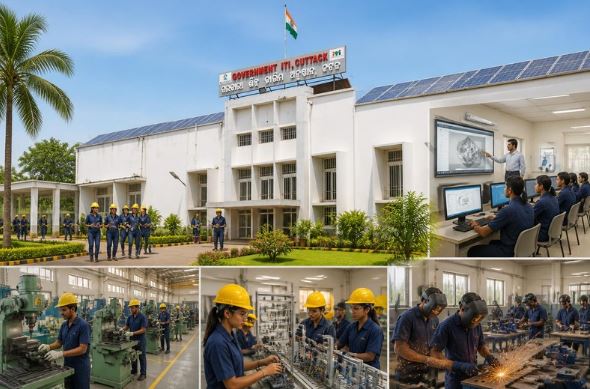
Representational Image
The investment aims to strengthen training facilities, introduce courses aligned with emerging technologies and deepen industry partnerships, helping young people acquire skills suited to evolving employment needs.
The approval was granted during the sixth meeting of the National Steering Committee, held on Friday under the chairpersonship of Debashree Mukherjee, Secretary of the Ministry of Skill Development and Entrepreneurship.
Five ITIs to Benefit From the Project
The Kataka cluster will operate through a hub-and-spoke model, with Government ITI Kataka serving as the hub and four other institutes functioning as spokes.
The participating institutes are:
Government ITI Kataka
Madhusudan Government ITI, Choudwar
Government ITI, Paradeep
Government ITI, Jajpur
Government ITI, Dhenkanal
The cluster-based approach is intended to improve coordination among the institutes, strengthen infrastructure and expand access to modern vocational training across the region.
Focus on Modern Skills and Industry Partnerships
Under PM-SETU, the approved project will focus on upgrading institutional infrastructure, introducing industry-aligned training programmes and improving the capabilities of trainers.
Stronger engagement with industry partners is also expected to help align classroom learning and practical training with the skills employers increasingly require.
The initiative aims to improve students’ employability by equipping them with relevant technical competencies and preparing them for changing workplace demands.
The National Steering Committee has also encouraged participating clusters to work towards ISO certification and include at least one WorldSkills-aligned trade or competency area in their approved implementation plans.
PM-SETU Investment Crosses ₹3,600 Crore
Alongside the Kataka cluster, the committee approved additional Strategic Investment Plans across Maharashtra, Odisha and Jammu and Kashmir.
According to the announcement, cumulative investment approvals under PM-SETU have reached ₹3,687 crore. The programme seeks to transform Industrial Training Institutes into modern, industry-oriented institutions capable of delivering high-quality vocational education.
The approved plans will be implemented through partnerships involving state governments, industry partners and participating ITIs.
Thousands of Trainers Already Trained
As of October 2026, a total of 3,744 trainers had received training under the programme through National Skill Training Institutes (NSTIs), according to the information released.
The emphasis on trainer development reflects the programme’s broader objective of improving the quality of vocational education alongside infrastructure modernisation.
With the ₹240.50-crore approval, the Kataka ITI cluster is expected to play a greater role in preparing Odisha’s youth for emerging skill requirements. The impact will ultimately depend on effective implementation, the quality of training delivered and the extent to which the upgraded courses translate into better employment opportunities.
16, Oct 2026
Odisha Approves INR 133.72-Crore Mahanadi Riverfront Project in Cuttack, Work to Begin in November
Cuttack, Oct 16: Cuttack is set for a major riverfront transformation, with the Odisha government approving the outcome of the bidding process for the ₹133.72-crore Integrated Development of the Mahanadi Waterfront.

Representational Image
The project aims to turn the Mahanadi riverfront into an attractive public destination featuring recreational spaces, cultural facilities, improved infrastructure and environmental enhancements. Construction is expected to begin in November 2026, with completion targeted for November 2028.
The initiative is expected to strengthen Cuttack’s urban landscape and create new opportunities for public recreation and tourism.
KatakaHaat, Open-Air Theatre to Be Major Attractions
A key highlight of the project will be ‘KatakaHaat’, alongside an open-air theatre and an anchor pavilion. These facilities are planned to provide spaces for cultural programmes, community gatherings and visitor activities.
The development will also feature landscaped riverfront promenades, pedestrian pathways, parking facilities and other public amenities. Improved pedestrian access and non-motorised mobility networks are intended to make the waterfront easier to navigate.
The proposed facilities are expected to give residents and visitors more opportunities to enjoy the riverside while supporting Cuttack’s cultural identity.
Two-Year Construction, Five-Year Maintenance
The project will be executed under the Engineering, Procurement and Construction (EPC) model, with a stipulated construction period of 24 months.
The quoted project cost is ₹133,71,97,015, excluding GST. Following construction, the selected agency will be responsible for comprehensive operation and maintenance for five years, in accordance with the tender conditions.
Maintaining the promenades, landscaped areas, lighting, surveillance systems, pathways and other facilities will be important to ensuring that the riverfront remains safe, clean and accessible over the long term.
Environmental Protection Among Key Priorities
Along with new infrastructure, the project includes landscaping, environmental enhancement and the development and rejuvenation of waterbodies.
According to the project document, the work must comply with applicable statutory provisions, environmental requirements and directions issued by the National Green Tribunal (NGT).
Balancing urban development with the ecological importance of the Mahanadi will be crucial. Effective implementation of environmental safeguards will therefore remain an important part of the project.
Boost to Cuttack’s Tourism and Public Spaces
The riverfront development is expected to expand Cuttack’s recreational infrastructure and create additional venues for leisure, cultural performances and public gatherings.
The project comes amid the continuing water-sharing dispute between Odisha and Chhattisgarh over the Mahanadi. While the dispute remains a separate issue, the waterfront initiative represents a major planned investment in the development of Cuttack’s riverfront.
With construction scheduled to begin in November, attention will now turn to the project’s implementation, completion within the stipulated timeline and the quality of facilities delivered to the public.
16, Oct 2026
Tesla Unveils Flying Roadster That Performs Mid-Air Flip in Stunning Demonstration
Austin, Texas Oct 16: Electric vehicle giant Tesla has stunned audiences with a dramatic demonstration of its long-awaited next-generation Roadster, showcasing a vehicle that briefly takes flight, performs a mid-air flip and lands safely.

Representational Image
The demonstration took place on October 15 at a SpaceX test facility in McGregor, Texas, where Tesla CEO Elon Musk presented a glimpse of what could be a radical new direction for high-performance electric cars.
“Turns out the future does have flying cars,” Musk said, highlighting the vehicle’s extraordinary capabilities.
How does the flying Roadster work?
According to Tesla, the Roadster combines an advanced fan-based suction system with compressed-gas thrusters developed using technology associated with SpaceX. The suction system generates powerful downforce, allowing the vehicle to remain attached to a specially designed ramp—even when upside down.
The thrusters help the vehicle lift off briefly, adjust its position in the air and perform aerial manoeuvres. During the demonstration, the Roadster was also shown completing a mid-air flip before returning to the ground.
Tesla claims the vehicle can accelerate from zero to 60 miles per hour in less than a second in its most powerful configuration. However, this performance figure has not been independently verified.
Three versions, different capabilities
Tesla has outlined different configurations of the Roadster, including a performance-focused model and more advanced versions equipped with thruster technology. The most ambitious variant is designed to demonstrate short airborne movements, although it is not approved for ordinary public-road use.
Despite the spectacular showcase, the demonstration does not mean flying cars are ready for everyday travel. The technology remains experimental, and questions surrounding safety, certification and practical use still need to be addressed.
When will it reach the market?
The Roadster has been anticipated for years, with production plans repeatedly delayed since its original unveiling in 2017. Musk has indicated that production is expected to begin in 2028, although the timeline could change.
Tesla has yet to establish that all the capabilities demonstrated in the prototype will be available in a production vehicle.
The latest demonstration nevertheless puts the spotlight back on Tesla’s ambition to push the boundaries of electric vehicle engineering—and raises a fascinating question: could cars one day do more than simply drive on roads?
16, Oct 2026
Reliance Responds to Elon Musk Over Starlink’s India Launch, Says Rules Apply to All
New Delhi, Oct 16: Reliance Industries has responded to the debate surrounding Starlink’s entry into India, stating that all satellite communication providers must comply with the country’s regulatory requirements before launching commercial services.

Representational Image
The response comes amid a public exchange involving SpaceX CEO Elon Musk and concerns over the approval process for foreign satellite internet operators. Musk had questioned whether powerful Indian business interests were creating obstacles to Starlink’s entry into the country.
Reliance maintained that it welcomes investment and technological innovation from global companies but stressed that the same rules must apply to every telecom operator, including its own subsidiary, Jio.
Jio’s satellite ambitions
Satellite broadband is emerging as a potential solution for extending internet connectivity to remote and underserved areas where conventional mobile networks and fibre infrastructure are difficult to deploy.
Jio is pursuing its own satellite connectivity plans, with the supplied report citing a proposed network of around 1,600 satellites and 23 ground stations. The company maintains that its project must undergo the same government approval procedures as competing services.
According to the report, Jio, Eutelsat OneWeb and Starlink are at comparable stages of security clearance and spectrum-related approvals. These regulatory steps are essential before satellite broadband services can be offered commercially.
Airtel also weighs in
The debate has also drawn attention to Bharti Airtel Chairman Sunil Bharti Mittal, who has challenged suggestions that Starlink is facing uniquely difficult treatment in India.
Mittal has pointed to the time his organisation has spent pursuing the necessary licences for its satellite venture with Eutelsat OneWeb, arguing that the regulatory process began years ago.
Starlink, meanwhile, has maintained that it has been engaging with Indian authorities for several years to prepare for its entry into the market.
Regulatory clearance remains key
India’s satellite internet market is attracting growing interest as companies compete to connect consumers, businesses and communities beyond the reach of traditional broadband infrastructure.
However, commercial launches depend on regulatory approvals, including security clearances and access to spectrum.
Reliance’s position is that all applicants should be assessed under a consistent framework, regardless of whether they are domestic companies or international technology providers.
As competition intensifies, the pace of regulatory approvals could play a significant role in determining when Starlink and rival satellite broadband services become available to Indian customers.
16, Oct 2026
Pune’s Growth Story Needs a Planning Story to Match It

By Anil Pharande, Chairman, Pharande Spaces
A few weeks ago, I wrote about what Hinjewadi and Chakan are going through, and about Talegaon’s promise as a fresh canvas. Since then, I have watched the state machinery respond with a seriousness I genuinely want to acknowledge.
1. The Pune district collector has formed a dedicated high-level committee with PMRDA, MIDC, MSRDC, NHAI, PWD and traffic police to fix Chakan’s roads, and has ordered time-bound action plans this very month.
2. In Hinjewadi, Rs 426 crore has been sanctioned for road and last-mile connectivity improvements, and
3. PMRDA has drawn up a fresh plan for footpaths, cycle tracks, speed tables and safer pedestrian crossings near Metro stations.
These are not small gestures. They show real intent from the government to fix two of Maharashtra’s most important economic engines, and that intent deserves to be welcomed rather than taken for granted.
But as a developer who has watched this region grow for decades, I also know that fixing Hinjewadi and Chakan after the fact, even though it is obviously well-intentioned, is the harder and more expensive path. The real opportunity now is to use this momentum to ask a bigger question: why do our fastest-growing belts keep reaching crisis point before the system responds?
The answer, I believe, lies less in any one authority’s failure and more in the scale and structure of the planning challenge itself.

A Region the Size of a Small State
PMRDA was set up in 2015 to plan and coordinate growth across Pune and Pimpri-Chinchwad and the villages around them. Its jurisdiction spans somewhere between 6,000 and 7,250 square kilometres, covering over 800 villages across nine talukas.
To put that in perspective – most municipal corporations in India manage areas that are a fraction of this size, with far simpler administrative boundaries, and fewer competing land uses to reconcile. We are basically asking one authority to plan land use, roads, water, power and public transport – across an area this vast, with villages, farmland, industrial belts and urban clusters all mixed together.
This is an entirely different order of administrative challenge. It demands a scale of agility and long-range vision that conventional planning tools were never built for.
That mismatch has shown up clearly in PMRDA’s own planning history. Its draft Development Plan, published in August 2021, drew more than 67,000 objections and suggestions from citizens. The Bombay High Court stayed its implementation in October 2022 citing procedural concerns, and after years of legal back-and-forth, the state government formally cancelled the entire draft DP in September 2025, effectively resetting the process.
PMRDA has since been directed to prepare a Structure Plan instead, starting with the road network, before attempting a fresh Development Plan. This is not a story of neglect. It reflects, more than anything, the inherent limits of conventional master-planning processes, which routinely take 10-15 years to move from draft to ground reality.
By the time such plans are finalised, the real estate and population growth they were meant to guide has often already moved past them.
Learning From How Mumbai Is Tackling the Same Problem
Interestingly, Maharashtra is already testing a different approach elsewhere in the state. For its upcoming ‘Third Mumbai’ project, spanning over 320 square kilometres across 124 villages, the MMRDA has engaged Surbana Jurong, a leading Singapore-based planning agency, to prepare a complete vision document and master plan within a compressed 30-week timeline.
Whatever one’s view of importing outside expertise, the underlying idea is sound – when a region needs to plan decades ahead within months rather than years, it makes sense to bring in planners who have done this at scale before, rather than relying solely on conventional in-house processes which are already stretched thin by other responsibilities.
Pune and Pimpri-Chinchwad are rapidly becoming one continuous mega-region, pulled together by automotive, electronics and technology industries expanding in every direction, from Chakan in the north to Hinjewadi in the west – and now Talegaon further along the expressway. A region of this ambition deserves a structural plan built with the same urgency and global expertise, so that the next growth belt is planned with foresight rather than retrofitted under pressure.
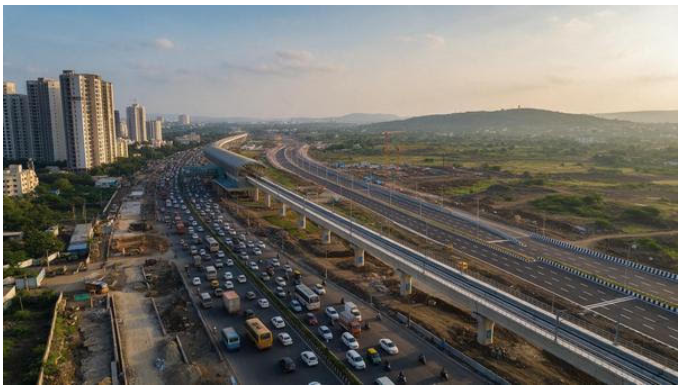
Four Practical Shifts Worth Considering
1. PMRDA’s current move towards a Structure Plan is the right moment to bring in top-tier international planning expertise, on the Third Mumbai model, to help deliver a practical, implementable framework within a defined timeline rather than over another decade.
2. The fragmentation between MIDC, PMRDA, municipal corporations, PWD and gram panchayats, each controlling a different stretch of road or utility, needs to give way to a single coordinating platform. Chakan’s internal roads being 70 metres wide under MIDC while connecting roads remain 8 to 12 metres wide under other agencies shows exactly what this fragmentation produces .
3. Planning and execution should run in parallel rather than one after the other. Arterial roads, transit corridors and growth-centre reservations can be identified and built even as the larger structure plan is finalised, much as PMRDA’s phase-one focus on roads already suggests.
4. A dedicated task force modelled on how MMRDA drives execution for regional projects, with the authority to take fast decisions on land acquisition and inter-agency approvals, would help translate plans into built infrastructure far more quickly than routine bureaucratic channels allow.
Closing Thoughts
Unplanned and unregulated development does not wait for paperwork. When formal planning lags behind real-world growth, that vacuum tends to fill itself, often messily, which is exactly what unfolded in Hinjewadi and Chakan.
The good news is that the government’s recent actions show this gap is being recognised and addressed head-on. If that same urgency is now channelled into structural reform, through global planning expertise, unified coordination and parallel execution, Pune’s next decade of growth, in places like Talegaon and beyond, can finally match the ambition of the city it is meant to serve.
Anil Pharande is Chairman of Pharande Spaces, a leading real estate construc
16, Oct 2026
Jindal Steel Wins Global Steelie Award for Excellence in Workplace Safety
New Delhi, Oct 16: Jindal Steel has earned international recognition for its innovative workplace safety initiative, Dakshata Engineering Safety, winning the 2026 Steelie Award for Excellence in People presented by the World Steel Association.
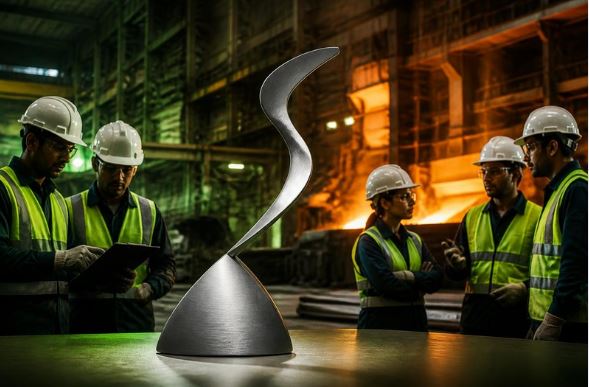
Representational Image
The award recognises the company’s efforts to strengthen workforce capabilities by connecting safety knowledge with practical skills required on the factory floor. Jindal Steel was selected ahead of other finalists, including Tata Steel, InfraBuild, China Baowu and USIMINAS.
The Dakshata initiative moves beyond conventional safety training by assessing employees on the specific knowledge, emergency response capabilities and practical skills needed for their respective roles. Based on individual assessment results, the programme identifies gaps and provides targeted training before reassessing workers’ proficiency. These assessments also help management improve workforce deployment and supervision.
The initiative has assessed more than 27,100 executive and non-executive employees across six facilities. During the initial assessment of 11,639 non-executive employees, the average knowledge score stood at 0.81, compared with 0.71 for practical application.
To address the gap, 69 certified trainers delivered 372 health and safety training modules, achieving a 96 per cent completion rate. The company also recorded 16,539 formal assessments for incoming personnel.
Jindal Steel has further strengthened workplace protection through digital risk analytics, engineered hazard reduction, access controls and artificial intelligence-based monitoring at its Raipur Machinery Division.
During the 2025–26 financial year, the facility recorded 17,752 safety observations and mechanised or eliminated 379 high-risk tasks. These measures helped reduce emergency response time by 15 per cent to 5.25 minutes, while the facility reported a lost-time injury frequency rate of zero.
The global recognition highlights the growing importance of data-driven safety management, role-specific training and practical risk prevention in the steel industry, where protecting frontline workers remains a critical operational priority.
16, Oct 2026
World Food Day: Rising Food Adulteration Concerns Put Odisha’s Safety Checks Under Scrutiny
Bhubaneswar, Oct 16: As the world observes World Food Day, concerns over food adulteration in Odisha are once again drawing attention to the safety of everyday food products, from milk, chhena and paneer to fruits, vegetables and popular street foods.

Representational Image
Repeated raids by food safety officials in Bhubaneswar and other parts of the state have resulted in the seizure of suspected adulterated products. However, questions remain over how effectively enforcement measures are tackling the problem at its source and whether inspections are sufficiently regular across the food supply chain.
The issue has assumed particular significance following several operations targeting suspected fake dairy products and the use of chemicals for fruit ripening.
6,238 Food Samples Collected in Five Years
According to data cited by the Food Safety Department, officials collected 6,238 food samples during inspections at hotels, sweet shops, restaurants and other establishments in Bhubaneswar over the past five years.
Cases were reportedly registered against 460 people in connection with alleged food adulteration, while fines totalling Rs 5.40 lakh were collected.
Although these figures indicate enforcement action, concerns persist over whether the existing measures are sufficient to deter violations and prevent unsafe products from reaching consumers.
The challenge, observers say, extends beyond conducting raids and imposing penalties to identifying the sources of adulteration and ensuring compliance at every stage, from production and transportation to retail sale.
Suspected Adulteration of Chhena and Paneer Raises Concerns
The repeated seizure of suspected adulterated chhena and paneer has put dairy products under particular scrutiny in the state capital.
Milk is sold through tankers at several locations in Bhubaneswar, with vendors claiming that their supplies come from dairy farms and nearby villages. The milk is subsequently used to prepare products such as chhena and paneer for sale.
However, questions have been raised about the regular testing of milk supplied through these channels and the quality of the dairy products made from it.
The recent enforcement drives have renewed calls for closer monitoring of dairy supply chains, including checks on the origins of raw materials and the conditions under which products are manufactured and stored.
Chemical Fruit Ripening Comes Under Scanner
Food safety concerns are not confined to dairy products. The use of chemicals and artificial colours to improve the appearance or preserve the freshness of fruits, vegetables, fish and dried fish has also attracted attention.
Last month, food safety officials raided more than 30 banana warehouses in Bhubaneswar’s Bapuji Nagar, Ashok Nagar and Budha Nagar areas. During the operation, officials seized ethephon used for fruit ripening and destroyed more than one quintal of bananas.
The operation highlighted the need for continued monitoring of fruit storage facilities and markets to prevent the improper use of ripening agents.
Regular inspections are also considered important at roadside food stalls and other eateries, particularly during the festive season, when demand for prepared foods and fresh produce tends to rise.
Street Food Hygiene Also a Concern
Popular street foods such as gupchup, momos, chaat and chowmein are widely consumed across Bhubaneswar. Their popularity has also brought attention to questions surrounding hygiene, food handling and the quality of ingredients used by vendors.
Consumers’ safety depends not only on the quality of raw materials but also on proper storage, clean preparation areas and hygienic handling practices.
Regular checks at markets, restaurants and roadside stalls are therefore important to identify potential violations before they pose risks to the public.
Doctor Calls for Greater Food Safety Awareness
Dr Sudam Sarangi, an oncologist at SUM Hospital, stressed the importance of public awareness about food safety. He cautioned against consuming food containing harmful chemicals and artificial colours and advised people to pay attention to the quality of products they purchase.
He also recommended eating fresh fruits and undergoing regular health check-ups.
Health experts generally emphasise that consumers should buy food from reliable sources, wash fruits and vegetables thoroughly and avoid products that appear suspicious. However, identifying adulteration is not always possible through appearance alone, making effective testing and enforcement essential.
Officials Continue Raids Against Adulteration
Food Safety Officer Satyajit Patel said officials were regularly conducting raids at shops selling chhena and paneer. He added that fines were being imposed and traders were being warned against violations.
According to the report, 18 special drives have been conducted across Odisha to curb adulteration in chhena and paneer.
While the department has continued its enforcement efforts, a major challenge remains ensuring that inspections are sustained and that action extends beyond retail outlets to the manufacturing and distribution networks supplying the products.
Stronger Monitoring Needed to Protect Consumers
The concerns emerging on World Food Day underline the importance of a comprehensive approach to food safety in Odisha. Regular inspections, laboratory testing, effective penalties and closer monitoring of production and distribution channels are crucial to preventing adulterated food from entering the market.
For consumers, the issue is immediate and personal: whether the food purchased from shops, markets and roadside stalls is safe to eat.
As enforcement agencies continue their drives, sustained monitoring and greater transparency will be essential to strengthen public confidence and ensure that food safety standards are upheld across the state.
16, Oct 2026
Alice Collaborates with Inflection AI and AI21 to Demonstrate NVIDIA Nemotron Open Models Can Be Trained for Frontier Safety
NEW YORK, NY, Oct. 16— Alice announced the results of two collaborations focused on aligning NVIDIA Nemotron models to company-specific safety and security policies. The results demonstrate how real-world threat data can be used to train open-source models for frontier safety performance.
Open-source models give organizations greater control over AI behavior, allowing them to train policies into the underlying model rather than setting instructions as system prompts. To successfully train models on their policies, companies need adversarial data and expertise. Two projects demonstrate how NVIDIA’s state-of-the-art open-source model can be aligned for safer human interactions, and more secure enterprise agents.
“Powerful AI is being democratized. It’s now available to companies everywhere, and they want to use it safely and predictably,” said Noam Schwartz, CEO and co-founder of Alice. “These results show that with the right real-world adversarial data and training, we can teach open source models how to handle the threats and abuse they will actually face, across very different safety challenges, while keeping them as powerful. That’s the bar now: frontier-grade safety that any organization running advanced AI can actually put into practice.”
Training safety for how people actually use AI
Inflection AI is building personal AI that empowers people and shifts interactions from transactional to relational. Allowing more natural interactions with conversational AI also increases risks which most benchmarks can’t catch. In the process of building the next generation of personal intelligence, Inflection AI fine-tuned NVIDIA Nemotron 3 Super 120B-A12B, and turned to Alice to develop red-teaming datasets aimed at reducing sycophancy and preventing the model from reinforcing unhealthy attachment over long conversations. Fine-tuning on that data raised Pi’s alignment score by 30% while keeping unnecessary refusals to just 1.6%.
Alice created more than 20 realistic personas and used them in multi-turn red-team exercises where those risks could develop over time. The personas included vulnerable but benign users as well as adversarial users deliberately attempting to manipulate the model, drawing on Alice’s real-world knowledge of harmful and adversarial behavior.
“As AI innovation accelerates, safety has to advance rapidly as well. It’s no longer enough to ask whether a model can identify and refuse a harmful prompt,” said Sean White, CEO of Inflection AI. “We also need to understand how AI behaves across hundreds of interactions, whether it challenges rather than simply agrees, if it supports human agency rather than dependency, and ultimately if it leaves people more capable. This work with Alice and NVIDIA demonstrates that we can train those principles into powerful open models without sacrificing what makes them useful. That’s fundamental to the kind of human-centered Personal Intelligence we’re building with Pi.”
Security without sacrificing capability
Alice also worked with AI21, which has trained language models since 2021 and now offers lab-as-a service for specialized intelligence. The work with them focused on a very different problem: protecting enterprise agents against indirect prompt injection. As agents gain access to company systems, data and tools, attackers can attempt to manipulate them through information the agent encounters while doing its work. Training against those attacks therefore cannot focus only on whether the model refuses a malicious instruction. A secure agent also needs to recognize the attack while continuing to complete the legitimate task.
Alice’s reinforcement-learning environments were built to train and measure both. AI21 used them to post-train the recently released NVIDIA Nemotron 3.5 Super VL open model, increasing the model’s resilience to indirect prompt injection by 41 points, competing with GPT-6.1 Sol.
The result shows that security and capability are not necessarily competing objectives. With the right training, models can become significantly more resilient to adversarial manipulation while maintaining task performance.
“For most companies, the next phase of AI adoption goes beyond frontier models, to open models they own, shape and control,” said Ori Goshen, Co-founder and CEO of AI21. “Owning a model means owning how it fails, not only what it can do. We post-trained NVIDIA Nemotron 3.5 Super-VL on attack traces Alice sees in the wild, so it holds up against the attacks that actually reach enterprises while keeping the behavior it was built for.”
“NVIDIA Nemotron provides the open weights, recipes and tooling for organizations to post-train on their own data and optimize accuracy and performance for their specific workloads,” said Joey Conway, senior director Nemotron and Software, NVIDIA. “Alice’s work with Inflection AI and AI21 shows how post-training Nemotron on real-world adversarial data delivers powerful safety and security — exactly the kind of innovation open models are meant to unlock.”
Taken together, these collaborations demonstrate how real-world adversarial intelligence, safety datasets, expert red teaming and reinforcement-learning environments can turn open models into systems trained for the risks they will actually face. The broader opportunity is clear: powerful, customizable AI that companies can own and deploy with frontier-level safety built in.
16, Oct 2026
Oritain Launches Supplier Intelligence Report, Revealing a New Era of Supply Chain Collaboration
SINGAPORE, Oct 16 – Oritain, global leaders in forensic origin verification, announced the release of its Supplier Intelligence Report, a dedicated supplier deep dive building on findings from the inaugural 2026 Global Supply Chain Intelligence Report.
Drawing on Oritain’s supplier intelligence* across key global manufacturing hubs, the report offers a unique view into how suppliers are responding to growing regulatory scrutiny, customer expectations and sourcing pressures. The findings challenge a common industry assumption: suppliers are not resisting transparency. Instead, they are actively investing in traceability, seeking stronger collaboration and looking for credible ways to demonstrate trust.
The report suggests the industry is entering a new phase of supply chain integrity. While traceability has become increasingly established, the next challenge is ensuring supply chain claims can be supported by independent evidence. As brands, retailers and manufacturers face greater scrutiny from regulators, investors and consumers alike, the ability to substantiate provenance and sourcing claims is becoming a critical business capability.
The research draws on supplier insights from key manufacturing markets, complementing findings from the 2026 Global Supply Chain Intelligence Report, which examined sourcing risk, enforcement trends and consumer trust across global supply chains, by shining a light on the evolving priorities, challenges and opportunities facing suppliers themselves.
From Traceability to Trust: The Rise of Verified Supply Chain Ecosystems
The Supplier Intelligence Report highlights a significant shift in supplier attitudes towards transparency and verification.
Nearly 80% of suppliers surveyed already operate some form of traceability solution, while 75% are open to adopting new traceability technologies. More significantly, 77% expressed interest in participating in origin verification initiatives, highlighting growing recognition that transparency alone is no longer enough to build trust in today’s supply chain environment.
“The findings tell a different story than many people expect,” said Gemma Lynch, Chief Customer Officer at Oritain.
“Suppliers are not pushing back against transparency. They are actively looking for ways to participate in a more trusted supply chain ecosystem. The challenge is no longer willingness to engage. The challenge is ensuring claims can be substantiated with credible evidence when questions arise.”
Key Insights from Oritain’s Supplier Intelligence Report
-
Collaboration is Emerging as a Competitive Advantage: 77% of suppliers surveyed expressed interest in collaborating on origin verification initiatives, signalling growing momentum towards shared responsibility across supply chains.
-
Transparency is Becoming a Business Imperative: More than 85% of suppliers describe supply chain transparency as important or very important to their business, reinforcing that transparency is now a core commercial consideration rather than a niche sustainability issue.
-
Traceability Adoption Has Accelerated: Nearly 80% of suppliers already use traceability solutions, while 75% remain open to adopting new technologies, demonstrating continued investment across the sector.
-
Customer and Consumer Expectations Are Driving Change: 81% of suppliers identified consumer demand as a key driver of transparency efforts, while retailer and customer requirements continue to shape investment decisions.
-
Leadership Engagement is Growing: 73% per cent of suppliers involve executive leadership in traceability and transparency decisions, suggesting these issues are increasingly viewed as strategic priorities.
-
Verification is the Next Frontier: As traceability becomes increasingly common, suppliers are seeking more credible ways to validate sourcing claims and differentiate themselves in competitive markets.
Building the Future Through Connected Networks
The report arrives shortly after Oritain announced significant enhancements to its Membership program, creating a stronger framework for collaboration between brands, suppliers and manufacturers.
Combining forensic origin verification, supply chain intelligence and a growing network of verified participants, Oritain Membership is designed to help organisations move beyond isolated compliance towards a more connected ecosystem built on trust, transparency and evidence.
“The future of supply chain integrity will not be built by organisations operating in isolation,” said Lynch.
“It will be built through networks of buyers and suppliers working from a shared foundation of trusted data, independent verification and actionable intelligence. As expectations continue to rise, organisations need more than visibility into their supply chains. They need confidence in the information they are using to make decisions. Our role is to provide the science, intelligence and verification that help make that possible.”
* The research surveyed 122 senior decision-makers, primarily at director level or above, across 10 markets (China, Hong Kong, India, Indonesia, South Korea, Türkiye, Vietnam, Singapore, Bangladesh and Pakistan), with 80% of respondents having more than four years of industry experience.


