


19, Aug 2026
EVM Launches EnTwins, a Premium Detachable Twin-Speaker 2.0 Stereo System with 10W RMS Stereo Sound
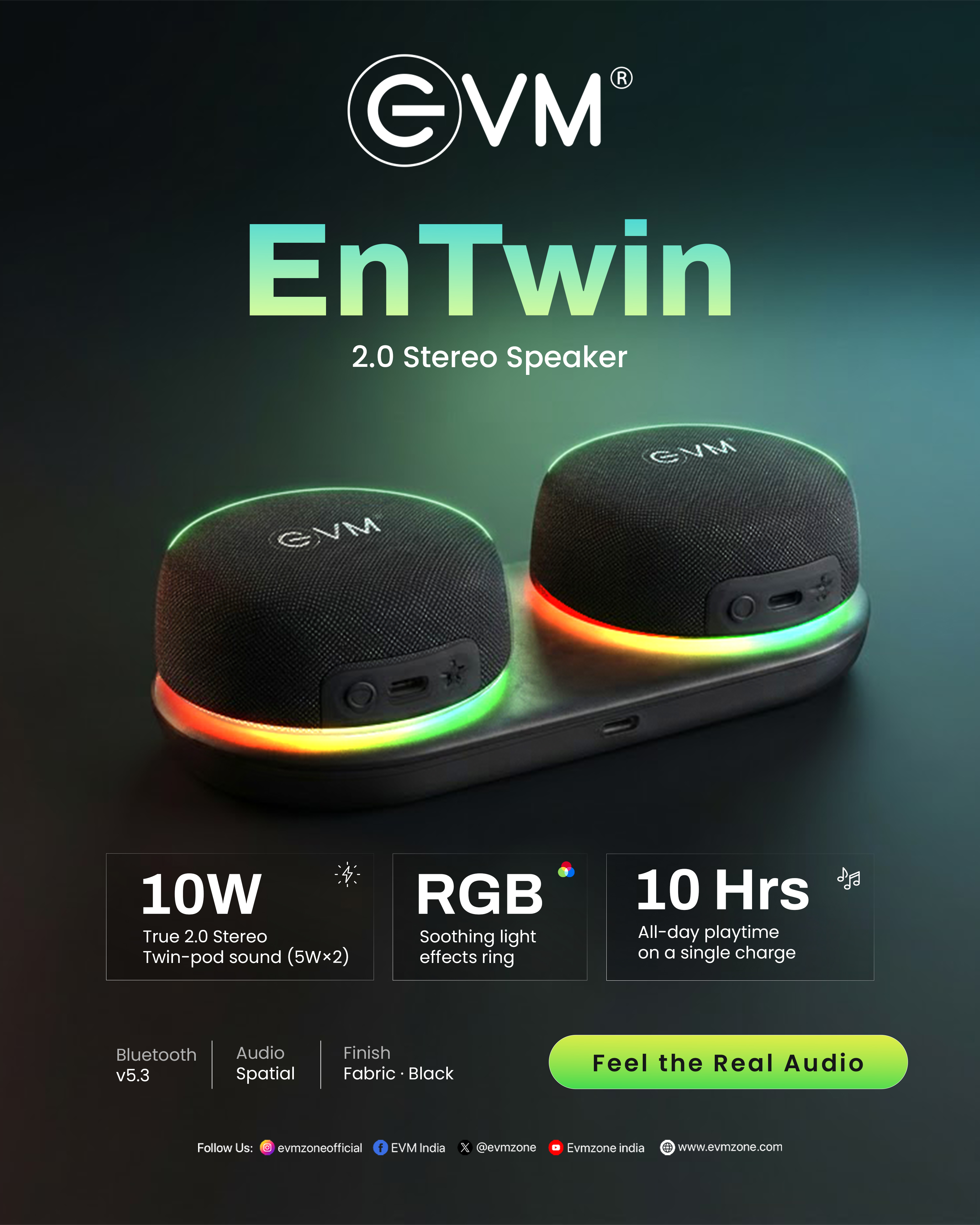
Mumbai, Aug 19: After establishing itself as a leading Indian brand in the IT storage segment, EVM, the flagship technology brand of Hundia Infosolutions Pvt. Ltd., is now expanding its footprint in the premium audio accessories category with the launch of EnTwins Speaker. Designed to combine performance with versatility, EnTwins features two detachable magnetic speaker units that can be used together or placed separately to create a wider, more immersive stereo experience—bringing a fresh, design-led approach to compact personal audio.
Delivering a combined 10W RMS output, EnTwins brings together stereo sound, Bluetooth 5.3 connectivity, spatial audio support, RGB ambient lighting and approximately 10 hours of playback in a compact, fabric-finished design.
At the heart of EnTwins is its distinctive twin–speaker format. Unlike a conventional portable speaker, where the sound comes from a single enclosure, EnTwins allows the two speaker units to be separated and positioned on either side of a smartphone, laptop or workspace. This creates a more natural left-and-right stereo experience and gives music, movies and games a wider sense of sound.
The two speakers can also be placed back on their magnetic base when not being used separately, keeping the setup compact and organised. The speaker also supports spatial audio, helping create a broader and more immersive listening experience. Whether users are streaming music, watching a movie or gaming on their smartphone or laptop, the twin–speaker arrangement is designed to make the audio feel more open and engaging.
Despite its compact size, EnTwins weighs just 285 grams, making it easy to move between a work desk, bedroom, gaming setup or while travelling.
EVM has also integrated a 2-in-1 phone stand into the design, allowing users to place their smartphone alongside the speakers for watching videos, gaming or consuming content hands-free.
The exterior features a fabric-finished design, giving the product a refined, premium look. A rotating RGB light effect adds subtle ambient lighting around the speakers, helping EnTwins naturally into modern desks, entertainment spaces and gaming setups.
Speaking on the launch, Ankit Shah, COO, Hundia Infosolutions Pvt. Ltd., said, “With EnTwins, we wanted to create something beyond a conventional compact Bluetooth speaker. The idea was to combine good sound with a design that gives users more freedom in how they experience it. The detachable speakers allow users to create a proper left-and-right setup, while features such as the magnetic form factor, phone stand and compact design make the product practical for everyday use.”
He added, “As EVM expands its consumer technology portfolio, our focus remains on bringing products where quality can be experienced not only through specifications, but also through the design, finish, usability and overall ownership experience. EnTwins reflects that approach.”
With EnTwins, EVM is strengthening its presence in consumer audio with a product that focuses equally on sound, design and everyday usability. Rather than competing only on loudness or battery specifications, the product has been designed around how consumers actually use portable audio today — across smartphones, laptops, workspaces, gaming environments and entertainment setups.
EnTwins comes with a 1 Year warranty, assuring consumers of the finest after-sales assistance. The after-sales service is also top-notch, with a free on-site warranty available for added convenience. EVM is committed to serving its customers with a wide network of 500+ service locations across the country.
- 0
- By Neel Achary

19, Aug 2026
Central Bank of Jordan and MENA Fintech Association Launch Quarterly Fintech Dialogue, Point to a Shift From Foundation-Building to Ecosystem Activation

First session details CliQ’s growth to 1.6 million users, an open finance framework due by year-end, and Jordan’s new virtual asset licensing regime
AMMAN, Jordan Aug 19: The Central Bank of Jordan (CBJ) and the MENA Fintech Association (MFTA) held the first session of a new Quarterly Fintech Update Series on June 25, 2026, bringing banks, fintech companies, investors and regulators together to discuss the next stage of Jordan’s digital finance sector.
The session was led by Abdulrahman Al-ababneh, Assistant Executive Manager at the Central Bank of Jordan, and chaired by Nameer Khan, Chairman of the MENA Fintech Association. It covered digital payments, open finance, virtual assets, the regulatory sandbox and cross-border payment plans, and closed with a moderated question and answer session on tokenization, stablecoins, buy now pay later financing and non-resident access to Jordan’s payment systems.
MFTA framed the session as the start of an ongoing dialogue with CBJ and described Jordan not as an emerging fintech market but as an established and increasingly strategic one for the region.
Key figures shared at the session
CliQ, Jordan’s instant payment system, had reached 1.66 million users through bank accounts and JOD 12.2 billion (US$17.1 billion) in account-based transaction value by 2024, up from a standing start in 2017. Wallet-based instant payments through JoMoPay added a further JOD 5.1 billion (US$7.1 billion) in transaction value across 2.58 million users, up from 216,000 users and JOD 6.5 million (US$9.1 million) in transaction value in 2017.
An updated open finance framework, covering both Account Information Services and Payment Initiation Services, is expected by the end of 2026.
The Virtual Asset Dealing Law (June 2025) and the VASP Licensing By Law (November 2025) now form the legal core of Jordan’s virtual asset framework, with licensing split between the Jordan Securities Commission and CBJ.
CBJ’s regulatory sandbox has received 29 applications to date, with nine currently in testing and four in the express sandbox track, including the country’s first virtual asset, BNPL and insurtech pilots.
CliQ and JoMoPay: growth since 2017
|
Metric |
2017 |
2024 |
|
Users via bank accounts (CliQ) |
0 |
1.66 million |
|
Users via e-wallets (JoMoPay) |
216,000 |
2.58 million |
|
Transaction value, bank accounts |
Negligible |
JOD 12.2 billion (US$17.1 billion) |
|
Transaction value, e-wallets |
JOD 6.5 million (US$9.1 million) |
JOD 5.1 billion (US$7.1 billion) |
|
Transaction volume, bank accounts |
0 |
84 million transactions |
|
Transaction volume, e-wallets |
164,319 transactions |
56.8 million transactions |
Figures in Jordanian dinars; JOD 1 = US$1.4.
Statements
“Jordan’s fintech progress was never only about new technology. It has been about building the legal certainty, infrastructure and institutional trust that let innovation take hold safely. With CliQ now past 1.6 million users and our open finance framework moving toward implementation, we’re shifting from putting the foundation in place to actively growing the ecosystem, without giving up the oversight that keeps the market stable.” Abdulrahman Al-ababneh, Assistant Executive Manager, Central Bank of Jordan
“Jordan is showing what a regulator-led approach to fintech growth can look like. The instant payment numbers alone make the case: 1.6 million CliQ users and JOD 12.2 billion moving through the system. Add a virtual asset law, an open finance framework due this year and an active sandbox, and you have a market that’s ready for real investment, not just conversation. We’re glad to start this dialogue with the Central Bank of Jordan and expect these sessions to become a fixture for our members.” Nameer Khan, Chairman, MENA Fintech Association
Five stages of development
CBJ presented its fintech progress as a five-stage build: setting an initial vision, strengthening core payment infrastructure, shaping enabling regulation, catalyzing innovation through the sandbox and open finance testing, and now working toward regional leadership as Jordan positions itself as a fintech hub.
What’s next
CBJ confirmed that work is underway on CliQ Plus, a cross-border extension of the instant payment system, developed with the instant payment system operator and payment service providers alongside licensed exchange houses to protect existing market participants. On tokenization, stablecoins and central bank digital currencies, CBJ said these remain under study and are not yet part of a formal regulatory framework.
19, Aug 2026
Beyond Black: G+D Brings New Colors to Convego Ceramic Payment Cards as Banks Compete for Affluent Customers
India, Aug 19: As fintechs and digital-first challengers narrow the gap on price and convenience, a growing number of banks are also exploring new target groups. Giesecke+Devrient is expanding its Convego Ceramic payment card line with a wide range of new on-trend colors, including elegant white, bright blue and deep red. It takes the material beyond the black and dark tones that have defined it so far, giving banks a new tool for physical differentiation as they compete with fintechs for affluent customers.

Retail banking is undergoing a recalibration. Fintechs’ combined share of revenue among the world’s largest banks and fintechs rose from 10 % in 2021 to 17 % in 2025, according to McKinsey’s Global Banking Annual Review – evidence, that, according to the report, fintechs are maturing from niche challengers into full-scale competitors for broad customer relationships, not just individual transactions. Facing the competition, many banks are looking past standard segmentation toward more personalized, identity-driven relationships with affluent and aspirational customers.
This group is not easy to win or keep. Ultra-high-net-worth individuals collectively spend USD 280 billion on luxury goods annually, according to analyst Altrata. Also, aspirational consumers pursuing that lifestyle account for a significant share of premium brand purchases.Overall, the global luxury market is projected to reach $700 billion by the end of the decade, growing 4 % to 6 % annually, according to McKinsey consumer research.
For banks, the competition for these customers has less to do with rates or fees, and more with whether customers feel their status is recognized. What better way to reinforce that connection than through a payment card, the most visible link between a customer and their bank?
Ceramic cards: A demanding material gets more color
This is the specific space G+D is addressing with its updated Convego Ceramic line, adding a variety of colorways, including white, blue- and red-toned finishes, to a portfolio that has so far been almost exclusively black. A wide range of additional colors can also be produced. Further customization options, such as laser engraving for background textures and electroplating, are also available. Here, a thin layer of metal is deposited electrochemically onto the ceramic surface, producing a mirror-like, color-shifting effect, giving issuers an additional way to customize a ceramic card.
Already the material itself, with its distinct look, offers a special payment experience. G+D launched the Convego ceramic card in black some time ago as the first payment card on the market made entirely of ceramic, except for its electronic components and antenna.
Creating colored ceramics is easier said than done. Color in fired ceramics is not printed onto the surface; it is produced chemically within the material itself. During firing at high temperatures, many pigments fade or shift in tone. Only compounds combined with stabilizers such as zirconium reliably survive the process without discoloring, which is one reason dark, oxide-based tones have dominated ceramic production.
Achieving stable, repeatable colors at scale still requires significant craftsmanship and specialized manufacturing processes. Zirconia also brings additional benefits: It makes the surface resistant to scratches and enables a mirror-like effect, helping the card maintain its look and feel even after being taken in and out of a wallet many times. G+D’s ceramic cards are particularly distinguished by their high-gloss, durable surface.
“Ceramic in payment cards has been almost synonymous with black. Expanding the palette is a technical achievement that gives banks a genuinely new tool to signal exclusivity and identity,” says Mikko Kähkönen, Head of Payment Cards Portfolio at G+D. “As institutions compete for affluent customers, the physical card is once again becoming a strategic differentiator, one that customers can see, hold, and identify with.”
19, Aug 2026
AAEON to Demonstrate High-Performance Computing for Next-Gen Semiconductor Manufacturing at SEMICON Taiwan
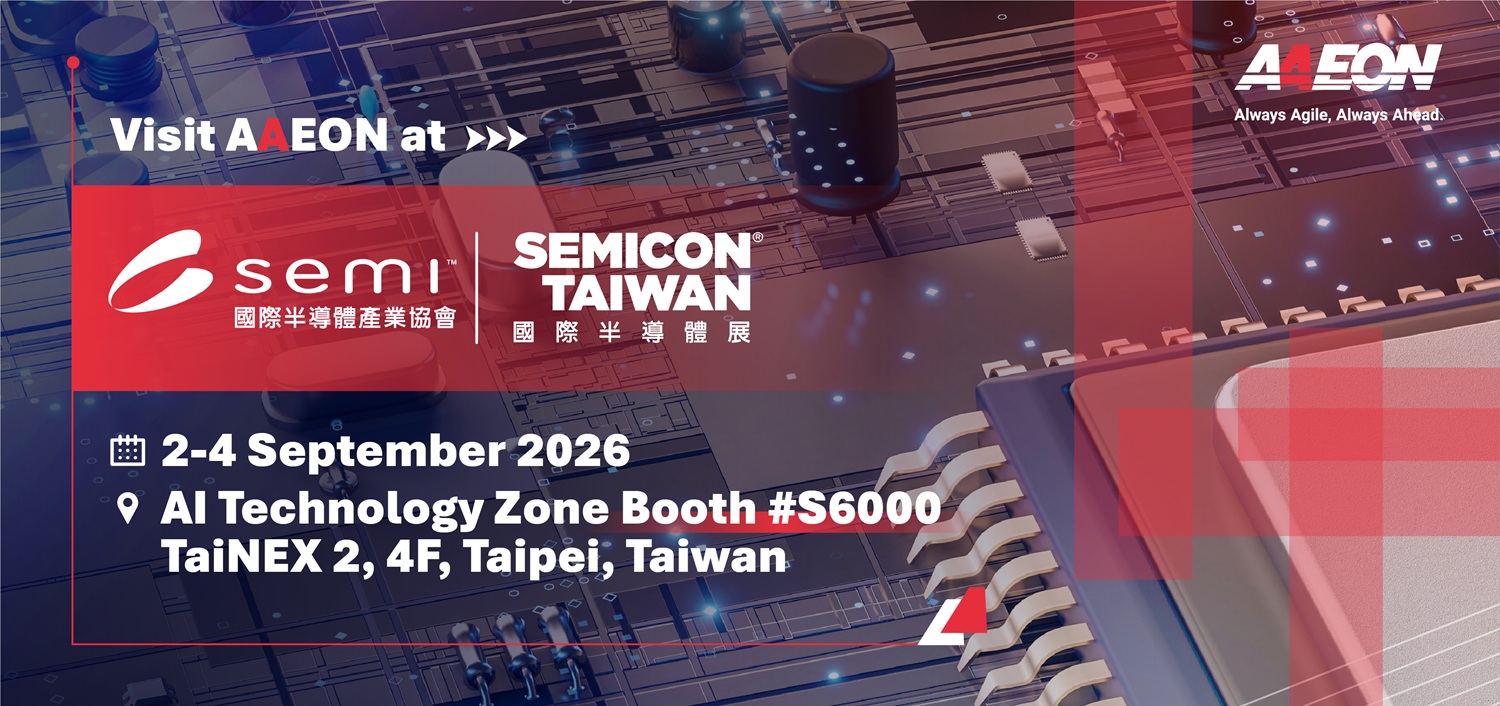
Taipei, Taiwan – Aug 19: AAEON, an industry-leading provider of edge AI solutions, will present new platforms from across the AAEON portfolio alongside an AI vision wafer inspection demonstration at SEMICON Taiwan 2026.
Date: September 2nd – September 4th, 2026
Booth: #S6000, AI Technology Zone
Venue: Taipei Nangang Exhibition Center, Hall 2 (TaiNEX 2), 4F, Taipei, Taiwan
The show, which brings together companies from across the semiconductor industry and features a range of forums, partner programs, and exhibitions, will explore how the industry’s key supply chain sectors intersect to form the backbone of the global collaboration ecosystem.
At booth S6000, AAEON will present a live AI vision wafer inspection solution designed in conjunction with leading industrial camera provider The Imaging Source and machine vision specialist Nevis, featuring the BOXER-8651AI-PLUS Embedded AI System, powered by NVIDIA Jetson Orin NX with Super Mode.
Demonstrating how precision robotics can be used in semiconductor manufacturing spaces, AAEON will also host an AI vision-driven pick-and-place robotic arm solution powered by the Intel Core Ultra Processor-based UP Xtreme i14 developer board with GMSL camera technology.
In addition to live demos, Booth S6000 will host a range of new platforms from across AAEON’s portfolio, including Single Board Computers, Computer-on-Modules, Embedded AI Systems, and Industrial Fanless Box PCs.
The most anticipated platforms from this selection are likely to be the upcoming BOXER-8740AI and MAXER-5000, which are set to be AAEON’s first products to feature new NVIDIA Jetson Thor series modules. Meanwhile, products leveraging new, innovative Intel processing architectures will also be present. Notably, the UP WCL, featuring Intel Core processors (Series 3) CPUs (formerly Wildcat Lake), will be showcased ahead of its scheduled release later this month.
For more information on the full program of events, forums, and exhibitions taking place at SEMICON Taiwan 2026, please visit the event’s official website.
19, Aug 2026
Vedanta’s Renewable Energy Use Surges 52 percent to 4 Billion Units as Net-Zero Investments Cross US Dollar 1 Billion
New Delhi, Aug 19: As India rapidly expands renewable energy and electrification to meet its growing energy needs, Vedanta Group is strengthening its position across the energy transition — both as a supplier of the critical materials needed to build the new energy economy and as a large energy consumer transforming how those materials are produced.
India has set an ambitious target of 500 GW of non-fossil fuel-based power capacity by 2030, alongside its broader ambition of meeting 50% of its energy requirements from renewable sources and achieving net–zero emissions by 2070. This expansion will require significant investments in renewable generation, transmission, power grids, storage and electrification — driving long-term demand for the metals and minerals that underpin this infrastructure.
Vedanta’s diversified portfolio gives it a strategic position in this opportunity. Copper, aluminium, zinc, silver and steel are fundamental to renewable power generation, transmission, grids, solar technologies, energy storage and the broader electrified economy. At the same time, Vedanta is transforming the energy profile of its own energy-intensive operations.
On Akshay Urja Diwas, Vedanta announced that it has invested more than US$1 billion in net–zero transition initiatives through FY2025-26, with renewable energy, lower-carbon fuels, energy efficiency and technology-led interventions driving its decarbonisation efforts. As part of this transition, the Group’s renewable energy utilisation increased 52% year-on-year to 4 billion units (400 crore units) in FY2025-26, equivalent to the annual electricity consumption of around 3 crore Indian households. Vedanta now has nearly 2,000 MW of installed and contracted renewable energy capacity and is targeting 2.5 GW of round-the-clock renewable energy capacity by 2030. These initiatives, alongside other decarbonisation interventions, helped avoid approximately 3 million tonnes of CO₂e emissions in FY2025-26, while greenhouse gas emissions intensity across the Group’s metals and mining production declined by approximately 14% from the FY2020-21 baseline.
Vedanta’s energy-transition strategy spans both sides of the value chain. The Group is building the materials and capabilities required for a more electrified economy while simultaneously transforming the way its own operations are powered. This dual positioning creates an opportunity to strengthen Vedanta’s relevance to customers seeking to decarbonise their value chains, while positioning its businesses at the centre of one of the most significant structural shifts in the global economy.
“The global transition to clean energy demands both, sustainable materials and sustainable operations. Vedanta operates at the heart of this shift; producing the critical metals essential for a low-carbon future while aggressively decarbonizing our own footprint. And in doing so, we are building the resilient, sustainable industrial foundation that will power an Atmanirbhar and Viksit Bharat.” said Priya Agarwal Hebbar, Non-Executive Director, Vedanta Ltd. and Chairperson, Hindustan Zinc Ltd.
Vedanta Aluminium’s Restora and Restora Ultra and Hindustan Zinc’s EcoZen are designed to address growing demand for lower-carbon materials. In FY2025-26, customers using EcoZen avoided approximately 8,268 tonnes of CO₂e emissions.
Across its businesses, Vedanta is also deploying AI, automation, Industrial IoT and advanced analytics to improve energy efficiency, optimise processes and enhance asset performance.
The Group’s focus on responsible business practices is also reflected in the ESG performance of its companies, with Vedanta Limited, Vedanta Aluminium and Hindustan Zinc (HZL) featuring among leading performers in S&P Global’s ESG assessments. HZL is also a member of the International Council on Mining and Metals (ICMM), reinforcing its commitment to responsible mining practices and sustainable development. Vedanta Oil & Gas is also strengthening emissions management and became the first and only upstream oil & gas company in India to achieve OGMP 2.0 Gold Standard Pathway status for methane reporting and management, reflecting its focus on robust measurement, transparency and emissions reduction.
As India’s energy transition accelerates, Vedanta’s opportunity extends beyond reducing the carbon intensity of its own operations. Its portfolio is positioned to supply the materials required for the transition, its investments are building the capabilities to produce them more sustainably, and its lower-carbon products are enabling customers to transition alongside it.
19, Aug 2026
AI Improving Job Security and Productivity for Asset Managers, Clearwater Analytics Research Reveals
61% of asset managers say the technology will make their jobs safer
BOISE, Idaho, NEW YORK, CHICAGO, LONDON and HONG KONG, Aug 19 – Senior executives at asset management firms are overwhelmingly positive about the benefits of artificial intelligence (AI) for enhancing their job security, new research from Clearwater Analytics shows.
While there is concern more widely that the technology may be responsible for reducing work for humans, 61% of senior executives at asset managers participating in the research, which covered a broad spectrum of fund managers including insurance asset managers, hedge funds, private markets specialists, and general asset managers, say AI will increase their job security.
However, more than a quarter (28%) of those surveyed concede AI will reduce job security and 1% say it will replace their role completely.
The Efficiency Dividend
The efficiency gains AI is delivering are tangible and measurable. Six per cent of managers report saving between one and 30 minutes per week, while one in three save between 31 and 59 minutes.
The impact is more significant for the majority: 45% report efficiency gains of one to two hours per week, while 16% are saving as much as three to four hours.
Building for the AI Age
The data suggests that AI is not being viewed as a replacement for human talent. Asset managers are making deliberate investments to ensure their people evolve alongside the technology. Seven in ten firms are providing AI literacy and awareness training, while 63% are investing in internal mobility and redeployment pathways, actively repositioning talent rather than reducing it. Almost half (49%) are redesigning roles specifically to integrate human and AI collaboration, and 47% are hiring talent with AI-complementary skills. Taken together, these findings paint a picture of an industry that sees AI not as a substitute for human judgement, but as a platform for enhancing it.
Souvik Das, CTO at Clearwater Analytics, said: “What I find most telling in this research is where the confidence is coming from. Job security has traditionally come from being hard to replace. Here, it’s coming from a different direction entirely. Firms investing in their people as AI becomes part of the everyday work. That’s a more durable kind of confidence, and it reflects an industry choosing to grow into this moment. The firms doing this well are using AI to make the people doing the job better at it.”
19, Aug 2026
Ekatra Reaches INR 100 Crore Valuation Within 100 Days of Launch, Raises INR 10 Crore in Strategic Investment

Mumbai, Aug 19: Ekatra Retail Ventures Pvt. Ltd., a design, technology and content company, has raised ₹10 crore in strategic investment at a valuation of ₹100 crore, within 100 days of launch. The round saw participation from strategic investors, and follows ₹10 crore of founder capital deployed over two years of pre-launch development. The capital will support brand building, retail expansion and product innovation across India and international markets.
Founded by Pavitra Gandhi, Ekatra has also announced Ekta Kapoor and Sussanne Khan as Co-Founders of Ekatra Jewels, with Sussanne Khan additionally taking on the role of Co-Founder and Design Director. Ekatra owns its end-to-end value chain on a vertically integrated, farm-to-finger model. The company grows and cuts its own Type IIa lab-grown diamonds — the rarest category, roughly 2% of all diamonds — and holds four patented cuts, including the 108-facet Shristi Ratna™, alongside proprietary hollow gold construction technology.
Pavitra Gandhi, Founder, Ekatra Jewels, said, “Ekatra was built with the belief that the future of luxury lies in owning every part of the journey, from innovation and craftsmanship to consumer experience. This investment validates our vision and gives us the momentum to scale thoughtfully, expand globally and continue creating jewellery that blends technology, design and everyday elegance.”
Vasuki Punj, Founder & Strategic Investor, said, “From day one, our focus has been on building a differentiated business with strong fundamentals, not chasing short-term milestones. This investment reflects confidence in our long-term vision, our integrated model and our ability to create a globally relevant luxury brand from India.”
Ekta Kapoor, Co-Founder, Ekatra Jewels, said, “Every industry eventually reaches a point where convention has to make way for reinvention. I believe luxury is at that moment today. Ekatra isn’t here to participate in the category; it’s here to challenge it, with innovation, design and a completely new way of thinking about fine jewellery. The brands that will define the future are the ones that dare to rewrite the rules, and that’s exactly what we’re building.”
The announcement comes as gold trades at record highs of over ₹1.5 lakh per 10 grams in India, up more than 30% in a year, forcing the industry to confront how much metal a piece actually needs. Ekatra spent its two pre-launch years answering that question: its hollow gold construction technology delivers the scale and presence of statement jewellery using a fraction of the gold — engineering the volume rather than buying it.
Sussanne Khan’s newly launched OH MY GOLD collection is the first full expression of that work. Sussanne Khan, Co-Founder and Creative Director, Ekatra Jewels, said, “With the OH MY GOLD collection, we wanted to challenge the idea of what statement jewellery can feel like. The collection is built on one bold idea, jewellery can look chunky, big and luxurious without using a lot of gold. By bringing together real gold, smart engineering and lab-grown diamonds made in India, we’ve created pieces that make a statement while remaining surprisingly light and effortless to wear every day. It’s the look of heavy jewellery, without the heaviness.”
With a library of more than 5,000 designs developed for India, the United States and the Middle East, Ekatra aims to build a globally relevant luxury brand from India.
19, Aug 2026
From Likes to Revenue: How Businesses Can Turn Digital Marketing Into Real Growth

Pic Credit: Pexel
In the competitive business sector, digital marketing is no longer just about gaining followers, likes or website traffic. Companies are increasingly focusing on sales and customer conversions to understand whether their marketing efforts are delivering real business results.
Businesses should begin by identifying clear goals, such as generating enquiries, increasing online sales or attracting repeat customers. Once these goals are defined, they can track conversion rate to see how effectively website visitors and potential customers are turning into paying customers.
Another important term is Customer Acquisition Cost (CAC). It helps businesses understand how much they spend on marketing and sales to acquire one new customer. Keeping CAC under control is particularly important for startups and small businesses with limited budgets.
Companies should also monitor Customer Lifetime Value (CLV), which estimates how much revenue a customer can generate over the entire relationship with the business. A strong CLV indicates that customers are returning and continuing to spend.
For businesses using paid advertising, Return on Ad Spend (ROAS) is another valuable measure. It shows how much revenue is generated from advertising expenditure and helps companies identify campaigns that are delivering better commercial results.
While likes, followers and website visits can indicate brand visibility, they should not be the final measure of success. Businesses need to connect digital activity with actual customer behaviour and revenue.
A practical approach is to track the complete customer journey—from the first click to the final purchase and repeat business. This allows companies to invest more confidently in marketing strategies that generate measurable growth.
In the business sector, the real value of digital marketing lies not in how many people see a campaign, but in how effectively that campaign converts attention into customers, revenue and long-term business growth.
19, Aug 2026
Imarticus Learning launches Centre of Excellence for Indian Capital Markets
Mumbai, Aug19: Imarticus Learning announced the launch of its Centre of Excellence for Indian Capital Markets, a dedicated certification and capability-building practice built to close a widening gap between India’s investor base and the certified professionals serving it. The CoE brings NISM and NCFM certification training, applied capital markets programs and continuing professional education under a single practice, delivered through a fully managed national network of training centres and a digital learning platform designed so institutions can deploy it without building any training infrastructure of their own.
The CoE is structured as a progression rather than a set of standalone products, reflecting that a capital markets professional will need multiple certifications over a career, plus continuing education for as long as they hold a licence.
The practice’s current priority is the Mutual Fund–SIF Distributors examination, which NISM launched on July 22, 2026, replacing the earlier two-exam route for Specialized Investment Fund distribution. SIF is currently the fastest-growing category in Indian capital markets: AMFI data shows industry AUM in the category has grown from roughly ₹2,000 crore at its October 2025 launch to ₹23,177 crore as of July 2026, a 29.8% month-on-month rise. The practice also covers Mutual Fund Distributors, Portfolio Management Services Distributors, Alternative Investment Funds Category III, Securities Operations and Risk Management, Investment Adviser, Research Analyst, Equity and Derivatives, NCFM modules, and CPE refreshers across all license categories. An applied Wealth Management Program, developed in-house, sits alongside the certification track for practicing relationship and advisory teams.
Programs are delivered through classroom, live-online and blended formats at fully-equipped centres, or through a dedicated digital platform offering exam simulation and a question bank mapped to current NISM syllabi, giving institutions a single governance model whether their teams are concentrated in one city or spread nationally.
Commenting on the launch, Mr. Nikhil Barshikar, Founder & CEO, Imarticus Learning said:
“The Centre of Excellence responds to a clear shift in the Indian market. Retail participation has expanded to over 23 crore demat accounts and ₹85 lakh crore in mutual fund assets, while the certified professional base serving those investors has grown at a fraction of that pace. Over the past 14 years, we’ve built deep BFSI training capability for India’s largest banks, AMCs and insurers. The Centre of Excellence takes that same infrastructure, our NISM and NSE accreditations and our national centre network, and brings them together for the first time as a dedicated capital markets practice, so institutions don’t have to build anything themselves, and individual professionals have one partner across every certification their career requires.”
Built on existing delivery infrastructure
The CoE operates through Imarticus’s established network of fully-equipped centres across Mumbai, Delhi NCR, Bengaluru, Chennai, Pune, Hyderabad, Ahmedabad, Jaipur, Indore, Lucknow, Kochi and Coimbatore, with extended delivery reach across approximately 60% of India’s PIN codes through partner networks.
Imarticus has delivered over 8,500 training sessions in FY 25–26 and has trained over 10 lakh professionals across 1,000-plus enterprises and public sector undertakings, with an average participant feedback rating of 4.26 out of 5. The organisation holds NSDC certification and PFRDA Authorised Training Agency status for 2024–2027, under which it has trained 1.25 lakh participants across Central and State Governments, Autonomous Bodies and Corporates.
19, Aug 2026
India, Iceland Eye Stronger Fisheries and Green Shipping Partnership

Pic Credit: Pexel
Aug 19: India and Iceland are looking to deepen cooperation in fisheries, green shipping and maritime skills as both countries seek to expand their partnership in the blue economy.
India’s Ambassador to Iceland, R. Ravindra, held discussions with Iceland’s Infrastructure Minister Eyjolfur Armannsson on Tuesday and briefed him on the upcoming Sagarmanthan: The Great Oceans Dialogue. The meeting also covered opportunities for cooperation in green shipping, capacity building and fisheries.
Fisheries emerged as an important area where the two countries can work more closely. Iceland has considerable experience in sustainable fishing, seafood processing and efficient use of marine resources, while India has a large fisheries sector with significant potential for value addition and exports.
Greater cooperation could help Indian businesses adopt better fishing and processing technologies, improve skills and strengthen the seafood value chain. Earlier cooperation between the two countries has also explored areas such as zero-waste fisheries, traceability, certification, deep-sea fishing technology and aquaculture.
Green shipping is another promising area. Discussions on cleaner maritime transport and capacity building come as India works to develop a lower-carbon shipping sector and encourage the adoption of greener fuels and technologies. India’s maritime authorities are already working on measures covering green ships, alternative fuels, green ports and sustainable shipping corridors.
The latest engagement builds on the broader discussions between Prime Minister Narendra Modi and Icelandic Prime Minister Kristrun Frostadottir at the India-Nordic Summit in Oslo earlier this year. The two leaders had discussed cooperation in fisheries, clean energy, sustainability, geothermal energy, carbon capture and storage, as well as Arctic research.
The India-EFTA Trade and Economic Partnership Agreement is also expected to provide additional opportunities for trade and investment between India and Iceland.
With fisheries, maritime technology and green shipping gaining importance globally, closer India-Iceland cooperation could create new opportunities for businesses, support technology and knowledge sharing, and contribute to the sustainable growth of the blue economy.


