


15, Oct 2026
Leonardo DRS STAG-5 EO/IR Gimbal with Laser Target Designator Supports Precision Fires Demonstration During Iron Sting Event
Precision fires validation highlights how DRS’ STAG-5 gimbal can help operators improve targeting accuracy, extend standoff and enable precision fires in contested environments

ARLINGTON, Va.– Oct. 15, 2026 – Leonardo DRS, Inc. (Nasdaq: DRS) announced today that its STAG-5 EO/IR Gimbal with Laser Target Designator (LTD) supported a recent precision fires demonstration in conjunction with Performance Drone Works (PDW) during the Iron Sting Precision Mortar Validation Event, highlighting the role of advanced target design capabilities in enabling extended-range, accurate strike operations. The event was hosted by the Capability Development & Innovation (CD&I) office, formerly the Irregular Warfare Technical Support Directorate (IWTSD), within the Secretariat for Special Operations (SSO) in support of the U.S. Army Special Operations Command (USASOC).
Conducted at the White Sage Mortar Range in Dugway, Utah, the event evaluated the safety, accuracy, and extended-range performance of next-generation precision mortar munitions while also providing operators with hands-on experience using emerging technologies in realistic scenarios.
During the event, a PDW C100 drone equipped with the DRS STAG-5 EO/IR Gimbal with Laser Target Designator supported target designation during mortar engagements at ranges exceeding the standard maximum range of a 120 mm non-rifled mortar. The successful execution of repeated engagements demonstrated the consistency and reliability required for operational employment and reinforced the value of advanced laser designation capabilities in modern fires workflows.
“The STAG-5 is designed to provide operators with precise, reliable ISR and targeting capabilities that can enhance mission effectiveness across a wide range of operational environments,” said Jerry Hathaway, senior vice president and general manager of Electro-Optical Infrared Systems (EOIS) at Leonardo DRS. “Events such as Iron Sting underscore the importance of delivering technologies that improve accuracy, extend operator standoff, and support evolving battlefield requirements.”
The STAG-5 is designed to support mission success by enabling operators to designate targets with precision and confidence as part of integrated fires operations. When paired with advanced electro-optical and infrared sensing capabilities on deployed platforms, the system can improve target acquisition and designation, strike confirmation, and mission observation from safer standoff positions.
DRS continues to work closely with customers, operators, and industry partners to advance precision engagement solutions that address the needs of today’s warfighter. Through participation in events such as Iron Sting, the company is demonstrating how scalable, mission-ready technologies can help operators Own the Edge™ through improved precision, survivability and operational flexibility in contested environments. For more information regarding the DRS STAG-5 EO/IR Gimbal, visit www.leonardodrs.com/stag5.
- 0
- By Neel Achary

15, Oct 2026
Jeanologia brings a new perspective on the product to Kingpins Amsterdam:
Jeanologia brings a new perspective on the product to Kingpins Amsterdam: understanding its impact and expanding creative possibilities
-
The company presents the new generation of EIM to the international denim community.
-
Jeanologia’s presence at Kingpins also includes COMMON GROUND, a collaboration with Sue Barrett exploring the relationship between nature, camouflage, craft and technology.
Valencia (Oct 15, 2026). What lies behind a garment? From the processes and resources used to make it to the creative decisions that shape its final look. Jeanologia brings this question to Kingpins Amsterdam, one of the leading meeting points for the international denim community, where on October 14–15 it will present two different perspectives on the product: understanding and measuring its impact and exploring new ways to create it.
For two days, yarn and fabric manufacturers, garment makers, finishers, brands and designers come together in Amsterdam. This makes Kingpins a key setting for Jeanologia to introduce the new generation of EIM, which expands environmental measurement across the different stages involved in making a garment, and to present COMMON GROUND, its collaboration with Sue Barrett, where nature and camouflage become the starting point for creative exploration.
From yarn to garment: EIM comes to Kingpins
After more than 15 years measuring the environmental impact of garment finishing, EIM is expanding its scope to connect information from yarn, fabric and garment finishing under one common methodology. This evolution addresses one of the textile industry’s key challenges: a garment passes through multiple processes and players before reaching the consumer, and understanding its impact requires reliable, comparable information from each of these stages.
At Kingpins, Jeanologia will demonstrate how this new architecture works through live demonstrations of the different EIM modules and sessions with brands and manufacturers, showing how environmental information can be generated, connected and used throughout the production chain.
The new EIM includes independent Yarn, Fabric and Garment Finishing modules, allowing each stage to be measured separately, while EIM+ brings the results together to provide a complete view of the product. Using primary production data, EIM measures water and energy consumption and chemical use, as well as worker impact at the garment-finishing stage, and classifies environmental performance as low, medium or high impact.
The information remains traceable and is structured for use in tools such as the Digital Product Passport (DPP) and Life Cycle Assessment (LCA). While EIM has its roots in denim and the measurement of garment-finishing impact, this new generation expands its application to any textile product, from yarn to finished garment.
“Kingpins gives us the opportunity to introduce the new EIM to a community that brings together many of the players involved in creating a garment. The challenge is no longer to measure processes in isolation, but to connect that information, understand the product as a whole and turn data into a tool to compare, decide and improve,” says Begoña García, EIM Director.
COMMON GROUND: observe, transform, belong
Jeanologia’s second proposal in Amsterdam moves into the creative space. Developed in collaboration with Sue Barrett, COMMON GROUND is a collection that explores our relationship with nature through pattern, camouflage and transformation.
Inspired by shapes, textures, shadows and patterns found in the natural environment, the collection reinterprets camouflage through craft, creativity and technology. Camouflage becomes the visual thread connecting the pieces and a way to explore ideas of adaptation, identity and belonging.
Jeanologia’s laser and G2 Ozone technologies are part of this creative process. Laser brings pattern, contrast and depth directly onto the garment, while ozone works with colour and ageing to shape the final look. Technology becomes a tool to translate the creative idea into the product and expand its possibilities.
The concept is captured in the COMMON GROUND manifesto:
Observe.
Transform.
Belong.
Nature creates the pattern.
The maker transforms it.
The wearer gives it meaning.
“There are a handful of projects we remember as ‘the ones’, built on true collaboration and creativity. COMMON GROUND is one of those. It has been a chance to bring together my passion for camouflage and utility clothing with nature, craft and technology, and reinterpret these references in a new way,” says Sue Barrett.
“For some of us, the creative process is as meaningful as the final collection. COMMON GROUND made us think about the balance between becoming part of our surroundings while still preserving our own identity, what makes us unique while sharing a common ground,” says Carme Santacruz, Creative Director at Jeanologia.
15, Oct 2026
EASYMLS BRINGS AN INDEPENDENT MLS TO U.S. YACHT BROKERS FROM NEW MIAMI HEADQUARTERS
Enhanced by AI tools, the Multiple Listing Service platform expands across the U.S., reaching brokers on both the East and West coasts
MIAMI, Fla.(October 15, 2026) – EasyMLS, the all-in-one platform built for yacht brokers, dealers, shipyards, charter operators and private owners, founded by Lionel Nicolai and now headquartered in Miami, is expanding its reach across both the East and West coasts of the United States, powered by a growing suite of artificial intelligence tools.
Founded on the idea that the yacht or boat itself should be the center of a broker’s business, EasyMLS gives yachting professionals a single platform to list, distribute, share and close deals, with artificial intelligence increasingly at the core of how the platform helps brokers work.
In yachting, the software a broker uses usually belongs to the site they advertise. Unlike software tied to a single advertising portal, EasyMLS is independent. Brokers can publish once, distribute their listings across the channels they choose, and maintain ownership of their leads and data.
At the center of that intelligence is the AI Estimator, which produces an indicative market estimate in seconds, based on real market comparables, giving brokers instant, data-driven pricing instead of relying on guesswork or outdated comps. The AI Import Engine automatically imports boat catalogs from PDFs, Excel files or third-party portal URLs, eliminating hours of manual data entry each week.
EasyMLS is the work of founder Lionel Nicolai, a Frenchman who grew up around the yachting industry; in his family, selling boats is a business passed down from father to son. While living and working in the United States, notably in real estate, Nicolai discovered the power of the Multiple Listing Service (MLS)
and realized yachting had never had a universal, independent MLS equivalent. That dual perspective, deep knowledge of boats paired with firsthand insight into the American market, became the foundation for EasyMLS.
“In real estate, no broker would work without an MLS. Yachting never had a universal, independent MLS. That is what we are building, and it belongs to the brokers who use it, not to a portal renting them space,” said Nicolai.
EasyMLS is used by brokers across the United States, alongside an established base in Europe.
Looking ahead, EasyMLS plans to extend its reach beyond the U.S., with future expansion planned into Canada, the Caribbean and South America, further connecting yacht professionals across the Americas to its network.
15, Oct 2026
Wiliot and Thinaer Partner to Bring Secure Physical AI to the Department of Defense Customer Base
SAN DIEGO, CA – October 15, 2026 – Wiliot, a global leader in Physical AI for supply chains, and Thinaer, an industry leading provider of Physical AI infrastructure and software, today announced a partnership to bring secure, real-time asset visibility to the defense industrial base. The collaboration begins with a Thinaer deployment at a major U.S. aerospace and defense manufacturer serving the Department of Defense (DoD), tracking critical materials and parts throughout its internal supply chain.
Thinaer will begin deploying 1.7 million Wiliot IoT Pixels in Q1 2027 at the first customer’s operations, establishing a foundation for broader adoption across the defense industrial base.
The partnership also marks Wiliot’s entry into defense following scaled deployments across retail, post and parcel, logistics, and food and beverage. It extends Physical AI to complex defense manufacturing operations, where continuous asset visibility can help keep critical production programs on schedule.
Within these operations, materials and parts can undergo ten or more transformations as they move between locations, including temporary external facilities. Losing visibility between production stages can leave teams searching for critical components and put production schedules at risk. Tracking those movements continuously helps manufacturers understand where materials have stalled and intervene before delays spread across the operation.
“True Physical AI closes the gap between raw material and intelligent action. When every object on the factory floor is ambiently connected, the floor becomes a dynamic, self-navigating ecosystem where materials communicate their own state, location, and operational readiness to the systems and humans moving them,” said Bryan Merckling, CEO of Thinaer. “Wiliot IoT Pixels’ combination of size, cost, and battery-free operation lets us connect far more of those materials to the ‘Connect Everything’ layer of our Physical AI platform.”
Wiliot IoT Pixels are stamp-sized, battery-free Bluetooth sensors that attach to materials, parts, or containers to aggregate real-time location data. Wiliot’s Physical AI platform processes this data into asset-level insights that Thinaer integrates with information from its broader sensor infrastructure.
Together, these inputs give defense teams a shared view of operations across facilities to track asset movements, identify bottlenecks, and address delays. They also provide AI systems with the physical-world context needed to anticipate disruptions and keep production on schedule.
Protecting that operational data is central to the joint solution. Wiliot IoT Pixels transmit encrypted data that remains protected during collection and relay until it reaches the processing environment behind secure firewalls. Thinaer’s platform operates in government secure cloud environments, including Impact Level 5 environments, bringing established security infrastructure to the partnership’s defense applications.
“Defense manufacturers need continuous insight into their operations and control over the sensitive information those operations generate,” said Alex Sliwinski, Wiliot Vice President of Sales. “Encrypted data at the asset level is fundamental to serving this market. With Thinaer, we can put that data to work securely across the materials and parts on which defense production depends.”
With a roadmap to millions of tracked assets, the first deployment establishes a foundation for broader adoption of Physical AI across defense manufacturing. Thinaer has already identified additional customers for the joint solution, while its work in healthcare and other industrial markets provides opportunities to extend the partnership beyond defense.
14, Oct 2026
PayQuicker Strengthens Its Leading Orchestration Platform with Advanced API Capabilities, AI-Driven Automation and Real-Time Visibility
Customers gain real-time webhooks, batch processing at scale, payment retractions, and expanded funds visibility with API v2
New York — October 14, 2026 — PayQuicker, a leading global payouts orchestration platform, today announced that API v2, its next-generation API platform, is now available to its customers. With the launch, clients gain access to advanced capabilities, including real-time webhooks, high-volume batch processing, payment retractions, and expanded visibility into funds activity.
In delivering new AI-driven automation capabilities, PayQuicker customers can now react to events as they happen instead of repeatedly checking for updates, process payments and invitations in high-volume batches, and gain greater visibility into funds activity through the API. Existing integrations are unaffected and remain fully supported, so customers can upgrade when it suits their teams and timelines.
“API v2 gives customers more ways to automate payout workflows, manage payments at scale and gain real-time visibility into funds activity,” said James Legan, CTO of PayQuicker. “From processing thousands of payments in a single job to responding to payout activity as it happens, these capabilities give program administrators greater efficiency, flexibility and control over their payout operations.”
Key capabilities of API v2 include:
-
Real-time webhooks: Signed notifications for payee registrations, payment status changes, account receipts, and batch job progress, replacing the need to poll for updates.
-
Batch processing: Submit up to 5,000 payments or invitations per job, with payments schedulable up to 30 days ahead. Failed rows are reported individually without stopping the rest.
-
Payment retractions: Recover the remaining balance of a payment sent in error directly through the API, without a support ticket or manual recovery process.
-
Enhanced funds visibility: Access funding balances and transaction activity through the API for greater oversight and easier reconciliation.
API v2 is available now. Developers can explore API v2 documentation at https://docs.payquicker.io, while existing customers can contact their PayQuicker representative for sandbox credentials and guidance on planning their upgrade.
14, Oct 2026
Leonardo DRS Awarded JIATF-401 IDIQ Contract to Accelerate Delivery of Tactical Expeditionary Sensing Capabilities for Critical Counter UAS Mission
ARLINGTON, Va.– Oct. 14, 2026 – Leonardo DRS, Inc. (Nasdaq: DRS) announced today that it has been awarded a $500 million ceiling indefinite-delivery/
The JIATF-401 IDIQ is designed to increase speed and agility in delivering vetted Counter UAS (C-UAS) technologies and systems to operators. Under this contract, DRS will be eligible to compete for task orders that enable the rapid delivery of integrated C-UAS sensing capabilities supporting force protection and low-altitude air defense missions.
“Today’s threat environment is evolving faster than ever, and our customers need proven capabilities delivered at operational speed,” said John Baylouny, president and chief executive officer of Leonardo DRS. “This JIATF IDIQ positions DRS to accelerate the delivery of integrated C-UAS sensing technologies through rapid fielding of operationally relevant capabilities that help protect forces and strengthen low-altitude air defense as new threats emerge.”
“Our counter UAS and air defense radars have demonstrated proven detection, tracking, and force protection performance in operational environments,” said Max Cohen, senior vice president, general manager at Leonardo DRS RADA Technologies business unit. “We design, manufacture, and deliver combat-proven sensing systems at speed, and we’re ready now to support JIATF with mission-ready expeditionary radar capability that can be fielded rapidly as operational needs for C-UAS evolve.”
DRS manufacturers combat-proven radar and sensing solutions that support mission sets including counter-UAS, counter-rocket, artillery, and mortar, and short-range air defense, helping to provide persistent situational awareness and threat tracking for deployed forces. Backed by deep mission expertise and rapid design and manufacturing capabilities, the team supports customers from concept through production and sustainment to meet evolving threats with speed, scale, and reliability.
This IDIQ contract award positions DRS to compete for future task orders throughout the contract’s period of performance.
14, Oct 2026
Brainomix and Pulmonary Fibrosis Foundation Partner to Bring Patient Perspectives to AI-Powered Pulmonary Fibrosis Care
OXFORD, UK and CHICAGO, October 14th, 2026 – Brainomix, a leading medtech company specializing in AI-powered imaging tools for lung disease and stroke, today announced a new partnership with the Pulmonary Fibrosis Foundation (PFF) to bring the voices of patients and caregivers into exploring how AI-powered imaging could support the care of people living with pulmonary fibrosis (PF) and other fibrotic interstitial lung diseases (ILD).
The partnership will focus on understanding patients’ perspectives when e-Lung quantitative CT analysis is incorporated into clinicians’ assessment workflow. The research will explore how access to objective quantitative CT metrics could enhance clinicians’ understanding of changes in disease over time, while examining how these insights are experienced and understood by patients. The initiative will also explore how these imaging insights could support more informed conversations between patients and their healthcare teams, including discussions around treatment decisions.
Brainomix 360 e-Lung is an FDA-cleared, CE-marked AI-powered image analysis tool that provides automatic quantifications and visualizations of radiographic features in lung CT scans. Clinicians can use these outputs to aid in their diagnostic assessment of lung diseases.
With its deep connection to the PF and ILD community and extensive expertise in patient education, research and care, the PFF is uniquely positioned to help guide this initiative. The Foundation will draw on its patient and caregiver community and its understanding of both the clinical and lived experience of pulmonary fibrosis, helping ensure patient perspectives remain central to the programme. Through its Care Center Network, the PFF also connects medical centers with expertise in diagnosing and treating fibrotic lung diseases and in patient-oriented research.
The programme is part of PROGRESS-PPF, a broader research initiative between Brainomix and Boehringer Ingelheim, exploring the potential of quantitative CT imaging tools to provide objective metrics that support clinicians in their assessment of disease progression in patients with progressive pulmonary fibrosis. The new collaboration with the PFF builds on that work by bringing the patient perspectives to the forefront, exploring how these imaging insights can support meaningful conversations between patients and clinicians.
“Patients are at the heart of everything we are trying to achieve with e-Lung,” said Dr. Michalis Papadakis, CEO and Co-Founder of Brainomix. “While our technology can provide new imaging tools for lung disease, we need to understand how those tools inform clinical understanding and how that information is communicated to and understood by the people living with the disease. Our partnership with the Pulmonary Fibrosis Foundation will help us listen directly to patients and caregivers and explore how AI-powered imaging tools can support greater understanding, communication and shared decision-making.”
The partnership will explore what patients want to know about their disease, how they respond to visual and quantitative outputs, and where e-Lung may provide the greatest value across their care. It will also explore how clinician imaging-derived insights could support conversations with patients about whether to start, continue or change treatment, particularly when changes in disease may not be evident from symptoms alone.
“People living with pulmonary fibrosis and their caregivers bring an essential perspective to the development of new approaches to understanding and managing this disease,” said Scott Staszak, President and CEO of the Pulmonary Fibrosis Foundation. “The PFF is deeply connected to the PF and ILD community and has a long-standing commitment to advancing research, education and care. We are pleased to partner with Brainomix to bring that patient voice and expertise into exploring how AI-powered quantitative imaging tools can be used in care. By listening directly to the community, we can better understand what information patients find valuable and how it can support conversations with their healthcare teams.”
The partnership reflects Brainomix and PFF’s shared commitment to further advancing a patient-centred approach to pulmonary fibrosis care, where new technologies are developed and evaluated with a clear understanding of the needs, experiences and priorities of the people they are intended to serve.
14, Oct 2026
Logitech Unveils Its Biggest Enterprise Launch Ever: More Power, More Future-Proofed Rooms for the AI Revolution
Dubai, United Arab Emirates — October 14, 2026 — Logitech has unveiled the largest enterprise product launch in company history, engineered to equip companies for the AI revolution. Headlined by Logitech Rally Bar 2, Rally System 2 Pro, and Sound Shape technology, the new portfolio brings advanced compute, intelligence and sensing into more workspaces to support the next decade of intelligent collaboration.
“This second generation of smart video collaboration devices is Logitech’s answer to a new, dual mandate for IT: Deliver exceptional meeting experiences today while preparing for an AI-powered tomorrow,” said Henry Levak, general manager of Team Workspace Solutions at Logitech.
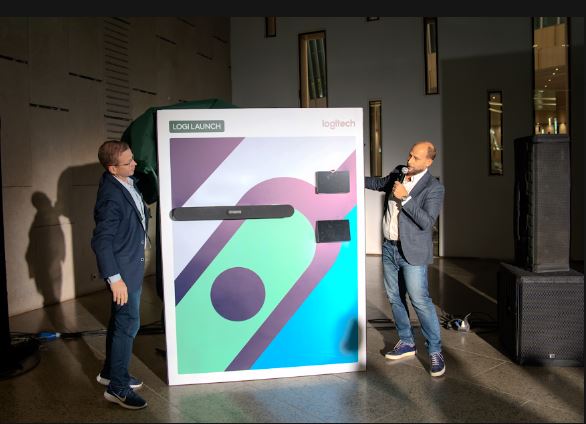
“AI-powered workspaces will be most valuable when they make collaboration feel effortless and fit the way organizations actually work,” said Murad Ali, Head of Middle East & Central Asia, Logitech for Business. “For Middle Eastern organizations, where teams often collaborate across cities, countries and cultures, the next generation of intelligent meeting rooms can help every voice be heard, every space work harder, and every meeting feel more connected. Logitech’s new portfolio is an important step toward that future.”
Rally Bar 2: A Market Leader, Reinvented for the AI era
Rally Bar 2 is the successor to the industry-leading Rally Bar, now supercharged by a Qualcomm chipset that offers four times more edge AI processing power than various other video bars on the market.
A custom-designed lens and 1-inch sensor bring stunning visual clarity, and AI-powered Right Sound 3 brings studio-quality audio to meeting rooms. Embedded sensors automate the workplace by booking meetings when people walk in and provide occupancy data to help leaders make informed decisions about real estate.
With its sleek design, Rally Bar 2 can easily be installed by one person in just minutes. It is housed in an aluminum unibody for easier recycling.
Certified for Microsoft Teams, Zoom Rooms, and Google Meet, and built on Microsoft Device Ecosystem Platform (MDEP), Rally Bar 2 merges Microsoft’s enterprise-grade security standards with Logitech’s room intelligence and signature meeting experiences.
Rally System 2 Pro: Mastering Massive Spaces
A chronic pain point for IT is delivering quality, AI-driven meeting experiences in large, multi-purpose spaces–rooms. These spaces may constitute only a fraction of the building but consume the majority of IT effort. Logitech Rally System 2 Pro is a modular new solution that dramatically simplifies multi-vendor setups in complex and divisible rooms, making Logitech a one-stop-shop for all spaces, from small to extra-large rooms.
Introducing Sound Shape: Audio That Defies Expectations
High-value spaces like executive boardrooms and training rooms are historically tricky to outfit with audio. Logitech’s Rally Speaker 2 Pro and Rally Speaker 2 Max house groundbreaking new Sound Shape audio technology. Sound Shape uses focused acoustic beams to precisely direct sound toward listeners throughout the room. The result is evenly distributed sound across a 20-meter (about 65 feet) space–a feat only partially achieved previously by costly and complex ceiling speaker array installations.
Next-generation product highlights:
● Rally Bar 2: Video bar for medium to large rooms, with next-generation processing power; 4-speaker system, 6 beamforming mics, occupancy detection and environmental sensing.
● Rally System 2 Pro: Modular video conferencing system for large, complex, and divisible rooms, includes:
○ RoomMate 2 Pro: A Qualcomm-powered compute box running up to three 4K displays, multiple cameras, speakers, and mic pods across Android, PC, or BYOD setups.
○ Rally AI Camera Pro: A dual-camera device combining a wide-angle 1-inch sensor with Logitech’s legendary optical PTZ camera design.
○ Rally Speaker 2: Linear, 7-driver beaming networked speaker delivers the same volume and intelligibility in the back of the room as it does in the front.
○ Logitech Link: Native AV-over-IP tech that links Logitech devices using simple Category cables—no external extender and no PoE injectors.
○ Right Sight 3: Smarter multi-camera tracking that uses multiple wall-mounted or center-of-table cameras and angles to automatically capture the best view of the room.
● Rally Speaker 2 Pro: Soundbar with 32 micro-drivers evenly distributes sound throughout large rooms via Logitech’s new Sound Shape audio technology.
● Rally Speaker 2 Max: Soundbar with 64 micro-drivers evenly distributes sound throughout extra large 20m (65-foot) rooms via new Logitech’s unique Sound Shape audio technology.
Also new:
● Tap IP 2: Brighter, smarter, network-connected meeting room touch controller.
● Tap Scheduler 2: Room scheduling panel with brighter display, higher-resolution, upgraded compute and built-in motion sensor.
Pricing and Availability
Rally Bar 2, Tap IP 2, and Tap Scheduler 2 are rolling out globally now. Rally System 2 Pro, RoomMate 2 Pro, and the Rally Speaker 2 lineup will be available in Summer 2027. Right Sight 3 camera switching capability will be available in the second half of 2027 as a free CollabOS software update. For more details, please visit www.logitech.comor check with your local or online retailer.
14, Oct 2026
Affibody Highlights Progress Across Radiopharmaceutical Pipeline at EANM 2026
Stockholm, Sweden, October 14, 2026. Affibody AB (“Affibody”) today announced a series of presentations at the 2026 Congress of the European Association of Nuclear Medicine (EANM), taking place October 17-21 in Vienna.
The presentations span both clinical and preclinical research and include results from the ongoing Phase I study with the Radioligand Therapy (RLT) candidate ABY-271 in HER2-positive metastatic breast cancer, clinical data with the HER2 PET imaging agent tezatabep matraxetan, and preclinical findings with Affibody molecules targeting B7-H3. Together, the presentations highlight the breadth of Affibody’s capabilities across targeted RLTs and precision imaging.
“The wealth and diversity of results being presented at EANM, one of the world’s leading congresses in nuclear medicine and theranostics, reflects both the potential of our Affibody technology and the strength of our collaborations,” said David Bejker, Chief Executive Officer of Affibody. “We are excited to see our science translate into meaningful advancements with the aim to address significant unmet needs in patients with hard-to-treat cancers.”
Presentations
Title: A First-in-Human Phase 1 Trial Safety and Biodistribution of [¹⁷⁷Lu]Lu-ABY-271 in Subjects with HER2-Positive Metastatic Breast Cancer (NCT07081555)
Presenter: Joachim Feldwisch, Affibody
Session: C: Therapy Clinical Study – C1 Oncological Therapy Clinical Study – C16 Other Oncological Treatments
Format: e-Poster
Presentation ID: EP-0981
Title: Whole-body HER2 PET/CT reveals spatial heterogeneity of HER2 expression in advanced gastroesophageal adenocarcinoma.
Presenter: Antonios Tzortzakakis, Karolinska Institutet
Date and Time: October 18, 2026, 08:00 CEST
Session: Clinical Oncology Track: Gastro-Intestinal Malignancy
Format: Oral
Presentation ID: OP-035
Title: Standardization of image quality and activity quantification in a multi-centre PET imaging study (Ex-PET)
Presenter: Jakob Lagerstedt, Karolinska University Hospital
Date and Time: October 20, 2026, 16:45 CEST
Session: Cutting Edge Science Track: Physics Committee: Quantitative PET:
Harmonisation and Robustness
Format: Oral
Presentation ID: OP-734
Title: Preclinical Evaluation of PNABased Affibody-mediated Pretargeting for targeting HER2: A direct comparison between Tb-161 and Lu-177
Presenter: Maryam Oroujeni, Uppsala University
Date and Time: October 18, 2026, 09:45 CEST
Session: M2M Track: TROP Session – Radiopharmaceutical Sciences Committee: 161Tb vs 177Lu, and The Winner Is…
Format: Oral
Presentation ID: OP-084
Title: Modular Molecular Design of B7H3Targeting Affibody Molecules for Radionuclide Therapy: Biodistribution-Driven Selection and Therapy
Presenter: Maryam Oroujeni, Uppsala University
Date and Time: October 20, 2026, 16:45 CEST
Session: Radiopharmaceutical Sciences Committee: Modern Approaches to Drug Development in Nuclear Medicine
Format: Oral e-Poster
Presentation ID: EPS-223
Title: HER2-Ex PET trial: A multicentre, prospective, open-label study using [68Ga]Ga-ABY-025 PET-imaging to characterize HER2-expression and explore the therapy-predictive value for HER2 antibody-drug conjugates in patients with metastatic breast cancer.
Presenter: Anna Kistner, Karolinska Institutet
Session: B: Imaging Clinical Studies – B1 Oncological Imaging Clinical Study – B13 Breast
Format: e-Poster
Presentation ID: EP-0261
Title: In vitro evaluation of Affibody molecules targeting B7-H3 for radionuclide therapy of neuroblastoma
Presenter: Maryam Oroujeni, Uppsala University
Session: A: Preclinical and Translational Studies – A1 Medical Preclinical – A11 In Vitro Studies
Format: e-Poster
Presentation ID: EP-0003
Title: Optimized Affibody Molecule targeting B7-H3 immune checkpoint: Improved Tumor Targeting Properties in a Syngeneic MC38 Model
Presenter: Enrique Recasens Pérez-Vera, Uppsala University
Session: A: Preclinical and Translational Studies – A1 Medical Preclinical – A18 New Radiopharmaceuticals – Therapy
Format: e-Poster
Presentation ID: EP-0171
Title: Feasibility of affibody-based pretargeted delivery of 225Ac
Presenter: Vladimir Tolmachev, Uppsala University
Session: A: Preclinical and Translational Studies – A1 Medical Preclinical – A18 New Radiopharmaceuticals – Therapy
Format: e-Poster
Presentation ID: EP-0161
Title: Biodistribution and dosimetry for PET imaging of HER2-receptor expression using [18F]-HER2 in metastatic breast cancer
Presenter: Ulrika Estenberg, Karolinska University Hospital
Session: B: Imaging Clinical Studies – B10 Dosimetry in Diagnostic Applications – B101 Dosimetry in Diagnostic Applications
Format: e-Poster
Presentation ID: EP-0617
View the EANM abstracts here: https://eanm26.eanm.org/
14, Oct 2026
Provenir Named a Major Player in the IDC MarketScape: Worldwide Decision Intelligence Platforms 2026 Vendor Assessment
PARSIPPANY, N.J., – October 14, 2026 – Provenir, the Decision Intelligence Platform for financial services providers, on Oct 12 announced it has been positioned in the Major Players Category in the IDC MarketScape: Worldwide Decision Intelligence Platforms 2026 Vendor Assessment (Doc #US54118426, September 2026). Provenir was also named a Major Player in the 2024 edition of this IDC MarketScape.
The recognition follows two years of continued investment in Provenir’s Decision Intelligence Platform, including production-accurate simulation, advances in AI models and assistants, and expanded capabilities designed to help customers design, test and deploy decision strategies faster.
The IDC MarketScape evaluated vendors supporting decision design, decision engineering and decision orchestration. The assessment covered vendors serving industries from financial services and insurance to government, manufacturing, and retail; we believe Provenir earned its position while maintaining a deliberate focus on financial services and adjacent sectors. The 2026 assessment also reflects the growing role of generative and agentic AI in how decision logic is authored, tested and explained, alongside continued human oversight.
The IDC MarketScape highlights Provenir’s unified low-code platform, stating “Provenir brings together decisioning, data orchestration, model orchestration, simulation, and case management in a single cloud-native environment, reducing reliance on separate point solutions for related decisioning functions.”
IDC highlights three areas of strength:
- Unified low-code platform: Provenir brings together decisioning, data orchestration, model orchestration, simulation, and case management in a single cloud-native environment, reducing reliance on separate point solutions for related decisioning functions.
- Breadth of the data marketplace: The vendor’s marketplace includes more than 150 prebuilt integrations with third-party data and analytics providers, and new integrations are typically turned around in about two weeks, shortening timelines that can otherwise stretch to several months.
- Platformwide AI assistant: A generative AI assistant operates across dashboards, model building, and documentation functions platformwide, providing conversational access to insights, recommendations, and translated documentation regardless of which page a user is working from.
The IDC MarketScape also notes Provenir’s “same engine” simulation approach: “where changes are tested using the identical processing rails and up to 12 months of live production data that power the operational platform, which may appeal to organizations that want confidence in projected outcomes before rules or scorecards go live.” This gives organizations greater confidence in projected outcomes before changes go live.
“I believe being named a Major Player for the second assessment in this market reflects the progress we’ve made in building a true decision intelligence platform,” said Lawrence Smith, CEO of Provenir. “Financial services providers need to change strategy quickly without losing control of how decisions are made. By bringing data, AI, simulation and governance together, we help customers test, understand and improve decisions before changes go live.”
Provenir’s generative AI assistant and MCP connectivity are in production today, supporting documentation retrieval, insight generation and guided model building. The IDC MarketScape also notes that Provenir’s near-term road map priorities include “natural language–driven flow generation, expanded automated recommendations, and human-in-the-loop monitoring for agents, reflecting a broader shift from assisted decision design toward continuous, machine learning–informed strategy optimization across the decisioning life cycle.”
To read the IDC MarketScape excerpt featuring Provenir, visit: https://www.provenir.


