


14, Oct 2026
Workday Launches Autopilot Agents That Get Real Work Done Across HR, Finance, and IT
“Probabilistic AI is great at guessing, but in payroll and finance, a good guess isn’t good enough,” said Gerrit Kazmaier, president, product and technology, Workday. “Our agents can work in the background because they follow the same policies, permissions, and approvals that already run the business. That’s what lets them go beyond making suggestions to anticipate, advise, and act autonomously.”“Until now, AI has worked like a copilot – helpful, but only when you ask it something. That’s not enough anymore,” said Joel Hellermark, chief AI officer, Workday. “Our agents work like autopilots – they get the work done on their own and bring people in exactly when their judgment makes the difference.”
“Agents are moving from singles pickleball – one human and one agent – to an orchestra phase, where the human is the director and agents run in the background, proactively doing the work,” Holger Mueller, vice president and principal analyst, Constellation Research. “Workday’s agents for talent acquisition, payroll, accounting, and more are built for that shift, working as autopilots while people stay in charge.”
- 0
- By Neel Achary

14, Oct 2026
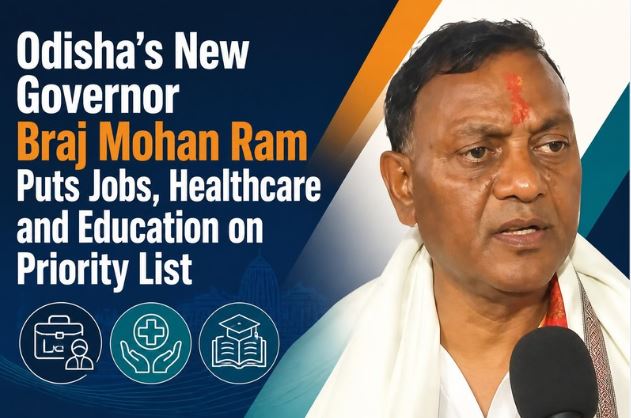
Odisha’s New Governor Braj Mohan Ram Puts Jobs, Healthcare and Education on Priority List
Bhubaneswar, Oct 14 (UDN): Newly appointed Odisha Governor Braj Mohan Ram has identified employment, healthcare, education and farmers’ welfare as key areas of focus, saying he will work in coordination with the state government to address public concerns and support Odisha’s development.
Representational Image
Ram is expected to arrive in Odisha shortly to assume office. Speaking to the media following his appointment, he said he would assess the state’s needs through discussions with Chief Minister Mohan Charan Majhi and members of the public before deciding on appropriate steps.
“The duty is to serve the people,” Ram said, emphasising the importance of cooperation and engagement in addressing the state’s challenges.
Jobs, Healthcare and Education in Focus
The incoming Governor highlighted unemployment, access to healthcare and education as major concerns requiring attention. He also stressed the need to listen to farmers and ensure that their issues receive due consideration.
Ram indicated that his approach would involve understanding ground realities and coordinating with the state government to identify ways to address these challenges.
Mineral Wealth Seen as an Opportunity
Referring to Odisha’s abundant mineral resources, Ram said the state’s natural wealth could play an important role in tackling unemployment.
His remarks underscored the potential to use the state’s resources to support economic activity and create employment opportunities, although he did not announce any specific initiative or timeline.
Pledges Cooperation for State’s Development
Ram expressed gratitude to the central leadership and Prime Minister Narendra Modi for entrusting him with the responsibility of Governor.
He said he would engage with the Chief Minister and citizens as required, assess the situation and work towards the state’s progress.
His priorities signal an emphasis on public welfare and cooperation with the elected government as he prepares to take charge as Odisha’s constitutional head.
14, Oct 2026
Lioness Shreya Gives Birth to Cub at Nandankanan; Newborn Under Special Care
Bhubaneswar, Oct 14 (UDN): Asiatic lioness Shreya has given birth to a cub at Nandankanan Zoological Park near Bhubaneswar, but the newborn is currently being raised under specialised care after the first-time mother reportedly failed to accept it.

Representational Image
Shreya, housed in enclosure number 18, delivered a single cub on Tuesday evening, according to reports. As she did not provide maternal care to the newborn, zoo authorities separated the cub from her and shifted it to the infant animal care centre within the veterinary hospital premises.
Experienced animal keepers are now bottle-feeding the cub with diluted milk formula. The newborn is being kept under controlled lighting and monitored as part of its early care.
First-Time Mother Does Not Accept Cub
The birth marked Shreya’s first pregnancy. Reports said the lioness did not show the expected maternal response towards the newborn, prompting zoo officials to intervene to ensure its care and survival.
The cub was born after Shreya mated with Asiatic lion Harsh. Both lions were born on August 29, 2024, to lion Samrat and lioness Bijli, along with another cub, Dhruv. As Shreya and Harsh are siblings, the newborn is the result of inbreeding.
Concerns Over Cub Survival
The latest birth comes amid concerns over the survival of lion cubs born through closely related pairings at the zoo.
Last month, lioness Maya gave birth to two cubs following mating with Shivam, who is also her litter-mate. One cub was stillborn, while the other, a male, died four days after birth while receiving veterinary care, according to the report.
The recent cases highlight the challenges involved in raising newborn lion cubs at Nandankanan, particularly when maternal care is absent or the cubs face additional risks.
Newborn Receives Intensive Care
With Shreya not caring for her cub, the immediate focus remains on providing appropriate feeding and a controlled environment for the newborn. Its long-term survival will depend on its condition and response to the care being provided.
Zoo authorities are continuing to care for the cub at the infant animal care centre. No further details about its current health condition or long-term prospects were available in the report.
14, Oct 2026
Odisha Relaxes Mandatory EV Hiring Rule, Allows Fuel Vehicles After Failed Tenders
Bhubaneswar, Oct 14 (UDN): The Odisha Government has relaxed its mandatory electric vehicle (EV) hiring policy, permitting departments to hire petrol- and diesel-powered vehicles if open tenders for electric vehicles fail to attract eligible bids.

Representational Image
The Finance Department announced the relaxation through an Office Memorandum, citing operational difficulties faced by government offices, including a lack of responsive bids for EVs.
The earlier directive, issued on June 4, 2026, had made EV hiring mandatory from June 1 as part of the state government’s efforts to reduce fuel expenditure amid the West Asia crisis.
Fuel Vehicles Allowed Under Specific Conditions
Under the revised guidelines, departments can opt for internal combustion engine (ICE) vehicles only after inviting open tenders for EVs and receiving no responsive bids.
The concerned offices must submit documentary evidence of the unsuccessful tender to their administrative departments before proceeding with the alternative arrangement.
Where a hired vehicle is intended to replace a condemned or scrapped government vehicle, the administrative department can approve the relaxation. However, hiring a vehicle for a new office or post, or without scrapping an existing vehicle, will require prior concurrence from the Finance Department, supported by proper justification.
Departments to Conduct Their Own Hiring Process
The new guidelines also change the procedure for hiring vehicles. Individual government offices will now invite their own open tenders after obtaining approval from the competent authority, instead of routing the process through the Odisha Renewable Energy Development Agency (OREDA).
Vehicles already deployed by OREDA will continue to serve the concerned departments and organisations until their existing contracts expire. After that, OREDA will withdraw completely from vehicle hiring and provisioning for other government departments and organisations.
Revised Order Takes Immediate Effect
The revised order has come into effect immediately and provides departments with an alternative when EV hiring proves unworkable through the tendering process.
While the state’s policy continues to prioritise electric vehicles, the relaxation is intended to address practical difficulties in procurement and ensure that government offices can meet their transportation requirements when suitable EV bids are unavailable.
14, Oct 2026
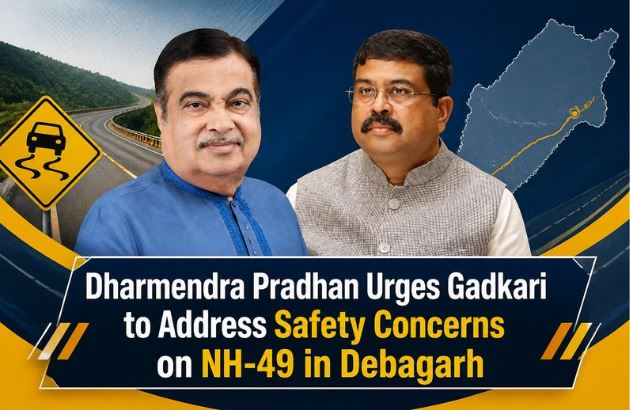
Dharmendra Pradhan Urges Gadkari to Address Safety Concerns on NH-49 in Debagarh
Bhubaneswar, Oct 14 (UDN): Former Union Minister Dharmendra Pradhan has urged Union Road Transport and Highways Minister Nitin Gadkari to take urgent measures to improve road safety and resolve traffic congestion along National Highway-49 in Odisha’s Debagarh district.
Representational Image
In a letter to Gadkari, Pradhan highlighted the risks posed by heavy inter-state freight and passenger traffic on the highway, calling for structural interventions at accident-prone junctions and densely populated stretches.
He proposed three key measures aimed at improving traffic flow, protecting pedestrians and making daily travel safer for residents.
Flyover Proposed at Ambedkar Square
Pradhan stressed the need for an elevated flyover, a dedicated service road and an adequate highway lighting system at the Y-junction near Ambedkar Square, located at the beginning of the Debagarh bypass.
The junction experiences frequent traffic movement because major public institutions, including the Collectorate, New Bus Stand and Women’s College, are situated nearby. The mixing of fast-moving highway traffic with local vehicles and pedestrians has raised concerns over road safety.
Pradhan said suitable infrastructure at the junction was urgently needed to reduce traffic conflicts and improve movement through the area.
Underpass, Slip Road Sought at Birsamunda Square
The former Union Minister also called for the construction of an underpass and a slip road at Birsamunda Square to improve connectivity and minimise disruptions caused by highway traffic.
In addition, he sought the development of service roads, drainage systems and pedestrian-safety infrastructure in populated areas, including Kala, Kandhal and Tileibani.
These measures, he said, would help separate local traffic from through traffic and make road use safer for residents.
Appeal for Permanent Solutions
Sharing details of the letter on X, Pradhan said he had requested Gadkari’s intervention for better road infrastructure, enhanced safety measures and a lasting solution to traffic-related problems along NH-49 in Debagarh.
The proposed interventions are intended to address the challenges arising from heavy traffic movement while improving access to public institutions and essential services.
Pradhan’s appeal places the focus on long-term infrastructure improvements along the highway, particularly at busy junctions and inhabited stretches where highway traffic and local movement frequently intersect.
14, Oct 2026
IMD Issues Yellow Alert for Thunderstorms, Lightning in Odisha Till October 19
Bhubaneswar, Oct 14 (UDN): The India Meteorological Department (IMD) has issued a yellow warning for thunderstorms, lightning and gusty surface winds across several districts of Odisha over the next five days, till October 19.

Representational Image
According to the IMD’s mid-day bulletin issued on Wednesday, isolated locations in the alerted districts may experience thunderstorms accompanied by lightning and gusty winds reaching speeds of 30–40 kmph. The districts covered by the warning will vary from day to day.
District-Wise Weather Forecast
October 15: Thunderstorms, lightning and gusty winds are likely at isolated places in Rayagada, Koraput, Malkangiri, Gajapati, Ganjam, Puri, Khordha and Nayagarh districts.
October 16: The warning will cover Balasore, Bhadrak, Jajpur, Kendrapara, Jagatsinghpur, Cuttack, Angul, Dhenkanal, Kendujhar, Mayurbhanj, Rayagada, Koraput, Malkangiri, Gajapati, Ganjam, Puri, Khordha and Nayagarh.
October 17 and 18: Similar weather conditions, including lightning and gusty winds of 30–40 kmph, are forecast at isolated places in Rayagada, Koraput, Malkangiri, Gajapati, Ganjam, Puri, Khordha and Nayagarh.
October 19: The yellow warning will remain in force for Rayagada, Koraput, Malkangiri, Gajapati and Ganjam districts, where thunderstorms accompanied by lightning and gusty winds may occur at isolated locations.
Residents Advised to Remain Cautious
With thunderstorms and lightning expected in different parts of the state, residents in the affected districts have been advised to remain alert and take precautions during adverse weather.
People should seek shelter inside a safe building during thunderstorms, avoid standing in open areas or under isolated trees, and stay away from exposed locations while lightning is occurring.
The IMD’s latest forecast indicates that thunderstorm activity may continue across parts of Odisha through October 19, with the areas under warning changing over the five-day period.
14, Oct 2026
Hundreds of Kites Descend on Puri’s Bada Danda, Draw Crowds Near Mausima Temple
Puri, Oct 14 (UDN): An unusual gathering of hundreds of kites on Puri’s Bada Danda near Mausima Temple caught the attention of residents and commuters on Wednesday morning, turning a busy stretch of the road into a striking spectacle.

Representational Image
The birds were seen congregating on the road and moving about in search of food. According to reports, food scattered along the stretch appeared to have attracted the kites, prompting them to gather in large numbers.
The birds repeatedly moved from one side of the road to the other as they tried to pick up food. However, the steady flow of traffic interrupted their feeding, forcing them to retreat whenever vehicles approached.
At times, the kites managed to seize food from the road, while at other moments they had to move away to avoid passing vehicles.
Unusual Scene Draws Public Attention
The large gathering soon became a point of curiosity for people in the area and commuters passing through the busy Grand Road. The sight of so many birds assembled in one place stood out against the usual bustle of the city’s main thoroughfare.
While the gathering offered an unusual spectacle for onlookers, the birds’ attempts to feed amid moving traffic also highlighted the challenges of sharing a busy urban space with wildlife.
The kites remained a visible presence on the stretch for some time, drawing attention from passersby before the usual movement of traffic continued around them.
14, Oct 2026
Jharsuguda Airport Set for INR 2,100-Crore Expansion, New Domestic Routes on the Horizon
Jharsuguda, Oct 14 (UDN): Veer Surendra Sai (VSS) Airport in Jharsuguda is set for a major expansion following the Centre’s sanction of ₹2,100 crore for the project. The proposed upgrade is expected to enhance aviation infrastructure in western Odisha and create scope for additional domestic flight connections.

Representational Image
The airport currently handles around 1,000 passengers daily, with services linking Jharsuguda to Delhi, Kolkata, Bengaluru and Bhubaneswar. Officials expect passenger traffic to double after the expansion, alongside the possibility of more airlines and flight routes.
The project is also expected to strengthen connectivity for the region’s industrial and commercial centres, potentially supporting trade, tourism and investment across western Odisha.
Runway Extension and New Terminal Planned
The expansion plan proposes extending the existing runway from 2,391 metres to 3,600 metres to facilitate the operation of larger aircraft. It also includes the construction of a second terminal building and a new administrative complex.
Other proposed facilities include a parallel taxi track, additional aircraft parking bays and aprons, improved approach lighting systems and advanced navigational infrastructure. These additions are expected to increase the airport’s capacity and improve operational efficiency.
Land Acquisition in Progress
Bargarh MP Pradeep Purohit said the Centre had sanctioned funds for the airport’s expansion and noted that the state government was undertaking the land acquisition process.
The airport currently spans approximately 1,027 acres, while the acquisition of another 226 acres is underway. The additional land is intended to accommodate the planned infrastructure and equipment required for larger aircraft operations.
Connectivity Boost for Western Odisha
The proposed expansion is expected to improve air connectivity and strengthen Jharsuguda’s position as a key aviation hub for western Odisha. Better infrastructure could make the region more accessible to businesses, tourists and investors.
While the upgrade could pave the way for additional domestic destinations and expanded flight operations, the introduction of new routes will depend on implementation of the project and decisions by airlines.
14, Oct 2026
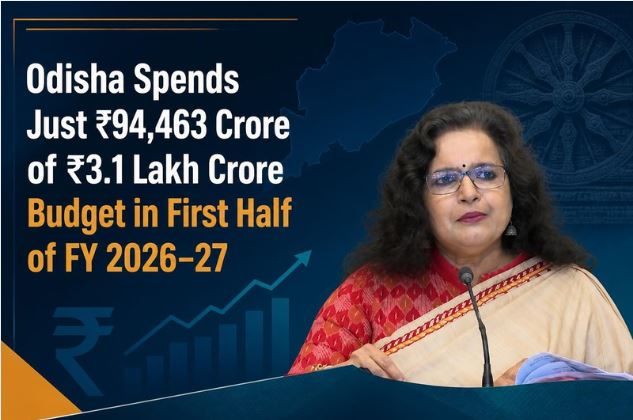
Odisha Spends Just INR 94,463 Crore of INR 3.1 Lakh Crore Budget in First Half of FY 2026–27
Bhubaneswar, Oct 14 (UDN): Odisha spent ₹94,463 crore, roughly 30 per cent of its ₹3.1 lakh crore annual budget, during the first six months of the 2026–27 financial year, with capital expenditure remaining significantly below the yearly target.
Representational Image
The expenditure figures were presented by the Finance Department at a recent meeting of departmental secretaries, prompting directions to accelerate spending and remove bottlenecks delaying the implementation of development projects.
Capital Expenditure Lags Behind
Of the ₹1.8 lakh crore allocated for programme expenditure in the current financial year, the state had spent ₹58,508 crore by the end of September, according to reports.
Capital expenditure stood at ₹18,183 crore against the annual allocation of ₹72,100 crore, meaning roughly one-fourth of the planned amount had been utilised in the first half of the financial year.
Meanwhile, expenditure on establishment, operations and maintenance declined by around 4.1 per cent in absolute terms compared with the corresponding period last year.
CAG Flags Persistent Underspending
The latest figures come against the backdrop of a Comptroller and Auditor General (CAG) report highlighting substantial budgetary savings over five financial years.
Between 2020–21 and 2024–25, Odisha reportedly underspent its capital outlay by an average of 17 per cent and its overall budget by 20 per cent. Savings against budgetary provisions ranged from 17.7 per cent to 25.98 per cent during the period.
The state budget expanded from ₹1,67,663 crore in 2020–21 to ₹2,87,770 crore in 2024–25, an increase of 71.64 per cent. The figures raise questions about the pace at which budget allocations are being translated into actual expenditure and completed projects.
Vacancies and Delays Cited as Key Challenges
Amarendra Das, associate professor at the National Institute of Science Education and Research (NISER), attributed lower-than-expected expenditure partly to vacancies in government departments and delays in the release of central funds.
Administrative hurdles, including delays in preparing detailed project reports (DPRs), tender finalisation, committee appraisal and Cabinet approvals, have also been identified as areas requiring attention.
Departments Told to Accelerate Spending
Chief Secretary Anu Garg has directed departmental secretaries to closely monitor expenditure and speed up the implementation of schemes, particularly those involving programme and capital spending.
Engineering departments have been asked to expedite project execution and achieve at least 10 per cent growth in expenditure over the next six months.
Officials have also been instructed to identify implementation bottlenecks, resolve pending approvals on priority and fix accountability for avoidable delays.
With the financial year entering its second half, the focus will be on whether departments can accelerate spending and ensure that budgetary allocations translate into timely infrastructure development and public services.
14, Oct 2026
Odisha CM Launches 46 Projects Worth INR 39,382 Crore, 42,500 Jobs Expected
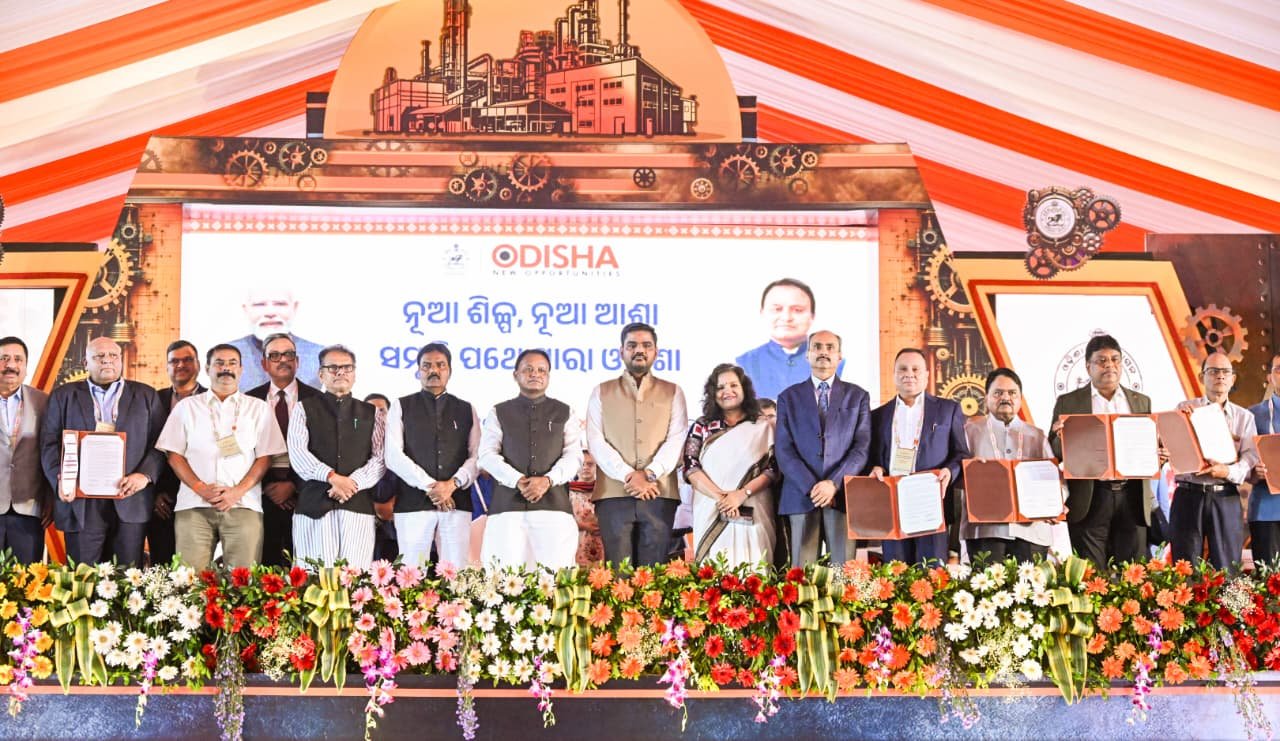
Jajpur, Oct 14 (UDN): Odisha Chief Minister Mohan Charan Majhi on Wednesday inaugurated and laid the foundation stones for 46 industrial and development projects worth ₹39,382 crore, with the investments expected to generate around 42,500 employment opportunities across the state.
Pic Credit: x.com/IPR_Odisha
The projects were unveiled at a major groundbreaking and inauguration ceremony in the Kalinganagar industrial hub of Jajpur district, bringing together government officials and industry representatives to discuss investment plans, project implementation and future industrial expansion.
Investments Across 14 Districts
The projects will be spread across 14 districts—Angul, Bargarh, Balasore, Boudh, Cuttack, Dhenkanal, Jajpur, Jagatsinghpur, Kendujhar, Khordha, Mayurbhanj, Puri, Sambalpur and Sundargarh.
They cover a diverse range of sectors, including steel and metals, chemicals, renewable energy, food processing, biofuels, textiles, electronics, IT services, logistics, tourism, healthcare, shipbuilding, energy storage, rubber and plastics, and circular economy initiatives.
The investments are expected to strengthen Odisha’s industrial ecosystem while creating opportunities for local businesses, micro, small and medium enterprises (MSMEs) and entrepreneurs.
Employment and Local Economic Growth in Focus
The Chief Minister’s initiative is expected to generate jobs for skilled and semi-skilled workers, particularly young people. Beyond direct industrial employment, the projects could also create demand for construction workers, transport operators, logistics providers and other supporting services.
Officials and industry representatives are also expected to hold discussions on project execution, address investors’ concerns and explore opportunities to attract further investments into Odisha.
Security Tightened for CM’s Visit
Elaborate security arrangements were put in place for Majhi’s visit to Kalinganagar. According to reports, 22 platoons of police personnel, 100 home guards and around 150 police officers of different ranks were deployed to maintain law and order during the event.
The latest project launch marks another push by the state government to expand industrial activity beyond established hubs and position Odisha as a competitive destination for investment. The actual employment impact will depend on the timely implementation and operationalisation of the projects.


