


25, Jun 2026
PM Modi to Visit Seychelles for Golden Jubilee Celebrations of National Day
June 25: Prime Minister Narendra Modi is scheduled to visit Seychelles to attend the Golden Jubilee celebrations of the country’s National Day, marking an important milestone in India–Seychelles bilateral relations.
The visit is expected to further strengthen diplomatic ties between the two nations and reinforce ongoing cooperation in areas such as maritime security, trade, development partnership, and regional stability in the Indian Ocean region.
During the visit, the Prime Minister will participate in official commemorative events and hold discussions with the leadership of Seychelles on ways to expand and deepen bilateral engagement. The two sides are also expected to review progress in existing partnerships and explore new avenues of collaboration.
Officials note that India and Seychelles share long-standing and friendly relations built on mutual trust, shared democratic values, and close maritime connectivity. The visit underscores India’s continued commitment to strengthening ties with Indian Ocean island nations and enhancing regional cooperation.
The Golden Jubilee celebrations of Seychelles’ National Day mark 50 years of the country’s national journey, and India’s participation highlights the importance it places on its partnership with Seychelles.
The visit is expected to add further momentum to bilateral relations and support broader cooperation in the Indian Ocean regio
- 0
- By Neel Achary

25, Jun 2026
IBM Pushes Semiconductor Limits with Sub-1 Nanometre Chip Innovation
June 25: IBM has announced a major breakthrough in semiconductor innovation with the development of a sub-1 nanometre chip architecture, marking a significant step forward in next-generation computing technology.
The new advancement is designed to deliver higher performance while using less energy, addressing the growing global demand for faster and more efficient computing systems. By pushing beyond traditional scaling limits, the technology represents a major milestone in chip design and engineering.
IBM stated that the breakthrough leverages advanced fabrication techniques aimed at improving transistor density and overall chip efficiency. This could help unlock new possibilities in areas such as artificial intelligence, cloud computing, data processing, and scientific research.
Experts believe this development may reshape the future of the semiconductor industry, as companies continue to seek more powerful and energy-efficient solutions to support increasingly complex digital workloads.
The innovation also highlights the rapid pace of progress in chip technology, where even small improvements in size and efficiency can lead to significant gains in computing power and performance.
IBM’s latest announcement reinforces its position as a key player in advanced semiconductor research and next-generation computing solutions.
25, Jun 2026
Russia Considers Gasoline Imports from India Amid Refinery Disruptions: Report
June 25: Russia is reportedly exploring the possibility of importing gasoline from India as it navigates temporary disruptions in its domestic refinery operations, according to recent reports.
The development highlights emerging energy trade dynamics between the two countries, with India’s refining capacity increasingly positioned as a potential source of supply in global fuel markets. India, one of the world’s largest refining hubs, has expanded its export capabilities in recent years, supplying petroleum products to multiple international markets.
The report suggests that refinery disruptions in Russia have created short-term supply pressures, prompting considerations for alternative sourcing options to ensure stable domestic fuel availability. In this context, India’s robust refining infrastructure and surplus production capacity have drawn attention as a viable option for meeting demand.
Industry observers note that any potential fuel trade between India and Russia would reflect broader shifts in global energy flows, where refining capacity and export flexibility are becoming key strategic assets. Such developments could also strengthen energy trade ties between the two nations.
Experts believe that India’s growing role in global petroleum product markets underscores its importance as a reliable energy supplier, particularly in times of regional supply constraints.
The report reflects ongoing changes in global energy supply chains and highlights the increasing interconnectedness of fuel markets across regions.
25, Jun 2026
India Monitoring 1,987 Major Infrastructure Projects Across Key Sectors
June 25: The Government of India is currently monitoring 1,987 ongoing infrastructure projects with a total investment value of approximately ₹42.50 lakh crore, reflecting the country’s large-scale focus on infrastructure-led development.
The initiative aims to ensure timely execution, improved efficiency, and better coordination across various infrastructure sectors, including transport, energy, urban development, and logistics. Regular monitoring is being carried out to address delays, resolve implementation challenges, and enhance project delivery outcomes.
Officials noted that infrastructure development remains a key priority for the government, as it plays a crucial role in driving economic growth, generating employment, and improving connectivity across regions. The large number of ongoing projects highlights the scale and ambition of India’s long-term development strategy.
According to available details, the monitoring framework is designed to strengthen accountability and ensure that projects progress as planned. This is expected to help reduce cost overruns and improve overall implementation efficiency.
Experts believe that successful execution of such large-scale infrastructure projects will significantly contribute to India’s economic expansion and support its long-term growth trajectory. Improved infrastructure is also expected to boost industrial activity and enhance ease of living for citizens.
The statement reinforces the government’s continued emphasis on infrastructure development as a key pillar of national economic progress.
25, Jun 2026
India’s Growth Driven by Resilience, Learning and Ambition: Piyush Goyal
June 25: Union Minister Piyush Goyal has said that India’s growth journey continues to be shaped by resilience, a strong culture of learning, and national ambition.
He noted that India has consistently shown the ability to adapt to global challenges while maintaining steady economic progress. This resilience, he said, has played a key role in strengthening the country’s position in the global economy.
Goyal further emphasized that continuous learning and innovation are central to India’s development model. He highlighted that individuals, businesses, and institutions are increasingly embracing new ideas and improving their capabilities, which is helping drive competitiveness and long-term growth.
He also said that ambition at all levels of society is contributing to India’s rapid progress. According to him, this collective drive is enabling the country to expand opportunities and move steadily toward its long-term development goals.
Experts believe that India’s growth story reflects a combination of strong domestic demand, policy reforms, and a dynamic workforce, which together are supporting sustained economic momentum.
The statement reinforces India’s positioning as a resilient and fast-growing major economy focused on innovation, adaptability, and long-term vision.
25, Jun 2026
ACPET and Tata Power-DDL Partner to Accelerate Research and Innovation for India’s Energy Transition
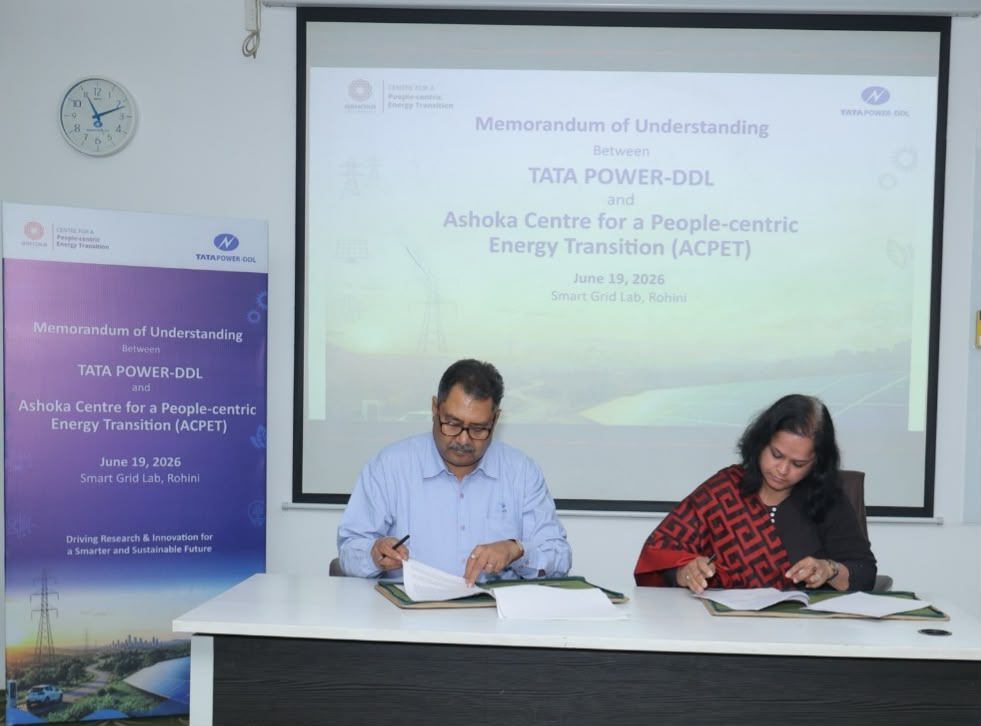
New Delhi, June 25: The Ashoka Centre for a People-centric Energy Transition (ACPET) and Tata Power Delhi Distribution Limited (Tata Power–DDL) have signed a five-year Memorandum of Understanding (MoU) to advance research, innovation, and capacity building in the domain of the energy and power sector, and to create innovative solutions to support India’s overall energy transition.
The partnership brings together ACPET’s expertise in research, data analysis, energy policy, and sustainable transitions with Tata Power–DDL’s operational experience as one of India’s leading power distribution entities. Through this collaboration, the two organisations will jointly undertake research, technology demonstrations, policy engagement, and knowledge-sharing initiatives to build a more sustainable, secure, and equitable energy future.
The collaboration comes at a critical time for India’s power sector, which is witnessing rapid technological and regulatory transformation. The expansion of renewable energy, rising electricity demand, rising consumer expectations, and the need for resilient, low-carbon infrastructure require closer collaboration between academia and industry. Emerging areas such as smart grids, electric vehicles, distributed energy resources, energy storage, demand-side management, and consumer engagement require new knowledge, practical insights, and opportunities for testing and demonstrating innovative approaches. This MoU creates a structured platform through which ACPET and Tata Power–DDL can jointly explore these opportunities and contribute to advancing industry knowledge and best practices.
As part of the collaboration, ACPET and Tata Power–DDL will jointly pursue research, innovation, customer engagement and capacity-building initiatives aimed at advancing India’s energy transition. The partnership will focus on undertaking research projects, developing policy briefs and technical reports, and generating evidence-based insights to inform industry practices and policymaking.
The collaboration will focus on joint research and learning in emerging areas such as smart grids, electric vehicles, distributed energy resources, energy storage, demand-side management, and design innovative regulatory and business models. The partners will also undertake technology demonstrations, organise expert dialogues and training programmes, facilitate knowledge exchange, and explore the establishment of a Centre of Excellence to drive innovation and strengthen institutional capabilities in the power sector.
Commenting on the partnership, Dr. Praveer Sinha, CEO & Managing Director, Tata Power, said, “India’s energy transition presents a unique opportunity to bring together research, policy, innovation and real-world implementation. As the sector evolves over the coming years, meaningful progress will depend on stronger collaboration between academia, industry, policymakers, startups and innovators. This partnership between Tata Power‘s distribution arm in Delhi and ACPET creates a unique platform that combines academic rigour, policy expertise and industry experience to address emerging energy challenges and develop practical, scalable solutions for the power sector.”
Vaibhav Chowdhary, Director, ACPET, said, “Technology alone will not deliver India’s energy transition – the human capacity to deploy, operate, and innovate around that technology is equally decisive. This partnership between Tata Power–DDL and ACPET brings together operational depth and research rigour to address both. Our shared goal is to co-create an energy system that is empirically grounded, practically tested, and designed to be sustainable, secure, and equitable for India and the Global South.”
Rakesh Kacker, Senior Advisor, ACPET, said, “India’s electricity sector is undergoing a profound transformation. We want renewable energy to scale rapidly, but we also recognise that transitions of this magnitude are shaped by historical realities, market dynamics, and technological constraints. This is where a collaboration between ACPET and Tata Power can be especially powerful. ACPET brings academic rigour and robust analytical tools, while Tata Power contributes invaluable insights from implementation on the ground. Together, we can bridge evidence and practice to shape more effective pathways for India’s energy transition.”
Dwijadas Basak, CEO, Tata Power Delhi Distribution Limited (Tata Power–DDL), said, “The power sector is undergoing a fundamental transformation driven by rapid technological advancements, growing renewable energy integration, distributed energy resources, and evolving consumer expectations. In this dynamic environment, research-led insights and evidence-based policy support are critical to shaping the future of the sector. Our partnership with ACPET will bring together industry experience and academic excellence to develop innovative solutions, strengthen policy and regulatory frameworks, and contribute meaningfully to India’s energy transition journey.”
As part of the collaboration, Tata Power–DDL will support dedicated research personnel and provide infrastructure access, while both institutions will jointly design and implement research projects, consumer awareness programmes, and dissemination of research outcomes. A Joint Steering Committee comprising representatives from both organisations will provide strategic oversight and guide future activities.
The collaboration reflects a shared commitment by ACPET and Tata Power–DDL to address the complex technological, regulatory, and societal dimensions of the energy transition. By fostering innovation and translating research into practice, the partnership aims to contribute to India’s vision of a sustainable and secure energy future.
25, Jun 2026
Nagpur Airport to Power Development Across Central India: Nitin Gadkari
June 25: Union Minister Nitin Gadkari has said that Nagpur Airport is set to play a key role in driving economic growth across Central India, supported by ongoing infrastructure development and improving connectivity.
He highlighted that Nagpur’s central location gives it a natural advantage to emerge as an important aviation and logistics hub in the coming years. With continued upgrades and expansion, the airport is expected to strengthen regional connectivity and support faster movement of passengers and cargo.
According to the Minister, improved airport infrastructure will help boost trade, tourism, and industrial activity across surrounding regions. He added that better air connectivity will make Central India more accessible and attractive for investment and business expansion.
The planned developments at Nagpur Airport include capacity enhancement, improved passenger facilities, and upgraded cargo operations, aimed at meeting future demand and improving efficiency.
Experts believe that the airport’s growth could generate new employment opportunities and support allied sectors such as logistics, warehousing, and tourism, contributing to overall regional development.
The statement reflects the government’s continued focus on infrastructure-led growth as a key driver of economic development in India.
25, Jun 2026
MAHE Ranked Global No. 1 for SDG 5 in THE Impact Rankings 2026
June 25: The Manipal Academy of Higher Education (MAHE) has achieved outstanding global recognition in the Times Higher Education (THE) Impact Rankings 2026, securing the World No. 1 position for Sustainable Development Goal (SDG) 5: Gender Equality.
This remarkable achievement highlights MAHE’s continued commitment to promoting inclusivity, gender equity, and empowerment of women across all levels of its academic and institutional ecosystem. The ranking reflects the university’s strong performance in implementing policies, initiatives, and practices that support equal opportunities and foster a safe, inclusive, and supportive environment.
According to the THE Impact Rankings assessment, SDG 5 evaluates institutions based on their contribution to gender equality through teaching, research, leadership representation, institutional policies, and community engagement. MAHE’s top global position underscores its leadership in advancing these critical parameters on an international scale.
University officials attributed this milestone to sustained efforts in strengthening diversity-focused policies, enhancing participation of women in education and leadership, and integrating gender equality principles into academic and administrative frameworks. The recognition also reflects MAHE’s broader vision of aligning higher education with the United Nations Sustainable Development Goals (SDGs).
Experts note that this achievement further strengthens MAHE’s global academic reputation and reinforces India’s growing presence in international sustainability-focused university rankings. It also positions the institution as a leading contributor to global conversations on equality, inclusion, and sustainable development in higher education.
MAHE’s success in the THE Impact Rankings 2026 demonstrates its ongoing commitment to academic excellence combined with social responsibility, innovation, and global impact.
25, Jun 2026
Sensex and Nifty End Marginally Higher Despite Late Selling Pressure
June 25: Indian equity benchmarks closed marginally higher in a volatile trading session, as early gains were partially erased by late selling pressure. Despite intraday fluctuations, both Sensex and Nifty managed to end in positive territory, reflecting a cautious yet stable market sentiment.
The session witnessed a strong start, supported by selective buying across key sectors. However, profit booking in the latter half of the trading day weighed on overall momentum, leading to a moderation in gains by the close of trade.
Market participants observed that investor sentiment remained mixed amid global cues and ongoing domestic developments. While some sectors showed resilience, others faced selling pressure, resulting in a narrow trading range for most of the session.
Analysts noted that the market continues to be driven by stock-specific movements, with investors focusing on corporate earnings, macroeconomic indicators, and global market trends. The overall trend, however, indicates underlying strength in the broader market despite short-term volatility.
Experts suggest that cautious optimism persists among investors, with a focus on quality stocks and long-term positioning. The ability of the indices to hold gains despite late-session weakness is seen as a sign of continued market resilience.
25, Jun 2026
India-Led BRICS Initiative Launches Digital Centre of Excellence for Smart Grids and Energy Storage
June 25: Marking a significant milestone in international energy cooperation, BRICS nations have officially launched a Digital Centre of Excellence (DCoE) dedicated to Smart Grids and Energy Storage under India’s chairmanship. The initiative is aimed at fostering innovation, knowledge-sharing, and technological collaboration among member countries in the rapidly evolving energy sector.
The newly established Centre of Excellence will serve as a collaborative platform for research, capacity building, and the exchange of expertise in smart grid technologies and advanced energy storage systems. The initiative is expected to support the modernization of power infrastructure and facilitate the integration of renewable energy sources across BRICS economies.
The launch underscores the collective commitment of BRICS nations to strengthening energy security, promoting sustainable development, and accelerating the adoption of digital technologies in the energy sector. By encouraging cooperation among governments, industry stakeholders, and research institutions, the Centre will help address emerging challenges related to energy transition and grid resilience.
India’s leadership in establishing the Digital Centre of Excellence reflects its growing role in advancing global clean energy initiatives and promoting technology-driven solutions for sustainable growth. The Centre is also expected to support policy development, skill enhancement, and innovation-led partnerships among member countries.
As energy systems worldwide undergo rapid transformation, the BRICS Digital Centre of Excellence is poised to become an important hub for collaboration, helping member nations build smarter, more efficient, and sustainable power networks for the future.


