
21, Feb 2026
From Burnout to Alignment: Why Inner Healing Is Gaining Attention in Uncertain Times
BLACK MOUNTAIN, N.C., Feb. 21 — Burnout, uncertainty, and a growing sense of disconnection have fueled a surge in spiritual curiosity — particularly practices that promise inner alignment rather than external fixes. In The Akashic Way: Living Through the Lens of the Akashic Records, three-time Emmy Award-winning director and advanced Akashic Records practitioner Mary Madeiras explores why so many people are searching inward for clarity, affirmation, and healing.
After decades spent shaping stories for millions of viewers, Madeiras now invites readers into a different kind of narrative — one rooted in the Akashic Records, a quantum divine field believed to contain the energetic imprint of every soul’s journey through time. Rather than offering another roadmap for self-improvement, The Akashic Way reframes healing as an act of remembering and reconnecting with the deeper truth of who we are and why we are here.
“We can actually access our own journey — our own soul’s imprint — for every incarnation,” Madeiras explained.
Drawing from her own Akashic experiences and client sessions, Madeiras shows how working within the Records consistently creates alignment — emotionally, spiritually, and energetically. “It’s like having a conversation with the higher, divine aspect of yourself,” she said. “And when we’re aligned, the world becomes more aligned.” The result, she believes, is clarity, affirmation, and self-empowerment — tools urgently needed in a fragmented, fast-moving world.
The Akashic Way touches upon the many challenges that pull people away from connecting with their intuition and inner love — relationship struggles, traumas, unresolved patterns, and health issues. Madeiras shows how anyone can access this deeper guidance to create meaningful change and awaken that inner love. Her personal Akashic exchanges — woven with messages for humanity — offer readers the opportunity to reflect on their life’s purpose. The wisdom from the Akashic Realm is a profound tool for rediscovering purpose, trusting intuition, and learning to live through love and intention.
As Madeiras writes, “I titled this book The Akashic Way because I believe that living life through the Akashic Records is a path back to ourselves — a way to remember who we are, why we chose to come here, and what we are here to do. When we view our life through our own Akashic lens, we experience self-empowerment in the most profound way.”
The Akashic Way: Living Through the Lens of the Akashic Records
Publisher: Precocity Press
ISBN-13: 979-8993115092 (Paperback)
ISBN-13: 979-8993115047 (Kindle)
- 0
- By Neel Achary

21, Feb 2026
Archon Group Builds Grand Temple in Kakarai as Tribute to Faith and Community
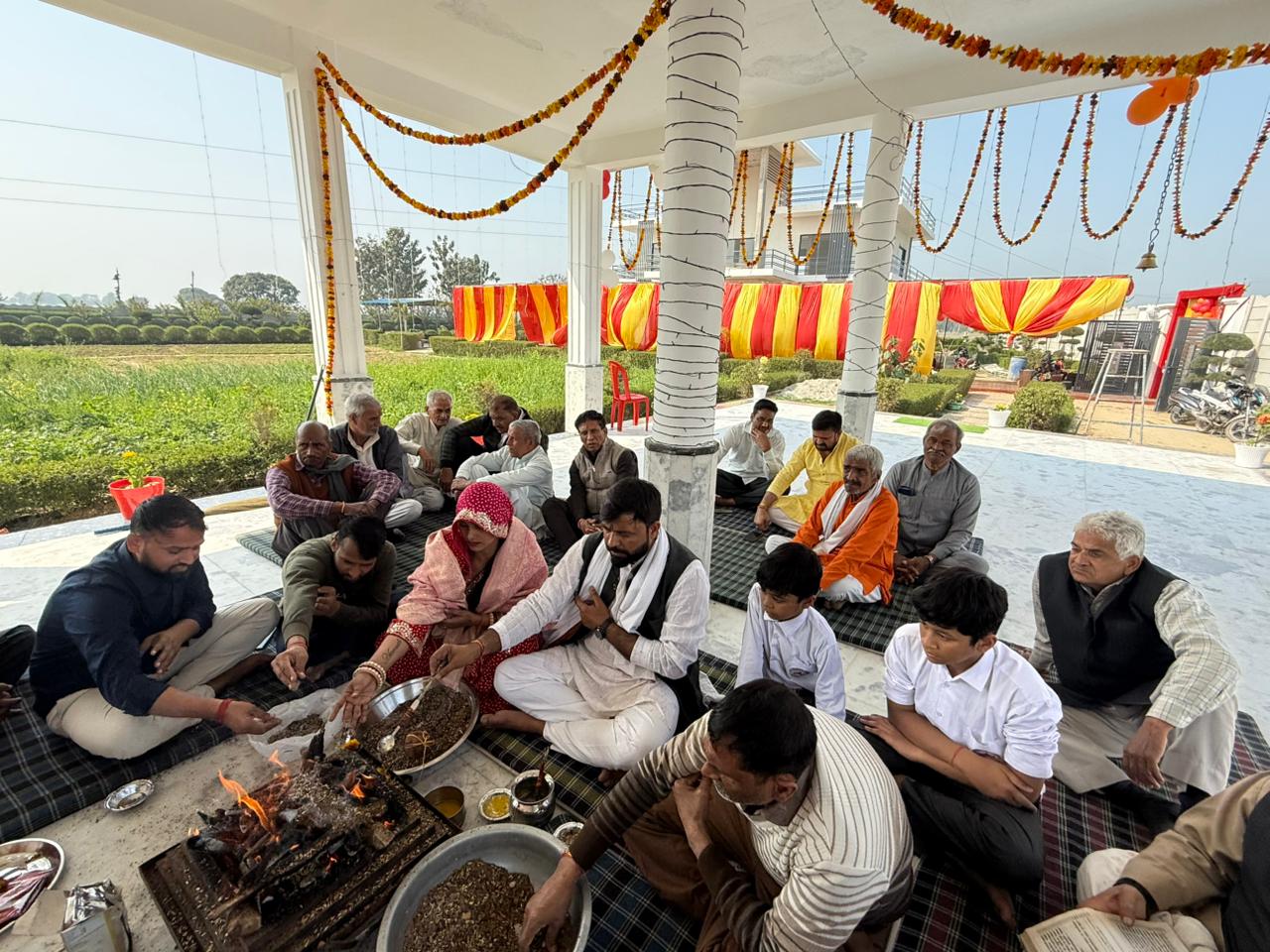
Feb 21: Bulandshahr: In a gesture rooted in social responsibility and deep spiritual devotion, Kapil Sharma, founder of Archon Group, along with his father Momraj Sharma, has constructed a grand new temple at Shankar Farm on the Jadol Canal in Gram Panchayat Kakarai, Bulandshahr.
The temple was officially inaugurated on February 20 through a traditional pran pratishtha (idol consecration) ceremony in accordance with the Vedic ritual. The event was attended by hundreds of followers of Kakarai and surrounding towns to observe the most impressive ceremony that consisted of mantras, havan and other religious rituals that gave the whole region a spiritual experience.
The new temple has idols of the Shiva family, Radha- Krishna, Ram- Lakshman, Maa Sita, Maa Durga and Lord Hanuman. Before the consecration, there was a colorful Kalash Yatra and a big procession, which was implemented throughout the village, and the women attended it in large numbers, contributing to the devotion.
A native of Bulandshahr (currently a renowned industrialist with his location being Ahmedabad) Kapil Sharma spoke of the temple as a simple form of paying a debt of gratitude to the town of his birth. The initiative also indicates how committed the family is towards spiritual values but also community development and social harmony.
After the rituals, a community feast (bhandara) was arranged, during which the villagers and the devotees attended the feast in huge numbers. The people in Kakarai praised the work done by Kapil Sharma and Momraj Sharma labeling the temple as an eternal beacon of beliefs, community and cultural identity
The locals assume that the temple shall be a spiritual and cultural center to the generations to come as a way of boosting the principles of devotion, unity and social accountability in the area.
20, Feb 2026
HE DATO Dr. Bhargav Mallappa & HE DATO Dr. S. Selvaganesh Selvaraj Ink Kampung Bharu 2.0 Twin-Tower MoU
Indian Investor & Entrepreneur HE DATO Dr Bhargav Mallappa & HE DATO Dr S. Selvaganesh Selvaraj Meets Yam Raja Izzuddin Iskandar Shah Al-Haj Ibni Almarhum Sultan Idris Afiffullah Shah, Seeks Blessings for Kampung Bharu 2.0 Project
Signs Major MoU to Speed Up Iconic Twin-Tower Plan, Boost FDI, Create High-Value Jobs, Modernize City Infrastructure, and Strengthen Malaysia–India Ties
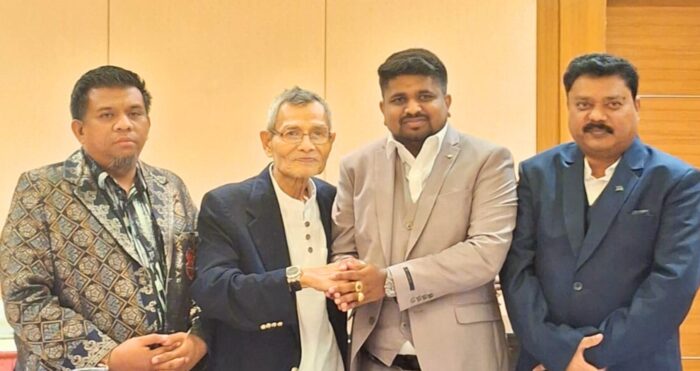
Malaysia / India, Feb 20: HE DATO Dr Bhargav Mallappa, a prominent Indian investor and entrepreneur from the MBRA Group, along with HE DATO Dr S Selvaganesh Selvaraj, recently met Yam Raja Izzuddin Iskandar Shah Al-Haj Ibni Almarhum Sultan Idris Afiffullah Shah, a Member of the Malaysian Royal Family (Perak), on February 15 at the Mid Valley Hotel in Kuala Lumpur.
During the meeting, HE DATO Dr Bhargav Mallappa sought His Highness’s blessings for the ambitious Kampung Bharu 2.0 redevelopment project. The discussion focused on shared vision, mutual respect, and long-term cooperation aimed at transforming one of Kuala Lumpur’s oldest and most historic neighbourhoods.
Following the meeting, a major strategic partnership was formalized with DSAT Private Equity Sdn. Bhd., under which HE Dato Dr Bhargav Mallappa is committing substantial investment to accelerate the redevelopment initiative. A key highlight of the project is the proposed iconic twin-tower development, designed to redefine the city’s skyline while carefully preserving the cultural and historical identity of Kampung Bharu.
As part of the agreement, HE DATO Dr Bhargav Mallappa has acquired equity in DSAT Private Equity Sdn. Bhd., a company licensed and regulated by the Securities Commission Malaysia. The regulated structure ensures that all investments follow strict legal, regulatory, and governance standards, maintaining full transparency and accountability.
Speaking about the initiative, HE DATO Dr Bhargav Mallappa said:
“Malaysia stands out for its economic resilience, stable governance, and vast opportunities in urban transformation. Kampung Bharu 2.0 presents a unique opportunity to create a landmark that honors heritage while embracing modern progress. Our commitment is to invest responsibly, transparently, and with a long-term development vision.”
Adding to this, HE DATO Dr. S Selvaganesh Selvaraj stated:
“This collaboration reflects the growing strength of Malaysia–India partnerships in strategic development. By combining international expertise with local vision, we aim to contribute meaningfully to sustainable growth, job creation, and long-term economic value.”
Welcoming the engagement, Yam Raja Izzuddin Iskandar Shah Al-Haj Ibni Almarhum Sultan Idris Afiffullah Shah said:
“We appreciate the confidence shown by international investors in Malaysia’s growth story. Development must be forward-looking while respecting our cultural roots. Initiatives like Kampung Bharu 2.0 have the potential to generate economic value, create skilled employment, and further strengthen Malaysia–India relations.”
The partnership is expected to attract foreign direct investment (FDI), create high-value jobs, upgrade urban infrastructure, and deepen economic ties between Malaysia and India, while supporting inclusive and sustainable national development goals.
20, Feb 2026
Aditya Mehta Foundation Para Cyclists Shine at Para Track Cycling National Championship.

Hyderabad, Feb 20: Para cyclists trained under the Aditya Mehta Foundation (AMF) delivered an outstanding performance at the Para Track Cycling National Championship, held today at the Cycling Velodrome, O.U. Campus, Hyderabad, securing an impressive haul of 18 Gold and 3 Silver medals across multiple events.
The championships featured intense competition in Individual Pursuit, Time Trial, and Sprint, where AMF athletes showcased exceptional performance, resilience, and competitive excellence against the best para cyclists from across the country.
Medal Winners
MC1 Category – Anshuman (15 years), Maharashtra – 3 Gold Medals
MC2 Category – Arshad, Andhra Pradesh – 3 Gold Medals
MC2 Category – Aryavardhan, Telangana – 3 Silver Medals
MC3 Category – Pawan, Andhra Pradesh – 3 Gold Medals
WC3 Category – Vishva (16 years), Gujarat – 3 Gold Medals
MC4 Category – Sameer (16 years), Uttar Pradesh – 3 Gold Medals
MC5 Category – Aabid (17 years), Jammu & Kashmir – 3 Gold Medals
The athletes demonstrated remarkable determination, discipline, and sporting excellence, reaffirming Aditya Mehta Foundation’s commitment to nurturing world-class Indian para-cycling talent and creating pathways for international success.
The Foundation extends its sincere gratitude to its valued supporters Alcon, GMMCO, Invesco, and Flutter Entertainment India for their continued partnership in empowering para-athletes and enabling them to achieve excellence at national and global platforms.
20, Feb 2026
It Is Time to Exit the Macaulay Mindset and Lead India into Viksit Bharat — Dharmendra Pradhan
Dharmendra Pradhan Announces Conversion of SRCC GBO Diploma into Full-Fledged Master’s Degree Programme at Yugantar ’26
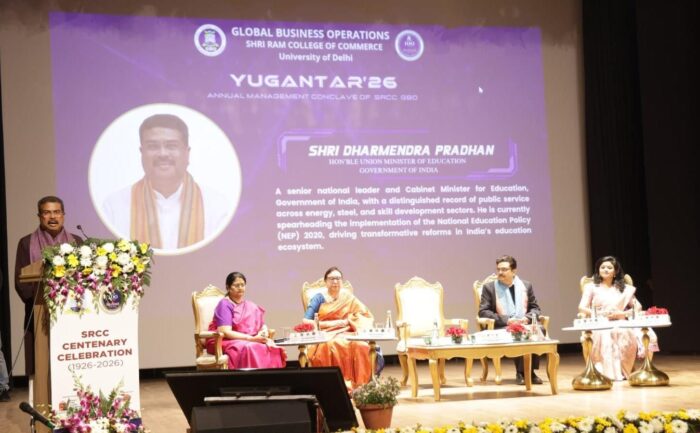
Feb 20| New Delhi: The Education Minister on Friday called on institutions to “exit the Macaulay doctrine” and align higher education with the vision of Viksit Bharat, and announced the conversion of SRCC’s Post Graduate Diploma in Global Business Operations (PGDGBO) into a full-fledged Master’s degree programme.
He made these remarks while inaugurating Yugantar ’26, the Annual Management Conclave of SRCC’s Post Graduate Diploma in Global Business Operations (PGDGBO), themed “AI for Sustainability & Startup Innovation.”
The inaugural session at the Shridhar Shriram Auditorium was graced by Dharmendra Pradhan, Hon’ble Union Minister of Education, Government of India, as the Distinguished Chief Guest. The ceremony was presided over by Prof. Yogesh Singh, Vice-Chancellor, University of Delhi, and hosted by Prof. Simrit Kaur, Principal, SRCC. Senior faculty members, industry leaders, alumni, and students attended the event, along with Dr. Misha Govil, GBO Coordinator, SRCC; Dr. Sapna Bansal, Convener, Yugantar 2026; and Dr. Sunita Sharma, Co-Convener, Yugantar 2026.
The programme opened with a tribute to Sir Shri Ram, followed by the ceremonial lighting of the lamp.
“We Must Not Be Afraid to Accept Change”
In his keynote address, the Education Minister described the National Education Policy (NEP) as a structural reset of India’s academic framework.
“We have to get out of the Macaulay doctrine that enslaved India academically. The National Education Policy, envisioned by Prime Minister Modi ji, will ensure that Bharat becomes a Vishwa Guru. Institutions like SRCC must lead this transformation. SRCC is sowing the seeds to achieve the vision of Viksit Bharat.”
He emphasised technological sovereignty and institutional reform: “In this age of technology, the nature of competition has fundamentally changed. We know that change is needed — but we must not be afraid to accept it. India must move toward sovereign AI ecosystems, strengthening institutions like IIT Madras and IIT Bombay, and building indigenous capabilities so that Bharat becomes a leader in Artificial Intelligence.”
He urged higher education institutions to embed research, patents, startup incubation, and AI-led innovation into their academic structures.
PGDGBO to Be Upgraded into Master’s Degree Programme
The Education Minister announced that SRCC’s two-year Post Graduate Diploma in Global Business Operations (PGDGBO), offered by Shri Ram College of Commerce, University of Delhi, will be converted into a full-fledged Master’s degree programme.
The transition is expected to strengthen academic recognition, align the programme with National Education Policy reforms, and enhance its global academic equivalence while integrating greater research and innovation components.
Universities Must Build Market-Ready Innovation
Vice-Chancellor Yogesh Singh said universities must convert research into commercially viable outcomes.
“Only three words can safeguard the future of young minds — innovation, creativity, and originality. Universities must go beyond publications; we must develop patents, prototypes, and commercially sustainable products.”
He cautioned institutions against resisting technological shifts and called for stronger university–industry collaboration.
AI Must Be Ethical and Inclusive
Principal Simrit Kaur said institutions must guide artificial intelligence with responsibility and human judgment.
“Artificial Intelligence has the capacity to shift both demand and supply curves, improving productivity and efficiency. But without the intelligence of humans, there is no optimal solution. AI must be coordinated with humanity and adopted responsibly.”
She added, “We are committed to viewing Artificial Intelligence as our destiny — ensuring that its growth remains inclusive, accountable, and sustainable.”
Day 1 of Yugantar ’26 featured corporate panels on AI-enabled sustainability, founder sessions on startup scaling, and case simulations across finance, marketing, analytics, HR, and international business.
The Education Minister also visited the Viksit Bharat Startup Expo 2026, where student-led ventures showcased innovation prototypes.
With the announcement of the Master’s degree upgrade for SRCC GBO and a push toward NEP-led reform and sovereign AI capabilities, Yugantar ’26 positioned SRCC within the broader roadmap toward Viksit Bharat 2047.
20, Feb 2026
Asia’s Protein Buyers Still Trail Global Best Practice — But Momentum is Building, New ARE Benchmark Finds
SINGAPORE, Feb 20 - Asia’s largest food retailers, manufacturers, restaurant chains, and hospitality groups remain behind international better practice on sustainable and responsible protein sourcing, but progress is accelerating across the region, according to The Asian Protein Buyers 100: An Assessment of Responsible and Sustainable Sourcing released today by Asia Research & Engagement (ARE).
The APB100 is a benchmark based on investor-backed priorities – assessing how 100 of Asia’s largest listed protein-buying companies — headquartered or operating across Hong Kong, India, Indonesia, Japan, Mainland China, Malaysia, Philippines, Singapore, South Korea, Taiwan, Thailand and Vietnam — manage environmental, social, and governance risks embedded in meat, dairy, poultry, and seafood supply chains. Collectively, the companies assessed represent more than USD500 billion in market capitalisation and sit at the choke point of Asia’s protein system, where procurement decisions shape production standards, risk management and food-system outcomes.
The companies assessed include some of Asia’s most recognisable food and retail groups. These include China Mengniu Dairy, Yili Group, Yonghui and Yum China (Mainland China); AEON, Seven & I Holdings, Meiji, Nissin and NH Foods (Japan); CJ CheilJedang, Lotte and E-Mart (South Korea); Charoen Pokphand Foods and Thai Union (Thailand); Jollibee, Century Pacific Food and San Miguel Food & Beverage (Philippines); Vinamilk (Vietnam); and Hindustan Lever, Nestle India, Jubilant, Devyani, DMart, Westlife Foodworld (McDonald’s India) (India), among others.
Scores are improving, but the baseline remains low
Now in its second edition, the benchmark shows clear momentum since 2023 — but also highlights that most companies remain at an early stage of credible implementation.
The average overall score increased from 9% in 2023 to 16% in 2025, with around 80% of companies improving year-on-year. More than half of comparable companies moved up at least one performance tier.
However, no company reached the top two performance tiers, underscoring a persistent gap between sustainability commitments and on-the-ground execution.
A growing group of leaders is emerging
The number of companies in the leading Tier 3 group more than doubled from 10 in 2023 to 26 in 2025, while the lowest-scoring group halved from 44 to 21 companies.
Progress, however, remains uneven and concentrated among a subset of early movers and sustainability themes, while a significant minority of companies continues to disclose little or nothing across several material risk areas.
Climate, labour, and waste are moving fastest
Companies performed strongest on Water & Waste, Labour , and Climate Change, reflecting wider uptake of international disclosure frameworks and growing expectations around supply-chain due diligence.
Climate and labour show the fastest improvement since 2023, driven by emerging regulatory pressure and investor scrutiny, particularly around Scope 3 emissions and labour standards in supply chains.
Governance and protein diversification remain critical gaps
Several material risk areas continue to show weak performance. Governance in relation to protein sustainability, remains the lowest-scoring theme, averaging just 4.5%, with most companies scoring zero. Few have board-approved protein sustainability strategies, capital allocation plans, or accountability mechanisms.
Protein diversification also remains underdeveloped at 7.4%, indicating that most companies have yet to articulate how they will shift product portfolios toward truly low carbon plant proteins at scale.
Disclosures on deforestation and biodiversity, animal welfare, and antimicrobial resistance (AMR) also remain thin and rarely quantified. The intersection of climate and deforestation is still not being duly harnessed. Similarly, policies and procurement practices that strengthen animal welfare and enable antibiotic reduction remain a low point, with average animal welfare performance at just 14.1% and only one company aligned with recognised higher-welfare standards or independently certified disclosure.
Why this matters: Asia is the decisive region for global protein systems
Compared with innovative international peers, many of Asia’s protein buyers remain behind on deforestation-free sourcing, antibiotic stewardship, higher-welfare policies and procurement, plant-protein targets and science-based climate transition planning.
However, Asia now represents the most important opportunity for global leadership in responsible protein systems. And with less than five years to implement meaningful change towards various 2030 United Nations and related targets, the vision of a more responsible and sustainable food system is at risk.
“Asia is the world’s fastest-growing protein market, which means what happens here will determine the future of global food systems,” said Kate Blaszak, ARE Director, Protein Transition. “ThisAPB100 shows that disclosure and awareness are improving and aims to trigger a shift from Policy to Practice. With a realm of better practice examples in the report to also assist companies, the next phase must focus on full supply-chain coverage, measurable targets, and annual progress with board-level accountability.”
20, Feb 2026
Judge India Solutions Plans Strategic Hiring Drive to Boost U.S. Staffing
Noida, Feb 20 : Judge India Solutions, a leading IT solutions company and the India arm of The Judge Group, today announced an active strategic hiring drive to expand its U.S. staffing team, reinforcing its role as a critical growth engine for the company’s global talent solutions business.
As part of this expansion, Judge India Solutions plans to onboard specialized recruiters across high-impact domains, including Information Technology, Engineering, Healthcare, Aerospace, and Banking, Financial Services, & Insurance (BFSI). The initiative is aligned with rising demand from U.S. enterprises for high-quality, domain-specific talent and reflects the company’s continued investment in building scalable, future-ready staffing capabilities.
On this announcement, Mr. Abhishek Agarwal, President – Judge India & Global Delivery at The Judge Group, said,
“Demand for specialized talent in the U.S. market is accelerating across multiple industries. This strategic hiring drive strengthens our ability to deliver speed, precision, and expertise to our clients, while reinforcing India’s role as a center of excellence for global staffing operations.
The company supports over 10,000 placements each year, partnering with many of the world’s most respected corporations, including 60 Fortune 100 companies. With over five decades of experience, Judge has evolved into a global organization with more than 30 offices across the United States, Canada, Europe, and India.
Established in 2016, Judge India Solutions serves as The Judge Group’s Center of Excellence (CoE) for technology-led innovation and talent delivery. The organization employs over 300 professionals across Noida, Bangalore, and Hyderabad, supporting global clients through technology, staffing, and consulting solutions.
This expansion underscores Judge India Solution’s growing importance in The Judge Group’s global delivery model, particularly in supporting U.S. staffing operations with specialised recruitment expertise, advanced sourcing strategies, and technology-enabled processes.
20, Feb 2026
MIT xPRO Equips Leaders to Move From AI Vision to Measurable Business Value
New Delhi, Feb 20: As artificial intelligence shifts from experimentation to enterprise-wide transformation, organizations are discovering that technology alone does not guarantee results. According to research by PwC, AI-exposed industries have experienced revenue per employee growth three times faster than others (27% vs 9%), while professionals with AI skills command a 56% wage premium. Yet, despite this momentum, 56% of companies report no measurable financial benefit from AI investments to date — highlighting a widening gap between ambition and execution.
Addressing this critical challenge, MIT xPRO’s advanced professional programs are empowering leaders to operationalize AI at scale by integrating strategy, data, and productization into sustainable business impact.
Bridging the Execution Gap
As organizations move beyond pilots and proof-of-concept experiments, the need for strategic alignment, decision-grade analytics, and production-ready AI products has become paramount. MIT xPRO’s portfolio of professional programs is designed to help leaders translate AI investments into enterprise-level value creation.
1. Lead With Strategic Clarity
Advanced Program in Technology Leadership and Innovation (TLIP)
AI initiatives often falter due to fragmented leadership and lack of cohesive strategy. The Advanced Program in Technology Leadership and Innovation equips senior executives to transform emerging technologies into enterprise-wide roadmaps aligned with measurable outcomes.
Participants gain:
- Executive ownership of AI-driven strategy
- Systems thinking for cross-functional execution
- Balanced innovation portfolio design
- Responsible technology governance frameworks
- Hands-on experience through immersive simulations and capstone projects
Ideal for: CXOs, VPs, founders, and senior leaders
Duration: 9 months
2. Turn Data Into Decisions
Post Graduate Program in Data Science and AI (DSAI)
In many organizations, analytics efforts remain confined to dashboards and models. The DSAI program focuses on embedding AI into core business decisions — from pricing and risk optimization to operational efficiency and forecasting.
Key outcomes include:
- Decision-oriented analytics frameworks
- Mathematical and AI-driven optimization capabilities
- Explainable and trustworthy AI foundations
- Hands-on experience with 25+ industry tools and libraries
- Capstone projects solving real-world business problems
Ideal for: Data professionals, analytics leaders, and tech managers
Duration: 9 months
3. Ship Products, Not Pilots
Building AI Products and Services (AIP)
Moving from concept to production remains one of the biggest hurdles in AI adoption. The AIP program equips teams with structured methodologies to design, validate, and launch AI-driven products that deliver tangible value.
Participants learn to:
- Apply a structured four-stage AI design framework
- Develop compelling business cases and risk assessments
- Select appropriate AI approaches — ML, deep learning, or generative AI — based on strategic fit
- Integrate human-centric design and adoption principles
- Explore emerging trends including agentic AI and Retrieval-Augmented Generation (RAG)
Ideal for: Technical product managers, engineers, UX leaders, and founders
Duration: 12 weeks
A Unified Approach to AI Transformation
Operationalizing AI is not solely a technical challenge — it is an organizational transformation imperative. Strategic clarity, data fluency, and product execution must work in tandem to unlock measurable value.
With AI adoption accelerating globally and organizations with deep AI integration seeing disproportionate competitive advantages, MIT xPRO’s complementary programs provide a structured pathway from experimentation to execution.
By combining rigorous academic foundations with applied, real-world learning, MIT xPRO continues to empower leaders to move decisively from AI vision to sustained business value.
20, Feb 2026
Prego at Westin Gurgaon Brings Italy to the Table with New Sunday Brunches

The Westin Gurgaon, New Delhi invites guests to slow down their weekends with the launch of Sunday Brunches at Prego, a refined Italian dining experience curated by Expat Chef Davide Di Domenico. Designed as an elegant yet leisurely escape, the brunch brings together soulful Italian flavours, artisanal craftsmanship, and the comforting warmth of a true Italian table.
Hosted every Sunday from 11:30 AM to 3:30 PM, the brunch celebrates Italy’s timeless culinary traditions where meals are unhurried, conversations linger, and indulgence is embraced without guilt. At the heart of the experience is Chef Davide’s passion for authentic Italian cooking, drawing from regional classics, handcrafted pastas, and wood-fired favourites.
Sunday Brunch at Prego
Every Sunday
Time : 11:30 AM – 3:30 PM
Venue : Prego, The Westin Gurgaon, New Delhi
20, Feb 2026
Thermography helps leading bike fitter find optimal cyclist position
One of the most advanced bike-fitting studios worldwide is tapping into the benefit of Flir thermal imaging technology to push the boundaries of sports science and biomechanics at all levels of cycling.
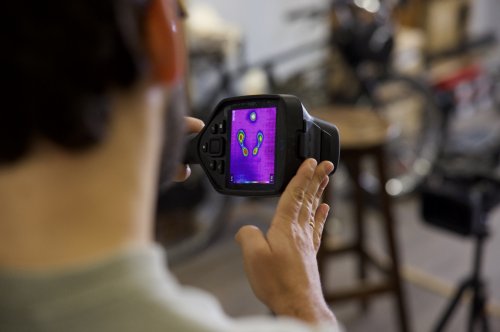
Located in Antwerp, Belgium, Bikefit Van Staeyen uses Flir-generated infrared images to visualize body heat and pressure distribution in real time, subsequently optimizing rider position and bike set up.
Bikefit Van Staeyen offers professional bike fitting based on more than 20 years of experience in cycling. Founded by brothers Kevin and Michael Van Staeyen (a former professional road racing cyclist), the business has built its success on extensive expertise in sports science, biomechanics and cycling. What started as a passion for precision and performance evolved into one of the world’s most advanced bike-fitting studios.
The principal differentiator of Bikefit Van Staeyen is its dual-expert approach: every bike fit is performed by both brothers working together, merging technical analysis and professional cycling experience with medical understanding.
“This synergy allows us to identify patterns and dysfunctions far beyond what conventional systems can capture,” explains Kevin.

Real-time insight
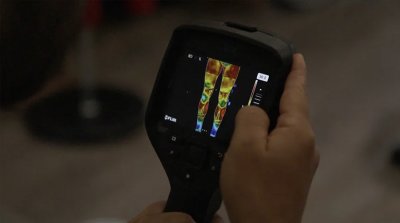
Central to the process is the use of advanced thermal imaging technology from Flir, which provides a real-time view into physiological asymmetries, pressure distribution, and underlying muscular imbalances.
“We use a Flir infrared camera to study a heat map of a rider pedaling to optimize body position and bike set up,” says Kevin. “By combining thermography with motion tracking, force analysis, and EMG [electromyographic] data, we can see what others can only guess: how the rider’s body reacts, compensates, and adapts under load. We’ve named our thermography application ‘Lava.flow’, a process that allows us to understand and optimize injury-prone areas, muscle activation, and pressure points in a completely new way.”
Bikefit Van Staeyen initially used a Flir E76 thermal imaging camera but has since migrated to the newer E96. The E96 is Flir’s first pistol-grip camera with 640 × 480 thermal resolution, allowing users to survey targets safely and quickly. This advanced sensor offers complete coverage of near and distant targets through a range of lens options. In addition, Flir Ignite provides the automatic uploading of E96 images directly from the camera to the cloud for easy, secure storage and sharing.
As pioneers in thermal analysis for cycling applications, Bikefit Van Staeyen works in close collaboration with Thermal Focus, a Flir Platinum Partner and stockist of the largest selection of Flir infrared cameras in the Benelux (Belgium, Netherlands, Luxemburg) region.
Temperature in focus
The hot spots and cold spots identified by Flir thermal cameras serve as direct indicators of how a cyclist’s body functions on the bike. An excessive temperature increase in certain areas can indicate overexertion, friction, or poor posture.
Using the Flir E96, Bikefit Van Staeyen can: detect hot spots and elevated pressure zones on the saddle, shoes, or handlebars; identify asymmetric muscle loading and unbalanced activation patterns; analyze vascular restrictions that may lead to numbness or reduced performance; and detect thermal irregularities that could indicate overload.
With this in-depth thermal analysis, the brothers are able to identify a range of issues that prompt adjustments for the optimal riding experience. For instance, asymmetric heat distribution around the kneecap points to a possible biomechanical problem, while too much heat in the ball of the foot typically means incorrect positioning of the cleat position. Similarly, increased temperature in the lower back could be the result of a compensatory mechanism or incorrect saddle adjustment.
“While traditional bike fits are often based on observation and feel, we use objective, data-driven measurements from the Flir thermal camera,” reveals Kevin. “Our Lava.flow process gives us unique, real-time insight into how a rider’s body responds while cycling. By way of example, we recently helped a cyclist experiencing unexplained knee pain during rides. Using our Flir infrared imaging technology, we observed excessive heat accumulation in the tibia [tibialis anterior muscle]. Thanks to the Flir imaging of this increased heat and our leg length software, we discovered that this leg was structurally shorter and that the rider had to pull the pedal excessively upward when cycling, resulting in knee pain.”
All levels of cyclist
Cyclists turning to Bikefit Van Staeyen for assistance range from dedicated amateurs to World Tour professionals. They trust the company for the same reason: attention to detail. From saddle pressure to neural load; from crank dynamics to thermal asymmetry – no variable is left unexplored. The company is also pioneering the bike-fit domain at university level, a first in Europe, by collaborating with the University of Antwerp to integrate data-driven approaches.
“We want to serve as the fundamental partner and reference point for thermal camera technology within the sport of cycling,” concludes Kevin. “Our ambition is to help shape the future of performance diagnostics, not just for our own athletes, but as a knowledge and technology hub for teams and riders worldwide. With our expertise and experience we can demonstrate the immense potential of thermography in biomechanical and performance analysis.”


