


7, May 2026
Government School Enrollment Falls to 49.24 pc in 2024–25, Private Sector Expands
New Delhi, May 7 (BNP): School enrollment in government institutions has declined to 49.24% in the 2024–25 academic year, while the private education sector continues to expand rapidly, according to concerns highlighted by NITI Aayog.

The findings point to a steady shift in student preference toward private schools, reflecting changing perceptions around quality of education, infrastructure, and learning outcomes. The trend indicates that private institutions are gaining a larger share of new enrollments compared to government schools.
According to the assessment, the decline in government school enrollment raises important concerns for the public education system, particularly in terms of equity and access. Since government schools play a crucial role in providing affordable education, especially in rural and lower-income segments, a continued drop in enrollment could widen educational disparities.
The report notes that the rapid growth of private schooling is reshaping India’s education landscape, with increased household spending on education and rising demand for alternative learning environments.
It further suggests that improving infrastructure, teacher availability, and learning outcomes in government schools will be critical to reversing the trend and restoring confidence in public education.
Overall, the data highlights a structural shift in India’s schooling system, where the balance between public and private education is gradually evolving, raising policy-level concerns about long-term accessibility and inclusiveness in the education sector.

- 0
- By Neel Achary

7, May 2026
AI and Data Modernisation Fuel India’s Tech Spending Boom, Transform Enterprise Digital Growth
New Delhi, May 7 (BNP): India’s technology spending is witnessing a strong upswing, driven primarily by rapid adoption of artificial intelligence (AI) and large-scale data modernisation across industries, according to a recent industry report.
The report notes that enterprises are increasingly prioritising investments in AI-powered tools, cloud infrastructure, and advanced data systems as they shift away from legacy IT setups toward more agile, scalable digital architectures.

A key driver of this trend is the growing need for real-time insights and automation. AI is helping businesses streamline operations, improve decision-making speed, and enhance customer experience through predictive analytics and intelligent process automation.
At the same time, data modernisation is emerging as a foundational requirement for digital transformation. Companies are upgrading fragmented legacy systems into unified, cloud-based data platforms that allow faster processing, better data governance, and improved integration across business functions.
According to the report, this dual shift is enabling organisations to build more resilient and efficient digital ecosystems. It is also helping enterprises across banking, healthcare, retail, manufacturing, and public services adopt more data-driven and technology-led operating models.
The transformation is expected to generate significant demand for cloud services, AI solutions, and cybersecurity frameworks, while also expanding opportunities for technology providers and startups in the digital infrastructure space.
Industry experts say this trend is not just increasing IT budgets but fundamentally reshaping how businesses operate, compete, and innovate in India’s fast-evolving digital economy.
Overall, the report suggests that AI and data modernisation are becoming central pillars of India’s technology growth story, laying the foundation for the next phase of enterprise digital transformation.
7, May 2026
India Set to Host Inaugural Edition of the World Yogasana Championship 2026 in Ahmedabad
Ahmedabad, May 07: In a significant milestone for the global Yogasana movement, India is set to host the inaugural edition of the World Yogasana Championship from June 4th–8th, 2026, at TransStadia in Ahmedabad, Gujarat, with participation from over 40 countries.
Organized under the aegis of World Yogasana, the championship will be hosted by Yogasana Bharat to bring together leading athletes from across the globe, further strengthening India’s position at the forefront of promoting Yogasana as a recognized competitive sport. This movement seeks to create a resonance that paves the way for the sport’s inclusion in multi-sport events globally, with a high possibility of becoming an Olympic sport.
As part of the preparations, the official selection trials for the Indian National Yogasana Team were conducted on May 1st and 2nd, 2026, at the Sports Authority of India (SAI) Centre in Sonepat, Haryana. Athletes competed in categories including Traditional, Artistic, Rhythmic, and Athletic Yogasana. The selected athletes will now participate in a National Coaching Camp at the Naranpura Sports Complex (SAI NCOE), Ahmedabad, from May 10th to June 2nd.
Speaking on the occasion President of Yogasana Bharat, Udit Sheth, said:
“Hosting the first-ever World Yogasana Sports Championship is a defining moment for the sport. It is our vision as India, led by our Hon’ble PM, to take Yoga to the youth globally through the sport of Yogasana such that it resonates in many multi-sport events globally with a high possibility to make it an Olympic Sport. We’ve built a strong competitive ecosystem, and now Yogasana is ready for the global stage. India is proud to lead this movement. Yogasana is a gateway to the Yoga way of life.”
Elated on hosting the inaugural edition of the World Yoga Championship, Secretary General of World Yogasana and Yogasana Bharat, Dr. Jaideep Arya, added: “The level of participation and talent witnessed during the national trials in Sonepat highlights the tremendous growth of Yogasana across India. The championship will provide athletes with an international platform while further accelerating the sport’s global recognition and development.”
Recognized and governed globally by World Yogasana, the sport merges the discipline of yoga with the spirit of athletic competition. Performance is judged on precision, balance, flexibility, control, stability, and degree of difficulty under standardized rules. With athletes, officials, and federations from across the globe set to converge in Ahmedabad this June, the championship promises to be a landmark celebration of sporting excellence and India’s yogic heritage.
7, May 2026
Data Centres and Green Hydrogen to Drive Next Phase of Solar Demand Growth from FY29, ValueQuest
New Delhi, May 7 (BNP): India’s solar energy sector is poised for a strong structural expansion from FY29, supported by rising electricity demand from data centres and the emerging green hydrogen industry, according to an analysis by ValueQuest.

The report estimates that these two high-growth sectors could together add around 15–20 gigawatts (GW) of incremental solar power demand over the medium term, signalling a meaningful shift in the country’s renewable energy consumption profile.
It notes that the rapid expansion of digital infrastructure, particularly large-scale data centres, will significantly increase power requirements in the coming years. With global technology companies increasingly focusing on decarbonisation, solar energy is expected to become a preferred source for meeting long-term clean energy commitments.
Alongside this, green hydrogen is expected to emerge as a key long-term driver of renewable electricity demand. Since hydrogen production is highly energy-intensive and closely linked to renewable power sources, it is likely to support sustained additions to solar capacity.
The report further highlights that the combined demand from digitalisation and clean energy transition initiatives will provide stronger long-term visibility for India’s solar industry. This is expected to encourage investments across solar generation, storage solutions, and grid infrastructure.
Analysts observe that this trend reflects a broader structural transformation in India’s energy landscape, where emerging industries and sustainability goals are increasingly shaping future power demand.
Overall, the outlook points to a durable growth opportunity for India’s solar sector, driven by new-age industrial demand and the country’s accelerating shift toward a low-carbon energy system.
7, May 2026
Nitish Kumar’s Son Nishant Among BJP-JD(U) Leaders Sworn In During Bihar Cabinet Expansion!
Patna, May 7 (BNP): In a major political development in Bihar, several leaders from the Bharatiya Janata Party (BJP), Janata Dal (United) [JD(U)] and other National Democratic Alliance (NDA) allies took oath as ministers during the expansion of the Samrat Choudhary-led cabinet in Patna on Thursday.
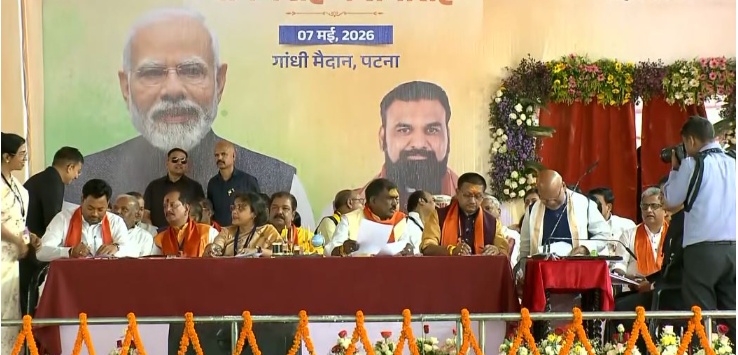
The swearing-in ceremony, held at the historic Gandhi Maidan, witnessed the induction of several prominent leaders, including Nitish Kumar’s son Nishant Kumar, marking his formal entry into ministerial politics. The development has drawn significant attention in Bihar’s political circles, with many viewing it as the beginning of a new political chapter for the Kumar family.
Among those who took oath were Vijay Kumar Sinha, Shrawon Kumar, Dilip Kumar Jaiswal, Leshi Singh, Ram Kripal Yadav, Nitish Mishra, Ashok Choudhary and several other NDA leaders. Governor Lt Gen Syed Ata Hasnain (Retd) administered the oath of office to the newly inducted ministers.
The cabinet expansion comes amid significant political changes in Bihar following Nitish Kumar’s move to the Rajya Sabha and the formation of the new NDA government under Chief Minister Samrat Choudhary. According to reports, the BJP secured the highest number of ministerial berths, while JD(U) also received substantial representation in the expanded cabinet.
Prime Minister Narendra Modi, Union Home Minister Amit Shah, Defence Minister Rajnath Singh and several senior NDA leaders attended the ceremony, underlining the political importance of the cabinet reshuffle.
Political observers believe the inclusion of Nishant Kumar reflects the NDA’s strategy to blend experienced leadership with a younger generation ahead of future electoral battles in the state. The newly expanded cabinet is expected to focus on governance, development initiatives and strengthening coordination among alliance partners.
The portfolios of the newly inducted ministers are likely to be announced soon.
7, May 2026
Urban VPN Launches Urban LinkX & Protocol Control: New In-House WireGuard-Based Protocol with User-Selectable Switching
Urban LinkX delivers up to 5x faster connections in lab tests, with 2x to 4x faster speeds in real-world testing. Protocol Control lets users select their VPN protocol directly from the app.
DELAWARE, USA, May 7: Urban VPN, one of the largest free VPN services globally, today launches Urban LinkX & Protocol Control. Urban LinkX is an in-house developed VPN protocol built on a WireGuard foundation, delivering approximately 5x faster connections in lab tests compared with Urban VPN’s previous protocol stack. Real-world testing on Android in the United States shows 2x faster mean download speeds and 4x faster mean upload speeds. Protocol Control is a new in-app feature that lets users select which protocol to use, with Urban LinkX as the default and the previous protocol stack available as an option for specific use cases.
Urban LinkX is now active on 394 of Urban VPN’s 692 servers globally, currently available to Urban VPN’s premium users on Android and iOS, with macOS and Windows scheduled for May 2026. Following the Windows rollout, Urban LinkX will be available to all Urban VPN users.
Urban LinkX operates in three stages. When the user taps Connect, the client selects a server from the available pool based on weights, requests an Urban LinkX configuration from the backend, and establishes the connection, automatically falling back to the next available server if the connection fails. If a connection fails for some technical reason (switching from Wifi to 4/5G) the app seamlessly reconnects to the same or a different server as needed to maintain a smooth user experience. When the connection ends, the client unregisters its session, with the backend automatically cleaning up any session not closed by the client within a few minutes as a safety net.
In internal testing comparing Urban LinkX with Urban VPN’s previous protocol stack, lab tests showed approximately 5x faster connections, while real-world testing on Android with U.S. servers showed 2x faster mean download speeds and 4x faster mean upload speeds. Urban LinkX is engineered to deliver improved connection stability through more resilient tunnels with faster reconnection and better handling of intermittent networks. Its lightweight protocol design reduces CPU and memory consumption on both servers and clients, while key-based authentication and a smaller codebase support simpler configuration, faster troubleshooting, and faster deployment as new server locations can be added quickly using simple key pairs. State-of-the-art cryptography by default reduces the risk of misconfiguration, and seamless roaming maintains connections across IP address changes, including transitions between Wi-Fi and mobile data.
Urban LinkX delivers strong performance in scenarios such as streaming services in regions where single-protocol traffic is filtered, competitive online gaming with mid-session network changes, and travel scenarios switching between hotel Wi-Fi, mobile data, and home networks.
Protocol Control is a new in-app feature that gives users direct choice over which protocol their VPN connection uses. Urban LinkX is the default for most use cases. Users can switch to Urban VPN’s previous protocol stack from the app interface when their specific connection conditions call for it. The selection is made in the app, with no manual reconfiguration required.
Urban LinkX is currently active for 100 percent of premium users on Android by default, and 33 percent of premium users on iOS, with iOS ramping to 100 percent by Thursday, May 7, 2026. macOS is targeting mid-May 2026, and Windows is targeting late May 2026. Urban VPN operates 692 servers in 88 countries globally and has surpassed 100 million downloads since launch.
|
“Urban LinkX is faster, simpler, and more efficient than the protocol stack it replaces,” Urban VPN said. “Protocol Control gives users direct choice over which protocol to use, since the right answer depends on the use case.” |
7, May 2026
Thailand’s Strategic Realignment Could Unlock New Trade and Investment Channels for India: ORF
New Delhi, May 7 (BNP): Thailand’s evolving strategic and economic orientation is likely to create new opportunities for deeper economic engagement with India, according to a recent analysis by the Observer Research Foundation (ORF).

The report notes that Thailand is gradually recalibrating its external partnerships and economic priorities in response to shifting global geopolitics and changing supply chain dynamics. This transition is expected to open space for stronger regional cooperation, particularly with fast-growing economies like India.
As Bangkok looks to diversify trade links and strengthen its position in global value chains, the study highlights potential areas of collaboration for Indian businesses, including manufacturing, digital services, infrastructure development, and emerging technology sectors.
The ORF analysis suggests that this shift could also support broader regional economic integration, especially within the ASEAN framework, by encouraging more diversified and resilient trade relationships across Asia.
It further observes that ongoing global supply chain reconfiguration is prompting countries in the region to reduce dependence on a narrow set of markets, creating momentum for more balanced and flexible economic partnerships.
Within this context, India is seen as a key partner for Thailand due to its expanding industrial base, large consumer market, and growing capabilities in digital and services-led sectors. The report indicates that deeper cooperation could help enhance investment flows, improve connectivity, and foster greater technological collaboration between the two economies.
Overall, the ORF assessment underscores that Thailand’s strategic recalibration presents a timely window for India to strengthen its economic presence in Southeast Asia and play a more active role in shaping the region’s evolving growth architecture.
7, May 2026
Dubai homeowners now holding as long as Londoners and New Yorkers

New fäm Properties analysis of more than 1.1 million Dubai Land Department transactions shows clear shift away from short-term investors
Dubai, UAE, May 07: Dubai homeowners are now holding their properties for as long as Londoners and New Yorkers, according to a new study of more than 1.1 million transactions spanning the last 16 years.
It underlines how the city’s real estate sector has evolved to stand alongside the world’s most mature markets, no longer driven by short-term investors.
The analysis of Dubai Land Department transaction data by fäm Properties covers 687,406 primary market transactions between 2012 and 2025, and 425,083 resale market transactions between 2009 and 2025.
Of those, 480,604 primary market homes and 259,615 resale market properties remain with the original buyer, adding up to 740,219 residential properties purchased since 2012 that have never been resold. That represents 69.9% of primary market purchases and 61.1% of resale market transactions over the period.

“Buyers focused on flipping properties have been replaced by owners committed to staying in Dubai and holding on to them,” said Firas Al Msaddi, CEO of fäm Properties. “That’s what a market looks like when it matures.”
“Until now, much of the conversation about Dubai’s residential holding behaviour was built around a 2013 framework, but we’ve moved on from there. A buyer who purchased in Dubai in 2014 and is still holding their property today is behaving exactly like the median homeowner in New York or London.”
The new data shows a consistent and strengthening pattern across both market segments. Among primary market buyers, 42% of those who purchased in 2014 are still holding their property eleven years later, rising to 53% among 2017 buyers after eight years and 61% among those who bought in 2022 after three years.
The resale market tells a similar story, with 38% of 2014 buyers still in ownership after eleven years, 53% of 2017 buyers after eight years, and 65% of those who purchased in 2022 still holding after three years.
Those figures mirror ownership patterns in the US, where the typical homeowner now stays for between 11 and 12 years, according to 2025 data from Redfin and the National Association of Realtors. Meanwhile, in the UK, only around 4% of homes change hands in any given year, implying the majority of owners hold for well over a decade.
The new data analysis is drawn from DXBinteract, the market intelligence platform developed by fäm Properties in partnership with the Dubai Land Department records. All figures reflect ownership status as at the end of April 2026.
Al Msaddi links the change in ownership behaviour with a series of structural developments in Dubai’s residential market. The Golden Visa programme, introduced in 2019 and expanded in 2022, established a direct link between property ownership and long-term residency, while regulatory reforms strengthened protections for buyers purchasing off-plan.
While the timing of the Golden Visa rollout and the impact of Covid-19 influenced a slight dip in retention rates, these have risen with each successive group of buyers since 2020.
Significant infrastructure investment over the same period, including new metro connections and the development of major new residential districts such as Dubai South, Dubai Creek Harbour and Dubai Islands, has also extended the range of locations where buyers are willing to commit for the long term.
Primary market – share of buyers still holding, by year of purchase
|
Year |
Years held |
Still holding |
|
2014 |
11 |
42% |
|
2017 |
8 |
53% |
|
2018 |
7 |
55% |
|
2019 |
6 |
51% |
|
2020 |
5 |
53% |
|
2022 |
3 |
61% |
Resale market – share of buyers still holding, by year of purchase
|
Year |
Years held |
Still holding |
|
2014 |
11 |
38% |
|
2017 |
8 |
53% |
|
2019 |
6 |
55% |
|
2022 |
3 |
65% |
7, May 2026
Sitharaman, Vietnam Finance Minister Review Global Economy and Geopolitical Challenges
New Delhi, May 7 (BNP): Union Finance Minister Nirmala Sitharaman held discussions with Vietnam’s Finance Minister on key issues shaping the global economy, with a focus on emerging geopolitical uncertainties and their impact on growth and trade.
The two leaders exchanged views on the evolving international economic environment, including challenges arising from ongoing geopolitical tensions, supply chain disruptions, and financial market volatility.
According to official updates, the discussions highlighted the importance of stronger economic cooperation between India and Vietnam at a time when global trade and investment flows are being reshaped by shifting geopolitical dynamics.
Both sides also reviewed opportunities to deepen bilateral financial and economic engagement, particularly in areas that can enhance resilience against external shocks and support stable growth in their respective economies.
The talks come at a time when many emerging economies are closely monitoring global developments, including fluctuating commodity prices, energy market instability, and changing trade alignments.
Officials indicated that the engagement reflects a shared interest in maintaining macroeconomic stability while exploring avenues for greater collaboration in trade, investment, and financial sector cooperation.
7, May 2026
Nashik Set for INR 33,000 Crore Kumbh-Driven Infrastructure Push to Boost Long-Term Growth: Fadnavis
Nashik, May 7 (BNP): Maharashtra is preparing for a major development push in Nashik with ₹33,000 crore worth of infrastructure and connectivity projects planned around the upcoming Simhastha Kumbh Mela, Chief Minister Devendra Fadnavis said, adding that the city is set to evolve far beyond its religious identity into a sustained economic growth centre.

Speaking at the closing session of the Kumbh Udyog Sangam and Nashik Investment Summit 2026, he said the scale of investment is designed not only to support the massive congregation expected during the Kumbh but also to leave behind permanent urban and industrial assets.
The Simhastha Kumbh Mela, scheduled from October 31, 2026 to July 24, 2028, is expected to drive large-scale upgrades in transport, civic infrastructure, mobility systems, and urban facilities across the district.
Fadnavis said the development programme is being structured to ensure that pilgrimage-driven infrastructure also strengthens Nashik’s long-term economic base. Key focus areas include road expansion, ring roads, logistics connectivity, and improved public utilities.
Alongside infrastructure development, the state is positioning Nashik as an emerging industrial destination. At the investment summit, agreements worth ₹13,190 crore were signed with over 300 investors, projected to generate nearly 32,000 jobs.
The Chief Minister said Nashik has already seen strong investment traction, with more than ₹31,900 crore implemented in recent years and overall inflows crossing ₹57,000 crore over the last two years.
He noted that implementation levels remain high, with nearly 77 per cent of signed investment commitments already moving into execution, reflecting growing investor confidence in the region.
Industrial interest is expanding across sectors such as manufacturing, electronics, automobiles, textiles, agriculture-linked services, and logistics. Major industry players, including Mahindra & Mahindra, are among those investing or expanding operations in the region.
Fadnavis also highlighted that Nashik is being developed as part of a broader regional growth corridor, alongside districts like Jalgaon, Dhule, Nandurbar, and Ahilyanagar, to ensure more balanced industrial distribution across Maharashtra.
He said improvements in airport capacity, railway connectivity, and industrial infrastructure are strengthening Nashik’s attractiveness as an investment destination, while dedicated facilitation systems are helping speed up project execution.
Officials said the Kumbh-linked development model is being used as a catalyst to integrate spiritual tourism with economic planning, creating opportunities for hospitality, transport, retail, and small businesses.
With large-scale public investment and rising private participation, Nashik is being positioned as a future-ready urban and industrial hub expected to anchor growth in northern Maharashtra over the next decade.


