


6, May 2026
Swiggy Onboards MoEngage’s AI-Native Platform
Bengaluru, India May 06: MoEngage, India’s #1 AI-native Customer Engagement Platform, today announced a strategic partnership with Swiggy, India’s pioneering on-demand convenience platform. Through this collaboration, MoEngage will empower Swiggy to enhance customer experiences through relevant engagement based on user preferences.
With a trusted brand serving millions of users across the board, Swiggy selected MoEngage to further strengthen its customer engagement capabilities at scale. The platform’s enterprise-grade capabilities will help Swiggy automate customer journeys.
The partnership has already delivered a measurable impact. By leveraging MoEngage’s automation capabilities, Swiggy’s marketing team has significantly reduced manual effort, thus allowing them to focus on strategy and creative innovation rather than operational overhead.
“At Swiggy, our ambition is to make every customer interaction feel relevant, timely, and valuable,” said Niranjan Sane, AVP – Growth at Swiggy. “MoEngage gives us the scale, reliability, and AI-driven intelligence to do exactly that. The platform’s capabilities have enabled us to engage more effectively, while maintaining a robust security framework.”
Along with omnichannel capabilities, Swiggy is also leveraging MoEngage’s Merlin AI Agents to enhance customer engagement across its platform. The Content AI Agents enable Swiggy to create push notifications and in-app messages.
“Swiggy represents the future of customer engagement, a brand that understands that relevance at scale requires intelligence, not just volume,” said Raviteja Dodda, CEO & Co-Founder of MoEngage. “We’re proud to partner with brands that are embracing AI-native platforms to transform how they connect with customers.”
Looking ahead, Swiggy plans to explore MoEngage’s Merlin AI Decisioning. This feature of Merlin AI is designed to help brands optimize their engagement strategies and improve campaign effectiveness.

- 0
- By Neel Achary

6, May 2026
Soulful Summer Stories at Pondicherry & Mamallapuram Resorts
Pondicherry, May 06: This summer, Radisson Resort Pondicherry Bay and Radisson Blu Resort Temple Bay Mamallapuram invite travellers to rediscover the timeless charm of beach holidays with ‘Soulful Summer Stories’—a thoughtfully curated campaign that blends coastal serenity with immersive, story-led experiences.

Developed by GRT Hotels & Resorts, the initiative reimagines East Coast getaways by combining the rhythm of the sea with meaningful leisure experiences tailored for modern travellers.
A Beach Escape That Feels Effortless
Located within easy driving distance from Chennai and well-connected to Bengaluru, both resorts offer a seamless blend of accessibility and coastal immersion—ideal for weekend getaways, pet-friendly vacations, romantic escapes, and family holidays.
Soulful Summer Offer at Pondicherry
At Radisson Resort Pondicherry Bay, the Soulful Summer Offer is designed for relaxed coastal living, featuring curated experiences for families, couples, and leisure travellers. The package includes signature dining experiences, curated activities, and access to immersive storytelling formats inspired by the region. Guests can also enjoy pet-friendly stays, making it a wholesome getaway for the entire family.
Soulful Summer Offer at Mamallapuram
Set along a scenic stretch of the East Coast, Radisson Blu Resort Temple Bay Mamallapuram offers an expansive beachfront retreat with its summer offering. The experience combines spacious accommodations, engaging family-friendly activities, and vibrant leisure moments—from beach walks to poolside relaxation—crafted to bring people together.
Introducing Katha: Stories That Stay With You
At the heart of the campaign lies Katha, a signature experiential concept by GRT Hotels. Meaning “story,” Katha brings together curated experiences inspired by local culture, heritage, and the spirit of each destination.
Designed for travellers seeking deeper engagement, Katha offers a wide spectrum of activities including wellness rituals, culinary journeys, beach explorations, water sports, ATV rides, heritage visits, and immersive in-hotel experiences. Guests can choose from a mix of complimentary and customizable experiences to create their own personalized “Soulful Summer Story.”
Vikram Cotah, CEO of GRT Hotels & Resorts, said the initiative aims to make summer getaways more immersive yet accessible, allowing guests to connect with local culture and take home meaningful memories.
With ‘Soulful Summer Stories’, GRT Radisson Resorts transform a simple beach holiday into a rich, experience-driven journey—perfect for travellers looking to slow down, reconnect, and rediscover the joy of coastal living.
6, May 2026
Causal Dynamics Lab outperforms Anthropic & OpenAI in multiple coding tests
New research shows AI coding agents spend >80% of their time searching for files rather than editing them. Cielara Code changes this by using a clear map of production software. This approach helps find the right code to change faster, cheaper, and more accurately than typical coding agents.
San Francisco, CA – May 06: AI coding tools are now producing code faster than teams can check what it will do in real use. Causal Dynamics Lab (CDL) announced new research explaining why this happens, along with a new product called Cielara Code. This product achieved the highest accuracy in code localization among AI coding tools, outperforming both Claude Code (Opus-4.6) and OpenAI Codex (GPT-5.4) across three independent tests.
CDL studied how coding agents operate by tracking their actions across thousands of coding sessions. They found 56.8% of agents’ actions involved reading files, and 24.2% involved using grep. Less than 1% of their actions were actual code edits. The problem was not that agents couldn’t write code; they had difficulty finding the correct code to edit. The situation worsened with more complex tasks: when a correct fix involved more than six files, the agents’ ability to recall the necessary information dropped significantly, and the computing power used in failed attempts increased by a factor of 4 compared to successful ones.
“Every coding agent out there today uses grep, which is like a surgeon operating without imaging,” said Hasibul Haque, CEO at Causal Dynamics Lab. “We created Cielara Code to help agents see better: it provides a clear understanding of the working environment, making the reasons behind each change clear and verifiable.”
The 2025 DORA report showed the use of AI coding tools led to a 7.2% drop in deployment stability. AWS CTO Werner Vogels called this problem “dynamic verification debt.” A well-known issue with Claude Code (GitHub issue #42796) illustrates the same problem on a larger scale: current agents treat code as flat text without showing how files connect, how functions call each other, or how changes affect the overall system.
How Cielara Code works
Cielara Code uses a model to represent a customer’s production environment in a 6-layer causal graph. This graph includes information on what the code does, why it was created, who owns it, its limitations, where it runs, and what happens at runtime. If there is a failure, it can be linked back to the specific code change, the developer who approved it, and the reason for that change. Before an agent begins to explore, Cielara Code builds a Code Dependency Causal Graph. This graph tracks four types of relationships, allowing the agent to navigate the structure rather than just look through files one by one.
Benchmark results
Across three independent benchmarks, Cielara Code beat both Claude Code (Opus-4.6) and OpenAI Codex (GPT-5.4) at the hardest part of agent work: finding the right place to make a change. Overall localization accuracy hit 0.774, versus 0.738 for Claude Code and 0.707 for Codex. On MULocBench (1,033 issues across 46 repositories), Cielara reached 0.752 recall@5 versus 0.727 for Claude Code, and cut mean task time from 141.84 to 128.62 seconds. The result: fewer wrong-file edits, fewer failed runs, and 30 to 40 percent lower compute cost per task.
REASONARA: causal memory at enterprise scale
Cielara Code makes this practical through REASONARA, a graph-structured causal memory layer that stores 125M+ tokens of effective context but retrieves only what matters for each query. A typical lookup uses 1,000–2,500 tokens, compared with 23,000–115,000 for full-context approaches — a reduction of up to 98%. On independent benchmarks, REASONARA scores 94% on UltraDomain, 92% on LoCoMo, 73% on LoCoMo-plus, and 87.4% on LongMemEval, and runs 5–8× faster than Codex high-reasoning mode. The roadmap targets a one-billion-token context window.
Cielara Code is a safety layer for AI coding agents. It aims to enhance the safety of their output rather than replace them. Currently, 11 Fortune 100 and over 40 Fortune 500 companies use Cielara Code on their codebase.
“Board members and auditors expect more proactive risk management. Leaders now want proof that security can anticipate risks caused by fast-moving AI and automation, instead of just reacting after incidents,” said the CISO of one of the largest law firms in the United States, who is also a Cielara Code customer.
Phillip Miller, Vice President, Global Chief Information Security Officer, H&R Block added: “Enterprises need solutions to problems they cannot solve with people alone. Cielera’s technology is a generational leap towards the original promise of AI: tackling complexity 7×24 with acquired knowledge, deep reasoning, and unbeatable accuracy. For engineering teams, this means a single engine to discover faults in real-world deployments (including legacy, cloud) and provide clear resolution steps. When I wrote, Hacking Success, I described a world where AI needs strong, directive policy (not rules / guardrails) to be safe and effective. Information Security lags behind the innovation curve, as most options rely on legacy thinking including posture, gateways, and logging. Enterprises now have an option to leverage Cielera’s models to oversee deployments of AI agents, models, and their supporting infrastructure.”
The team
The team has strong skills based on the problem they are addressing. CEO Hasibul Haque led platform engineering at Uber during its rapid growth. CTO Ryan Turner was a Staff Engineer at Uber and helped maintain the SPIRE Project within the Cloud Native Computing Foundation (CNCF). R&D is led by Dr. Xuchao Zhang, who worked at Microsoft Research, and Dr. Liang Zhao from Emory University, who has 200+publications and is ranked among the top 2% of scientists by Stanford University. CDL has a formal research partnership with Emory’s AI Lab.
“AI has already changed how people find information. The next step is to change how people make decisions by exploring possibilities, comparing options, and understanding the outcomes before making a choice,” said Matt Fisher, former Co-Founder and CTO of Daydream and an Adjunct Professor at Brown University. “That shift towards exploring outcomes is what CDL is focusing on.”
What’s next
The Production World Model serves as a foundation. Cielara Code and REASONARA are the first products to use this foundation. In the future, Causal Dynamics Lab will fully simulate the effects of changes in code, infrastructure, policy, and operation. This will create a permanent reasoning layer in the enterprise system that any AI agent can access before making changes that affect production.
6, May 2026
The Royal Government of Bhutan and the World Bank Sign Financing Agreements for the Dorjilung Hydroelectric Power Project

Bangalore, May 06: The Royal Government of Bhutan and the World Bank today signed financing agreements totaling $515 million for the 1,125 MW Dorjilung Hydroelectric Power Project, which will account for about one-third of the Kingdom’s total energy generation, drive economic growth through access to affordable electricity and clean energy exports, and create new jobs.
“The Dorjilung Hydroelectric Power Project is a cornerstone of Bhutan’s 13th Five-Year Plan and will be the Kingdom’s largest hydropower project developed under a public-private partnership. This transformational investment will supply clean energy, spur economic growth, and advance our carbon-negative commitment,” said Dasho Tshering Tobgay, Prime Minister of Bhutan. “This project is a testament to our strong partnership with the World Bank Group and our shared vision for a sustainable and prosperous future for Bhutan’s people.”
The project, located on the Kurichhu River in eastern Bhutan, will generate over 4,500 GWh of clean electricity annually, closing Bhutan‘s seasonal energy gap during the winter months and providing surplus power for export to India in the summer and rainy seasons.
The hydropower plant is expected to increase Bhutan’s GDP by 2.4%. It will generate economy-wide benefits, create direct and indirect jobs as well as entrepreneurial opportunities for Bhutan. It will boost manufacturing, tourism, and small businesses by supplying reliable and affordable electricity, with the revenues from energy exports available for reinvestment in essential services such as health, education, and infrastructure. It will also have an important regional impact by displacing 3.3 million tons of CO2 annually and facilitating clean energy trade.
“The Dorjilung Hydroelectric Power Project is unique for Bhutan and the World Bank Group. The innovative financing model, which brings together public and private capital, sets a new standard for sustainable infrastructure development,” said Johannes Zutt, World Bank Vice President for the South Asia Region. “The benefits will be far‑reaching for Bhutan and South Asia. Bhutan will be able to reduce costly energy imports and earn revenues from energy exports, while South Asia will reduce carbon emissions and diversify its energy sources.”
“The Dorjilung Hydroelectric Power Project is a national priority and will be transformational for Bhutan—delivering clean electricity, spurring economic growth and advancing our carbon‑negative commitment,” said H.E. Lyonpo Lekey Dorji, Finance Minister of Bhutan. “Its innovative financing structure ensures that this project does not unduly burden public finances, allowing us to continue investing in our people.”
“This project marks a transformative shift in Bhutan’s energy sector and opens the door for scaling this financing model across the hydropower sector,” said Dasho Chhewang Rinzin, Managing Director of the Druk Green Power Corporation. “It is designed to provide critical grid flexibility, allowing us to manage seasonal shortfalls while maximizing export revenues. We are deeply committed to the project’s rigorous environmental standards and maintaining Bhutan’s standing as a carbon-negative country.”
Earlier this year, the World Bank Group’s Board of Executive Directors approved $300 million in concessional financing from the International Development Association (IDA), of which $150 million is a grant; $215 million in financing from the International Bank for Reconstruction and Development (IBRD); and up to $300 million from the International Finance Corporation (IFC) to Dorjilung Hydro Power Limited (DHPL), which is a Special Purpose Vehicle entity jointly owned by Bhutan’s Druk Green Power Corporation (60 percent) and Tata Power (40 percent), India’s largest private integrated power company. The Project will boost clean energy cooperation between India and Bhutan and strengthen regional energy security.
Dr Praveer Sinha, CEO&MD Tata Power said, “We thank the Royal Government of Bhutan, the World Bank Group, and Druk Green Power Corporation for their partnership in advancing the 1,125 MW Dorjilung project. The signing of $515 million in financing agreements marks a momentous milestone for a project that will contribute nearly one-third of Bhutan’s electricity generation. This landmark project will strengthen regional energy security and deepen India–Bhutan clean energy cooperation. With nearly 80% of its 4,500 GWh annual generation supplied to India, it will help meet rising peak demand especially in summer while enabling Bhutan to expand clean energy exports for shared economic benefit.”
The estimated $1.7 billion project is structured as an innovative public-private partnership to minimize sovereign borrowing. The financing is expected to catalyze an additional $900 million in private sector financing. This unique financing structure enables Bhutan, with only $150 million direct credit exposure, to cover the $1.7 billion project cost and cumulatively earn about $4 billion of revenues through taxes, free power, and equity dividends over the 30-year IDA credit period.
Today, Dasho Leki Wangmo, Finance Secretary, Royal Government of Bhutan and Jean Pesme, World Bank Division Director for Bangladesh and Bhutan signed the $300 million IDA financing and $215 million IBRD financing on behalf of Bhutan and the World Bank, respectively.
“Amid global fuel supply disruptions, the Dorjilung Hydroelectric Power Project represents a model for building energy security that is clean, sustainable and resilient,” said Xavier Furtado, the World Bank Group’s Country Manager for Bhutan. “The World Bank Group brought together IDA, IBRD, and IFC to deliver an innovative financing package that enables a project of this scale while protecting Bhutan’s debt sustainability.”
6, May 2026
MathCo Collaborates with Google Cloud to Help Enterprises Adopt Workflow-Native AI on Gemini Enterprise
6, May 2026
The Crimson Crown by Edith Layton now available from Histria Books
Histria Books is pleased to announce the release of The Crimson Crown by Edith Layton. This novel is published by Histria Romance, an imprint of Histria Books dedicated to outstanding books in the romance genre.
Set against the paranoid early years of Henry VII’s reign, The Crimson Crown follows Lucas Lovat, an exiled spy summoned back to a cold, unfamiliar England to investigate the royal pretender Perkin Warbeck. But what sounds like a traditional Tudor thriller actually reads like a claustrophobic psychological mystery where the locked room is the royal court itself. Edith Layton strips away the usual pageantry to expose the sheer exhaustion of surviving a regime built entirely on surveillance. Lucas is a brilliantly realized lead. He is cynical, deeply observant, and distinctly unheroic in his ambitions. The novel feels startlingly modern in its exploration of espionage, performative loyalty, and the emotional toll of political manipulation.

Readers hungry for historical fiction that prioritizes sharp dialogue and moral ambiguity over battlefield glory will find a refreshing, intensely atmospheric, and razor-sharp story that breathes genuine life into a famously treacherous era.
Edith Layton (1938-2009) began her career as a freelance journalist before publishing her debut novel, The Duke’s Wager. She went on to write over 30 novels, winning numerous accolades including the Romantic Times Award for Best New Regency Author. Today, her classic backlist is being brought back to a new generation of readers, along with several never-before-published works.
The Crimson Crown by Edith Layton, 360 pp., ISBN 978-1-59211-721-5 is available at HistriaBooks.com and from all major book retailers. This title is available as print on demand through Simon & Schuster. This title is also available as an eBook. For information on publishing with Histria Books, please visit HistriaBooks.com or contact us at info@histriabooks.com.
Histria Books
7181 N. Hualapai Way, Suite 130-86, Las Vegas, NV 89166 USA
HistriaBooks.com
(561) 299-0802
6, May 2026
The Broken Fence by James J. Antonio now available from Histria Books
Histria Books is pleased to announce the release of The Broken Fence by James J. Antonio. This story is published by Histria Kids, an imprint of Histria Books dedicated to outstanding works for children that both educate and entertain.
The Broken Fence follows a ten-year-old boy who inherits an unexpected foal on his grandfather’s thoroughbred farm, tracing their years-long journey from the birthing stall to the starting gates of a high-stakes race. But rather than leaning on the familiar beats of a sports triumph, James J. Antonio’s novel strips away the glamour of the track to focus on the dirt, sweat, and quiet patience of raising a difficult animal.

In a culture obsessed with instant gratification, this book offers a vital retreat into the slow, deliberate rhythm of barn life and intergenerational mentorship. The author writes with an unsentimental precision that captures the tactile reality of mucking stalls and the genuine frustrations of training an anti-social filly. It is a story about the unglamorous daily work of nurturing potential. Readers looking for a grounded, deeply felt exploration of discipline and animal connection will find something remarkably anchoring here.
James J. Antonio, a former French teacher and produce business manager, is now retired and dedicated to his passion for storytelling. Known for his works on numismatics, James has published numerous stories in Canadian coin publications, including the CNA Journal and the Ontario Numismatic Association Journal. His story “Miss Daisy” received an Editor’s Choice Award in Winning Ways, the journal of the Ohio State Numismatic Association. He is the author of Roads Here and There (two novellas in one book) and Stories for Coin Collectors and Everyone, both available on Amazon.
The Broken Fence by James J. Antonio, 114 pp., ISBN 978-1-59211-599-0 is available at HistriaBooks.com and from all major book retailers. This title is also available as an eBook. Titles published under the imprints of Histria Books are distributed in the United States and Canada by Simon & Schuster and in the rest of the world through Unified Book Distribution. For information on publishing with Histria Books, please visit HistriaBooks.com or contact us at info@histriabooks.com.
Histria Books
7181 N. Hualapai Way, Suite 130-86, Las Vegas, NV 89166 USA
HistriaBooks.com
(561) 299-0802
6, May 2026
The Seekers by Jack Bartley now available from Histria Books
Histria Books is pleased to announce the release of The Seekers by Jack Bartley, the second volume in the Hilo Dome series. This book is published by Histria YA, an imprint of Histria Books dedicated to outstanding works for teens and young adults.
The Seekers takes the framework of a post-apocalyptic survival story and roots it entirely in Hawaiian mythology and Polynesian wayfinding. Generations after a devastating global war, isolated communities on the Big Island must set aside bitter rivalries when the volcano goddess Pele awakens. To escape impending lava flows, a small crew builds a traditional double-hulled sailing canoe to chart a course into the unknown Pacific.

Jack Bartley’s second Hilo Dome novel trades standard dystopian action for a focus on cultural reclamation. The true tension comes not just from navigating a ruined world, but from the painstaking effort of relearning lost ancestral skills. The book asks what happens when a community must resurrect ancient traditions to save its future. It is a localized, community-driven approach to the end of the world that feels vital for readers tired of lone-wolf survival tropes.
Praise for The Seekers:
“The Seekers: Hilo Dome by Jack Bartley is a brilliant, nail-biting adventure that is full of action. It is one of the rare gems that take place on the water, where explorers must navigate uncharted territory to survive. It will appeal to anyone who enjoys an adventure full of suspense, thrills, and the awe of discovery.” — Readers’ Favorite
Jack Bartley is a U.S. Navy veteran, retired University of Delaware ecology professor, and the author of several books, including the 2025 naval memoir Smoke on the Water (Koehler Books) and the young adult series Hilo Dome (Histria Books). His extensive time spent in Hawaiʻi, both during his military service and while leading academic ecology expeditions, heavily influences his writing. Also an accomplished musician and former newspaper columnist, Jack now lives in Ocean View, Delaware, where he focuses on writing, music, and environmental volunteer work.
The Seekers by Jack Bartley, 214 pp., ISBN 978-1-59211-733-8, is available at HistriaBooks.com and from all major book retailers. This title is also available as an ebook. Titles published under the imprints of Histria Books are distributed in the United States and Canada by Simon & Schuster and in the rest of the world through Unified Book Distribution. For information on publishing with Histria Books, please visit HistriaBooks.com or contact us at info@histriabooks.com.
Histria Books
7181 N. Hualapai Way, Suite 130-86, Las Vegas, NV 89166 USA
HistriaBooks.com
(561) 299-0802
6, May 2026
Broomsedge Golf Club Entrusts KemperSports to Manage Club
Industry-leading management firm to oversee operations as Broomsedge expands hospitality and club activity
NORTHBROOK, IL. — May 6, 2026 — KemperSports, a leading golf, sports and hospitality experience company is excited to announce it has been selected to manage Broomsedge Golf Club – bringing together one of the game’s most respected and passionate operators with one of the country’s most distinctive modern golf destinations.
Located in the sandhills of central South Carolina, Broomsedge Golf Club has quickly earned recognition for its thoughtful design, understated luxury, and commitment to delivering an exceptional golf experience rooted in the tradition of the great clubs of British Isles. Under KemperSports management, Broomsedge will incorporate the company’s expertise in club operations, agronomy, guest experience, food and beverage, and strategic planning as the club elevates its hospitality experience with the construction of 4 Bedroom cottages for members and guests and a food and beverage venue overlooking the golf course.
“The people at KemperSports are smart and driven – exactly what we need to build around the incredible golf course that Mike Koprowski and Kyle Franz crafted here,” said Broomsedge Golf Club managing partner and CEO Baker Thompson. “Their relationships, industry knowledge, and operational excellence – along with a deep understanding of private club culture – make them the ideal partner as we extend the vision for Broomsedge.”
The club recently announced that developer Baker Thompson has stepped into the role of managing partner and CEO, Michael Keiser, Jr. serving as a senior advisor.
KemperSports manages a portfolio of highly regarded golf destinations, private clubs, and resorts across the country, with a proven track record of enhancing member satisfaction, cultivating high-performing teams and delivering long-term value for ownership groups.
“We are honored to partner with Broomsedge Golf Club and work along Baker Thompson and the development team to help bring their bold vision to life,” said KemperSports CEO Steve Skinner. “Broomsedge provides an authentic, high-quality golf experience. We appreciate that, and we are eager to work with the club team to create value for ownership, members, and guests.”
6, May 2026
Synology® officially introduces AI Advisor for accurate, reliable information discovery
Taipei, Taiwan — May 6, 2026 Synology today officially introduces AI Advisor, an intelligent assistant designed to simplify information discovery. By delivering accurate, localized technical guidance directly on Synology’s website, the AI Advisor ensures reliable insights while significantly reducing resolution time for users worldwide.
“AI Advisor integrates over a decade of Synology’s AI expertise,” said Steven Liang, Manager of the Generative AI Application Group at Synology. “With an agent-as-tool design, dynamic knowledge injection, context optimization, and a continuous evaluation pipeline, AI Advisor delivers accurate, high-quality responses and continuously refines itself. These innovations will extend across Synology product lineup, advancing our vision of secure, intuitive solutions.
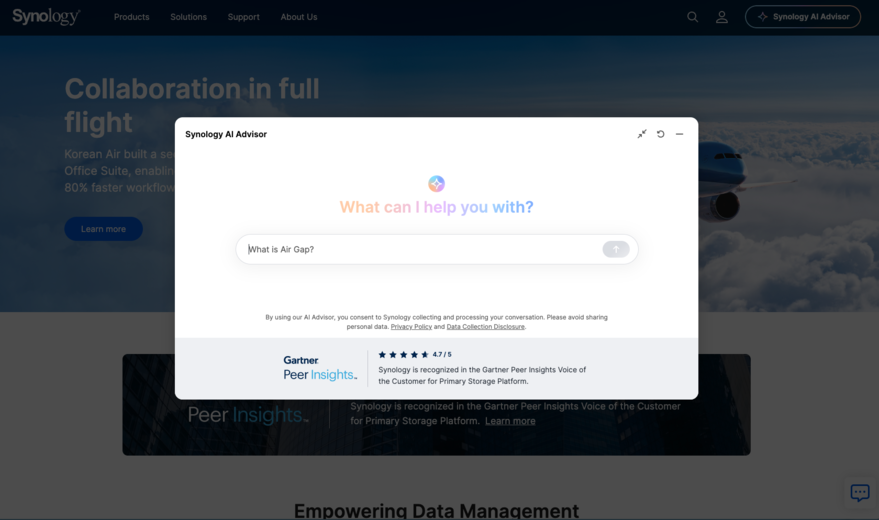
Self-hosted ecosystem to ensure AI sovereignty
Prioritizing customer privacy, the AI Advisor utilizes a self-hosted LLM that operates entirely independent of third-party AI providers, ensuring no context is shared externally. Moving toward complete data sovereignty, the service will transition to a dedicated Synology infrastructure later in 2026, guaranteeing 100% data residency and keeping all user interactions within a secure, sovereign ecosystem.
Streamlined navigation from inquiry to implementation
AI Advisor integrates with Synology’s NAS Selector and NVR Selector tools. Users are guided through preliminary sizing and product recommendation workflows tailored to their deployment needs, enabling faster and more informed early-stage purchasing decisions. By understanding the intent and context of each query, the Advisor further streamlines the journey by directing users to relevant support articles, downloads, or configuration guides to ensure a fast transition from question to solution.
Accessibility and Availability
Alongside the introduction of AI Advisor, this website update brings support for global web accessibility standards, ensuring an inclusive and user-friendly experience for audiences worldwide.
The Synology Website AI Advisor is available now on Synology’s official website. To learn more about Synology’s AI-driven services and experience the new Advisor, visit Synology’s official website. www.synology.com


