


5, Oct 2026
RBI May Hold Repo Rate in October, Rate Hikes Could Start in December: BoB
New Delhi, Oct 5: The Reserve Bank of India (RBI) may keep the repo rate unchanged at 5.25 per cent in its October monetary policy meeting, while a rate-hike cycle could begin from December, according to an assessment by Bank of Baroda.
The bank expects the RBI to maintain its neutral policy stance in October as it continues to monitor inflation, economic growth, crude oil prices and global financial conditions.
Bank of Baroda expects the RBI to raise the repo rate by a total of 50-75 basis points in the next tightening cycle, starting in December. However, the timing and pace of any future rate changes will depend on how inflation and other economic indicators develop.
India’s economy continues to show strong growth, giving the central bank some room to assess the situation before making a change in interest rates. Bank of Baroda expects India’s GDP growth to remain around 7-7.2 per cent in FY27.
Inflation is also an important factor for the RBI. Retail inflation has moved higher in recent months, mainly due to food prices, while core inflation has remained relatively moderate.
The banking system is also seeing surplus liquidity, while credit growth remains healthy across several sectors. These factors could influence the RBI’s approach to monetary policy in the coming months.
Global developments will remain another key factor. Changes in crude oil prices, movements in global interest rates and foreign investment flows can affect India’s inflation outlook, the rupee and bond yields.
If the RBI keeps the repo rate unchanged in October, it would give policymakers more time to assess these developments before considering a possible rate increase later in the year.
For borrowers, businesses and financial markets, the October policy decision and the RBI’s guidance will be closely watched for signals on the future direction of interest rates.
- 0
- By Neel Achary

5, Oct 2026
Gold Slides Nearly 1% While Silver Gains Amid Global Uncertainty
Mumbai, Oct. 5: Gold prices declined nearly 1 per cent in domestic futures trading on Monday, while silver moved higher as bullion markets reacted to movements in the US dollar and continuing geopolitical uncertainty.

Representational Image
On the Multi Commodity Exchange (MCX), December gold futures were trading at ₹1,49,184 per 10 grams around 10 am, down ₹1,206, or 0.8 per cent, from the previous close.
Gold had earlier slipped as much as 1.02 per cent to ₹1,48,850. The contract touched an intraday high of ₹1,51,197 before easing.
Silver Moves Higher
Silver futures bucked the trend, with the December contract gaining as much as 0.49 per cent to reach an intraday high of ₹2,26,999 per kg.
The white metal was later trading at around ₹2,26,340 per kg, up ₹463, or 0.2 per cent, from the previous close. Silver had opened at ₹2,25,900, while gold began the session at ₹1,51,197.
Gold Faces Key Resistance
Commodity analysts said gold’s fall below the ₹1.50 lakh level has turned the mark into an immediate resistance zone.
Resistance is seen around ₹1,51,000-₹1,51,600, followed by ₹1,52,500-₹1,53,000. On the downside, support is expected around ₹1,48,000-₹1,47,300, followed by ₹1,46,000-₹1,45,300.
Analysts said the technical outlook remains cautious, with the Relative Strength Index (RSI) at 43 and the Moving Average Convergence Divergence (MACD) indicator in negative territory.
A sustained move above ₹1.50 lakh could help stabilise gold, while a break below ₹1,48,000 may expose the contract to further downside towards ₹1,46,000.
Silver Outperforms Gold
Silver has continued to show relative strength, holding above the ₹2,24,000 support zone.
Analysts have placed immediate resistance at ₹2,27,000-₹2,28,000, followed by ₹2,31,000-₹2,32,000. A sustained rise above ₹2,28,000 could support further recovery, while a fall below ₹2,24,000 may pull prices towards ₹2,20,000.
The contrasting movement in domestic prices reflects a similar trend in international bullion markets, where silver has recently outperformed gold.
Geopolitical Developments in Focus
Global geopolitical developments remain an important driver for precious-metal prices.
US President Donald Trump recently said Washington faced a choice between further military action against Iran and reaching an agreement with Tehran, adding another layer of uncertainty for global markets.
Investors are therefore closely tracking currency movements and geopolitical developments for further direction in bullion prices.
5, Oct 2026
Ujjivan Small Finance Bank expands footprint in East India; opens Retail Asset Centre in Siliguri, West Bengal
Siliguri, Oct 05: Ujjivan Small Finance Bank (Ujjivan SFB) today announced the opening of its Retail Asset Centre (RAC) at Siliguri marking a significant step in expanding its presence across East India. The new centre will provide a comprehensive range of credit solutions including affordable housing loans, micro mortgages, and vehicle loans to individuals and micro and small enterprises (MSEs) across Siliguri.
The RAC is designed to streamline the application, processing, and management of retail credit products, enabling faster turnaround times and efficient service delivery for customers in the region.
Commenting on the launch, Mr. Umesh Arora, Head – Emerging Business, Ujjivan Small Finance Bank, said, “The opening of our Retail Asset Centre in Siliguri reflects our commitment to serving the financial needs of customers in East India. WB has shown encouraging economic activity, with individuals and small businesses seeking access to formal credit for housing, transportation, and business expansion. Through this RAC, we aim to provide quick and reliable financing solutions that support asset creation and economic progress in the region. This expansion is aligned with our strategy to deepen our reach in underserved markets and contribute to inclusive growth.”
Ujjivan SFB’s customer base of ~99.6 lakh includes 3.8 lakh asset-only customers, 52 lakh liability-only customers, and 43.7 lakh customers with both asset and liability, reflecting its balanced and inclusive growth strategy. The bank continues to provide a comprehensive suite of financial products and services, including savings and current accounts, fixed and recurring deposits, demat and insurance services, as well as loans spanning microfinance, housing, MSME, agriculture, vehicle, and gold segments.
To address diverse credit needs, Ujjivan SFB offers Business Loans ranging from ₹10 lakh to ₹10 crore, Affordable Housing Loans between ₹5 lakh and ₹75 lakh, Micro-Mortgage Loans from ₹3 lakh to ₹15 lakh, Gold Loans from ₹25,000 to ₹25 lakh, and Vehicle Loans from ₹26,000 to ₹5 lakh. On the deposit side, the bank offers competitive interest rates with savings accounts earning up to 7.25% per annum and fixed deposits offering up to 7.95% per annum for senior citizens.
The bank has been steadily enhancing its digital footprint through platforms such as Ujjivan EZY for mobile and internet banking, and Hello Ujjivan, the bank’s vernacular, visual, and voice-based app designed for easy accessibility. Other digital offerings include video banking, UPI-based payments, IMPS, NEFT, and RTGS facilities, ensuring seamless and secure transactions for customers across segments.
Ujjivan Small Finance Bank reported robust performance in the December 2025 quarter, total deposits rising 22.4% year-on-year to ₹42,223 crore and CASA grew 33.2% to ₹11,535 crore taking the CASA ratio to 27.3%. The gross loan book expanded 21.6% year-on-year to ₹37,057 crore, driven by strategic diversification with the secured loan share increasing to 48.1%.
The quarter also saw the bank’s highest-ever disbursement of ₹8,293 crore. Asset quality improved further, with Portfolio at Risk (PAR) declining to 3.98%, while GNPA stood at 2.39%. In line with the FY26 plan, during the quarter bank also opened 11 new branches and has applied to the RBI for a Universal Banking License and awaits a decision.
5, Oct 2026
Rajnath Singh to Visit HAL’s Sunabeda Unit in Koraput on Tuesday
Bhubaneswar, Oct. 5 (UDN): Union Defence Minister Rajnath Singh is scheduled to visit Odisha on Tuesday, with a key engagement lined up at the Hindustan Aeronautics Limited (HAL) facility in Sunabeda, Koraput district.

Representational Image
The one-day visit is expected to focus on defence production activities at the strategically important HAL unit and provide an opportunity for the Union Minister to review ongoing operations.
Review of Defence Production Activities
During his visit to Sunabeda, Rajnath Singh is scheduled to attend a programme at the HAL facility and review various aspects of its defence production operations.
He is also expected to interact with senior HAL officials and officers associated with the defence sector and discuss matters concerning the functioning and future activities of the unit.
CM Majhi to Accompany Defence Minister
Odisha Chief Minister Mohan Charan Majhi is also scheduled to be present during the Defence Minister’s visit.
The engagement is being viewed as significant for the state’s defence manufacturing ecosystem, particularly in the context of the role played by the Sunabeda HAL facility in India’s defence production infrastructure.
Visit Holds Significance for Koraput
The Defence Minister’s visit to Sunabeda comes against the backdrop of continued emphasis on strengthening domestic defence manufacturing and production capabilities.
The HAL facility at Sunabeda is an important industrial establishment in Koraput and has a long association with India’s aviation and defence sector.
Following the scheduled engagements, Rajnath Singh is expected to leave Odisha for Delhi in the afternoon via Raipur.
5, Oct 2026
Dharmendra Pradhan Urges Sambalpur Residents to Join October 10 Cleanliness Drive
Sambalpur, Oct. 5 (UDN): Sambalpur MP and former Union Minister Dharmendra Pradhan has appealed to residents across the district to participate in a mass cleanliness campaign scheduled for October 10 under the Seva Sankalp Abhiyan.

Representational Image
In a video message shared on social media, Pradhan called upon citizens, youth, women, elected representatives and members of various organisations to come together and clean their villages, hamlets, wards, neighbourhoods and public spaces.
Call for Cleanliness to Become a Mass Movement
Pradhan urged people to transform the campaign into a sustained public movement aimed at making Sambalpur cleaner, healthier and more attractive.
He said cleanliness should not be viewed merely as a household responsibility but as a broader social value reflected in people’s everyday lives and conduct.
Cultural Traditions Linked to Cleanliness
Highlighting Odisha’s cultural traditions, Pradhan said cleanliness and purity have long held an important place in the state’s social and religious practices.
Referring to the Lakshmi Purana, he said the tradition associates cleanliness with the presence of Goddess Lakshmi and noted that religious rituals in Odia households traditionally place strong emphasis on cleanliness and purity.
According to Pradhan, the values associated with cleanliness have been passed down through generations and carry both social and spiritual significance.
Invokes Gandhi, Modi’s Swachhata Message
Pradhan also recalled Mahatma Gandhi’s emphasis on sanitation and cleanliness, saying Gandhi viewed cleanliness as essential to building a healthy society and improving quality of life.
He also referred to Prime Minister Narendra Modi’s “Swachhata Hi Seva” message, stressing that maintaining clean surroundings is a form of service to society, the nation and future generations.
Sambalpur’s Heritage in Focus
Describing Sambalpur as an important centre of Odia literature, culture, art and tradition, Pradhan said maintaining the cleanliness and beauty of the region was a collective responsibility.
He urged citizens to actively participate in the October 10 campaign and contribute towards creating cleaner public spaces across the district.
The cleanliness drive is expected to cover villages, urban wards, localities and other public places as part of the Seva Sankalp Abhiyan.
5, Oct 2026
India’s infrastructure challenge shifts from raising capital to making projects investable: Deloitte
New Delhi, Oct 05, 2026: Infrastructure leaders across the Asia Pacific are signalling a fundamental shift in how infrastructure will be financed, delivered and operated over the next decade. New findings from Deloitte‘s Future of infrastructure survey 2026 reveal that the future of infrastructure will be defined by the ability to connect capital, policy, technology and delivery across interconnected infrastructure systems.
For India, the findings suggest that the challenge extends beyond mobilising capital to making projects more investable and execution ready. 38 percent of Indian respondents cite lack of private-sector participation as a key challenge, while 42 percent point to complex policies, regulations and permitting processes as barriers to infrastructure delivery. In addition, 38 percent cite budgetary constraints as a key impediment to project execution. Together, these findings underscore the need for stronger project preparation, clearer revenue models and financing structures that allocate risk to stakeholders best placed to manage it.
“India’s infrastructure opportunity is multi-decadal, but seasoned investors view it as two distinct tranches separated by risk. The public sector has helped reduce risk and attract private investment in greenfield sectors such as renewables and highways. However, similar mechanisms are yet to emerge at scale in urban infrastructure. At the same time, private capital is increasingly participating in brownfield assets through asset recycling, M&A, InvITs and listings. The monetisation of de-risked assets is a sign of the Indian market’s growing maturity, helping recycle capital into new infrastructure development. M&A is playing a key role in this process, connecting brownfield monetisation with new greenfield development and helping sustain India’s investment cycle. As deal sizes expand, supported by deeper capital pools and relaxation of acquisition financing norms, investors will need to focus on unlocking embedded value and generating alpha post-acquisition,” said Manish Aggarwal, National Leader – Infrastructure & Capital Projects, Deloitte South Asia.
India’s HAM demonstrates how targeted government support and risk-sharing can improve project bankability and attract private capital. By balancing risks between the public and private sectors and funding 40 percent of construction costs, the model has helped create more investable infrastructure opportunities. Risk-sharing can help unlock private capital.
The survey highlights that APAC is emerging as a global infrastructure innovation hub, with 80 percent of respondents expecting greater integration of digital technologies across public and social infrastructure and 86 percent identifying data infrastructure as a priority investment area.
India’s priorities mirror these trends while displaying even stronger conviction in select areas. 93 percent of Indian respondents expect increased investment in cybersecurity, while 80 percent expect an increase in public Wi-Fi infrastructure investment. At the same time, 77 percent expect growth in alternative energy sources such as solar, wind and geothermal, while 82 percent anticipate increased investment in freight rail and mass transit systems.
The survey also underscores India’s strong focus on digital transformation. 71 percent of Indian respondents agree that the public sector needs to modernise infrastructure and integrate digital engineering technologies to meet evolving needs, compared with 36 percent across APAC. Additionally, 83 percent believe that public and critical infrastructure requires stronger protection from cyberattacks, compared with 63 percent across APAC.
Technology, AI and government modernisation
The findings point to growing momentum around AI-enabled infrastructure planning, delivery and operations. 91 percent of Indian respondents expect adoption of advanced technologies such as GenAI, digital twins and predictive analytics to significantly impact infrastructure and transportation operations, compared with 57 percent across APAC. Meanwhile, 50 percent of Indian respondents agree that AI technologies will revolutionise infrastructure planning and operations, and 50 percent believe that integrating digital twins and real-time analytics is essential to improving asset performance and enabling predictive maintenance.
“Technology is becoming the connective tissue across infrastructure systems. Indian leaders are moving beyond viewing AI as a standalone technology and are beginning to see it as an operating layer for infrastructure planning, financing, delivery and operations. Governments will need to combine AI, digital twins, cybersecurity and real-time analytics to improve project delivery, strengthen resilience and make more informed investment decisions. The next generation of infrastructure will be defined by physical assets and the intelligence embedded within them,” said NSN Murty, Government & Public Services Consulting Leader, Deloitte South Asia.
Organisations are already preparing for this shift. 79 percent of Indian respondents report that they are developing AI training and development programmes, 62 percent are building AI vision and implementation roadmaps, and 54 percent are taking actions to strengthen data quality for effective AI adoption. Infrastructure organisations are deploying AI for predictive maintenance, cyber and physical security, energy demand forecasting and real-time asset monitoring.
As India seeks to accelerate infrastructure development and attract greater institutional capital, the ability to build investable project pipelines, adopt fit-for-purpose financing models and leverage technology to improve delivery outcomes will become important to sustaining long-term growth.
5, Oct 2026
Successful partnership between TÜV SÜD and BRE
“Implementing sustainability in a way that is measurable, comparable, and economically successful”
Munich. With over a million certifications in more than 80 countries, BREEAM is one of the leading global sustainability standards for property. As National Scheme Operator (NSO), TÜV SÜD has been responsible for the national adaptation, quality assurance, training and market development of BREEAM in Germany, Austria and Switzerland for the past ten years.
BREEAM has become a crucial tool for the sustainable transformation of buildings. As National Scheme Operator (NSO), TÜV SÜD consistently aligns the national adaptation and further
development of the system with the needs of building owners, investors, asset managers, and occupants. The development of independent DACH adaptations, the introduction of new
system versions, and the continuous expansion of the network of auditors and experts have contributed significantly to establishing BREEAM in the DACH region as a recognized standard
for the assessment and continuous improvement of existing real estate.
As real estate markets become increasingly globalized, the comparability of sustainability performance is gaining in importance; transparent assessments based on internationally recognized standards are becoming a key success factor for institutional investors, international users, and global capital markets. “Against this backdrop, our task is not only to adapt the BREEAM standard to national requirements, but above all to strengthen the DACH region in international competition,” says Alexander Rüb, Head of the BREEAM National System Representation at TÜV SÜD. “Our goal is to combine global requirements and best practices with the high-quality standards and unique characteristics of the German-speaking markets.”
Trends in recent years show that the sustainable development of the real estate portfolio is becoming increasingly important. While new construction activity is slowing in many markets, issues such as decarbonization, ESG compliance, taxonomy compliance, and the long-term preservation of value in existing properties are gaining in significance. BREEAM offers a holistic framework that takes environmental, social, and economic aspects into account and covers the entire life cycle of a property.
An important strategic decision
The tenth anniversary of the National System Representation for BREEAM in Germany, Austria, and Switzerland also highlights an important strategic decision: As early as September
2025, the Building Research Establishment (BRE) – as the developer and standard-setter for BREEAM – and TÜV SÜD had agreed to extend their successful partnership, thereby laying
the foundation for the next phase of the sustainability standard in the DACH region. “The contract extension was a clear signal for the future of sustainable construction in Europe,” emphasizes Rüb. “Ten years after assuming the role of National Standards Organization (NSO), we can see how our shared vision has proven itself in practice. BREEAM has become established as a key tool for the sustainable transformation of real estate, particularly in the existing building stock, and significantly contributes to greater transparency, comparability, and quality in the market.”
BRE and TÜV SÜD will continue to consistently drive the further development of BREEAM in Europe, strengthen the transfer of knowledge between national and international markets, and
further expand the training of professionals. “Together, we are pursuing the goal of providing owners, investors, and project developers with practical tools that enable them to implement
sustainability in a way that is measurable, comparable, and economically successful,” emphasizes Rüb. “At the same time, we want to help ensure that the high quality and innovative strength of our construction and real estate industry remain visible and recognized in the face of international competition.”
TÜV SÜD Is the NSO for BREEAM in the DACH Region
Since 2016, TÜV SÜD Industrie Service GmbH has been the exclusive National Scheme Operator (NSO) for BREEAM in Germany, Austria, and Switzerland. In this role, TÜV SÜD
develops and operates national BREEAM systems, is responsible for the training and licensing of experts, and oversees quality assurance and project certification in the DACH region. With
over one million certifications in more than 80 countries, BREEAM is one of the world’s leading sustainability standards for the entire life cycle of real estate.
For more information on BREEAM services offered by TÜV SÜD, visit us October 5–7, 2026, at EXPO REAL in Munich (Hall B1, Booth B1.532) or go totuvsud.com/en/services/management-system-certification/breeam-certification-for-green-
buildings.
5, Oct 2026
Get Ready for the Festive Season at The Spa, Four Seasons Hotel Mumbai

Weeks before the festive season tends to move fast, filled with plans, celebrations and preparations. The Spa at Four Seasons Hotel Mumbai offers a reason to pause, if only for a few hours, and be looked after before the season begins. This October, the Spa introduces a seasonal experience built around exactly that idea: a chance to feel refreshed and step into the festivities at your best.
The Festival Rejuvenation Journey takes its cue from the energy of Navratri, Dussehra and Diwali. The 180-minute experience includes a Rubis Anti-Ageing Salt Scrub, Rejuvenating Serenity Massage and Hydrating Facial, with the treatments focused on relieving festive fatigue, releasing muscle tension and restoring the skin.
“Festive season is such a special time of year, but it can also be one of the busiest. We wanted to create experiences that give our guests a little time away from the preparations to relax, feel refreshed and enjoy being looked after before the celebrations begin. That sense of care is at the heart of the generous hospitality we offer at Four Seasons Hotel Mumbai” says Nitesh Gandhi, General Manager, Four Seasons Hotel Mumbai.
Being festive-ready is about more than what you wear. It is about walking into the season feeling good, looking rested and ready for every celebration ahead. At The Spa, that starts with a little time set aside for yourself, delivered with the elegance that defines the experience.
Timing: 10am -10 pm, all 7 days
5, Oct 2026
Shoppers Stop Brings Its Dasara Collection to Life at a Special Fashion Showcase in Hyderabad

Hyderabad, 05 October 2026: Shoppers Stop, India’s premium fashion, beauty and gifting destination, brought the festive spirit of Dasara to life with a special fashion showcase at Sarath City Mall, Hyderabad. The showcase celebrated the season through a curated presentation of festive fashion, bringing together the richness of Indian traditions with contemporary style. Adding star power to the evening, actor Nidhhi Agerwal walked the runway as the showstopper, showcasing the festive spirit of the collection.
Drawing inspiration from the vibrant colours and celebratory spirit of Dasara, the collection features rich hues, elegant silhouettes, intricate detailing and statement accents across a carefully curated selection of looks. The showcase brought together four distinct fashion stories inspired by the festive spirit of the season. The Dasara Pooja Look opened the showcase with festive floral prints and elegant ethnic wear, followed by the Navratri Golu Edit, which brought a contemporary, Indo-western perspective to festive dressing. The Vijayadashami Look embraced the grandeur of the occasion through vibrant, polished and statement-making heavy ethnic wear, while The Party Edit brought the evening to life with versatile, fashion-first western styles. Together, the looks captured the many moods of festive dressing; from traditional celebrations to contemporary gatherings and festive nights out.
The collection reflects Shoppers Stop’s approach to premiumisation through curation, bringing together the right brands, fashion and lifestyle categories under one roof while offering customers a more elevated and personalised shopping experience. From timeless Indian ensembles to contemporary festive styles, customers can discover fashion from leading Indian and international brands, complemented by premium watches, handbags, fragrances, beauty and accessories to complete the occasion.
Mr. Jiten Mahendra, Customer Care Associate & CMO, Shoppers Stop, said, “Dasara represents celebration, togetherness and new beginnings, and fashion is an integral part of how we experience these moments. Through our Dasara fashion showcase, we wanted to bring together the beauty of Indian festive dressing with contemporary styles that reflect how our customers dress and celebrate today. Having Nidhhi Agerwal bring the collection to life on the runway added another dimension to the celebration, showcasing how festive fashion can be expressive, versatile and deeply personal. At Shoppers Stop, our focus is on helping customers discover the right look for every celebration while bringing together fashion, beauty and lifestyle in one curated experience.”
The Dasara Collection is available across Shoppers Stop stores and online, with customers able to explore a curated selection of festive fashion, accessories and beauty to complete their celebration-ready looks. customers discover, style and personalise their festive wardrobe for every celebration.
With Personal Shopper services and exclusive First Citizen Club privileges, and a portfolio of 500+ premium brands, Shoppers Stop goes beyond simply offering festive fashion but creates a complete premium experience.
5, Oct 2026
A unique Jain prayer, Namoththunam, with 1,200 couples held
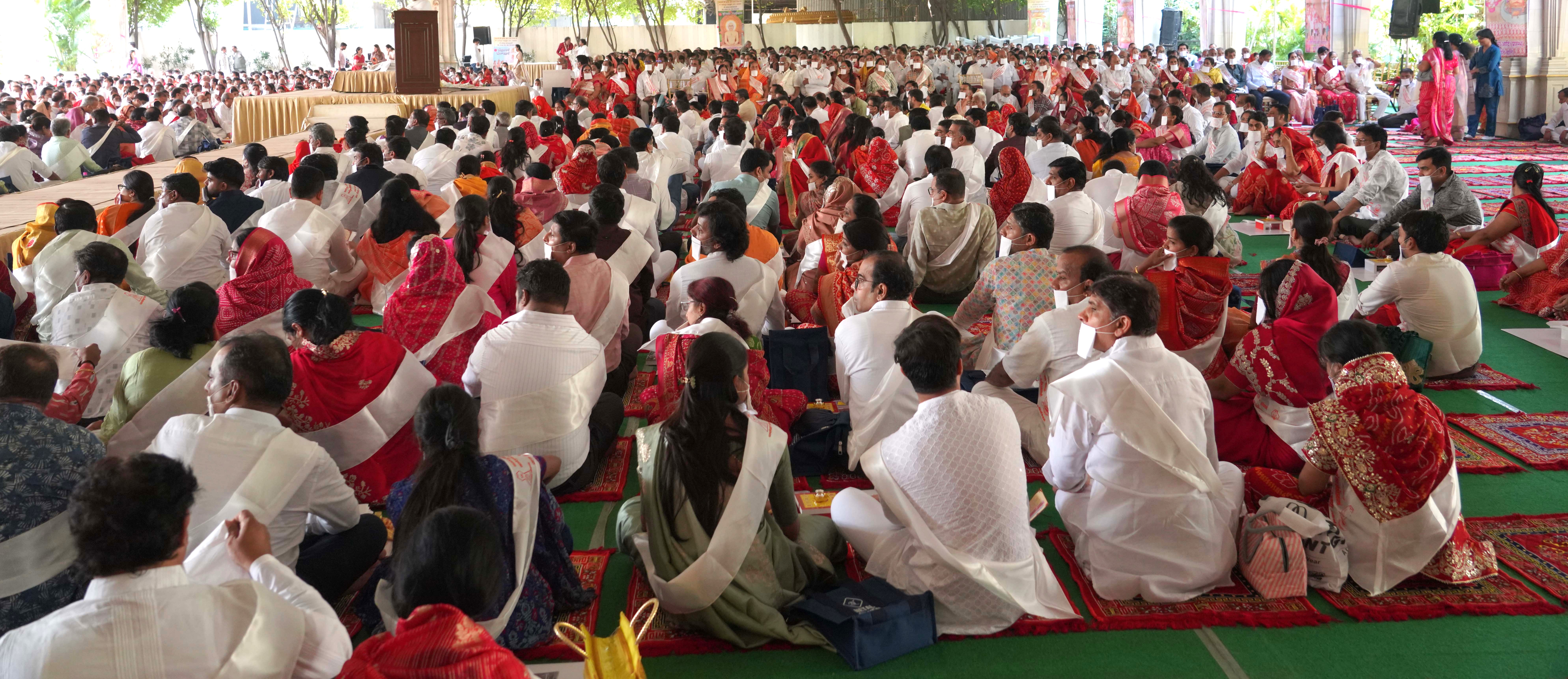
Hyderabad, Oct 05: A unique Jain prayer with a difference, Namoththunam, brought together around 1,200 couples at Imperial Gardens, Secunderabad, on Sunday morning. Couples from different walks of life from Hyderabad and neighbouring towns, cities and states participated in the collective prayer. All together, more than 3000 devotees joined in it stated Manoj Kothari, Prachar Manthri for the event in a press note issued.
The programme was organised under the guidance of Jain monk 1008 Pujya Acharya Sri Gyanchandra Ji Marasab Sahib by Shri Vardhaman Sthanakvasi Jain Shravak Sangh, Greater Hyderabad, Kachiguda.
Namoththunam, in simple words, is a prayer—but a prayer with a difference. Across religions, prayer can be a way of seeking, thanking, remembering or transforming oneself. Namoththunam is distinctive in the way it combines reverence with an aspiration to cultivate the qualities of spiritually accomplished beings.
“We often approach prayer with a wish: ‘Give me strength, give me success, give me happiness.’ Namoththunam offers another dimension of prayer: ‘Let me recognise greatness, learn from it and cultivate those qualities in myself.’”
According to Annraj Bafna, President, and Pavan Katariya, Mahamanthri, of Shri Vardhaman Sthanakvasi Jain Shravak Sangh, Greater Hyderabad, Kachiguda, “Namoththunam is a prayer that doesn’t ask, ‘What will I get?’ but ‘What can I learn and become?’”
Unlike prayers centred primarily on seeking material benefits, Namoththunam encourages self-reflection and self-improvement, cultivating qualities such as patience, compassion, humility, discipline and control over anger and ego. “This gives the programme a strong human-interest and social relevance,” said Dr. Archana Ranka, Gynaecologist and participant.
The message, they said, goes beyond the Jain community. At a time when families and individuals face stress, impatience, anger and increasing individualism, the idea of husbands and wives coming together to pause, pray and reflect on the qualities they wish to cultivate in themselves has wider relevance to contemporary society, said Siddharth Pokarna, who is into corporate gifting.
Jainism encourages people not merely to admire someone, but to understand the qualities that make that person worthy of admiration. “We often teach children whom to admire; perhaps we should also teach them what qualities to admire,” said Suresh Sisodiya, Chief Convenor, and Ashok Tated, Chief Convener of Chaturmas.
The programme was therefore more than a religious gathering or a recitation. It became a collective experience of prayer, self-reflection and the aspiration to become better human beings.
Trishla, a newly married 24-year-old Gen-Z participant attending Namoththunam for the first time, said, “It was so calming. I felt as if I was seated next to God and facing Him while praying.”
Mrs. Lalita, a homemaker from Jalgaon, Maharashtra, who participated in the prayer along with around 90 other women, said, “Bhakti mein shakti hai.” (There is power in devotion.)
For IT professionals Prateek Jain and Raksha Jain, both working with multinational IT companies, Namoththunam offered a different perspective on prayer. “We usually pray for something. Namoththunam makes us ask: ‘What can I become?’ It teaches us to admire good qualities in others and consciously cultivate those qualities in ourselves,” they said.
“We usually pray for what we want. Namoththunam reminds us to become what we admire.”
The learning from Namoththunam, participants said, is wide-ranging. Humility, self-control, patience, compassion, discipline, contentment, detachment, self-reflection, choosing better role models and the shift from ‘getting’ to ‘becoming’ were among the qualities highlighted by Surender Jain, Mahender Kumar Jain and Jyothi Lalwani from Jalgaon, Maharashtra, along with Mrs. Shakuntala Pokarna and Harsh Jain from Bengaluru.
The gathering of around 1,200 couples praying together created a powerful visual and spiritual experience, while also highlighting a simple message relevant to everyone: prayer can be not only about what we seek, but also about who we aspire to become.


