


22, Oct 2026
One Dead, Over 100 Injured in Traditional Stick Fight During Dussehra Celebrations in Andhra Pradesh
Kurnool, Oct 22: One person was killed and more than 100 others injured during a traditional stick fight held as part of the annual Dussehra celebrations at Devaragattu village in Andhra Pradesh’s Kurnool district, officials said.
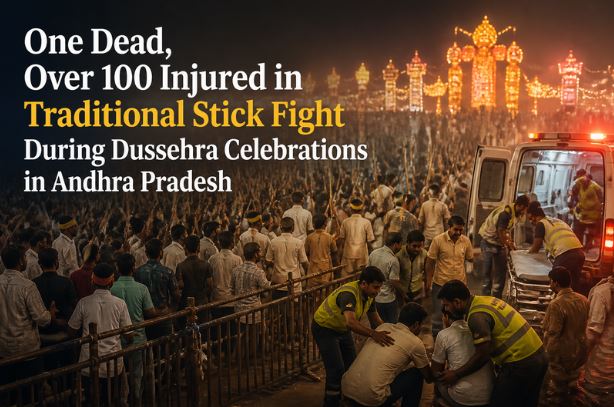
Representational Image
The violent clash took place late Wednesday night during the Devaragattu Banni Utsav in Holagunda mandal, where devotees from several villages gathered for the centuries-old ritual associated with the Mala Malleswara Swamy temple.
The deceased was identified as Potaraju, 28, a resident of Alur. Among the injured, around 10 people were reported to be in critical condition, while others sustained varying degrees of injuries.
The injured were rushed to hospitals in Adoni and Alur for treatment. Those with minor injuries received medical attention at a temporary facility established by the authorities near the venue.
Thousands Gather for Annual Ritual
The Banni Utsav is observed every year during the Dussehra festivities at the Mala Malleswara Swamy temple, situated on a hillock at Devaragattu. The ritual centres on a symbolic battle in which participants wield sticks to gain possession of the idols of deities Mallamma and Malleswara Swamy following their ceremonial wedding around midnight.
According to local belief, Lord Shiva assumed the form of Bhairava and defeated the demons Mani and Mallasura with sticks. The annual event reenacts this mythological episode, with participants divided into two rival groups representing the divine forces and the demons.
Villagers from Nerani, Nerani Tanda and Kothapeta traditionally take part on one side, while devotees from Arikera, Alur, Suluvai, Ellarthi, Nidravatti and Bilehall participate on the other.
During the ritual, members of the two groups engage in fierce stick fighting as they attempt to seize the sacred idols from their rivals. The practice frequently results in serious injuries, which some devotees regard as an auspicious part of the tradition.
Police Measures Fail to Prevent Violence
Despite repeated efforts by the authorities to discourage the dangerous practice, the ritual continued this year. Police had reportedly issued directions against the stick fight and deployed more than 1,000 personnel to maintain order and prevent injuries.
However, the preventive measures failed to stop the participants from engaging in the clash, resulting in one death and more than 100 injuries.
The recurring violence during the annual festival has posed a persistent challenge for law enforcement agencies, which face resistance from sections of the local population who consider the ritual an integral part of their religious and cultural heritage.
Major Attraction for Devotees
The Devaragattu Banni Utsav draws thousands of devotees from across Kurnool district, neighbouring areas and states such as Telangana and Karnataka. Large crowds gather to witness the midnight ritual, which remains a significant annual event for the surrounding villages.
Despite repeated appeals from authorities to abandon the dangerous practice, the tradition continues to attract enthusiastic participation.
The latest casualty has once again brought the risks associated with the ritual into focus, highlighting the challenge of balancing longstanding religious customs with public safety during large-scale festivals.
- 0
- By Neel Achary

22, Oct 2026
Weak Monsoon May Push India’s Farm Loan NPAs To 5.6% By FY28: CareEdge
New Delhi, Oct 22: India’s agriculture gross non-performing assets (GNPA) at scheduled commercial banks could rise to 5.3–5.6 per cent by March 2028, as the weakest monsoon since 2015 strains kharif crop loans, according to a CareEdge Ratings report. Public sector banks are expected to bear the larger share of the stress.
Representational Image
Current Stress Levels
The agriculture GNPA ratio stood at 5.11 per cent in June 2026, with farm-loan GNPAs at Rs 1.41 lakh crore. Although agriculture accounts for only 12.9 per cent of scheduled commercial bank advances, it represents 37.5 per cent of all bank GNPAs.
CareEdge expects the ratio to improve to 4.6–4.8 per cent by March 2027, aided by strong credit growth and write-offs. However, it is projected to rise thereafter as crop loans in monsoon-deficient regions turn overdue and are classified as NPAs.
Monsoon Impact
The 2026 southwest monsoon ended at 87 per cent of the long-period average, the weakest season since 2015, according to the India Meteorological Department. The shortfall was concentrated in states that account for most agricultural credit.
About 68 per cent of scheduled commercial bank agriculture credit is in states where rainfall was at least 20 per cent below normal, compared with 48 per cent during the 2015 drought year. This concentration increases the risk of loan delinquencies in FY28.
NPAs May Reach Rs 2 Lakh Crore
Agriculture GNPAs are projected to rise from Rs 1.41 lakh crore in June 2026 to Rs 1.47–1.53 lakh crore by March 2027, and further to Rs 1.9–2 lakh crore by March 2028. The weak monsoon alone could add 70–80 basis points to the farm GNPA ratio.
Including restructured farm loans in drought-affected areas, which remain classified as standard assets, stressed agriculture advances could reach 6–6.3 per cent of total agriculture advances.
What It Means For Banks
The report signals that while headline farm-loan asset quality has improved sharply since the pandemic, the 2026 monsoon shortfall could reverse part of that gain. Banks with higher exposure to rain-dependent kharif crops and deficit rainfall states may need closer monitoring of repayments, restructuring and provisioning in the coming quarters.
22, Oct 2026
Sonia Gandhi Joins Instagram, Unveils First Look Of Memoir ‘Belonging’
New Delhi, Oct 22: Congress Parliamentary Party chairperson Sonia Gandhi made her Instagram debut on Thursday, using her first post to reveal the cover of her forthcoming memoir, Belonging: A Journey of Love. The book is scheduled for worldwide release on November 10, with pre-orders already open.

First Post On Instagram
In her debut video, Sonia Gandhi is seen receiving the first copies of the memoir and sharing sweets with her daughter, Congress MP Priyanka Gandhi Vadra. She described the book as “a story of love, duty, loss and finding a place to belong.”
Until now, the senior Congress leader had no personal social media account. Her new Instagram profile follows Rahul Gandhi, Priyanka Gandhi and the Indian National Congress, and had crossed 10,700 followers shortly after her first post.
Memoir Details
The 544-page memoir will be published globally by Alfred A. Knopf, while HarperCollins India will release it in India on November 10. HarperCollins has described it as a deeply personal account of love, identity, duty and belonging, offering an insider’s perspective on India’s journey.
The announcement ends weeks of uncertainty over the memoir’s Indian publication after Penguin Random House India said it would not be the domestic publisher. HarperCollins India subsequently acquired the publishing rights.
Publisher Row
Penguin Random House India rejected suggestions that it withdrew because Sonia Gandhi declined editorial changes. The publisher said fact-checking and editorial recommendations are a normal part of publishing, and maintained that it had remained willing to publish the book.
The company said it would not comment further on confidential discussions with the author. The memoir’s release is now being closely watched as one of the most anticipated political books of the year.
22, Oct 2026
Tata Power To Set Up Rs 54-Crore AI-Focused Global Capability Centre In Odisha
Oct 22: Tata Power is establishing a Global Capability Centre (GCC) in Khordha district, Odisha, with an initial investment of Rs 54.31 crore. The facility, expected to become fully operational within three months, will create 110 high-skilled jobs and is the first GCC approved under the state’s dedicated GCC policy.

Representational Image
AI-Led Energy Solutions
The centre will develop digital solutions for the power and energy sector using artificial intelligence, machine learning, generative AI and agentic AI. Its work will support asset health monitoring, demand forecasting, operational efficiency and investment planning across Tata Power’s businesses.
It will also work on emerging technologies such as knowledge graphs, blockchain, digital twins and simulation systems. These tools are expected to support renewable energy, manufacturing, power grids and pumped-hydro projects across both construction and operational requirements.
Jobs And Commercial Potential
The centre will bring together professionals in digital technology, engineering and energy analytics. Roles are expected to include AI specialists, data scientists, digital platform engineers, cloud infrastructure engineers and power-sector domain experts.
Besides serving Tata Power’s internal operations, the facility will develop digital products and services for external customers, opening possibilities to commercialise technologies created in Odisha.
Boost For Odisha’s GCC Push
Odisha’s GCC Policy, unveiled last year, aims to attract investments of more than Rs 1,000 crore and develop at least five GCC hubs across Bhubaneswar, Cuttack, Puri, Paradip, Bargarh, Jharsuguda and Sambalpur. The policy also targets over 50,000 direct and indirect jobs.
Tata Power’s project was among 19 proposals worth about Rs 3,280 crore cleared by the Odisha government in September, reinforcing the state’s effort to build a knowledge- and technology-driven services ecosystem.
22, Oct 2026
Delhi-NCR Sees Season’s First Poor Air Day; GRAP-I Curbs Take Effect As Winter Chill Sets In
Oct 22: Delhi-NCR woke up to a noticeable chill on Thursday morning, but the drop in temperature brought little relief from pollution. The capital recorded its first “poor” air-quality day of the season, prompting the Commission for Air Quality Management (CAQM) to enforce Stage I of the Graded Response Action Plan (GRAP) across the National Capital Region.
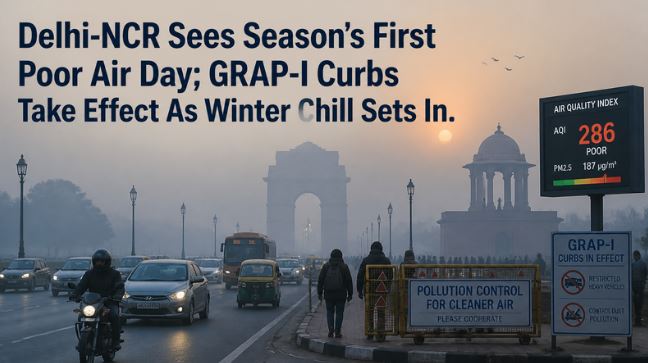
Representational Image
Air Quality Worsens
Delhi’s overall AQI rose sharply to 244 at 2 pm on October 21, up from 179 in the “moderate” category the previous day. The CAQM said the deterioration, combined with forecasts of persistently elevated pollution, necessitated immediate action.
Chandni Chowk was among the worst-affected areas, recording an AQI of 306 in the “very poor” category, with PM10 identified as the dominant pollutant. Several other stations, including Mandir Marg, Punjabi Bagh, Sirifort and Dwarka Sector 8, also recorded AQI levels in the poor range.
Under the CPCB scale, an AQI of 201–300 is “poor,” 301–400 is “very poor,” and 401–500 is “severe.” Authorities said pollution levels are expected to remain elevated over the coming days.
GRAP-I Restrictions
Stage I measures are now in force across Delhi and adjoining parts of Haryana, Uttar Pradesh and Rajasthan. The restrictions prohibit the use of coal and firewood in tandoors at hotels, restaurants and open eateries, and impose curbs on diesel generator sets.
The CAQM’s GRAP sub-committee has directed agencies to implement the measures immediately, strengthen surveillance and ensure compliance with the citizen charter. Officials will continue to track air quality and weather conditions before considering stricter steps.
Metro Adds Trips
To reduce reliance on private vehicles, the Delhi Metro Rail Corporation will operate 20 additional train trips on weekdays from October 22. The DMRC will also intensify dust-control work at construction sites and nearby roads, including clearing accumulated dust, removing garbage from footpaths and cleaning road medians.
Winter Action Plan Ahead
The curbs precede the Delhi government’s Winter Action Plan, which will come into effect from November 1. It includes measures targeting vehicular emissions, construction dust and industrial pollution, along with stricter dust monitoring and increased mechanised road sweeping.
The plan also proposes a “No PUC, No Fuel” policy, under which vehicles without valid Pollution Under Control certificates will be denied fuel. From November 1, non-Delhi registered vehicles that do not meet BS-VI emission norms will face entry restrictions, subject to exemptions.
22, Oct 2026
PM Modi, Polish PM Donald Tusk To Hold Key Talks As India-Poland Partnership Seeks New Momentum
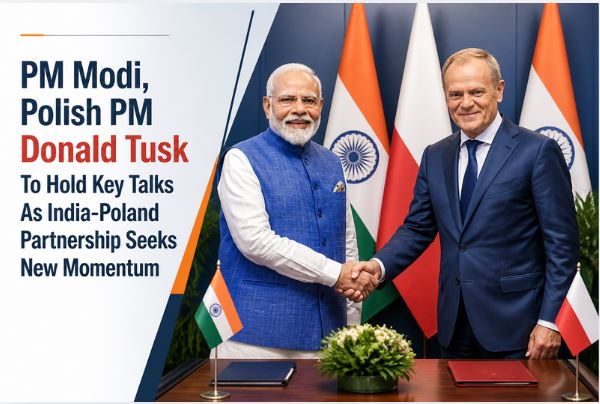
Oct 22: Prime Minister Narendra Modi will hold bilateral talks with Polish Prime Minister Donald Tusk in New Delhi on Thursday, as the two countries look to deepen cooperation in defence, trade, technology and clean energy. The meeting comes during Tusk’s three-day official visit to India from October 21 to 23, undertaken at PM Modi’s invitation.
Agenda For Talks
The leaders are expected to review the entire range of India-Poland relations, which were elevated to a Strategic Partnership during PM Modi’s visit to Warsaw in August 2024. They will also exchange views on regional and global developments of mutual interest, including the Russia-Ukraine conflict and India-European Union relations.
Discussions are likely to focus on expanding cooperation in defence manufacturing, trade and investment, emerging technologies, space research, port infrastructure and renewable energy. The meeting is expected to give fresh momentum to the India-Poland Strategic Partnership.
High-Level Engagement
External Affairs Minister S. Jaishankar met the visiting Polish leader and discussed bilateral cooperation ahead of the prime ministerial talks. Tusk arrived in New Delhi on Wednesday evening and was received by Minister of State for Food Processing Industries and Jal Shakti, Raj Bhushan Choudhary.
The Polish delegation includes Finance and Economy Minister Andrzej Domanski and a high-level business delegation. The Ministry of External Affairs said the visit would further deepen the long-standing ties between the two countries.
Business Forum And Bengaluru Leg
An India-Poland Business Forum will be held in New Delhi on October 22, followed by another engagement in Bengaluru on October 23. Tusk is scheduled to interact with business stakeholders, particularly from the information technology and space sectors, during his Bengaluru visit.
This is Tusk’s second official visit to India as Polish Prime Minister; he earlier visited in 2010. He had also travelled to New Delhi in 2017 for the India-EU Summit in his capacity as President of the European Council.
22, Oct 2026
Kuwait-Flagged Tanker Hit by Unknown Projectile in Strait of Hormuz; 21 Indian Seafarers Safe
New Delhi, Oct 22: A Kuwait-flagged oil product tanker carrying 21 Indian seafarers was struck by an unidentified projectile while sailing through the strategically important Strait of Hormuz on Wednesday, October 21. All crew members aboard the vessel have been reported safe, Union Minister for Ports, Shipping and Waterways Sarbananda Sonowal confirmed.
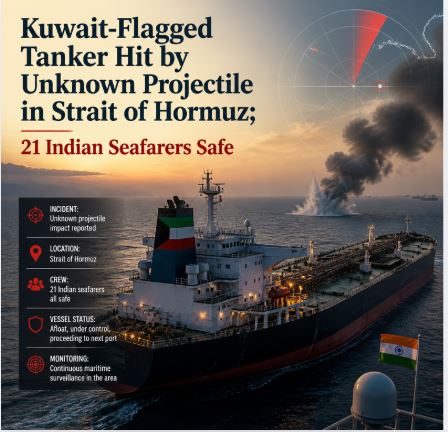
Representational Image
The vessel, M/T Al Dasma, came under attack while transiting the busy maritime corridor, raising fresh concerns over the safety of commercial shipping in the Gulf region amid escalating regional tensions.
In a statement shared on social media platform X, Sonowal said all 21 Indian crew members, along with the remaining crew aboard the tanker, were safe. He added that the government was closely monitoring developments and maintaining contact with the ship’s management company to ensure the continued safety and well-being of the seafarers.
According to the United Kingdom Maritime Trade Operations (UKMTO), the incident was reported approximately 11 nautical miles west of Bukha, Oman.
A report by Times Kuwait said the impact triggered a fire aboard the tanker, which was subsequently brought under control. The vessel reportedly remained stationary following the incident, while all crew members were accounted for and safe.
The circumstances surrounding the strike, including the origin of the projectile, were not immediately established.
Second Tanker Incident Involving Indian Seafarers
The latest incident follows another attack on a commercial tanker in the Strait of Hormuz earlier this month. On October 16, the crude oil tanker MT ST 3, carrying 15 Indian seafarers, was reportedly struck by a projectile in the same waterway.
Indian authorities subsequently confirmed that all Indian nationals aboard that vessel were safe and that no casualties had been reported.
The two incidents have heightened concerns about the risks faced by Indian seafarers working aboard commercial vessels navigating one of the world’s most strategically significant shipping routes.
Concerns Over Maritime Security
The Strait of Hormuz is a critical passage for international energy supplies, connecting the Persian Gulf with the Gulf of Oman and the wider Arabian Sea. Disruptions to shipping in the region can have implications for global oil transportation, energy markets and international trade.
India has consistently called for the protection of merchant vessels and seafarers, stressing that attacks on commercial shipping undermine maritime security and freedom of navigation.
New Delhi has maintained that attacks on commercial vessels and merchant mariners are legally and morally indefensible, while emphasising the importance of ensuring the safe and uninterrupted movement of maritime commerce through international waterways.
With the latest incident involving M/T Al Dasma, authorities continue to monitor the evolving security situation and coordinate with the vessel’s management to safeguard the crew.
Although all seafarers aboard the tanker have been reported safe, the incident underscores the continuing security challenges confronting commercial shipping in the Gulf region.
22, Oct 2026
RAKEZ connects industrial businesses with trade ecosystem experts to support global growth

|
22, Oct 2026
Centre Tells TV Channels to Tighten Editorial Checks, Curb Sensationalism and AI Misuse
New Delhi, Oct 22: The Ministry of Information and Broadcasting (MIB) has issued a fresh advisory asking private satellite television channels to strictly follow the Programme Code, amid concerns over sensational coverage, graphic visuals, inflammatory debates and the growing use of artificial intelligence in news production. The advisory was circulated on October 21, 2026.

Representational Image
The ministry said the advisory follows observations by the Inter-Departmental Committee (IDC) that telecasts on several channels did not conform to the spirit of the Programme Code under Rule 6 of the Cable Television Networks Rules, 1994. It warned that violations could invite action under the Cable Television Networks (Regulation) Act, 1995, and rules framed under it.
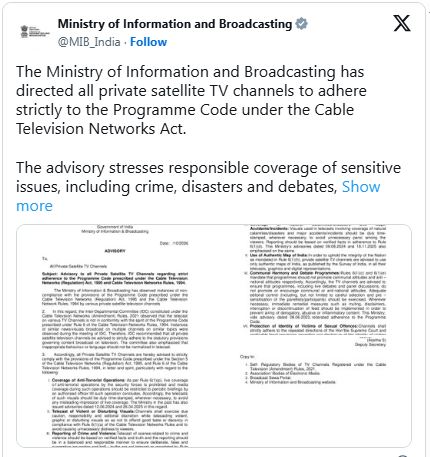
The Ministry of Information and Broadcasting has directed all private satellite TV channels to adhere strictly to the Programme Code under the Cable Television Networks Act. The advisory stresses responsible coverage of sensitive issues, including crime, disasters and debates, and warns of strict action against violations.
— Ministry of Information and Broadcasting (@MIB_India) October 21, 2026
Eight-point compliance advisory
The advisory lays out eight broad areas of compliance for broadcasters:
Anti-terror operations: Live coverage of security-force operations remains prohibited under Rule 6(1)(p). Channels should rely on periodic briefings by authorised officers until an operation ends, and time-stamp visuals where necessary to avoid creating a false impression of live coverage.
Violent and disturbing visuals: Channels must exercise editorial discretion, avoid excessive repetition or looping of distressing footage, and blur or mask visuals wherever warranted.
Crime reporting: Reporting should be fact-checked, balanced and responsible, without glorifying or normalising unlawful or socially undesirable behaviour.
Victim protection: Broadcasters must protect the identity of victims of sexual offences, including indirect details, photographs or family information that could identify them.
Disasters and accidents: Coverage of natural calamities, disasters and major accidents should be based on verified facts, with time-stamped visuals used to prevent unnecessary panic.
Maps of India: Channels have been asked to use only authentic maps published by the Survey of India in telecasts, graphics and digital representations.
Debates and communal harmony: Live panel discussions must not promote communal or anti-national attitudes; broadcasters should screen and sensitise participants and use corrective tools such as muting, disclaimers, interruption or discontinuation when needed.
Artificial intelligence: AI and generative AI may be used only in an assistive role, without compromising the accuracy, authenticity or sensitivity of news content.
Focus on AI in newsrooms
A notable addition is the ministry’s caution on AI-generated graphics, virtual news presentations and other AI-assisted programming. The advisory does not ban the technology outright but says it must not replace editorial judgment or weaken verification standards.
The ministry also asked broadcasters to strengthen internal content-review mechanisms and sensitise staff involved in news gathering, editing, production, transmission and telecast. It encouraged regular workshops and training sessions to ensure continued compliance.
Earlier warnings repeated
This is not the first time the Centre has flagged these issues. The MIB had earlier issued advisories on June 12, 2024, and April 26, 2025, reiterating restrictions on live coverage of anti-terror operations and responsible broadcast practices.
The latest advisory signals that the government expects channels to treat the Programme Code as an operational standard—not merely a legal formality—particularly in high-traction formats such as breaking-news coverage, crime reporting, disaster visuals and prime-time debates.
22, Oct 2026
EDMI installs first smart meters in the United States with Central Rural Electric Cooperative
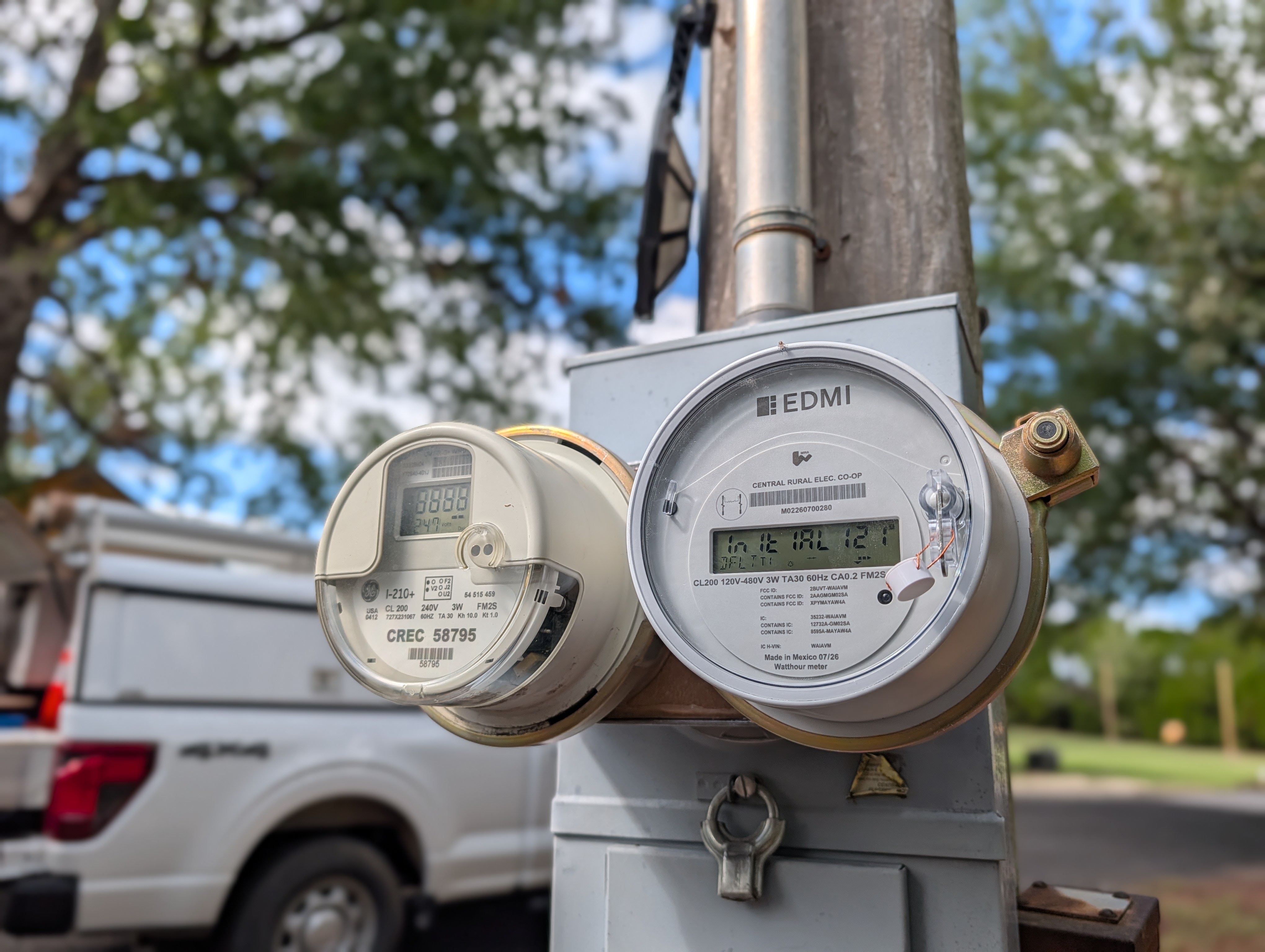
Stillwater, Oklahoma, Oct 22: EDMI, a global leader in intelligent energy solutions, has completed the first installation of its meters on US soil, with Central Rural Electric Cooperative (CREC) in Stillwater, Oklahoma.
The pilot project begins with the initial installations, featuring AMI 2.0 and grid-edge capabilities. Afurther phase will be installed later in October as CREC evaluates the potential of EDMI’s technology to enhance network visibility, operational efficiency and grid modernisation initiatives.
The project will give CREC access to more timely and granular energy data through EDMI’s Storm software platform, providing greater visibility into network performance, asset health and outages. The technology is also intended to support faster identification and resolution of network issues, helping CREC make more informed operational decisions as it continues to serve a growing service territory.
For EDMI, the project represents an important milestone in the company’s expansion into the US market and its goal of providing utilities with greater choice through its next-generation Neos AMI 2.0 solutions.
“This is an important milestone for EDMI as we establish our presence in the US market,” said Roy Kirsopp, Group CEO of EDMI. “Working with CREC gives us the opportunity to bring more than 45 years of experience delivering smart metering solutions to support US cooperatives as they assess next-generation AMI capabilities while also helping us better understand the needs of cooperatives and the communities they serve.”
Mike Somersmith, Managing Director EMEA of EDMI, said, “Utilities are seeking greater visibility and more timely access to data as they modernise their networks. Through our Neos AMI 2.0 approach, EDMI is focused on providing utilities with flexible solutions, actionable insights and greater choice to support evolving grid requirements.”
For CREC, the project provides an opportunity to evaluate next-generation AMI 2.0 capabilities while improving operational visibility and supporting a more resilient electric system. Advanced metering and analytics will provide timely information to support operational decision-making, outage response and long-term system planning.
“We are pleased to be working with EDMI as we explore the next generation of metering technology,” said Shane Burgess, CEO of Central Rural Electric Cooperative. “The pilot will allow our team to evaluate how greater access to data and improved visibility can support the reliability of our system and the service we provide to our members.”
EDMI provides intelligent energy solutions for utilities worldwide. A subsidiary of Osaki Electric, one of Japan’s leading metering technology companies, EDMI is expanding its presence in the US market while offering utilities greater choice as they modernise their energy infrastructure.