


21, Apr 2026
Royal Realtors Focuses on Structured and Concrete-Driven Development to Enhance Construction Quality
Mumbai, April 21(BNP): Royal Realtors Group has announced an enhanced focus on structured planning and concrete-driven construction practices aimed at improving durability, efficiency, and long-term value across its projects.
As the real estate sector continues to evolve, the company is prioritizing system-driven execution, robust structural design, and modern construction methodologies to ensure consistent quality and faster project delivery timelines.
Commenting on the development, Deven Shah, Managing Director, Royal Realtors Group, said,
“Today, quality is not just about design it’s about how well a structure is planned and executed. At Royal Realtors, we are focusing on more structured development processes and stronger construction practices to ensure durability, safety, and timely delivery across our projects.”
The company is aligning its construction strategy with efficient planning, optimized material utilization, and streamlined on-site execution. This approach is expected to reduce delays, improve productivity, and enhance overall project performance.
With a continued emphasis on governance, quality control, and disciplined execution, Royal Realtors aims to deliver developments that not only meet present-day expectations but also stand the test of time.

- 0
- By Neel Achary

21, Apr 2026
New Study Warns Law Firms Face an Existential Crisis in Talent Development as AI Replaces the Apprenticeship Model
Apr 21: The traditional foundations of legal training are being dismantled by automation, leaving the industry’s elite firms facing a radical ‘capabilities gap’ in their future talent pipeline. This is according to a new study from leadership consultancy firm The Positive Group, which highlights how the rapid adoption of GenAI is transforming the centuries-old apprenticeship model that underpins how trainee lawyers develop legal judgement, expertise and the skills needed to become a partner.
The report, titled The AI Leadership Challenge in Law, was produced in collaboration with researchers from Harvard Business School, RSGI, and Hubel Labs. It draws on insights from 16 of the industry’s most influential decision-makers -including Managing Partners, Chief AI Officers, and heads of professional standards from firms including Orrick, Herbert Smith Freehills, Baker McKenzie, Bird & Bird, A&O Shearman, White & Case, and Gilbert + Tobin.
The end of ‘learning by doing’
For generations, junior lawyers built their “legal muscle” through repetition: document review, due diligence, and exhaustive research. The report argues that this “volume work” was not merely a revenue driver, but a psychological necessity for building the cognitive foundations of professional reasoning and judgement.
However, the study warns that as AI takes over these foundational tasks, the ‘repetition loop’ is breaking. Junior lawyers are being catapulted into higher-level advisory work much earlier in their careers—often before they have developed the instinctive ‘gut feel’ for risk that only comes from years of interrogating primary sources.
Anna Sutherland, Executive Partner at Herbert Smith Freehills, a contributor to the research, highlights the scale of the challenge: “Traditionally, juniors learned by repetition through drafting, due diligence, and volume work. AI is changing that, so the challenge is to ensure they still build solid foundations while acquiring new skills.”
A Scrutiny Gap is emerging:
The report identifies a burgeoning risk within the firm hierarchy: a decline in critical scrutiny. One participant noted that with AI-generated drafts, there is now “less requirement to go and interrogate sources”, creating a dangerous psychological bias where outputs are accepted at face value.
“We are heading toward a potential crisis of potential skills deficit in critical thinking and appraisal,” says Will Marien, Director at The Positive Group. “If a junior lawyer hasn’t spent years digging through the ‘why’ behind a contract clause because a machine produced it in seconds, they lose the ability to spot the nuance where the real risk lives. The apprenticeship model wasn’t just about learning the law; it was about learning how to think under pressure. By removing the repetitive, routine work, we are inadvertently removing the training ground for work that involves judgement, appraisal and interrogation of sources.”
Marien continues: “Law firm leaders must recognise that AI doesn’t just change the workflow; it changes the cognitive development of their most valuable asset: their people. We are seeing the end of the stable strategy; firms must now move to a model of ‘Adaptive Apprenticeship’ where critical thinking is taught as a primary skill, not an accidental byproduct of volume work.”
From information generators to curators of meaning
The research suggests that the role of the junior lawyer is being redefined in real-time. Rather than acting purely as generators of information, they are increasingly becoming “curators of meaning” and “challengers of logic”. This shift is not only changing the skills required, but is reshaping where expertise sits within firms.
Junior lawyers are often more fluent in emerging AI tools and are playing a growing role in driving innovation from the ground up. As Christian Bartsch, CEO of Bird & Bird, notes: “Some of our best ideas don’t come from senior leaders, but from next-gen talent. We’ve built innovation channels to capture these ideas so they aren’t lost in our wider organisation. As part of our journey, we’ve become braver about calling time on what doesn’t work.” In this environment, curiosity, adaptability, and the ability to interrogate AI outputs are becoming core capabilities at every level of the firm.
However, the report warns that this transition must be managed carefully. Rather than relying solely on traditional repetition-based learning, leaders are being encouraged to take a more active role in shaping how junior lawyers engage with AI through clear narratives, role-modelling, and creating environments where questioning and critical thinking are actively encouraged.
By fostering trust and openness around both the potential and limitations of AI, firms can ensure that junior lawyers build the confidence and nuance needed to apply these tools effectively. In this way, the transition becomes less about managing risk, and more about intentionally developing the next generation of lawyers to combine technological fluency with strong professional judgement.
The Leadership Mandate: devising adaptive apprenticeships
For the law firm C-suite, the findings reinforce the need for a radical departure from traditional talent management. The report concludes that AI maturity is not about how many licences a firm buys, but how it re-engineers the path to expertise.
Marien concluded: “The task for leading law firms is no longer to protect the old ways of working, but to find new pathways for developing “depth” in an automated environment. This means placing an unprecedented premium on “soft” cognitive skills—curiosity, the ability to challenge automated reasoning, and ethical interpretation—that were previously assumed to develop over time.
“In a world where the commodity – the legal output – is increasingly free, the ‘Psychology of AI Maturity’ proves that the only remaining value is the human at the keyboard. If firms fail to fix the apprenticeship model now, they aren’t just losing their juniors; they are losing their future partnership.
21, Apr 2026
Airbnb Data Shows How Indian Travellers Are Turning to Asia This Summer
Apr 21: This summer, Indian travellers are choosing Asia. Powered by a generation raised on Korean dramas, Japanese aesthetics and Asian street food culture, destinations across Asia feel both familiar and exciting and travel interest is reflecting that. Travellers are exploring destinations that offer a compelling mix of cultural discovery, strong connectivity and convenient travel times, making Asia an appealing choice for summer getaways.
According to Airbnb search data, Gen Z led this charge, accounting for over 40% of Airbnb’s summer searches this year and growing faster than any other generation at approximately 60% year-on-year. This generation tends to travel more frequently and is increasingly planning trips around experiences, from concerts and festivals to cultural events and culinary exploration.
Airbnb data reveals growing interest in destinations across Japan, South Korea and Southeast Asia. Osaka (over 85% growth in searches), Tokyo (over 90%) and Busan (over 95%) recorded some of the strongest increases in search interest among Indian travellers. This aligns with broader travel trends pointing to rising interest driven by pop culture fandom, culinary appeal and ease of travel. Kuala Lumpur (over 50%) and Bangkok (over 35%) continued to see steady demand, reflecting their strong connectivity and familiarity among Indian travellers.1
Travel also remains a shared experience, with nearly 60% of searches driven by group and family travel, followed by over 30% from duo travellers, highlighting the importance of spending time together while exploring new destinations.1
This interest in exploration is also shaping domestic travel trends. Within India, travellers are increasingly looking beyond established hotspots and exploring destinations that offer nature, heritage and cultural richness. Thiruvananthapuram (over 90% growth in searches), Puri (over 30%), Jaipur (over 70%) and Meghalaya (over 70%) have all seen strong growth in interest.1
“What we are seeing this summer is travel driven by curiosity and culture,” said Amanpreet Singh Bajaj, Country Head, Airbnb India and Southeast Asia. “Asia offers something rare: the familiarity of a culture Indian travellers love, and a chance to discover a new destination. That, paired with greater connectivity and the option to plan a meaningful yet short trip during a long weekend, makes Asia even more appealing to Indian travellers. It’s interesting to see that Indian travellers are slowly moving beyond the templatized and obvious, both internationally and within India, and proactively seeking destinations that feel more personal, not just popular.”
As travel habits continue to shift, Asia is where Indian travellers are heading this summer, offering a sense of ease through its accessibility, affordability and range of experiences.
21, Apr 2026
Phu Quoc set to become a major Asia Pacific aviation hub with scalable, fully automated passenger processing
GENEVA – 21 April 2026 — Phu Quoc International Airport is set to become a next-generation, fully self-service aviation hub ahead of the Asia-Pacific Economic Cooperation (APEC) 2027 Forum. Sun Group, one of Vietnam’s largest private conglomerates, has partnered with SITA to lead this transformation. To support Vietnam’s rapidly growing air travel demand, the parties have also signed a Memorandum of Understanding establishing a framework for broader collaboration across Sun Group’s future airport developments in Vietnam.
Phu Quoc International Airport is projected to handle 24 million passengers annually once the new Terminal 2 opens, with long-term capacity designed to scale to 50 million. The development comes at a pivotal moment and will place Phu Quoc in the global spotlight as a rising destination in the Asia Pacific region.
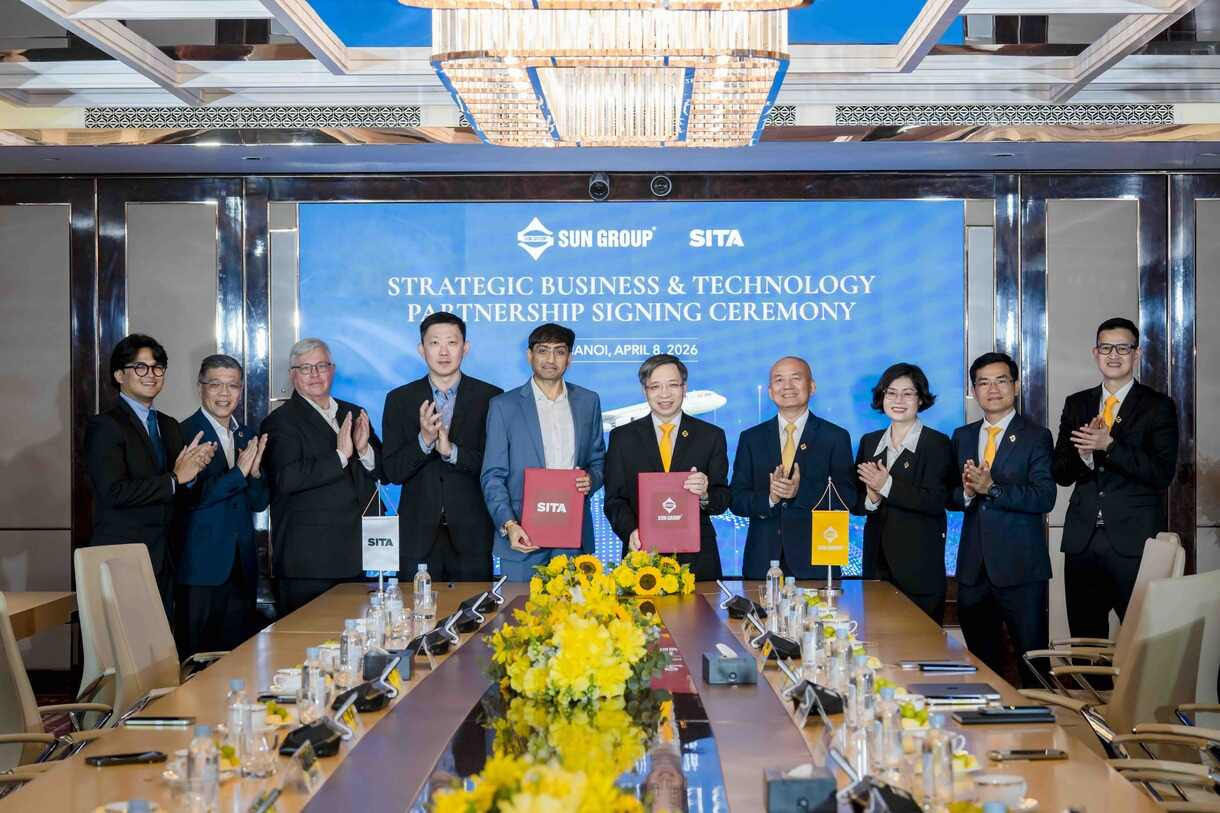
Under the Phu Quoc project, SITA will deploy an end-to-end suite of airport technologies across the new terminal, delivering a fully self-service passenger experience. Travelers will be able to check in, select seats, print boarding passes and bag tags, drop their luggage, and board their flights through automated touchpoints.
The new terminal will feature SITA Flex Hybrid, supporting 204 common-use workstations for passenger processing. To secure operational resilience, SITA Local Departure Control System (DCS) will be deployed as a backup.
Passengers will use 150 SITA Smart Path kiosks for check-in, seat selection, boarding pass printing, and tagging check-in bags, 100 SITA Smart Path Bag Drop (Scan & Go) units for selfservice baggage drop, and 38 dual-lane SITA Smart Path Gates for automated boarding. All systems are seamlessly coordinated through the SITA Smart Path Hub biometric technology.
Real-time baggage tracking and reconciliation will be delivered through SITA Bag Manager Lite, supporting four baggage workstations and 20 handheld terminals. Airport operations will be powered by SITA Airport Operational Database (AODB), while passenger information will be managed by SITA AirportVision Evolved, covering 397 displays. Overall airport operations will be overseen by SITA Airport Management, supporting ten operational workstations.
The project, which began development in March 2026, is scheduled to open in July 2027.
“We are pleased to partner with SITA on this strategic collaboration to support the transformation of our airport portfolio. As we continue to invest in world-class aviation infrastructure, SITA’s proven expertise and end-to-end technology capabilities will play a key role in helping us deliver smarter, more efficient, and seamless passenger experiences,” said Mr. Nguyen Chi Thanh, President, Sun Group. “This partnership reflects our shared vision of elevating Vietnam’s aviation sector, and we look forward to working closely with SITA to bring innovative, future-ready solutions to Phu Quoc and our upcoming airport developments.”
The partnership extends beyond a single terminal. Sun Group has designated SITA as a key strategic technology partner for its broader airport transformation initiative in Vietnam. The operating model established at Phu Quoc will serve as a template for future developments, including Phan Thiet Airport and planned projects in Con Dao and Rach Gia. Over the next five years, Sun Group aims to expand its airport footprint to at least five locations across Vietnam, with each targeting the 5-Star Skytrax standard.
“Vietnam is one of the fastest-growing aviation markets in the region, and this partnership with Sun Group marks a key milestone in supporting that growth with future-ready infrastructure. By bringing together SITA’s end-to-end airport technologies, we are delivering smarter, more efficient, and scalable airport operations,” added Sumesh Patel, President, Asia Pacific at SITA. “As Phu Quoc evolves into a key aviation hub ahead of APEC 2027, we are proud to support Sun Group’s vision of delivering world-class passenger experiences while strengthening connectivity across Vietnam.”
Phu Quoc International Airport will be operated in partnership with Singapore’s Changi Airports International, bringing internationally recognized standards to what is fast becoming a major leisure destination. The airport upgrade forms part of a broader effort to integrate aviation with Sun Group’s tourism and hospitality ecosystem on the island, which includes luxury resorts, entertainment destinations, and Sun Phu Quoc Airways, launched in November 2025.
SITA and Sun Group have worked together since 2019, when SITA first delivered airport technology solutions at Van Don Airport. This new agreement deepens that relationship and reflects a shared commitment to advancing air travel infrastructure in Vietnam.
21, Apr 2026
Breakthrough Study Maps Postnatal Brain Blood Vessel Growth, Reveals Active Role in Neural Development
Apr 21 (BNP): Scientists have made a major advance in developmental neuroscience, creating the very first detailed atlas of how the vascular network of a mouse’s brain grows after birth. Their study is published in Cell.
Co-led by Alexandre Dubrac, a researcher at the Centre de recherche Azrieli du CHU Sainte‑Justine and professor at Université de Montréal, the study was carried out in close collaboration with the laboratory of Nicolas Renier at the Paris Brain Institute.
It reveals that blood vessels in the brain don’t simply develop in parallel with neurons.
Instead, their growth follows a dynamic, multi‑phase trajectory that varies across brain regions and is tightly linked to the maturation of neural circuits—granting blood vessels an active role in brain construction after birth.
“We knew that neurons undergo extensive changes after birth, but we understood far less about how blood vessels adapt to these transformations,” said the study’s co-first author Mathilde Bizou, a PhD student in Dubrac’s lab.
“This atlas finally provides a comprehensive view of this essential dynamic.”
A vital yet still mysterious network
Although it represents only a small fraction of body weight, the brain alone consumes about 20 per cent of the body’s available oxygen and energy. Meeting this high demand depends on a dense and finely organized network of blood vessels responsible for delivering oxygen and nutrients to neurons.
At birth, this vascular network is still immature. Yet it is precisely after birth that the brain undergoes major transformations: it grows rapidly, neural circuits are refined, and certain regions specialize based on sensory experience and environmental input.
Until now, researchers had very limited tools to track—over time and across the entire brain—how blood vessels adapt to these changes.
“We had very detailed maps of the adult brain, but far less information on how the vascular network is established after birth,” said Dubrac. “It was a bit like trying to understand how a city functions without access to its road map.”
To address this gap, Renier’s team developed a three‑dimensional atlas based on a mouse model, enabling them to track—with unprecedented spatiotemporal precision—the development of the vascular network from birth to adulthood.
For their part, Dubrac’s team generated and integrated spatiotemporal transcriptomic data, making it possible to link vascular architecture to dynamic molecular programs.
By combining these complementary areas of expertise, the study reconstructs the brain’s entire vascular network and analyzes its evolution over time, both structurally and molecularly.
Three major phases of development
One of the study’s main contributions is the identification of three successive phases in postnatal blood vessel development.
The first phase corresponds to coordinated growth, during which the vascular network and the brain increase in size in a relatively proportional manner. This stage ensures adequate baseline perfusion during the first days of life, comparable to the final months of human fetal development.
The second phase marks a major shift. During this period, blood vessels grow faster than the brain itself, leading to a marked densification of the vascular network. This stage, which may correspond to early childhood and school age in humans, coincides with so‑called “critical periods” of brain development, when neural circuits are formed, refined, and specialized, particularly in response to sensory activity.
Finally, a third phase corresponds to a period of stabilization and refinement of the vascular network, which could be associated with adolescence. During this stage, vascular architecture reaches a more mature organization while retaining some capacity for remodeling.
Vascularization not uniform
The study shows that vascular network development is not uniform throughout the brain.
These differences are not explained solely by a general increase in neuronal activity, but rather by the fact that certain brain regions emit specific signals that directly influence whether blood vessel growth continues or stops.
By cross‑referencing vascular density maps with gene expression profiles, the researchers discovered that these signals act as genuine guidance cues for the vascular network, indicating where—and to what extent—it should continue to develop.
When these signaling pathways are disrupted, blood vessels lose their guidance, become disorganized, and grow aberrantly.
These findings demonstrate that the vascular network does not merely passively accompany brain development; it depends closely on communication with neuron, the scientists say.
This interaction is particularly critical during the second phase of postnatal development, a period when neuronal activity intensifies and tight coordination between the two systems becomes decisive for the brain’s fine‑scale organization.
Probing childhood disorders and diseases
Beyond its fundamental contribution, the atlas provides an essential starting point for studying various disorders—including autism—as well as certain cerebrovascular diseases that emerge or originate during childhood, the researchers believe.
“Having a reference map of normal development will now allow us to compare what happens when this process is disrupted,” said Dubrac.
“We will be able to better understand whether—and how—a mismatch between neuronal development and vascularization contributes to the vulnerability of specific brain regions.”
He argued that the developing brain should now be thought of as a deeply neurovascular system, in which blood vessels play an active role in brain health, on a par with neurons themselves.
21, Apr 2026
Apple Names John Ternus CEO in 2026; Tim Cook Becomes Executive Chairman
Apr 21 (BNP): Apple has announced that Senior Vice President of Hardware Engineering John Ternus will become CEO effective September 1, 2026, succeeding Tim Cook. Cook, who has led the company since 2011, will take on the role of Executive Chairman.
The board unanimously approved the planned transition as part of a long-term succession strategy. Arthur Levinson will become Lead Independent Director, and Ternus will join Apple’s board upon becoming CEO.
Ternus, who has led Apple’s hardware engineering since 2021, is expected to guide the company’s next phase of growth in hardware, services, and artificial intelligence. Apple said the move ensures leadership continuity and stability for the future.
21, Apr 2026
Private markets ‘retailisation’ to drive semi-liquid fund assets past $3 trillion by 2030, Carne Group study reveals
Apr 21: New research* from Carne Group (Carne), Europe’s largest third-party management company (ManCo), reveals that both wealth managers and private markets fund managers expect assets under management (AUM) held in semi-liquid vehicles to exceed $3 trillion by 2030. The semi-liquid market has already demonstrated explosive momentum, with AUM nearly tripling between 2020 and 2024 to approximately $349 billion**.
Nearly eight out of 10 (78%) private market fund managers surveyed expect the sector to surpass $3 trillion by 2030. Wealth managers are equally bullish: 54% expect AUM to reach between $3 trillion and $3.5 trillion, while 18% believe the figure will climb even higher.
Semi-liquid funds operate as open-ended investment vehicles, providing sophisticated and mass-affluent retail investors with access to typically illiquid assets like private equity, with periodic redemption windows.
Wealth managers and IFAs increase their focus on the semi-liquid wrapper
Carne’s research reveals 72% of wealth managers surveyed already use semi-liquid funds for their clients. The remaining 28% are preparing to follow suit almost immediately – 75% of those not currently offering these funds expect to start within the next 12 months, and the remaining 25% within the next two years.
The speed of adoption is reflected in the anticipated weightings within client portfolios. Nearly a third (32%) of wealth managers surveyed expect to have 5% of their clients’ total investible assets in semi-liquid funds within three to four years. This conviction strengthens over a slightly longer horizon, with 66% expecting to hit that 5% allocation within four to five years.
Commenting on the growing focus wealth managers are placing on semi-liquid funds, Des Fullam
Chief Regulatory and Client Solutions Officer, Carne Group, said: “The democratisation of private markets must be met with a rigorous commitment to retail investor education. For this ‘retailisation’ trend to be sustainable, investors must fully grasp the mechanics of periodic redemptions and the long-term nature of the underlying assets. Empowering wealth managers with the right educational tools is as critical as the digital infrastructure itself in ensuring that mass-affluent investors can build truly diversified, resilient portfolios.”
The manager pipeline: A Massive Supply Shift
While the demand from wealth managers is clear, the supply side is also moving quickly. Currently, only 2% of the private market fund managers surveyed have launched a semi-liquid fund. However, the survey reveals a massive potential pipeline of new entrants:
- 19% of private market fund managers surveyed are considering launching a semi-liquid fund within the next 12 months
- 42% plan to launch within 12 to 18 months
- 29% are targeting a launch within 18 to 24 months
In total, over 90% of the managers surveyed intend to have a semi-liquid offering in market within the next two years, signalling a fierce competitive landscape as firms vie for retail market share.
Des Fullam added: “We are seeing a historic pivot in how private capital is raised and deployed. Wealth managers are no longer viewing private markets as an optional ‘extra’ but as a core component of a modern, diversified portfolio. For fund managers, this represents a golden opportunity to tap into a massive, relatively untapped pool of retail capital.
“However, the operational complexity of managing semi-liquid vehicles – balancing daily or monthly subscriptions with illiquid underlying assets – requires a level of digital sophistication and governance that many firms are only now beginning to implement.
“As the industry moves toward the potential 2030 $3 trillion milestone, the distinction between “institutional” and “retail” investment strategies is blurring. The next decade of growth in private markets will not be driven solely by pension funds and other institutional investors, but also by the democratisation of access via the semi-liquid wrapper.”
Regulatory tailwinds: The ELTIF and LTAF Boom
The expansion of the market is being underpinned by significant regulatory progress in Europe and the UK. The European Long-Term Investment Fund (ELTIF) 2.0 and the UK’s Long-Term Asset Fund (LTAF) have become the primary vehicles for this “retailisation” wave.
Private market managers are overwhelmingly optimistic about these structures:
- LTAFs: 84% of managers surveyed expect flows into LTAFs to increase over the next 12 months, with 44% predicting a “dramatic” increase
- ELTIFs: 77% expect flows into ELTIFs to rise over the same period, with 34% anticipating dramatic growth
21, Apr 2026
CJI Surya Kant Pushes for Real-Time Cybercrime Response System, Launches AI Tool ‘ABHAY’
New Delhi, Apr 21 (BNP): Chief Justice of India Surya Kant has called for a major shift in India’s approach to cybercrime, urging the adoption of real-time enforcement systems to keep pace with increasingly fast, anonymous, and cross-border digital offences.
Speaking at the 22nd D.P. Kohli Memorial Lecture organised by the Central Bureau of Investigation (CBI) in New Delhi, he said traditional investigative processes are proving inadequate against the speed and scale of modern cyber threats.
He emphasised that effective response requires seamless coordination between banks, telecom operators, digital platforms, and law enforcement agencies to ensure rapid detection, prevention, and action.
The CJI also highlighted the need for technology-driven policing, including automated threat detection, integrated command systems, and stronger cyber intelligence capabilities. He stressed that capacity building in digital forensics and specialised cyber training is now essential for investigators and enforcement personnel.
On the occasion, he launched “ABHAY”, an AI-powered chatbot designed to help citizens verify the authenticity of CBI-related notices, particularly in response to rising cases of “digital arrest” scams and online impersonation frauds.
The address underlined the need for a proactive, technology-enabled, and collaborative framework to strengthen India’s fight against cybercrime and improve digital trust in public systems.
21, Apr 2026
Foreign Investment May Strengthen Credit Profiles of Indian Financial Firms: Fitch Ratings
New Delhi, Apr 21 (BNP): Fitch Ratings has said that higher foreign ownership in Indian financial institutions can be credit-positive, as it may bring long-term capital support and help improve governance standards in certain cases.
However, the global rating agency cautioned that foreign investment alone is not a reliable indicator of stronger credit fundamentals. It noted that the quality of investment matters more than ownership levels when assessing financial stability.
Fitch said transactions that lead to stronger internal controls, better risk management practices, and improved leadership accountability are more meaningful from a credit perspective than investments driven purely by financial returns.
The agency also observed that rising foreign investor interest reflects growing confidence in India’s long-term economic growth prospects, as well as the strength of financial sector regulation and supervisory frameworks.
Overall, Fitch said foreign participation can support the sector, but its credit impact ultimately depends on how effectively it contributes to institutional resilience and governance improvements.
21, Apr 2026
Toyota Kirloskar Motor Advances Towards a Carbon-Neutral Future on Earth Day 2026
Chandigarh, Apr 21 (BNP): On this Earth Day 2026, Toyota Kirloskar Motor (TKM) reiterates its commitment to advancing sustainable mobility and environmental stewardship under the theme ‘Our Power, Our Planet’. Building on its continued progress, the company is strengthening its efforts toward a carbon-neutral future by integrating sustainability across products, manufacturing operations and the wider mobility ecosystem.
Aligned with Toyota’s global Environmental Challenge 2050, TKM continues to take a holistic approach across all six challenges spanning clean mobility, green supply chains, renewable energy & energy efficient technology adoption, water stewardship, circular economy practices and biodiversity conservation. It is accelerating its journey towards achieving carbon-neutral manufacturing operations by 2035.
In India’s evolving mobility landscape, TKM is advancing a multi-pathway approach to electrification offering diverse clean mobility solutions. By aligning technology innovation with India’s unique energy mix and infrastructure readiness, the company aims to deliver accessible, low-emission mobility solutions at scale while reducing lifecycle carbon emissions. As part of its unwavering commitment to India’s national objectives, TKM is undertaking multiple pilot projects involving Hydrogen Fuel Cell Electric Vehicles (FCEV) and Electrified Flex‑Fuel Vehicles (FFV SHEV). These initiatives are aimed at contributing to the advancement of a clean, secure and Atmanirbhar energy ecosystem that leverages India’s abundant domestic green energy resources and reduces dependence on energy imports.
Extending its focus beyond products, TKM continues to make significant progress in decarbonising its manufacturing operations. For the fifth consecutive year, the manufacturing operations have recorded 100% renewable grid electricity usage across its facilities, leading to the elimination of 100% Scope 2 emissions along with the integration of environmental standards across its supplier and manufacturing ecosystem. Additionally, 24% of CBU logistics is now routed through railways, reducing logistics emissions from 185 kg/vehicle to 175 kg/vehicle. For shorter distances, EV trucks have been piloted, contributing to an annual reduction of approximately 950 tCO₂e.
Water stewardship remains a key priority, with approximately 89% of water requirements met through rainwater harvesting and recycling initiatives. Through its 4R approach—Reduce, Reuse, Recycle, and Recharge—TKM is actively working towards water positivity while ensuring responsible resource management across its operations.
In line with its commitment to a circular economy, the company has achieved over 96% waste recycling, maintaining its Zero Waste-to-Landfill status across manufacturing plants. Through initiatives such as end-of-life vehicle management and resource optimisation, TKM continues to drive sustainable material usage across the vehicle lifecycle.
TKM’s efforts toward environmental sustainability also extend to biodiversity conservation. Under the Toyota Green Wave Project and allied initiatives, the company has developed a thriving green ecosystem within its premises, with over 650+ plant species and 468+ faunal species contributing to enhanced biodiversity. The Green Wave afforestation project has helped sequester 8,118 tCO₂e within the TKM premises to date. Its Ecozone, a 25-acre experiential learning centre, continues to foster environmental awareness, having engaged over 95 schools and reaching more than 10095 students during this academic year and trained over 62729 students till date, inspiring future generations to adopt sustainable practices.
Reinforcing its commitment to driving impact beyond its operations, TKM is actively working across its value chain to enable ecosystem-wide sustainability. Through supplier engagement programs, the company has enabled significant carbon emission reductions, while its dealer and logistics initiatives are contributing to lowering emissions across the mobility lifecycle. This includes increased adoption of rail transport and transition to cleaner fuels that are contributing to lowering emissions across the mobility lifecycle.
Mr. B. Padmanabha, Executive Vice President, Manufacturing, TKM said,
“On Earth Day 2026, Toyota Kirloskar Motor proudly reinforces its commitment to ‘Our Power, Our Planet,’ advancing a carbon‑neutral future by embedding sustainability into every aspect of our products, operations, and partnerships. Since 2021, our manufacturing facilities have been powered entirely by renewable grid electricity, eliminating Scope 2 emissions for five consecutive years and demonstrating that industrial growth and environmental responsibility can go hand in hand.”
Looking ahead, TKM remains focused on scaling its sustainability efforts through innovation, collaboration, and responsible growth. With investments in future-ready manufacturing facilities, and continued advancements in clean technologies such as hydrogen and alternative fuels, the company is strengthening its role in supporting India’s transition towards a low-carbon economy.
As India accelerates its journey towards energy independence and sustainable development, Toyota Kirloskar Motor remains committed to creating a ripple effect of positive change where every innovation, every partnership and every action contributes to building a cleaner, greener and more resilient future.


