


17, Apr 2026
Manipal Hospital Kharadi Hosts Health Mela, Introduces MAHI Health Packages
Pune, Apr 17 : Manipal Hospital, Kharadi successfully organised a Health Mela along with a Free Health Check-up Camp, reinforcing its commitment to preventive healthcare and community wellness. The event also marked the launch of MAHI Health Packages, designed to encourage regular health screening across different age groups.
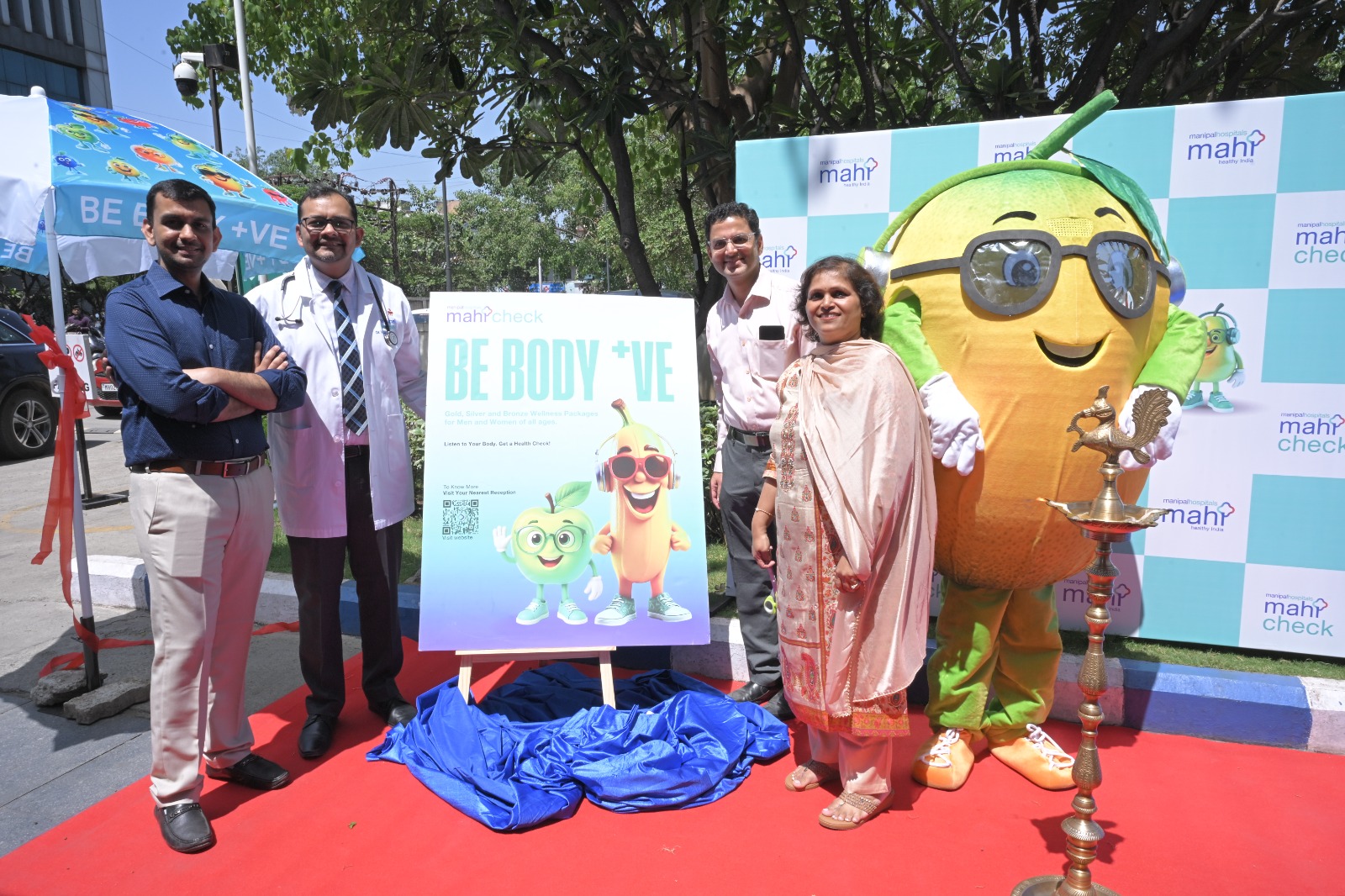
A total of 189 participants benefited from the camp, availing services such as ECG, pulmonary function tests (PFT), bone density screening, diet consultations, internal medicine consultations, physiotherapy consultations, and basic health assessments. The initiative aimed to promote early detection of health conditions and encourage individuals to take a proactive approach towards their overall well-being.
Speaking on the occasion, Dr. Amit Mane, Hospital Director, Manipal Hospital, Kharadi, Pune, said
“To identify risks to health early on and lessen the burden of advanced diseases, preventive healthcare is essential. The goal of programs like the Health Mela and MAHI Health Packages is to increase accessibility to high-quality screening services and motivate people to prioritize their health by getting regular checkups. Age-appropriate preventative screening options can be found by the MAHI Health Packages, which help people in all phases of life in keeping an eye on their health and spotting issues that could otherwise go undetected over time. Manipal Hospital Kharadi’s dedication to meeting the healthcare requirements of residents in Pune and the surrounding regions is reflected in the program, which also emphasizes the significance of quick medical intervention and professional treatment.”

- 0
- By Neel Achary

17, Apr 2026
Croma Unveils Akshay Tritiya ‘Golden Offers’ with Up to 50 Percent Off on Electronics
Chandigarh, April 17: This Akshay Tritiya, Croma, India’s trusted omni-channel electronics retailer from the Tata Group, is turning festive shopping into a golden opportunity with discounts of up to 50% across air conditioners, large-screen televisions, soundbars and more. Available on April 19, the limited-period offers combine deep price cuts, cashback, exchange benefits and easy EMIs, making it the perfect time to upgrade your home. Additionally, Tata Neu HDFC Bank Credit Card holders can enjoy up to 10% savings as NeuCoins on select Apple & Google products.
Beat the Heat with Unmissable Cooling Deals:
As summer peaks, Croma is helping customers stay cool with compelling offers on inverter air conditioners, including a minimum of two EMIs free on select models and an exchange benefit of up to ₹8,500.
·Bluestar 1.5T Inverter AC now at 43% off, available for an effective price of ₹34,490
·Croma 1T inverter AC is available at an effective price of ₹26,590
·Samsung 1.5T Inverter AC now at 51% off, available at an attractive price of ₹38,990
·Godrej 1.5T Inverter AC can be availed for just ₹28,383
Big Screens, Bigger Savings on Home Entertainment:
Customers looking to elevate their entertainment experience can enjoy a minimum of 25% off on a wide range of 55-inch and larger TVs from leading brands such as LG, Samsung, Sony and Croma.
·Samsung 55-inch QLED 4K TV is now available at 41% off for ₹50,990
·Sony ‘Pay as Per Screen Size’ EMI Offer – for instance own a 55-inch Sony TV at just ₹5,500 per month for a 30-month tenure
·AI-powered QLED/QNED TVs is available from ₹2,999 per month, bringing next-gen viewing within easy reach
·Enjoy 1 EMI free on 75-inch and above TVs, making big-screen upgrades even more rewarding
Adding to the festive cheer, Croma is offering a flat 10% discount with savings of up to ₹3,200 on productsabove ₹25,000. The offer applies to a select range of air conditioners, refrigerators, washing machines, televisions and Android smartphones from top brands. An exchange bonus of up to ₹15,000 is also available on select categories and brands. Also, for students and teachers, all MacBook are available with a special 10% discount.
“Akshay Tritiya is a time when customers look to invest in purchases that bring long-term value and prosperity. With our Golden Offers, we are bringing together the best deals on essential summer appliances and cutting-edge home entertainment, making it easier for customers to celebrate the festival with meaningful upgrades,” said a spokesperson from Infiniti Retail Ltd.
These festive offers are available pan-India across all Croma stores for a limited period, giving customers across budgets access to premium technology at compelling prices.
Final prices are inclusive of applicable bank cashback, exchange value of old devices, and additional exchange bonuses, where applicable.
17, Apr 2026
VIRGIO Is Leading India’s Shift to Clean Fashion

Bengaluru, India, Apr 17 – VIRGIO, the fashion-tech brand at the intersection of sustainability and trend-forward design, is defining a new way of dressing, one where fashion is not just desirable, but also responsible.
Built on the belief that fashion can be both desirable and responsible, VIRGIO stands for a shift in how consumers engage with clothing today. As the market moves toward more conscious consumption, the brand is shaping Clean Fashion as the future of mainstream fashion, moving it beyond a niche idea into an everyday standard.
At its core, VIRGIO brings together trend-forward design with a more thoughtful approach to materials, production, and value. This creates a fashion experience that feels good in every sense, aesthetically, ethically, and emotionally—resonating with a growing consumer mindset that seeks both style and substance.
Unlike traditional approaches that isolate sustainability into limited collections, VIRGIO embeds Clean Fashion across its entire value chain. From mindful material choices and longevity-driven design to greater transparency in pricing and storytelling, the brand is building a more aware and intentional fashion ecosystem.
More than a brand narrative, VIRGIO is helping shape what Clean Fashion truly means today. Through cultural storytelling, creator-led conversations, and consumer-first communication, it is reframing conscious fashion as something that is not just responsible but also relevant, aspirational, and scalable.
VIRGIO’s approach challenges long-standing industry norms of opacity, inflated markups, and disconnected storytelling. Instead, it champions clarity, better choices, and a more informed relationship between consumers and what they wear—without compromising on style or individuality.
At a time when consumers are seeking greater awareness and intention in their choices, VIRGIO positions Clean Fashion as a natural evolution of fashion itself—where looking good and doing better are no longer separate ideas.
Amar Nagaram, Founder, VIRGIO, said, “VIRGIO was built on the belief that fashion can be both desirable and responsible. Clean Fashion, for us, is about bringing that balance to life, where great design is matched by transparency, better choices, and a deeper awareness of how clothes are made. We don’t see Clean Fashion as a niche or a trend. We see it as the future of how people will dress. Our focus is on shaping what that future looks like, making it relevant, accessible, and meaningful for today’s consumer.”
By positioning Clean Fashion as the future of mainstream fashion, VIRGIO is not just responding to change; it is helping define it, encouraging a move toward more thoughtful, informed, and meaningful choices in how India dresses.
17, Apr 2026
ECI Starts EVM Commissioning Ahead of April 23 Assembly Polls
New Delhi, April 17 (BNP): The Election Commission of India (ECI) has commenced the commissioning of Electronic Voting Machines (EVMs) and Voter Verifiable Paper Audit Trail (VVPAT) units for constituencies going to polls in the first phase on April 23, officials said on Thursday.
The commissioning process began across various constituencies in Tamil Nadu and West Bengal (Phase-I) in the presence of candidates, their authorised representatives, and General Observers, ensuring transparency in poll preparations.
According to the ECI, the commissioning will be followed by mock polls, where 1,000 votes will be cast in 5 per cent of randomly selected EVMs. Candidates or their representatives will also be allowed to conduct mock polls themselves.
Ahead of commissioning, EVMs and VVPATs were allocated to polling stations through a two-stage randomisation process using the EVM Management System (EMS). In the first stage, machines were distributed from district warehouses to assembly constituencies, and in the second stage, from constituencies to individual polling stations.
Officials said Tamil Nadu has a total of 75,064 polling stations, while 44,378 polling stations in West Bengal will go to polls in the first phase on April 23.
The first randomisation was carried out by District Election Officers (DEOs) in the presence of representatives of recognised political parties, while the second randomisation was conducted by Returning Officers (ROs) with candidates, their agents, and General Observers present.
Lists of allocated EVMs and VVPATs were shared with political parties and candidates at each stage. The machines have since been securely stored in designated strong rooms under the supervision of stakeholders, the Commission added.
The commissioning exercise is part of preparations for the ongoing General Elections to Legislative Assemblies in several states and accompanying bye-elections scheduled this year.
17, Apr 2026
Ayush Chintan Shivir 2026 Opens in Delhi, Focus on Policy, Innovation
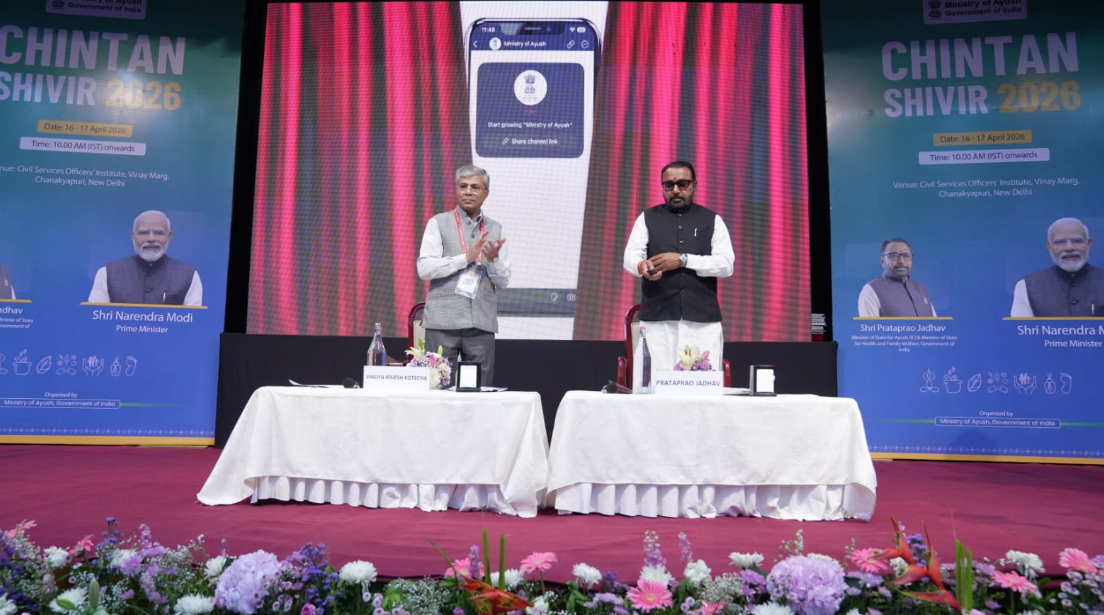
New Delhi, April 17 (BNP): Union Minister of State (Independent Charge) for Ayush and Minister of State for Health and Family Welfare, Prataprao Jadhav, on Wednesday inaugurated the two-day “Ayush Chintan Shivir 2026” in the national capital.
The event, which concludes on April 17, is aimed at reviewing progress, strengthening policy direction, and charting a future roadmap for the Ayush sector, officials said.
Addressing the gathering, Jadhav said the Chintan Shivir reflects the government’s commitment to reinforcing policy implementation and institutional capacity in Ayush. He noted that the platform would help assess achievements since the previous conclave and identify gaps for future action. He also underlined the growing role of Ayush in addressing lifestyle diseases through a holistic approach.
Highlighting the government’s focus, the minister pointed to increased budget allocations for education, research, infrastructure, and global outreach. He stressed the need for evidence-based research, innovation, digitalisation, and greater public awareness, expressing confidence that Ayush will play a key role in achieving the “Viksit Bharat 2047” vision.
Secretary, Ministry of Ayush, Vaidya Rajesh Kotecha, described the Shivir as an important platform for policy review and long-term planning, adding that efforts are underway to integrate traditional knowledge with modern science and expand global collaboration.
Joint Secretary Alarmelmangai D. said the initiative promotes collaborative policymaking and noted the rising national and international recognition of Ayush systems.
A key highlight of the inaugural session was the signing of a Memorandum of Understanding between the All India Institute of Ayurveda (AIIA) and the General Insurance Council to expand insurance coverage and streamline claim settlements for Ayush treatments.
The minister also launched the Ministry’s official WhatsApp channel to enhance citizen engagement and released a document on revised benchmark rates for insurance coverage of Ayush therapies. A toll-free helpline (1800-11-0008) for Ayush insurance was also introduced.
The first day featured three thematic sessions focusing on review of earlier outcomes, strengthening research and global partnerships, and improving legal preparedness in the sector, officials added.
17, Apr 2026
LUMISTAR Launches TERO Series and Opens Preorders for its Always‑On Tennis Training Partner
TERO Pro leads the new series with 0.1-second adaptive returns and post-session reports that convert rallies into measurable improvement.
Los Angeles, CA, USA, April 17, 2026 – LUMISTAR, a sports technology company focused on making high-quality training more accessible, today announced its flagship TERO series Tennis Training Partner will be available for preorder by April 30, with sales beginning May 30, 2026. The series includes TERO and TERO Pro, with the Pro model offering the most responsive experience and the deepest training feedback through the Vision Module, including post-session training reports that offer clear feedback and next steps.
Tennis improvement often hits a ceiling that has little to do with talent or effort. Consistency is the difference maker, and it’s hard to build without a partner who can keep up and always be available when you are. When that’s missing, practice gets fragmented. Players end up doing workarounds that don’t feel like real points, or they simply don’t get the reps they need to keep progressing. A reliable, always-available partner changes that equation and that’s what LUMISTAR envisions TERO to be. TERO Pro Sets a New Standard for Match-Real Tennis Training on a Personal Level
For players who want the most comprehensive training loop, the TERO Pro takes competitive tennis even further. After each session, TERO Pro generates personal training reports with an objective breakdown of performance, then saves those reports in your history so you can track progress over time and plan the next step with purpose. TERO Pro is also designed around a more advanced hardware and interaction stack, including:
- The All-in-One Court Kit that keeps racket, balls, a detachable bag and machine
integrated into one seamless system - Real-time visual perception and AI insight that unlocks new ways to play through
modes such as “All Star Game”, where you can face off against tennis legends like
Roger Federer and Serena Williams - 4K AI dual-focal lens (60fps) with an automotive-grade SoC and pre-trained AI model
that makes each rally smarter and more adaptive as you grow (with Vision Module) - Extendable system intelligence with swappable modules that allow TERO Pro to
evolve and upgrade as new features are released
TERO Delivers Reliability to Tennis Training for Consistent Reps and Real Progress TERO is designed to make practice feel less like feeding and more like playing. With 238 built-in drills, it gives players a deep library to train consistency, patterns and point-ready scenarios without needing to plan every session from scratch. The session itself stays dynamic and reactive, so you can train against changing tempo and placement instead of settling into predictable routines.
Just as importantly, TERO is built to keep you in rhythm. You can start a session with one click, then make changes through voice and gesture control for speed and spin adjustments, or placement without stopping to dig through menus. With wristband positioning and swing-speed detection, TERO also understands your location, timing and pace during the rally, which makes the next ball feel earned and responsive rather than pre-programmed.
Core performance specs (TERO series):
- Max ball speed: 140 km/h
- Max range: 26 m
- Max height: ≥ 4.2 m
- 238 built-in drills
- Upgradeable with the Vision Module to add “sight” and expanded capabilities (Vision + AI features enabled with the module)
- The world’s first dual-axis, dual-end gimbal design, uniquely engineered for a
rock-solid, stable feed
“Reps matter, but reps alone don’t necessarily make you a better player. You improve when practice gives you instantaneous feedback, real variety and moments that force better decision making,” said Rachel Yang, CMO at LUMISTAR. “That’s what we had in mind when designing TERO. We want it to truly feel like the training partner you wish you had on call, ready when you are, reacting instantly and pushing you in all the right ways. Then it shows you what actually improved and what still needs to be worked on.”
Further details for the TERO and TERO Pro, including ordering information and pricing will be announced towards the end of April.For product details and preorder updates, visit: https://lumistar.ai
17, Apr 2026
AMPP to Host Webcast Highlighting India’s Role in Advancing Maritime Safety, Sustainability, and Global Trade Resilience
Two-hour session features India-based experts addressing corrosion control, decarbonization, and evolving regulatory challenges in global shipping
Maharashtra, India – (April 17, 2026) — As global shipping faces increasing pressure from decarbonization mandates, aging fleets, and supply chain disruptions, maritime experts from India are playing a growing role in shaping how the industry responds to these challenges.
The Association for Materials Protection and Performance (AMPP), the world’s leading authority on corrosion control and protective coatings, will host an upcoming webcast focused on strengthening safety, sustainability, and operational resilience across the global commercial maritime industry—featuring a strong lineup of India-based experts.
The event, “Corrosion, Safety, and Sustainability in Commercial Maritime,” will take place on Thursday, April 23, 2026, at 9:00 a.m. EDT (6:30 p.m. IST). In this two-hour session, global industry experts, including leaders from India’s maritime, engineering, and training sectors, will examine how shipowners, operators, port authorities, and supply-chain partners can address evolving challenges and advance modern, sustainable practices. The session brings together perspectives from engineering, operations, and maritime training to provide practical, real-world approaches to today’s most pressing industry challenges.
With approximately 90% of international trade moving by sea, ship reliability and performance are critical to global commerce. As India continues to expand its maritime capabilities and global footprint, experts from across the country are contributing to key discussions on asset integrity, regulatory compliance, and long-term sustainability in commercial shipping.
Speakers include:
- Dylan Goddard, Coating Performance Specialist, Seaspan
- Venkatraman Sheshashayee, Executive Chairman, Shipworkz Marine Services LLC
- Capt. RKP Sinha, Co-Founder & Director, Marine Solutionz Group
- Rishabh Jangra, Senior Engineer, American Bureau of Shipping
- Dr. (Captain) Suresh Bhardwaj, Director & Principal, MASSA Maritime Academy, Chennai
Attendees will gain insights into:
- Decarbonization strategies and port-led green transitions
- Maritime security frameworks and risk mitigation
- Seafarer wellbeing and workforce considerations
- Practical implementation of evolving International Maritime Organization (IMO) regulations
- Ongoing modernization efforts across commercial maritime operations
“Commercial maritime operations are facing a convergence of pressures, from stricter environmental regulations to increasing demands on global supply chains,” said Jennifer Merck, Vice President of Maritime and Defense at AMPP. “Corrosion control is not a maintenance issue. It’s a reliability and risk issue that directly impacts safety, operational continuity, and long-term sustainability.”
As regulatory requirements evolve and global trade demands intensify, industry stakeholders must align technical practices with broader operational goals. Corrosion prevention plays a critical role in extending asset life, reducing unplanned downtime, and supporting compliance with environmental standards.
Register to gain practical insights from global maritime experts and stay ahead of evolving regulatory and operational demands.
To learn more and register, visit: https://event.on24.com/wcc/r/
17, Apr 2026
TAU Systems joins RADNEXT 2030 network to expand global access to radiation effects testing
Carlsbad, California. 17th April 2026: TAU Systems, the pioneer in compact laser-powered accelerator technology, today announced it has joined RADNEXT 2030, a European initiative coordinated by CERN that provides access to world-class radiation testing infrastructures for electronics. As a network member, TAU Systems will open its TAU Labs facility in California to European researchers and industry testers, supported by a dedicated allocation of European funding to subsidize test time for qualifying users.
RADNEXT 2030 is being developed in response to the Horizon Europe programme and unites a network of accelerator-based and complementary testing facilities across Europe and beyond. The initiative enables researchers, industry users, and early-stage innovators to test and better understand the effects of radiation on electronics for applications in space, automotive, communications, energy, and quantum technologies.
TAU Systems’ inclusion in the network, as its only US-based test facility, reflects the growing recognition of laser-powered accelerators as a credible and commercially accessible complement to traditional large-scale facilities. TAU Labs in Carlsbad, California, the world’s first commercial laser-powered accelerator center, is capable of generating high-energy particle beams to replicate real-world radiation environments with high precision, repeatability, and flexibility. The facility offers beamtime-as-a-service for Single Event Effects (SEE) testing for space, defense, semiconductor, and industrial electronics.
“Joining the RADNEXT 2030 network is a significant milestone for TAU Systems and for the future of radiation testing,” said Jerome Paye, CEO of TAU Systems. “There is a serious global bottleneck in access to radiation testing infrastructure, and Europe in particular is working hard to address that gap. Being part of this network means European researchers and companies can now access our unique laser-powered accelerator capabilities, backed by European funding, and without the long wait times that have traditionally held the industry back. We are proud to contribute to this important initiative and to work alongside some of the world’s leading testing facilities.”
Rubén García Alía, RADNEXT Project Coordinator, CERN, said: “Given the overall scarcity of heavy-ion SEE testing beam time, as well as the physical anti-correlation between the energy of a heavy ion and its capability of generating failures in electronics, alternative testing approaches such as the one proposed by TAU Systems need to be explored and carefully validated. Space electronics testing requires very high levels of accuracy and reproducibility, and therefore a thorough benchmarking of the proposed technique – as planned within the framework of the RADNEXT 2030 activities on this topic – will be of great relevance and impact for the radiation effects community. We are therefore delighted to welcome TAU Systems as a key partner in the RADNEXT 2030 international facility network.”
TAU’s technology is particularly well-suited to Single Event Effects testing, providing electron beams that effectively simulate the cosmic radiation environment encountered by space-bound and safety-critical electronics.
The RADNEXT 2030 project is targeted to run from June 2026 through May 2030.
17, Apr 2026
RealSense Demonstrates Industry’s Most Comprehensive GMSL Depth Camera Portfolio at Hannover Messe 2026
SAN FRANCISCO- RealSense today announced expanded support for Gigabit Multimedia Serial Link (GMSL) across its depth camera portfolio, delivering a scalable, production-ready perception platform for robotics and industrial automation. The company will showcase its new GMSL-enabled lineup at Hannover Messe 2026, Hall 26, Stand D29.
Robots and industrial automation require high-precision, robust and reliable perception systems to ensure they navigate safely and operate predictably across a variety of conditions. GMSL is rapidly emerging as the preferred standard for robotic industrial vision systems, overcoming the limitations of USB with improved synchronization, longer cable reach and greater dependability in demanding environments.
By enabling rugged, scalable multi-camera perception through a single cable infrastructure, GMSL supports the next generation of autonomous machines operating in factories, warehouses and logistics environments.
Expanding the GMSL Portfolio
RealSense is introducing GMSL support across three of its most widely used depth cameras:
- D401: Sub-millimeter precision in a compact form factor, ideal for robotic arms and humanoids, with a tiny GMSL package that enables near-invisible integration into manipulators
- D430: High-accuracy, mid-range 3D depth sensing, deployed extensively across robotics systems worldwide
- D415: Precision mid-range scanning and spatial intelligence in factories and warehouses
These join the existing D457, creating the industry’s most comprehensive lineup of industrial-ready GMSL depth cameras.
The cameras are powered by the RealSense SDK 2.0, featuring native ROS 2 support for seamless integration into modern robotics stacks. The RealSense D457 also includes native models in Isaac Sim, accelerating development and significantly reducing sim-to-real deployment time. Crucially, all RealSense cameras perform depth processing directly on-device via the company’s AI Vision ASIC, eliminating the need for external compute while delivering low-latency, reliable performance at the edge.
Built for Industrial Scale
USB-based systems often require complex synchronization and can suffer from instability in harsh environments. GMSL enables:
- Consistent, predictable performance with reduced calibration needs
- Native multi-camera synchronization with up to 8 cameras per system
- Long-reach, secure industrial cabling via FAKRA connectors
- Reduced system complexity and cost with up to four cameras per deserializer
These capabilities allow OEMs and system integrators to deploy scalable, multi-camera perception systems with greater reliability and lower total cost of ownership.
From Cameras to a “Visual Cortex”
The launch marks a shift from standalone sensors to an integrated perception platform, designed for industrial-scale deployment and multi-camera autonomy. This innovation reinforces RealSense as the visual cortex of Physical AI, delivering the perception layer that enables machines to see, understand and act in the physical world.
“Industrial autonomy depends on perception that works in the real world, not just in the lab,” said Nadav Orbach, CEO of RealSense. “With our GMSL portfolio, we enable scalable multi-camera vision with the reliability, reach and integration simplicity required for production deployment. Together with partners like AVerMedia, we are making it easier to build and deploy complete perception systems, faster and at scale.”
Partner Ecosystem and Live Demonstrations
At Hannover Messe, RealSense and its partners will demonstrate real-world applications of scalable perception:
- AVerMedia Demo (Multi-Camera Scaling): Built on a compact indoor AMR, the AVerMedia SenseEdge Development Kit demonstrates real-time 3D perception for navigation through synchronized multimodal sensing and on-device inference. Powered by RealSense GMSL cameras and the RealSense Visual Cortex, the system supports up to 4 cameras per interface and scales to 8 cameras out of the box.
- Inbolt Demo (Real-Time Control): Inbolt will demonstrate real-time part tracking and robot control using AI-driven software and a RealSense D435 depth camera integrated into a robot-mounted system. The demo highlights continuous localization and closed-loop trajectory control, showing how perception translates directly into precise robotic action in production environments.
“RealSense’s new GMSL cameras significantly advance 3D perception capabilities, and our expanded SenseEdge Development Kit provides a validated, production-ready platform to deploy them at scale,” said Alex Liu, Vice President, Industrial Product Division at AVerMedia. “By enabling the full RealSense GMSL lineup across both AGX Orin and NVIDIA Jetson AGX Thor editions, we’re helping customers accelerate from development to real-world deployment in robotics and industrial environments.”
Thought Leadership and Sessions
RealSense executives will also lead key sessions at Hannover Messe, including:
- Panel Discussion: Led by Mike Nielsen, RealSense CMO, “The Visual Cortex for Industrial Robots: From Perception to Predictable Autonomy,” will be held April 21 at 10:25 CEST in Hall 26, Solution Lab (E43), Expert Stage 2
- Demo Talk: Chris Matthieu, RealSense VP Developer Ecosystem, will explore human-robot interaction and identity recognition in his presentation, “When Robots Recognize You,” on April 24 at 10:20 CEST in Hall 26, Solution Lab, Spotlight Stage
For more information, contact Penny Malsch, RealSense Global Senior Marketing Strategist, at penny.malsch@realsenseai.com
16, Apr 2026
AD Ports Group Leverages Integrated Logistics Network to Ensure Trade Resilience and Strengthen Regional Supply Chains
Abu Dhabi, UAE – 16 April 2026: AD Ports Group (ADX: ADPORTS), a leading global enabler of trade, industry, and logistics solutions, has successfully drawn on its diversified logistics capabilities to strengthen local and regional supply chains in the Gulf region, ensuring continued resilience.
Since the onset of the recent regional developments at the end of February, the Group has continued to operate as normal, serving the needs of its global clients by establishing alternative routes and rerouting cargo across land, rail, sea, and air to mitigate supply chain disruptions affecting Arabian Gulf ports, in light of the traffic conditions through the Strait of Hormuz.

To date, AD Ports Group handled over 54,000 TEUs at Fujairah Terminals and Khor Fakkan Port, and successfully transported over 22,000 containers through its land logistics services, alongside 18,000 TEUs across its maritime network, supported by a dedicated fleet of 24 vessels operating 8 feeder services. In addition, the Group has transported more than 8,000 tonnes of cargo through its air logistics services, enabled by more than 100 chartered flights.
Captain Mohamed Juma Al Shamisi, Managing Director and Group CEO of AD Ports Group, said: “Our long-term investments in a diversified and comprehensive network of logistics and trade infrastructure have enabled one of the UAE’s largest-ever logistics redeployments to be executed with speed, agility and efficiency. Under the guidance of our wise leadership in the UAE, AD Ports Group will continue to guarantee the flow of goods across local and regional markets, particularly essential commodities such as food, medicines, strategic reserves, and other critical inputs. Our commitment towards serving our partners and customers remains firm, while safeguarding the safety of our workforce and strengthening the resilience of local and regional supply chains.”
To ensure continuity of regular shipping services to Khalifa Port, and across three key trade corridors linking the UAE’s eastern ports with ports in the Arabian Sea and the Red Sea, the Group has launched new regional feeder shipping services to maintain supply chain integrity, which redeployed and scaled up its dedicated vessel fleet to 24 container and bulk cargo vessels, with plans to increase fleet capacity.
Feeder shipping services operated by the Group’s SAFEEN Feeders and Global Feeder Shipping (GFS) have been rerouted via Fujairah Terminals and Khor Fakkan Port, both located on the Gulf of Oman, providing alternative gateways to the UAE and the wider GCC region.
New container feeder shipping services have been established connecting ports in India, Pakistan and Oman, as well as Red Sea ports, and ports along the Upper Arabian Gulf region.
By leveraging its logistics assets and extensive strategic and commercial networks, the Group has established an air bridge comprising three chartered aircraft, to transport vital goods, with plans to further increase capacity.
The Group has also established a land bridge to transport cargo from Fujairah and Khor Fakkan through bonded customs corridors in the UAE to Khalifa Port, Jebel Ali Port, and Sharjah, using 800 trucks and four new daily rail service trips by Etihad Rail. These efforts are supported by the Group’s expanded warehousing and storage capacity for essential goods, currently exceeding 76,000 sqm, with plans to more than double to 188,000 sqm.
Leveraging its award-winning digital trade infrastructure, the Group has launched new freight management platforms that deliver visibility and resilience, enabling the efficient management of trade flows. By unifying and processing data across the Group’s global operations, these platforms have enabled the Group to leverage real-time trade lane intelligence to strengthen supply chain integrity, while repurposing empty import containers for export along alternative high-volume corridors– enhancing resilience and reducing time and cost for customers.
Working closely with UAE authorities and industry partners, AD Ports Group continues to safeguard its workforce, partners and stakeholders, while ensuring uninterrupted services to customers.


