


16, Apr 2026
Study Explores Why Fasting Can Lead to a Longer Lifespan
DALLAS, April 16: Restricting calories has long been recognized as a powerful way to live longer, with periods of intermittent fasting proving more effective than a steady diet. However, the mechanism behind this phenomenon has been unclear.
Research led by UT Southwestern Medical Center scientists and published in Nature Communications suggests it’s not the fast itself that extends life, but how the body metabolically pivots during refeeding after fasting. Although the findings were made in Caenorhabditis elegans, a roundworm often used as a lab model, they could eventually lead to new ways to boost health in humans.
“Our discoveries shift the focus toward a neglected side of the metabolic coin – the refeeding phase. Our data suggest that the health-promoting effects of intermittent fasting are not merely a product of the fast itself, but are dependent on how the metabolic machinery recalibrates during the subsequent transition back to a fed state,” said study leader Peter Douglas, Ph.D., Associate Professor of Molecular Biology and a member of the Hamon Center for Regenerative Science and Medicine at UT Southwestern. Dr. Douglas co-led the study with Lexus Tatge, Ph.D., a former member of the Douglas Lab.
When organisms undergo fasting, their cells quickly burn through meager glucose reserves and shift to breaking down stored lipids, a potent source of energy. This process, called catabolism, is mediated by a protein known as NHR-49, which activates when glucose runs low and prompts cells to digest lipids. Refeeding causes NHR-49 to shut down, preventing cells from breaking down lipids and allowing them to rebuild their reserves. In 2022, Dr. Douglas and his colleagues published a study showing that NHR-49 also serves as a sensor for intracellular lipid stores, activating a mechanism that prevents cellular starvation when lipid supplies deplete.
Dr. Douglas and colleagues suspected that NHR-49’s activity could be key to fasting’s life-extending benefits. To test this idea, the team used genetic engineering to delete NHR-49 in C. elegans, then fasted the worms for 24 hours. Surprisingly, this did not diminish life extension. Fasting still boosted the altered worms’ average lifespan by about 41% and made older worms behave more youthfully, reflected in more movement, much like fasting did in C. elegans with intact NHR-49.
On a hunch, the researchers decided to examine the flip side of NHR-49 activation: What happened when the worms were refed after fasting and NHR-49 shut off?
To do this, they needed to better understand how NHR-49 naturally becomes inactivated. Experiments led by Vincent Tagliabracci, Ph.D., Associate Professor of Molecular Biology at UTSW and a Howard Hughes Medical Institute Investigator, and Victor Lopez, Ph.D., a postdoctoral researcher in the Tagliabracci Lab, revealed that this occurs when an enzyme known as protein kinase CK1 alpha 1 (KIN-19) chemically modifies NHR-49 through a process called phosphorylation. When Dr. Douglas and his colleagues tampered with this system to keep NHR-49 turned on – which maintained lipid breakdown even when C. elegans was refed – it eliminated any life extension from fasting.
Together, Dr. Douglas said, these results suggest that being able to efficiently deactivate NHR-49 after fasting is a key factor in caloric restriction’s ability to lengthen lifespan. Finding ways to manipulate this system could eventually help people live longer without the need to fast.
“Our findings bridge a gap between lipid metabolism and aging research,” Dr. Douglas said. “By targeting aging, the single greatest risk factor for human disease, we move beyond treating isolated conditions toward a preventive model of medicine that enhances quality of life for all individuals.”
Dr. Douglas is a Southwestern Medical Foundation Scholar in Biomedical Research. Dr. Tagliabracci is a Michael L. Rosenberg Scholar in Medical Research.
A complete list of other UTSW authors who contributed to this research can be found in the study.
This study was funded by the Clayton Foundation for Research, The Welch Foundation (I-2061-20210327), the American Federation of Aging Research (AFAR 2023), and the National Institutes of Health.

- 0
- By Neel Achary

16, Apr 2026
PNG Expansion Gains Momentum with 4.4 Lakh New Connections
New Delhi, Apr 16 (BNP): The Government of India has stepped up efforts to expand access to Piped Natural Gas (PNG) as part of a broader strategy to promote cleaner energy usage and reduce reliance on conventional fossil fuels, according to the Ministry of Petroleum and Natural Gas (MoPNG).
Under the ongoing expansion programme, around 4.40 lakh PNG connections have been commissioned since March 2026. In addition, nearly 4.88 lakh new consumers have registered for PNG connections, reflecting strong and growing adoption across regions.
The rapid scale-up is being supported by a structured policy framework aimed at improving execution efficiency and accelerating infrastructure rollout under the City Gas Distribution (CGD) network.
A key enabler of this progress is the Natural Gas and Petroleum Products Distribution Order, 2026, which introduces time-bound guidelines for infrastructure development and streamlines implementation across authorised geographical areas.
Officials noted that the initiative is part of India’s long-term clean energy transition strategy, aimed at improving household access to cleaner fuel alternatives while strengthening the country’s energy distribution network.
The continued expansion of PNG infrastructure is expected to play a crucial role in reducing dependence on more polluting fuels and supporting India’s broader environmental and energy security goals.
16, Apr 2026
Adani Wind Unveils 5 MW Turbine Prototype in Mundra, Strengthening India’s Clean Energy Ambitions
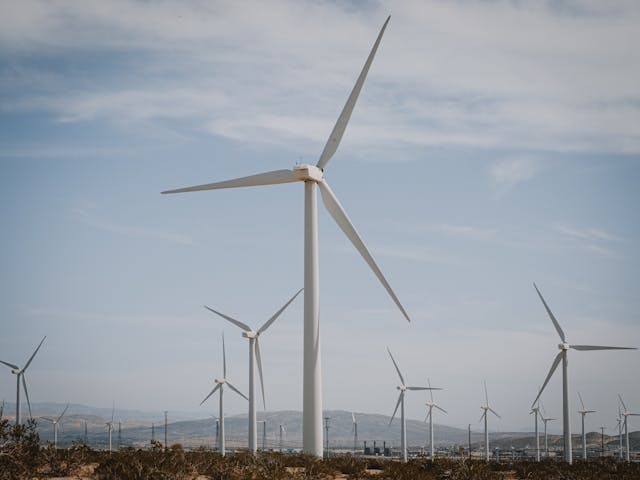
Gujarat, Apr 16 (BNP): India’s clean energy sector received a boost as Adani Wind commissioned a 5 MW wind turbine prototype at Mundra, marking a significant step in domestic renewable energy innovation.
Pic Credit: Pexel
The prototype is among the largest wind turbines developed in India and is expected to enhance power generation efficiency while lowering the cost of wind energy. The project reflects the company’s focus on building advanced, locally manufactured renewable energy solutions.
Located in Gujarat’s key renewable energy hub, the Mundra facility will serve as a testing ground for next-generation wind technologies before large-scale deployment. The development aligns with India’s broader push to expand its renewable energy capacity and reduce dependence on fossil fuels.
Industry observers note that larger turbine capacities can generate more electricity per unit, improving project viability and accelerating the country’s transition toward clean energy.
16, Apr 2026
RCB tops the table after defeating Lucknow; Mumbai Indians vs Punjab Kings match scheduled today.
Mumbai, April 16: Royal Challengers Bengaluru (RCB) moved to the top of the IPL 2026 points table following a strong five-wicket victory over Lucknow Super Giants (LSG) on April 15, driven by disciplined bowling and a crucial top-order performance from Virat Kohli.
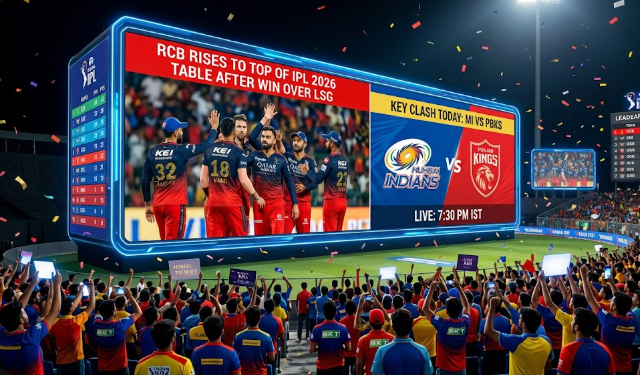
RCB’s win, their fourth in five matches, took them to 8 points and a net run rate of +1.503, placing them ahead of Rajasthan Royals in a tightly contested early phase of the tournament. The team’s balanced performances with both bat and ball have established them as early frontrunners in the season.
Lucknow Super Giants, meanwhile, were restricted to 146 and could not recover from early setbacks, slipping further in the standings as their net run rate declined.
Latest points table after LSG vs RCB
| Position | Teams | M | W | L | NR | Points | NRR |
|---|---|---|---|---|---|---|---|
| 1 | RCB | 5 | 4 | 1 | 0 | 8 | +1.503 |
| 2 | RR | 5 | 4 | 1 | 0 | 8 | +0.889 |
| 3 | PBKS | 4 | 3 | 0 | 1 | 7 | +0.720 |
| 4 | SRH | 5 | 2 | 3 | 0 | 4 | +0.576 |
| 5 | DC | 4 | 2 | 2 | 0 | 4 | +0.322 |
| 6 | GT | 4 | 2 | 2 | 0 | 4 | -0.029 |
| 7 | LSG | 5 | 2 | 3 | 0 | 4 | -0.804 |
| 8 | CSK | 5 | 2 | 3 | 0 | 4 | -0.846 |
| 9 | MI | 4 | 1 | 3 | 0 | 2 | -0.772 |
| 10 | KKR | 5 | 0 | 4 | 1 | 1 | -1.383 |
Punjab Kings continue their impressive run as one of the most consistent sides this season, remaining in the top three with 7 points from four matches.
Attention now shifts to today’s fixture, April 16, 2026, where Mumbai Indians (MI) will host Punjab Kings (PBKS) at 7:30 PM IST in Match 24. The encounter is expected to be a crucial contest for both sides as MI look to improve their position on the table, while PBKS aim to maintain their unbeaten momentum.
With the points table tightly packed and multiple teams separated by narrow margins, every match is increasingly significant in shaping the playoff race as the tournament progresses.
Fans can expect another high-intensity contest as IPL 2026 continues its competitive and closely fought season.
16, Apr 2026
India’s Gem and Jewellery Exports Slip in FY26, but New Markets Offer Hope
New Delhi, Apr 16 (BNP): India’s gem and jewellery exports saw a slight decline in FY26, as global trade challenges and tariff pressures weighed on demand. However, the industry showed resilience by expanding into new markets and adapting to changing conditions.

Pic Credit: Pexel
Exports during the year stood at $27.72 billion, reflecting a modest drop compared to the previous year in dollar terms, even as rupee earnings remained broadly stable.
The slowdown was largely due to weaker demand from the United States, where higher tariffs and policy uncertainties affected export volumes. At the same time, ongoing geopolitical tensions and fluctuations in global markets added to the pressure on the sector.
Despite these challenges, Indian exporters made steady progress in diversifying their reach. Markets such as the UAE, Australia, Hong Kong, and Canada emerged as important growth drivers, helping offset declines in traditional destinations.
Trade agreements with countries like the UAE and Australia supported this shift, making it easier for exporters to access new opportunities. While some geopolitical tensions in West Asia impacted momentum toward the end of the year, overall demand from these regions remained encouraging.
The industry is also witnessing a gradual shift in product demand. While certain segments like cut and polished diamonds faced pressure, others such as silver and platinum jewellery gained traction, reflecting changing global consumer preferences.
Experts believe that this phase marks a transition for the sector, with a stronger focus on market diversification and value-added products. Looking ahead, potential trade deals with regions like the UK and the European Union could further support growth and help the industry regain momentum.
16, Apr 2026
Muted Global Steel Demand Through 2026, Strong Recovery Expected Led by India
Pic Credit: Pexel
New Delhi, Apr 16 (BNP): Global steel demand is expected to remain subdued in the near term, with meaningful recovery likely only in 2027, according to a recent report by Centrum citing estimates from the World Steel Association.
The report projects global steel demand growth of just 0.3% in 2026, reflecting continued weakness in key markets. China, the world’s largest steel consumer, is expected to remain the primary drag on demand, with consumption forecast to decline by 1.5% year-on-year in calendar year 2026 and remain flat in 2027.
In contrast, India is emerging as a major growth driver. The report highlights that India’s steel demand is expected to grow by 7.4% in 2026 and accelerate further to 9.2% in 2027, positioning the country as a key contributor to the global demand rebound.
Despite muted demand conditions, steel prices have risen across major markets. Input costs have shown mixed trends, with iron ore and non-coking coal prices moving higher, while coking coal prices have softened compared to the previous month.
Among non-ferrous metals, aluminium continues to outperform, with prices remaining firm. Meanwhile, other metals such as copper, zinc, and nickel have witnessed marginal declines, reflecting uneven trends in the broader commodities market.
The report underscores that while near-term challenges persist due to weak global demand, particularly from China, India’s strong growth outlook offers a positive signal for the steel sector’s recovery in the coming years.
16, Apr 2026
Indian Equity Markets Surge on Easing West Asia Tensions
News Delhi, Apr 16 (BNP): Indian equity markets recorded a strong rally today, driven by improved global sentiment as geopolitical tensions in West Asia showed signs of easing. Benchmark indices posted notable gains, with the Nifty rising by 500 points and the Sensex advancing 0.7%.

The positive momentum was supported by renewed investor confidence, as concerns over potential disruptions in global markets and energy supplies began to recede. Easing tensions contributed to stability in crude oil prices, further encouraging buying across sectors.
Gains were broad-based, with key sectors such as banking, information technology, and energy leading the upward movement. Market participants responded positively to the reduced uncertainty, increasing exposure to equities.
Experts suggest that while the current trend reflects optimism, investors should continue to monitor global developments and macroeconomic indicators that may influence market direction in the coming weeks.
16, Apr 2026
Neurored and CHAMP Cargosystems expand partnership to enable ONE Record with 1Neo-Connect and eAWB solutions
Frankfurt, Apr 16: Neurored and CHAMP Cargosystems have announced the next phase of their strategic partnership, aimed at delivering advanced digital solutions to the air cargo industry. Building upon their successful history of collaboration in electronic Air Waybill (eAWB) integration, the two companies are now expanding their joint capabilities to support ONE Record through CHAMP’s innovative 1Neo-Connect solution.

The air cargo sector is poised for a digital step-change as the industry rethinks data standardization and exchange to increase operational efficiency and transparency. ONE Record, an IATA initiative and the preferred standard for data sharing since January 2026, aims to create a single, standardized data-sharing model for the air cargo supply chain. Adopting ONE Record will replace fragmented legacy processes with a unified, high-efficiency data ecosystem.
Neurored and CHAMP have taken a significant step towards this reality by working together to streamline eAWB processes, enabling seamless electronic documentation and data exchange for freight forwarders, airlines, and logistics providers in line with ONE Record standards. This partnership has empowered customers to reduce manual paperwork, improve compliance, and accelerate shipment processing while futureproofing for a new standard.
By integrating the capabilities of 1Neo-Connect, CHAMP’s dedicated ONE Record adoption solution, with Neurored, stakeholders will be able to access, share, and update shipment information in real-time, fostering greater collaboration and visibility across the industry.
This expanded integration allows Neurored’s customers to leverage their existing eAWB workflows while gaining the enhanced functionality of ONE Record, ensuring maximum value with minimal operational disruption. 1Neo-Connect provides secure, real-time access to critical shipment data, which improves communication between global partners and reduces the risk of data entry errors. Furthermore, the solution is designed to be both scalable and flexible, adhering to strict industry security standards while adapting to the evolving technological requirements of organizations of all sizes.
The ongoing partnership combines CHAMP’s deep expertise in cargo management systems with Neurored’s strengths in cloud-based logistics solutions. Together, they provide a robust suite of tools that help customers navigate the complexities of global supply chains, including the efficient ONE Record adoption and digitalization.
Ricardo Medem de la Torriente, CEO at Neurored said,
“This next phase of our partnership with CHAMP brings practical value to customers by extending existing eAWB workflows with ONE Record capabilities. It helps freight forwarders, shippers, and carriers improve collaboration, efficiency, and real-time visibility with minimal operational disruption.”
Ed Dorr, VP eCargo Portfolio at CHAMP said,
“Our collaboration with Neurored has consistently delivered cutting-edge digital solutions to the air cargo community. By introducing our dedicated ONE Record adoption solution, 1Neo-Connect, we are providing our customers with the essential tools they need to thrive in a more connected and transparent digital world.”
16, Apr 2026
EDII Announces National Entrepreneurship Summer Camps for Youth & Children for 2026
.jpg)
New Delhi, Apr 16: The Entrepreneurship Development Institute of India (EDII), Ahmedabad, a pioneer in the field of entrepreneurship development, education, and training, has been organising national summer camps since 1992. These unique summer camps, organised for children in the age group of 12–16 years and youth aged 16–22 years, aim to imbibe winning skills in them, alongside building an entrepreneurial mindset at an early stage.
This year, the 46th and 47th editions of the camps on ‘Entrepreneurial Stimulation for Children’ will be held from May 3–8 and May 24–29, respectively, at the institute’s campus. Similarly, the 49th and 50th editions of the camps on ‘Entrepreneurial Adventures for Youth’ will be held from May 11–20 and June 1–10, respectively.
- Over the last three decades, through the national summer camps on ‘Entrepreneurial Stimulation for Children’, EDII has provided a platform to help children understand their strengths and weaknesses, develop a growth perspective, and imbibe in them, learning that fosters winning skills. So far, 45 camps have groomed 3,228 children. Participants develop a strong ‘spirit of enterprise and achievement’, enabling them to aim for higher-order success. After the camp, parents receive a comprehensive report on their ward, highlighting personality traits and suggesting future developmental directions.
- Similarly, through its national summer camps on ‘Entrepreneurial Adventures for Youth’, EDII has been developing entrepreneurial traits among youth across the country. A total of 2,100 youth have been trained so far. Participants discover their hidden potential and build capabilities to face future challenges by acquiring entrepreneurial traits such as risk-taking, creative thinking, conflict management, effective communication, teamwork and problem solving. Career counselling is also extended during the camps.
Interactions with achievers and field visits to observe classroom learnings in practice leave a lasting impact on participants of both the camps.
With such focussed, competency-based training, the participants have evolved into high-achieving individuals.
Dr Pankaj Bharti, Faculty at EDII, is the camp leader and can be reached at pbharti@ediindia.org / camps@ediindia.org.
16, Apr 2026
Tendo Marketplace Hits One Million Vouchers Purchased, Establishing the Standard for Price-Transparent, High-Quality Care
Accelerating adoption signals a market-wide shift toward employer and consumer-driven, bundled healthcare
Philadelphia, PA — (April 16, 2026) — Tendo, a healthcare technology company committed to putting quality at the center of every care decision, today announced that its Tendo Marketplace has surpassed one million vouchers purchased nationwide, a major milestone in delivering more accessible, high-quality, and price-transparent care.
The Tendo Marketplace serves the needs of individual consumers, navigators, employers, and healthcare providers by bringing together trusted provider networks, quality insights, procedure bundling, claims management, and transparent, all-inclusive pricing into a single shoppable care experience.
Through Tendo Marketplace, consumers, employees, and navigators can search for procedures, compare provider quality, view upfront bundled pricing, and secure care through a simple voucher purchase, eliminating surprise billing and reducing friction at every step of the care journey. Healthcare providers can create and list bundled procedures, analyze and set procedure pricing, and manage claims and payment processes without the challenges typically associated with things like pre-authorizations, claims denials, and payments to ancillary providers.
“One million vouchers purchased tells us something fundamental is changing,” said Jennifer Goldsmith, CEO and Co-founder of Tendo. “Employers are taking ownership of how their dollars are spent, demanding quality care at a transparent and predictable cost. Consumers are making care decisions the same way they make every other major purchase – with information, intention, and choice. And providers are freed from the administrative burden of pre-authorizations and claim denials, receiving timely, predictable payment for the quality care they deliver. That’s a structural shift, and it’s only accelerating.”
Patients across the country are already seeing the impact. Testimonials highlight both financial relief and improved access to care, with one user sharing, “It was a life-changing moment… the voucher program helped my family tremendously,” another noting savings of more than 50% on an MRI through the marketplace, and another patient describing: “This is the future of medicine in the U.S., I was able to get long-overdue testing without insurance. It was easy to set up. I’ve been telling all my newly uninsured friends about it—this is the wave of the future.”
The shift toward employer-driven and consumer-led healthcare is accelerating, and the demand for solutions that deliver quality, affordability, and transparency has never been greater. Recognition on TIME’s 2025 World’s Top HealthTech Companies list underscores Tendo’s position at the forefront of that transformation — redefining how care is discovered, evaluated, and accessed. With the Tendo Marketplace, the company is delivering on a simple but powerful promise: every healthcare decision is informed by cost and quality, without compromise.