


10, Apr 2026
BNW Developments Stands Tall with the UAE
One of the first firms to showcase its belief in the UAE through multi-emirate OOH tributes, new projects, and a zero-layoffs policy.
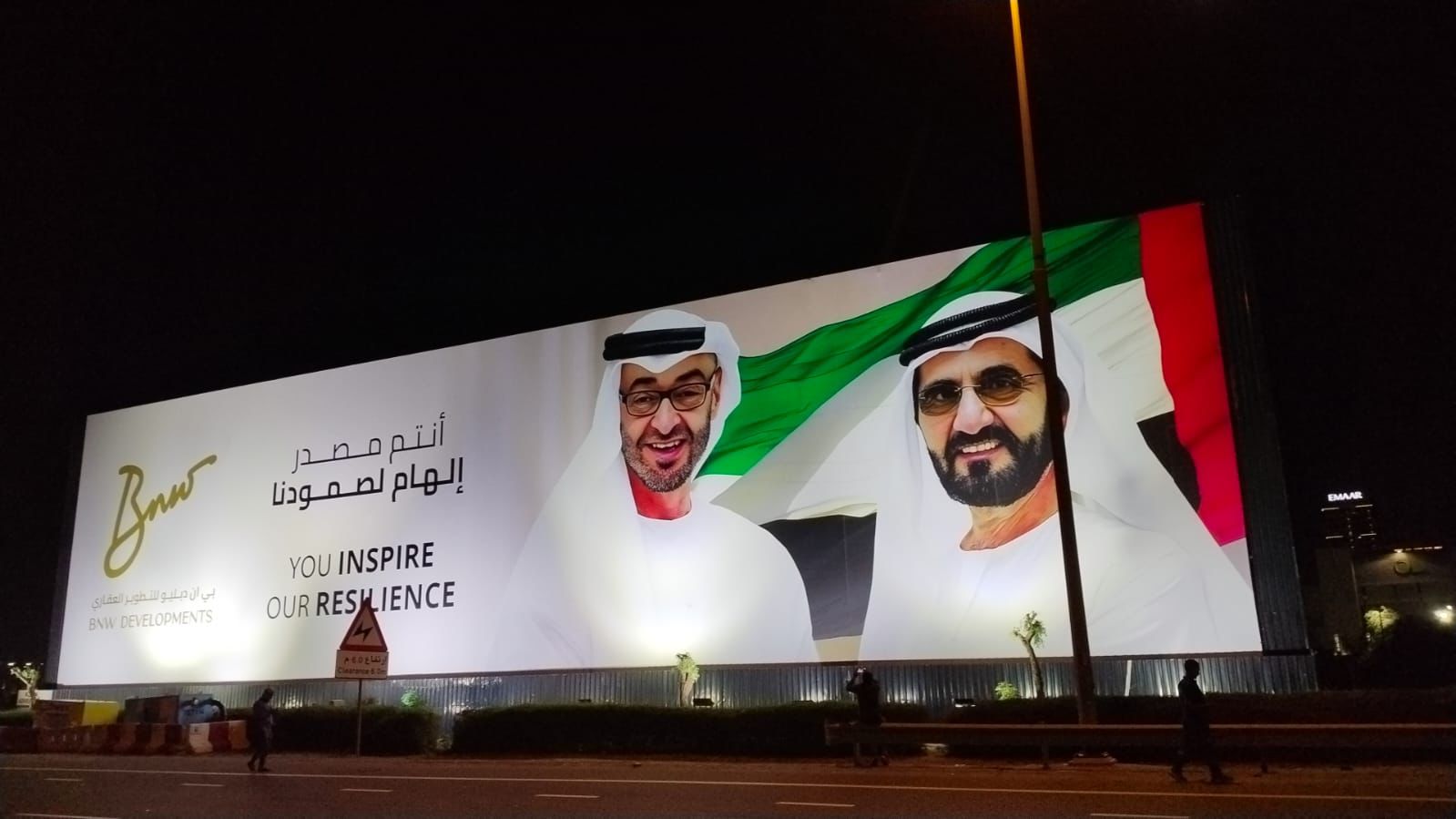
DUBAI, UAE — Apr 10 — BNW Developments has unveiled prominent installations in both Dubai and Ras Al Khaimah, serving as a visual tribute to the leadership of the UAE and a public reaffirmation of the nation’s enduring resilience.
The installation along Al Khail Road in Dubai features His Highness Sheikh Mohamed Bin Zayed Al Nahyan, President of the UAE, and His Highness Sheikh Mohammed bin Rashid Al Maktoum, Vice President and Prime Minister of the UAE and Ruler of Dubai.
Simultaneously, the developer has unveiled a dedicated tribute in Ras Al Khaimah featuring His Highness Sheikh Saud bin Saqr Al Qasimi, UAE Council Member and Ruler of Ras Al Khaimah, and His Highness Sheikh Mohamed bin Zayed Al Nahyan, President of the UAE.
As one of the UAE’s fastest-growing developers, BNW’s growth has been built on the country’s foundation of stability and ambition. These installations are a statement of intent, aligning the developer’s trajectory with the UAE’s wider vision for the future.
At a time when global markets face uncertainty, BNW is proving that nothing is stopping its momentum. Following the recent launch of its latest landmark project, Orvessa Residences by Michel Adam in Dubai, the firm is demonstrating its conviction through tangible action.
Furthermore, while many industries have tightened operations, BNW has maintained a strict “zero layoffs” policy, choosing instead to invest in its human capital. The company continues to roll out internal promotions and is actively expanding its footprint, recently welcoming a wave of new senior management leadership to steer its next phase of development.
“The UAE provides more than just a platform for business; it provides a sense of certainty,” said Dr. (CA) Ankur Aggarwal, Chairman and Founder of BNW Developments. “This tribute is rooted in a genuine belief in the resilience that defines this nation. We chose to build here because the leadership’s clarity makes the impossible feel like a standard.
“Our internal growth—retaining every member of our team and expanding our leadership suite—is a direct result of the confidence we have in this market. We aren’t just building structures; we are building a legacy that mirrors the grit of the UAE. This is our way of acknowledging the inspiration that fuels our own progress.”
The Al Khail and Ras Al Khaimah installations underscore BNW’s commitment to the region, moving beyond real estate to reflect a deeper investment in the national identity. For BNW, business continuity and national pride are not separate; they are the same mission.

- 0
- By Neel Achary

10, Apr 2026
RXIL TReDS Crosses Landmark INR 3,00,000 Crore Milestone in Cumulative Invoice Financing
Mumbai, Apr 10: Receivables Exchange of India Ltd (RXIL), India’s leading RBI-regulated Trade Receivables Discounting System (TReDS) platform, today announced that the cumulative value of invoices financed in the platform since inception, has crossed ₹3,00,000 Crore becoming the first TReDS platform to achieve this milestone. During FY 26, RXIL achieved a total throughput (invoices financed) of ₹1,21,105 crore, registering a 51% growth, reflecting strong momentum in platform adoption and increased participation across stakeholders.
RXIL is now a central pillar of India’s MSME Financing Infrastructure and has , onboarded 72,000+ MSMEs and 3,400+ corporate buyers since inception, and facilitated the financing of over 1.2 crore invoices. The platform enables MSME suppliers to convert their approved receivables into cash without collateral in under 24 hours, through a transparent multi-financier bidding mechanism. This has helped MSMEs reduce their receivable cycles, strengthen creditworthiness and sustain business growth.
After achieving cumulative throughput of ₹2,00,000 crore in July 2025, RXIL accelerated its growth trajectory by facilitating financing of MSME invoices of another ₹1,00,000 crore in just eight months.
Commenting on the milestone, Shri Manoj Mittal, CMD, SIDBI, and Chairman, RXIL said: “The growing relevance of the TReDS ecosystem underscores its role in addressing MSME working capital needs in a more efficient and transparent manner. Platforms like RXIL TReDS are enabling timely access to finance through digital, market-based mechanisms. As the ecosystem evolves, wider participation from buyers and financiers will be key to unlocking its full potential.”
This milestone reflects the collective commitment of the Government of India, Reserve Bank of India, and RXIL’s promoter institutions SIDBI, NSE, State Bank of India, ICICI Bank, and YES Bank.
Over the years, RXIL has played a defining role in shaping the TReDS landscape connecting buyers, sellers and financiers on a single digital platform, streamlining payment cycles, and improving working capital efficiency across industries.
The recent policy direction in the Union Budget 2026, with its increased emphasis on scaling the TReDS ecosystem, is expected to further accelerate adoption and deepen credit access for MSMEs.
As India advances towards the vision of Viksit Bharat, RXIL remains committed to enhancing access to formal credit, expanding platform participation, and building a future-ready trade finance ecosystem that empowers enterprises of every scale.
10, Apr 2026
Silver Futures Drop 1.46 pc as Selling Pressure Weighs on Prices
New Delhi, Apr 10 (BNP): Silver prices saw a noticeable dip on Friday, reflecting a cautious mood among traders. On the Multi Commodity Exchange, silver futures for May delivery dropped by ₹3,549, settling at ₹2,40,219 per kilogram—a decline of 1.46%.
Market activity showed moderate participation, with a turnover of 1,718 lots. According to analysts, the fall was largely driven by traders scaling back their positions, leading to a wave of selling pressure in the market.
This pullback suggests a shift in sentiment, as participants appear to be booking profits or adopting a wait-and-watch approach amid uncertain market cues. While such fluctuations are common in commodity markets, the sharp drop highlights how quickly prices can react to changes in trader confidence.
For investors, the movement serves as a reminder of the volatility in precious metals, where prices are often influenced not just by demand and supply, but also by broader market sentiment.
10, Apr 2026
Bharat Petroleum Corporation Limited Appoints Sanjay Khanna as New CMD
Apr 10 (BNP): In a key leadership move, Bharat Petroleum Corporation Limited (BPCL) has announced the appointment of Sanjay Khanna as its new Chairman and Managing Director (CMD). The decision was approved by the Appointments Committee of the Cabinet following recommendations from the selection panel under the Ministry of Petroleum and Natural Gas.
Currently serving as Director (Refineries), Khanna brings years of hands-on experience in refinery operations and large-scale project execution. He will take charge from the date he assumes office and is set to lead the company until his retirement on May 31, 2029, unless directed otherwise.
His elevation comes at a time when BPCL is navigating a rapidly changing energy landscape. With a strong technical and operational background, Khanna is expected to steer the company toward greater efficiency, expansion in petrochemicals, and a sharper focus on value-added products.
Beyond strategy, his leadership is likely to play a crucial role in balancing business growth with sustainability goals—an increasingly important priority for energy companies in India and globally.
As BPCL continues its transition amid evolving energy demands, Khanna’s appointment signals continuity in expertise while aiming for forward-looking growth and long-term energy security.
10, Apr 2026
KFON Signs MoU with C-DIT to Strengthen Surveillance Against Waste Dumping
Thiruvananthapuram, Apr 10: To support efforts by grama panchayats to prevent waste dumping in public places, Kerala Fibre Optic Network (KFON) has signed a Memorandum of Understanding (MoU) with the State Centre for Information Technology (C-DIT). As part of the initiative, CCTV cameras will be installed in selected panchayats across various districts in Kerala, with KFON providing the required internet connectivity.
“This collaboration, which leverages technology to control indiscriminate waste dumping, is a timely intervention by KFON,” said Dr. Santhosh Babu IAS (Retd.), Managing Director, KFON. “By providing reliable internet services, KFON will extend full support to efforts aimed at ensuring cleaner and better-managed public spaces,” he added.
The MoU was signed in the presence of Dr. Santhosh Babu IAS (Retd.), Managing Director, KFON, Jayadev Anand, Registrar, C-DIT and other KFON officials. As part of the first phase, C-DIT cameras have already been installed and made operational with KFON internet connectivity in Vadakkanchery (Palakkad), Panniyannur (Kannur), and Pattanakkad (Alappuzha).
The initiative is expected to strengthen monitoring mechanisms and support local bodies in maintaining cleaner public spaces across the state.
10, Apr 2026
GPF Interest Rate Stays at 7.1 pc for April–June 2026
The Ministry of Finance India has retained the General Provident Fund (GPF) interest rate at 7.1% for the April–June 2026 quarter. The rate is effective from April 1 to June 30, 2026, with no change from the previous quarter.
The announced rate will apply to GPF as well as similar government-managed funds, including the Contributory Provident Fund (CPF) and All India Services Provident Fund.
The government reviews these rates every quarter, but for the current period, it has opted to maintain stability. The decision ensures consistent returns for government employees relying on these schemes for long-term savings and retirement planning.
10, Apr 2026
RITES-led consortium delivers its 1st Retrofit Metro Trainset to DMRC, equipped with ‘Next-Gen’ PAPIS
Gurugram, April 10: RITES Ltd., the leading Transport Infrastructure Consultancy and Engineering firm, along with its consortium partners r2p Asia-Pacific Pty Ltd., Australia and ACT Fibreglass Ltd., today delivered the first refurbished metro trainset equipped with an advanced IP-based Passenger Announcement and Passenger Information System . The upgraded trainset was flagged-off by Delhi Metro Rail Corporation Managing Director Dr. Vikas Kumar at the Najafgarh Depot, New Delhi.
The system is designed to enhance operational efficiency, passenger convenience & safety and provide onboard communication systems for metro networks. It features an advanced integrated IP-based architecture with a centralized Human Machine Interface, enabling seamless control of passenger information, public address, CCTV and communication systems.
Built on Power over Ethernet (PoE), the PAPIS reduces wiring complexity and lifecycle costs while improving reliability and maintenance efficiency. It also integrates safety features such as CCTV, emergency communication and alarm systems, along with real-time diagnostics for efficient operations. The solution is compliant with BIS, EN and MeitY/STQC standards.
Apart from PAPIS, re-painting of saloon interiors, provision of IV couplers, fire detection system and mobile charging socket, refurbishment of EDB and relay panels have also been completed.
With its expertise in transport infrastructure and system integration, RITES continues to deliver benchmarked, future-ready solutions to the urban mobility ecosystem.
10, Apr 2026
AI and Industry Collaboration Drive BIMTECH’s Future-Ready Education Push
The Birla Institute of Management Technology (BIMTECH) is positioning itself as a future-focused business school by combining global exposure, industry partnerships, and technology-driven learning to prepare students for evolving management careers.
At the centre of this transformation is the leadership vision of Dr. Prabina Rajib, Director of BIMTECH, who has emphasised building an institution rooted in innovation, industry integration, student development, and global engagement.
A key milestone in this journey is BIMTECH being recognised as a 2026 AACSB Global Impact Award winner for its “AI-Enabled Interview Mastery” initiative. The project, honoured in the Teaching & Learning Excellence category, uses AI-powered interview simulations to provide students with real-time feedback, helping them improve communication skills and professional readiness.
Beyond digital learning tools, the institute is expanding its global footprint through international academic collaborations, including programmes with Singapore Management University. It has also strengthened ties with industry leaders such as Swiss Re and UNIQLO, offering students direct exposure to real-world business environments.
BIMTECH has further enhanced experiential learning through facilities like the Bloomberg Financial Markets Lab and a Centre of Excellence established with Hexalog Technologies. These platforms allow students to work with industry-standard tools and engage in applied, hands-on problem-solving.
Officials said these initiatives are helping the institute strengthen key academic performance areas, including teaching quality, research output, industry engagement, and graduate outcomes. Over time, this approach is expected to improve BIMTECH’s national rankings and global academic reputation, positioning it as a modern benchmark in management education.
10, Apr 2026
India Moves to Reduce Carbon Emissions in Steel Industry by 25 pc
India is working on a plan to reduce carbon emissions from its steel industry by around 25%, as part of its broader efforts to decarbonise one of the country’s most energy-intensive sectors.
The steel sector is a major contributor to industrial emissions, and the proposed reduction is expected to be achieved through improved energy efficiency, greater use of cleaner technologies, and a gradual shift towards low-carbon production methods.

Officials said the initiative aligns with India’s long-term climate commitments and its goal of balancing rapid industrial growth with environmental sustainability. The focus will also be on promoting greener manufacturing practices without affecting production capacity or economic expansion.
The move is seen as a significant step toward transforming the steel industry into a more sustainable and climate-resilient sector in the coming years.
10, Apr 2026
PFRDA Integrates Healthcare Benefits with NPS Through Swasthya Initiative
The Pension Fund Regulatory and Development Authority (PFRDA) has introduced a new healthcare-linked facility under ‘NPS Swasthya’, aimed at combining retirement savings with medical support for subscribers.
Under this initiative, eligible National Pension System (NPS) subscribers can now use a portion of their pension corpus to meet hospitalisation and in-patient treatment expenses, while the remaining funds continue to grow through market-linked investments.
Subscribers are allowed to access up to 25% of their “Net Eligible Balance” for medical emergencies. This marks a shift from the traditional NPS structure, where funds remain locked until retirement, offering greater flexibility during healthcare needs.
The programme has been developed through a partnership involving the pension regulator and multiple stakeholders, including pension funds and health insurance players. It is powered by Medi Assist’s digital “Maven” platform, which is integrated with the Central Recordkeeping Agency system for seamless processing.
The initiative also provides access to a wide hospital network across India, enabling cashless treatment facilities for subscribers in more than 1,500 cities, along with support for outpatient care services.
Officials said the move aims to strengthen India’s social security system by linking retirement planning with healthcare protection, ensuring financial support during medical emergencies without disrupting long-term savings.


