


10, Apr 2026
Lucknow Super Giants Stun Kolkata Knight Riders with Last-Over Thriller, Win by 3 Wickets
Apr 10 (BNP): In a high-voltage encounter at Kolkata, Lucknow Super Giants registered a dramatic 3-wicket victory over Kolkata Knight Riders in one of the most thrilling matches of the ongoing Indian Premier League season.
Batting first, Kolkata Knight Riders posted a competitive total of 181/4 in 20 overs. In reply, Lucknow Super Giants chased down the target in dramatic fashion, scoring 182/7 in 20 overs to seal the win in the final moments of the match.
The victory was powered by a sensational performance from emerging star Mukul Choudhary, who was named Player of the Match for his fearless and match-winning innings under pressure. Demonstrating remarkable composure, Choudhary anchored the chase and delivered crucial hits at key moments, including decisive shots in the final over.
Reflecting on his journey, Choudhary credited his father’s dream as his inspiration and highlighted his rise from humble beginnings in Rajasthan to competitive cricket in Jaipur and Delhi. He emphasized his belief in staying till the end and backing his natural attacking game, even in high-pressure situations.
Captain Rishabh Pant praised the youngster’s outstanding performance and underlined the importance of trust and confidence in nurturing talent. He also acknowledged the contributions of senior players and the collective team effort in securing the win.
On the other hand, Ajinkya Rahane, captain of Kolkata Knight Riders, described the defeat as a tough one but appreciated his team’s overall performance. He credited Choudhary’s innings as the defining factor, noting that minor lapses in execution during the final overs proved costly.
The match once again showcased the electrifying and unpredictable nature of the IPL, delivering back-to-back thrilling finishes for fans.
Meanwhile, excitement continues as Rajasthan Royals are set to face Royal Challengers Bengaluru in the next league fixture, promising another blockbuster clash with both teams in top form.
- 0
- By Neel Achary

10, Apr 2026
Commerce Ministry Reviews Export Disruptions Amid West Asia Crisis
New Delhi, Apr 10 (BNP): The Commerce Ministry has held a series of high-level meetings with exporters and key stakeholders to address rising challenges in packaging, shipping, and port operations amid the ongoing geopolitical tensions in West Asia.
The meetings were chaired by Commerce Secretary Rajesh Agrawal and attended by Shipping Secretary Vijay Kumar, along with representatives from shipping lines, ports, Export Promotion Councils (EPCs), and commodity boards.
Officials said the discussions focused on disruptions in maritime trade following escalating tensions in the West Asia region, which have impacted vessel movement and shipping routes, especially on key international corridors.
Exporters flagged several concerns, including delays in shipments, logistical bottlenecks, and rising operational costs affecting overall export performance. Export Promotion Councils have been directed to submit detailed feedback on port-wise issues to enable targeted policy responses.
In a separate review, industry representatives highlighted a sharp rise in packaging material costs, driven by increased petrochemical prices. This has led to an estimated 50% surge in packaging costs over recent weeks, further squeezing export margins.
The ministry said it is actively monitoring the situation and engaging with stakeholders to ensure continuity in trade operations and minimise supply chain disruptions.

10, Apr 2026
UPI Completes a Decade, Records Massive Growth in Digital Transactions
New Delhi, Apr 10 (BNP): India’s Unified Payments Interface (UPI) has completed a remarkable decade of growth, transforming the country’s digital payments landscape and becoming one of the world’s most widely used real-time payment systems.
According to data from Tracxn, shared with ETBFSI, UPI transactions have surged from just 18 million in its early phase to 219 billion transactions, marking a nearly 12,000-fold increase in volume over the past 10 years. In value terms, the platform has expanded more than 4,000 times, highlighting its massive adoption across the country.
Developed by the National Payments Corporation of India (NPCI), UPI has played a key role in advancing India’s digital economy by enabling instant, secure, and low-cost money transfers through mobile phones.
Over the years, the system has evolved from a simple peer-to-peer transfer tool into a comprehensive payments ecosystem used for merchant payments, bill settlements, e-commerce transactions, and everyday financial activity.
Experts say the rapid rise of UPI reflects India’s strong push towards financial inclusion, with millions of first-time users entering the formal digital banking system. Its ease of use, interoperability, and zero or low transaction costs have been key drivers of adoption.
Today, UPI stands as one of India’s most significant digital public infrastructure successes, reshaping how individuals and businesses transact across the country and gaining global attention for its scale and efficiency.
10, Apr 2026
Emerging Startups Bring New Opportunities to Odisha’s Business Landscape
Odisha, located on India’s eastern coastline, has historically depended on agriculture, handloom weaving, and mineral-based industries for its economic stability. With fertile land and rich natural resources, agriculture especially rice and pulse cultivation has long supported a large share of the population.

In recent years, however, the state has been steadily shifting toward a more diversified and modern economy. Improved infrastructure, supportive policies, and growing entrepreneurial activity are reshaping Odisha into an emerging center for business innovation and industrial development.
Industrial Growth and Rising Entrepreneurship in Odisha
The state has made significant progress in expanding its industrial base. Government efforts to improve connectivity, simplify business regulations, and attract investment have played a major role in this transformation. Sports news Odisha is also gaining attention as improved infrastructure and growing media coverage highlight local talent and sporting achievements across the state.
New industrial clusters and development zones have encouraged the growth of manufacturing, information technology, tourism, and renewable energy sectors. This shift is gradually reducing reliance on traditional industries and creating new employment opportunities for the youth.
Alongside these changes, entrepreneurship and startups are becoming an important part of Odisha’s economic identity.
Growth of the Startup Culture
Over the past decade, Odisha has seen a noticeable rise in entrepreneurial activity. A key factor behind this growth is the structured support system created to encourage new businesses.
The startup environment is supported through:
- Incubation and innovation centers
- Early-stage financial assistance
- Training and mentorship programs
- Policy-driven incentives for new entrepreneurs
These initiatives have encouraged young professionals and graduates to explore entrepreneurship as a viable career option. As a result, cities like Bhubaneswar are emerging as growing hubs for innovation and new-age businesses.
Transforming Business Landscape of Odisha
Sectors Experiencing Startup-Driven Change
Technology and Digital Services
Startups in the technology sector are introducing digital solutions that help businesses operate more efficiently. From mobile applications to software platforms, these innovations are modernizing traditional systems and improving service delivery.
Agriculture and Rural Innovation
Agriculture-focused startups are bringing scientific methods into farming practices. Tools such as smart irrigation systems, drone monitoring, and data-based crop management are helping farmers increase productivity while reducing costs and environmental impact.
Healthcare Services
In the healthcare sector, startups are developing telemedicine platforms, online consultation systems, and affordable diagnostic tools. These innovations are improving access to healthcare, especially in rural and remote areas.
Tourism and Culture
Tourism-focused startups are promoting local heritage sites, cultural experiences, and eco-tourism. Digital marketing, virtual experiences, and personalized travel planning are helping attract more visitors and boosting local economies.
Government Role in Supporting Startups
The government has played a crucial role in shaping the startup ecosystem in Odisha. Through targeted policies and institutional support, it has created a favorable environment for innovation and business growth.
Key forms of support include:
- Dedicated startup policies and frameworks
- Financial assistance programs for new ventures
- Business incubation and accelerator support
- Networking opportunities with investors
- Participation in entrepreneurship events and competitions
These efforts have helped reduce barriers for new entrepreneurs and improved access to resources and funding.
Challenges in the Startup Ecosystem
Despite rapid progress, startups in Odisha continue to face certain challenges:
Limited access to funding: Early-stage startups often struggle to attract sufficient investment.
Infrastructure gaps: In some areas, connectivity and business facilities still need improvement.
Skill shortages: Many startups face difficulties in finding locally trained professionals with industry-specific skills.
Addressing these challenges will require collaboration between educational institutions, policymakers, and private investors.
Inspiring Startup Successes
Several startups from Odisha have demonstrated how innovation can create meaningful impact:
- A food-based venture promoting organic farming and supporting local farmers through sustainable practices
- A digital platform connecting traditional artisans with broader markets, helping preserve cultural heritage
- An education-focused startup offering skill development programs to improve employability among youth
These examples highlight how entrepreneurship in Odisha is not only generating income but also contributing to social development.
Role of Technology and Innovation
Technology has become a key driver of startup growth in Odisha. Many new businesses are using advanced tools such as artificial intelligence, Internet of Things, and data analytics to build efficient and scalable solutions.
Digital platforms are also enabling local entrepreneurs to reach wider markets, breaking geographical limitations and increasing competitiveness. This increasing reliance on technology is helping startups grow faster and operate more effectively.
Future Outlook
The future of startups in Odisha appears promising, with strong potential for expansion in areas such as renewable energy, artificial intelligence, agriculture technology, and digital commerce.
Growing collaboration between educational institutions, government bodies, and private investors is expected to strengthen the ecosystem further. Improved skill development programs and innovation-driven policies will also support the next generation of entrepreneurs.
With continued progress, Odisha has the potential to become a significant startup hub in India.
Conclusion
Odisha is undergoing a major economic transformation, moving from a resource-dependent economy toward a more innovation-driven and diversified system. The rise of startups is playing a central role in this change by creating jobs, encouraging creativity, and introducing modern solutions across industries.
Although challenges remain, the combined efforts of government support, technological advancement, and entrepreneurial enthusiasm are steadily shaping a strong and sustainable startup ecosystem in the state.
10, Apr 2026
Hockey India Appoints Tim White as Junior Women’s Coach
New Delhi, Apr 10 (BNP): Hockey India has appointed experienced Australian coach Tim White as the new head coach of the Indian junior women’s hockey team, replacing Tushar Khandekar, who had been with the squad since 2023.
The federation announced the change on Friday but did not provide details regarding the reason for the transition or the duration of White’s contract.
Tim White brings international coaching experience to the role and was recently associated with the Hockey India League, where he served as head coach of the Accord Tamil Nadu Dragons. His appointment is expected to strengthen the team’s preparation and development at the junior level.
Khandekar’s tenure with the side saw steady involvement in building the squad, but the federation has now opted for a change in leadership as part of its ongoing restructuring and performance strategy.
The move reflects Hockey India’s continued focus on bringing global coaching expertise into its system to enhance the performance of India’s junior women’s hockey programme.
10, Apr 2026
Shipping Sector Boost: India’s Fleet Surpasses 14.2 Million GT
New Delhi: India’s national shipping fleet has crossed a major milestone, surpassing 14.2 million Gross Tonnage (GT) for the first time, supported by the addition of 92 new vessels during FY 2025–26.
Officials said the sharp expansion reflects a significant boost in the country’s maritime strength, with vessel additions recording a threefold increase in tonnage growth compared to previous periods.

Pic Credit: Pexel
The development is seen as a key step towards enhancing India’s presence in global shipping and reducing dependence on foreign fleets. It also aligns with the broader vision of Atmanirbhar Bharat, aimed at strengthening self-reliance in critical strategic sectors.
Experts note that the rising fleet capacity will improve cargo handling capability, support trade efficiency, and enhance India’s competitiveness in international maritime logistics.
With sustained investments and policy support, the shipping sector is expected to play an increasingly important role in driving trade growth and strengthening India’s blue economy ambitions.
10, Apr 2026
World Homoeopathy Day 2026: India Emphasises Homoeopathy for Sustainable Health
New Delhi, Apr 10 (BNP): World Homoeopathy Day is being observed on April 10, commemorating the birth anniversary of Dr. Samuel Hahnemann, the German physician who founded homoeopathy in the late 18th century. This year’s theme, “Homoeopathy for Sustainable Health,” highlights the growing focus on holistic and long-term wellness through alternative systems of medicine.
Homoeopathy, derived from the Greek words “homoios” (similar) and “pathos” (suffering), is based on the principle of treating illness with highly diluted substances that produce symptoms similar to the disease in healthy individuals. The system was formalised by Hahnemann in 1796 and continues to be guided by his foundational work, Organon of Medicine.

Pic Credit: https://x.com/PMOIndia
Two core principles define homoeopathy: “like cures like,” which suggests that substances causing symptoms in a healthy person may help treat similar symptoms in a patient; and the “law of minimum dose,” which advocates the use of highly diluted remedies to stimulate the body’s natural healing process while reducing side effects.
Homoeopathic medicines are typically prepared from natural sources such as plants, minerals, and animal products through processes of dilution and succussion. They are administered in various forms, including tablets, globules, and liquid preparations. A key feature of the system is its individualised treatment approach, where therapy is tailored to a patient’s overall physical and mental condition rather than focusing solely on the disease.
India remains one of the largest centres for homoeopathy in the world. According to official data, the country has around 3.45 lakh registered homoeopathy doctors, 8,593 dispensaries, 277 educational institutions, and 34 research centres, reflecting its strong institutional base.
Homoeopathy was introduced in India in 1810, when German missionaries first brought its medicines to the country. Over time, it has become an integral part of India’s pluralistic healthcare system, supported by a growing workforce and expanding public acceptance.
Officials and experts note that the system continues to evolve through research and education, with increasing emphasis on evidence-based practice and integration into broader healthcare goals. The observance of World Homoeopathy Day also serves to promote awareness about its role in preventive care and sustainable health systems.
10, Apr 2026
Priyanka Singh Promoted to EVP, Operations & CFO at Litera, Taking on Expanded Strategic Role as Litera Sees Ongoing Strong Growth
HOLMDEL, N.J. and CHICAGO – Apr. 10 – Litera, a leading legal AI platform provider that unifies the practice and business of law, announced the promotion of Priyanka Singh to Executive Vice President, Operations & Chief Financial Officer. Since joining Litera one year ago as CFO, Priyanka has expanded her impact beyond financial leadership, overseeing support and services, legal, and HR, and playing a central role in the company’s operational transformation. Her elevated title reflects the scope she has taken on, and the transformation she has led, helping reshape the company into a customer‑first organization and redefining how Litera partners with customers.

“From day one, Priyanka has shown a relentless drive to do right by our customers, and that commitment is showing up where it matters most,” said Avaneesh Marwaha, CEO of Litera. “What sets Priyanka apart is that she never stops at the balance sheet. She brings a CFO’s discipline to every corner of the business, and it’s her genuine care for our customers that has truly set the tone. Sentiment in the market is up, and Priyanka’s promotion reflects the direct impact her leadership has had on delivering the operational foundation behind our mission to pave the path for the future of law.”
Priyanka brings more than 20 years of experience in financial strategy, operations, and organizational transformation to her expanded role. Her background spans public and private companies focused on SaaS, mergers, and acquisitions at Togetherwork, Global Payments Inc., Heartland Payment Systems, and several verticals at General Electric. She is a Certified Public Accountant (CPA) and Chartered Accountant (CA).
During her first year at Litera, Priyanka has also been instrumental in the company’s return-to-office initiative, overseeing the opening of seven offices and building a culture of in-person collaboration that employees are choosing to embrace. That cultural shift reflects her broader leadership philosophy that strategy only works when it translates into concrete priorities at every level of the organization.
“Litera is at an exciting point in its growth,” said Priyanka Singh. “The opportunity in front of us to help law firms unify the practice and business of law through AI requires operational excellence and a dedication to customers that matches our technology ambition. I’m energized by what we’ve built in the past year, and even more so by what we’re positioned to build for the next decade on a foundation of 30 years of unmatched legal expertise along with our rapid pace of innovation.”
Litera’s pedigree of 30 years of legal expertise, combined with the AI capabilities embedded across its platform through Lito, its award-winning legal AI agent, positions the company as the only legal AI platform built to unify the practice and business of law. Priyanka’s expanded role strengthens the operational foundation to execute that vision.
10, Apr 2026
Massive Voter Turnout Drives High-Voltage Polling in Assam, Kerala & Puducherry
Democracy in Action: Voters Turn Out in Huge Numbers Across 3 States
Apr 10, (BNP): Polling for the 2026 Assembly elections in Assam, Kerala, and the Union Territory of Puducherry progressed smoothly on Thursday, recording strong voter participation across all regions.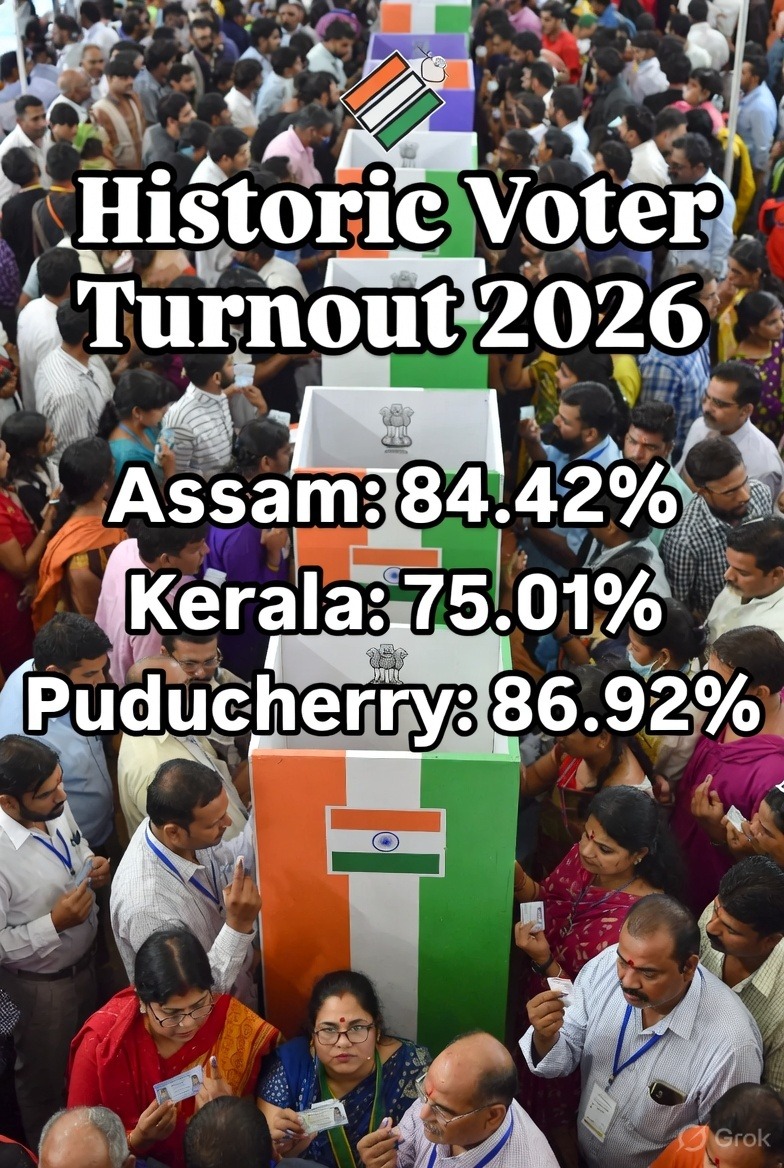
According to the Election Commission of India, voter turnout by 5 p.m. stood at 84.42% in Assam, 75.01% in Kerala, and 86.92% in Puducherry, reflecting robust public engagement in the democratic process.
In Assam, Chief Minister Himanta Biswa Sarma cast his vote in Jalukbari, a constituency he has represented since 2001. He was accompanied by his family and earlier offered prayers at the revered Kamakhya Temple. Jalukbari continues to remain his political stronghold over the past two decades.
Polling is being conducted for 126 Assembly seats in Assam, 140 in Kerala, and 30 in Puducherry, with counting of votes scheduled for May 4.
Kerala witnessed participation from over 2.69 crore eligible voters across 140 constituencies, including more than 1.38 crore women, 1.31 crore men, and 277 third-gender voters. Around 4.24 lakh voters are in the 18–19 age group, while over 2 lakh are above 85 years. A total of 30,471 polling stations were set up. The electoral battle is primarily between the Left Democratic Front led by Chief Minister Pinarayi Vijayan and the Congress-led United Democratic Front.
Assam has over 2.5 crore eligible voters, with 722 candidates contesting across 126 seats. The electorate includes more than 1.25 crore male and 1.25 crore female voters, along with 318 transgender and over 63,000 service voters. Notably, 6.42 lakh voters are aged 18–19, while more than 2.5 lakh are above 80 years. Webcasting was enabled at all 31,490 polling stations, with 1.51 lakh personnel deployed to ensure smooth conduct. The contest is mainly between the BJP-led National Democratic Alliance and a Congress-led alliance.
In Puducherry, over 10.14 lakh voters are eligible to vote across 30 constituencies, including 5.39 lakh women, 4.74 lakh men, and 157 third-gender voters. Around 24,156 voters are aged 18–19, while 6,034 are above 85 years. The contest is primarily between the All India NR Congress-led NDA and the Congress-DMK alliance, with Vijay’s Tamilaga Vettri Kazhagam also fielding candidates.
Meanwhile, bypolls in select constituencies recorded moderate turnout, including Bagalkot (65.68%) and Davanagere South (63.04%) in Karnataka, Koridang (80.62%) in Nagaland, and Dharmanagar (79.84%) in Tripura.
Election authorities have ensured peaceful polling with tight security and efficient arrangements, while officials have praised the enthusiastic participation of voters, underscoring the strength of democratic engagement across the regions.
10, Apr 2026
TCS Slips 3 pc as March Quarter Results Fail to Impress Investors
New Delhi,Apr 10 (BNP): Shares of India’s largest IT services company, Tata Consultancy Services (TCS) came under pressure on Friday, falling over 3% in early trade after its March quarter results failed to meet investor expectations.

The stock declined by about 3.25% to ₹2,503.45 on the BSE, while on the NSE it slipped nearly 3.24% to ₹2,505, reflecting broad-based selling pressure following the earnings announcement.
Investor sentiment turned cautious as the results did not provide strong triggers for fresh buying, leading to profit booking in the heavyweight IT stock.
Market participants said the reaction indicates muted near-term expectations from the IT sector, which continues to face global demand uncertainties and margin pressures.
Despite the decline, analysts note that TCS remains a key benchmark stock for the Indian IT industry, and its performance is closely tracked for broader sector cues.


