


21, Oct 2026
Odisha Plans International Research Centre for Olive Ridley Turtles at Berhampur University
Berhampur, Oct 21: Odisha is set to strengthen its marine conservation efforts with plans to establish an international research centre dedicated to Olive Ridley sea turtles at Berhampur University in Ganjam district. The proposed facility aims to deepen scientific understanding of the endangered marine species, with a focus on migration routes, breeding behaviour, mass nesting and habitat protection.

Representational Image
The initiative brings together the Forest Department, Berhampur University’s Department of Environmental Science and the Zoological Survey of India’s Gopalpur centre. Researchers and institutions from Odisha and beyond are expected to contribute to studies aimed at addressing critical questions about the turtles’ life cycle and annual movements.
Rushikulya Coast to Remain a Key Research Focus
The Rushikulya river mouth in Ganjam district is one of the world’s important nesting sites for Olive Ridley turtles, attracting large numbers of the species during the breeding season. The turtles travel long distances across the ocean before arriving at Odisha’s sandy shores to lay their eggs.
Following incubation, which generally lasts around 45 to 60 days, hatchlings emerge from the nests and make their way towards the sea. However, several aspects of their migration, breeding cycles and ability to return to specific nesting beaches continue to require further scientific investigation.
The proposed research centre is expected to provide a dedicated platform for examining these patterns and improving understanding of the environmental factors that influence turtle nesting and survival.
Advanced Technology to Support Conservation
Satellite tagging and other scientific techniques have already helped researchers track the movements of Olive Ridley turtles across marine environments. The new facility could expand such investigations by encouraging collaborative studies on migration corridors, nesting frequency, breeding behaviour and the condition of coastal habitats.
The findings could help conservation authorities develop more effective strategies to protect nesting beaches, reduce threats to hatchlings and adult turtles, and safeguard the marine ecosystems on which the species depends.
Research Institutions to Collaborate
Berhampur Divisional Forest Officer Sunny Khokhar said Berhampur University, Khallikote University, the Zoological Survey of India and other research institutions would be involved in the initiative.
He added that researchers interested in studying Olive Ridley turtles would be able to submit research proposals to the centre, opening opportunities for wider academic participation and scientific collaboration.
Professor Anjan Prusty of Berhampur University’s Department of Environmental Science said research conducted over the past three decades would provide an important foundation for future investigations.
According to Prusty, researchers intend to explore several unanswered questions, including whether the turtles follow mass or periodic nesting patterns, how their arrival patterns vary and what role habitat quality plays in their reproductive behaviour.
Strengthening Odisha’s Conservation Efforts
The proposed centre is expected to create opportunities for researchers from India and other countries to exchange scientific knowledge and develop a more comprehensive understanding of Olive Ridley turtles.
For Odisha, where large-scale turtle nesting is an important feature of the coastal ecosystem, the initiative could help bridge gaps between scientific research and practical conservation measures.
The centre’s operational timeline has not yet been announced. However, its proposed focus on long-term research and institutional collaboration signals a push towards strengthening the scientific basis of marine wildlife protection in the state.
As conservationists continue to work to safeguard Olive Ridley turtles and their nesting grounds, the planned facility could emerge as an important hub for research, knowledge-sharing and evidence-based protection of the species.
- 0
- By Neel Achary

21, Oct 2026
CM Vijay Pays Homage to Police Martyrs, Praises Force’s Unwavering Commitment to Public Safety
Chennai, Oct 21: Tamil Nadu Chief Minister Vijay on Wednesday paid tribute to police personnel who laid down their lives in the line of duty, acknowledging their courage, sacrifice and unwavering commitment to protecting citizens and maintaining law and order.

In a message marking Police Commemoration Day, the Chief Minister described the police force as a vital pillar of public safety and national security. He lauded personnel for their tireless service, often under difficult and unpredictable circumstances, and called for greater recognition of their contributions to society.
Recalling the sacrifice of 10 Central Reserve Police Force (CRPF) personnel who lost their lives while defending the country along the Ladakh border in 1959, Vijay said their courage remains an enduring symbol of duty and devotion to the nation.
Paying homage to police martyrs across the country, he honoured those who died while performing their responsibilities to preserve peace, protect lives and uphold the rule of law.
The Chief Minister also highlighted the demanding nature of police service, noting that personnel are frequently called upon to respond to emergencies, natural disasters, road accidents, criminal incidents and other threats to public safety. Their responsibilities often extend beyond regular working hours, requiring constant vigilance and an unwavering readiness to act whenever circumstances demand.
Vijay praised the dedication of officers and personnel who continue to discharge their duties despite long hours, limited rest and challenging working conditions. He noted that their commitment plays a crucial role in protecting communities, preventing crime and ensuring public order.
Emphasising the importance of remembering those who made the ultimate sacrifice, the Chief Minister urged people to honour fallen personnel and acknowledge the efforts of those continuing to serve on the front lines of public safety.
He called for collective appreciation of the police force’s exemplary service, describing its members as a protective shield for society.
The message served as both a solemn remembrance of police personnel who lost their lives in service and a tribute to the thousands who continue to safeguard citizens amid everyday risks and extraordinary emergencies.
Police Commemoration Day is observed annually on October 21 in memory of the 10 CRPF personnel killed in an ambush by Chinese forces at Hot Springs in Ladakh in 1959. The occasion honours police personnel across the country who have died in the line of duty and recognises the sacrifices made in the service of the nation.
21, Oct 2026
fäm Properties connects DXBinteract to ChatGPT and Claude
Brokers and investors who add DXBinteract can ask either assistant what Dubai properties sold for, what they rent for and what hands over next

Dubai, UAE, Oct 21: fäm Properties has connected DXBinteract, the free Dubai property data platform it built, to ChatGPT and Claude.
It means brokers, investors and buyers can add DXBinteract to either assistant as a custom connector, sign in and ask in plain language about prices, rents, yields, future supply and developer delivery records.
The service is available now, and the answers come from DXBinteract’s market data, including analysis based on Dubai Land Department records.

“While listings tell you what sellers want, transaction records tell you what buyers actually paid,” said Firas Al Msaddi, founder and CEO of fäm Properties. “We built DXBinteract for the whole market, not just for fäm. Every broker gets the same data on the same terms as ours.
“Now a broker or an investor can ask ChatGPT or Claude to check a price against real transactions, including the prices we quote.” Questions brokers and investors can ask include:
- Which Dubai communities offer the highest rental yields and strongest price growth?
DXBinteract ranks areas by gross rental yield, year-on-year price growth and transaction volume. It leaves out areas with too few transactions to give a reliable figure.
·Is this apartment overpriced? DXBinteract gives an indicative value and a low-to-high range, based on the area’s median price per square foot and recent sales of similar-sized units. It is a reference point, not a formal valuation.
·Does this developer deliver on time? DXBinteract shows how many of the developer’s projects were handed over on time, how many late and how many are still overdue, with the median delay in days. Every developer is scored the same way, Nordic by fäm included.

“An investor should be able to ask one question and understand not just what a property costs, but how it compares with the market, what returns it could generate and what risks lie ahead,” said Fateh Al Msaddi, founder of DXBinteract and COO of fäm Properties. “We’ve built the intelligence, and now AI makes it easier for everyone to use.”
Users can also compare up to six communities, side by side, and see how much of an off-plan project has sold and how far its construction has progressed.
They can track upcoming handovers and future supply, and work out gross rental yield, payback and mortgage affordability, including the cash needed upfront. Setup steps for both assistants can be found (available) at dxbinteract.com.
21, Oct 2026
Dussehra 2026: Vehicle Puja Draws Devotees To Durga Puja Pandals Across Bhubaneswar
Bhubaneswar, Oct 21: Vehicle puja emerged as a major attraction across Bhubaneswar on Wednesday as devotees marked Dussehra with special prayers and traditional rituals at Durga Puja pandals across the city.

Representational Image
From two-wheelers and private cars to auto-rickshaws and buses, vehicles of different types lined up outside temples and puja pandals from the early morning hours. Owners performed special pujas, seeking the blessings of Maa Durga for safety, prosperity and success in their daily lives.
The ritual saw devotees washing their vehicles, decorating them with flowers and garlands, and offering prayers before the Goddess. Many also applied vermilion and other auspicious materials as part of the traditional observances.
Vehicle Puja Marks An Auspicious Dussehra Tradition
Vehicle puja is an important tradition associated with Dussehra in several parts of India. Devotees believe that worshipping their vehicles on this auspicious day brings good fortune and protects them from accidents and other mishaps.
For many, vehicles are essential to their livelihoods and everyday activities. Commercial drivers, transport operators and private vehicle owners participate in the ritual to express gratitude and seek divine blessings for safe journeys throughout the year.
In Bhubaneswar, the practice brought together people from different walks of life, with many choosing to visit nearby puja pandals and temples with their vehicles before beginning their day’s work.
Festive Spirit Grips The Capital
The vehicle puja rituals added another dimension to the Vijayadashami celebrations in the Odisha capital, where devotees have been gathering at decorated pandals to offer prayers to Maa Durga.
The occasion marks the victory of good over evil and the culmination of Durga Puja festivities. Alongside traditional worship, the day is observed through a range of customs that reflect faith, gratitude and hopes for a prosperous future.
With devotees turning up in large numbers for the morning rituals, vehicle puja remained a prominent feature of this year’s Dussehra celebrations across Bhubaneswar, highlighting the enduring connection between religious traditions and everyday life.
21, Oct 2026
BJP Yuva Morcha Announces Major National Reshuffle; Leaders From 20 States Get Key Posts
New Delhi, Oct 21: The Bharatiya Janata Party (BJP) has carried out a major organisational reshuffle in its youth wing, the Bharatiya Janata Yuva Morcha (BJYM), appointing new national office-bearers across key organisational, administrative, research and media positions.
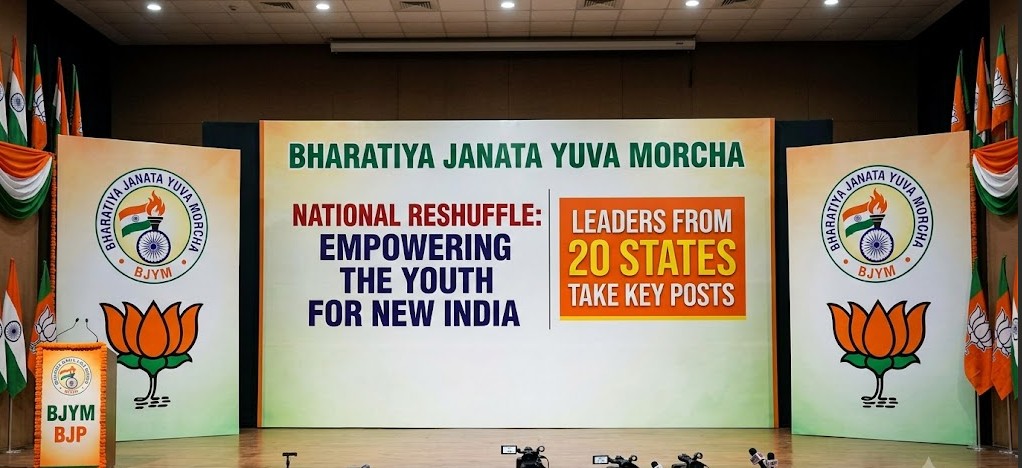
Representational Image
The appointments, made under the direction of BJP National President Nitin Nabin, include seven national vice-presidents, three national general secretaries and seven national secretaries, along with office-bearers for several other departments. The new appointments will take effect immediately.
The reshuffle brings together leaders from different states, reflecting the party’s efforts to strengthen its youth organisation and expand its organisational presence across the country.
Seven National Vice-Presidents Appointed
According to the list released by the party, seven leaders have been appointed national vice-presidents of the Yuva Morcha. They are Shagun Parihar, MLA, from Jammu and Kashmir; Nikhil Mani Tiwari from Uttar Pradesh; Arvind Damani from Nagaland; Maloth Komali Naik from Telangana; Raj Rajendra Singh from Bihar; Soumen Karfa, MLA, from West Bengal; and Bhupendra Nag from Chhattisgarh.
For the post of national general secretary, the party has appointed Arpita Aparajita Badjena from Odisha, Harsh Vardhan Singh from Uttar Pradesh and Mitta Vamshi Krishna from Andhra Pradesh.
The appointment of Arpita Aparajita Badjena from Odisha is among the key developments in the organisational changes, giving the state representation in the Yuva Morcha’s national leadership.
Seven Leaders Named National Secretaries
The party has also appointed seven national secretaries to strengthen its organisational framework. The newly appointed secretaries are Biswajit Khound from Assam, Ashish Jhala from Madhya Pradesh, Sayali Raghunath Kulkarni from Maharashtra, Himanshu Sharma from Rajasthan, Sardar Armaanjot Brar from Punjab, Aman Yadav from Jharkhand and Rahul Jha from Bihar.
In the finance-related appointments, Vineet Vats Tyagi from Uttar Pradesh has been named national treasurer, while Devvrat Singh Rajawat from Rajasthan will serve as national joint treasurer.
For administrative coordination, Dhruv Pandit from Gujarat has been appointed central office in-charge, with Mohit Soni from Delhi named central office co-in-charge.
Policy, Research And Media Teams Get New Leadership
The organisational overhaul also covers the Yuva Morcha’s policy and research wing. Akhila Bandam from Telangana has been appointed in-charge of the Policy and Research Department. Rangam Trivedi from Gujarat, Kamal Madishetty from Telangana and Dr Rama Balhara from Haryana have been named co-in-charges.
In the media department, Himanshu Yadav from Bihar has been appointed media in-charge. Shivani Singh from Delhi, Atul Thakur from Himachal Pradesh and Vishu Basoya from Delhi will serve as media co-in-charges.
The party has also announced appointments to its social media team, naming Apurva Singh from Delhi as social media in-charge and Manvendra Chauhan from Bihar as social media co-in-charge.
Focus On Strengthening Youth Organisation
The latest appointments mark a significant restructuring of the BJP’s youth wing, with leadership positions distributed among representatives from multiple states and responsibilities spread across organisational, policy, financial and communications departments.
The new team is expected to take charge of its respective responsibilities immediately, as the party continues to focus on strengthening its youth leadership and organisational network at the national level.
With appointments spanning a wide range of functions, the reshuffle establishes a new leadership structure for the BJYM, placing emphasis on organisational coordination, policy engagement and communication.
21, Oct 2026
IIT Madras’ First-Ever Durga Puja Draws Over 2,500 People, Celebrates Bengal’s Cultural Heritage
Chennai, Oct 21: The maiden Durga Puja celebration at the Indian Institute of Technology (IIT) Madras has emerged as a major success, bringing together more than 2,500 people over four days and creating a vibrant platform for cultural exchange, religious devotion and community bonding.
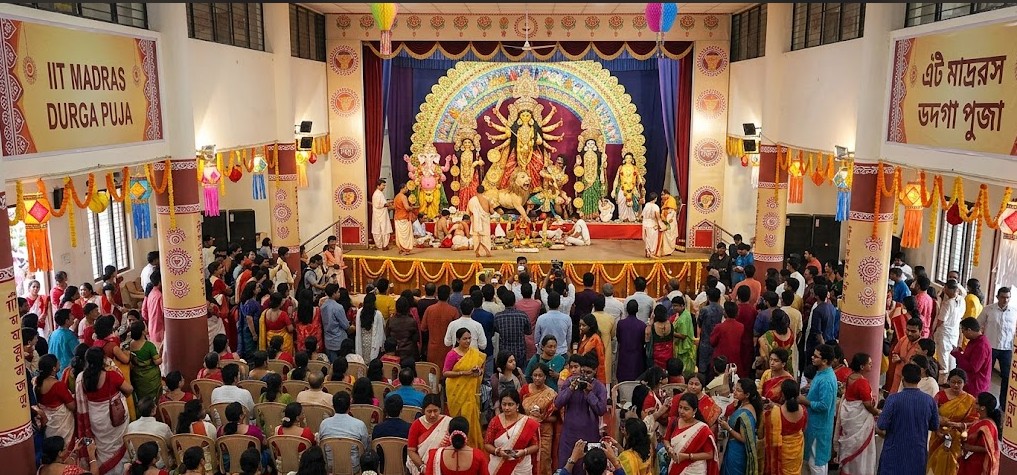
Representational Image
Organised by the IIT Madras Bengali community in association with Diganto, an independent student body and cultural club under the institute’s cultural umbrella, Sangam, the five-day celebration introduced the traditions and festive spirit of Bengal to the campus.
The festivities, which began on Sasthi evening and culminated on Vijaya Dashami, featured traditional rituals, Vedic chanting, homam and arati. IIT Madras Director V. Kamakoti also participated in the religious proceedings and chanted chapters from the Durga Saptashati, adding to the spiritual significance of the occasion.
Campus Turns Into A Cultural Confluence
Held at the institute’s community hall, the celebration was open not only to students, faculty members and staff but also to campus families and residents of neighbouring areas. Visitors from across Chennai joined the festivities, making the event a meeting point for people from diverse cultural and regional backgrounds.
According to the institute, the initiative reflected its commitment to fostering an inclusive campus environment where traditions from different parts of the country could be shared and appreciated.
Organisers paid close attention to the rituals and customs associated with Durga Puja. For attendees experiencing the festival for the first time, the proceedings offered an opportunity to understand the significance of individual ceremonies, their religious context and their place in Bengali cultural life.
A professor associated with the celebrations described the event as a cultural melting pot, noting that the enthusiastic participation of local residents and people from different regions contributed significantly to its success.
Beyond Religion, A Celebration Of Cultural Exchange
The programme went beyond religious observances to introduce participants to the broader cultural meaning of Durga Puja. Visitors learned about traditional offerings to the Goddess, including bhog, as well as the significance of Sandhi Puja, an important ritual performed at the transition between Ashtami and Navami.
The celebrations also highlighted the distinctive Bengali tradition of regarding Goddess Durga as a daughter returning to her parental home with her children before departing for her husband Lord Shiva’s abode at Mount Kailash.
The emotional significance of this tradition becomes particularly evident on Vijaya Dashami, when devotees bid farewell to the Goddess and look forward to welcoming her again the following year.
For Bengali students and families living on campus, the festivities provided a sense of familiarity and belonging, bringing a cherished home tradition into their academic surroundings. At the same time, participants from other backgrounds gained an opportunity to experience a festival deeply rooted in the cultural identity of eastern India.
Bringing Bengal’s Festive Traditions To Chennai
Durga Puja is celebrated on a grand scale across West Bengal, Odisha, Bihar, Jharkhand and northeastern states such as Assam and Tripura, with regional variations enriching the festival’s traditions.
Chennai, too, hosts several prominent Durga Puja celebrations organised by the Bengali community, attracting devotees and visitors from across Tamil Nadu.
Against this backdrop, IIT Madras’ first campus-wide celebration marked a significant addition to the city’s festive calendar. By bringing religious rituals, cultural learning and community participation together, the initiative demonstrated how festivals can bridge regional differences and strengthen social connections.
The successful inaugural celebration has set a positive precedent for cultural engagement on campus, underlining that the essence of Durga Puja extends beyond worship to embrace shared traditions, inclusivity and a spirit of togetherness.
21, Oct 2026
Puri Srimandir To Witness Grand ‘Raja Besha’ Of Lord Jagannath And Siblings On Vijayadashami
Puri, Oct 21: The sacred town of Puri is witnessing a surge of devotion as Lord Jagannath, Lord Balabhadra and Goddess Subhadra are set to be adorned in the magnificent ‘Raja Besha’ at the revered Srimandir on the auspicious occasion of Vijayadashami on Wednesday.

Representational Image
The special ritual, one of the significant ceremonial adornments of the Holy Trinity, is expected to draw thousands of devotees to the 12th-century shrine, with pilgrims gathering in the temple town to seek the blessings of the deities on the occasion of Dussehra.
Preparations for the elaborate adornment will commence after the completion of the ‘Abakasa’ rituals. As part of the arrangements, servitors belonging to the Bhandara Mekapa category will bring sandalwood paste in three silver bowls, along with gold ornaments required for the ceremonial dressing.
During the ‘Raja Besha’, the three deities will be dressed in new garments and adorned with sandalwood paste and 32 varieties of gold ornaments. Sacred ‘Pata Bastra’ and ‘Panchakhanda’ flower garlands will further enhance the grandeur of the divine attire.
The ceremonial adornment will also feature traditional weapons associated with the deities, including ‘Hala Musala’, ‘Subarna Tadaki’ and ‘Sankha-Chakra’, adding to the spiritual and traditional significance of the occasion.
Vijayadashami, which marks the triumph of good over evil, holds immense religious importance across the country. At Puri Srimandir, the occasion is observed through distinctive rituals and traditions that reflect the rich cultural and spiritual heritage of Odisha.
The ‘Raja Besha’ remains a special occasion in the annual ritual calendar of the temple, offering devotees an opportunity to witness the Holy Trinity in regal splendour. The ceremony also highlights the centuries-old traditions meticulously preserved by the temple servitors.
With devotees arriving from different parts of Odisha and beyond, the occasion has once again placed Puri at the centre of religious fervour, as pilgrims look forward to witnessing the divine splendour of Lord Jagannath and His siblings on the auspicious day of Vijayadashami.
21, Oct 2026
AAEON to Debut New Networking & Cybersecurity Solutions Powered by Intel Xeon 6 Processors at it-sa Expo&Congress 2026
AAEON’s comprehensive lineup of networking and security platforms will be on show throughout Europe’s leading IT security tradeshow.

Taipei, Taiwan – Oct 21: AAEON (Stock Code: 6579), a leading producer of networking and cybersecurity platforms will showcase a range of its most advanced products across multiple platforms at it-sa Expo&Congress.
Venue: NürnbergMesse, Germany
Date: 27 – 29 October 2026
Booth: Hall 6, Booth 301
Europe’s largest trade fair for IT security solutions, it-sa Expo&Congress has been operating since 2009 and saw a record 28,267 visitors from 64 countries and over 900 exhibitors during its 2025 edition. This year, visitors will see a broad selection of leading enterprises from the cybersecurity sphere exhibiting new and innovative platforms, while also hosting hundreds of forum sessions on key topics within the industry, ranging from AI and quantum security to governance and risk management.
In keeping with the exhibition’s theme, AAEON’s key product features will be from its Network Security Division, which will include the upcoming FWS-7700, a 1U Rackmount Network Appliance offering up to 80 cores of processing power through new Intel® Xeon® 6700/6500-series processors (formerly Granite Rapids), due to enter mass production in December of this year.
The event will provide a detailed insight into AAEON’s 2027 network security product roadmap, with a particular standout being the FWS-7550, a 1U Rackmount Network Appliance featuring Intel® Xeon® 6 processors and up to 10 RJ-45 ports alongside eight SFP28 ports offering 25GbE speeds. AAEON will also debut its first Rackmount Network Appliance powered by AMD Ryzen™ 9000 Series Processors, the NWR-1U2B6500.
On display from its Desktop Network Appliance portfolio will be the FWS-2290, FWS-2291 and FWS-2292, a trio of compact white box platforms available with three generations of Intel® Processor N-series SoCs (formerly Alder Lake-N, Amston Lake, and Twin Lake). In addition to this, visitors to Booth 301 can expect to see a number of upcoming NIM modules from AAEON, offering a variety of powerful networking expansion options.
AAEON invites all interested parties to join them at it-sa Expo&Congress, where attendees can discuss their needs and discover the wide-ranging innovative technologies shaping the future of IT security and networking.
21, Oct 2026
Optellum and RapidAI Bring AI-Supported Lung Nodule Management to the Rapid Enterprise™ Platform
Integration connects lung nodule identification, risk assessment, and follow-up with RapidAI’s clinical workflows, resilient infrastructure, and AI governance capabilities
OXFORD, United Kingdom and HOUSTON, October 21, 2026
Optellum, the leader in AI-enabled lung cancer diagnostics, today announced that its Virtual Nodule Clinic (VNC) with Lung Cancer Prediction (LCP) AI is integrated with the Rapid Enterprise™ Platform from RapidAI, a global leader in enterprise clinical AI. VNC joins a portfolio of 50+ RapidAI-developed and third-party clinical solutions that support radiologists and care teams across the patient journey, extending the platform’s oncology coverage to the lung nodule pathway. RapidAI technology is used in more than 2,500 hospitals across 100+ countries.
Lung cancer remains the leading cause of cancer death in the United States and worldwide.1 Many lung nodules are found incidentally on CT scans performed for other reasons, and 60% are lost to follow-up2. Without a clear path to follow-up, the opportunity for earlier diagnosis can be missed.
Optellum VNC includes Patient Discovery AI, which automatically searches radiology reports for documented lung nodules and identifies patients for review. VNC’s workflow management tools support patient tracking and follow-up, and LCP AI analyzes CT images to assess a nodule’s cancer risk.
Together, these capabilities help care teams prioritize patients and reduce the risk of patients being lost to follow-up. VNC with LCP AI is the world’s first FDA-cleared and Medicare-reimbursed AI solution for image-based lung cancer risk stratification, reimbursed under named CPT 0721T/+0722T.
Optellum is directly deployed at hundreds of clinical sites and has analyzed over 3 million cases to date. Integration with the Rapid Enterprise Platform will help accelerate that footprint, bringing Optellum’s capabilities to more care teams.
Through the integration, pulmonologists and clinic managers can access Optellum’s capabilities as part of a connected enterprise platform. Health systems can deploy Optellum on their existing RapidAI platform through a single IT deployment, supported by consistent clinical workflows, best-in-class clinical solutions, and shared AI governance capabilities that provide a central place to monitor performance and oversee AI use.
“Our collaboration with RapidAI makes Virtual Nodule Clinic available to the many health systems that already rely on the Rapid Enterprise Platform,” said Johnathan Watkins, PhD, CEO of Optellum. “Integrating VNC into the Rapid platform expands access, streamlines IT deployment, and accelerates putting clinically validated solutions in the hands of care teams. Together, we can help more patients with lung nodules get the right care sooner.”
The solutions support clinical decision-making, with qualified clinicians responsible for interpreting results and determining appropriate patient care.
21, Oct 2026
Brainomix Multicenter Study Demonstrates Potential of Quantitative CT for Earlier Detection of Progressive Pulmonary Fibrosis (PPF)
OXFORD, UK and CHICAGO, Oct 21, 2026 – Brainomix, a leading medtech company specializing in AI-powered imaging tools for lung disease and stroke, today announced the publication of new data from the REVISE PPF multicenter observational study demonstrating the potential of quantitative CT to help clinicians identify radiological evidence of progressive pulmonary fibrosis (PPF) significantly earlier than was possible using standard-of-care approaches. With additional insights supporting their assessment of disease progression and patient risk, clinicians could use quantitative CT data to complement their diagnostic and risk stratification assessments, support more informed and timely treatment decisions, and potentially improve patient outcomes.
Published in The Annals of the American Thoracic Society, the retrospective study evaluated 509 patients with fibrotic interstitial lung disease (ILD) across three specialist US centres: the University of Chicago, Weill Cornell Medicine and the University of Alabama at Birmingham. Researchers used Brainomix e-Lung, an FDA-cleared and CE marked AI-powered quantitative CT tool, to assess objective imaging outputs. The authors were able to relate their findings to ILD disease burden and pulmonary fibrosis progression.
Using Brainomix e-Lung quantitative CT measures, the researchers identified radiological progression an average of 16 months before the clinical PPF diagnosis, and up to 28 months earlier at one centre. The analysis also identified radiological progression in a substantial proportion of patients who had been categorized as clinically stable, highlighting the potential for clinicians to use quantitative CT insights to identify previously unrecognized progression of pulmonary fibrosis in patients who may benefit from earlier treatment.
The study demonstrated how clinicians could derive valuable prognostic insights through their use of quantitative CT outputs. Specifically, a high baseline weighted reticulovascular score (WRVS) was associated with an increased risk of future PPF, while a 1.5% change in total disease extent on serial CT scans was associated with increased mortality. As current treatments can slow but not reverse lung function decline, these additional quantitative CT insights could enable clinicians to identify patients at greatest risk earlier, supporting more timely treatment decisions at a stage when more lung function may still be preserved.
Professor Ayodeji Adegunsoye, Pulmonologist at the University of Chicago Medicine and lead author of the study, said:
“This study provides important real-world evidence that quantitative CT can help clinicians uncover disease progression that may otherwise go unrecognized, including in patients who were considered clinically stable. Tools such as e-Lung have the potential to complement the information we gain from symptoms, lung function and conventional radiological assessment. This could help clinicians identify patients experiencing progressive pulmonary fibrosis earlier and make more informed decisions about monitoring and treatment.”
The study’s principal investigator, Professor Peter George, Consultant Pulmonologist at Royal Brompton Hospital and Senior Medical Director at Brainomix, said:
“The challenge with progressive pulmonary fibrosis is that by the time progression becomes clinically apparent, patients may already have experienced significant and potentially irreversible loss of lung function. These findings show that quantitative CT can reveal subtle changes in radiological features which can be challenging to detect through conventional assessment. The potential for clinicians to identify progression up to 28 months earlier is particularly striking and highlights the potential of integrating objective imaging measures into routine ILD care to support earlier diagnosis and treatment, with the aim of preserving lung function and improving outcomes for patients.”
The research was supported by funding from Boehringer Ingelheim, the leading biopharmaceutical company providing therapeutic options for interstitial lung disease (ILD). Martin Beck, Senior Vice President and Head of Therapeutic Area Inflammation, Boehringer Ingelheim, said:
“Lungs can’t wait, especially when a disease is progressive and the loss of lung function is irreversible. Recognizing progression as early as possible is therefore critical for people living with progressive pulmonary fibrosis. These findings provide valuable insights into how quantitative CT could complement existing clinical assessments and help identify signs of progression earlier. By supporting research such as this, we aim to deepen understanding of PPF and help advance more informed and timely care decisions for patients.”
Building on the findings from REVISE-PPF, Brainomix and Boehringer Ingelheim are continuing their collaboration through PROGRESS-PPF, a prospective, multicenter US study that will explore how AI-powered quantitative outputs could help clinicians enhance their understanding of PPF. Using e-Lung, the study will assess how quantitative CT could complement clinical assessments. Clinicians could use this data to gain new insights into disease progression and potentially support more informed treatment decisions.
This study has not been evaluated by FDA.


