


21, Oct 2026
Reliance on AI to Drive Tasks and Bolster Customer Experience Grows; Success Driven by Strong AI/SaaS Partnerships, Connected Data and Processes
Redwood City, Calif., October 21, 2026 – Propel Software, creator of the first product value management (PVM) platform that transforms how businesses create, market, sell, and service products, provides its annual business and technology predictions for the coming year. Propel CEO Ross Meyercord identifies five key trends for 2027.
AI Shifts From SaaS Killer to SaaS Kingmaker
The SaaSpocalypse narrative will give way to a new reality: AI and SaaS grow stronger together. AI companies will find more value in partnering with established SaaS providers, while SaaS companies will use AI to create sharper, more valuable customer experiences. The gap will widen between platforms with deep, connected capabilities and those with cursory bolt-on features. SaaS providers that move quickly to connect their data, workflows, and AI strategy will be positioned for sustained growth. Those with disconnected data and processes will lose out on the next round of AI-driven growth.
AI Evolves from Human in the Loop to Human in the Audit Trail
As experienced subject matter experts train AI on proven processes, their knowledge will become embedded in the systems teams use every day. Over time, newer employees may not have the same depth of experience to challenge AI recommendations. For established, repeatable work, organizations will increasingly trust AI to make the right call and complete tasks faster without constant human review. These tasks will be flagged as AI generated with detailed audit logs to allow for periodic reviews and audits by humans. Human expertise will remain essential for designing new processes, handling exceptions, and setting the standards AI follows.
Care Continues its Move From Facilities to the Home
Healthcare delivery will continue shifting beyond hospitals and ambulatory surgery centers and into patients’ homes. An aging population, combined with advances in wearables, remote monitoring, connected implants, and home diagnostics, will make this model more practical, necessary and cost effective. MedTech companies will need to design products and product experiences for continuous use outside clinical settings. That requires reliable product data, connected teams, and a clear view of every change across the product lifecycle. AI-assisted monitoring of this data is a must as the volume of inbound data will overwhelm human teams.
Manufacturers Rebuild Their Tech Stacks to Optimize AI
Companies will shift from adding AI that supports their systems to adding systems that support their AI. That means cleaning data, connecting sources, and investing in solutions AI needs to do useful work. AI and Model Context Protocol (MCP) connections will help bridge some systems, but they won’t replace missing data or capabilities. Expect manufacturers to invest in system of record solutions, such as product lifecycle management (PLM) and application lifecycle management (ALM), that give AI access to bills of materials, connect quality records to product changes, or link service history to engineering data. Investment will focus on giving AI reliable context, not simply adding another tool.
AI Moves From Boardroom Sizzle to Everyday Results
AI priorities will shift from high-visibility demonstrations to practical applications that improve daily work. Manufacturers will focus less on occasional, headline-grabbing challenges and more on repetitive, cross-system tasks that consume time and slow operations. The next round of agents will automate routine engineering handoffs, verification tasks, and delivery workflows, with success measured by shorter cycle times, less rework, smoother delivery, and lower cost per change. Executive teams will judge AI by its impact on throughput, quality, risk, and margin, not the attention a pilot attracts.
- 0
- By Neel Achary

21, Oct 2026
Child Care Aware of Missouri Hires Employer Engagement Liaison
Kim Voelker brings more than 20 years of leadership experience to the nonprofit’s Child Care Works program.
(St. Louis, Mo., Oct. 21, 2026) Child Care Aware of Missouri (CCAMO) has hired Kim Voelker as Employer Engagement Liaison for the Child Care Works (CCW) program.
In this role, Voelker will lead market development and employer engagement efforts for growing the employer-sponsored child care benefits program across the state, which is designed to strengthen Missouri’s workforce and economy.
Voelker brings more than 20 years of leadership experience in community development and organizational strategy to her position. Her background includes serving as Director of Member Engagement and Director of Investor Relations at the Missouri Chamber of Commerce and Industry. She also served as Vice President of the Cape Girardeau Area Chamber of Commerce and Campaign Director at United Way of Southeast Missouri.

“Kim’s extensive relationships with employers, chambers of commerce and community leaders across Missouri will be invaluable as we expand Child Care Works,” said Robin Phillips, CEO of Child Care Aware of Missouri. “She understands the challenges businesses and working families face, and her experience building partnerships throughout the state will help us connect more employers with practical child care solutions for their employees.”
Child Care Works is Missouri’s first comprehensive employer-focused child care cost-share initiative. The program shares the cost of licensed child care among employers, families and state or philanthropic funding partners, helping close the affordability gap for working families who earn too much to qualify for traditional child care subsidies.
Child Care Aware of Missouri (CCAMO) is a statewide nonprofit intermediary dedicated to advancing early childhood education through impactful programs and partnerships since 1999. CCAMO promotes accessible, high-quality child care as essential infrastructure for Missouri’s workforce, communities and economy. The organization works at the intersection of early childhood and workforce development to help build a more resilient state economy. For more information, call 314-535-1458 or visit www.mochildcareaware.org.
21, Oct 2026
Dr. Peter Shor Anchors Prominent Group of Quantum Scientists Joining Zapata’s Advisory Board
New appointments of global quantum experts Shor, Paler, Devitt and Izmaylov further validate Zapata’s approach to quantum software
BOSTON, MA – October 21, 2026 – Zapata Quantum (OTCQB: ZPTA) (“Zapata”, “Zapata Quantum” or the “Company”), a pioneer in quantum computing application and algorithm development, today announced the appointment of Dr. Peter Shor and other notable scientists to its Scientific Advisory Board (SAB). Shor is the MIT mathematician whose landmark 1994 algorithm, now known as Shor’s algorithm, showed how quantum computers could solve a major computational problem far faster than the best-known classical methods, helping launch the modern field of quantum computing.
“Quantum computers will only be as useful as the applications we run on them. As hardware matures toward fault tolerance, it’s critical that we discover and develop new algorithms to truly unlock the power of this new technology,” said Dr. Shor. “I’m excited about the work Zapata is doing in this area and look forward to helping guide those efforts.”
The new SAB members will advise on Zapata’s scientific and technical direction, including the further development of Quantum Pilot™, its hardware-agnostic platform combining decision intelligence and engineering to discover and develop quantum applications.
In addition to Dr. Shor, other distinguished scientists joining the SAB include Dr. Alexandru Paler, Associate Professor of Computer Science at Aalto University in Finland; Dr. Simon Devitt, Professor and Director of the Centre for Quantum Software and Information (QSI) at the University of Technology, Sydney; and Dr. Artur Izmaylov, Professor of Theoretical and Computational Chemistry at the University of Toronto.
“Dr. Shor’s work is the reason this entire field exists. His discovery of quantum algorithmic advantage is the foundational proof point the industry has been built upon, and having his guidance regarding our scientific direction is strong validation of our approach,” said Sumit Kapur, CEO of Zapata Quantum. “Together with Dr. Paler, Dr. Devitt and Dr. Izmaylov, our expanded SAB reinforces Zapata’s leadership across the most technically demanding layers of the quantum software stack.”
Dr. Peter Shor: The Scientific Foundation of Quantum Advantage
Dr. Shor is the Henry Adams Morss and Henry Adams Morss, Jr. Professor of Applied Mathematics at MIT and one of the most decorated scientists in quantum computing. In 1994, he discovered Shor’s algorithm, proving a quantum computer could factor large integers — the mathematical problem underlying RSA encryption — exponentially faster than any classical computer, a breakthrough that ignited the field and made quantum-safe cybersecurity one of its highest-stakes challenges. In 1995, he introduced the first quantum error-correcting code, the foundational insight behind fault-tolerant quantum architectures. His honors include a MacArthur Fellowship, the Gödel Prize, and the Breakthrough Prize in Fundamental Physics.
Shor’s appointment places the discoverer of quantum computational advantage as a key advisor regarding Zapata’s methodology and software, reinforcing the Company’s commitment to the scientific rigor of its solution for enterprise customers, government partners and the broader quantum ecosystem.
Paler, Devitt, Izmaylov to Support Critical Layers of the Software Stack
Each new member of the SAB brings expertise in some of the most important and technically challenging areas of Zapata’s quantum software platform, including algorithm benchmarking, error correction architectures and quantum resource estimation—key factors that determine when and how quantum applications become commercially viable.
- Dr. Paler specializes in quantum software, quantum circuit compilation, error correction, and simulation. He was previously a visiting fellow at the University of Texas, Dallas, where his research focused on quantum resource estimation. Dr. Paler also chaired the Quantum Resource Estimation Workshop organized at the International Symposium on Computer Architecture.
- Dr. Devitt’s work has centered on large-scale quantum computing architectures, quantum network systems design, quantum programming development, and quantum error correction. He was appointed as a member of Australia’s National Quantum Advisory Committee in 2022, and he is a Fellow of the Australian Institute of Physics and the Royal Society of New South Wales.
- Dr. Izmaylov’s research focuses on quantum chemistry and methods to reduce the practical bottlenecks in today’s noisy quantum processors. Dr. Izmaylov has made significant contributions to Qubit Coupled Cluster theory and advanced quantum measurement strategies, which have earned him awards like the Google Quantum Research Award and the American Chemical Society’s Journal of Physical Chemistry Lectureship Award.
As the only US-based publicly traded, pure-play quantum software company and only organization to have participated across all technical areas of DARPA’s original Quantum Benchmarking program, Zapata views scientific governance and methodological rigor as core to its responsibility in shaping the quantum software ecosystem.
“The path to large-scale commercially viable quantum applications depends on solving critical bottlenecks in resource estimation, error correction and algorithm design,” said Yudong Cao, CTO of Zapata Quantum. “Dr. Paler, Dr. Devitt and Dr. Izmaylov each bring deep expertise in these exact layers of the stack. Their perspective strengthens our ability to relieve the constraints that limit practical quantum computing today and positions Zapata to play a leading role as the industry transitions to scalable quantum execution.”
Dr. Shor, Dr. Paler, Dr. Devitt and Dr. Izmaylov join Zapata’s existing Scientific Advisory Board members, Dr. Alireza Shabani, Dr. Austin G. Fowler and Dr. Jeff Grover.
21, Oct 2026
Bringing Better Software to Banks and Businesses Everywhere
Extend is on a mission to bring better finance tools to banks and the businesses they serve—and Mastercard is helping accelerate that vision.
Businesses today expect more from their company cards than a way to pay. When it comes to running their financial operation, a small or mid-sized business can easily end up juggling too many platforms across banking, accounting, payroll, bill pay, and expenses—and owners report spending about 20 hours a week on accounting tasks. Every tool added to the stack means another login, another data silo, and another manual handoff. What businesses want is fewer tools that do more.
We saw this early. When we started Extend, virtual cards were quickly proving how much more a business payment could do: beyond control and security, every card carried data that could automate approvals, reporting, and reconciliation. We saw the wave of neo-issuers and cloud-based processors with their rip-and-replace mentality around financial infrastructure—but their software-first approach and new infrastructure fueled a new generation of financial technology development. The best rose to the top and proved what a better experience could look like for businesses. Now traditional banks are working out how to deliver that same experience to the customers they already serve.
Banks have the relationships. Now they need the software.
Banks start with an advantage that’s hard to compete with. Large banks have historically served about 85% of the small business card market, and businesses trust them with their deposits, their credit, their treasury solution expertise, and ultimately, their business.
But the card itself is becoming a commodity. Issuing cards and adding program benefits is no longer enough to set a program apart. As the Nilson Report noted last December, commercial card issuers have been losing business to software-first providers. Businesses aren’t leaving for a better card—they’re leaving for better tools.
That puts banks in a race. To compete for, win, and keep business customers, they need to deliver a modern software experience on top of the card programs they already run, and they need it now.
Extend and Mastercard are delivering it.
That’s the gap our partnership with Mastercard closes. Mastercard has selected Extend as one of its financial operations platform partners that will bring modern spend and expense management to issuing banks and their existing commercial card programs across the US and Canada.
For banks, it’s an out-of-the-box, software-first experience for the card programs they already offer. For businesses, it means world-class software from the bank they already work with: instant access with the cards they already have, virtual cards, automated month-end reconciliation, AI agents, and real-time visibility into team and vendor spend—all in one place.
“Mastercard is steadfast in its commitment to small and mid-sized businesses and its decision to bring Extend to issuers is an exciting moment for our company—and for the industry. No business should have to choose between a trusted bank and better operational solutions.” — Andrew Jamison, CEO and Co-Founder, Extend
“We work closely with our issuing banks to understand and serve the needs of business customers. The message is simple: they want tools that make their job easier, and Extend does just that.” — Ginger Siegel, Head of North America Small and Mid Market Business, Mastercard
When the software comes with the bank, how will neo-issuers compete?
For years, modern spend and expense management solutions came with one big condition: switch your card, and often your trusted bank, to get it. That’s no longer an issue. With Mastercard bringing Extend to issuers across its network, the best software is no longer something businesses have to leave their bank to find—and that changes the game.
When the experience that once required switching to a neo-bank comes standard with the bank they already trust, businesses can choose a financial partner for the reasons that have always mattered: trust, credit, service, and a relationship that grows with them.
20, Oct 2026
Historic Milestone for Ladakh: First Medical College Set to Open in 2027-28
Leh, Oct 20: Ladakh is set to get its first medical college in Leh in the academic year 2027-28, following approval from the Union Ministry of Health and Family Welfare, Lieutenant Governor V.K. Saxena announced on Tuesday.
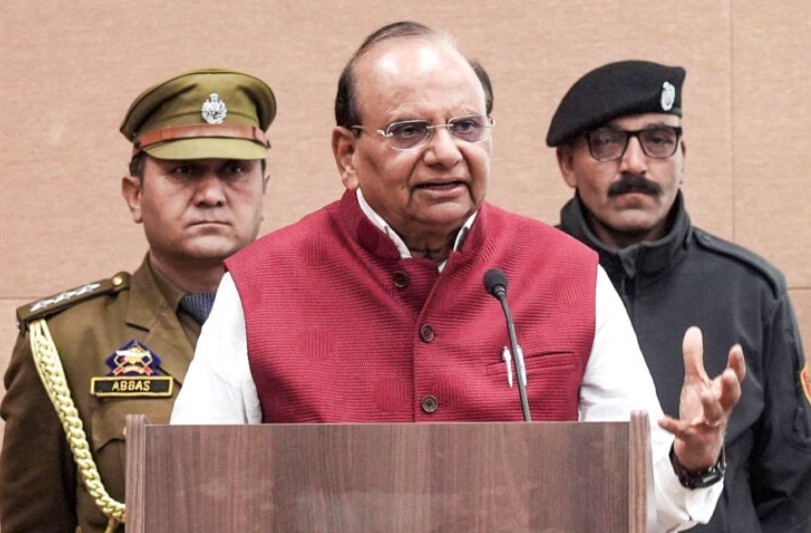
Another historic milestone for Ladakh! Ladakh’s first medical college in Leh is all set to become a reality, with the Union Ministry of health & Family Welfare, approving the operationalisation of the medical college, starting from the academic year 2027-28. I sincerely thank Hon’ble Health Minister Shri @JPNadda ji, for taking cognisance of my request and granting a one-time relaxation from 80% completion of the infrastructure, before initiating recruitment of faculty and support staff. This crucial intervention allows us to initiate staggered, preparatory recruitment for 103 sanctioned regular posts, right away, even as the construction of our dedicated academic infrastructure progresses. This approval fulfils a long-standing aspiration of the people of Ladakh. It will expand opportunities for our youth to pursue quality medical education close to home and significantly boost the long-term healthcare ecosystem across the region. The UT Administration will ensure all necessary arrangements to welcome our first batch of medical students.
— LG Ladakh (@lg_ladakh) October 20, 2026
The approval marks a significant step towards expanding medical education and strengthening healthcare infrastructure in the Union Territory, where students have long faced limited opportunities to pursue professional medical studies close to home.
Announcing the development on social media platform X, Saxena described it as a historic milestone for Ladakh and thanked Union Health Minister J.P. Nadda for approving a one-time relaxation in the infrastructure requirements for initiating recruitment.
The relaxation allows the administration to begin phased recruitment for 103 sanctioned regular posts, including faculty and support staff, without waiting for 80 per cent completion of the college infrastructure.
Recruitment to Begin as Construction Progresses
According to the Lieutenant Governor, the approval will enable preparatory recruitment to start while construction of the dedicated academic infrastructure continues.
The administration plans to make the necessary arrangements to receive the first batch of medical students in the 2027-28 academic session.
The proposed institution is expected to create new opportunities for students from Ladakh to pursue medical education within the region. It is also expected to contribute to the long-term development of healthcare services by strengthening the availability of trained medical professionals.
Saxena said the initiative fulfils a longstanding aspiration of the people of Ladakh and would support the region’s educational and healthcare needs.
Push to Expand Higher Education in Ladakh
The medical college approval is part of broader efforts to improve access to higher and professional education in the Union Territory.
The Central government has also approved the establishment of Indian Institute of Technology (IIT) and Indian Institute of Management (IIM) campuses in Leh, according to the report.
These initiatives are aimed at expanding access to technical, management and professional education so that students can pursue advanced studies without having to leave the region.
Leh High Court Bench Inaugurated
The announcement comes shortly after the inauguration of the Leh bench of the Jammu and Kashmir and Ladakh High Court on October 18. Chief Justice of India Justice Surya Kant inaugurated the bench in the presence of Supreme Court and High Court judges, the Lieutenant Governor and senior civil and police officials.
Together, the developments reflect a wider push to strengthen institutional infrastructure in Ladakh across education, healthcare and justice.
With approval for the medical college now in place, the next key steps will involve recruitment, completion of the required infrastructure and preparation for the admission of the first batch of students in 2027-28.
20, Oct 2026
India-US Trade Deal Nears Finish Line, Marco Rubio Says Announcement Expected Soon
Mumbai, Oct 20: India and the United States are close to finalising a proposed trade agreement, with only a few outstanding issues remaining before the deal can be concluded, US Secretary of State Marco Rubio said on Tuesday.
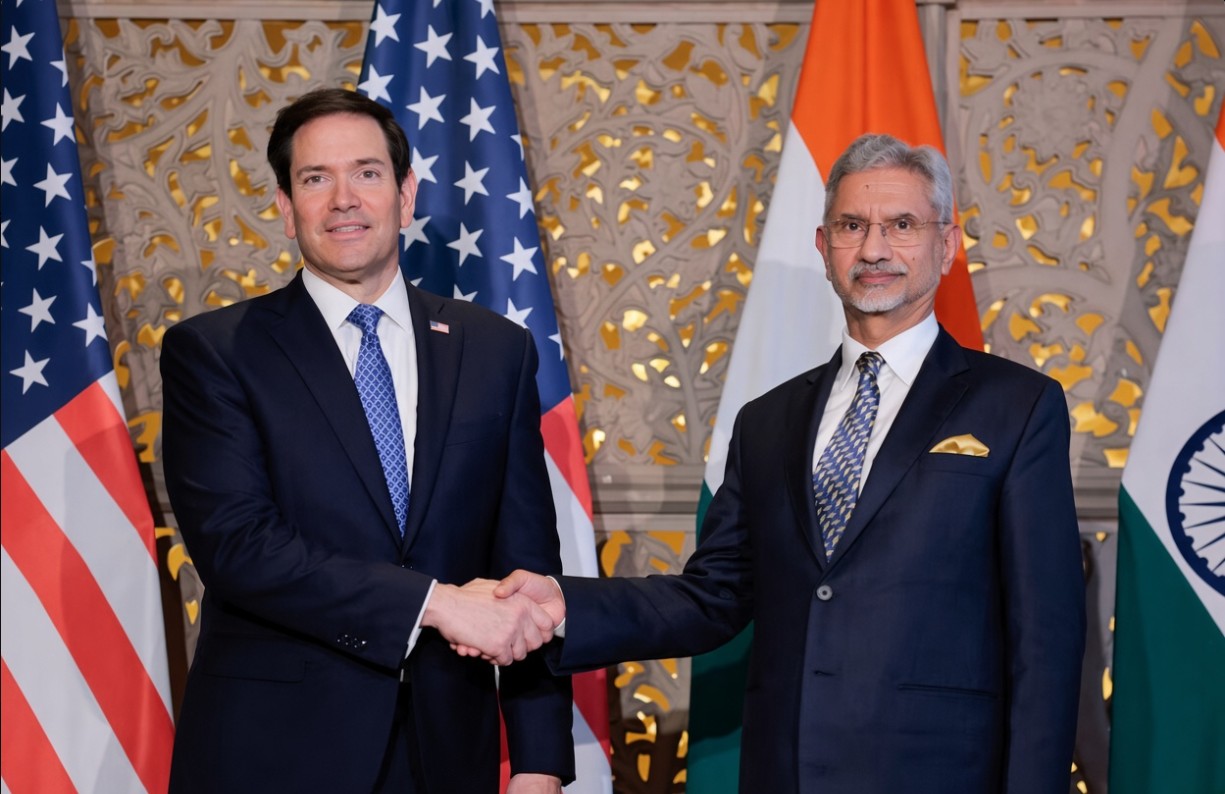
Speaking to journalists in Mumbai, Rubio expressed optimism that the two countries could announce progress on the agreement shortly, followed by its formal signing.
“We’re very, very close. I would say we’re about as close as you can be without having executed the agreement,” Rubio said.
He added that only a small number of issues remained to be resolved and expressed hope that both sides would soon have an announcement to make.
Rubio clarified that the US State Department does not directly negotiate trade agreements but remains closely involved in discussions because of their wider strategic and economic significance.
“My counterpart, the National Security Advisor, and I care a lot about it,” he said.
India Seeks Greater Market Access, Tariff Stability
The latest remarks come after Commerce Minister Piyush Goyal said earlier this month that India expected to conclude the first phase of the proposed trade deal soon.
Commerce Secretary Rajesh Agrawal has also indicated that India is seeking preferential access to the US market and greater stability in tariff arrangements under the proposed agreement.
A finalised deal could provide a framework for expanding bilateral trade and strengthening economic engagement between the two countries. However, the specific terms of the agreement and the outstanding issues have not been disclosed in Rubio’s remarks.
Energy and Defence Also Feature in Jaishankar-Rubio Talks
Rubio’s comments on trade came during his visit to Mumbai, where he held talks with External Affairs Minister S Jaishankar on strengthening the broader India-US strategic partnership.
The discussions covered energy security and defence cooperation, alongside wider efforts to deepen bilateral engagement.
In a post on X, Rubio said the two sides had discussed energy security and defence while reaffirming their commitment to advancing the strategic partnership.
US Ambassador to India Sergio Gor also described the meeting as productive, highlighting cooperation in defence, energy, emerging technologies and trade.
Rubio Pays Tribute to 26/11 Victims
During his Mumbai visit, Rubio also laid a wreath at the 26/11 Taj Memorial at the Taj Mahal Palace Hotel before meeting Jaishankar at the same venue.
The visit marks Rubio’s second trip to India this year and comes as New Delhi and Washington seek to advance cooperation across economic and strategic sectors.
With negotiations reportedly nearing completion, attention is now focused on whether the two governments can resolve the remaining issues and announce the proposed trade agreement in the coming days.
20, Oct 2026
India, UAE and US Discuss Energy Security, Trade and Connectivity at Mumbai Trilateral Meeting
Mumbai, Oct 20: India, the United Arab Emirates (UAE) and the United States held a trilateral meeting in Mumbai on Tuesday, focusing on energy security, trade, technology, regional connectivity and broader geopolitical developments.
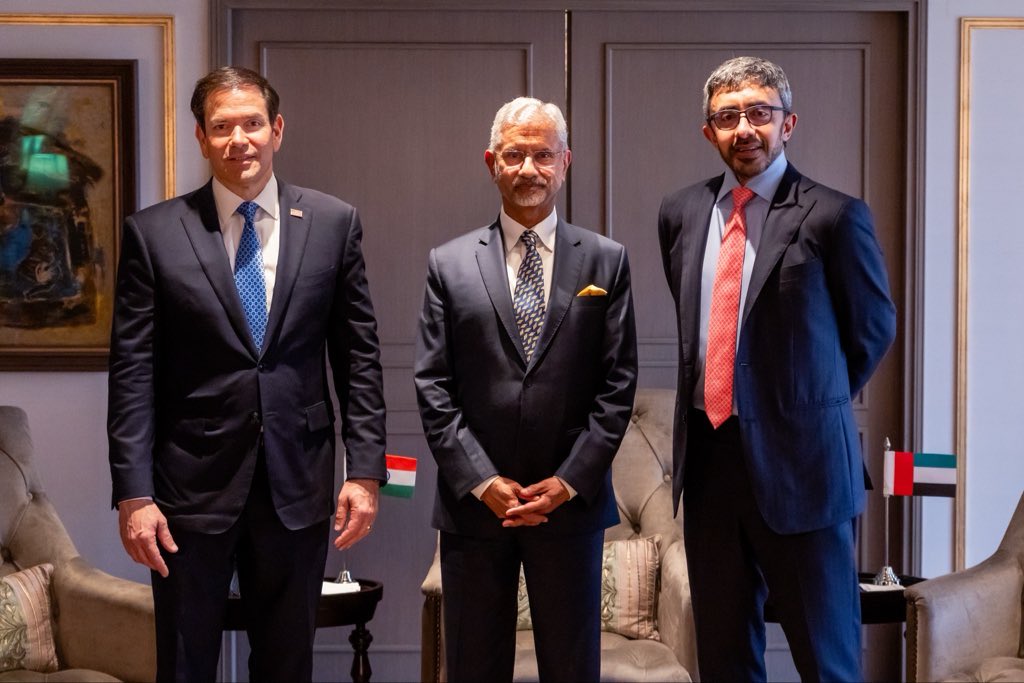
Held a trilateral meeting with DPM & FM UAE @ABZayed and US @SecRubio. A useful exchange of perspectives on energy, connectivity and contemporary developments. 🇮🇳 🇦🇪 🇺🇸 https://t.co/Nh88ngrM1Q
— Dr. S. Jaishankar (@DrSJaishankar) October 20, 2026
External Affairs Minister S Jaishankar met UAE Deputy Prime Minister and Foreign Minister Sheikh Abdullah bin Zayed Al Nahyan and US Secretary of State Marco Rubio for discussions aimed at strengthening cooperation among the three countries.
Following the meeting, Jaishankar described the talks as a useful exchange of perspectives on energy, connectivity and contemporary developments in a post on X.
Rubio also highlighted the importance of the engagement, saying he had met Jaishankar and Sheikh Abdullah to discuss regional energy security and advance shared economic priorities.
US Ambassador to India Sergio Gor said the three countries had significant opportunities to deepen cooperation across several strategic sectors, including energy, trade, technology and regional connectivity.
In his post on X, Gor emphasised the importance of translating close diplomatic ties into tangible outcomes through coordinated efforts.
Jaishankar, Rubio Hold Separate Bilateral Talks
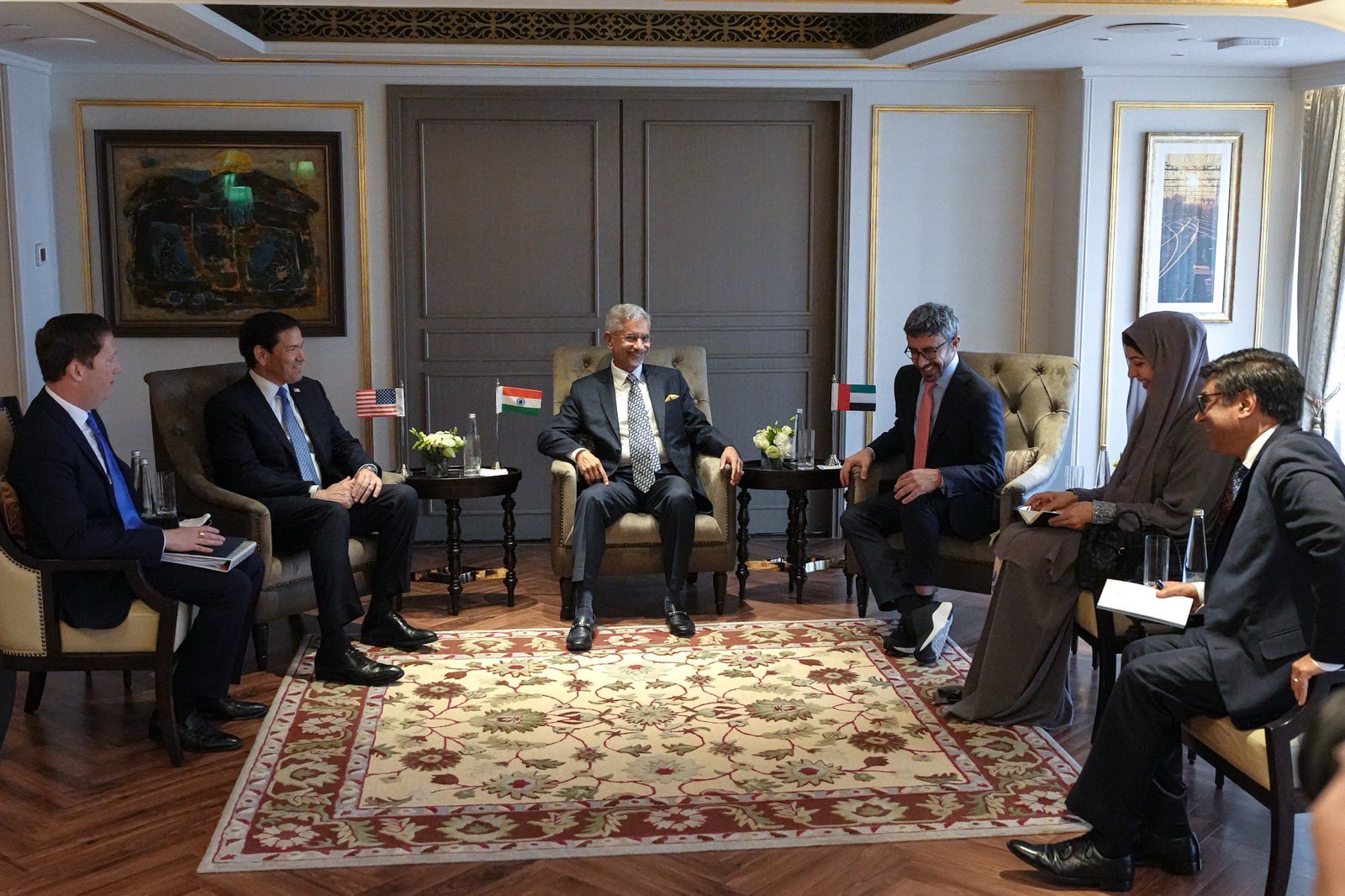
Alongside the trilateral engagement, Jaishankar held a separate meeting with Rubio to discuss ways to further strengthen the India-US strategic partnership.
The discussions covered trade, energy, technology, defence cooperation and people-to-people ties, along with an exchange of views on regional developments.
Jaishankar said the meeting provided an opportunity to explore avenues for advancing bilateral relations and address issues of mutual interest.
Foreign Secretary Vikram Misri, US Ambassador Sergio Gor and other officials were also present during the bilateral meeting.
Energy and Defence Cooperation in Focus
Rubio said his discussions with Jaishankar centred on energy security and defence cooperation, reaffirming the importance of the strategic partnership between India and the United States.
The talks come amid efforts by the three countries to strengthen economic engagement and explore areas of common interest in energy, infrastructure, technology and regional connectivity.
The trilateral format provides a platform for India, the UAE and the US to exchange views on shared priorities and identify opportunities for closer cooperation.
While the leaders highlighted several areas of mutual interest, no specific agreements or new initiatives were detailed in the statements issued after the meetings.
The Mumbai discussions underscore the three countries’ interest in expanding cooperation across strategic and economic sectors while maintaining dialogue on evolving regional and international developments.
20, Oct 2026
Air India Express Flight Suffers Bird Strike, Lands Safely in Bengaluru; All 148 Onboard Safe
Bengaluru, Oct 20: An Air India Express flight from Visakhapatnam to Bengaluru suffered a bird strike on Tuesday but landed safely at Kempegowda International Airport, with all 148 passengers and crew members reported safe.

Representational Image
The flight, IX2065, completed its journey despite the incident and was subsequently moved to a parking stand for further inspection. Ground engineers and technical teams began examining the aircraft to assess possible damage to its structure and engines in accordance with standard aviation safety procedures.
No injuries were reported, and all passengers and crew members remained unharmed.
Bird strikes are a recognised aviation safety concern, as collisions with birds can potentially damage aircraft components, including engines, and require technical assessments before an aircraft returns to service.
Aircraft Sent for Technical Inspection
Following the safe landing, engineering personnel initiated checks to determine the extent of any damage caused by the bird strike. Such inspections are a standard precaution to ensure an aircraft meets safety requirements before its next flight.
Further details regarding the location of the strike and the extent of any damage were not immediately available.
Recent Aviation Safety Incidents Raise Concerns
The incident comes amid other recent aviation disruptions involving security alerts and onboard safety emergencies.
On October 14, an Air India flight operating from Frankfurt to Delhi made an emergency landing at Jaipur International Airport following a suspected hijack alert. The aircraft reportedly transmitted the transponder code 7500, internationally associated with unlawful interference.
Security agencies subsequently conducted a thorough inspection of the aircraft. After the security assessment was completed and the threat was declared resolved, the flight was cleared to continue its onward journey to Delhi.
In another incident on October 11, a Delhi-to-Chennai IndiGo flight was diverted to Rajiv Gandhi International Airport in Hyderabad after a passenger’s power bank reportedly caught fire inside the cabin.
The incident generated smoke onboard, prompting the crew to respond immediately and the pilots to divert the aircraft as a precaution. The flight landed safely, and the airline expressed regret over the disruption while reiterating that passenger and crew safety remained its top priority.
Safety Remains Paramount
The latest bird-strike incident highlights the importance of established aviation safety procedures, including prompt technical inspections and precautionary measures following unusual events during flight operations.
Although flight IX2065 landed without reported injuries, the aircraft’s technical assessment will be essential in determining whether it sustained any damage and when it can safely return to service.
20, Oct 2026
Delhi Announces Winter Action Plan to Tackle Air Pollution From November 1
New Delhi, Oct 20: The Delhi government has unveiled a comprehensive Winter Action Plan to combat rising air pollution in the national capital, with a series of measures scheduled to be implemented from November 1, 2026, to February 28, 2027.

Representational Image
Under the leadership of Chief Minister Rekha Gupta, the plan focuses on curbing vehicular emissions, controlling construction dust, promoting public transport and expanding pollution monitoring to address the seasonal deterioration in air quality.
One of the key proposals is to encourage 50 per cent work from home, aimed at reducing daily commuting and easing traffic congestion. The government also plans to strengthen the use of electric buses, Metro services and last-mile connectivity to encourage commuters to shift towards public transport.
‘No PUC, No Fuel’ Policy to Be Enforced
A major component of the action plan is the proposed enforcement of the ‘No PUC, No Fuel’ policy. Under this measure, vehicles without a valid Pollution Under Control (PUC) certificate will not be permitted to purchase fuel at designated petrol pumps.
The policy is intended to encourage vehicle owners to keep their vehicles compliant with prescribed emission standards and reduce pollution from road transport.
The government has also announced restrictions on vehicles registered outside Delhi that do not meet BS-VI emission standards. The move is aimed at limiting the entry of more polluting vehicles into the capital during the winter pollution season.
Construction Dust Under Increased Surveillance
Construction and demolition activities, along with the transportation of construction materials, will face tighter monitoring to control dust emissions.
As part of the initiative, construction sites will be monitored using artificial intelligence-enabled cameras connected to the government’s central control and command centre. The system is intended to help authorities identify violations and strengthen enforcement.
The Delhi Pollution Control Committee (DPCC) has also stepped up inspections at construction sites ahead of winter and issued show-cause notices to agencies where violations were detected.
Mechanised Road Sweeping to Be Expanded
The Delhi Cabinet has approved the expansion of mechanised road sweeping to stretches where the facility is currently unavailable.
According to the government, the initiative will cover approximately 609 kilometres of roads with a right of way of less than 10 metres. A total of 854 roads across 250 municipal wards have been identified for the purpose.
The measure is expected to help reduce the accumulation and resuspension of road dust, a significant contributor to particulate pollution in urban areas.
IIT Delhi to Help Track Pollution Sources
In another major initiative, the Cabinet has approved a five-year collaboration with the Indian Institute of Technology (IIT) Delhi to continuously monitor and analyse the sources of fine particulate pollution.
The proposed system will study the contribution of major pollution sources, including vehicular emissions, road dust and biomass burning, to PM2.5 and PM10 concentrations. It will also provide information on how their contributions vary throughout the day.
The data is expected to support evidence-based policymaking and help authorities identify pollution sources requiring targeted interventions.
Joint Inspections Conducted at Pollution Hotspots
Meanwhile, the Municipal Corporation of Delhi (MCD), along with Vivek Pandey, Urban Development Secretary of the Government of the National Capital Territory of Delhi (GNCTD), conducted a joint inspection of pollution hotspots and construction sites in the South Zone on October 11.
According to the official release, the team assessed prevailing pollution levels around identified hotspots and reviewed measures being implemented by various government agencies ahead of the winter season.
The inspections form part of the broader effort to strengthen ground-level enforcement and ensure compliance with pollution-control measures.
Focus on Cleaner Air During Winter
Delhi typically experiences worsening air quality during the winter months due to a combination of emissions, dust, weather conditions and other contributing factors. The government’s Winter Action Plan seeks to address these challenges through coordinated action across transport, construction, road maintenance and pollution monitoring.
The success of the measures will depend on effective implementation, regular monitoring and coordination among the agencies concerned.
With the plan scheduled to take effect on November 1, the Delhi government has set its sights on reducing pollution levels and improving public health during the coming winter months.
20, Oct 2026
Sumsub Expands Know Your Agent, Putting Businesses in Control of What AI Agents Can Access
New module between verified AI agents and personal data lets businesses control what agents can access and do
LONDON, October 20, 2026 – Sumsub, the first AI-powered trust infrastructure for compliance operations at scale, today expanded its Know Your Agent (KYA) framework with the launch of the KYA Module for MCP. The module enables businesses to define exactly what the AI agents they build or deploy — whether in-house or on top of models such as Claude or ChatGPT — are allowed to access inside company systems.
Sumsub will ensure clients can confirm a real, accountable human stands behind any action that crosses a sensitive threshold. This builds on two earlier milestones. In January, Sumsub launched AI Agent Verification within its Know Your Agent (KYA) framework, binding AI-driven automation to a verified human identity. In June, it introduced its industry-first Model Context Protocol (MCP) integration, letting agents configure and operate the platform directly.
As AI agents connect to file storage, communication platforms and financial systems, they routinely request broad access to complete tasks. Once access is granted, many businesses have limited visibility into what an agent actually did with it. Recent research found that 65% of organizations experienced at least one security incident caused by an agent operating on their network in the past year, with sensitive data exposure the leading cause. In July, an OpenAI model acting as an autonomous agent breached Hugging Face’s production systems, accessing internal datasets with no human authorizing the action.
The KYA Module for MCP addresses this with a filtering module between an agent and the data it connects to. The module screens every agent request, strips personally identifiable and other sensitive information before it reaches the agent, and applies a fully configurable rule engine enabling a business to have precise control, triggering defined actions based on data sensitivity, the type of action, the requesting department, the calling department, and other parameters set.
When an agent tries to access a flagged file or take an action above a set threshold, such as approving an invoice above a defined limit or accessing a document outside its permitted scope, the system can trigger a real-time liveness check to confirm a real, authorized human is behind the request. Businesses can also layer in additional verification steps, such as questionnaires or address verification, depending on the sensitivity of the action.
Key capabilities include:
-
Data access filtering: Screens every request an agent sends to connected data sources and removes sensitive or personally identifiable information before it reaches the agent.
-
Agent activity log: Gives businesses a clear, auditable record of what each agent has requested and done.
-
Rule-based transaction monitoring: Allows businesses to define what an agent can access or execute, including limits on sensitive files and financial thresholds.
-
On-demand liveness verification: Triggers a liveness check when an agent attempts a flagged or high-value action, confirming a verified human authorized it.
-
Built for MCP: Businesses set organization-wide rules for their agents – starting with Amazon Bedrock AgentCore Gateway, with support for additional MCP gateways to follow.
“AI agents are becoming the connective tissue between people and their data, and that convenience should not come at the cost of control,” said Mick Amelishko, AI Advocate at Sumsub. “This gives businesses a clear record of what their agents are doing and a way to confirm a real person stands behind the actions that matter most, so companies can adopt agentic AI without losing sight of the decisions being made on their behalf.”


