


9, Oct 2026
BMW Golf Cup 2026 India winners set to represent the country at the World Final

Gurugram | Oct 09. BMW Group India today announced the winners of the 16th edition of the BMW Golf Cup 2026 final, held at DLF Golf and Country Club, Gurugram. Anish Bhujle – Category A and Vikas Mahajan – Category B emerged victorious in their respective handicap categories and will represent India at the BMW Golf Cup World Final scheduled to be held in South Africa in March 2027.
Mr. Hardeep Singh Brar, President & CEO, BMW Group India said, “The BMW Golf Cup is more than a celebration of sporting excellence, it is a powerful expression of performance, passion and the strength of the BMW community. This year, the tournament reached a new milestone, bringing together 2,300 amateur golfers from across India, with 40 exceptional players advancing to the national final. I congratulate our winners on this outstanding achievement. As they step onto the global stage to represent India at the World Final, they carry the pride and support of the entire BMW community. Through distinctive experiences such as the BMW Golf Cup, we continue to bring our customers together and create memorable moments that reflect the spirit of BMW.”
The national final brought together 40 leading amateur golfers who qualified through regional tournaments held at spectacular golf courses across Chennai, Hyderabad, Mumbai, Pune, Ahmedabad, Delhi, Vadodara, Jaipur, Bengaluru, Lucknow, Patna, Kolkata and Gurugram. This season attracted 2,300 participants, the finalist competed for national honours and the opportunity to represent India at the pinnacle of the BMW Golf Cup.
At the final, Anish Bhujle from Mumbai claimed the title in Category A for handicaps upto 12, while Vikas Mahajan from Muradabad won the Category B for handicaps 13-28. The two champions will form Team India at the BMW Golf Cup World Final, competing against leading amateur golfers from participating nations.
BMW Golf Cup, one of the world’s largest amateur golf tournament series can trace its roots back a quarter of a century to a British-based initiative that ran on its own for five years before going international. The tournament started as the BMW Invitation Tournament in UK. It has now developed into a global series with 1,000 qualifying tournaments involving 100,000 players in up to 40 countries. The best players from each nation qualify for the highlight, the BMW Golf Cup World Final, where the individual titles are contested in three categories.
The BMW Golf Cup 2026 has two categories, A (for handicaps up to 12) and B (for handicaps 13 – 28). The winners of the individual handicap categories qualify for the National Final. The winners in each of the two handicap categories in the National Final qualify to take part in the World Final of BMW Golf Cup.
- 0
- By Neel Achary

9, Oct 2026
Rising Digital Demand to Drive India’s Mobile Network Growth Through 2030
New Delhi, Oct 9: India’s mobile network traffic is expected to grow at an annual rate of 17 per cent between 2025 and 2030, supported by increasing smartphone usage, wider 5G adoption and growing demand for digital services, according to a report.
The rising use of mobile internet for video streaming, online gaming, digital payments and other online activities is expected to drive data consumption over the coming years.
As digital services become an increasingly important part of everyday life, telecom operators will need to expand network capacity and improve connectivity to meet the growing demand. The expansion of 5G services is also expected to support faster data speeds and more reliable connections.
The growth in mobile traffic is likely to create new opportunities for India’s telecommunications industry, encouraging investment in network infrastructure and advanced technologies.
At the same time, telecom companies will need to focus on improving service quality, managing network congestion and keeping mobile data services affordable for consumers.
The expected increase in mobile network traffic highlights the growing importance of digital connectivity in India’s economy. Continued investment in reliable telecommunications infrastructure will be essential to support businesses, consumers and the country’s expanding digital ecosystem.
9, Oct 2026
1,200 Children to Take the Field at Mobile Creches’ Annual Sports Meet in Delhi
New Delhi, Oct 09, 2026: The children of the people who build our cities, grow our food and keep communities running will take centre stage this Sunday as Mobile Creches hosts its Annual Sports Meet – “Kheltey Raho, Khiltey Raho” at the Thyagaraj Sports Complex, New Delhi.
Around 1,200 children from 50 Mobile Creches centres will participate in the sporting event on October 11, turning the track into a field of running, cheering, competing and celebration. The event will be joined by Pooja Dhanda, Indian wrestler, 2018 Commonwealth Games silver medallist and 2019 Arjuna Award recipient, as the Chief Guest. The event will also include an award distribution ceremony.
For Mobile Creches, the sports meet is more than a sporting event. It reflects a larger belief that every child deserves the right to play, learn, grow and be celebrated — irrespective of where their parents work or where their family lives.
Across India, construction workers raise buildings and infrastructure, families working in brick kilns make the bricks that shape our cities, and tea garden workers help put tea on tables across the country. Their children often grow up alongside these workplaces, with families moving in search of work or living in communities where access to quality childcare and early learning can be limited.
For more than five decades, Mobile Creches has worked to address this gap by taking childcare to where families live and work.
Founded in 1969, the organisation runs creches and learning centres across construction sites, urban settlements, brick kilns, tea gardens and rural and tribal communities, providing daycare, early learning, nutrition and health support close to children’s homes and their parents’ workplaces.
The organisation currently works across 17 states through more than 5,000 childcare centres and has reached over one million children, while training more than 20,000 care workers who form the backbone of its early childhood programmes.
From a creche to the sports field
The Annual Sports Meet brings this everyday work into focus.
At Mobile Creches centres, play is treated not as a reward, but as an essential part of childhood. Through play and early learning, children develop physical strength, confidence, social skills and a sense of belonging.
“Play is not a reward for children who have everything. It is how every child learns to trust, to try and to belong, For children from the communities we work with, this sports meet is the day the country turns around and says: we see you.” said Sumita Mishra, CEO, Mobile Creches.
The sports meet is an opportunity to see that belief in action — children lining up at the starting line, running their races, cheering for friends, experiencing the excitement of competition and celebrating each other’s achievements.
The programme will begin with an Indian Map formation and National Anthem, followed by a Torch Lighting Ceremony. Sporting activities will then take place across the track, with children participating age-wise.
Pooja Dhanda, whose own journey in wrestling has taken her to the international sporting arena, will join the children as Chief Guest. Her presence will add another dimension to the day’s message — that talent can come from every corner, and opportunity can help it find its field.
A celebration of the circle around every child
Mobile Creches believes that no child grows alone. Around every child is a circle of care — parents and families, the didis and care workers at the creches, communities, employers and developers who enable childcare spaces at worksites, and partners who support the organisation’s work.
The Annual Sports Meet brings this circle together on one field.
For one day, the children of families who spend their days building, growing and powering the country will not be on the sidelines. They will take the field, compete, cheer, laugh and be applauded.
And that, for Mobile Creches, is the spirit of “Kheltey Raho, Khiltey Raho” — because every child deserves the chance to play, compete and be cheered.
9, Oct 2026
Harness Acquires Augment Code, Advancing the Autonomous SDLC from Idea to Production
Oct 09, 2026: Harness, the Autonomous SDLC PlatformTM company, today announced that it has acquired select Augment Code assets, including Cosmos and the Auggie CLI products, the Code Context Engine, and related technology. The team behind these products will join Harness, accelerating its work to make the entire software development lifecycle increasingly autonomous.
Cosmos will become Harness Cosmos Software Factory Agent, with a clear role: automate engineering work from idea to code. From there, Harness‘s existing agents for software delivery, security testing, runtime protection, and cost management take over, carrying the work into production and operations, creating a seamless agent to agent experience.
Connecting Augment’s Code Context Engine with Harness’s Software Delivery Knowledge Graph provides insights across the full SDLC — what’s being built, and what happens to it once it ships. Harness is bringing codebase understanding together with delivery context, so Harness Cosmos can make better-informed changes upfront, and Harness agents can use downstream findings to correct and verify them.
“AI’s impact on software will not be measured by how much code it generates, but by how much valuable software reaches customers,” said Jyoti Bansal, founder and CEO of Harness. “Augment Code built Cosmos to create a software factory for repeatable engineering work. With this acquisition, we are bringing code context together with delivery and production context to help agents make better changes from the start. When Harness downstream agents identify an issue while testing, securing, or deploying code, they send it back to Cosmos with the context to fix it.”
“We set out to bring AI to the entire software development lifecycle, starting with context-aware coding,” said Igor Ostrovsky, co-founder and CTO of Augment Code. “Joining Harness is the next step toward that vision. Together, we can make engineering work increasingly autonomous, with engineers stepping in only where judgment really matters. We’ve seen software factories transform how companies build software. Now, with Harness, that same transformation is within reach for every team already on the Harness platform — and every team getting started.”
Introducing the Harness Cosmos Software Factory Agent
Harness Cosmos takes engineering work from idea to merge-ready code. When a requirement is written, a ticket is assigned, or a bug is reported, a fleet of Cosmos agents plans the change, writes the code and tests, and opens a pull request. Each agent works in its own isolated VM and pulls in an engineer only where judgment is needed, like approving a design or making the final merge.
Cosmos agents run as a continuous loop through ticket, code, and review. When a reviewer comments or a check fails, an agent fixes the issue on the same pull request. Teams can fork prebuilt Experts like Project Builder, PR Author, Deep Reviewer, and PR Fixer, tune each one to their own codebase, and deploy it organization-wide.
Augment’s Code Context Engine keeps a live map of the codebase, so changes fit the code already there. Model routing matches each task to the right model, and built-in integrations connect to GitHub, Jira, and Slack. Shared memory carries lessons from each review into the next change, and versioning and budget controls let teams run autonomous coding across the entire engineering organization.
What leaves the factory is a reviewed pull request, ready for Harness agents to test, secure, and deploy.
Shared context from code to production
Harness’s Software Delivery Knowledge Graph connects delivery and operational information, including builds, deployments, infrastructure, security, and costs. Augment’s Code Context Engine brings that same specificity to the code itself.
Before a change is written, Harness Cosmos will pull together the delivery context that should shape it: test cases, security requirements, past incidents and their remediations. Once that change exists, Harness‘s downstream agents will use codebase context to reason about dependencies, risk, and what validation it needs. If something fails, the agents can loop until resolution.
Extending the Harness Autonomous SDLC Platform
Harness Cosmos joins the Harness platform, automating engineering work from idea to code. No matter how that code is written, the Harness platform already takes it the rest of the way:
- Software Delivery Agent moves changes safely to production
- Security Testing Agent finds and fixes risk before production
- Runtime Protection Agent protects applications, APIs, and AI in production
- Cost Management Agent controls and optimizes cloud and AI costs
The integration vision focuses on connecting Harness Cosmos workflows with the policies, permissions, and approvals that already govern the Harness platform, bringing the same discipline to creating a change that enterprises already expect when releasing one.
Availability
Harness Cosmos is now available. To learn more, read the announcement blog post, visit the website, or get started now.
8, Oct 2026
nurture.retail Decodes Ag-Tech’s Next Phase: Shifts Paradigm from Channel ‘Disruption’ to ‘Co-Creation’ for Agri-Manufacturers and Retailers
National, October 8, 2026: As India’s agri-tech ecosystem moves beyond the hyper-growth phase into an era of sustainable execution, nurture.retail was built by UPL Sustainable Agri Solutions as a digitally enabled B2B distribution platform. It is pioneering an Ag-Tech Model designed explicitly for brands, manufacturers, and agri-retailers where it aims to create a sustainable model creating value through complementation, not competition with the conventional channel, while helping brands grow to their potential.
nurture.retail has over 1,15,000 registered agri-retailers, many high-quality manufacturers and brands which distribute exclusive products through the platform, and key NBFC partners offering credit to small retailers, who are onboarded with the platform. nurture.retail went through the same learning curve before realizing that agri-input distribution requires co-existence and co-creation, not disruption!
It offers a tailored suite of B2B capabilities built to help manufacturers scale without sacrificing brand control, while resolving historic market distortions.
For manufacturers, this can mean:
1. Direct linkage with retailers – enabling manufacturers to establish a direct relationship with retail partners
2. Brand protection as the #1 priority – ensuring that products are not listed or sold by unauthorized sources
3. Greater control over pricing – manufacturers retain control over pricing decisions, rather than the platform determining the selling price
4. Granular geographic control – brand partners can decide which products to sell in specific geographies, with the ability to control availability down to the PIN-code level
5. Complete sales data access: Manufacturers get full access to their sales data and actionable insights, enabling better visibility into demand, performance, and market trends
Traditionally the distribution networks typically reach maximum 20% of India’s 400,000+ agri-retailers, often leaving extended product portfolios unrepresented. nurture.retail functions as a powerful complement rather than a substitute for traditional channels.
“A more sustainable model is one where we create value through complementation, not competition with the conventional channel, while helping brands grow to potential. At nurture.retail, we are helping expand access to agri-retailers in a phased manner, creating a compelling complementary channel through which brands and manufacturers can extend their reach” said Ravishankar Cherukuri, CEO, UPL Sustainable Agri Solutions (nurture.retail)
nurture.retail provides direct ordering access to authentic manufacturer products, transparent pricing without complex rebate structures, reliable door-step delivery, and integrated credit options for small and medium agri-retailers.
With AI and improving mobile internet, we believe there are endless possibilities to help retailers and farmers. Algorithmic recommendations based on hyperlocal purchase patterns, weather data and satellite monitoring can help get the right products to the right places. Strong direct to farmer engagement can help the best retailers serve farmers better than ever.
The future of ag-tech, especially ag-input distribution tech is indeed very bright. Key to success is collaboration and co-creation, abandoning notions of disruption.
8, Oct 2026
TVS MOTOR COMPANY TAKES ITS GLOBAL MOTORCYCLE JOURNEY TO EUROPE WITH TRIC DEBUT AT MISANO
Chandigarh, October 8, 2026:TVS Motor Company (TVSM), the world’s third-largest two-wheeler manufacturer and a global leader in three-wheeler manufacturing, strengthened its global motorcycle ambition with the European debut of 2026 TVS Racing International Championship (TRIC) at the iconic Misano World Circuit in Misano Adriatico, Italy. Held from October 2-4, 2026, the Italy round marked a significant new chapter in TVS Motor’s International journey, bringing its racing heritage, engineering capabilities and performance-led philosophy to one of the world’s established motorcycle ecosystems.
The Italy round featured 14 fastest racers representing 12 nationalities across 4 continents, competing on the TRIC race-spec TVS Apache RR 310. The European debut of TRIC marks another significant step in this journey, reflecting the growing importance of Europe in TVS Motor’s global expansion. With a growing presence across 90+ international markets, TVS Motor Company is strengthening its position as a global motorcycle brand by steadily expanding its product innovation, premiumisation, advanced engineering and global expertise.
TRIC has progressively evolved and held across key international markets including Malaysia, Thailand, Japan and Indonesia, spanning 4 countries and 5 rounds. With the addition of Italy, TRIC now extends its racing footprint into Europe, bringing together global racing talent on a common platform. The championship provided the riders an opportunity to compete against diverse international racers, challenging their skills and showcasing their racing capabilities.
Speaking at the occasion, Mr. Vimal Sumbly, Head – Premium Business, TVS Motor Company, said, “The European debut of the TVS Racing International Championship is a defining milestone in our global racing journey. What began in 2022 as an Asia-focused championship with riders from nine countries has now evolved into a truly global platform with riders from 16 countries. Taking an Indian-origin championship to Europe reflects the strength of our racing pedigree, engineering and our ambition to compete on the world stage. This is ‘Track to Road’ in action taking our racing expertise from India to the world.”
Mr. Ron Hogg, Promotions Director of Two Wheels Motor Racing (TWMR),said, “The expansion of TRIC into Europe marks an exciting development for the championship and reflects the growing international role of the platform. It brings together racers from diverse nationalities, creating a strong competitive environment for riders to challenge themselves against different racing styles, techniques and approaches to championships. This platform gives the racers an opportunity to push their limits, learn from their competition and elevate their performance on an international stage. Our partnership with TVS Racing has always been driven by the ambition to create meaningful racing experiences for riders while taking the championship to new territories and continuously raising the level of competition. We are sure the experience the riders and the team members gathered here in Misano World Circuit will be invaluable for their future also for FIM Asia Road Racing Championship.”
Mr. Simone Folgori, Sporting Director of the Federazione Motociclistica Italiana (FMI), said, “We are pleased to welcome the TVS Racing International Championship to Italy and to see an Indian-origin racing championship make its European debut at Misano. Italy has a strong connection with motorcycle racing, and hosting an international field of racers adds an exciting international dimension to the event. We are delighted to see Misano host this new section for TRIC, allowing participants to compete in a new and highly competitive ecosystem. We look forward to witnessing the energy and competitiveness that this international circuit will bring to the event.”
The globalisation of TVS Racing is part of the broader international growth of TVS Motor’s two-wheeler portfolio. As TVS Racing extends TRIC into new markets, this international growth is mirrored by the expanding footprint of the TVS Apache series, which has surpassed 7 million customers worldwide. Further strengthening this ecosystem is the TVS Apache Owners Group (AOG), a community of more than 500,000 members united by their passion for performance, adventure and camaraderie. The Italy round builds on this momentum, bringing TVS Motor Company’s racing heritage to one of Europe’s most established motorsport regions.
TRIC Race-Optimized TVS Apache RR 310
In 2023, the race-spec TVS Apache RR 310 set a top-speed record of 215.9 kmph and a lap record of 1:49:74 at Thailand’s Chang International Circuit. In 2024, it raised the bar further, achieving a top speed of 216 kmph and setting a new lap record of 1:48:44 at the same circuit, along with a lap time of 2:20:80 at Malaysia’s Sepang International Circuit. The race-spec bike features enhanced aero package, increased power, and refined riding dynamics, bringing its latest performance, technology and design enhancements to riders and strengthening the experience that has defined the brand for more than 20 years.
8, Oct 2026
India’s Wind Energy Sector Set for Strong Growth, Capacity Additions Seen Rising to 13.2 GW by FY31
New Delhi, Oct 8: India’s wind energy sector is poised for a strong expansion over the next five years, with annual capacity additions projected to reach around 8 GW in FY2026-27 and rise steadily to 13.2 GW by FY2030-31.
The expected acceleration reflects the country’s growing focus on renewable energy, rising electricity demand and efforts to build a more secure and sustainable power system. Wind power is increasingly emerging as a key complement to solar energy, helping India diversify its renewable-energy mix.
India’s wind industry has already entered a higher-growth phase. The country added a record 6.05 GW of wind capacity during FY2025-26, taking total installed wind capacity to more than 59 GW.
Wind Power Gains Strategic Importance
The growing pace of wind installations is significant for India’s energy transition. While solar power is largely dependent on daylight hours, wind generation can complement solar output by producing electricity at different times.
This makes wind-solar hybrid projects increasingly attractive and could help improve the reliability and utilisation of renewable power infrastructure.
India is targeting 100 GW of installed wind capacity by 2030, making sustained growth in annual installations important for achieving its long-term renewable-energy ambitions.
Strong Project Pipeline Supports Outlook
The sector has a sizeable pipeline of projects that could support the expected increase in capacity additions. More than 28 GW of wind projects were under implementation, providing a foundation for future growth.
Faster project execution, improved transmission availability and rising demand for clean electricity are expected to remain important drivers.
Policy support for renewable-energy procurement and continued investment in clean-power infrastructure are also creating a more favourable environment for wind developers and equipment manufacturers.
Growth Could Boost Manufacturing and Jobs
The expansion of wind power is expected to generate opportunities well beyond electricity generation.
Higher installations will increase demand for wind turbines, blades, towers, generators, gearboxes, electrical equipment and engineering services. Construction, transportation, project development and operations and maintenance activities are also likely to benefit.
India’s established domestic wind-manufacturing capabilities provide an additional advantage. As demand increases, strengthening local supply chains could support manufacturing investment, skilled employment and potentially greater export opportunities.
The wind sector could therefore become an important contributor to both India’s clean-energy transition and industrial growth.
Gujarat, Tamil Nadu and Karnataka Continue to Lead
Wind development remains concentrated in states with strong wind resources and established renewable-energy ecosystems.
Gujarat, Tamil Nadu and Karnataka continue to be among the country’s leading wind-power markets. Their experience in project development, grid connectivity and renewable-energy infrastructure provides a strong base for further expansion.
At the same time, the industry is exploring opportunities in other states and in emerging areas such as offshore wind, which could eventually provide another source of large-scale renewable electricity.
Transmission and Storage Key to Future Growth
The rapid expansion of renewable power also highlights the importance of transmission infrastructure.
Wind and solar projects are often located far from major electricity-consuming centres. Strengthening transmission networks will therefore be essential to move renewable electricity efficiently from generation sites to areas of high demand.
Energy storage will also become increasingly important as the share of variable renewable power rises. Battery storage and other technologies can help balance fluctuations in generation and provide electricity when renewable output is lower.
Wind Energy to Play a Bigger Role in India’s Future
The projected rise in annual wind additions from around 8 GW in FY2026-27 to 13.2 GW by FY2030-31 marks a significant opportunity for India’s renewable-energy industry.
Realising this potential will require continued investment, timely project approvals, adequate transmission capacity, access to finance and a reliable domestic supply chain.
The opportunity, however, goes beyond installing more turbines. A stronger wind industry can contribute to energy security, lower dependence on fossil fuels, industrial investment, employment and India’s long-term decarbonisation goals.
As India works towards a larger non-fossil-fuel power base, wind energy is expected to become an increasingly important part of the country’s electricity system.
The coming years could mark a decisive phase for India’s wind industry — turning rising renewable-energy demand into new investment, manufacturing activity and a stronger foundation for the country’s clean-energy future.
8, Oct 2026
Birla Opus Paints Celebrates the Family Bonds That Bring Us Home This Durga Pujo

Mumbai, 8th October 2026: Birla Opus Paints, housed under Aditya Birla Group’s Grasim Industries, has unveiled its new Durga Pujo campaign. Inspired by the brand’s philosophy of Duniya Ko Rang Do, the film beautifully portrays how festive traditions foster a sense of belonging towards family and culture and thereby tie us back to our roots.
The film revolves around a young girl visiting India after a long time, who is reluctant to join in her family’s Pujo celebrations. As the house comes alive with preparations, her family gently draws her into the festivities, encouraging her to create alpona, taste homemade nadu, play with her cousins and experience the traditions around her. What begins as an unfamiliar celebration gradually becomes one filled with laughter, connection and new memories, rediscovering the warmth of home and family, leaving her already looking forward to returning the following year.
Through her journey, the film captures how festivities and celebrations can turn unfamiliar faces into familiar ones and shared traditions into cherished memories. It reinforces Birla Opus Paints’ belief that while colours can transform spaces, it is the people and memories within them that truly make a house feel like home.
Inderpreet Singh, Head – Marketing, Birla Opus Paints, said, “Through this festive campaign, we wanted to capture how celebrations bring people closer and create a sense of belonging across generations. The film celebrates that emotion, reminding us that while homes may evolve over time, the memories, traditions, and relationships that colour them remain timeless.”
Sachin Kamble, Chief Creative Officer, Leo India, said, “Durga Pujo is an emotion, not just a festival, and deserves to be celebrated beyond familiar rituals and imagery. Through our film, we wanted to capture the beauty of passing on our roots through little gestures that make traditions their own. Because culture truly lives on when the next generation embraces it and carries it forward in their own way, with colour becoming a beautiful expression of that belonging.”
Conceptualised by Leo India, the campaign celebrates the emotional significance of Durga Pujo and the role of homes in bringing families together. The film will be available across digital and social media platforms.
Link of the video: Birla Opus Paints | Togetherness Is the True Colour of Pujo | Durga Pujo | Bengali
Client: Birla Opus Paints
Creative Agency: Leo India
Production House: SVF Entertainment Private Limited
8, Oct 2026
UP Rise 2026: Bridging Students with Industry, Government, and Entrepreneurship
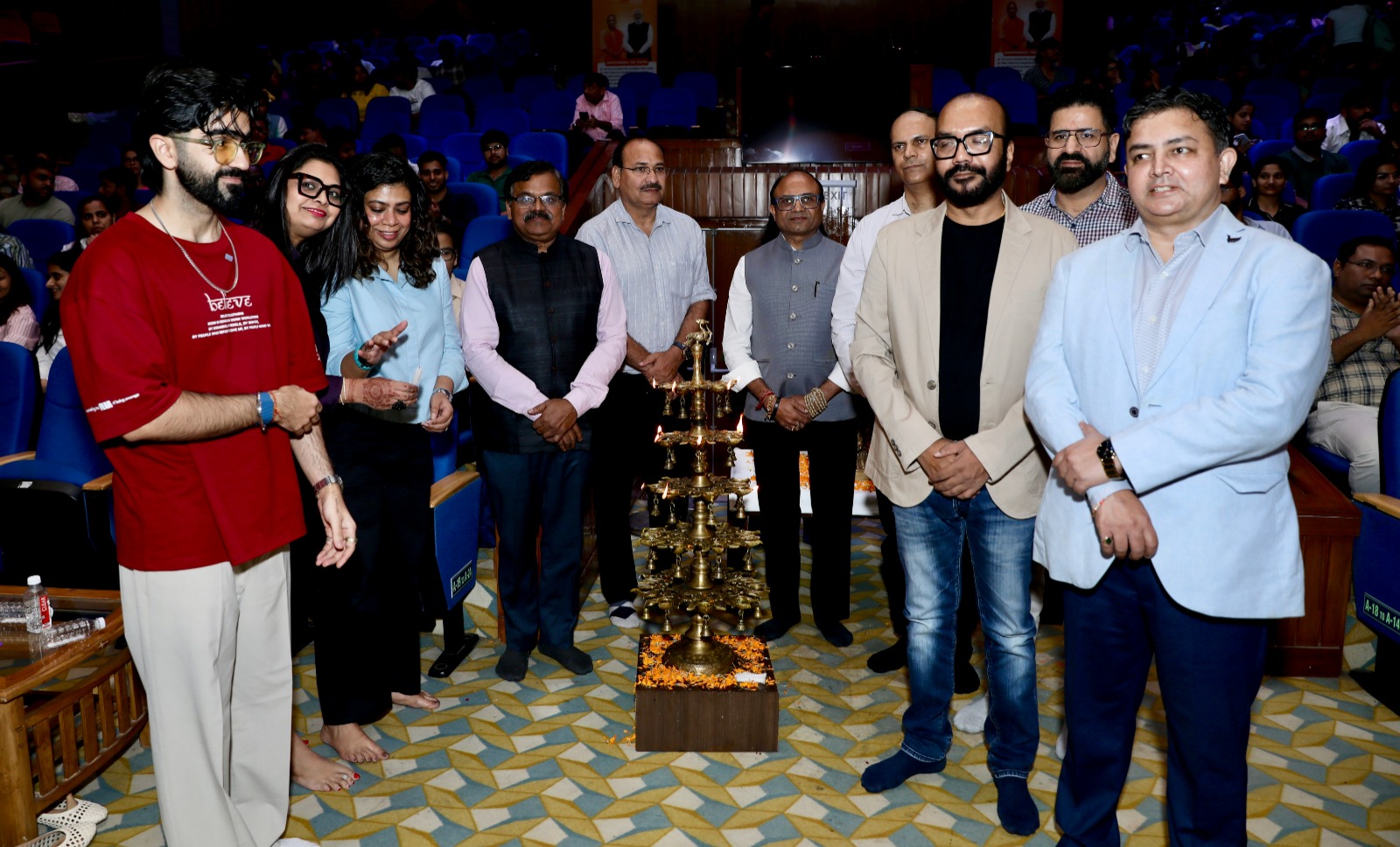
Greater Noida, Oct 08: Sharda University successfully organized ‘UP Rise 2026’, an initiative of the Government of Uttar Pradesh aimed at connecting students with the industrial sector, government opportunities, entrepreneurship, and rapidly emerging career paths. The programme was part of a statewide movement across 30 institutes in Uttar Pradesh, collectively reaching over 700 million people, making it one of the largest student‑industry‑government engagement drives in the state.
The initiative provided students with a comprehensive ecosystem to interact with industry leaders, government scheme facilitators, and entrepreneurial mentors. It sought to foster skills, innovation, entrepreneurship, and employability‑oriented mindsets, preparing youth to be self‑reliant and future‑ready. Students participated in live pitch sessions, industry case challenges, and interactive dialogues with corporate recruiters and mentors, while also availing on‑the‑spot registration for government schemes such as CM Yuva Yojana, PMKVY, Mission Shakti, ODOP, and ODOC.
In his keynote address, Chief Guest Paritosh Anand remarked: “UP Rise 2026 is more than an event—it is a movement of ideas, ambition, and courage. It gives young minds the chance to tell their stories, showcase their creativity, and connect with opportunities that can turn dreams into reality. By engaging with industry leaders, government facilitators, and mentors, students discover that the future is not something to wait for—it is something they can build today. This initiative reflects the power of youth to inspire change, create businesses that matter, and lead India into a new era of innovation and self‑reliance.”
Dr. Sibaram Khara, Vice-Chancellor of Sharda University, welcomed the chief guest and other dignitaries. He noted that the country possesses a vast youth population brimming with energy and innovative thinking. Under the leadership of the state government, the youth are gaining direction and new opportunities—an impact that will become evident in the near future. He added that Uttar Pradesh is steadily advancing in new sectors, and the participation of the youth plays a crucial role in this progress.
Adding to the perspectives, Dr. Amit Sehgal, Director of Sharda University Launchpad, highlighted: “A key attraction of UP Rise 2026 was the ‘Industry Case Challenges,’ which gave students the opportunity to solve real‑world business and social problems. These challenges sharpened their problem‑solving, analytical thinking, innovation, and teamwork skills, while bridging academic learning with workplace realities.”
He further said, “The enthusiasm and participation of students demonstrated their readiness to embrace new opportunities. UP Rise 2026 showcased Uttar Pradesh’s potential to become a hub of innovation, entrepreneurship, and talent development.”
The event concluded with resounding appreciation from participants and stakeholders, positioning UP Rise 2026 as a landmark initiative in fostering innovation, career readiness, and student empowerment across the state.
8, Oct 2026
Jan-Sep 2026 investments in Indian real estate touch USD 5.9 Bn, highest 9-month volume in recent years: Colliers India
Gurgaon, 08th October 2026: Institutional investments in Indian real estate remained strong during the first three quarters of 2026, with capital inflows reaching USD 5.9 billion, reflecting a 39% Year-on-Year (YoY) growth. This marks the highest 9-month investment volume in recent years, underscoring the continued investor optimism in India’s real estate sector. This optimism is more significant as Indian real estate has largely remained resilient to external volatilities, despite bleak global economic outlook and caution towards capital allocation in markets around the world.
Domestic investors remained the dominant source of capital during the nine-month period, contributing USD 3.5 billion and accounting close to 60% of the total investments during the period. A strong 59% YoY increase in domestic capital inflows highlights the depth and maturity of core real estate asset classes in India. At the same time, foreign investments also recorded a notable growth during the first three quarters of 2026, rising 17% YoY to about USD 2.4 billion. A significant share of foreign capital was directed towards developmental assets, driven by investors’ ongoing pursuit of long-term value creation in alternative, hospitality and mixed-use projects.
During Q3 2026, institutional capital inflows stood at USD 1.4 billion, a 12% YoY increase, albeit witnessing a 51% drop on a sequential basis.
“The strengthening of domestic capital is perhaps the most defining theme of institutional investments in Indian real estate. In Q3 2026, domestic investors drove about USD 0.9 billion inflows, accounting for nearly two-thirds of the total investments. Local investors continue to prefer core assets, with residential & office segments collectively accounting for 46% of the domestic capital allocation during the quarter. While residential investments were largely directed towards developmental projects, office investments were primarily focused on operational assets. Looking ahead, with evolving preferences across the risk-return spectrum, growing depth in domestic capital is expected to drive real estate investments in India, along with an uptick in foreign investment volumes in upcoming quarters,” said Badal Yagnik, Chief Executive Officer and Managing Director, Colliers India.
Trends in institutional investment inflows (USD million) –
|
Asset Class |
Q3 2025 |
Q2 2026 |
Q3 2026 |
Q3 2026 vs Q3 2025 (% YoY Change) |
Q3 2026 vs Q2 2026 (% QoQ change) |
YTD 2025 (Jan-Sep 2025) |
YTD 2026 (Jan–Sep 2026) |
YTD 2026 vs YTD 2025 (%YoY change) |
|
Office |
779.9 |
1056.9 |
291.3 |
-63% |
-72% |
1,482.7 |
2,169.3 |
46% |
|
Residential |
319.7 |
146.1 |
224.1 |
-30% |
53% |
1,139.7 |
694.5 |
-39% |
|
Industrial & Warehousing |
17.0 |
84.5 |
180.5 |
962% |
114% |
324.7 |
371.9 |
15% |
|
Retail |
– |
37.5 |
– |
*NA |
-100% |
380.0 |
85.2 |
-78% |
|
Hospitality |
– |
108.8 |
352.6 |
*NA |
224% |
88.2 |
632.2 |
617% |
|
Alternate assets1 |
73.5 |
635.0 |
200.2 |
172% |
-68% |
144.5 |
968.2 |
570% |
|
Mixed use2 |
79.4 |
806.7 |
167.6 |
111% |
-79% |
707.8 |
1,007.0 |
42% |
|
Total |
1,269.5 |
2,875.5 |
1,416.3 |
12% |
-51% |
4,267.6 |
5,928.3 |
39% |
Note: 1-Alternative assets include data centers, life sciences, senior housing, holiday homes, student housing, schools, real estate services etc.
*NA-Not applicable: Investment inflows were limited for Retail in Q3 2025 and in Q3 2026; and for hospitality assets in Q3 2025; 2-Includes investments in mixed-use projects as well as deals involving investments across multiple assets in various locations
The institutional flow of funds include investments by Alternative Investment Funds (AIFs), family offices, foreign corporate groups, foreign banks, pension funds, private equity, real estate funds & platforms, foreign-funded NBFCs, listed REITs and sovereign wealth funds. The data has been compiled as per available information in the public domain.
Office segment dominates with 37% share; hospitality & alternative assets see multi-fold growth
During the first three quarters of 2026, office segment attracted USD 2.2 billion in capital inflows, witnessing a 46% YoY rise. Domestic investors played a pivotal role, contributing more than 90% of the institutional inflows in the segment during the same period. Sustained leasing momentum across high-quality Grade A office assets and long-term demand prospects continue to reinforce the segment’s attractiveness amongst investors. While office assets remained the major driver of real estate investments, accounting for 37% share during the nine-month period, mixed-use & alternative assets followed, with each of them corresponding to a share of 16-17%.
Interestingly, alternative & hospitality segments have been one of the best performing segments in 2026 so far. During the nine-month period, alternative & hospitality assets garnered over USD 0.9 billion & USD 0.6 billion investments respectively, individually rising 6-7X times compared to the corresponding period of 2025. Strong foreign investor interest underpinned both segments, with overseas capital accounting for nearly three-fourths of alternative asset investments and almost the entirety of hospitality inflows during the period.
“Investor participation remained broad-based across real asset classes, albeit slightly more skewed on account of a marquee transaction in hospitality segment. All three core segments – office, residential and industrial & warehousing witnessed around USD 0.2-0.3 billion inflows each during Q3 2026. These three segments collectively accounted for nearly half of the quarterly investments led by domestic investors. Most importantly, buoyed by strong capital allocation across real estate segments, the first nine months of 2026 have already seen institutional investments to the tune of USD 5.9 billion, a 9-month high in recent years. This reiterates the confidence of investors in Indian real estate, even in the wake of growth moderation elsewhere,” said Vimal Nadar, National Director & Head of Research, Colliers India.
Bengaluru, Chennai & Delhi NCR collectively account for nearly one-third of the inflows; multi-city deals see more than 2X rise YoY
At around USD 0.6 billion inflows each, Bengaluru, Chennai & Delhi NCR dominated investment volumes, cumulatively accounting for nearly one-third share during the first nine months of 2026. Office assets drove majority of the investment inflows in these three cities during the same period. In fact, Delhi NCR witnessed close to three-fold rise in investment inflows during the nine-month period, reiterating sustained investor confidence in income-generating & operational Grade A assets.
At the same time, investor preference for diversified, multi-location portfolios remained noteworthy and surged over 2X times YoY during the first nine months of 2026. Multi-city deals attracted USD 2.9 billion inflows and contributed about half of the investment volumes during the same period.


