


26, May 2026
Moneycontrol Eco Pulse rises to 51.6 in April as exports, manufacturing lift activity
Index returns to expansion zone despite West Asia disruptions; exports, PMI strength and rural demand offset softer urban consumption
India, 26th May 2026: India’s economy performed better in April, with the Moneycontrol Eco Pulse Index rising to 51.6 from 49.2 in the previous month, despite disruptions from the West Asia crisis continuing for yet another month.
A reading above 50 signals expansion, indicating that economic momentum recovered after March’s contraction as manufacturing, exports and parts of domestic consumption continued to support activity.
What’s moving the index?
|
Indicator |
Mar-26 |
Apr-26 |
|
PMI Manufacturing |
53.9 |
54.7 |
|
PMI Services |
57.5 |
58.8 |
|
PMI Composite |
57.0 |
58.2 |
|
Four-wheeler sales |
25.8 |
11.6 |
|
Tractor sales |
11.1 |
24.5 |
|
Two-wheeler sales |
29.5 |
13.0 |
|
Three-wheeler registrations |
27.3 |
27.2 |
|
Petrol consumption |
7.6 |
6.8 |
|
Diesel consumption |
8.0 |
0.9 |
|
ATF consumption |
0.7 |
-0.1 |
|
Naukri Job Speak Index |
9.2 |
5.8 |
|
Electricity demand |
1.7 |
3.9 |
|
E-way bill generation |
12.9 |
11.8 |
|
Non-food credit |
16.9 |
16.3 |
|
UPI volume |
23.7 |
24.9 |
|
Credit card payments |
7.1 |
0.7 |
|
MGNREGA work demanded |
-21.8 |
-36.0 |
|
Major Port Cargo Traffic |
1.1 |
2.5 |
|
Core sector output |
1.2 |
1.7 |
|
Exports |
-7.4 |
13.8 |
|
Imports |
-6.0 |
10.0 |
|
Wholesale inflation |
3.9 |
8.3 |
|
Urban unemployment |
6.8 |
6.6 |
The recovery was led by an improvement in business activity. Manufacturing PMI rose to 54.7 in April from 53.9 in March, while services PMI improved to 58.8 from 57.5. The composite PMI also rose to 58.2, suggesting that private-sector activity remained resilient despite global uncertainty.
Exports provided a major boost after March’s weakness. Merchandise exports grew 13.8 percent in April, compared with a contraction of 7.4 percent in the previous month.
Consumption indicators remained supportive, although momentum moderated in some segments. Four-wheeler sales grew 11.6 percent, slower than 25.8 percent in March, while two-wheeler sales rose 13 percent compared with 29.5 percent earlier. Tractor sales, however, strengthened to 24.5 percent, pointing to stronger rural demand.
Financial activity stayed firm. Non-food credit grew 16.3 percent, while UPI volumes rose 24.9 percent, higher than 23.7 percent in March. However, credit card payments slowed sharply to 0.7 percent from 7.1 percent, indicating some softness in discretionary urban spending.
Infrastructure indicators showed only a modest improvement. Core sector output rose 1.7 percent in April, compared with 1.2 percent in March, while electricity demand growth improved to 3.9 percent from 1.7 percent. Major port cargo traffic also rose by 2.5 percent.
Labour market indicators were mixed. Urban unemployment eased to 6.6 percent from 6.8 percent, while youth unemployment declined to 18 percent from 18.4 percent. However, the Naukri Job Speak Index slowed to 5.8 percent, suggesting moderation in formal hiring momentum.
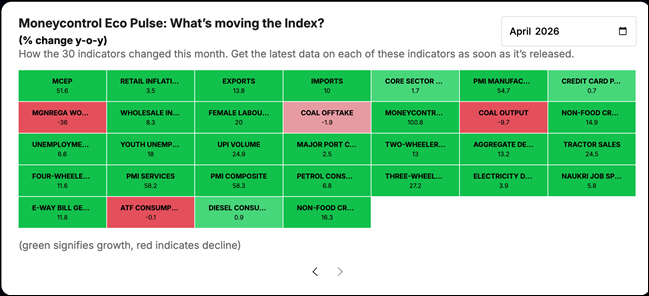
Inflation remained a key pressure point. Wholesale inflation accelerated to 8.3 percent in April from 3.9 percent in March, reflecting the impact of higher commodity prices and supply disruptions linked to the West Asia crisis.
The April reading suggests that India’s economy regained momentum after March’s contraction, but the recovery remains uneven. Manufacturing, exports and rural demand supported the index, while softer credit card spending, slower e-way bill growth and weak fuel indicators pointed to areas of caution.
The government allowed some pass-through of crude prices, with pump prices rising by nearly Rs 4 for both diesel and petrol. The increased prices are likely to start reflecting in consumption, with no end to the West Asia crisis in sight as yet.
Moreover, adverse weather conditions, such as El Niño, may hamper rural consumption.
The Moneycontrol Eco Pulse tracks high-frequency indicators across consumption, manufacturing, labour markets, trade and financial activity to provide an early monthly snapshot of India’s economic momentum ahead of official GDP releases.
- 0
- By Neel Achary

26, May 2026
Bertelsmann India Investments Leads Fairdeal.Market’s Dollar 15M Series A to Expand B2B Quick Commerce for Kirana Stores
New Delhi, May26 : Fairdeal.Market, a B2B quick commerce platform building the replenishment infrastructure for India’s kirana economy has raised US Dollar 15 million in a funding round led by Bertelsmann India Investments . WaterBridge Ventures is returning as a cornerstone investor from seed, and Incubate Asia Fund is also participating in the round.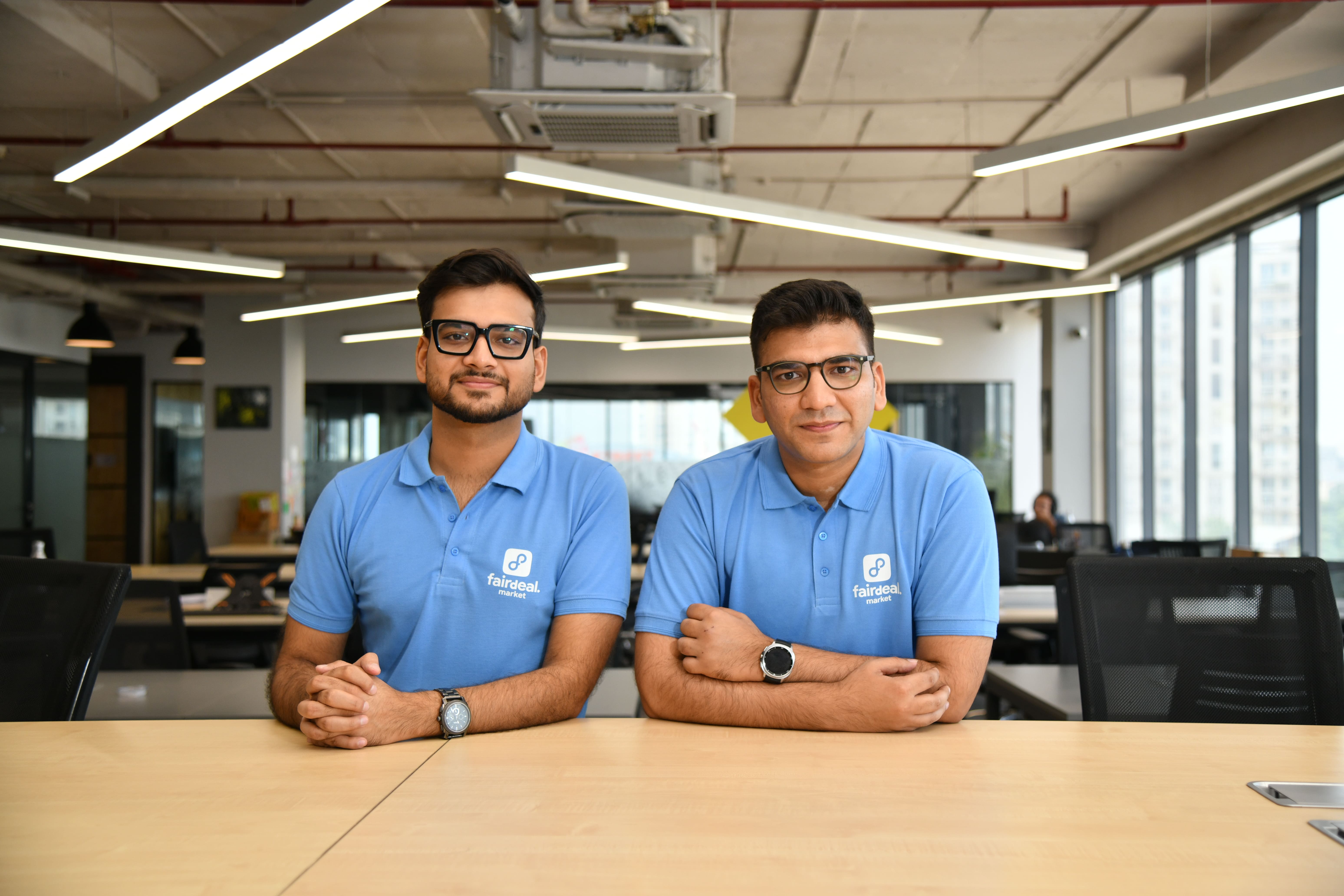
The company currently operates across Delhi NCR and is actively expanding its retailer network, dark store footprint, and brand partnerships. The fresh capital will be deployed to scale dark-store operations across dense urban clusters, strengthen technology and data infrastructure, deepen retailer engagement, and expand last-mile delivery capabilities to redefine the retail business in India.
Fairdeal is India’s first B2B quick commerce platform which delivers 1,000+ SKUs to kirana retailers across Delhi NCR within 60 minutes, bringing speed and reliability to a procurement system that has remained unchanged for decades. Kiranas order what they need, when they need it, and get it in 60 minutes. That is the Fairdeal promise. In the last six months, Fairdeal has scaled to over 20,000 active retailers across Delhi NCR. More notably, over 80% of retailers who ordered from Fairdeal 12 months ago are still ordering today, this reflects the growing reliance of retailers on Fairdeal’s replenishment network.
India is home to over 13 million kirana stores. Yet, inventory procurement for these retailers still largely depends on offline wholesale markets and fragmented distributor networks that were never designed for small-format, high-frequency retail. Delhi NCR alone accounts for approximately 260,000–280,000 retailers, representing one of the largest yet most underserved markets in the world. While earlier B2B commerce models attempted to address this gap, Fairdeal’s approach is built specifically around the replenishment frequency and operational realities of kirana retail enabling retailers to replenish inventory within 60 minutes.
Building on its Delhi NCR foundation, Fairdeal will leverage this round of funding to accelerate its expansion into new metropolitan cities across India. The company aims to scale its retailer network to over 100,000 retailers within the current financial year. And as this network grows, so does something far more valuable: a compounding data flywheel that gives brands real-time intelligence into what is selling, where, and why. For brands, that is a capability that has never existed before. For Fairdeal, it is the foundation of a business that gets stronger with every order placed.
“India’s kirana stores are the backbone of the country’s retail economy, yet the procurement infrastructure serving them has barely evolved in decades. The inefficiency isn’t incidental; it’s structural. If we can help millions of small retailers operate better every day, the impact will go far beyond commerce, it will strengthen local economies across the country. That’s the problem Fairdeal was built to solve, and this round gives us the firepower to solve it at scale,”said Prateek Bansal, Co-founder, Fairdeal
“We started Fairdeal with a simple belief that every retailer, no matter how small, should have access to reliable inventory and the ability to grow with confidence. At the same time, thousands of emerging brands across India are building great products but struggle to access efficient offline distribution. Fairdeal is bridging that gap by building a simple supply and distribution infrastructure that powers the next generation of offline retail in India, where small businesses and emerging brands can grow together with the same speed,” said Yash Bansal, Co-founder, Fairdeal.
“FairDeal is building a new operating model for wholesale procurement in India. What Prateek and Yash understood early was that quick commerce in wholesale is not just about convenience; it fundamentally improves inventory turns, shelf efficiency, and replenishment reliability for kirana stores. They have been pioneers in bringing this approach to the category, and the early traction has been phenomenal. We are excited to partner with them on this ambitious journey,” said Rohit Sood, Partner, Bertelsmann India Investments.
“At WaterBridge, we remain excited about the nonlinear potential of the demand engine that Fairdeal has built. At scale, it will process millions of real-time retail transactions with precise cart-level visibility, empowering it to build a large data set with context and intelligence layers on top. These will provide live actionable insights to brands on what is selling, where, and why, and not what sold last quarter. It is a potential that comes from what the data becomes at scale,” said Ashish Jain, Partner, WaterBridge Ventures.
26, May 2026
Bertelsmann India Investments Backs Fairdeal.Market’s $15M Series A for B2B Quick Commerce Expansion
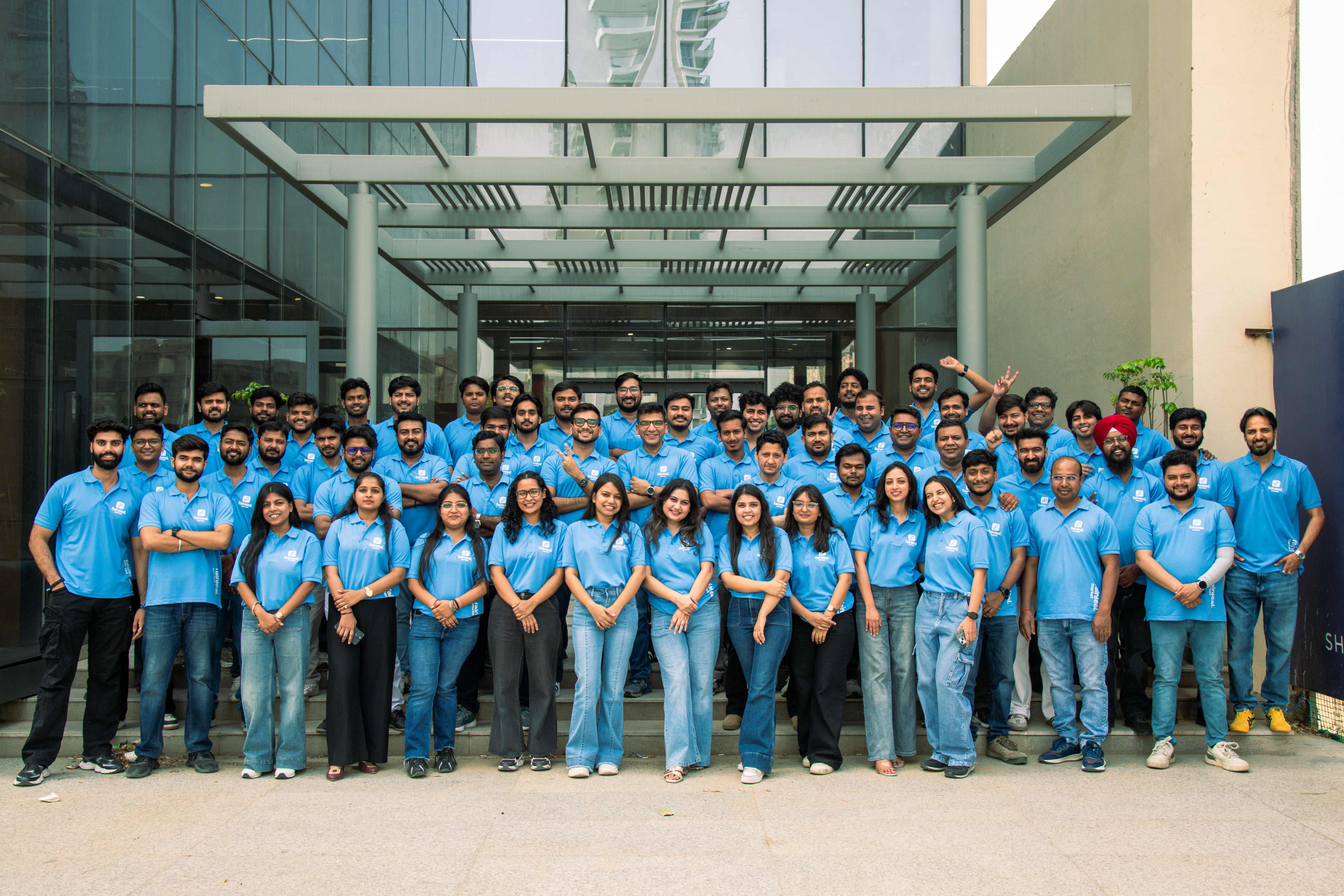
New Delhi, May 26: Fairdeal.Market, a B2B quick commerce platform building the replenishment infrastructure for India’s kirana economy has raised US$15 million in a funding round led by Bertelsmann India Investments (BII). WaterBridge Ventures is returning as a cornerstone investor from seed, and Incubate Asia Fund is also participating in the round.
The company currently operates across Delhi NCR and is actively expanding its retailer network, dark store footprint, and brand partnerships. The fresh capital will be deployed to scale dark-store operations across dense urban clusters, strengthen technology and data infrastructure, deepen retailer engagement, and expand last-mile delivery capabilities to redefine the retail business in India.
Fairdeal is India’s first B2B quick commerce platform which delivers 1,000+ SKUs to kirana retailers across Delhi NCR within 60 minutes, bringing speed and reliability to a procurement system that has remained unchanged for decades. Kiranas order what they need, when they need it, and get it in 60 minutes. That is the Fairdeal promise. In the last six months, Fairdeal has scaled to over 20,000 active retailers across Delhi NCR. More notably, over 80% of retailers who ordered from Fairdeal 12 months ago are still ordering today, this reflects the growing reliance of retailers on Fairdeal’s replenishment network.
India is home to over 13 million kirana stores. Yet, inventory procurement for these retailers still largely depends on offline wholesale markets and fragmented distributor networks that were never designed for small-format, high-frequency retail. Delhi NCR alone accounts for approximately 260,000–280,000 retailers, representing one of the largest yet most underserved markets in the world. While earlier B2B commerce models attempted to address this gap, Fairdeal’s approach is built specifically around the replenishment frequency and operational realities of kirana retail — enabling retailers to replenish inventory within 60 minutes.
Building on its Delhi NCR foundation, Fairdeal will leverage this round of funding to accelerate its expansion into new metropolitan cities across India. The company aims to scale its retailer network to over 100,000 retailers within the current financial year. And as this network grows, so does something far more valuable: a compounding data flywheel that gives brands real-time intelligence into what is selling, where, and why. For brands, that is a capability that has never existed before. For Fairdeal, it is the foundation of a business that gets stronger with every order placed.
“India’s kirana stores are the backbone of the country’s retail economy, yet the procurement infrastructure serving them has barely evolved in decades. The inefficiency isn’t incidental; it’s structural. If we can help millions of small retailers operate better every day, the impact will go far beyond commerce, it will strengthen local economies across the country. That’s the problem Fairdeal was built to solve, and this round gives us the firepower to solve it at scale,”said Prateek Bansal, Co-founder, Fairdeal
“We started Fairdeal with a simple belief that every retailer, no matter how small, should have access to reliable inventory and the ability to grow with confidence. At the same time, thousands of emerging brands across India are building great products but struggle to access efficient offline distribution. Fairdeal is bridging that gap by building a simple supply and distribution infrastructure that powers the next generation of offline retail in India, where small businesses and emerging brands can grow together with the same speed,” said Yash Bansal, Co-founder, Fairdeal.
“FairDeal is building a new operating model for wholesale procurement in India. What Prateek and Yash understood early was that quick commerce in wholesale is not just about convenience; it fundamentally improves inventory turns, shelf efficiency, and replenishment reliability for kirana stores. They have been pioneers in bringing this approach to the category, and the early traction has been phenomenal. We are excited to partner with them on this ambitious journey,” said Rohit Sood, Partner, Bertelsmann India Investments.
“At WaterBridge, we remain excited about the nonlinear potential of the demand engine that Fairdeal has built. At scale, it will process millions of real-time retail transactions with precise cart-level visibility, empowering it to build a large data set with context and intelligence layers on top. These will provide live actionable insights to brands on what is selling, where, and why, and not what sold last quarter. It is a potential that comes from what the data becomes at scale,” said Ashish Jain, Partner, WaterBridge Ventures.
26, May 2026
A Different Kind of Seattle Landmark: World’s Largest Goodwill Offers Visitors a One-of-a-Kind Experience Near Seattle Stadium
SEATTLE — May 26, 2026 — With Seattle set to welcome visitors from around the world for the FIFA Soccer World Cup in just a few weeks, those planning their time between matches will likely gravitate toward familiar stops, such as Pike Place Market, the Space Needle, and MoPOP. Just steps from Seattle Stadium, a less known stop offers a different kind of experience:
Evergreen Goodwill of Northwest Washington’s Seattle flagship store, the largest Goodwill in the world, invites visitors to immerse themselves into something very Seattle—the city’s commitment to sustainability and the circular economy.
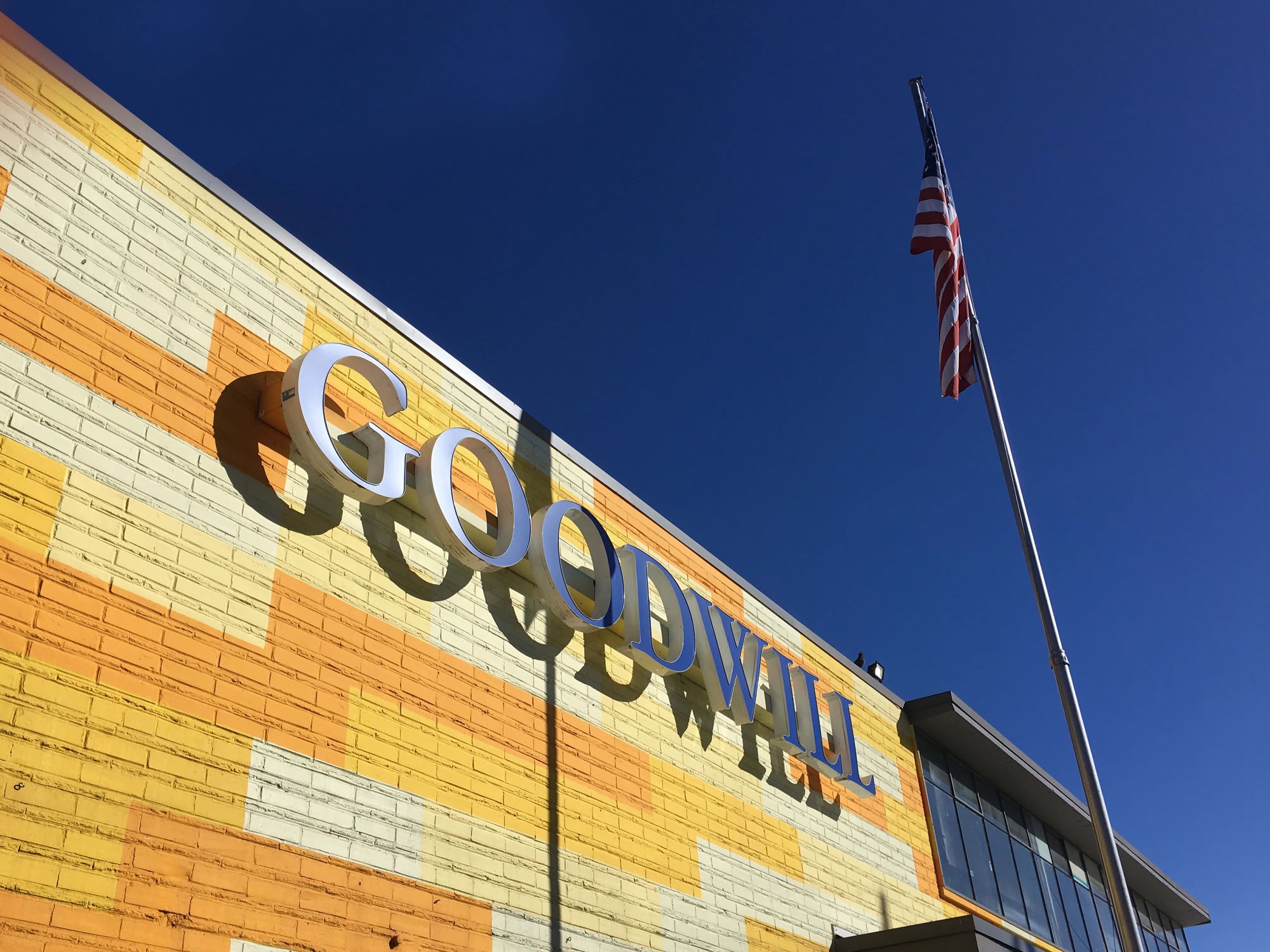
A treasure hunters’ paradise, the 70,000-square-foot resale space stocks approximately 10,000 new items on the shop floor each day. A team comprised of members from over 20 different nations assists visitors as they explore and replace whatever they may have forgotten at home or didn’t realize they might need for their trip.
For travelers navigating a busy and often expensive event, resale offers a compelling shopping alternative:
- A multitude of affordable options at a time when prices are rising
- Access to quality used items being kept out of landfills for minimum environmental impact
- A retail experience shaped by the local community, where inventory reflects what Seattleites give—the best starting point for memorable travel souvenirs
For those moving between matches or exploring nearby neighborhoods, the store can serve several purposes at once: a place to pick up an extra layer, find something unexpected, or take home a piece of Seattle that doesn’t feel mass-produced. Its proximity to Seattle Stadium makes it an easy addition to any itinerary, whether stopping in briefly or spending time exploring.
Unlike traditional retail, each purchase carries an added dimension. Revenue from every sale supports Evergreen Goodwill’s tuition-free job training, education, and career placement programs across Northwest Washington, connecting everyday shopping to long-term community impact.
25, May 2026
UK’s Crypto Pivot Sparks New Possibilities for India’s Digital Finance Sector
New Delhi, 25 May 2026
The United Kingdom has made a quiet but decisive shift in how it views crypto. What was once treated as a risky, fringe activity is now being brought firmly within the boundaries of mainstream financial regulation. This is not a rhetorical change but it is structural. The UK is building a full regulatory regime where crypto firms will be authorised, supervised, and held to standards similar to traditional financial institutions. The Financial Conduct Authority (FCA) has already laid out timelines, with firms expected to begin applying for authorisation from September 2026, ahead of a broader regime coming into force in 2027.
What is striking about the UK approach is that it is anti-disorder. Regulators are simultaneously encouraging innovation and tightening enforcement. Stablecoins, for instance, are being actively explored as part of the payments ecosystem, with regulatory sandboxes allowing experimentation under supervision. At the same time, authorities have shown they are willing to act against non-compliant activity, including recent crackdowns on illegal crypto trading networks.

India, in contrast, has taken a far more cautious and fragmented path. Instead of building a regulatory framework, it has focused on taxation as the primary tool of policy. Crypto gains are taxed at a flat 30%, accompanied by a 1% tax deducted at source on transactions. This makes India one of the most heavily taxed crypto markets in the world. Yet, despite this clarity on taxation, there is still no comprehensive regulatory structure governing exchanges, custody, or investor protection.
This creates a peculiar imbalance. Crypto is recognised as a taxable asset, but not as a regulated financial product. The state participates in the upside through taxes without fully defining the rules of the market itself. At the same time, institutional caution remains high. The Reserve Bank of India has repeatedly flagged concerns around financial stability and has instead pushed for a central bank digital currency as a safer alternative to private crypto assets.
The divergence between the UK and India reflects two very different policy instincts. The UK is choosing integration: bringing crypto into the system, regulating it, and shaping its evolution from within. India is choosing containment: discouraging excessive participation while waiting for global standards to settle. Both approaches are defensible, but they lead to very different outcomes in practice.
The UK’s model creates clarity. Firms know the rules, investors understand the risks, and innovation happens within defined boundaries. India’s approach, however, risks creating prolonged uncertainty. High taxes combined with regulatory ambiguity risk pushing activity offshore, even as domestic demand continues to exist. Industry voices in India have increasingly called for clearer rules and rationalisation of the tax regime, arguing that certainty not just caution is essential for growth.
What is becoming evident is that crypto policy is no longer just about risk management it is about economic positioning. The UK is attempting to position itself as a global hub where crypto can operate within a trusted regulatory environment. India, by contrast, is still calibrating its stance, balancing concerns around stability with the need to not fall behind in financial innovation.
In the end, the question for India is not whether to follow the UK model, but whether its current middle path is sustainable. Markets tend to gravitate toward jurisdictions that offer clarity, even if the rules are strict. A system that taxes without regulating may not hold for long. Because in finance, as in policy, choosing to wait is not a neutral act. It is a decision in itself and one that shapes who leads and who follows in the next phase of global financial evolution.
25, May 2026
Affordable Grooming Gets a Boost as VI-JOHN Launches Rs.20 Twin Blade Razor
Ghaziabad 25 May 2026:
VI-JOHN strengthens its grooming portfolio with a comfortable, value-driven shaving solution for the mass market. Reinforcing its commitment to making quality grooming accessible to a wider base of consumers, VI-JOHN has announced the launch of the VI-JOHN Shave Pro Twin Blade Razor, an affordable shaving solution designed to deliver a smooth, comfortable, and reliable shaving experience for the mass Indian market. Priced at just ₹20, the razor aims to bridge the gap between low-cost disposable razors and premium multi-blade systems by offering improved shaving performance at an accessible price point.
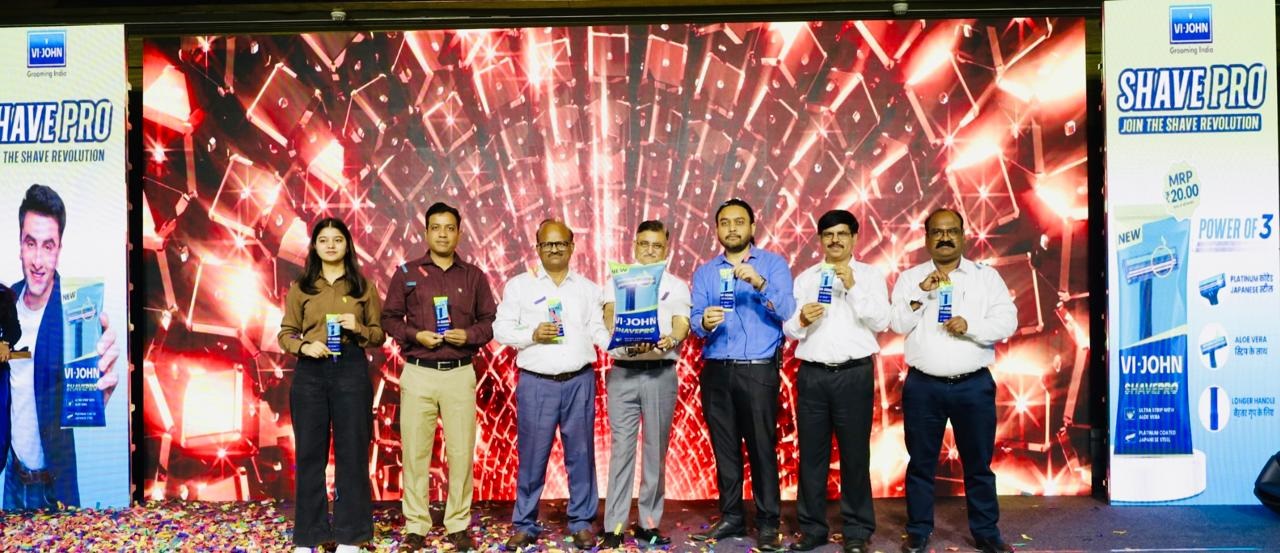
The launch marks VI-JOHN’s strategic entry into the affordable razor category as the brand continues to strengthen its presence across the broader men’s grooming ecosystem. Building on its strong legacy in shaving preparations and grooming products, the company aims to make upgraded shaving experiences accessible to consumers across urban, semi-urban, and rural India.
Speaking on the launch, Ashutosh Chaudharie, GM Marketing, VI-JOHN Group, said, “At VI-JOHN, we have always believed that quality grooming should be accessible to every consumer. Shaving is an everyday ritual for millions of Indian men, and we saw an opportunity to introduce a product that delivers both comfort and value. With the launch of the VI-JOHN Shave Pro Twin Blade Razor, we aim to offer consumers a reliable grooming solution that combines quality, performance, and affordability. This launch also reflects our larger vision of democratising quality grooming and expanding VI-JOHN’s presence across the shaving ecosystem.”
The razor features two super sharp Japanese blades designed to provide a closer and more precise shave with minimal effort. It also includes an Aloe Vera lubrication strip that helps soothe the skin, improve glide, and reduce irritation during shaving. Additionally, the razor’s longer ergonomic handle offers better grip and control, improving stability and helping minimise the risk of nicks and cuts during everyday use.
The product has been developed keeping Indian grooming habits and consumer preferences in mind, where affordability, convenience, and reliable performance remain key purchase drivers. With a large proportion of consumers still relying on basic shaving solutions, VI-JOHN identified a strong opportunity to introduce a better-quality razor that balances comfort, performance, and value.
India’s grooming market continues to see growing demand for affordable yet effective grooming products, particularly across Tier 2, Tier 3, and rural markets where grooming awareness and aspirations are steadily rising. With nearly 65% of India’s population residing in semi-urban and rural areas.
With the launch of Shave Pro, VI-JOHN continues to strengthen its commitment to delivering affordable, reliable, and accessible grooming solutions for Indian consumers.
25, May 2026
Sundaram Finance logs disbursements of Rs. 32,321 crores for FY26
Audited standalone & consolidated financial results for the quarter and year ended March 31, 2026
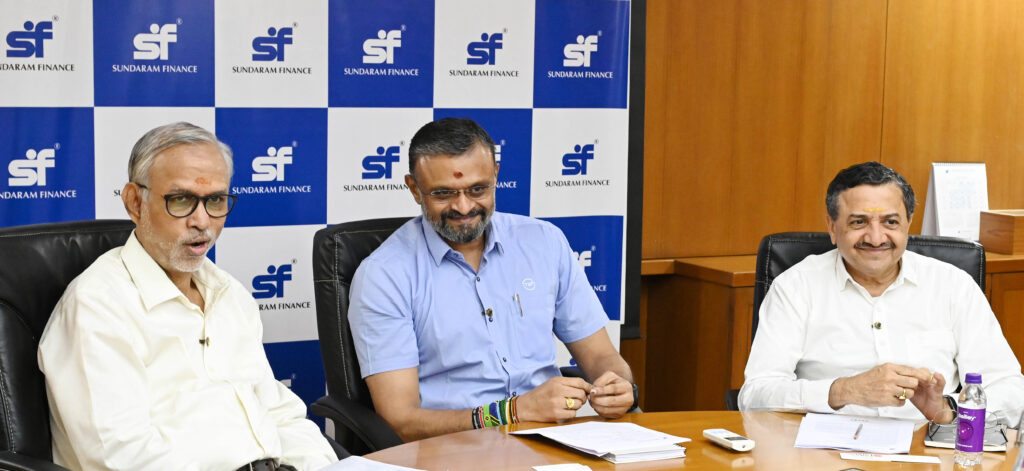
L to R -Mr. M. Ramaswamy, Chief Financial Officer, Mr. Rajiv C. Lochan, Managing Director, and Mr. A. N. Raju, Joint Managing Director of Sundaram Finance Limited addressing the media
May 25: The Board of Directors of Sundaram Finance Ltd. (SFL) approved the audited standalone and consolidated financial results for the quarter and year ended March 31, 2026, at its meeting held on May 25, 2026, in Chennai.
“Q4FY26 witnessed continued improvement in the economic environment following the GST 2.0 reforms effected in September 2025. While H1FY26 witnessed trade tariff related complications resulting in somewhat muted demand and macroeconomic activity, H2FY26 gathered steam spurred by the transmission of monetary policy and stimulus provided by fiscal policy measures.Under these circumstances, Team Sundaram has delivered 16.4% growth in AUM to Rs. 59,908 crores, asset quality with net stage 3 assets at 0.69% vs 0.75% last year and profits after tax growth of 19% year-on-year. Our Group companies in asset management, general insurance and home finance have continued to record strong results. We continue to rely on our time-tested approach of steady and sustainable growth with best-in-class asset quality and consistent profitability,” said Harsha Viji, Executive Vice Chairman.
AUM for FY26 grew 16% to Rs. 59,908 crores. Disbursements for FY26 recorded a growth of 14% over FY25 and for Q4FY26, disbursements have grown 17% Y-o-Y. Gross stage 3 assets as on March 31, 2026, stood at 1.44% with provision cover of 53% as against 1.44% as on March 31, 2025, with provision cover of 49%. Profits from operations performed strongly, growing by 18% in FY26 and 14% in Q4FY26. Profit after tax registered a 19% rise in FY26, with net profit at Rs. 1,834 crores.
During the year, the Company has considered Rs. 75 crores under “Exceptional Items” for the incremental impact of the new Labour Codes. Consequently, for Q4, the net profit grew by 11% to Rs. 608 crores. Return on assets closed at 3.03% in FY26 as against 2.85% for FY25 and capital adequacy at 19.1% remained quite comfortable.
Rajiv Lochan, Managing Director, stated, “Our overall performance for the year has been well balanced across growth, asset quality and profitability. Our profitability and profit growth has been strong, asset quality has improved substantially in Q4FY26 to close the year well and growth in disbursements and assets under management has been reasonable. Looking ahead, we remain optimistic that India’s macroeconomic fundamentals remain strong supported by resilient domestic consumption, sustained public capital expenditure and a gradual revival in private investment. While uncertainties due to geopolitical challenges are a key monitorable, we remain confident of our plan to gain market share, maintain best in class asset quality and operating expenses and deliver sustainable profit growth.”
STANDALONE PERFORMANCE HIGHLIGHTS FOR FY26
·Disbursements for FY26 grew by 14% to Rs. 32,321 crores as compared to Rs. 28,405 crores registered in FY25. Disbursements for Q4FY26 grew by 17% to Rs. 8,051 crores as compared to Rs. 6,873 crores registered in Q4FY25.
·The assets under management grew by 16% to Rs. 59,908 crores as on 31stMarch 2026 as against Rs. 51,476 crores as on 31stMarch 2025.
·Net interest income (NII) grew by 21% to Rs. 3,376 crores in FY26 from Rs. 2,793 crores in FY25. Q4FY26 growth in NII was 20% to Rs. 901 crores.
·Gross stage 3 assets as on 31stMarch 2026 stood at 1.44% with 53% provision cover as against 1.44% with provision cover of 49% as on 31stMarch 2025. Net stage 3 assets as on 31stMarch 2026 closed at 0.69% as against 0.75% as on 31stMarch 2025. During the year, the Company reviewed and refined its methodology for computing Expected Credit Loss (ECL), including the use of more recent historical data and machine learning-based model enhancements, where appropriate.
·The Gross and Net NPA, as per RBI’s asset classification norms for NBFCs, are 2.14% and 1.27% respectivelyas against 2.17% and 1.38% as of 31stMarch 2025.
·Costto income ratio improved to 28.71% in FY26 as against 30.80% in FY25.
·Profits from operations grew 18% to Rs. 2,151 crores in FY26 as against Rs. 1,825 crores in FY25. For the quarter, profits from operations grew 14% to Rs. 622 crores.
·The Company has considered Rs. 75 crores under “Exceptional Items” for the incremental impact of the new Labour Codes.
·Higher dividend income resulted in profit after tax registering 19% rise in FY26, with net profit at Rs. 1,834 crores as against Rs. 1,543 crores in FY25. For Q4FY26, PAT grew 11% Y-o-Y to Rs. 608 crores.
·Return on assets (ROA) for FY26 closed at 3.03% as against 2.85% for FY25. Return on equity (ROE) was at 17.49% for FY26 as against 16.30% for FY25. Including the impact of new Labour Codes, the ROA and ROE for FY26 were 2.94% and 17.00% respectively.
·Capital Adequacy Ratio stood at 19.1% (Tier I –17.2%) as of 31stMarch 2026 compared to 20.4% (Tier I – 17.4%) as of 31stMarch 2025.
·The Company has declared a final dividend of Rs. 24/- per share (240%).
CONSOLIDATED PERFORMANCE HIGHLIGHTS FOR FY26
The consolidated results of SFL include the results of its standalone subsidiaries Sundaram Home Finance, Sundaram Asset Management and joint venture company Royal Sundaram General Insurance.
·The assets under management (AUM) in our lending and general insurance businesses stood at Rs. 89,541 crores as on 31stMarch 2026 as against Rs. 78,145 crores as on 31stMarch 2025, a growth of 15%. The assets under management of our asset management business stood at Rs. 77,457 crores as on 31stMarch 2026 as against Rs. 71,826 crores as on 31stMarch 2025.
·Profit after tax for FY26 grew by 10% to Rs. 2,059 crores as compared to Rs. 1,879 crores in FY25, after considering Rs. 76 crores under “Exceptional Items” for the incremental impact of the new Labour Codes.
GROUP COMPANY PERFORMANCE HIGHLIGHTS
Our group companies continued to perform well.
·The asset management business closed the year ended 31stMarch 2026with assets under management of Rs. 77,457 crores (around 80% in equity) and consolidated profits from the asset management businesses were at Rs. 174 croresas against Rs. 154 crores in FY25.
·Royal Sundaram reported a Gross Written Premium (GWP) of Rs. 4,638crores as compared to Rs. 4,065 crores in the previous year, representing a growth of 14%. The company reported a profit after tax of Rs. 107 crores for FY26 as against a profit of Rs. 133 crores in FY25.
·Sundaram Home Finance disbursements grew by 4% to Rs. 6,805 crores in FY26. The profit for FY26 was Rs. 282 crores, as against Rs. 245 crores in FY25.Gross stage 3 assets as on 31stMarch 2026 stood at 1.11% as against 1.02% as on 31stMarch 2025. Net stage 3 assets as on 31stMarch 2026 closed at 0.51% as against 0.53% as on 31stMarch 2025.The Gross and Net NPA, as per RBI’s asset classification norms, are 1.21% and 0.59% respectivelyas against 1.33% and 0.77% as of 31stMarch 2025.
25, May 2026
Shriram General Insurance and Piramal Finance Join Hands for Strategic Partnership
May 25 : Shriram General Insurance today announced a strategic corporate agency partnership with Piramal Finance, a retail-focused upper-layer NBFC in India, to improve access to insurance solutions, particularly across semi-urban and rural markets.
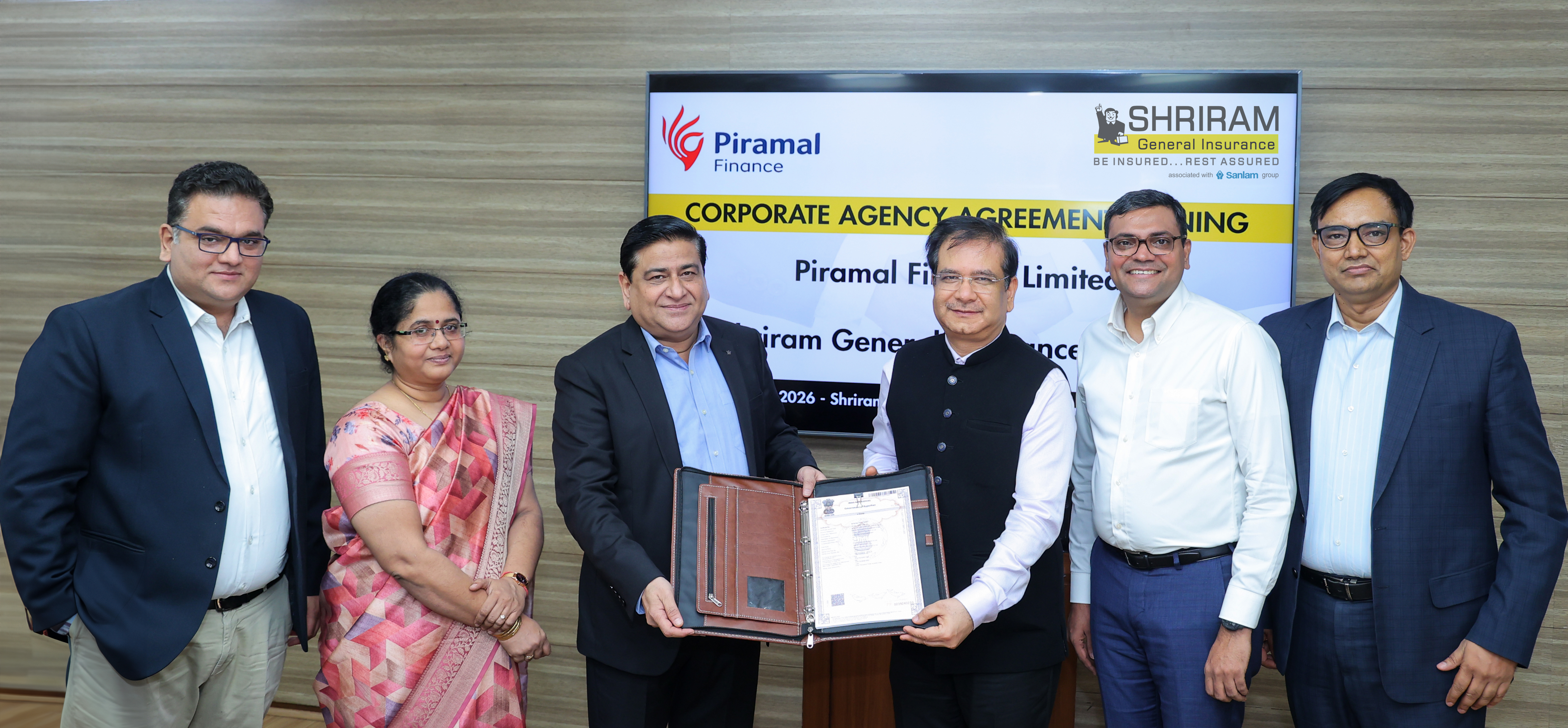
Under the partnership, SGI will leverage Piramal Finance’s extensive branch network and customer outreach to offer its wide range of insurance products across 701 branches of Piramal Finance spanning 26 states and over 13,000 pin codes.
The partnership reflects the shared commitment of both organisations to make insurance solutions more accessible and meaningful for customers, helping them safeguard their assets, livelihoods and long-term financial well-being. By combining Shriram General Insurance’s long-standing industry experience, customer-centric approach, and the trust it has built over the years with Piramal Finance’s innovative ‘High Tech + High Touch’ approach, the partnership aims to create seamless and convenient access to protection solutions across diverse geographies.
Speaking on the partnership, Mr. Jairam Sridharan, MD & CEO, Piramal Finance Limited, said:
“We are pleased to partner with Shriram General Insurance to expand the reach of insurance solutions across our customer base, particularly in semi-urban and rural markets. Insurance penetration remains low across many parts of India, especially in smaller towns and there is a need for simpler and more inclusive protection solutions. For many of our customers, a single unexpected event can set a family back significantly. Insurance is therefore not just a product, but a way to protect what they worked hard to build.
Through this partnership, we hope to bring insurance products closer to customers through our extensive branch network and on-ground presence, in a way that is simple, trusted and accessible. As a company, we see this as an extension of our responsibility to stand by our customers, helping them not just grow but stay protected.”
Mr. Aftab Alvi, Executive Director and CMO, Shriram General Insurance Company, said:
“We are delighted to partner with Piramal Finance to further strengthen our distribution capabilities and expand access to comprehensive insurance solutions across a broader customer base. This collaboration brings together our customer-centric offerings and Piramal Finance’s extensive reach and customer ecosystem, enabling us to enhance insurance accessibility, particularly across underserved and emerging markets where insurance penetration remains low. We believe this partnership will play a meaningful role in deepening financial protection, driving greater awareness, and delivering enhanced value to customers. It also reinforces our continued commitment towards building strong strategic alliances that support sustainable growth and wider insurance inclusion.”
25, May 2026
PepsiCo India, the energy drinks market leader, expands the category with a bold new flavour – Sting Classic Kick
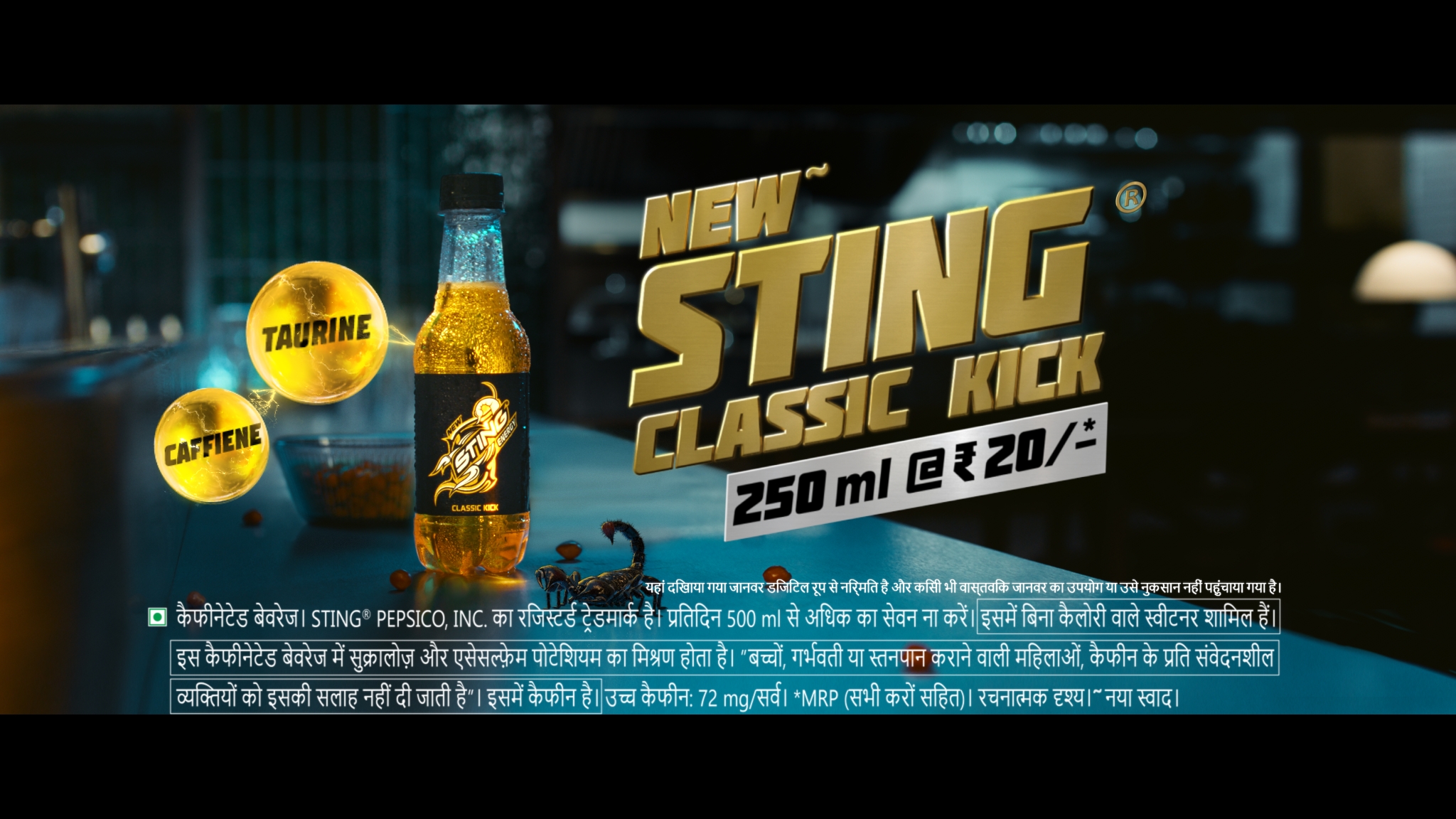
Hyderabad, May 25: PepsiCo India’s iconic energy drink brand, Sting® Energy is turning up the intensity with the launch of Sting® Classic Kick – a bold new flavour designed for today’s generation that thrives on individuality, high energy and is always looking for choices. Expanding the Sting portfolio, the new flavour introduces a bold identity rooted in intense energy, retaining the brand’s signature fun and cheeky personality.
The launch is accompanied by a high-octane campaign film for ‘Sting Classic Kick’, showcasing actor Lakshya in a stylish restaurant setting. He effortlessly takes control of a tense situation with wit, confidence, and unmistakable Sting® energy, perfectly reflecting the flavour’s bold and commanding personality.
The film opens inside a restaurant where two intimidating men are seen roughing up an innocent waiter. Sitting nearby, Lakshya casually intervenes, asking them to take it easy. Dismissing him mockingly, the men tell him to focus on the peanuts on his table. Calm and unfazed, Lakshya takes a swig of Sting® Classic Kick and slams the bottle onto the table. In a dramatic slow-motion sequence, peanuts leap into the air and are flicked like carrom strikers toward the men, sending them flying backwards in a stylishly exaggerated display of power. The film closes with the actor’s effortless smile and the bold sign-off.
Commenting on the launch, Diksha Bajaj, Category Head – Energy Portfolio, PepsiCo India, said: “As the leading brand in India’s energy drink category, Sting Energy continues to expand and evolve the category through innovation that offers consumers greater choice and differentiated flavour experiences. With the launch of Sting® Classic Kick, we are introducing an enhanced bold new flavour that responds to evolving consumer preferences while staying true to the high-energy experience Sting Energy is known for. The launch reinforces our commitment to continuously growing the category and bringing exciting new offerings to consumers.”
Adding to this, actor Lakshya said: “While shooting the campaign, I really enjoyed the intense energy and cinematic treatment that the film brings alive. The action, humour and confident storytelling come together in a very entertaining way, making the campaign feel stylish and impactful. What makes the campaign stand out is how effortlessly it captures the bold and distinctive appeal of the all-new Sting Classic Kick flavour, and I’m excited for audiences to experience it.”
The campaign builds on Sting®’s youthful and disruptive brand voice, introducing a more, bold and self-assured tonality for Classic Kick.” With cinematic visuals, high-energy storytelling, and stylized action, the campaign aims to resonate with consumers seeking a flavour that feels powerful and differentiated.
The new Sting® Classic Kick campaign will be amplified through a 360-degree rollout across television, digital, social media, influencer collaborations, and outdoor platforms.
25, May 2026
NTT, NTT DATA and INDYCAR Extend Entitlement Partnership with Multi-Year Agreement
Tokyo / Indianapolis, May 25: NTT, Inc., together with NTT DATA Group Corporation, today announced the renewal of its sponsorship of the NTT INDYCAR SERIES. Under the renewed agreement, NTT has expanded its role beyond race analytics and fan engagement to provide advanced AI and data capabilities for Penske Entertainment and INDYCAR. This includes AI-driven operations, real‑time decision intelligence and emissions visibility across INDYCAR, the historic Indianapolis Motor Speedway (IMS) and marquee events within the Penske Entertainment portfolio.
110th Running of the Indianapolis 500
NTT, along with its subsidiary NTT DATA, a global leader in AI, digital business and technology services, will continue as the Official Technology Partner for INDYCAR, the NTT INDYCAR SERIES, IMS, the Indianapolis 500 and the NASCAR Brickyard weekend.
“Our partnership has evolved from series‑level analytics into an enterprise‑wide AI and data intelligence collaboration,” said Akira Shimada, President and CEO, NTT. “In addition to powering race‑day analytics and enabling AI‑driven intelligence that supports safety, sustainability and decision‑making, NTT is applying data and AI at scale with our clients and partners to create a more connected, resilient and responsible future.”
Evolving the Fan Experience Through AI-Driven Intelligence
During a typical race weekend, including the Indianapolis 500, the NTT INDYCAR SERIES generates billions of real‑time data points from cars, teams and track operations. NTT DATA provides actionable insights to inform race control, operations teams, broadcast partners and event planners to support faster, more precise decisions.
Penske Entertainment and NTT DATA are deploying AI to transform how fans experience INDYCAR—starting with “Up To Speed,” a new AI‑powered feature delivering smarter, more dynamic race insights to fans, alongside expanded real‑time data, content and digital experiences coming online throughout this season. The new “Up To Speed” feature is available now on the INDYCAR App powered by NTT DATA.
700,000+ new users have downloaded the reimagined INDYCAR App powered by NTT DATA since its 2023 re-launch, driving an overall usage increase of more than 30% with fans in more than 100 countries reflecting expanded international interest in motorsports.
NTT DATA Provides Developments in Sustainability and Safety
- Emissions tracking and sustainability accountability were strengthened through carbon accounting and automated data collection, supporting Penske Entertainment’s “Racing toward Zero” initiative across 100+ organizations and partners.
- A state‑of‑the‑art tracking platform streamlines data collection, reduces reporting gaps and provides improved visibility for emissions measurement.
- AI‑driven Venue Solutions at IMS support real‑time decision‑making across the 1,000‑acre venue, using predictive modeling, advanced connectivity and analytics to enhance crowd management, traffic planning and operational safety.
With attendance rising annually to over 350,000 fans on site, including a sold‑out race in 2025 and 2026, NTT DATA delivers critical data to provide a safe, seamless, high‑quality experience at scale.
“Leading into another iconic edition of The Greatest Spectacle in Racing, we are thrilled to continue our world-class partnership with NTT,” said Roger Penske, Founder and Chairman, Penske Corporation. “Their significant expertise as a global leader in AI, digital business and technology services is integral to how we build engagement across INDYCAR’s fanbase and provide a top-notch customer experience at the Racing Capital of the World. This is a partnership based on trust and a shared commitment to innovation and excellence, providing all the foundational attributes necessary for a long-term and highly successful relationship.”
The announcement comes on heels of significant momentum driven during NTT’s ongoing immersive partnership with Penske Entertainment.


