


2, Sep 2026
India’s Petrol, Diesel Demand Rises in August as Mobility and Economic Activity Support Fuel Consumption
New Delhi: India’s fuel consumption landscape showed a notable divergence in August, with petrol and diesel demand registering strong year-on-year growth even as liquefied petroleum gas (LPG) consumption continued to weaken. The increase in transport fuels points to sustained mobility, agricultural activity and freight movement, although the broader economic picture remains mixed.
According to provisional data from the Petroleum Planning and Analysis Cell (PPAC) under the Ministry of Petroleum and Natural Gas, petrol consumption rose 7.88 per cent year-on-year to 3.82 million tonnes (MT) in August 2026, compared with 3.54 MT in the corresponding month last year.
Diesel, the country’s largest-selling petroleum product, recorded a 6.46 per cent increase to around 7.00 MT, against 6.58 MT a year earlier. The growth assumes significance because diesel demand is closely linked to freight transportation, agriculture, construction and other productive activities across the economy.
The August numbers underline the continued resilience of India’s domestic fuel market despite higher energy costs and disruptions in global oil markets.
Mobility emerges as a key driver
The increase in petrol consumption reflects stronger road mobility across the country. A combination of vehicle usage, road travel and changing travel preferences contributed to higher demand during the month.
One factor supporting petrol consumption was relatively deficient rainfall in several regions, which allowed road movement to continue at a stronger pace. There was also evidence of travellers opting for road journeys for shorter distances rather than air travel.
The trend has been reinforced by healthy vehicle sales. India’s passenger vehicle market recorded strong dealer sales in August, with major automakers reporting year-on-year increases. This provides another channel through which rising vehicle ownership and usage can translate into higher petrol consumption.
For the broader economy, higher petrol consumption is therefore more than an energy statistic. It can reflect increased household mobility, personal transportation and activity in sectors dependent on road connectivity.
Diesel demand reflects agriculture, freight and industry
Diesel demand offers a somewhat different picture.
Unlike petrol, diesel remains deeply embedded in India’s commercial and productive economy. Trucks and other freight vehicles rely heavily on diesel, as do agricultural machinery, irrigation pumps and several industrial applications.
In August, diesel consumption benefited from continued economic activity as well as agricultural demand. The uneven monsoon played an important role in some regions, with farmers turning to diesel-powered irrigation equipment where rainfall was inadequate.
The combination of agricultural requirements, freight movement and manufacturing activity helped sustain diesel consumption despite the challenging global energy environment.
The increase also came on the back of a relatively lower base in August 2025, making year-on-year comparisons somewhat favourable. Nevertheless, the 6.46 per cent rise indicates that demand for diesel-powered mobility and economic activity remained substantial.
Strong GDP growth provides a supportive backdrop
The latest fuel data comes against the backdrop of stronger-than-expected economic growth.
India’s real GDP expanded 7.8 per cent year-on-year in the April-June 2026 quarter, beating market expectations of around 7.1 per cent. Growth was supported by investment, manufacturing and domestic consumption, although the pace moderated from the previous quarter’s revised 8.6 per cent.
Manufacturing output expanded 9.2 per cent in the April-June quarter, while consumer spending also remained relatively strong. These trends provide a supportive foundation for transportation and energy demand.
However, the August fuel numbers should not be interpreted as a standalone measure of economic strength. India’s manufacturing sector subsequently showed signs of moderation, with the August Purchasing Managers’ Index indicating the slowest factory growth in five years amid weaker domestic and international demand.
This suggests that while fuel consumption remained resilient, businesses and policymakers will need to watch whether the momentum can be sustained in the coming months.
Five-month fuel demand remains firmly in positive territory
The cumulative April-August numbers reinforce the picture of relatively strong transport-fuel demand.
During the first five months of the current fiscal year, petrol consumption increased 6.48 per cent to 18.94 MT, while diesel demand rose 4.29 per cent to 40.56 MT, according to provisional PPAC data.
The figures indicate that the increase is not confined to a single month. Petrol demand has benefited from growing vehicle usage and mobility, while diesel continues to be supported by India’s logistics, agricultural and commercial networks.
At the same time, the growth rates remain sensitive to the base effect, monsoon conditions, fuel prices and the pace of economic activity.
LPG tells a contrasting story
The most striking feature of India’s August petroleum consumption data is the sharp divergence between transport fuels and LPG.
LPG consumption fell 16.15 per cent year-on-year to 2.42 MT in August, compared with 2.89 MT a year earlier. For April-August, LPG consumption declined 15.89 per cent to 11.29 MT.
Industry executives have linked part of the decline to changing consumption patterns, including a shift towards piped natural gas among some households, restaurants and industrial and commercial users.
The decline also reflects the unusual conditions surrounding India’s LPG supply chain following disruptions in global energy markets and the country’s dependence on imported LPG.
The contrasting trends highlight how different segments of India’s energy economy are responding differently to changing prices, supply conditions and consumption patterns.
Aviation fuel shows tentative recovery
Aviation turbine fuel (ATF) consumption also returned to growth in August.
ATF demand increased 1.4 per cent to around 720,000 tonnes, compared with 710,000 tonnes a year earlier. However, cumulative ATF consumption for April-August remained marginally lower, declining 0.57 per cent to 3.68 MT.
The August increase could indicate some recovery in air traffic following earlier disruptions and elevated fuel costs.
Taken together, rising petrol, diesel and ATF demand suggests that mobility across different modes of transport remained relatively resilient during the month.
Global oil risks remain a key uncertainty
India’s fuel-demand outlook cannot be separated from developments in the international crude oil market.
The country imports the bulk of its crude oil requirements, leaving domestic energy costs vulnerable to global supply disruptions, geopolitical tensions and fluctuations in international crude prices.
The ongoing geopolitical uncertainty in West Asia has added another layer of risk. Higher crude prices can eventually put pressure on India’s trade balance, inflation and fuel marketing margins, while also raising transportation costs for businesses and consumers.
This creates a delicate balance for the economy. Strong fuel demand is positive from the perspective of economic activity, but persistently high international oil prices can increase input costs and weaken purchasing power.
What the August numbers mean for India’s economy
The latest fuel-consumption figures offer a useful real-time indicator of activity on the ground.
Petrol demand points towards continued personal mobility and vehicle usage. Diesel consumption reflects the movement of goods, agricultural operations and commercial activity. ATF demand provides a window into air travel, while LPG consumption captures changing household and commercial energy patterns.
The August data therefore paints a nuanced picture rather than a simple story of uniformly accelerating growth.
India’s economy entered the second half of 2026 with strong GDP momentum and healthy vehicle demand, but manufacturing indicators have begun to show signs of moderation. At the same time, global oil-market risks remain elevated.
For now, however, the resilience of petrol and diesel consumption suggests that India’s transport and productive economy continues to generate substantial demand for conventional fuels.
The key question for the months ahead will be whether this fuel-demand momentum can withstand higher energy costs, global uncertainty and softer manufacturing conditions.
If road mobility, freight movement, agricultural activity and domestic consumption remain firm, petrol and diesel demand could continue to provide an important real-time signal of India’s underlying economic resilience.
- 0
- By Neel Achary

2, Sep 2026
Indian Equities Slide at Open as Rising Crude and Geopolitical Risks Trigger Sell-Off
Mumbai, September 2, 2026: Indian benchmark equity indices came under heavy selling pressure in early trade on Wednesday, with investors turning cautious amid heightened geopolitical uncertainty and a sharp rise in crude oil prices.
At 9:47 a.m., the Nifty 50 was trading at 23,830.90, down 225.75 points, or 0.94 per cent, from its previous close. The BSE Sensex stood at 76,299.85, lower by 640.04 points, or 0.83 per cent.
The weak opening reflected a broader deterioration in global risk sentiment as escalating geopolitical tensions raised concerns over energy supplies and the possibility of prolonged disruption in the international oil market.
The surge in crude oil prices has emerged as one of the principal concerns for investors. Any sustained increase in energy costs could have wider implications for inflation, corporate margins and India’s external balances, given the country’s dependence on imported crude.
Higher oil prices can increase costs across transportation, aviation, chemicals and other energy-intensive industries. They can also put pressure on the rupee by increasing the country’s import bill.
For equity investors, the concern is not merely the immediate increase in crude prices but whether geopolitical tensions could keep energy prices elevated for an extended period.
The domestic sell-off mirrored weakness across international markets. Investors globally have been reassessing risk exposure as geopolitical developments add uncertainty to the outlook for economic growth, inflation and monetary policy.
The rise in oil prices has also revived concerns that renewed inflationary pressure could complicate the path of interest-rate cuts in major economies. Higher global bond yields and a stronger dollar can further reduce the attractiveness of emerging-market assets.
This combination of geopolitical uncertainty, expensive crude and tighter global financial conditions has encouraged investors to adopt a defensive stance.
The broad market weakness is expected to keep investors focused on sectors with high sensitivity to crude prices and global financial conditions.
Oil-consuming industries could face margin pressure if input costs remain elevated, while companies with strong pricing power and relatively lower exposure to energy costs may prove more resilient.
At the same time, oil and gas companies could attract attention as crude prices move higher, although the overall market direction remains dependent on the duration and intensity of the geopolitical shock.
Currency movements are another important factor for Indian equities. A weaker rupee alongside higher crude prices could increase imported inflationary pressures and complicate the broader macroeconomic outlook.
Foreign institutional flows will also remain on investors’ radar. Persistent overseas selling can amplify market declines during periods of heightened global risk aversion, while continued support from domestic institutional investors could help limit the downside.
With the Nifty now trading below the 24,000 mark, market participants are likely to closely monitor whether the index can stabilise at lower levels or whether selling pressure intensifies during the session.
The immediate focus will remain on developments in global crude oil markets, geopolitical events, movements in the US dollar and bond yields, and foreign investor activity.
For India, the impact of the current market shock will ultimately depend on how long crude prices remain elevated. A short-lived spike could be absorbed by the economy and markets, but a prolonged oil-price surge could create greater pressure on inflation, the rupee, corporate profitability and investor sentiment.
For now, geopolitical uncertainty and the oil-price surge have pushed Indian equities firmly into risk-off territory, with investors expected to remain cautious until greater clarity emerges on the global energy and economic outlook.
2, Sep 2026
Raincheck Earth Appoints Sanjit Phukan as Head of Marketing

New Delhi, Sept 02: Raincheck Earth, the company behind the internationally acclaimed Cherrapunji Eastern Craft Gin, has appointed Sanjit Phukan as its Head of Marketing, marking a significant step in the brand’s next phase of growth, both in India and globally.
Sanjit joins Raincheck Earth from Jameson, where he most recently served as Director – Marketing Communication, playing a pivotal role in shaping the brand’s cultural relevance and accelerating its growth in India. During his tenure, he conceptualised and led Jameson Connects India, a platform that brought together music, art, culture, and community through meaningful collaborations, partnerships, and original brand experiences.
With over 21 years of experience across sales, communications, digital transformation, and brand marketing, Sanjit has built an impressive career with some of the world’s most recognised consumer brands. Before Jameson, he spent over a decade with Nestlé, contributing to the growth of iconic brands including Maggi, Nescafé, Milkmaid, and KitKat. He also worked with Nestlé’s Global Digital Team in Switzerland before returning to India to lead the company’s digital transformation ecosystem.
His move to Raincheck Earth is as much a professional decision as it is a personal one. Born and raised in Northeast India, Sanjit shares a deep connection with the region and its stories. Joining Cherrapunji allows him to help build a brand that celebrates the landscape, culture, and craftsmanship of the Northeast while taking it to audiences around the world.
Speaking on the appointment, Mayukh Hazarika, Founder & CEO, Raincheck Earth, said:
“Sanjit understands something that’s difficult to teach, how brands become part of culture. Throughout his career, he’s consistently built communities, conversations, and experiences that people genuinely connect with. As Cherrapunji enters its next chapter, we’re excited to have someone who not only brings world-class marketing expertise but also shares a deep personal connection with the Northeast and everything this brand stands for.”
On joining Raincheck Earth, Sanjit Phukan said:
“I’ve spent much of my career building brands with incredible scale, but what drew me to Raincheck Earth was something different. Cherrapunji is building from a place with a powerful story, extraordinary ingredients, and a point of view that’s deeply authentic. Coming from the Northeast, this feels personal. It’s an opportunity to help build a globally respected brand while representing a region I’ve always been proud to call home.”
Beyond marketing, Sanjit is also a professional musician, having toured extensively with his band, and a published author. These creative pursuits continue to shape the way he approaches storytelling, culture, and brand building, qualities that align closely with Raincheck Earth’s vision of creating products rooted in place, purpose, and craftsmanship.
As Raincheck Earth continues to expand its global footprint following recent international recognition, including the Red Dot Award: Product Design 2026, Sanjit’s appointment reinforces the company’s commitment to building culturally relevant, design-led brands from Northeast India for the world.
2, Sep 2026
Peggy Lillis Foundation to Host 17th Annual Changing the Odds Gala in Support of C. Difficile Advocacy and Awareness
BROOKLYN, NY (September 2, 2026) – The Peggy Lillis Foundation (PLF), the nation’s leading nonprofit dedicated to raising awareness of and combating Clostridioides difficile (C. diff), will host its 17th Annual Changing the Odds Gala on Friday, September 18, 2026, at 26 Bridge in Brooklyn, NY. The Foundation’s signature fundraising event will unite patients, caregivers, healthcare professionals, researchers, and industry leaders for an evening dedicated to advancing education, advocacy, and policy efforts that improve outcomes for those affected by C. diff—a serious bacterial infection that sickens nearly half a million Americans and contributes to nearly 30,000 deaths each year.
“The fragmentation of our healthcare system is a key factor in C. diff infection proliferating. Patients seeing doctors at multiple systems; the disconnect between in-patient and outpatient care; the underinvestment in infection prevention; and the lack of input from patients in everything from drug to guideline development allows C. diff infections to proliferate,” said Christian John Lillis, Co-Founder and CEO of the Peggy Lillis Foundation. “That’s why I’m so pleased that this year we’re honoring people who represent the whole fight against C. diff. Dr. Alexander Khoruts of the University of Minnesota, a physician-scientist; Peter Westerhaus of Achieving Cures Together, a philanthropist; Bobby Warren, director of the DiRTE Lab at Duke, an environmental hygiene researcher; and Carol Raye, a patient who survived recurrent C. diff and has become a national leader in providing peer support. Along with PLF, our honorees touch every aspect of the fight against C. diff.”
Guests will enjoy a cocktail reception, a full dinner, casino games, raffles, and dancing while celebrating the individuals whose leadership, innovation, and support are advancing the fight against C. diff, with the presentation of the Foundation’s annual awards.
Recurrent C. diff survivor and longtime Peggy Lillis Foundation advocate Carol Raye is being honored with this year’s Advocate Award. After developing a severe C. diff infection in 2011, Carol endured months of illness, isolation, and failed treatments before receiving a fecal microbiota transplant (FMT). Through her recovery, she has become one of the Foundation’s most dedicated volunteers, serving as Chair of the Peer Support Network and helping countless patients navigate their own C. diff journeys through education, lobbying efforts, mentorship, and advocacy.
“In the middle of the pandemic shutdown, I found the 2020 Peggy Lillis Foundation’s virtual Summit and immediately volunteered. I have become lifetime friends with other PLF advocates and some of the patients that I have mentored,” said Carol Raye. “Attending the annual Summit and Lobby Day has become a joyful annual family reunion! I am deeply honored to be this year’s advocacy award recipient.”
The Leadership Award will be presented to Alexander Khoruts, MD, and Pete J. Westerhaus in recognition of their accomplishments in advancing microbiome science and improving outcomes for patients affected by C. diff. Dr. Khoruts is a nationally recognized gastroenterologist, microbiome researcher, and pioneer in microbiota therapeutics. As Professor of Medicine and Director of the Microbiota Therapeutics Program at the University of Minnesota, he has led groundbreaking research that helped establish fecal microbiota transplantation (FMT) as a transformative treatment for recurrent C. diff.
“I am immensely honored to be recognized by the Peggy Lillis Foundation. The award is especially meaningful because this Foundation was established in memory of a patient who died of fulminant C. difficile infection, the most lethal form of this disease and a condition that I am especially focusing my clinical and research efforts at this time,” said Dr. Khoruts.
Peter Westerhaus is the founder of Achieving Cures Together (ACT), a nonprofit organization dedicated to accelerating medical research and advancing treatments in the field of the human microbiome. Through ACT, he has championed collaboration among researchers, clinicians, and industry leaders to help bring innovative microbiome therapies to patients in need.
“Having personally suffered through multiple C. diff infections, I know firsthand the devastating impact this horrific superbug can have on patients and their families. The Peggy Lillis Foundation has been a powerful voice in raising awareness and advocating for those affected by C. diff, and I’m deeply honored to be recognized by such an outstanding organization,” said Peter Westerhaus.
Bobby Warren, MPS, will receive this year’s Innovator Award. Warren is a researcher in antimicrobial stewardship, healthcare epidemiology, and infection prevention at Duke University, where he serves as Lab Director of the Duke Center for Antimicrobial Stewardship and Infection Prevention’s Disinfection, Resistance and Transmission Epidemiology (DiRTE) Lab. Through his research on environmental contamination, disinfection strategies, and the prevention of healthcare-associated infections, including C. diff, Warren is advancing innovative approaches to improve patient safety and reduce the spread of infectious diseases.
“Receiving the Peggy Lillis Foundation’s Innovator Award is a tremendous honor. I’ve always believed that some of the biggest opportunities to prevent healthcare-associated infections come from better understanding how pathogens move through and persist in the healthcare environment—and then figuring out what we can actually do about it,” said Warren. “What makes this recognition especially meaningful is PLF’s commitment to turning science and advocacy into action that improves patient safety. I’m incredibly grateful to be recognized by an organization that shares that same drive to challenge how we think about infection prevention and find better ways to protect patients.”
For tickets and more information about this year’s gala, visit https://cdiff.org/event/
1, Sep 2026
Landmark India Book Market Report 2026–2030 to Be Unveiled on 3rd September by FIP and NielsenIQ BookData
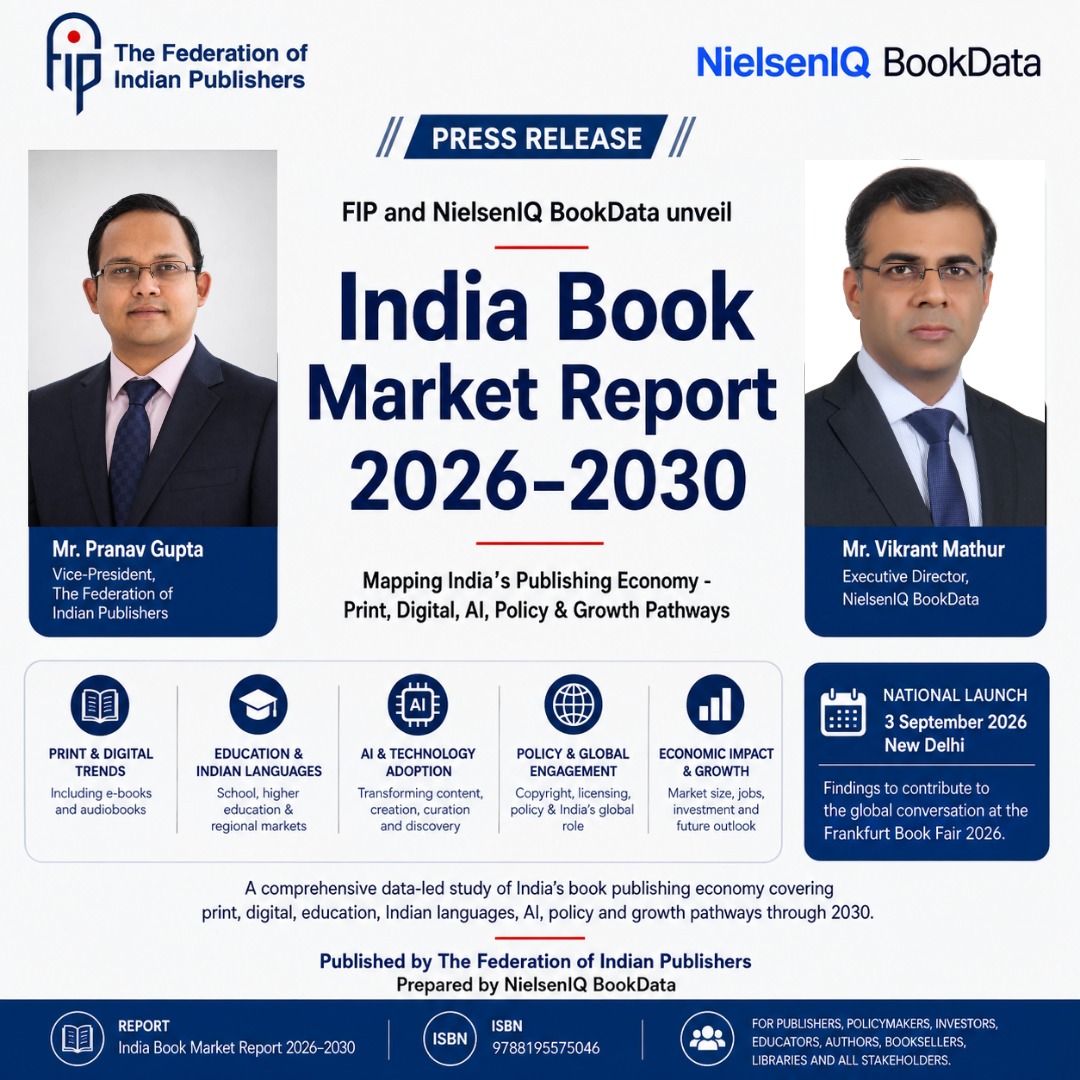
New Delhi, Sept 01: The Federation of Indian Publishers (FIP), in collaboration with NielsenIQ BookData, today announced the release of the India Book Market Report 2026-2030, a comprehensive study mapping the scale, structure, transformation and future growth opportunities of India’s book publishing industry.
Building on the landmark India Book Market Report released in 2022, the new edition looks ahead to the forces likely to reshape publishing over the remainder of the decade, including Artificial Intelligence, digitisation, new distribution models, the growth of Indian-language markets and India’s expanding role in the global publishing ecosystem.
The report analyses print and digital trends including e-books and audiobooks across school, higher education, trade and scholarly publishing. It also evaluates the sector’s economic impact, employment, technology adoption, copyright and licensing and the evolving policy environment.
This study combines extensive industry research, stakeholder consultations and market intelligence to help publishers, policymakers, investors, educational institutions, technology companies, authors, booksellers, libraries, and other stakeholders make more informed data driven decisions.
Data as Infrastructure for the Industry
Pranav Gupta, Vice President, Federation of Indian Publishers and Project Leader, India Book Market Report 2026-2030, said:
“Publishing has always been fundamental to India’s intellectual, educational and cultural progress. But an industry of this scale and strategic importance cannot plan its future on perception or anecdotal evidence alone. It needs credible data, continuous research and an evidence base that policymakers, businesses and institutions can confidently work with.”
“For us, the India Book Market Report 2026-2030 is therefore much more than a report. It is an industry infrastructure project. It attempts to create a common factual foundation from which we can discuss growth, investment, copyright, technology, education, Indian languages, exports and public policy. As India moves towards becoming one of the world’s leading knowledge economies, publishing must be recognised not simply as a commercial industry, but as an essential pillar of that ambition.”
Gupta added:
“The real value of data begins when it improves decisions. We hope this report helps move conversations about Indian publishing from assumptions to evidence and from evidence to meaningful action.”
Bringing Greater Market Intelligence to a Rapidly Evolving Sector
Vikrant Mathur, Executive Director, NielsenIQ BookData, India & GCC, said:
“India represents one of the most exciting and complex publishing markets in the world. Its scale, demographic profile, education ecosystem, linguistic diversity and increasing adoption of technology create significant opportunities, but they also make reliable market intelligence essential.”
“The India Book Market Report 2026-2030 brings together research and industry insight to provide a clearer understanding of how the market is evolving and where future opportunities may emerge. From print and digital formats to education, Indian languages, Artificial Intelligence, policy and international engagement, this report seeks to give stakeholders a comprehensive perspective on the forces shaping Indian publishing through 2030.”
Mathur further said:
“Reliable data enables businesses to invest with greater confidence, allows policymakers to frame better-informed interventions and helps the international publishing community understand India more accurately. We believe this report can serve as an important reference point for all three.”
From India to the Global Publishing Conversation
Following its national launch in New Delhi on 3 September 2026, the findings of the India Book Market Report 2026-2030 are also expected to contribute to the international conversation around Indian publishing, including at the Frankfurt Book Fair 2026.
As global publishers, technology companies, educational organisations, and investors look to India, the report offers a more structured, evidence-led view of the country’s domestic publishing ecosystem and its international potential.
The Federation of Indian Publishers published the report, and NielsenIQ BookData prepared it.
1, Sep 2026
Festive Shopping Set to Lift GST Collections as Consumer Spending Gains Strength
New Delhi, Sep 1: India’s GST collections are expected to gain further momentum in the coming months as festive-season shopping and stronger consumer spending support economic activity.
Industry experts believe higher spending during the festive period could translate into stronger GST revenues, particularly across sectors such as automobiles, consumer electronics, retail, FMCG and other discretionary categories.

India’s gross GST collections rose 14.8 per cent year-on-year to nearly Rs 2 lakh crore in August 2026, while net collections increased 8.3 per cent after accounting for refunds. The latest numbers indicate continued strength in economic activity and tax compliance.
The upcoming festive season is expected to provide another boost as households typically increase spending on products and services. Stronger consumption can benefit businesses across the supply chain, from manufacturers and wholesalers to retailers, logistics companies and digital payment providers.
The outlook is also supported by India’s broader economic performance. The economy grew 7.8 per cent in the April-June quarter, with consumption and private investment contributing to the expansion.
For businesses, stronger festive demand could improve sales volumes and provide a positive start to the second half of the financial year. For the government, higher GST collections would strengthen revenue flows and provide greater fiscal flexibility.
However, global risks remain a factor to watch. Elevated crude oil prices, geopolitical tensions and inflationary pressures could affect household budgets and business costs if they persist.
With consumer sentiment showing resilience, industry experts expect the festive season to play an important role in sustaining India’s consumption momentum and supporting GST revenue growth in the months ahead.
1, Sep 2026
Force Motors Reports 62 percentage Growth in Domestic Wholesales in August 2026
Mumbai, Sep 01: Force Motors Limited, India’s largest van maker and an automotive manufacturer, reported total domestic sales of 3,721 units in August 2026, registering a strong 62% growth compared to 2,295 units sold in August 2025. The strong growth reflects healthy demand across the company’s vehicle segments, with customers responding positively to its diverse product portfolio.

A key highlight of the recent period has been the introduction of the new Force Traveller N and Urbania Deluxe, both of which have received an encouraging response from the market. Following the initial scale-up of these new offerings, volumes have stabilised since launch, enabling the company to meet market demand with greater consistency. The Traveller N builds on the strong legacy of the Traveller, while the Urbania Deluxe further strengthens Force Motors’ presence in the premium shared mobility segment.
Commenting on the performance, Mr. Prasan Firodia, Managing Director, Force Motors Limited, said,
“The strong growth in August is encouraging and reflects the positive response we are seeing across our portfolio. The recent introduction of the Traveller N and Urbania Deluxe has further strengthened our product offering, and we are pleased with the response from our customers.
We will continue to stay close to our customers, understand their needs and keep improving our products to serve them better. As we build on this momentum, our focus will remain on delivering the right products and experiences, while continuing to execute with consistency.”
1, Sep 2026
Singapore Market Update: STI Falls Nearly 1 pc as Oil Surge Hits Sentiment
Singapore, Sep 1: Singapore’s stock market came under pressure on Tuesday as rising crude oil prices and continued geopolitical tensions made investors more cautious.
The Straits Times Index (STI) ended the session at 5,710.37, down 44.99 points, or 0.8 per cent, from the previous close. The index moved between 5,694.39 and 5,770.33 during the day.
The decline followed a weaker trend across several Asian markets as investors assessed the possible economic impact of higher energy prices and growing uncertainty in global markets.
Rising oil prices remained a major concern. Higher energy costs can increase expenses for companies, put pressure on consumers and add to inflation, potentially influencing the outlook for interest rates.
Geopolitical tensions also kept investors on edge, encouraging a more cautious approach to riskier assets. Market participants are closely watching developments in the Middle East for signs of further disruption to global energy supplies.
Despite the overall decline, some Singapore-listed companies saw positive corporate developments. Hong Leong Asia gained nearly 2 per cent after its subsidiary renewed its application for a listing on the Main Board of the Hong Kong Stock Exchange.
Keppel DC REIT also remained in focus after agreeing to acquire an 88.62 per cent effective stake in two hyperscale data centres in Japan, strengthening its exposure to the growing digital infrastructure sector.
Vibrant Group announced the acquisition of a 60 per cent stake in Fair Breeze Trading for around SG$7.7 million.
Looking ahead, investors are expected to closely track crude oil movements, global interest rates, bond yields and geopolitical developments. With external uncertainties still high, Singapore’s stock market may remain volatile in the near term.
The market’s direction will largely depend on whether oil prices stabilise and global risk sentiment improves.
1, Sep 2026
Chennai Gears Up for the Fourth Edition of HCL Cyclothon
Chennai, Sep 01: HCL Group, a US Dollar 14.8 billion global conglomerate, announced the launch of the 2026 edition of HCL Cyclothon Chennai, scheduled for October 11, 2026. The event is being organised in association with Tamil Nadu Government, being powered by Sports Development Authority of Tamil Nadu and under the aegis of Cycling Federation of India. HCL Cyclothon Chennai will bring together professional and amateur cyclists for a competitive and community-driven celebration of cycling in Chennai. Registrations for the event are open now and will close on September 27, 2026.
The Chennai edition will feature a Professional Elite Road Race, Amateur Road Race, Amateur MTB Race and Green Ride, catering to cyclists across different levels of experience and interests. The Professional Elite Road Race will cover 54 km, while the Amateur Road Race will be held across 54 km and 28 km categories. The Amateur MTB Race will cover 28 km, while the non-competitive Green Ride will cover 10 km. The event will offer a total prize purse of ₹33.6 lakh, including ₹15 lakh for the Professional Elite Road Race, ₹12.6 lakh for the Amateur Road Race and ₹6 lakh for the Amateur MTB Race.
The Professional Elite Road Race is open to cyclists aged 18–40 years and will be conducted as a mass-start race. Participation in the professional category will be through the Cycling Federation of India. The Amateur Road Race will have age categories of 18–30, 30–40, 40–50 and 50+ years, with separate prizes for men and women. The Amateur MTB Race will also feature the same age groups.
Commenting on the announcement, Nikhil Soni, AGM- Marketing, HCL Group, said,
“HCL Cyclothon continues to provide a platform for cyclists across diverse levels to participate, compete and experience the sport. With the yet another Chennai edition, we look forward to bringing the cycling community together once again and encouraging more people to take up cycling as part of an active lifestyle. Through initiatives such as HCL Cyclothon, we remain committed to creating opportunities for people to engage with sport and build healthier communities.”
The event will also include the Green Ride, a 10 km non-competitive ride that is open to participants using any type of bicycle. The initiative is designed to encourage wider participation in cycling beyond competitive racing.
The HCL Cyclothon Chennai 2026 will also follow defined technical guidelines for participating bicycles. Road, hybrid, gravel and MTB bicycles are permitted across the relevant categories, subject to category-specific specifications. Participants using bicycles outside the permitted specifications may participate but will not be eligible for prize money.
1, Sep 2026
Matrix Geo Completes 314 km Geospatial Survey Across Five Highway Sections for RITES and NHAI
New Delhi, Sep 1: Matrix Geo Solutions Limited, a geospatial technology and engineering consultancy, has completed a highway survey assignment spanning approximately 314 km across five road sections under LOT-2/HARYANA/Package-1. The project was awarded by RITES Limited, a Navratna Enterprise of the Government of India under the Ministry of Railways, on behalf of the National Highways Authority of India .

The assignment was part of consultancy services for preparing a Detailed Project Report for the development of economic corridors, inter-corridor and feeder routes aimed at improving freight movement efficiency in India. Matrix Geo Solutions was responsible for mapping the physical, utility and land-related characteristics required across the identified highway sections.
The work combined several survey technologies within one assignment. Topographic data was captured using Aerial/Mobile LiDAR and UAV systems, while Ground Penetrating Radar was used for utility mapping. The scope also covered Final Location Survey, land acquisition support and digitization of cadastral maps.
The five road sections covered were Rewari–Narnaul–Pacheri Kalan on NH-11, Narnaul–Nangal Chaudhary–Paniyala Mor on NH-148B, Gurgaon–Pataudi–Rewari on NH-352W, Sangat Kalan–Mandi Dabwali–Sangaria on NH-54, and Bhiwani–Bawani Khera–Hansi–Barwala on NH-148B.
The assignment was executed with a contract value of ₹2,82,64,571 including GST. RITES Limited has now issued an Experience/Completion Certificate dated 21 August 2026, confirming the successful and satisfactory completion of the work.
Commenting on the completion, Mr. Rahul Jain, Managing Director, Matrix Geo Solutions Limited, said,
“Projects of this scale and duration require consistency, coordination and attention to detail throughout their execution. I would like to thank everyone involved for their contribution in bringing this assignment to completion. The work required sustained coordination across field surveys, data processing and project requirements over an extended period. Ensuring that each stage was executed with the required accuracy and discipline was central to completing the assignment successfully.”
For a project of this nature, the challenge extends beyond collecting survey data. Different datasets need to remain spatially consistent so that terrain information, underground utilities, road alignments and cadastral records can be used within the same project framework. This was particularly relevant given the length and varied nature of the five road sections covered under the assignment.
The completed assignment adds to Matrix Geo Solutions’ experience in large-scale highway surveying and geospatial mapping. It also represents an integrated use of aerial, mobile and ground-based technologies for infrastructure project preparation, where accurate spatial information is required across multiple stages of planning and development.


