


1, Sep 2026
India-Uzbekistan Payment Deal Brings UPI Closer to Global Mainstream
New Delhi, Sep 1: India’s digital payments ecosystem is taking another step towards global expansion as NPCI International Payments Ltd (NIPL) partners with Uzbekistan’s National Interbank Processing Centre (NIPC) to enable UPI-based merchant payments across the country.
Under the new arrangement, Indian tourists, business travellers and students visiting Uzbekistan will be able to use their UPI-enabled applications to scan the country’s UZQR code and make payments at participating merchants.

The commercial agreement between NIPL, the international arm of the National Payments Corporation of India, and NIPC, which operates Uzbekistan’s HUMO payment system, was signed on August 30 during Prime Minister Narendra Modi’s visit to Uzbekistan.
The partnership follows approvals from the Reserve Bank of India and the Central Bank of Uzbekistan. HUMO has been designated as NIPL’s authorised partner for cross-border merchant acceptance.
The integration of UPI with Uzbekistan’s national QR infrastructure is expected to make everyday payments easier for Indian visitors. Travellers will be able to pay directly from their Indian bank accounts, reducing the need to carry large amounts of cash or depend entirely on international payment cards.
The development could also benefit Uzbekistan’s tourism, hospitality, retail and service sectors by making payments more convenient for Indian visitors. Hotels, restaurants, shops and other merchants can gain access to another digital payment channel as the movement of Indian travellers between the two countries grows.
From India’s perspective, the agreement strengthens the international presence of UPI and highlights the expanding role of Indian digital payment technology in cross-border commerce.
The partnership also creates scope for deeper cooperation in financial technology, digital payments and related services between the two countries. For businesses, easier payment connectivity can support tourism spending, trade-related travel and other commercial activities.
UPI is already accepted in several international markets, including Singapore, the United Arab Emirates, France, Mauritius, Nepal, Bhutan, Qatar, Sri Lanka, Cambodia and Greece.
The addition of Uzbekistan further expands the international footprint of the Indian payment platform and strengthens India’s efforts to promote digital payment connectivity with partner countries.
The agreement comes at a time when QR-based payments are becoming increasingly important in international travel. For consumers and businesses alike, interoperable digital payment systems can make cross-border transactions faster, simpler and more accessible.
The India-Uzbekistan partnership therefore goes beyond a payment arrangement, offering potential benefits for tourism, retail, hospitality, fintech and wider economic engagement between the two countries.
- 0
- By Neel Achary

1, Sep 2026
ClearTax and Odoo Partner to Embed Tax Compliance and E-Invoicing Across Five GCC Markets
Dubai, UAE, Sep 1: ClearTax, a global tax compliance and e-invoicing technology company, has announced a partnership with Odoo, one of the world’s leading open-source business management platforms, to simplify tax compliance and e-invoicing for businesses across the Gulf region.
As part of the partnership, Odoo will develop a native integration with ClearTax for customers in the UAE and GCC. The integration will enable Odoo users to manage indirect tax compliance, invoicing and evolving regulatory requirements directly within their existing ERP workflows.
The partnership comes as governments across the region accelerate the digitisation of tax administration and introduce new e-invoicing frameworks. This is creating a growing need, particularly among small and medium-sized enterprises, for technology that can reduce manual processes, improve accuracy and keep pace with changing regulations.
Through the native connector, Odoo customers will be able to access ClearTax’s compliance capabilities through a simplified, self-service onboarding journey. By embedding compliance into software businesses already use, the integration is expected to reduce the time, effort and operational complexity involved in implementing compliant tax and invoicing processes.
The partnership is expected to initially benefit an estimated 4,000 to 5,000 businesses using Odoo across the UAE and Oman, while also extending access to Odoo customers across the wider GCC. ClearTax and Odoo plan to explore opportunities to expand the partnership into additional international markets over time.
“Businesses do not want tax compliance to operate as a separate and disconnected process. They expect it to be built into the systems they already use to manage their operations,” said Archit Gupta, Founder and CEO, ClearTax. “Our partnership with Odoo responds directly to that need. By bringing ClearTax’s compliance infrastructure into the Odoo ecosystem, we are making it easier for businesses across the region to manage regulatory change while remaining focused on growth.”
Pavitra Singh, Managing Director at Odoo Middle East, said, “The partnership between Odoo and ClearTax will allow Odoo customers to seamlessly stay compliant with the ever-evolving e-invoicing landscape across the region. At Odoo, our priority has always been to provide fully localized solutions that meet the needs of each market we operate in, and our partnership with ClearTax is a step in that direction.”
Odoo has established a strong presence among small and medium-sized businesses through its integrated suite of applications covering accounting, finance, sales, inventory, manufacturing, human resources, customer relationship management and e-commerce.
ClearTax supports more than 5,000 enterprises globally and processes over one billion e-invoices annually. Its tax compliance and e-invoicing platform enables businesses to integrate regulatory compliance into existing ERP and finance systems through automation, intelligent workflows and API-led integrations.
By combining Odoo’s business management platform with ClearTax’s compliance technology and regional expertise, the partnership aims to make tax compliance a more seamless part of everyday business operations for companies across the Gulf.
1, Sep 2026
Argentinian President Javier Milei and FIA President Mohammed Ben Sulayem open FIA American Congress in Buenos Aires
During their meeting, the two Presidents discussed the future of mobility and motorsport in Argentina and across the Americas

Dubai, UAE, Sept 01: The President of Argentina, Javier Milei, and FIA President H.E. Mohammed Ben Sulayem have officially opened the 2026 FIA American Congress in Buenos Aires, bringing together FIA Member Clubs from across the Americas to advance the future of mobility and motor sport.
President Milei joined President Ben Sulayem and representatives from 32 FIA Member Clubs from North, Central and South America and the Caribbean at the opening of the three-day Congress, hosted by the Automóvil Club Argentino (ACA).
Ahead of the opening yesterday (Monday), President Ben Sulayem met with President Milei, with discussions focused on the opportunities to strengthen cooperation between the FIA and Argentina across both mobility and motorsport.
The two Presidents discussed Argentina’s ambitions for the continued growth of motorsport, including Formula One and the FIA’s five other World Championships, building on a proud racing heritage and passionate fanbase.
They also discussed the rapidly changing mobility landscape and the importance of collaboration between governments, FIA Member Clubs and industry to deliver safer, more accessible and more sustainable transport for road users.
The meeting continued a series of high-level engagements by the FIA President across South America, following meetings with President José Antonio Kast of Chile and President Santiago Peña of Paraguay in recent days, as the Federation works with governments and its Member Clubs to grow motorsport and strengthen mobility across the region.

Opening the Congress, the President of Argentina Javier Milei said: “The Argentine Automobile Club has made an enormous contribution to national motorsport, and Argentina is a country that loves cars. The Argentine passion for racing is timeless.
“That is why I invite you to dream with me. Argentina has all the conditions necessary to once again welcome Formula One and the World Rally Championship onto its calendar. We have the tradition. We have the drivers. And now we are once again developing the institutional seriousness that these categories demand before choosing a country. We have absolutely everything.
“It is time to accelerate at full speed in this direction, and I invite you to make this [FIA American] Congress the first step towards that return. Because at the end of the day, the freedom to move, to choose the car you drive, the route you take and the destination you want to reach is one of the most concrete and everyday expressions of freedom.
“Today, we welcome you with those same roads, more open than ever, and with the same conviction that anyone who wants to move, compete or build in Argentina should be able to do so in freedom. Let us move forward together at full speed to turn this dream into reality.”
FIA President H.E. Mohammed Ben Sulayem said: “It was an honour to meet with President Milei and to open the FIA American Congress together here in Buenos Aires. Argentina has an extraordinary history in motor sport and a passionate community of fans, competitors and volunteers.
“We discussed how we can build on that heritage, create new opportunities for the next generation and support Argentina’s ambition to bring more international motor sport to the country.
“Across mobility too, this is a region undergoing significant change. Our Member Clubs are at the heart of that transformation, and this Congress is about bringing their knowledge together, sharing solutions and ensuring the FIA continues to deliver for road users and motor sport communities across the Americas.”

The Congress is being hosted by the Automóvil Club Argentino, one of the FIA’s long-standing Member Clubs with over 122 years of operations in the country, playing a central role in the development of both mobility and motor sport across Argentina.
The three-day FIA American Congress is providing a platform for FIA Member Clubs to share expertise and develop solutions around some of the biggest opportunities and challenges facing motorsport and mobility across the region.
Argentina provides a fitting backdrop. Motorsport is deeply embedded in the country’s culture, from five-time FIA Formula One World Champion Juan Manuel Fangio to current Formula One driver Franco Colapinto and the country’s thriving national competition scene across touring cars, rallying, karting and single-seaters.
Alongside its sporting heritage, Argentina is one of Latin America’s most significant mobility markets, with more than 15 million vehicles, an extensive road network and a major domestic automotive industry.
1, Sep 2026
UPI Sets New Monthly Record as Digital Payments Touch 24.51 Billion in August
New Delhi, Sep 1: India’s digital payments landscape continued to expand at a rapid pace in August, with the Unified Payments Interface (UPI) recording a new monthly high of 24.51 billion transactions worth Rs 29.82 lakh crore.
Data released by the National Payments Corporation of India (NPCI) showed that UPI transaction volumes increased 3.6 per cent from 23.66 billion in July. On a year-on-year basis, transaction volumes rose 22 per cent, highlighting the growing dependence of consumers and businesses on instant digital payments.

The value of transactions, however, remained broadly stable on a monthly basis. UPI processed transactions worth Rs 29.88 lakh crore in July, compared with Rs 29.82 lakh crore in August, marking a marginal decline of around 0.2 per cent. On a year-on-year basis, transaction value increased 20 per cent.
On an average day, UPI processed nearly 791 million transactions during August, while the average daily transaction value stood at around Rs 96,205 crore.
The latest performance underlines how deeply digital payments have become embedded in everyday economic activity. From neighbourhood shops and food outlets to online purchases, utility payments and money transfers, UPI has increasingly become a preferred payment option because of its speed and convenience.
The sharp rise in transaction volumes, despite the marginal decline in overall value from July, also points to the continued popularity of smaller-ticket digital payments. The government has noted that a large share of UPI merchant transactions consists of payments below Rs 500, reflecting its widespread use for routine purchases.
UPI’s growth has been particularly striking over the past decade. The platform has evolved from a relatively new digital payment system into a core part of India’s financial infrastructure, with annual transaction volumes rising dramatically since its launch.
The August milestone comes after UPI crossed the 23-billion monthly transaction mark earlier this year. Its latest performance further reinforces the platform’s position at the centre of India’s shift towards a real-time, mobile-first payments ecosystem.
Meanwhile, the Immediate Payment Service (IMPS) recorded 360 million transactions in August, with the transaction value rising 18 per cent year-on-year to Rs 7.04 lakh crore, according to NPCI data.
UPI is also steadily expanding its international footprint, with the payment system now available for merchant payments in multiple countries. The expansion is enabling Indian travellers to use familiar UPI-enabled applications for digital payments overseas while strengthening India’s presence in the global real-time payments ecosystem.
With transaction volumes continuing to set new records, the August numbers highlight the increasing role of digital payments in India’s consumer economy and the growing preference for fast, convenient and interoperable payment methods.
1, Sep 2026
HiLITE Group Hands Over Olympus Tower 1, Reshaping Modern Urban Living and a Sense of Community at HiLITE City, Calicut
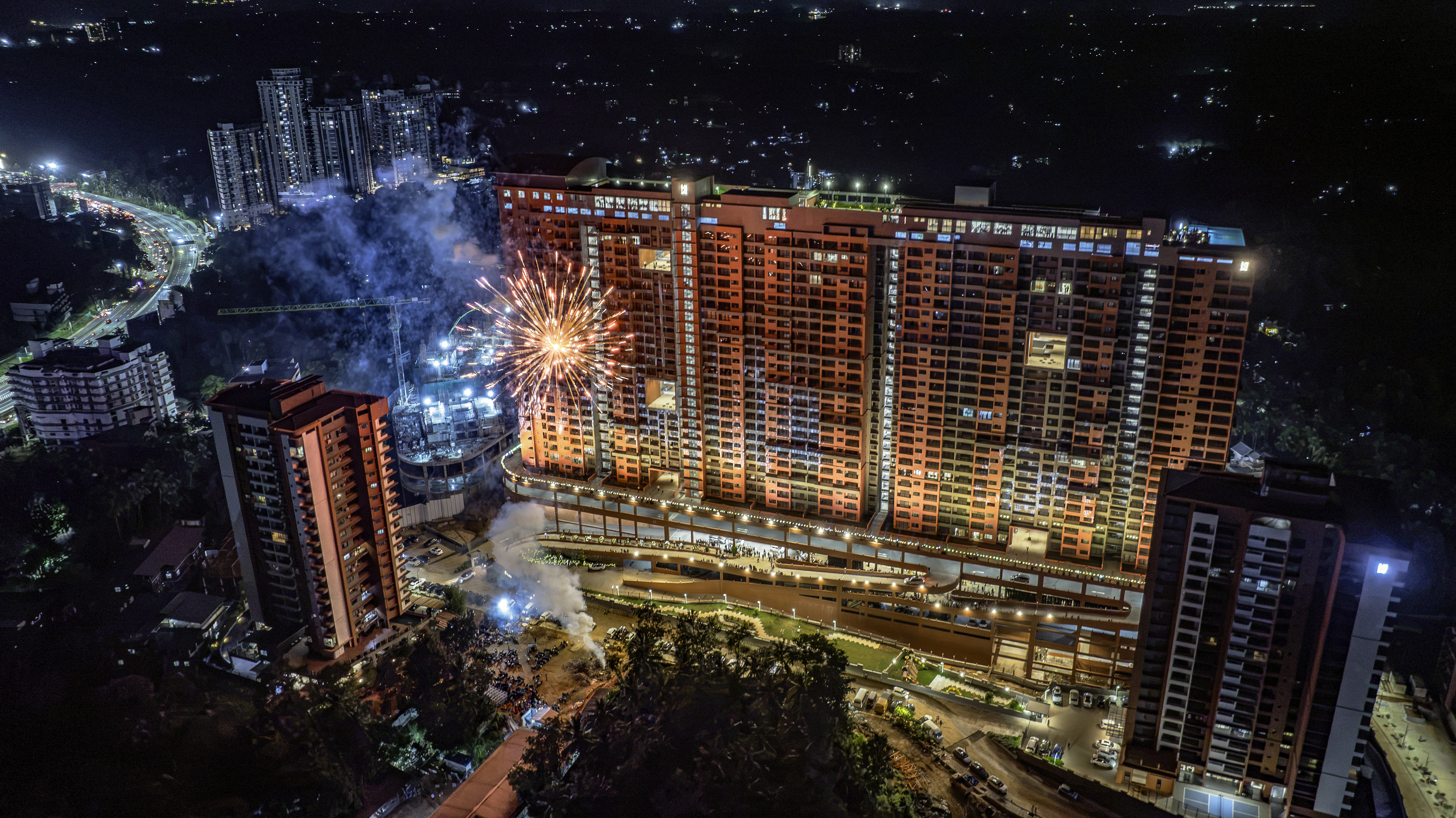
Kozhikode, Sept 01: HiLITE Group has handed over Olympus 1, the first tower of HiLITE Olympus, an ultra-modern residential development that brings together luxury, expansive amenities and nature at HiLITE City, Kozhikode. Set across 7.07 acres, Olympus features more than 100 amenities and India’s largest terrace recreation space, spanning over 40,000 sq ft, alongside 526 apartments across 33 floors. With a built-up area of 12,70,039 sq ft and apartments ranging from 919 sq ft to 3,150 sq ft, Olympus is designed to offer a distinctive, future-ready living experience. Sustainability and urban forestry are woven into the development, creating a balance between modern comforts and green spaces. The second tower, Olympus 2, comprises 412 apartments across 32 floors and is currently under construction.
Unlike conventional designs where multiple towers accommodate numerous apartments, all 938 apartments across the project are designed within just two towers. Each tower features a single straight passage connecting the apartments, a distinctive architectural choice that enhances connectivity and togetherness among residents. Beyond its architectural brilliance, Olympus is built on the idea of community living.
The concept of community living within a luxurious space was a vision deeply rooted in the mind of P. Sulaiman, the driving force behind HiLITE. “When someone chooses to settle in their homeland, they should not only experience global standards of luxury but also be part of a vibrant, secure, and engaging community,” said P. Sulaiman, Chairman, HiLITE Group. His vision was brought to life through the meticulous design crafted by Stapati Architects, ensuring that Olympus stands as a benchmark in modern living.
This sense of community is further strengthened by 100+ unparalleled amenities spread across what is among India’s largest recreation terraces. From expansive social spaces to world-class recreational facilities, every detail has been thoughtfully planned to create a living experience like no other.
Olympus 1‘s handover comes close on the heels of two other significant project completions by HiLITE Group, HiLITE Cypress and HiLITE Patras, emphasizing the Group‘s consistent momentum in delivering premium residential spaces across Calicut. The Group has already inaugurated HiLITE Countryside project at Chemmad, an innovative retail concept introduced by the Group, for smaller towns and emerging Tier 3 markets. It functions as a compact extension of the Group’s flagship HiLITE Mall format, tailored to deliver high-quality retail, dining, and entertainment experiences closer to rapidly developing locales.
“Bringing a project of this scale and ambition to Calicut has been both a privilege and a responsibility, and we are truly proud to see it take shape as one of the finest residential innovations in the region,” said Ajil Mohammed, CEO of HiLITE Group.
With 22 apartments on a single floor, HiLITE Olympus sets several records straight. Apart from the enormous terrace, the Plaza on the 4th Basement, sprawling across 20,000+ sq ft, provides further space for various amenities. Residents of HiLITE Olympus need not look elsewhere for entertainment and relaxation, they only need to step onto the recreational floor.
“This project is the culmination of meticulous planning and architectural innovation to redefine what urban living truly means. Every detail, from its architecture to its amenities, has been thoughtfully designed to give our residents an unmatched quality of life,” said Mohamed Fazeem, CEO – HiLITE Builders.
Located within HiLITE City, one of India’s largest mixed-use developments, HiLITE Olympus offers residents a host of added advantages, all within reach at HiLITE City. This includes the HiLITE Mall and HiLITE Business Park, along with everyday conveniences such as Hug a Mug, a 24×7 coffee shop, and Palaxi Cinemas, an 8-screen world-class theatre. Residents can also unwind at Compass, a dedicated center for rejuvenation, or spend time at Club 6T6. Adding to the everyday convenience is a 65,000 sq. ft. hypermarket within HiLITE Mall, while HiLITE City is home to over 2,000 apartments.
31, Aug 2026
PaySprint Launches SprintPGx: India’s Most Intelligent Multi-Gateway Payment Platform
New Delhi, 31st August 2026: PaySprint Private Limited, one of India’s fastest-growing B2B Banking FinTech and RegTech infrastructure companies, today announced the launch of SprintPGx, an intelligent Multi-PG (Multi Payment Gateway) platform purpose-built for Indian enterprises. SprintPGx eliminates one of the most persistent and costly pain points in digital commerce: payment failures. By connecting businesses to 10+ payment gateways simultaneously through a single integration and using artificial intelligence to route every transaction in real time, SprintPGx delivers higher conversion, lower cost, and near-zero downtime without any change to the customer checkout experience.
The Silent Revenue Drain Facing Indian Enterprises
On average, 2 to 5% of all online payment attempts in India fail, a figure that may seem small until the scale is applied. For an enterprise processing ₹100 crore in monthly transaction volume, that translates to ₹2 to 5 crore in lost revenue every single month from payments that simply did not go through.
These failures stem from a single structural vulnerability: dependence on one payment gateway. When that gateway experiences downtime, high traffic, or approval rate dips for a specific card type or bank, businesses are left powerless. SprintPGx was built to permanently solve this problem.
How SprintPGx Works
SprintPGx functions as an invisible intelligence layer between a merchant’s checkout page and multiple payment gateways. When a customer initiates a payment, SprintPGx receives the transaction in under 100 milliseconds, analyzes the card type, issuing bank, transaction amount, time of day, and historical success rates, and routes the payment to the gateway most likely to approve it, all before the customer notices anything.
If the selected gateway fails or times out, SprintPGx automatically switches to the next best option in milliseconds. The platform supports three core routing strategies: Success Rate Routing (routes to the gateway with the highest historical approval rate for that card-bank combination), Cost-Based Routing (directs transactions to the cheapest available gateway, reducing MDR costs by up to 20 basis points), and Load Balancing (distributes payment load across gateways during peak traffic periods such as festive sales or IPL ticketing).
SprintPGX Key Highlights
What sets SprintPGx apart from every other multi gateway solution in the market is how those routing rules are created. Merchants do not need to write code, build a separate integration or manually configure logic to change how their transactions are routed. They simply tell PIX, PaySprint‘s in built AI agent, what they want in plain conversational language, and the rules are applied. A merchant can state that all high value transactions on a particular bank’s cards should go to the gateway with the best approval rate, or that traffic should shift to the lowest cost provider after a certain hour, and PIX configures it instantly. This makes SprintPGx the only platform of its kind in India where payment routing can be managed entirely through natural language, without engineering support or vendor intervention.
Performance That Speaks for Itself
|
+2 to 5% Payment Success Rate Uplift |
>20bps MDR Cost Savings |
99.99% Uptime SLA |
<80ms Routing Decision Speed |
A Complete Payment Operations Platform
Beyond intelligent routing, SprintPGx is a full-stack payment operations platform. Its Unified Dashboard consolidates all transactions, settlements, refunds, and reports from every connected gateway into a single real-time view, ending the operational burden of logging into multiple portals. Automated Reconciliation reduces reconciliation overhead by up to 3x for finance teams. The platform‘s PCI-DSS-compliant, enables seamless recurring payments and card-on-file transactions for subscriptions and EMI-based businesses.
SprintPGx is integrated with 10+ payment gateways including Razorpay, PayU, Cashfree, Phonepe, and Paytm PG and can handle 10,000+ transactions per second, making it purpose-built for India’s highest-volume enterprises. Developer-friendly SDKs for Node.js, Python, PHP, Java, and Go, alongside native mobile SDKs and pre-built plugins for Shopify, WooCommerce, and Magento, allow most merchants to go live in hours.
Security & Compliance at the Core
SprintPGx is certified under ISO 27001, SOC 2 Type II, and PCI DSS, the most comprehensive compliance stack available in the Indian payments market. The platform employs AES-256 encryption for data at rest, TLS 1.3 for data in transit, Zero-Trust architecture, multi-factor authentication, and 24/7 real-time monitoring. Regular VAPT testing and annual third-party security audits ensure the platform continues to meet the rigorous standards of regulated industries.
“At PaySprint, we built SprintPGx because we saw a problem that was quietly costing Indian enterprises crores every month. A single payment gateway is no longer enough for businesses operating at scale. SprintPGx is not just a routing tool; it is the payment intelligence layer that Indian enterprises have needed. We are giving businesses the same kind of infrastructure that was previously only available to the largest global players, and we are delivering it with a compliance stack, a dedicated implementation team, and India-first thinking baked into every feature.”
S. Anand, Founder & CEO, PaySprint
Who SprintPGx Is Built For
SprintPGx is purpose-designed for e-commerce and D2C brands with high-volume transaction peaks, fintech and lending platforms requiring compliance and recurring payment support, healthcare and insurance providers with sensitive billing requirements, EdTech and subscription businesses dependent on card-on-file transactions, event ticketing and travel platforms that cannot afford checkout failures during demand spikes, and enterprise retail chains requiring unified reconciliation across multiple locations.
31, Aug 2026
India’s Toll Revenue Eyes 12 pc Growth in FY28 on Higher Rates, Steady Traffic
New Delhi, Aug 31: India’s toll collection revenue is projected to grow by up to 12 per cent in FY28, supported by periodic toll-rate revisions and resilient traffic movement, according to an industry report.
The expected growth underlines the continued expansion of India’s road infrastructure network and steady movement of passengers and goods across national highways and expressways.
Higher toll rates are expected to provide a direct boost to collections, while stable traffic volumes could offer additional support. Rising freight movement would be particularly important for sustaining revenue growth, as commercial vehicles account for a significant share of highway traffic.
The outlook is also positive for road developers, operators and infrastructure investment vehicles that depend on toll revenues for cash flows. Stronger collections can improve the financial performance of operational road assets and support investment in the sector.
India’s expanding highway network is another structural factor supporting the revenue outlook. As new expressways and highway stretches become operational, the number of toll-paying routes is expected to increase, creating additional opportunities for revenue generation.
The trend has wider economic significance. Efficient highways can reduce transportation time and logistics costs, improve connectivity between production centres and markets, and support the movement of goods across states. Recent government data also highlights the rapid expansion and digitisation of India’s national highway network, with FASTag playing a major role in streamlining toll payments.
At the same time, the sector could face challenges if economic activity or freight movement slows, while diversion of traffic to alternative routes could affect individual toll-road projects.
Overall, the projected double-digit growth in toll collections points to continued momentum in India’s infrastructure ecosystem. Rising traffic, periodic rate revisions and the addition of new road assets are expected to remain key drivers of revenue growth through FY28.
31, Aug 2026
MRO-TEK Returns to Its Legacy Identity as MRO-TEK Networks Ltd charting its next chapter in Networking
Bengaluru, 31 August 2026: Umiya Buildcon Limited today announced its official company name change to MRO–TEK Networks Ltd, reaffirming its legacy identity and strategic focus on telecom and networking solutions. The move aligns the company’s corporate identity with its flagship MRO–TEK brand, strengthening market recognition while reflecting its long-term vision for growth in India’s evolving digital infrastructure ecosystem.
The MRO–TEK brand is arguably the oldest and first Indian Network OEM company and has long been associated with India’s telecom and networking industry, backed by decades of engineering expertise and trusted technology solutions. By returning to its legacy identity and strengthening the R&D, the company aims to solidify its market recall while reinforcing its long-term growth strategy in digital infrastructure and enterprise networking. MRO–TEK Networks Ltd designs and manufactures telecom and networking products and solutions that support enterprises, telecom operators and critical infrastructure across India.
Commenting on the announcement, Aniruddha Mehta, Chairman & Managing Director, MRO–TEK Networks Ltd, said: “MRO–TEK is more than a brand name; it represents our legacy, our technology heritage, and the trust we have built over the years. Returning to this identity is a strategic step that reflects our roots and increased investments into R&D expansion while positioning us for the next phase of growth. As India’s digital infrastructure continues to expand, we remain committed to delivering innovative and reliable solutions that create long-term value for our customers, partners, and stakeholders.”
As India accelerates investments in digital infrastructure, data centres, enterprise networking and secure connectivity, MRO–TEK Networks Ltd remains focused on expanding its technology portfolio through indigenous innovation while strengthening its position across telecom, enterprise and critical infrastructure segments.
Group Captain C.S. Krishnadas (Retd), CEO, MRO–TEK Networks Ltd, added: “Our renewed identity aligns our brand with our core strengths of indigenous product development & R&D and long-term vision. This transition reflects our focus on strengthening our market position while continuing to develop products that support the evolving requirements of enterprises and critical infrastructure. We remain committed to innovation, operational excellence, and sustainable growth as we move forward.”
The company will progressively transition its corporate communications, digital platforms and stakeholder engagement initiatives to reflect the MRO–TEK identity. The return to the MRO–TEK name does not impact the company’s operations, existing customer relationships, partnerships or commitments, ensuring seamless business continuity while reinforcing its positioning for future growth.
31, Aug 2026
Vedanta Oil and Gas Steps Up Mangala Field Recovery Efforts

As per its corporate filings, India’s leading private oil and gas producer, Vedanta Oil and Gas Limited plans to invest $200 million in FY27 across Rajasthan North to accelerate enhanced recovery initiatives, production optimisation and resource-to-reserve conversion programmes.
“From redefining India’s onshore oil landscape to emerging as a cornerstone of domestic oil production – the Mangala field stands as a testament to the country’s hydrocarbon journey. Today, we are focused on unlocking its next phase of growth. Through advanced technologies, targeted workovers, sidetracks and well interventions, we aim to increase recovery from 30% to 60%. We are also evaluating unconventional opportunities with proven partners to unlock additional value from the reservoir. With substantial potential still ahead, Mangala will continue to drive sustainable production and strengthen India’s energy security for decades ahead.”
31, Aug 2026
NAREDCO Maharashtra to advocate for Rs. 10,000 crore investment in Indian real estate
Mumbai, 31st August 2026: As India advances toward its Viksit Bharat vision, the real estate sector is emerging as a critical driver of economic growth, productivity, and job creation. The sector remains one of the largest contributors to employment generation, capital formation, and urban development, underpinning robust macroeconomic prospects with the potential to scale up to $10 trillion by 2047. Having reached a market size of $650 billion in 2025, the Indian real estate sector currently contributes 7.3% to the national GDP—a share projected to expand significantly to approximately 20% in the coming decades.
In a major push to accelerate this growth narrative, NAREDCO Maharashtra will host its flagship Real Estate & Infrastructure Investors’ Summit 2026 (REIIS 2026) on 3rd September 2026 in Mumbai. Centered on the theme ‘RE-Defining India’s Growth Story,’ REIIS 2026 aims to directly facilitate and promote foreign investments across Indian real estate. JLL India is releasing an exclusive report on redevelopment in Mumbai at the event. At the summit, NAREDCO will advocate for target investment commitments exceeding ₹10,000 crore, alongside the announcement of a landmark initiative by the Government of Maharashtra: the launch of an International Business & Finance Center (IBFC) in Nagpur to establish a new regional financial hub and decentralize economic growth across the state.
Speaking about the launch of an International Business & Finance Center (IBFC) at Nagpur, Shri Sanjay Meena IAS, Metropolitan Commissioner, NMRDA said, “Naveen Nagpur IBFC is envisioned as a landmark development that will create a new business and investment destination for Nagpur and Central India. Spread across 1,710 acres, it will offer integrated infrastructure and a complete business ecosystem for corporates, GCCs, startups and financial institutions. As NMRDA, our focus is to develop Naveen Nagpur with quality infrastructure, efficient governance and a strong investment environment, strengthening Nagpur’s position as a major economic destination in Central India.”
Driven by landmark infrastructure developments such as Mumbai 3.0, transit-oriented corridors, and urban redevelopment, Maharashtra‘s real estate sector is positioned for unprecedented expansion. Surging interest from international institutional investors across Japan, Korea, the Middle East, and other global markets forms part of a broader investment target for the state, comprising ₹10,000 crore in foreign direct investments (FDI) and domestic institutional capital.
The high-profile convergence at REIIS 2026 will bring together policymakers, global and domestic institutional investors, banking leaders, AI and proptech innovators, and key industry stakeholders to deliberate on capital flows, urbanization strategies, alternative financing, and technology integration in Indian real estate.
The day-long summit features a packed lineup, beginning with an exclusive Power Breakfast on “Mumbai 3.0: The Innovation City”, an AI and Proptech Pavilion, and a series of dynamic panel discussions covering themes such as alternative capital, cross-border expansions, AI integration, and real estate liquidity blueprints.
The summit will feature key addresses and participation from eminent leadership and dignitaries including Shri Devendra Fadnavis, Hon’ble Chief Minister, Government of Maharashtra; Pranav Adani, Director, Adani Enterprises, Gautam Singhania, Chairman, Raymond Realty, Durga Shanker Mishra, IAS (Retd), Former Chief Secretary, Uttar Pradesh; Paritosh Kashyap, Whole‐time Director, Kotak Mahindra Bank ; Kaku Nakhate, Chairperson, Bank of America Securities India; Ashutosh Singh, MD and CEO, BSE Indices; Dr. Sanjay Mukherjee, IAS, Commissioner, MMRDA; Sanjay Meena IAS, Metropolitan Commissioner NMRDA; Maninder Cheema, Executive Director, SEBI; Kaustubh Dhavse, Chief Advisor (Investments & Strategy) to the Chief Minister of Maharashtra, among others.
Speaking on the vision for the summit, Mr. Kamlesh Thakur, President, NAREDCO Maharashtra said, “REIIS 2026 comes at a pivotal juncture as Maharashtra leads transformative infrastructure and urban development. Under the theme ‘RE-Defining India’s Growth Story,’ the summit will bring together developers, venture capital and institutional investors to unlock sustainable capital flows, promote proptech adoption and shape actionable growth opportunities for the region’s evolving built environment.”
Emphasizing long-term opportunities, Dr. Niranjan Hiranandani, Chairman, NAREDCO India noted, “India’s growth narrative is closely linked to the trajectory of its infrastructure and real estate sectors. With initiatives such as Mumbai 3.0 reshaping connectivity, significant opportunities are emerging through residential, commercial, data centres and logistics. REIIS 2026 provides a platform to rethink investment strategies, harness AI and build resilient structures that can support India’s journey towards a multi-trillion-dollar economy.”
Mr. Sandeep Runwal, Chairman, NAREDCO Maharashtra said, “The next phase of India’s real estate growth will be shaped by the alignment of capital, innovation and infrastructure with the needs of a rapidly urbanizing economy. REIIS 2026 brings together developers, investors, financial institutions and technology leaders to foster stronger investment partnerships, explore innovative financing models and advance sustainable, technology-enabled urban development.”
Highlighting the macroeconomic momentum, Mr. Rajan Bandelkar, Former Vice Chairman, NAREDCO India stated, “India’s real estate sector has institutionalized into a mature asset class that commands deep global confidence. Also, with the NextGen leadership stepping up, their innovative approach and fresh perspectives are driving new value and opening up modern avenues for foreign and domestic investments. REIIS 2026 highlights the critical role of alternative capital, private equity, and structured investment vehicles in sustaining this momentum. By bringing together foreign and domestic funds, this summit will explore equity and debt structures necessary to finance India’s urbanization surge.”
India’s real estate investment market maintains exceptional momentum with Q1 2026 transaction volumes reaching USD 1.7 billion, a 37% year-on-year increase, driven by a 178% surge in core asset acquisitions to USD 1.03 billion, demonstrating sustained institutional investor confidence despite global macroeconomic complexity, according to JLL India. This growth comes despite extended decision-making timelines driven by global macroeconomic complexity, demonstrating the resilience and fundamental strength of India’s real estate market. The quarter witnessed a significant structural shift in investor preferences, with core asset acquisitions surging 178% to USD 1.03 billion. This trend has accelerated into Q2, with core asset deals already totaling USD 1.48 billion, signaling sustained confidence in stable, income-generating properties, JLL added.
Key Highlights & Market Projections for REIIS 2026
The summit will commence with an exclusive Power Breakfast focused on “Mumbai 3.0: The Innovation City,” followed by the inauguration of a dedicated AI and Proptech Pavilion. Throughout the day, high-level panel discussions and keynote fireside chats will feature leaders from global alternative asset manager Brookfield, Raymond Realty, and other esteemed industry speakers. Key sessions will also provide insights into the deployment of AI in Indian real estate, regional expansion strategies from local to pan-India footprints, and new blueprints for real estate liquidity.
• Foreign Direct Investment (FDI): Projected ₹10,000 crore in foreign investment inflows into Maharashtra‘s real estate and infrastructure projects in FY27.
• Proptech & AI Acceleration: Dedicated showcases on AI integration, automated property management, and tech-enabled construction efficiency.
• Mumbai 3.0 & Infrastructure Dialogue: Strategic discussions with state leadership on expanding urban transit corridors, industrial zones, and redevelopment blueprints.
The event will conclude with an address by Chief Guest Shri Devendra Fadnavis, Hon’ble Chief Minister of Maharashtra.


