


30, Jun 2026
Mumbai Property Registrations Hit Highest Level Since 2013, Up 6 pc in H1 2026
Mumbai, June 30: Property registrations in Mumbai increased by 6% in the first half of 2026, reaching their highest level since 2013, according to recent data released by industry sources.
The growth reflects sustained momentum in the residential real estate sector, supported by stable interest rates, improved buyer sentiment, and continued infrastructure development across the Mumbai Metropolitan Region. Market observers said that consistent housing demand has played a key role in maintaining strong registration numbers.
Demand was seen across both mid-income and premium housing segments, with end-user purchases contributing significantly to overall transactions. Developers also reported steady sales performance during the period, indicating stable market activity despite broader economic uncertainties.
Experts noted that ongoing infrastructure projects, better connectivity, and urban development initiatives have further strengthened confidence among homebuyers and investors. The real estate market has shown resilience, even amid inflationary pressures and global economic challenges.
Going forward, the sector is expected to maintain stable growth, though factors such as interest rate changes, affordability constraints, and policy developments will continue to influence market trends. Analysts will closely monitor upcoming data to assess whether the current momentum sustains in the coming quarters.
- 0
- By Neel Achary

30, Jun 2026
Akamai Survey Reveals AI Adoption Outpacing Security Readiness Among Enterprises in India
Bengaluru, India June 30: As organizations across India accelerate AI adoption and digital transformation initiatives, many remain unprepared to address the security risks that come with them. According to a new survey conducted by Akamai during its 2026 Partner Summit in India, senior business and technology leaders across partner organizations, including CEOs, CTOs, vice presidents, business heads, and cybersecurity specialists, are increasingly concerned about the cybersecurity challenges customers are facing amid accelerated digital transformation and AI adoption. With increasingly sophisticated cyberthreats, rising API attacks, and growing challenges in securing AI-driven environments, organizations are under increasing pressure to balance innovation with resilience.
Key findings
- API attacks have emerged as the leading cybersecurity concern: 79% of respondents cited API attacks as one of the top cyberthreats customers are most concerned about.
- Cyberthreats are becoming more sophisticated: 42% cited evolving attack techniques as the biggest security challenge customers are facing today.
- AI security readiness remains low: Only 17% believe organizations are very well prepared to manage security risks associated with AI adoption, highlighting a significant preparedness gap.
- Data privacy concerns dominate AI risk discussions: 70% identified data privacy and leakage as the top security concern emerging from AI adoption, reflecting growing apprehension around sensitive enterprise data exposure and governance risks.
As cloud adoption and AI implementation continue to grow across industries, security teams are facing growing pressure to protect a rapidly expanding attack surface. APIs now serve as the backbone of modern applications, cloud services, and AI ecosystems, making them an increasingly attractive target for cybercriminals.
The survey findings also point to a growing disconnect between AI adoption and organizational preparedness. While businesses are moving quickly to integrate AI into workflows, customer experiences, and decision-making processes, security frameworks and governance practices are struggling to keep pace. The results point to a critical challenge for enterprises: securing data, applications, and AI systems without slowing innovation.
“India is rapidly emerging as one of the world’s leading AI-driven economies, with organizations embracing AI across sectors to transform customer experiences and business operations,” said Mitesh Jain, Regional Vice President for Akamai India. “However, security readiness is not advancing at the same speed. Strengthening governance, data protection, and risk management will be essential to unlocking AI’s full potential safely and responsibly.”
As businesses continue to modernize their infrastructure and expand digital ecosystems, cybersecurity is expected to remain a strategic priority. Organizations that can effectively secure their APIs, protect sensitive data, and establish robust AI governance frameworks will be better positioned to innovate with confidence while managing an increasingly complex threat landscape.
30, Jun 2026
Centre Releases INR 1 Lakh Crore Support Package for MSMEs Amid Gulf Crisis
New Delhi, June 30: The Government of India has disbursed ₹1 lakh crore to support Micro, Small and Medium Enterprises (MSMEs) in addressing liquidity challenges arising from the ongoing Gulf crisis, a senior government official said.
The financial assistance aims to ease cash flow pressures, stabilize operations, and ensure continuity of business activities for MSMEs that may be impacted by disruptions in trade, supply chains, and overseas markets linked to the Gulf region.
Officials stated that the support package is intended to strengthen working capital access and help businesses manage short-term financial stress caused by external geopolitical uncertainties. The initiative is also expected to safeguard employment and maintain stability in critical sectors dependent on MSME supply networks.
The government emphasized that MSMEs remain a key pillar of India’s economy, contributing significantly to employment generation and exports. The measure reflects a proactive approach to mitigate risks arising from global developments.
Further details on implementation mechanisms and eligibility guidelines are expected to be issued by the concerned ministries and financial institutions.
30, Jun 2026
Abu Dhabi Residential Real Estate Market on Target for Record Year
ADXinteract reveals sales climb 173% in value to AED 84.49 billion and 103% in volume to 16,585 deals in the first half of 2026
Abu Dhabi, UAE, 30th June: The Abu Dhabi real estate market is on course for a record-breaking year after the volume and value of residential sales transactions soared to new heights in the first half of 2026.
A market analysis issued today by ADXinteract revealed that sales of apartments and villas combined have climbed by 173.9% in value to AED 84.49 billion and by 103% in volume to 16,585 transactions compared with the first six months last year.
The report highlighted steady growth in annual sales volumes in Abu Dhabi over the last five years, from 7,242 transactions in 2021 to 9,053 in 2022, 15,013 in 2023, 16,244 in 2024 and 24,942 with a total value AED 91.9 billion last year.
So far this year, off-plan transactions represent 78% of all sales, and the median property prices stand at AED 1,927 per sqft for apartments and AED 1,500 per sqft for villas, rising by 22.5% and 41% respectively on the first half of 2025.
The bulk of the market activity so far this year has centred on Al Reem Island which has seen the biggest volume of sales, Al Hudayriyat which has recorded the highest overall value for transactions, Yas Island and Al Saadiyat Island.
Data from ADXinteract, the recently launched online property market intelligence platform, shows that major development in these four areas has accounted for 11,137 (67.15%) of overall sales deals and AED 54.8 billion (64.86%) of total sales value.
Significantly, it also reveals a 51% average absorption rate for all 286 projects comprising 98,823 units which are currently under development in Abu Dhabi.

Fateh Al Msaddi, Founder of ADXinteract, said the market was continuing to display continued momentum following a strong Q1 performance which saw 8,806 residential property sales with a combined value of AED 48.76 billion.
“The Abu Dhabi market has moved from quiet strength to strong, visible momentum,” said Al Msaddi. “The sharp rise that we’ve seen in sales value and the growth in transactions show that the capital is entering a new phase, one driven by real buyer demand, major project activity, and increasing market transparency.”
The new partner platform for the well-established DXBinteract was introduced to meet market demand for a comprehensive source of real estate data in the capital. In addition to tracking deals, it presents detailed insights on the key players in the Abu Dhabi real estate ecosystem.
This currently consists of 1,124 agencies and 3,699 brokers, 3,378 of which are employed by registered agencies, with 321 self-licensed and operating independently. Of the 140 developers presently operating in Abu Dhabi, 38 are primary developers holding primary project registration, and 102 are secondary developers who build within a primary developer’s master project.
TOP 5 ABU DHABI AREAS TO DATE IN 2026 BY SALES VOLUME
|
Area |
Volume |
|
|
Al Reem Island |
4,545 |
|
|
2 |
Yas Island |
3,031 |
|
3 |
Al Hudayriyat |
2,190 |
|
4 |
Al Saadiyat Island |
1,371 |
|
5 |
Khalifa City |
704 |
TOP 5 ABU DHABI AREAS TO DATE IN 2026 BY SALES VALUE
|
Area |
Value |
|
|
Al Hudayriyat |
AED18.95B |
|
|
2 |
Al Reem Island |
AED14.17B |
|
3 |
Al Saadiyat Island |
AED13.18B |
|
4 |
Yas Island |
AED8.50B |
|
5 |
Ramhan Island |
AED2.90B |
30, Jun 2026
Specta’s New Ad Series Turns Colour Swatches into Comic Gold
Jaipur, June 30: Specta Quartz Surfaces, India’s leading luxury quartz surface brand by ARL Group, has launched a new campaign titled “Colours That Make The World Stop”, marking the latest chapter in its ‘Palette of Possibilities’ vision. Through a series of multiple humorous films, Specta aims to reinforce its position as one of India’s most colour-forward quartz brands, championing wider design possibilities for modern homes.
The campaign places Specta’s colours at the centre of absurd, high-stakes situations. Whether it is a bomb disposal expert debating shades of red, a chef comparing browns in a commercial kitchen, or a police officer arguing over the nuances of green while investigating a crime, each story uses a combination of comedy, exaggeration, and relatable observations to demonstrate how distinctive colours can create lasting recall.
The campaign highlights some of Specta’s most distinctive shades, including Lustre Grey, Lustre Red, Sahara Swirl, and Mint Mirage. While engineered quartz has traditionally been dominated by neutral tones, Specta has pioneered unconventional colours, pastels, and statement surfaces. The campaign builds on this disruptive approach to product design with entertaining ads that conclude with a playful disclaimer warning viewers that Specta’s surfaces may be distracting and that important tasks should be handled with care.
Commenting on the campaign, Ankit Jain, Founder, Specta Quartz Surfaces, said, “At Specta, we believe that colour presents one of the biggest opportunities for innovation in quartz. With “Colours That Make The World Stop”, we wanted to explore an entertaining and emotionally engaging way of talking about this innovation. The result is a series of films that are humorous, memorable, and true to our belief that great design deserves great storytelling. The campaign reflects our commitment to pushing the boundaries of quartz design while helping homeowners discover colours that transform everyday environments into something extraordinary.”
The campaign forms part of Specta’s larger ‘Palette of Possibilities’ philosophy, which seeks to expand the role of quartz in interior design by introducing colours, textures, and finishes that go beyond conventional surface choices. Rather than focusing solely on product performance, Specta is pursuing narrative-led advertising to establish a lasting connection with consumers through culture, humour, and everyday experiences, bringing a fresh perspective to a functional product category.
As the company continues to expand its portfolio with distinctive shades, “Colours That Make The World Stop” reinforces Specta’s positioning as a brand that combines material innovation with creative expression, bringing a new language of storytelling to the world of interior surfaces.
30, Jun 2026
Gold and Silver Prices Fall as Federal Reserve Rate Concerns Weigh on Markets
June 30: Gold and silver prices extended losses as investor sentiment remained under pressure amid growing expectations around Federal Reserve monetary policy and potential interest rate adjustments.
Precious metals faced selling pressure as market participants weighed the impact of higher interest rates, which typically reduce the attractiveness of non-yielding assets such as gold and silver. A firmer US dollar also contributed to the downward trend in prices.
Analysts said uncertainty over the Federal Reserve’s future policy direction has led to cautious trading in commodity markets, with investors shifting toward yield-bearing and safer alternative assets.
Despite short-term volatility, experts noted that long-term demand for precious metals continues to be supported by global economic uncertainty and inflation-related concerns.
Market movements are expected to remain sensitive to upcoming macroeconomic data and policy signals from the US central bank.
30, Jun 2026
Gi Group Holding, India Appoints Manish Singh as Senior Vice President to Drive Growth and Workforce Solutions
New Delhi, June 30: Gi Group Holding, India a player in staffing solutions, today announced the appointment of Manish Singh as Senior Vice President. In his new role, Manish will focus on strengthening Gi Group’s staffing operations, deepening client partnerships, and driving innovative, solution-led workforce strategies across industries.
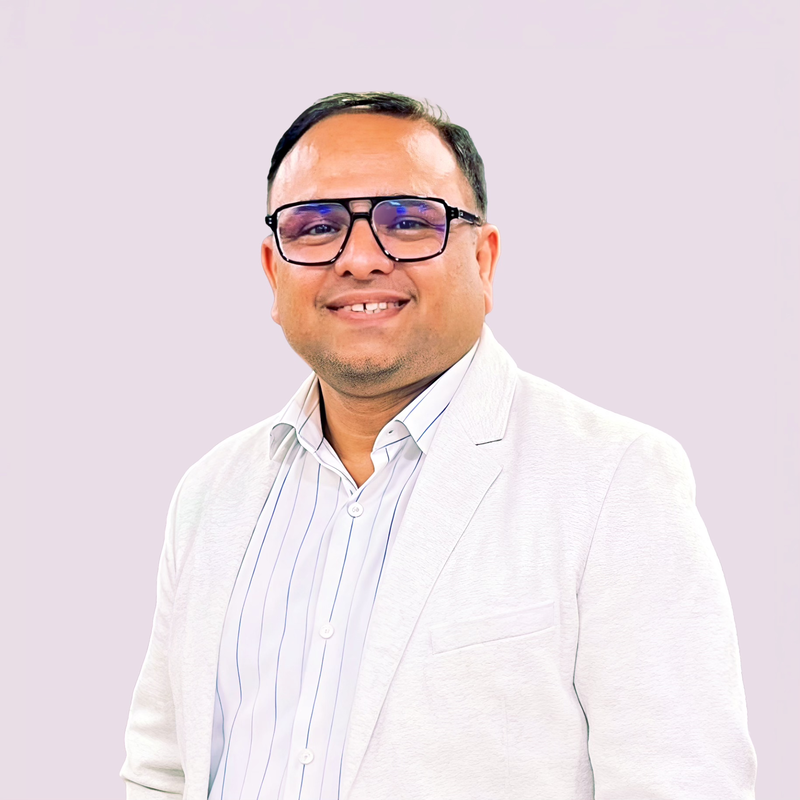
With over 18 years of leadership experience, Manish brings extensive expertise in building high-performing teams, scaling operations, enhancing business performance, and working closely with CXOs to develop impactful talent and workforce solutions. His experience in driving operational excellence and fostering strategic partnerships will play a key role in advancing Gi Group India’s growth journey.
His appointment reinforces Gi Group India’s commitment to building a strong leadership ecosystem that enables business transformation, enhances service excellence, and creates greater value for clients and candidates across sectors.
30, Jun 2026
AD Ports Group and IRH Global Trading Sign MoU to Advance Bunkering and Alternative Marine Fuels at Khalifa Port
Abu Dhabi, UAE – 30 June 2026: AD Ports Group (ADX: ADPORTS), a leading global enabler of integrated trade, industry and logistics solutions; and IRH Global Trading Ltd. have signed a Memorandum of Understanding (MoU) to explore strategic cooperation in bunkering services and alternative marine fuels at Khalifa Port.
The MoU outlines potential collaboration across a range of areas, including the provision of bunkering services to vessels calling at Khalifa Port, the development of alternative fuel solutions such as Liquefied Natural Gas (LNG), biofuels, and methanol, and the exploration of opportunities related to fuel storage infrastructure, terminal facilities, and fuel sampling and testing capabilities.
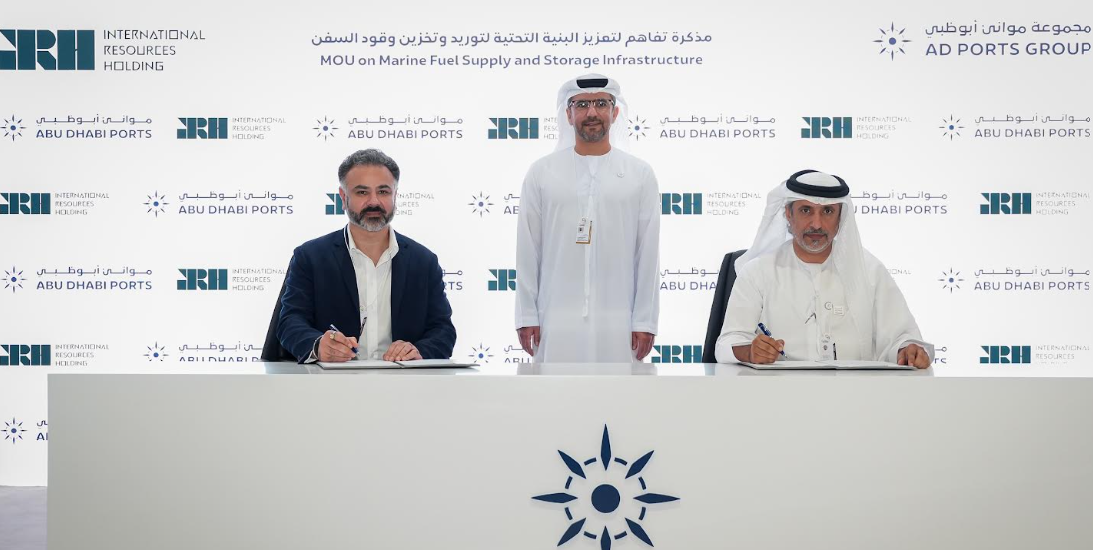
Saif Al Mazrouei, CEO, Ports Cluster – AD Ports Group, said: “This collaboration reflects our commitment to forging strategic alliances that create long-term, sustainable value. By working alongside trusted partners such as IRH, we are enhancing our capabilities and supporting the development of future-ready infrastructure and services that reinforce the UAE’s position as a leading global trade and logistics hub, in line with the vision of our wise leadership.”
Ali Rashed Alrashdi, Group CEO – International Resources Holding, said: “This collaboration with AD Ports Group reflects IRH’s commitment to build strategic partnerships that drive real economic impact. As we continue to develop our global energy trading platform, bunkering and alternative marine fuels represent a high-potential area of growth. We see Khalifa Port as an ideal base from which to explore these opportunities, and we look forward to working closely with AD Ports Group to bring them to life.”
Through this collaboration, AD Ports Group and IRH Global Trading aim to further enhance Khalifa Port’s value proposition as a multi-purpose, deep-water port that supports efficient, sustainable, and future-oriented maritime operations.
IRH Global Trading is a strategic global commodities trading firm with interests across the mining and energy value chain and plans to build a diversified global minerals and energy trading platform, including Liquefied Natural Gas (LNG), Liquefied Petroleum Gas (LPG), crude oil, and petroleum products. The collaboration would explore leveraging IRH’s international trading capabilities alongside AD Ports Group’s world-class port infrastructure and trade ecosystem.
30, Jun 2026
Fintech Revenues Hit Dollar 650B Globally But Europe Is Still Leaving Money on the Table, Investor Says

Daiva Rakauskaitė, CFA, partner and fund manager of Aneli Capital
Vilnius, June 30: After several years of turbulence, the global fintech sector is entering a new growth phase. In Europe, however, fintech penetration remains below 3% even as consumers trust digital platforms more than legacy banks. According to an investor, the next phase of European fintech growth will depend on startups that can build regulatory capability early and use AI to compete with better-funded incumbents.
Last year, global fintech companies generated approximately $650 billion in revenues, representing a growth rate of about 21% year over year from 2024, according to a recent McKinsey report. Investment data by CB Insights shows that in Q1 of this year, fintech deal value was $12,1 billion, up 3,7% year on year, with the US capturing 47% of deals, while Europe accounted for around 21%.
According to Daiva Rakauskaitė, Managing Partner at a VC firm Aneli Capital, despite global growth, the European fintech market remains underutilized.
A McKinsey consumer survey across European countries shows that consumers trust fintech companies and digital banks more than traditional banks for the first time, and see fintechs as more innovative, more transparent on fees, and better value overall.
However, fintech financial services still represent only a fraction of the broader financial market. In Europe, the fintech sector has remained smaller, with 2.6% market penetration, compared to 3% in Asia and 8% in Latin America.
Rakauskaitė notes that European fintechs often lag behind due to fragmented national markets, stronger incumbent banks, lower access to capital, and regulation.
“In Europe, regulation often sets the pace of fintech expansion. For early-stage companies, compliance and licensing requirements can increase the cost and complexity of market entry, often favoring larger, better-capitalized players. At the same time, fintechs that invest in regulatory capabilities early can turn compliance into a competitive advantage, strengthening customer trust and increasing their attractiveness to investors,” Rakauskaitė says.
According to Rakauskaitė, the main driving force behind the new wave of European fintech winners will be those that can grow in a regulated environment and deploy AI to scale. Q1 investment data by PitchBook already shows that investors are backing AI-native startups at the earliest stages, where smaller teams are hitting growth benchmarks faster than ever before.
“Scaling a financial product used to require massive engineering, operations, and compliance teams from day one,” Rakauskaitė says. “Today, AI-native startups can automate significant parts of product development, operations and customer support, allowing them to reach product-market fit and validate distribution channels with substantially less capital and smaller teams. While regulated financial activities still require robust compliance and governance functions, AI is reducing the cost and time needed to build and scale fintech products”.
30, Jun 2026
Eplan Next26: Inspiring insights into the future of engineering
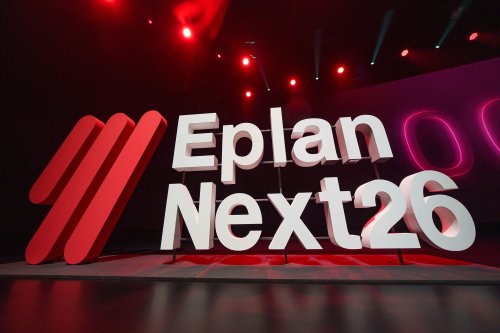
Around 1,500 attendees from 36 countries, renowned keynote speakers, fascinating panel discussions and interesting insights into the future of engineering, automation technology and the industry overall is the best way to describe the first Eplan Next conference, which took place in Munich’s Cavalluna Park on 20 and 21 May. Not only did Eplan Copilot and Eplan Smart Sourcing celebrate their premieres – attendees also got a sneak peek of the upcoming Eplan Platform 2027. High-profile speakers, experts from Eplan, users, decision-makers and Eplan business partners engaged in intensive discussions about the hottest topics for the engineering of the future during the two-day festival.
What changes are in store for electrical engineering in the coming years? Which next steps in automation will the industry be facing? How will artificial intelligence influence engineering? These and other questions were answered by internationally recognised experts in a variety of presentation formats at the Eplan Next26.
Eplan CEO Sebastian Seitz set the tone in his opening address: “We are giving you a taste of what’s to come. Here at Eplan Next, we need to discuss one of the greatest challenges facing our shared industry, namely the digitisation of our entire value creation process.” When presenting the new AI, which takes a different approach than many other industrial AI applications – in part due to its protecting of intellectual property – Seitz said: “Today we are launching out Eplan Copilot in the cloud environment.” He emphasised the importance of data security, the AI’s robust architecture, and the long-term goal of making workflows truly autonomous. “We need to contribute a great deal of knowledge and build the right skill sets into the AI, not just to automate processes, but also to autonomously control them. Our goal is to develop this technology so that it evolves from a copilot to a pilot.”
Insights into the industrial production of tomorrow
Attendees from around the globe were able to gain first-hand experience as to how leading industry innovators such as DMG MORI, Eaton and Siemens are preparing for the challenges of the future and which tools the special machine builders and control cabinet manufacturers already use today to succeed in the competitive landscape of tomorrow.
In his keynote, Siemens Digital Industries COO for Automation Business and CTO Rainer Brehm identified the shift from rule-based to goal-based automation as the next step. For instance, this can be achieved with an end-to-end, AI-based Advanced Machine Engineering, which Siemens is developing in close cooperation with Eplan.
In his keynote, DMG MORI Group President and CEO Dr.-Ing. Masahiko Mori introduced DMG MORI’s “Machining Transformation” initiative, and also referred to its collaboration with Eplan toward realizing a digital twin in the field of control cabinet design.
Eaton Operations Director Power Distribution Systems China Andy Lee offered attendees fascinating insights into a showcase factory for extensively automated control cabinet manufacturing in Changzhou, China. There, too, the Eplan Platform is being used as the backbone for electrical engineering and humanoid robots are auditing the connected wires.
Future Lab: Experiencing the future live, in person
The Future Lab featured groundbreaking new developments as well as a range of future technologies – for instance an auto panel design tool that generates a basic mounting panel design direct from an initial bill of materials. Using this as the foundation, a suitable housing can be selected and a reliable cost estimate produced with minimal effort, even during the bidding phase. Another highlight was a software supported production workstation that enables even less-experienced employees to build control cabinets to a very high quality standard – reliably, transparently and in compliance with all individual customer requirements. Topics including the Siemens Teamcenter integration and advanced machine engineering were also presented at the Future Lab – creating a direct link between mechanical engineering, product data management (PDM) and electrical control technology (CAE/TIA).
Looking back and gazing ahead: The Eplan Platform 2027 & Smart Sourcing
Eplan used the event for an exclusive preview of the new Eplan Platform 2027, the development of which has incorporated around 500 customer requirements. It’s been designed to further accelerate electrical engineering projects across three process stages: preplanning, electrical engineering and control cabinet engineering. In terms of component procurement, Eplan Smart Sourcing also offers a new and highly automated solution that celebrated its German premiere at the Eplan Next26. One practical benefit is that the tool makes it clear during the design phase where and how quickly the required parts can be sourced. In various Master Classes, users were able to explore the software’s new features and topics including control cabinet design, efficient machine cabling, and digital product structuring.
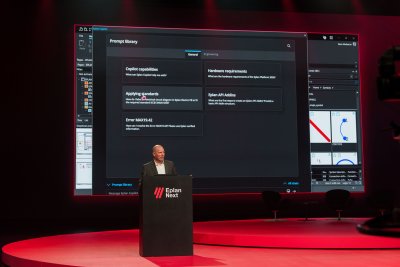
Eplan Copilot made its debut in the cloud, bringing AI to engineering, and was presented live on the main stage.
Conclusion: A successful start that is to be continued
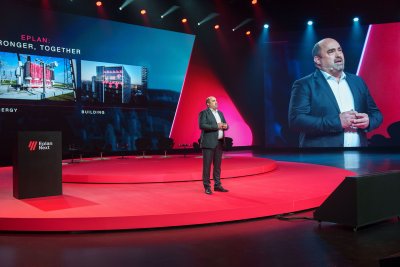
Eplan CEO Sebastian Seitz said in conclusion: “The future lies in cooperation and collaboration – this is the only way we can master the challenges of the future. The technologies are available. The crucial question is how we can consistently integrate these opportunities into our processes
Eplan Software & Service
EPLAN provides software and service solutions in the fields of electrical, automation and mechatronic engineering. The company develops one of the world’s leading design software solutions for machine and panel builders. EPLAN is also the ideal partner to streamline challenging engineering processes.
Both standardised as well as customised interfaces to ERP and PLM/PDM systems ensure data consistency along the whole value chain. Working with EPLAN means boundless communication across all engineering disciplines. No matter whether small or large enterprises: Customers can apply their expertise more efficiently. Worldwide, EPLAN supports 61,000 customers. EPLAN wants to grow further with customers and partners and pushes integration and automation in engineering forward. Within the EPLAN Partner Network, open interfaces and seamless integrations are realised together with partners. „Efficient engineering“ is the focus.
EPLAN was founded in 1984 and is part of the owner-operated Friedhelm Loh Group. The Friedhelm Loh Group operates worldwide with 12 production sites and 94 international subsidiaries. The entire group employs 11.600 people and generated revenues of around €2,6 billion in 2019. For the 13th time in succession, the family business has won the accolade “Top German Employer” in 2021. In addition, Friedhelm Loh Group was recognized as “Top vocational trainer” according to a study of Deutschland Test and Focus Money.


