


19, Jun 2026
From Antenna to Algorithms: Can Traditional Media Reclaim Its Lost Audience?
The Great Journey of Mass Communication: From Radio and Doordarshan to Digital Streaming
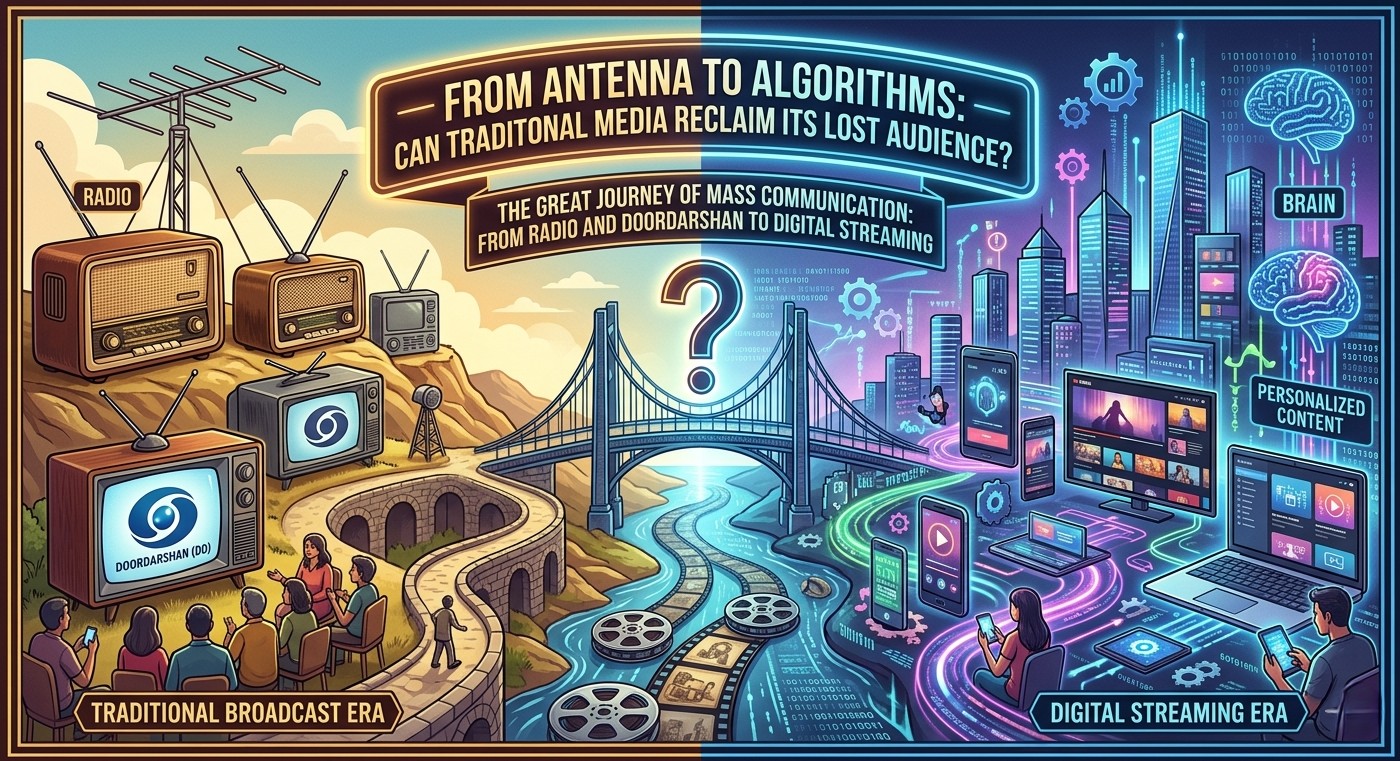
There was a time when information traveled slowly but carried immense value. Families gathered around radio sets to hear news bulletins, cricket commentary, and cultural programs. Later, television became the centerpiece of every household, bringing the nation together through shared experiences. Newspapers arrived every morning as trusted sources of information, while magazines offered in-depth analysis and storytelling.
Today, the media landscape has been completely transformed. Smartphones, fiber broadband, social media, YouTube, OTT platforms, podcasts, AI-powered tools, e-papers, and digital magazines have changed how people consume information.
Ironically, despite having more media platforms and content choices than ever before, traditional media is struggling to retain audiences.
The Evolution of Electronic Media
1. The Radio Era (1930s–1980s)
Before television became widespread, radio was the dominant electronic medium.
In India, radio connected millions through news bulletins, educational programming, music, dramas, and live sports commentary. Families relied on radio for information during elections, wars, natural disasters, and major national events.
For decades, radio was the fastest and most accessible source of news.
2. The Antenna and Doordarshan Era (1970s–1980s)
Television arrived as a revolutionary medium.
Viewers depended on rooftop antennas to receive signals from Doordarshan. Programming was limited but highly influential. Shows such as Ramayan, Mahabharat, Hum Log, Buniyaad, and Chitrahaar became national phenomena.
Television was not merely entertainment—it was a social experience that united families and communities.
3. The Cable Television Revolution (1990s)
Economic liberalization changed the Indian media industry forever.
Cable operators introduced private television channels into homes. Suddenly viewers had access to entertainment, sports, movies, music, and 24-hour news channels.
Networks such as Zee TV, Star TV, Sony, and numerous regional broadcasters transformed viewing habits.
For the first time, audiences had meaningful choice.
4. The DTH Era (2000s)
Direct-to-Home (DTH) technology improved signal quality and expanded access to hundreds of channels.
Consumers enjoyed better picture quality, wider channel selection, and greater viewing flexibility.
Television entered an era of intense competition.
5. The Fiber and Digital Streaming Era (2010s–Present)
The arrival of fiber broadband, smartphones, smart TVs, OTT platforms, social media, podcasts, and video-sharing platforms fundamentally altered media consumption.
Viewers no longer wait for scheduled programming.
News, entertainment, sports, documentaries, and live events are available instantly and on demand.
The audience now controls what to watch, when to watch, and where to watch.
From One Channel to Thousands
The media industry has evolved from scarcity to abundance.
We moved from:
- One television channel to thousands.
- One radio station to thousands of digital audio streams.
- A handful of newspapers to countless digital publications.
- Scheduled programming to personalized content feeds.
Yet paradoxically, more choice has not guaranteed more engagement.
Instead, audiences have become fragmented across multiple platforms.
Why Are Viewers Leaving Television News?
Television news once dominated public attention. Today, many viewers are turning away.
Several factors contribute to this trend:
Declining Content Quality
Investigative journalism and original reporting have often been replaced by repetitive debates and sensational discussions.
Loss of Credibility
Audiences increasingly question the neutrality and independence of many news organizations.
Ethical Concerns
Many viewers feel news coverage is becoming overly influenced by political, commercial, or ideological interests.
Technical Negligence
Frequent spelling mistakes, inaccurate graphics, poorly edited tickers, and rushed presentation standards create a perception of declining professionalism.
Endless Live Coverage
Many channels devote hours to repetitive live broadcasts with little new information, reducing the value of the viewing experience.
Rise of Independent Digital Journalism
YouTube channels, digital-first news organizations, podcasts, and independent creators often provide faster, more diverse, and more interactive coverage.
As a result, audiences increasingly seek information outside traditional television.
What Happened to Radio?
Radio remains relevant in automobiles, rural areas, and emergency communication.
However, younger audiences increasingly prefer:
- Podcasts
- Music streaming platforms
- Audio books
- On-demand content
The challenge facing radio is not merely retention but adoption. Many younger consumers never developed the habit of listening to traditional radio in the first place.
Newspapers: Declining but Still Trusted
Unlike television and radio, newspapers continue to enjoy a relatively high level of trust.
Their strengths include:
- Editorial discipline
- Fact-checking processes
- Structured reporting
- In-depth analysis
- Professional accountability
However, print circulation faces significant challenges as younger readers increasingly consume news digitally.
Many readers still trust newspaper brands but choose to access them through websites, mobile applications, and e-paper editions rather than physical copies.
The Slow Disappearance of Magazines
Perhaps no traditional medium has been affected more dramatically than magazines.
Weekly and monthly magazines once occupied a unique space between newspapers and books. They provided long-form reporting, interviews, analysis, and specialized content.
Today, demand for printed magazines has declined significantly due to:
- Instant digital access
- Free online content
- Social media platforms
- Specialized websites and blogs
Many readers now prefer e-magazines and digital subscriptions that offer convenience, portability, and real-time updates.
The future of magazines is increasingly digital rather than print-based.
The Rise of E-Papers and E-Magazines
Digital editions are becoming the new normal.
Readers appreciate:
- Instant availability
- Mobile accessibility
- Lower costs
- Search functionality
- Environmental sustainability
For younger generations, reading news on a smartphone or tablet often feels more natural than reading a printed publication.
The future of print media may depend less on paper and more on the strength of trusted journalism delivered through digital formats.
Can Traditional Media Make a Comeback?
Yes—but only through meaningful reinvention.
Restore Trust
Credibility must become the industry’s highest priority.
Invest in Journalism
Original reporting, investigative work, and field journalism should once again define news organizations.
Improve Editorial Standards
Accuracy in language, graphics, headlines, and presentation remains essential.
Embrace Digital Platforms
Traditional media must meet audiences where they already are—on mobile devices, social media, streaming platforms, and digital ecosystems.
Focus on Public Interest
Issues affecting ordinary citizens should receive greater attention than manufactured controversies.
Engage Younger Audiences
Explainers, data journalism, podcasts, short-form video, and interactive storytelling can help bridge the generational gap.
The Future of Media
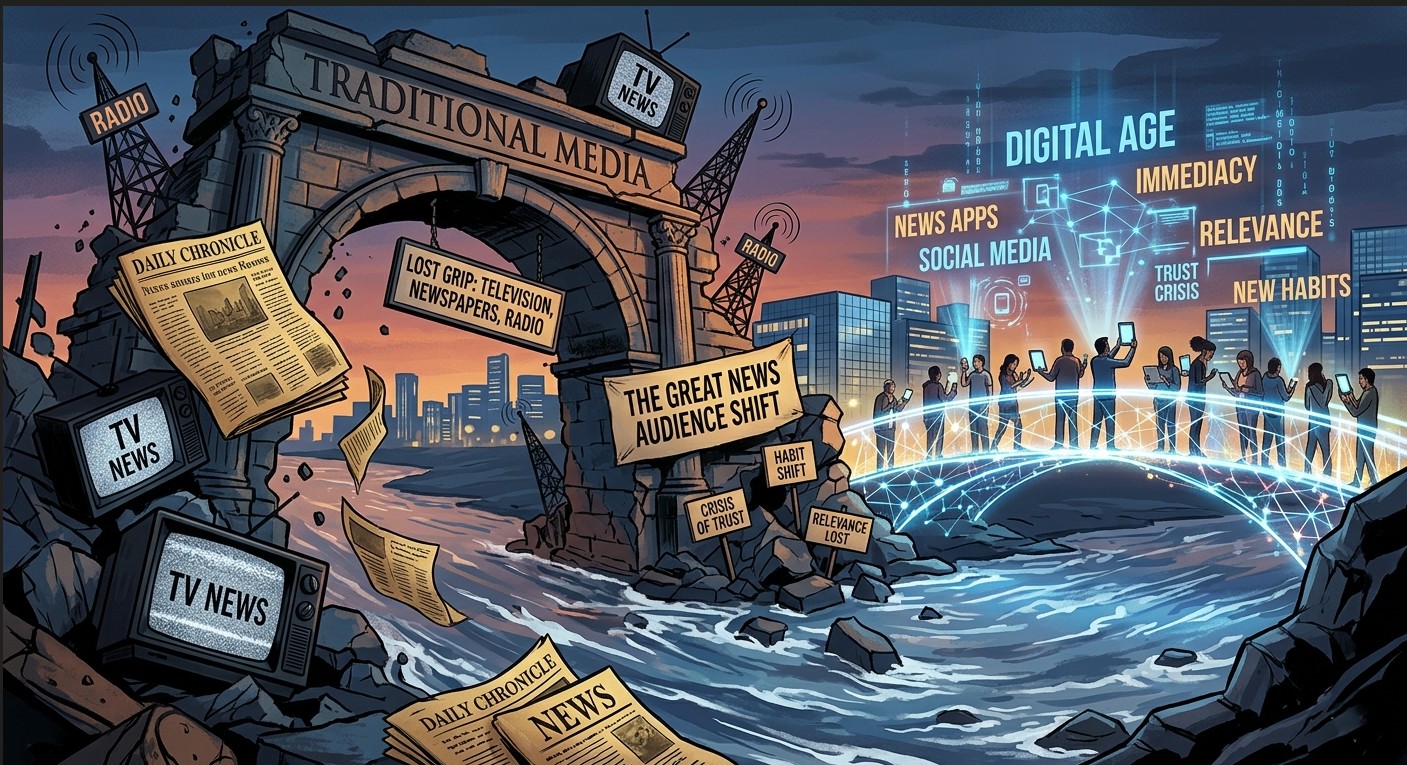
Traditional media is not dying—it is evolving.
Television, radio, newspapers, and magazines may no longer dominate public attention as they once did, but their core strengths remain valuable.
The future belongs to organizations that combine the credibility of traditional journalism with the speed, accessibility, and innovation of digital technology.
Audiences have not abandoned information.
They have abandoned formats that no longer meet their expectations.
The real crisis facing media today is not a shortage of content.
It is a shortage of trust.
And trust can only be rebuilt through accuracy, ethics, accountability, professionalism, and a renewed commitment to serving the public interest.
The journey from radio to television, from antenna to cable, from DTH to digital streaming, and from newspapers to e-papers tells the story of media’s past.
The next chapter will belong to those who understand that technology may change, but the public’s need for trustworthy journalism never will.
- 0
- By Neel Achary

19, Jun 2026
Govt Removes Domicile Certificate Requirement for SC and OBC Scholarships
New Delhi, June 19: The government has removed the requirement of domicile certificates for students applying for Scheduled Caste (SC) and Other Backward Classes (OBC) scholarships.
The move is aimed at simplifying the application process and making it easier for eligible students to access financial assistance without facing unnecessary documentation hurdles.
Officials said the decision will help reduce delays in processing scholarship applications and ensure faster delivery of benefits to students.
The step is expected to improve accessibility and encourage greater participation from eligible students belonging to SC and OBC communities.
The reform is part of ongoing efforts to make welfare schemes more efficient, student-friendly, and easier to access through simplified procedures.
19, Jun 2026
VU Researcher Develops AI Models to Assessthe Emotional Impact of Art and Advertising
June 19: Researchers from the Faculty of Physics at Vilnius University have developed a theoretical model that allows atoms to be “pre-programmed” by light alone to reshape laser beams that carry both a twist and a polarization.
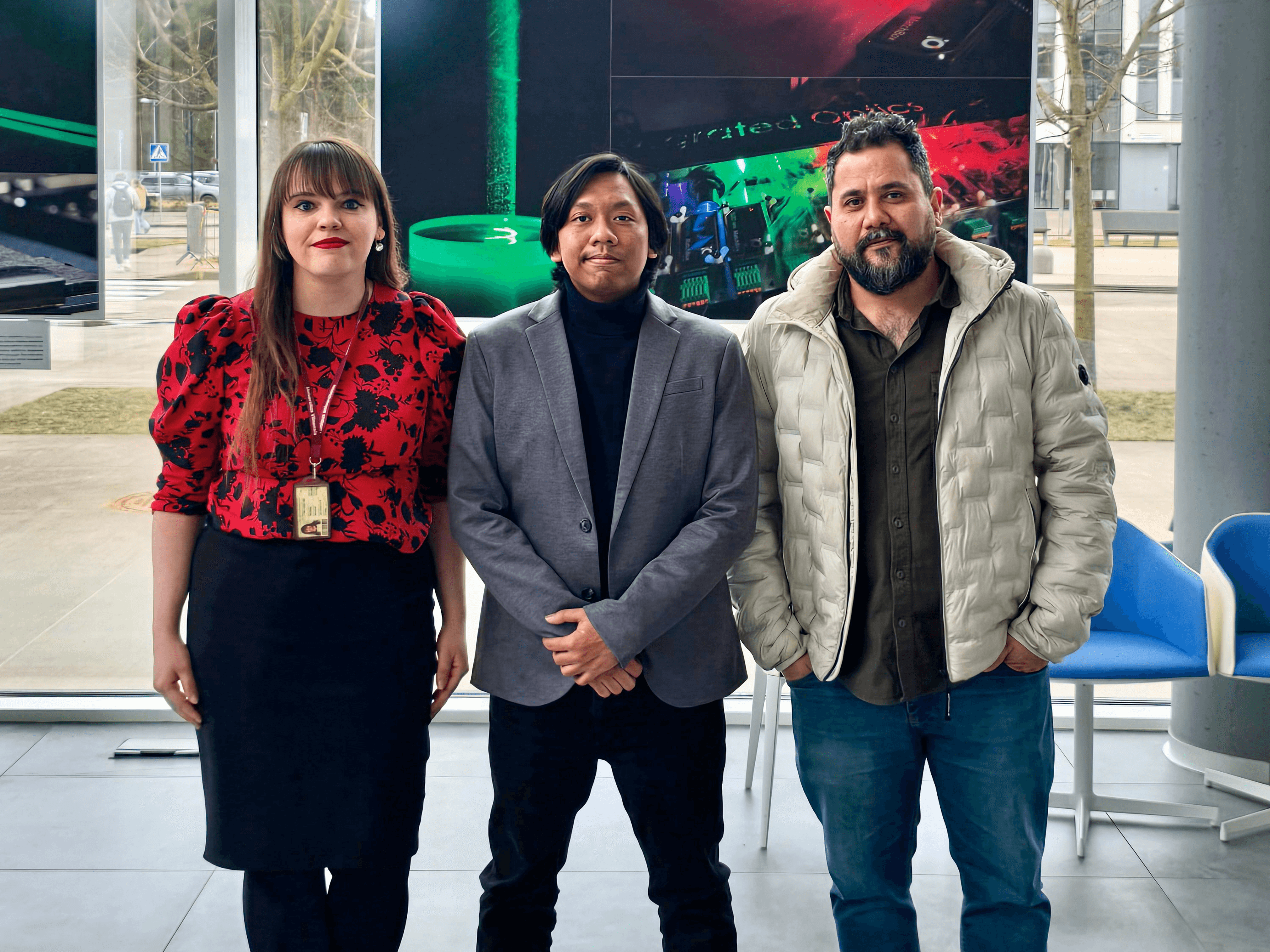
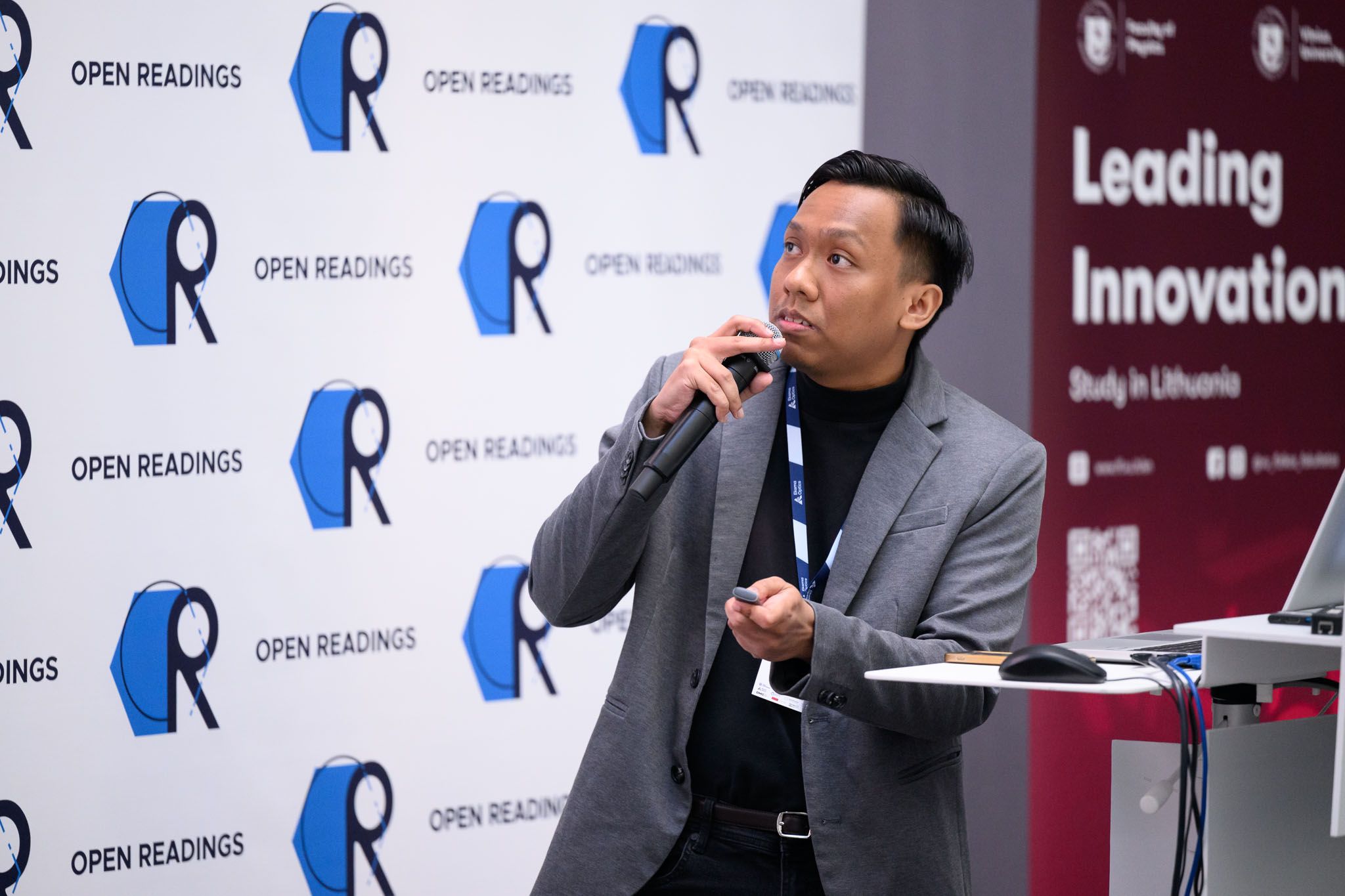
The study by master’s student Dharma Prasetya Permana, alongside Mažena Mackoit-Sinkevičienė, Julius Ruseckas, and Hamid Reza Hamedi from the Institute of Theoretical Physics and Astronomy, opens a magnet-free route to controlling structured light for quantum technologies. The research was recently published in Physical Review A.
Twisted Light
The team’s research focuses on optical vortices—special light beams whose structure twists as they propagate.
“Unlike whirlpools in water, where the matter itself spins, optical vortices are twists in the wave structure of light. As the beam travels, its wavefronts form a helical, spiral-like structure,” explains Permana.
At the center of such a beam, the light intensity drops to zero, leaving a small dark core. The size of this region depends on a quantity called the topological charge, which counts how many full twists the wavefront makes around the beam’s axis.
“A topological charge of zero means there is no twist. When the charge increases to one, a small dark core appears at the center. As the charge grows, the structure becomes more pronounced. You can think of it like the thread of a screw—the higher the charge, the tighter the twist,” Permana explains.
In theory, this number has no upper limit; it can take any integer value, positive or negative. That makes optical vortices particularly attractive for encoding information in many distinct states. In practice, it is possible to create up to 10,000 distinct states.
“Researchers have already begun using these light vortices to build advanced quantum communication channels,” adds Hamedi. “Instead of a standard quantum bit, or qubit, which holds only two states, light vortices allow information to be encoded in higher-dimensional quantum states, called qudits, dramatically increasing how much data a single photon can carry.”
Spin and Swirl in Light
Light travels as a wave, and there are two distinct ways it can be manipulated: polarization and vortices. Normally, light from a bulb or the Sun is chaotic, with waves vibrating in many directions at once.
“Polarization is how the wave vibrates. Imagine tying a rope to a wall and shaking it. Shake your hand up and down, and the wave vibrates vertically; shake it side to side, and it vibrates horizontally. This direction of vibration is what physicists call the wave’s polarization. Polarized sunglasses act like a fence with vertical slats: they let through vertically vibrating light and block the horizontal glare bouncing off roads or water.
“A vortex, on the other hand, describes the overall shape of the beam. Instead of traveling as a flat wall of waves, the light is twisted into a spiral staircase as it moves forward,” says Mackoit-Sinkevičienė.
When scientists combine these two concepts, they get a vector vortex—a beam with both a structured shape and structured polarization.

“Imagine a spiral staircase where the direction of the steps changes as you climb. At the bottom, the steps face north—that is, vertical polarization. As you walk up the spiral, the steps gradually turn to face east—horizontal polarization. In a vector vortex, the light beam is twisting like a whirlpool, and the direction in which the light waves vibrate changes depending on where you are inside that whirlpool,” explains Mackoit-Sinkevičienė.
“Programmable” Atoms
To manipulate vector vortices and harness them for advanced information processing, the researchers studied how these beams interact with an atomic gas. They chose a medium of three-energy-level atoms, a standard model in quantum optics.
“We developed a theoretical model showing how these atoms can be ‘pre-programmed’ to modify the shape of optical vector vortices. When such light passes through the prepared atomic medium, the atoms respond in a highly structured way. They effectively inherit the spatial pattern of the light, forming regions where they absorb strongly and regions where they become almost transparent to the light,” says Hamedi.
This creates a feedback mechanism between light and matter: the light shapes the atomic response, and the atomic response reshapes the light.
As the beam propagates, it transforms. Instead of a simple ring-shaped intensity profile with a dark center, it evolves into a petal-like pattern, where light concentrates in several bright lobes arranged around the center. At the same time, the beam’s polarization structure evolves, demonstrating that the medium actively controls both its spatial shape and its spin properties.
“This demonstrates that by preparing the atomic medium in advance, we can control not only how complex light structures evolve in space, but also how their polarization changes as they pass through matter,” says Ruseckas.
Applications in Quantum Technologies
The study positions pre-programmed atoms as a powerful tool for manipulating light, with implications for quantum computing and high-density data transfer.
“Until now, controlling structured light in this way required strong external magnetic fields. Generating those fields takes complex, bulky, and often expensive equipment, which limits how easily these systems can be integrated into compact technologies,” says Permana.
“Our method is entirely optical. By using light itself to ‘program’ the atoms, we eliminate the need for magnetic fields. This offers a much more flexible, scalable, and elegant way to control light–matter interactions. Ultimately, it paves the way for faster quantum processors, highly secure quantum communication networks, and incredibly precise optical sensors,” says Hamedi.
19, Jun 2026
Sambhav Launches First-Ever Sustainability E-Book for Students After Odisha Olympiad Success
Bhubaneswar, June 19: In a pioneering step to promote environmental awareness among schoolchildren, Sambhav has launched a first-of-its-kind E-book on Survival and Sustainability following the successful completion of Odisha’s inaugural Olympiad on Survival and Sustainability in Bhubaneswar.
The Olympiad was held at DAV Public School, Unit-8 Campus, and saw enthusiastic participation from 147 students representing both Odia- and English-medium schools from Bhubaneswar and Cuttack. The event highlighted growing interest among young learners in environmental issues and sustainable living practices.
As a key outcome of the initiative, Sambhav introduced an interactive digital learning resource titled the “Info-Action Picture Book.” Available in both Odia and English, the E-book is designed to go beyond traditional learning formats by integrating concepts, practical insights, and activity-based guidance. It aims to encourage critical thinking, environmental awareness, and reduced screen dependency through experiential learning approaches.
Students who emerged as winners of the Olympiad were felicitated with certificates and trophies during the 5th Memorial Programme of Padma Professor Radhamohan. In addition, each winner will receive an Experiential Learning Fellowship of ₹10,000, enabling hands-on exposure to nature-based learning and sustainability practices.
Speaking on the occasion, noted environmentalist and Padma Shri awardee Sabarmatee said the initiative is intended to inspire children to become active environmental stewards rather than passive learners. She emphasized the importance of nurturing young minds that can think critically, act responsibly, and contribute to environmental protection.
The E-book will be distributed across schools in Odisha to support environmental education and help students develop a deeper understanding of ecology and sustainability. Volunteers Tushar and Prapti, who were instrumental in the initiative, noted that the project aims to bridge classroom learning with real-world environmental action.
Through this initiative, Sambhav hopes to nurture a generation of environmentally conscious students equipped with the knowledge, values, and skills needed to address future sustainability challenges.
18, Jun 2026
Talents for Tech to Bring Free AI Skills Training to Thousands Across Central and Eastern Europe Through Google.org Support and Local NGOs
Vilnius, Lithuania,June 18: Talents For Tech, an organization set to empower careers through mentorship programs and career guidance, announced it will lead a major regional AI upskilling initiative supported by Google.org as part of AI Works for Europe and the AI Opportunity Fund. With more than $2.7 million (€2.3 million) in funding, the program will help thousands of people across Central and Eastern Europe build practical AI skills and prepare for the future of work.

Through this initiative, Talents For Tech will train at least 11,000 people across seven countries: Lithuania, Latvia, the Czech Republic, Romania, Bulgaria, Moldova, and Poland. The program focuses on expanding what people can do with AI, equipping workers in fast-changing fields: routine administrative, clerical, and cognitive roles, such as customer service, call centre operations, sales support roles, basic finance and accounting (e.g. bookkeeping, payroll), logistics coordination, junior marketing positions, and others.
As AI reshapes workplaces across CEE, the skills needed to use it effectively require more than knowing how to write a prompt. According to IPSOS research, workers need a broad mix of capabilities to truly benefit from AI, from data analysis and cybersecurity to change management and responsible AI use. Most employers, particularly smaller ones, simply don’t have the resources to train their entire workforce adequately.
The Digital Coalition report on AI challenges in CEE supports that by highlighting a lack of competence as one of the key barriers to AI adoption across the region.
Generative AI could boost CEE’s annual GDP by €90-100 billion if widespread adoption is achieved.
As AI transforms workplaces across Europe, many workers still lack access to the training needed to adapt. Talents For Tech was selected to lead this regional effort because of its mission to create inclusive pathways into the digital economy and ensure that technological progress benefits more people.
“This initiative is not only about learning new tools. It is about helping people stay competitive, improving economic resilience, and making sure the benefits of AI are shared across the region,” said Jarune Preiksaite, CEO of Talents For Tech.
“At the moment, too many people risk being left behind simply because they have not had the opportunity to learn. With Google.org’s support, we can now open practical and accessible pathways for thousands of people across Central and Eastern Europe to build confidence with AI and use it in their careers.”
The learning program will be built around practical, Google’s real-world application of AI tools, delivered through Coursera, and backed by a supportive community and networking opportunities across countries.
“AI is not just changing the nature of work; it is redefining what it means to be workforce-ready. By equipping our workforce with practical AI skills today, we aren’t just filling current job openings—we are unlocking a massive wave of economic productivity and ensuring that no worker is left behind in the digital economy,” said Liza Ateh, Head of Google.org EMEA.
Talents For Tech will coordinate the initiative across all participating markets, managing strategic direction, shared communications, and central infrastructure. Local partner organizations in each country will support learner outreach, recruitment, and delivery tailored to local workforce needs.
The program will run until January 31, 2028, and is designed to create a lasting impact by improving employability, supporting career transitions, and strengthening digital inclusion.
By working with trusted local partners under one regional framework, Talents For Tech aims to create a scalable model for AI workforce development across Europe.
18, Jun 2026
NIT Rourkela Develops Low-Cost Ceramic Adsorbent for Industrial Wastewater Treatment
Rourkela, June 18 (UDN): Researchers at the National Institute of Technology (NIT) Rourkela have developed an innovative and cost-effective ceramic adsorbent capable of removing harmful dyes from industrial wastewater, offering a sustainable solution to one of the most pressing environmental challenges.
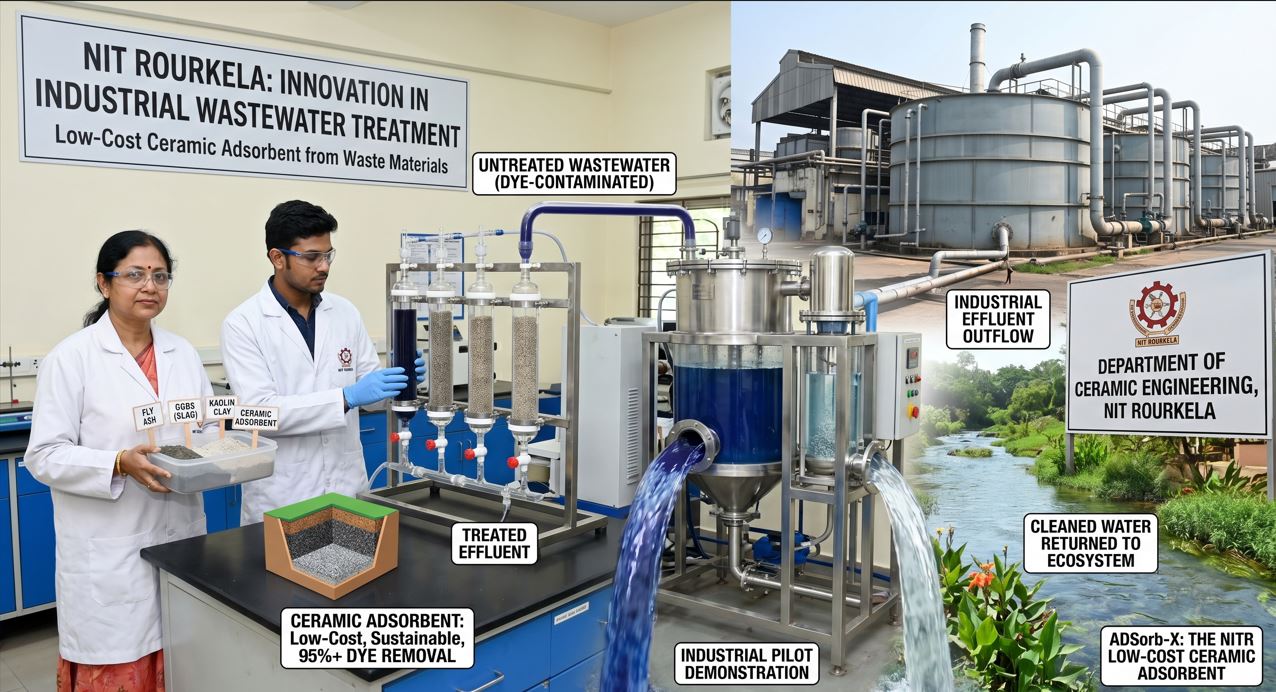
Representational image
The research team from the Department of Ceramic Engineering, led by Associate Professor Sunipa Bhattacharyya along with scholars Susanta Mohapatra and Sourav Ranjan Satpathy, designed the adsorbent using industrial by-products such as fly ash, ground granulated blast-furnace slag (GGBS), and kaolin clay.
Industries such as textiles, dyeing, and printing generate large volumes of coloured wastewater containing toxic chemicals that can contaminate rivers, lakes, and other water bodies, posing serious risks to aquatic ecosystems and public health. Conventional wastewater treatment methods are often expensive, energy-intensive, and generate additional waste.
To address these challenges, the NIT Rourkela team developed a ceramic adsorbent specifically engineered to remove Methylene Blue, a commonly used dye found in industrial effluents. Laboratory tests demonstrated remarkable performance, with the material achieving more than 95 percent dye removal efficiency.
A key innovation of the research lies in the use of raw kaolin clay instead of heat-treated metakaolin, eliminating an energy-intensive production stage. This not only reduces manufacturing costs but also makes the process more environmentally sustainable.
Researchers estimate that the adsorbent can be produced at a cost ranging between ₹25 and ₹50 per kilogram, making it an economically viable option for large-scale industrial wastewater treatment applications.
The findings of the study have been published in the reputed journal ChemistrySelect and support global efforts toward achieving the United Nations Sustainable Development Goals (SDGs), particularly those related to clean water, sanitation, and responsible production practices.
The breakthrough is expected to contribute significantly to sustainable wastewater management and reinforce NIT Rourkela’s reputation as a leading centre for innovative research addressing real-world environmental challenges.
17, Jun 2026
New Book on Property Tax in Europe Spotlights Lessons with International Relevance
THE HAGUE, NETHERLANDS—Property tax experts from across Europe came together last week to discuss comparative insights and policy lessons at a conference signaling the launch of Property Tax in Europe: A Changing Landscape—the Lincoln Institute of Land Policy’s newest book in a series on international property taxation.
Edited by Riël Franzsen, Roy Bahl, and William McCluskey, Property Tax in Europe features in-depth case studies from more than a dozen countries—including successful institutional transitions, use of the property tax as a land policy instrument, and innovative technological applications.
The conference, presented by the Lincoln Institute of Land Policy and the Netherlands Council for Real Estate Assessment, took place at The Hague in the Netherlands on June 8–9.
“This must-read volume is full of new information, ongoing challenges, and reform strategies, delivering important lessons for policymakers, practitioners, and scholars working on improving property taxation around the world,” said Jorge Martinez-Vazquez, Regents Professor of Economics Emeritus at Georgia State University.
Property Tax in Europe follows two other Lincoln Institute books that cover property tax on an international scale, Property Tax in Africa: Status, Challenges, and Prospects (2017) and Property Tax in Asia: Policy and Practice (2022).
“This is a timely resource, given the current fiscal and political situation in Europe and the diversity of the policies in place throughout the continent,” said Joan Youngman, executive director of Land and Fiscal Systems at the Lincoln Institute. “The local property tax can provide a stable revenue source well suited for local governments, and this book captures the many different approaches found in Europe and analyzes their operation.”
16, Jun 2026
Noida International University Organizes Grand Educator’s Meet 2026 in Varanasi to Strengthen Academic Collaboration
Varanasi, Uttar Pradesh: Noida International University (NIU) successfully organized an impactful Educators’ Meet at The Amayaa Hotel, Varanasi, bringing together distinguished academicians, teachers, counselors, and education professionals on one platform to discuss the evolving landscape of education, student development, and institutional collaboration.
The event was graced by Dr. Brijesh Kumar, Founder of L-1 Coaching Institute, who attended as the Chief Guest. The gathering was further honoured by the presence of Mr. Akash Sharma, Director – Admissions & Outreach, Noida International University, as the Guest of Honour. Mr. Anshuman Deo Gupta, President, Teacher Association, also marked his esteemed presence and shared valuable insights on strengthening educational ecosystems and teacher engagement.
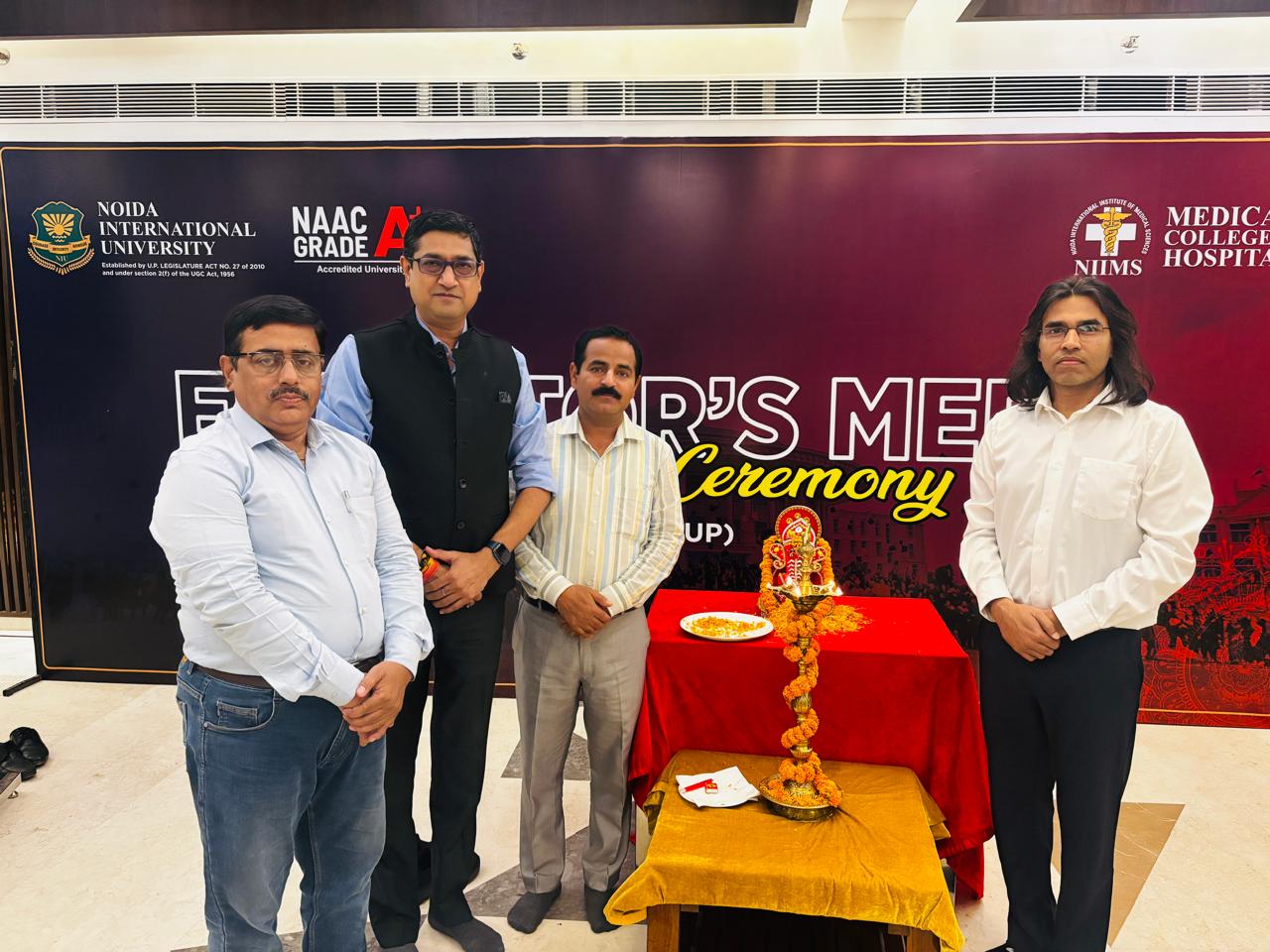
Dr. Brijesh Kumar said, “Education is the strongest foundation for nation-building, and educators play the most critical role in shaping young minds. Such collaborative platforms encourage meaningful dialogue and help institutions and educators work together for the holistic development of students.”
Mr. Akash Sharma said, “At Noida International University, our focus remains on providing students with industry-oriented education, global exposure, and skill-based learning opportunities. Educators are our strongest partners in guiding students toward the right academic and career pathways, and platforms like these help us build stronger academic relationships.”
The Educators’ Meet served as an important platform for knowledge sharing, networking, and discussions on emerging opportunities in higher education. Participants engaged in meaningful conversations around academic excellence, career guidance, and institutional partnerships aimed at enhancing student outcomes.
The event was efficiently coordinated by Mr. Ankur Sharma and Mr. Tarun Pratap, whose dedicated efforts contributed significantly to the successful execution of the gathering.
Speaking on the occasion, representatives from Noida International University expressed gratitude to all guests, educators, and participants for making the event a success. The university reiterated its commitment to fostering strong ties with the academic fraternity and continuing efforts toward educational advancement across the country.
The event concluded on a positive and collaborative note, reinforcing Noida International University’s vision of empowering educators and strengthening the future of higher education through meaningful engagement.
16, Jun 2026
IIT Madras and IITM Global Forge Landmark Strategic Partnerships at Bharat Innovates 2026, Unlocking US Dollar 100 Million in Value Creation
Chennai, June 16 : The Indian Institute of Technology Madras and IITM Global concluded day one engagement at ‘Bharat Innovates 2026’ in Nice, France, by exchanging seven commercial Memoranda of Understanding between Indian deep-tech startups and their international partners—predominantly from France—alongside two institutional MOUs aimed at accelerating global market access, investment, and innovation.
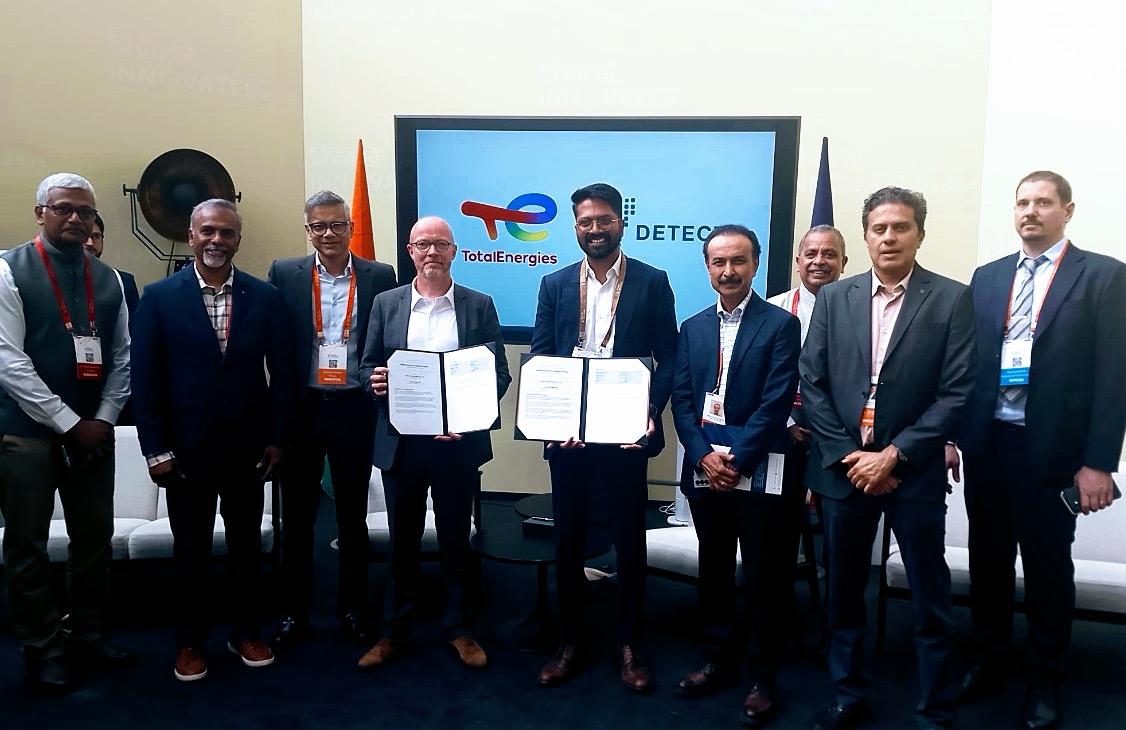
Collectively, these agreements are expected to unlock value creation of nearly US$100 million, strengthening India’s position as a global hub for deep-tech innovation and cross-border collaboration.
Speaking about Bharat Innovates 2026, Prof. V. Kamakoti, Director, IIT Madras, said,
“Bharat Innovates 2026 has proven to be a watershed moment for Indian deep tech. The MOUs exchanged are not just ceremonial – they are commercial, actionable, and backed by serious financial commitments. The premier higher educational institutions of Bharat have demonstrated that Indian innovation is ready to lead on the world stage.”
The startup partnerships announced included:
●Agnikul Cosmos with ICEYE, Finland, and Safran, France
●Detect Technologies with TotalEnergies
●TuTr Hyperloop with thyssenkrupp
●iElectron Technologies with ALTEN
●Indian Angel Network announced a potential investment in The ePlane Company
Prof. Manu Santhanam, Dean (Industrial Consultancy and Sponsored Research), IIT Madras, added,
“What we witnessed in Nice (France) was the translation of scientific excellence into cross-border economic value. The nearly US$ 100 million in expected value creation is a direct result of years of focused deep-tech incubation at IIT Madras. The partnerships with French and European industry leaders validate our approach.”
The two institutional MOUs further reinforced the global ambitions of the IIT Madras ecosystem:
– A strategic partnership between IITM Global and Agna Capital to establish the Bharat Innovates Fund aimed at catalysing investments in high-potential deep-tech ventures.
– A collaboration between IITM Global and SouthwestX to help Indian startups access and scale across the large German and French markets.
These institutional MOUs were exchanged in the presence of the Honourable Minister of Commerce and Industry, Piyush Goyal, and the Principal Scientific Adviser to the Government of India, Ajay Sood, reflecting strong national support for building globally connected innovation ecosystems.
Alongside the partnership announcements, IIT Madras presented a range of technologies and innovations developed by its research groups and startup ecosystem at Bharat Innovates. These included advancements in Hyperloop transportation, 5G and 6G communications, port automation, lab-grown diamond technologies, and indigenous AI systems designed for efficient computing.
Mr. Thirumalai Madhavnarayan, CEO and Director of IITM Global, said,
“The overwhelming response from stakeholders across Europe reaffirmed the growing global recognition of the IIT Madras innovation ecosystem as a trusted partner for building the next generation of globally scalable deep-tech enterprises.”
Beyond the formal agreements, the event generated interest from industry leaders, academic institutions, investors, and government representatives across the European Union, signalling significant opportunities for future collaborations with IIT Madras and IITM Global in research, innovation, entrepreneurship, talent development, and market expansion.
16, Jun 2026
Government Temporarily Restricts Telegram Access in Select Context Ahead of NEET (UG) 2026 Re-Exam

New Delhi, June 16: In view of concerns related to exam integrity and the upcoming NEET (UG) 2026 re-examination, authorities have implemented a temporary restriction on certain online communication platforms, including Telegram, as a precautionary measure. The restriction will remain in place until June 22, 2026.
Officials stated that the decision has been taken to prevent the potential misuse of digital platforms for the circulation of sensitive examination-related content, including unauthorized sharing of question papers, answer keys, or related materials. The move is part of a broader effort to ensure transparency, fairness, and credibility in high-stakes national examinations.
Authorities emphasized that safeguarding the examination process is a priority, and necessary steps are being taken to maintain a secure and unbiased environment for candidates. Monitoring mechanisms have been strengthened to prevent any form of malpractice or information leakage during the examination period.
The temporary measure is expected to be lifted after the completion of the re-examination cycle, subject to review. Officials have also urged students and stakeholders to rely only on official communication channels for updates related to NEET (UG) 2026.
The government reiterated its commitment to conducting examinations in a fair and secure manner, ensuring equal opportunity for all candidates.


