


12, Jun 2026
Global EDVentures 2026 Awards Celebrated at Galgotias University; INR 10 Crore Support for Three Student Startups
Greater Noida, June 12 : Galgotias University felicitated student innovators who represented India at EDVentures 2026 in Hong Kong, where Project TACTO emerged as the winning project among teams from 10 countries.

During the felicitation ceremony, the University announced funding support under its INR 10 crore Galgotias Innovation Fund for three student-led startups working across sustainability, agritech, robotics, and inclusive learning technologies. The selected ventures include CarbonSync, founded by Pushkar Singh; Agri Rover, founded by Satyam Kumar; and Project TACTO, founded by Gaurang Pant.
Project TACTO received the AWS Championship Prize at EDVentures 2026 for developing tactile learning systems that improve accessibility and coding education for visually impaired learners. The project emerged as the overall winner of the international competition.
Dr Dhruv Galgotia, CEO, Galgotias University, said,
“Our students have made India proud at EDVentures 2026 by demonstrating that young innovators from Indian campuses can compete and succeed on global platforms. Competing against teams from across the world and earning international recognition is a significant accomplishment.
Today’s funding announcement ensures that promising ideas do not stop at recognition. The Galgotias Innovation Fund provides student founders with the support needed to test, refine, and build ventures around solutions that address real-world challenges.”
Hosted by The Education University of Hong Kong, EDVentures 2026 brought together 19 student teams from 10 countries to develop solutions aligned with the United Nations Sustainable Development Goals. Project TACTO emerged as the winning project, while Tekurious Pvt. Ltd. was recognised among the finalists.
Rachit Mathur, Advisor to Galgotias Incubation Centre, said,
The funding announced for CarbonSync, Agri Rover, and Project TACTO demonstrates how this ecosystem is helping students move from ideas and prototypes to ventures with the potential for real-world impact.”
The University’s innovation ecosystem includes Centres of Excellence and collaborations with Cisco, Salesforce, Tata Technologies, Capgemini, IBM, and L&T EduTech, alongside an iOS Developer Center powered by Apple and Infosys and a High Performance Computing infrastructure anchored by the NVIDIA DGX H200. Students have access to specialised facilities focused on artificial intelligence, semiconductors, robotics, immersive technologies, electric mobility, advanced manufacturing, 3D printing, and applied innovation.
Through the Galgotias Incubation Centre for Research Innovation Startup & Entrepreneurs , the University has supported more than 135 startups across sectors. Earlier this year, CyberGenix Security Pvt. Ltd., founded by student entrepreneurs from the University, attracted INR 3 crore in funding, highlighting the growing strength of startup-led innovation emerging from the campus ecosystem.
The funding support announced for CarbonSync, Agri Rover, and Project TACTO marks the next step in helping student innovators transform promising ideas into scalable ventures.
- 0
- By Neel Achary

12, Jun 2026
Disha Publication Launches Errorless 202 PYQ Series With Self-Grading Revision System for JEE 2027

New Delhi, June 12:Disha Publication , a leading name in India’s educational publishing space, has launched the Errorless 202 New Syllabus Chapter-wise & Topic-wise 25 Years JEE Main PYQ Series (2026–2002) for JEE 2027 aspirants to help students move beyond conventional question-solving and adopt a more structured preparation approach.
As competition intensifies and preparation strategies become increasingly data-driven, Previous Year Questions (PYQs) continue to play a central role in helping students understand exam patterns and question trends. However, most PYQ resources stop at practice. The Errorless 202 Series seeks to go a step further by integrating practice, revision, and testing within a single framework, enabling students to use PYQs as a more structured preparation tool.
Commenting on the launch, Avinash Agarwal, Director, Disha Publication, said, “For more than two decades, we have observed how students prepare for competitive examinations and how their preparation evolves as the exam approaches. While PYQs remain one of the most effective preparation resources, many students use them only for practice. They often lack a structured way to revisit mistakes, identify weak areas, and measure progress over time. The Errorless 202 Series was created to address this gap by bringing together practice, revision, and testing within a single framework, helping students prepare in a more organised and purposeful manner.“
The series follows a three-step Practice-Revision-Testing (PRT) framework. Students can work through 25 years of JEE Main questions arranged chapter-wise and topic-wise, supported by detailed solutions and separate sections for MCQs and Numerical Value Questions. A key differentiator is the Self-Grading Sticker System, which allows students to mark questions that require revision or those they find particularly challenging, creating a personalised revision repository as preparation progresses.
The series also includes three-level mini quizzes for self-assessment, NCERT Page Locators for quick concept revision, and last five years’ trend analysis to help students identify important topics. Aligned with the latest JEE syllabus, the series is designed to support students throughout their preparation journey rather than only during the practice phase.
The Errorless 202 New Syllabus Chapter-wise & Topic-wise 25 Years JEE Main PYQ Series is available on Amazon and Flipkart. Students can also purchase the series through the official Disha Publications website, where launch offers are available, including complimentary Physics Flashcards featuring 55 high-impact revision cards for Classes 11 and 12, designed around active recall techniques.
11, Jun 2026
Odisha Govt Pulls Up Colleges Over Low Usage of Free Wi-Fi, Orders Immediate Corrective Measures
Bhubaneswar, June 11 (UDN): Concerned over the underutilisation of free Wi-Fi services in higher educational institutions, the Odisha Government has directed colleges and universities across the state to take immediate measures to increase student engagement with the facility.
The Higher Education Department observed that despite the availability of free internet access in campuses, daily data consumption by students remains significantly below expectations in several institutions. The government has expressed concern that the low usage is preventing students from fully benefiting from digital learning resources and online academic opportunities.

Representational image
As part of its digital education initiative, the state government had established free Wi-Fi infrastructure in 130 higher educational institutions to bridge the digital divide and provide students with seamless access to e-learning platforms, research materials, online journals and educational content.
In a recent communication, the department instructed college authorities to identify the factors responsible for the poor utilisation of the service and implement corrective measures without delay. Institutions have been asked to create greater awareness among students regarding the availability and benefits of the facility.
The Directorate of Higher Education (DHE) has recommended organising orientation programmes for both new and existing students, along with campus-wide awareness campaigns. Colleges have also been directed to prominently display Wi-Fi login details, registration procedures and usage guidelines at strategic locations such as libraries, laboratories, classrooms and student common areas.
To encourage meaningful use of the internet facility, faculty members have been advised to integrate digital learning tools into classroom teaching. Students should be encouraged to access online journals, e-books, open educational resources and Massive Open Online Courses (MOOCs) to enhance their academic learning and research capabilities.
Officials said improving the utilisation of free Wi-Fi services is crucial to achieving the government’s vision of creating digitally empowered campuses and ensuring that public investments in educational technology deliver maximum benefits to students.
11, Jun 2026
AI-Powered Railway Control System for Efficient Urban Train Operation
Researchers develop a new reinforcement learning framework for precise, real-time, and sustainable automatic railway control
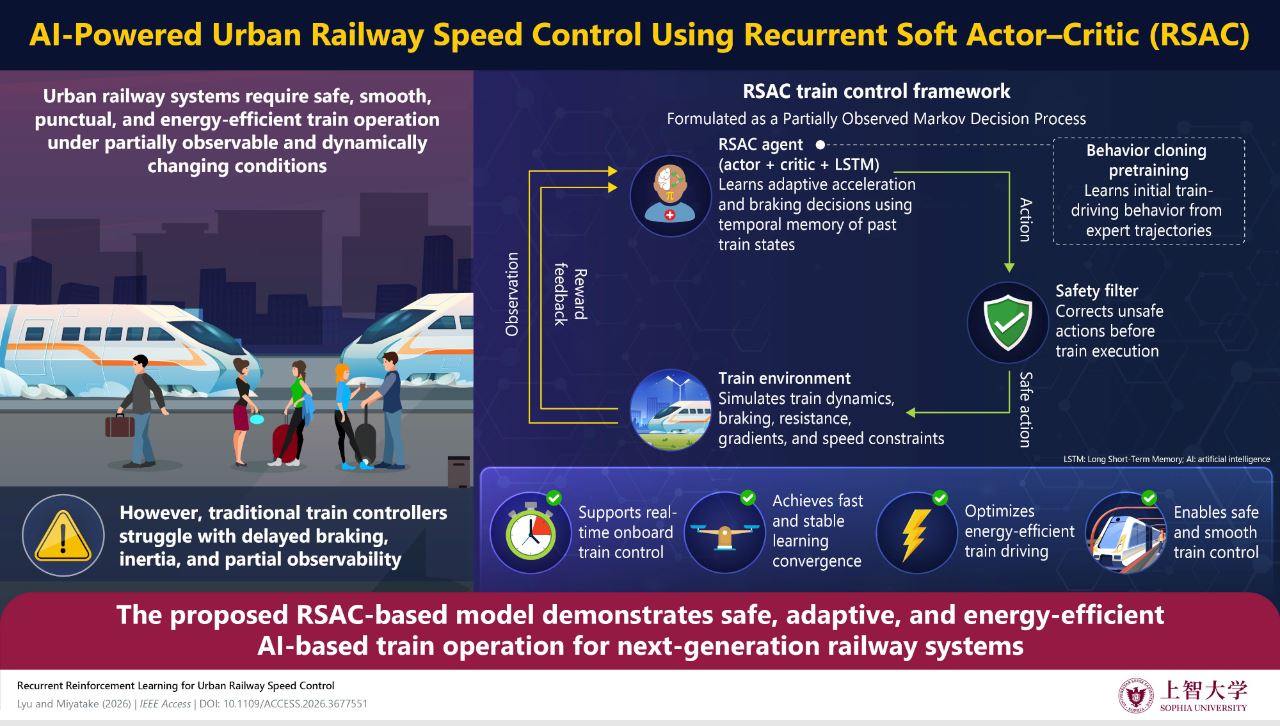
Urban railways play a key role in sustainable transportation systems. However, achieving precise and energy-efficient train control under diverse operating conditions of urban railways remains a challenge. Researchers from Japan have now developed a recurrent reinforcement learning framework for urban railway speed control that combines expert-guided learning and safety filtering. The proposed method demonstrated stable, real-time operation and energy-saving performance, highlighting its potential for next-generation automatic train operation systems.
As cities continue to expand,railways are expected to become an important component of urban mobility systems. Compared to automobiles and air transport, railways are highly energy efficient and produce relatively low environmental impacts and therefore form an important component of sustainable transportation systems. Thus, researchers have been exploring advanced train control technologies for further improvement of operational efficiency, passenger comfort, and punctuality while reducing energy consumption.
In this context, Professor Masafumi Miyatake from the Department of Engineering and Applied Sciences in collaboration with doctoral studentMingyu Lyu from Graduate School of Science and Technology, Sophia University,investigated a new AI-based framework for urban railway speed control. The findings were published in Volume 14 of IEEE Access on March 25, 2026.
Reinforcement learning is a branch of artificial intelligence (AI) which has attracted attention as a promising approach for automatic train operations as it enables an AI agent to learn optimal control strategies by interacting repeatedly with an environment and improving its behavior through trial and error. However, implementing this in railway operation presents several practical challenges including incomplete information about operating conditions, train inertia, braking delays, and strict safety requirements.
To overcome this, researchers developed a recurrent reinforcement learning framework based on Recurrent Soft Actor–Critic (RSAC) algorithm. RSAC is an AI method that enables train control systems to learn from past driving patterns and adapt to changing railway conditions over time.
“Our reinforcement learning-based algorithm was capable of adapting train driving control to a wide range of track and rolling stock conditions,” explains Prof. Miyatake.
Unlike conventional reinforcement learning methods,the proposed approach used arecurrent neural network that can retain information from previous train states. This allowed the system to capture time-based relationships associated with train operation, such as traction response delays, braking history, and inertial effects, thereby improving decision-making under partially observable conditions.The team also used a training approach that allowed the AI system to first learn from examples of expert driving behavior before learning on its own. By studying these optimized driving patterns early in training, the AI was able to learn faster, make better decisions, and develop more stable and efficient train control behavior.
Apart from this, the team also integrated a safety filter into the framework. The safety filter would override potentially unsafe control commands generated by the AI policy and ensure compliance with the operational constraints such as speed limits and braking feasibility. This mechanism also helped ensure safe operation when the learned policy encountered unfamiliar situations.
The proposed framework was evaluated through various simulations of urban railway operations over approximately two-kilometer sections between stations. The simulation environment was designed to closely resemble real-world railway conditions, including uphill and downhill tracks, changing speed limits, and required train arrival times.
Additionally, the proposed AI framework was also compared with several other widely used reinforcement learning algorithms. These included Deep Deterministic Policy Gradient (DDPG), Proximal Policy Optimization (PPO), Twin Delayed Deep Deterministic Policy Gradient (TD3), and Soft Actor–Critic (SAC), which are commonly used to train autonomous decision-making systems.
“Among all the methods tested, our developed frameworklearned faster and performed better than all tested methods,” explains Prof. Miyatake.
The research also demonstrated strong energy efficiency. While dynamic programming achieved the theoretical minimum energy consumption under ideal conditions, the developed system attained comparable performance while remaining suitable for real-time operation. Meanwhile, conventional reinforcement learning approaches exhibited less stable behavior and higher energy consumption.
The findings suggest that this framework could help introduce a cleaner and more convenient public transportation by facilitating accurate and energy-efficient train operation at relatively low cost. The study refines the advantages of railways as an energy-efficient and environmentally friendly transportation system contributing towards a sustainable future. Looking ahead, the study may contribute to enhancing the role of railways as a sustainable transportation system—supporting climate change mitigation and sustainable urban development.
The findings also highlight the potential of AI-driven railway systems to support safer, greener, and more reliable urban transportation in future smart cities.
11, Jun 2026
RMetS Weather Photographer of the Year 2026 Opens for Entries
The world’s favourite weather photography competition returns today as the Royal Meteorological Society (RMetS) officially opens entries for the Weather Photographer of the
Year 2026. Now entering its second decade, the competition invites photographers from around the globe to submit striking images that capture the power, beauty and impact of
weather. It celebrates outstanding photography that showcases both dramatic weather events and the growing influence of climate change.
The dedicated Climate Award also returns for 2026, recognising images that connect weather with wider environmental change. As a visual medium, photography offers a
powerful way to communicate complex scientific ideas and engage global audiences.

Prof Liz Bentley FRMetS, Chief Executive of the Royal Meteorological Society, said:
“The Weather Photographer of the Year competition continues to showcase the remarkable ways in which weather shapes our world, from moments of natural beauty to events of significant impact. As our climate changes, these images play an increasingly important role in helping people understand and engage with the science behind weather and climate.”
The competition is free to enter and open to photographers of all levels, from seasoned professionals to enthusiastic amateurs.
The 2026 categories include:
• Weather Photographer of the Year – awarded to the most striking image of weather in action (£1,500 prize).
• Mobile Weather Photographer of the Year – celebrating the best images captured on a smartphone or tablet (£500 prize).
• Climate Award – recognising photography that tells a compelling story about our changing climate (£500 prize).
• Public Favourite – decided by a global public vote.
Key Dates
• Entries open: 11 June – 20 August 2026
• Shortlist announcement and public vote: 22 October 2026
• Winners announced: 17 November 2026
10, Jun 2026
Telangana Village Sets Example by Choosing Government Schools for All Children
Hyderabad, June 10 (UDN): In a significant step towards strengthening public education, residents of Babapur village in Telangana’s Nirmal district have unanimously resolved to enrol their children in government schools, demonstrating strong faith in the state’s public education system.

Representational image
The decision was taken after a series of discussions held at the village level, where community members deliberated on ways to improve educational opportunities for children while supporting government institutions. The resolution was formally adopted during a Gram Panchayat meeting, with villagers agreeing that all school-going children from the village should attend government schools.
Babapur, a predominantly agrarian village under Lakshmanachanda Mandal, has drawn attention for what many see as a rare and inspiring collective commitment to public education. Villagers believe that increased enrolment will not only benefit students but also contribute to the overall improvement and growth of government schools.
Village Sarpanch Padigela Lakshmi said quality education is vital for the future of children and the development of the community. She expressed confidence in the capabilities of government school teachers and emphasized that public educational institutions continue to play a crucial role in providing affordable and quality education, particularly for rural and economically weaker families.
Education experts and local residents have welcomed the initiative, describing it as a model that could inspire similar efforts in other villages across Telangana and beyond. They noted that community participation is essential for strengthening government schools and ensuring better educational outcomes.
The resolution comes at a time when governments across the country are investing heavily in upgrading school infrastructure, enhancing teaching standards and improving learning environments. Observers believe the Babapur initiative sends a strong message about public trust in government education and highlights the role communities can play in shaping the future of local institutions.
The village’s collective decision is being viewed as a positive example of grassroots leadership and community-driven action aimed at ensuring quality education for every child while reinforcing the importance of a robust public education system.
10, Jun 2026
Dr. Ketan Deshpande Recognized by Cambridge Judge Business School for Outstanding Contribution and Social Impact
Pune , June 9 : Friends Union for Energising Lives , the Pune-based public charitable trust and NSE Social Stock Exchange – listed non-profit, has announced that its Founder, Chairman and Managing Trustee, Dr. Ketan Deshpande, has been formally recognised by the University of Cambridge, Judge Business School, for his outstanding contribution to the Cambridge India Business Society and for FUEL’s exemplary philanthropic work.
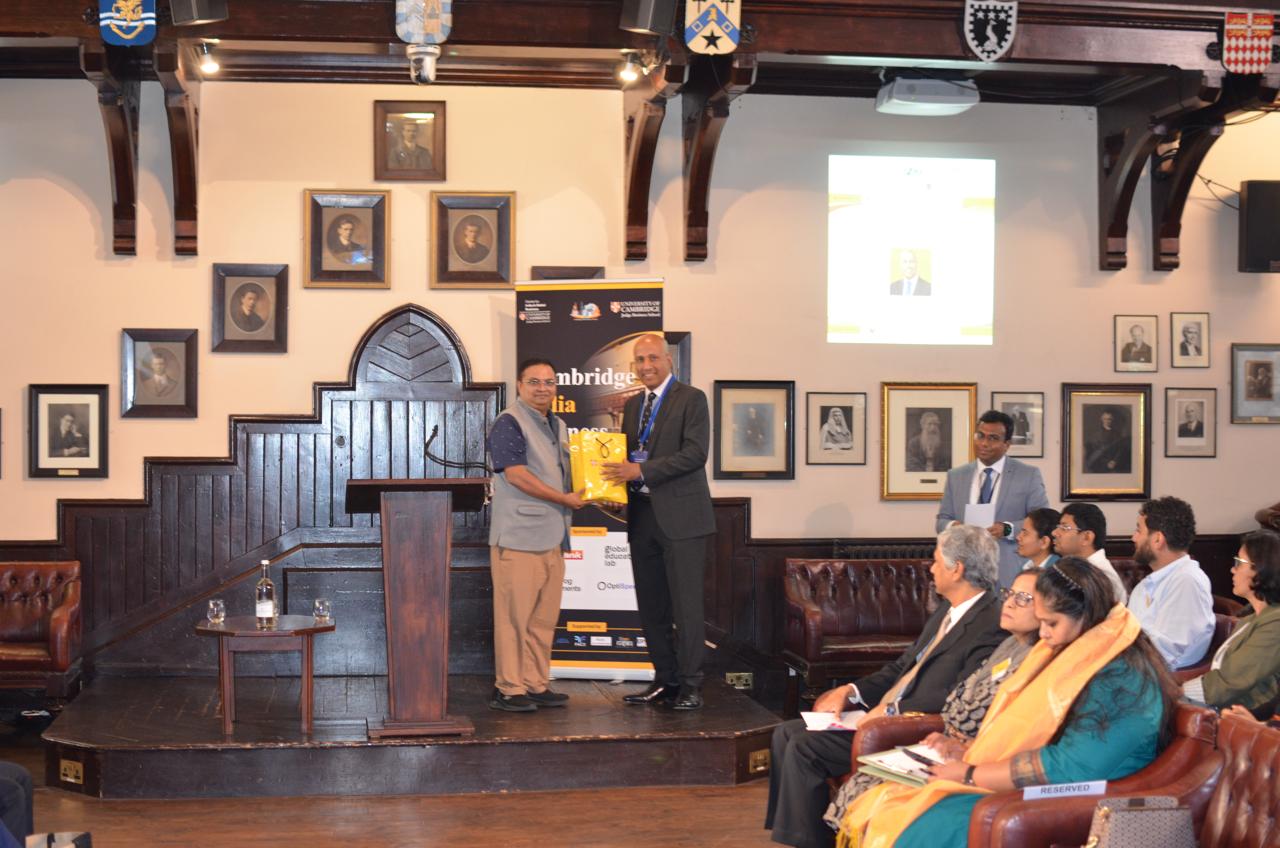
The recognition was conveyed through a letter dated 30 May 2026, issued on the occasion of the Cambridge India Business Dialogue 2026, and jointly signed by Prof. Gishan Dissanaike, Dean of Cambridge Judge Business School, and Prof. Jaideep Prabhu, Vice Dean and Director of the Centre for India & Global Business.
The letter acknowledged Dr. Deshpande’s steadfast support and mentorship of the Cambridge India Business Society over the past three years, crediting his guidance with helping shape it into one of the most active student-led communities at the School and enabling the growth of its flagship annual Dialogue. It further recognised FUEL’s pioneering work in career guidance, skill development and youth empowerment, which has touched the lives of over a million young people across India and opened doors of opportunity for those who need them most.
Responding to the recognition, Dr. Ketan Deshpande said:
“This honour belongs not to one person, but to a mission and a movement. For 19 years, FUEL has worked to open doors of opportunity for first-generation and underserved youth across India. To have that journey seen and valued by an institution like Cambridge is both a privilege and a renewed responsibility. In the same spirit, we are honoured that Cambridge alumnus Dr. Yusuf Hamied has adopted the School of Science at FUEL SkillTech & Entrepreneurship University. As Dr. APJ Abdul Kalam reminded us, dreams are not what you see in sleep — they are what do not let you sleep. There is still so much to build.”
The acknowledgement marks a significant milestone in FUEL’s growing international engagement and reflects the organisation’s deepening association with Cambridge Judge Business School and the wider Cambridge community.
10, Jun 2026
India Opens Doors to Global Education: Three Top Foreign Universities Receive Approval to Establish Campuses
New Delhi, June 10 (UDN): In a landmark step towards strengthening India’s position as a global education hub, Letters of Approval (LoAs) were handed over to three globally reputed foreign universities from the United Kingdom and Australia to establish campuses in India. The approvals were presented in the presence of Union Education Minister Dharmendra Pradhan.

x.com/EduMinOfIndia
The universities receiving approval are the University of Bristol, UK, and the University of York, UK, both of which will establish campuses in Mumbai, while the University of New South Wales (UNSW), Australia, will set up its campus in Bengaluru.
The initiative is a significant milestone under the National Education Policy (NEP) 2020, which promotes the internationalisation of higher education by attracting leading global institutions to India while also encouraging Indian universities to expand their international footprint.
The upcoming campuses in Mumbai and Bengaluru—two of India’s foremost centres of innovation, technology, and enterprise—are expected to provide students with world-class academic and research opportunities without requiring them to study abroad. The institutions will offer future-oriented programmes in cutting-edge fields such as Artificial Intelligence (AI), Cyber Security, Data Science, Finance, Entrepreneurship, Creative Industries, Immersive Arts, Renewable Energy, Health Sciences, Transport Systems, and Education Technology.
Speaking on the occasion, the Union Education Minister said the arrival of globally renowned universities reflects growing international confidence in India’s higher education ecosystem and the transformative reforms introduced under NEP 2020. He noted that the initiative would create new avenues for research collaboration, innovation, skill development, and global academic exchange.
The establishment of these campuses is expected to enhance access to high-quality international education, strengthen India’s knowledge economy, and contribute to the vision of making the country a global centre for learning and innovation. The move is also seen as a major boost to the aspirations of Indian youth and the broader goal of building a Viksit Bharat (Developed India).
With this development, India continues to emerge as a preferred destination for global academic institutions, further reinforcing its role in shaping the future of higher education and research.
9, Jun 2026
Parlini Land Launches Multilingual Children’s Language Learning App
App offers low-stimulation, play-based educational games that enable families around the world to raise digitally literate children in their heritage or second language
MALTA, June 9: Parlini Land, a multilingual educational app that enables children to learn up to 11 different languages, has launched on the Apple App Store and Google Play. Created for children ages three to eight, Parlini Land offers a library of quality, play-based educational games that feature fun, low-stimulation screen time. Activities on the app include number tracing, spelling, colour and shape recognition, matching, counting, flashcards, puzzles, and more. Parlini Land gives families around the world the ability to raise digitally literate children in their heritage or second language.
“The impetus for creating Parlini Land started when I became a mother,” explained Francesca Borg Bellanti, Parlini Land’s founder. “I noticed a gap that millions of families face but rarely talk about: the internet is overwhelmingly in English. For families who speak another language, whether it’s Arabic, Hindi, Irish, Polish, or Greek, it can be incredibly hard to find screen time that is genuinely engaging, age-appropriate, safe, and educational in their language. That’s the problem we’re solving with Parlini Land.”
Parlini Land is teacher-approved. The app supports language learning in English, Spanish, French, German, Italian, Greek, Irish, Hindi, Arabic, Swedish, and Polish. The immersive user experience features real human voices (not AI) in the child’s chosen language. The experience is calm and designed for low stimulation. It’s engaging, not addictive.
Borg Bellanti added, “Parlini Land is for bilingual families, perhaps in diaspora communities, who where parents want to keep a heritage language alive at home. We enable parents to introduce a new language naturally through play. The alternative is to surrender to English being the language of childhood, which is the risk parents face when every game, cartoon, and app a child interacts with is in English.”
6, Jun 2026
Terahertz Biophotonics: Understanding the Path Towards PracticalApplications

Researchers summarize the recent developments and future research directions toward the broader implementationof terahertz biophotonics
Biophotonicsrefers to the development and application of light-based technologies to study biological systems.The application of terahertz (THz) frequency range in biophotonics is considered a promising avenue for advancing biological research. However, several challenges still limit practical adoption, although recent developments show strong potential. In a new study, researchers present a comprehensive review of recent advancements and emerging applications of THz biophotonics, highlighting promising areas and future research directions that can expand its adoption.
Biophotonics is a multidisciplinary field that involves the development and application of light-based technologies to study, monitor, and treat biological systems. The ability to directly image cells and molecules has led to many fundamental discoveries in the past century. More recently, the terahertz (THz) region of the electromagnetic spectrum has attracted growing interest as a promising frontier for advancing biological research.
The THz frequency range is associated with several fundamental biological processes. Although THz radiation is strongly absorbed by water, traditionally viewed as a limitation, this property can enable sensitive characterization of hydration states and water content. Compared to visible light, THz waves can also penetrate certain biological tissues more effectively. However, despite steady advancements, the adoption of THz biophotonicsstill lags behind visible light-based techniques in directly observing cellular and molecular dynamics.This is largely due to several challenges, including relatively low spatial resolution (a consequence of the longer THz wavelengths), high sensitivity to water that complicates measurements, slower imaging speeds, and bulky instrumentation. Fortunately, recent developments suggest strong future potential.
To highlight these advancements, Associate Professor Kazunori Serita from theGraduate School of Information, Production, and Systems, Waseda University, Japan, together withSpecial-Appointment ProfessorMasayoshi Tonouchi from the Research Institute for Interdisciplinary Science, Okayama University, Japan, presented a comprehensive review summarizing current efforts to address limitations and improve the adoption of THz biophotonics. The study was published in the Journal of Physics PhotonicsonMay 28, 2026.
“THz biophotonics is a fascinating research area for next-generation biomedical technologies.Currently, THz biomedical applications are restricted to a few niche domains with many technical limitations.Recent developments in emerging THz technologies have greatly increased the potential for overcoming these technical limitations,” says Serita.
In their review, the researchers first outline how THz radiation interacts with biological processes, highlighting key advantages such as sensitivity to molecular fingerprint spectra and the ability to enable non-invasive, non-destructive, and label-free measurements. They also discuss the strong dielectric dispersion and absorption of water. Next, they trace the historical development of key THz technologies, including THztime-domain spectroscopy, the evolution of THzimaging techniques, and the emergence of THz metamaterial biosensors that can be used to probe complex and small biological samples.
A major focus was on fields that show strong potential for early application. For example, THz imaging is gaining attention in skin cancer diagnosis due to its sensitivity to tissue composition and is progressing toward clinical trials. Wound assessment is another field where THz imaging is being increasingly applied. Margin assessment in breast cancer is also a key area where THz technology has high potential for practical clinical application, offering a pathway to simplify current procedures. The review also highlights applications in drug discovery and pharmaceutical analysis.
Beyond these areas, the review identifies emerging directions such as single-cell THz imaging, molecular-scale THz studies, diagnostics for internal organs (including the gastrointestinal and respiratory systems), and THz-based blood analysis. In addition,it highlights future technologies that can enable THz observation of cells and molecules under physiological conditions, including the recently developed “point-terahertzsource” technology by Serita and colleagues.
“THz measurement technologies can benefit not only medicine, but also a wide range of industries, including drug discovery, food inspection, environmental monitoring, semiconductor evaluation, and biotechnology,” says Serita.
Finally, the researchers presented the main areas for future research, includingidentifying the precise origins of THz contrast in biological samples and improving the understanding of water dynamics to improve reliability.
“Our study provides a roadmap of emerging approaches that could help transform the field of THz biophotonics from proof-of-concept studies to practical biomedical applications,” concludesSerita.


