


15, Jan 2026
Gita-Inspired Needonomics Emerges as a New Paradigm for Teaching Excellence at MH-MMTTC, Hansraj College
New Delhi, Jan 15: Gita-inspired Needonomics is emerging as a transformative paradigm for teaching excellence and ethical education, said Prof. Madan Mohan Goel, Propounder of the Needonomics School of Thought, three-time Vice-Chancellor, and superannuated Professor of Kurukshetra University, during a Faculty Induction Programme (FIP) held at Mahatma Hansraj Malaviya Mission Teacher Training Centre (MH-MMTTC), Hansraj College, in collaboration with Miranda House, University of Delhi.
Prof. Goel delivered two insightful lectures on “Excellence Models for Teachers in a Changing Economic Scenario” and “Indian Knowledge System: Relevance of Gita-Guided Needonomics and Anu-Gita.” The programme was presided over by Dr. Ashutosh Yadav, Director, MH-MMTTC.
Welcoming the participants, Dr. Ritu Pandey, Coordinator of the FIP, delivered the opening address and presented a citation highlighting Prof. Goel’s distinguished academic journey and significant leadership contributions to higher education.
Drawing from the Bhagavad Gita, Prof. Goel emphasized that a truly wise person is one who “sees inaction in action and action in inaction,” remaining free from ego, attachment, and the fruits of action. He stressed that educators must cultivate humility, balance, and sensitivity while remaining street SMART—Simple, Moral, Action-oriented, Responsive, and Transparent.
Explaining the core philosophy of Needonomics, Prof. Goel highlighted the restoration of the natural sequence outlined in the Hitopadeśa—knowledge leading to humility, humility to worthiness, worthiness to wealth, wealth to dharma, and dharma to happiness. He noted that education must go beyond earning a livelihood to making life meaningful and fulfilling.
“The real genius,” he observed, “is one who can correctly differentiate what ought to be done from what should not be done.” He added that an average individual guided by values is far superior to a so-called genius who causes harm to others.
Prof. Goel further elaborated on Gita-guided Needonomics as a human-centric, ethical, environmentally friendly, and spiritually rooted approach. Citing the LIC of India motto “Yogakshemam Vahamyaham” (Gita 9.22), he explained that Needonomics promotes common sense economics focused on sustainable happiness and societal well-being.
The session resonated strongly with participating faculty members, reinforcing the relevance of Indian Knowledge Systems in shaping value-driven, responsible educators for a rapidly changing world.
- 0
- By Neel Achary

15, Jan 2026
Jaro Education and Delhi Technological University announceda collaboration to launch industry-focused online degree programs and strengthen workforce upskilling
New Delhi, Jan 15: Jaro Education, a publicly listed company and one of India’s leading EdTech players in higher education and upskilling company, has announced a collaboration with Delhi Technological University (DTU), one of India’s premier engineering and technology institutions, ranked 30th in Engineering by NIRF 2025.The two entities have signed a Memorandum of Understanding (MoU) to launch industry-relevant online degreeprograms, particularly in technology-driven domains, aimed at empowering learnersand enhancing the nation’s talent ecosystem.

Through this collaboration, Jaro Education and DTU plan to democratize access to high-quality higher education by offering flexible, modular, and digitally enabled degreeprograms that combine DTU’s academic excellence with Jaro’s deep expertise in learner outreach and technology-enabled delivery. These programs will cater to the growing need for tech-focused upskilling and create future-ready professionals aligned with evolving industry requirements.
Ranjita Raman, Chief Executive Officer, Jaro Education, said: “India’s growth story will be shaped by how effectively higher education responds to the needs of a changing workforce. Today, many capable learners are ready to advance but remain constrained by geography and rigid academic formats. This collaboration with Delhi Technological University addresses that challenge. DTU offers strong academic foundations in technology, and Jaro specialises in translating that excellence into accessible, industry-aligned online programs. Together, we are creating meaningful pathways that serves learners, meets industry needs, and aligns with the National Education Policy”.
Prof. S. Indu, Dean of Delhi Technological University, added: “DTU is committed to expanding its reach and impact by developing programs that respond to the evolving needs of industry and society. Partnering with Jaro Education allows us to offer our academic excellence to a wider audience and promote lifelong learning opportunities that foster innovation and employability.”
This collaboration reinforces both institutions shared vision of leveraging edtech innovation to scale quality education, promote industry-academia synergy, and upskill the Indian workforce for the digital economy.
13, Jan 2026
Swiggy Announces Winners of Inaugural ‘Food for Thought Challenge’
Swiggy Announces Winners of the Inaugural Edition of ‘Food for Thought Challenge’ – Reinforces Commitment to Student Innovation
Bengaluru, Jan 13: Swiggy (Swiggy Ltd, NSE: SWIGGY / BSE: 544285), India’s pioneering on-demand convenience platform, today announced the winners of the inaugural edition of Food For Thought Challenge (FFTC) – its flagship case study competition. The Food for Thought Challenge (FFTC) gave the opportunity to thousands of students across campuses in the country to share fresh, disruptive ideas that could further strengthen Swiggy’s position as a trusted companion for every student during the campus years.
IIM Lucknow was crowned the Winner for their innovative ideas for more meaningful student engagement for food delivery and dining out. The team was rewarded pre-placement interviews and a cash prize of ₹1,50,000. IIM Indore ranked First Runner Up and was rewarded with a cash prize of ₹50,000. Teams from IIM Bengaluru and MICA Ahmedabad were also amongst the other 4 finalists of the competition.
The Food For Thought Challenge, which was launched in September 2025, saw an overwhelming response from the student community, receiving 2,600+ submissions from 600+ colleges across India, with more than 30% of the entries from IIMs, IITs, NITs, and other leading institutions. The Finale Round was chaired by Rohit Kapoor, CEO, Swiggy Food Marketplace. Swiggy intends to make Food for Thought an annual platform with an objective of enabling innovation and connecting better with the student community.
Speaking on the entries and the initiative, Deepak Maloo, Vice President – Food Strategy, Customer Experience & New Initiatives, Swiggy, said,
“College students are more than just our customers; they are a catalyst for innovation. With FFTC, we were keen to harness their disruptive, fresh perspectives to identify and unlock new growth levers and further enhance customer experience. The participating teams were impressive, demonstrating an incredible knack for turning data-driven insights into disruptive, actionable ideas.”
The Food For Thought Challenge had a rigorous evaluation process and all the submissions underwent a multi-stage evaluation. The submissions were graded on a 4-point framework (innovativeness, impact on growth, execution feasibility, cost effectiveness). The top 8 teams from the list advanced to a semi-final round with top Swiggy executives in the Jury Panel and 4 teams made it to the Grand Finale, hosted in Bengaluru.
By engaging with campuses, Swiggy aims to foster an ecosystem where young talent can contribute to the future of food tech and logistics, mirroring the company’s own journey as a market disruptor founded on bold ideas. Swiggy’s Student Rewards Program and Campus Streaks initiatives have already garnered attention amongst the student community and are in line with Swiggy’s larger effort to deliver greater value and convenience to young consumers across India. The Student Rewards program has received an overwhelming response and enables over 7 lakh college students across 3,600+ campuses today.
13, Jan 2026
NIIT Foundation Receives ISO 9001:2015 Certification
“Receiving the ISO 9001:2015 certification is an important organisational milestone for NIIT Foundation. It reflects the rigour of our internal processes and our focus on delivering high-quality, consistent, and scalable skilling interventions. As we work across diverse geographies and communities, strong quality systems enable us to remain accountable to learners, partners, and the larger development ecosystem.”
13, Jan 2026
Koncept Global Books Launches India-Centric, Future-Ready ‘Leapstone’ Series for Classes 6–8
Koncept Global Books, a modern educational venture dedicated to providing holistic learning support to the next generation, today announced the launch of its new middle-school catalogue, Leapstone, for students in Classes 6–8. Building on the 25-year publishing legacy of Arihant Publications, the initiative aims to redefine how students learn, think, and apply knowledge in the 21st century.
Koncept Global Books was established to address the growing need for textbooks that go beyond academic content and develop broader competencies essential for today’s rapidly evolving world. With a shift in education towards critical thinking, problem-solving, emotional intelligence, and real-world application, traditional textbooks often fall short. Leapstone bridges this gap by offering learning resources that are India-centric yet globally aligned, ensuring students develop strong cultural roots while cultivating a future-ready mindset.
As the first milestone of its ambitious Project 21 Agenda, Koncept Global Books has launched a comprehensive catalogue of 45 titles across 15 series for Classes 6, 7, and 8. The Leapstone series represents a fundamental shift from conventional textbooks. While anchored in India’s cultural, social, and educational context, the content integrates a global outlook, preparing students for opportunities on both national and international platforms. The series emphasizes conceptual clarity, critical thinking, experiential learning, and emotional development, aligning closely with the spirit of NEP 2020 and NCF 2023.
Commenting on the launch, Mr. Atishay Jain, Managing Partner, Koncept Global Books, said:
“The ‘Project 21 Agenda’ is about transforming education from teaching ‘what to think’ to ‘how to think.’ We aim to nurture a generation of innovators and leaders who will shape the world rather than simply participate in it.”
The Leapstone series has been designed to support diverse school environments and student capabilities, ensuring accessibility and meaningful impact across different learning levels. By integrating inquiry-based activities, real-world tasks, and value-based learning, the books empower students to understand, question, apply, and internalize knowledge, moving beyond rote memorization.
The Leapstone series from Koncept Global Books is now available for schools and parents across India.
12, Jan 2026
61st Shankar’s On-the-Spot Painting Competition 2026 Celebrates Creativity and Digital Detox Among Young Minds
Delhi NCR, Jan 12: The 61st edition of Shankar’s On-the-Spot Painting Competition 2026 was successfully held, reaffirming its legacy as one of India’s most prestigious and enduring children’s art events. With participation from over 5,000 children aged 5 to 16 years, the competition once again provided a vibrant platform for young artists to showcase their imagination, originality, and artistic talent.

Commenting on the significance of the competition, Navin Menon, Editor Publications, Children’s Book Trust, said:
“Shankar’s On-the-Spot Painting Competition has always championed the free and fearless expression of a child’s imagination. In today’s screen-driven world, this initiative is more relevant than ever, giving children an opportunity to disconnect from digital distractions and reconnect with their inner creativity. Seeing thousands of young minds absorbed in art reaffirms that creativity remains essential to emotional and intellectual growth.”
Since its inception in 1952, the competition has evolved into a cultural institution, encouraging creativity, self-expression, and artistic discipline across generations. The 2026 edition continued this rich tradition while addressing contemporary challenges faced by children today.
A key highlight of this year’s edition was its strong focus on digital detox. In an era dominated by screens and gadgets, participants were given three uninterrupted hours to immerse themselves in colors, ideas, and hands-on artistic expression. This initiative emphasized the importance of balancing technology with creative and mindful activities, fostering holistic child development.
The event also featured enthusiastic participation from several NGOs across Delhi NCR, including Vidya Foundation, Aarohan Foundation, and Katha Foundation, enabling children from diverse backgrounds to showcase their talent on a shared platform. This inclusivity reinforced the competition’s commitment to equal opportunity and nurturing creativity beyond social and economic boundaries.
The presence of esteemed trustees, Yamuna Shankar and Robinder Sachdev, added further significance to the occasion. Their interactions with participants, educators, and organizers highlighted the enduring vision behind the competition and its dedication to fostering creativity among young minds.
The 61st Shankar’s On-the-Spot Painting Competition 2026 stood as a powerful reminder that art is a timeless medium of expression. By blending tradition with contemporary relevance, the event celebrated artistic excellence while promoting mental well-being, focus, and imagination. As the competition continues its journey that began in 1952, it remains committed to inspiring future generations to think creatively, paint fearlessly, and grow beyond screens through the power of art.
12, Jan 2026
KIIT World School Hosts CBSE Workshop on Art Integration
Gurugram, Jan 12: KIIT World School, Sohna Road, recently hosted a CBSE Capacity Building Programme (CBP) workshop focused on Art Integration, designed to equip educators with innovative strategies to make classroom learning more engaging, creative, and effective.

The workshop was led by CBSE Resource Persons Rama Shankar and Kalyani Voleti, both seasoned educators with extensive experience in teacher training. Kalyani Voleti, a specialist in Visual Arts Education, shared practical insights on embedding artistic approaches across subjects to enhance conceptual understanding and foster deeper learning.
Teachers actively participated in experiential activities, including role-playing exercises based on the Preamble of the Constitution and discussions aligned with the Multiple Intelligences theory. These hands-on sessions demonstrated how art can be seamlessly integrated into diverse disciplines, enabling students to connect better with academic concepts.
The workshop also emphasized the role of art-based learning in nurturing ethics, values, and emotional intelligence. Educators were encouraged to express ideas through acting, poetry, and visual storytelling, highlighting how every creative medium conveys meaningful narratives. Strategies to develop critical thinking, creativity, collaboration, and communication skills—key 21st-century competencies—were also discussed for immediate classroom implementation.
Speaking on the occasion, Principal Neelima Kamrah said,
“Art integration has become an essential component of modern education. It not only nurtures creativity but also enables students to develop a deeper and more meaningful understanding of academic subjects.”
12, Jan 2026
IIT Bombay Launches Certificate in Generative AI
Kochi, Jan 12: IIT Bombay is pleased to announce the launch of the Certificate in Generative AI, offered by the Technocraft Centre for Applied Artificial Intelligence. Delivered in collaboration with Great Learning as the edtech partner, this five-month, online, hands-on certificate programme is scheduled to commence in 2026, with registrations now open.
Designed and delivered by IIT Bombay faculty, the certificate features an industry-aligned curriculum that equips professionals with the skills to design, adapt, and deploy Generative AI (GenAI) applications. The programme follows a practical, LLM-first approach across five modules, taking learners from the fundamentals of artificial intelligence and large language models to prompt design, model adaptation using proprietary data, and the development of copilot tools and multi-step workflows.
The programme culminates in the deployment and security of GenAI solutions, reinforced through practical projects that ensure learners gain hands-on experience in building scalable, real-world AI applications.
Upon successful completion, participants will be awarded a Certificate of Completion from IIT Bombay, recognising their proficiency in building and deploying reliable GenAI applications.
Talking about the collaboration, Prof Manjesh K. Hanawal from IIT Bombay said,
“Generative AI marks one of the most significant technological shifts of our time, reshaping how ideas are created, knowledge is built, and work is organised. As the focus moves from curiosity to capability, it’s vital that professionals understand and apply this technology responsibly and effectively. This certificate course underscores IIT Bombay’s commitment to enhance conceptual understanding with practical implementation by imparting learning from foundational AI to the emergence and adoption of GenAI. It also equips learners to not just use AI tools, but to understand which Gen AI model is best suited for their use cases and be able to design and deploy reliable GenAI solutions. Learners will reinvent how they looked at AI and Gen AI and emerge more confident in handling AI driven decision making, productivity enhancements and building innovative solutions across industries.”
The certificate programme is tailored for software engineers, data scientists, analysts, product owners, technology professionals, product managers, STEM graduates, and GenAI enthusiasts who seek to build and operate GenAI systems, integrate them into workflows, and unlock new career opportunities.
Speaking about the Certificate, Mohan Lakhamraju, Founder and CEO, Great Learning, said,
“Generative AI has evolved from a niche technology to a core professional skill, and those who can design and apply these systems responsibly will drive the next wave of innovation and business impact. This program helps professionals move beyond experimentation to truly understand how GenAI works, what it can achieve, and how to apply it meaningfully to real-world challenges. This program deepens our collaboration with IIT Bombay, reflecting our shared commitment to empowering the next generation of AI talent.”
Candidates holding a Bachelor’s degree in any discipline from a recognised university, with a minimum aggregate of 50% or equivalent CGPA, are eligible to register for the programme.
9, Jan 2026
Govt. of Andhra Pradesh and Heartfulness Launched a Novel Net-Zero Residential School Pilot Programme at APSWREIS Residential School
Vijayawada, Jan 09: Heartfulness, in collaboration with the Government of Andhra Pradesh, today launched a landmark Net-Zero Residential School pilot project at the APSWREIS Residential School in Kuntamukkala, near Vijayawada. The initiative emerged from discussions between Hon’ble Chief Minister Sri Nara Chandrababu Naidu and Reverend Daaji, Global Guide of Heartfulness, reflecting a shared vision for sustainable and environmentally responsible education and aims to serve as a scalable model of an Integrated Ecological Campus.
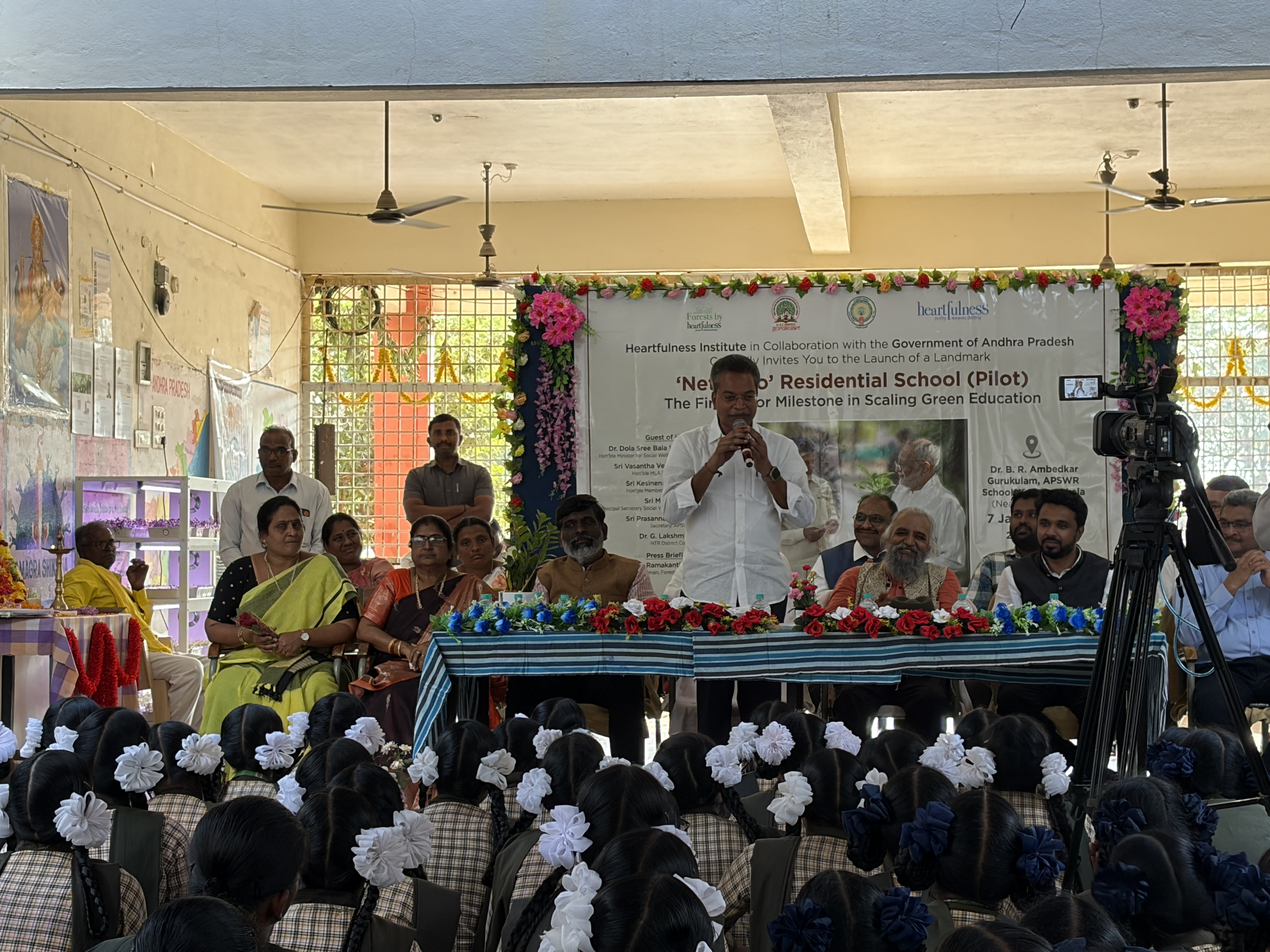
The campus will include green belts, a rainforest, wetlands, and microgreens, thereby closing the Net-Zero loop. It seeks to create an environment conducive to learning while grooming students to take responsibility for ecology through student-led green governance, with scope for scaling across Andhra Pradesh.
The launch was graced by Sri Vasantha Venkata Krishna Prasad, MLA, Mylavaram, NTR District; Sri Prasanna Venkatesh V., IAS, Secretary, APSWREIS; Dr Ramakantha, Chairman, Forests by Heartfulness; and Mr Saravanan Subramanian, Director, Forests by Heartfulness. This initiative is based on the discussions Hon CM Sri Nara Chandrababu Naidu had with Reverend Daaji, Global Guide, Heartfulness. The event was marked by a mass plantation drive, with green enthusiasts coming together to set a new national benchmark for climate-positive educational infrastructure.
The need for the pilot project was identified as a long-term, low-energy, sustainable solution for residential schools, where there is higher resource usage, increased water consumption, and significant wastewater generation. Larger campuses offer scope for ecological regeneration, development of Net-Zero and water-positive campuses, creation of carbon assets, and integration of sustainability into daily student life. The project also aims to develop a scalable model for Andhra Pradesh while helping students identify their role in environmental stewardship.
Sri Vasantha Venkata Krishna Prasad, MLA, Mylavaram, shared his thoughts:
“Andhra Pradesh will become a hub of environmentally aware youth through initiatives like this. With the support of our Government and inspired by the guidance of Revered Daaji, we hope this pilot project will have a ripple effect throughout the state by introducing the Net-Zero concept in residential schools.”
“The seven-year project aims to achieve negative carbon emissions, improve soil health and biodiversity, and reduce freshwater usage. When sustainability becomes a way of life in residential schools, it becomes a lifelong habit. This is a commendable initiative by the Government of Andhra Pradesh and Heartfulness,” said Sri Prasanna Venkatesh V., IAS, Secretary, APSWREIS.
Dr Ramakantha, Chairman, Forests by Heartfulness, added,
“We are delighted to partner with the Government of Andhra Pradesh. This pilot project will not only help raise environmentally conscious leaders but also create a replicable and sustainable model for schools that will have long-term impact.”
Mr Saravanan Subramanian, Director, Forests by Heartfulness, said,
“By planting a tree and caring for it over time, each student nurtures life itself. This is the most beautiful aspect of the initiative. We are confident that this pilot will succeed in creating a beautiful, conducive, and spiritually enriched environment for students.”
The Integrated Campus Zoning concept includes a small rainforest; one ‘Sandalwood Legacy’ tree per student; dense plantations for boundary protection and carbon sequestration; wind and sound buffers for hostel comfort; a pollinator garden for biodiversity learning; a herbal garden for traditional knowledge; and microgreens with Net-Zero nutrition for low-water food production, skill development, and health—spread across seven distinct zones.
Student Green Clubs have also proposed to monitor trees, wetlands, and waste systems; promote daily sustainability practices in residential life; conduct quarterly reporting and audits; manage microgreens; integrate kitchen waste composting; and oversee recycled water usage.
Aligned with ESG (Environmental, Social, and Governance) and CSR (Corporate Social Responsibility) goals, the pilot project is expected to deliver a Net-Zero carbon campus within 5–7 years, achieve a 40–70% reduction in freshwater usage, enhance biodiversity and soil health, and nurture environmentally responsible residential students. Over the seven-year project phase, the Net-Zero pathway is projected to transition from a +180 high carbon emission level to a carbon-negative status by the seventh year through interventions such as wetlands, sustainable food systems, composting, biochar, rainforest development, boundary plantations, sandalwood cultivation, canopy growth, soil carbon build-up, mature tree cover, solar power, and LED lighting.
The Net-Zero Residential School pilot is scientifically robust and financially transparent, serving as a Detailed Project Report (DPR) for long-term ecological and educational assets, with pilot implementation followed by district-wise scaling.
2, Jan 2026
SRCC’s 100-Year Journey: Centenary Curtain Raiser Reflects Enduring Impact on Indian Economy

New Delhi, Jan 2: Shri Ram College of Commerce (SRCC), one of India’s most influential institutions in commerce and economics education, formally commenced its centenary celebrations on Friday with a landmark Curtain Raiser ceremony at its North Campus, bringing together academic leaders, policymakers, and distinguished alumni from across sectors.
As SRCC enters its 100th year (1926 2026), the institution reflected on a legacy that has closely tracked the evolution of India’s economic and governance architecture. The centenary curtain raiser outlined a year- long programme of academic conclaves, policy dialogues, alumni engagements, and global collaborations aimed at positioning SRCC for the demands of the next century.

Tribute to Founder and Institutional Legacy
The event was presided over by Prof. Yogesh Singh, Vice Chancellor of the University of Delhi, who attended as Chief Guest, along with Mr. Ajay S. Shriram, Chairman, SRCC Governing Body. The ceremony opened with a floral tribute to Sir Shri Ram, the visionary industrialist who founded the institution in 1920 as The Commercial School to nurture indigenous business leadership in pre-Independence India.
A commemorative coffee table book, Timeless Frames, chronicling SRCC’s journey from its early years in Daryaganj to its emergence as a globally recognised centre of excellence, was also released on the occasion.
Vice Chancellor highlights SRCC’s Nation Building Role
Addressing the gathering, Prof. Yogesh Singh described SRCC as a “globally recognised academic brand” and said the college’s contribution went far beyond rankings or reputation.
“Hundred years is long enough to build institutions, shape generations and influence the journey of a nation. SRCC has done all three,” he said, adding that the University of Delhi took pride in the college’s role in producing economists, administrators, judges, and business leaders who continue to shape India’s growth story.
Referring to India’s recent economic milestone of becoming the 4th largest economy, the Vice Chancellor said the country’s emergence as a USD 4 trillion economy underscored the importance of institutions like SRCC in producing world class economists, entrepreneurs, and policy thinkers. He urged the college to focus its next phase on entrepreneurship, business incubation, and emerging areas such as artificial intelligence and digital finance.
“Institutions like SRCC must now prepare leaders who create enterprises, not just join them, and who see leadership as a moral responsibility,” he said.
Chairman’s Address
Addressing the gathering, Mr. Ajay S. Shriram, Chairman, SRCC Governing Body, said the centenary curtain raiser marked both a moment of reflection and a roadmap for the future. Recalling SRCC’s journey from its modest beginnings in Daryaganj to becoming one of India’s foremost centres for commerce and economics education, he said the occasion was an opportunity to recognise achievements while planning ahead.
Paying tribute to late Arun Jaitley for his enduring contribution to the institution, Mr. Shriram said SRCC’s greatest strength lay in its people, its faculty, students, staff, and alumni. Outlining the path forward, he said the college would focus on academic excellence, research, infrastructure expansion, AI enabled learning, entrepreneurship, inclusion, sustainability, and deeper alumni engagement. “Our responsibility now is to ensure that SRCC not only preserves its legacy, but remains relevant, ethical, and nationally significant in the century to come,” he said.
Principal emphasises values and purpose
Welcoming the guests, Prof. Simrit Kaur, Principal, SRCC, said the centenary was a collective achievement shaped by generations of faculty, students, administrators, and alumni.
“For a hundred years, SRCC has stood for purpose over profit and ethics over expediency,” she said, adding that the college remained committed to nurturing socially responsible leaders grounded in ethical business practices, sustainability, and national service. She also acknowledged the continued support of the University leadership and the Governing Body in strengthening the institution’s academic and research framework.
Distinguished alumni reflect on SRCC’s impact
Several eminent alumni and well-wishers attended the ceremony, underscoring SRCC’s enduring influence across public life, industry, and civil society.
Sangeeta Jaitley, wife of late Arun Jaitley, former Union Minister for Finance and Corporate Affairs, recalled the profound impact SRCC had on his life and public journey. “He often spoke about the formative years he spent at this college and how deeply it shaped his thinking and values,” she said. Congratulating SRCC on completing 100 years, she added, “This is a proud moment. I wish the college many more centuries of producing leaders who excel in their own spaces and serve the nation with distinction.”

Justice A.K. Sikri, former Judge of the Supreme Court of India, was also present at the event.
Sunit Sethi, Chairman, Fashion Design Council of India, said SRCC’s alumni success across sectors was rooted in its academic culture. “It is a matter of great pride that SRCC alumni are doing exceptionally well in every field. Much of this credit goes to the college’s versatile, forward-looking faculty,” he said.
Sminu Jindal, Managing Director, Jindal SAW Limited and Founder Chairperson of Svayam, reflected on the institution’s inclusive ethos. “I feel extremely proud to be part of SRCC. As a person on a wheelchair, the college gave me the opportunity to study in an accessible and enabling environment, something that stayed with me throughout my life,” she said.

Vijay Goel, alumnus and former Union Minister, said SRCC played a defining role in shaping his life and leadership journey. “Whatever I am today, I owe to Shri Ram College of Commerce. The values of leadership, discipline, teamwork, and public engagement that I learnt here through academics, sports, student politics, NCC and NSS shaped not just my career, but my character,” he said.
Neeraj Ghei, Co-founder and Promoter of Select Citywalk and Select Synergies and Services Private Limited, highlighted the institution’s role in shaping professional confidence. “SRCC instils a sense of discipline, curiosity and integrity that stays with you long after you leave the campus. It prepares you not just for careers, but for leadership,” he said.
The ceremony concluded with the illumination of the heritage campus, symbolising the dawn of SRCC’s next century, followed by a cultural presentation featuring a Kathak Bharatanatyam jugalbandi and a musical tribute reflecting the eras the institution has witnessed.


