


14, Sep 2026
Cellebrite CTO Chris Wade to Lead Cellebrite Labs, Sharpening Focus on Mobile Research
Strategic move strengthens Cellebrite’s flagship access, extraction and decoding technology as Cellebrite Labs joins Wade’s Innovation Hub
TYSONS CORNER, Va. and PETAH TIKVA, Israel, Sept. 14, 2026 /PRNewswire/ — Cellebrite DI Ltd. (Nasdaq: CLBT), a global leader in AI-powered digital investigative and intelligence solutions, today announced expanded resources and new leadership for Cellebrite Labs, the team responsible for much of the core mobile research behind the company’s access, extraction and decoding technology. Effective immediately, Cellebrite Labs is operating under the leadership of Chris Wade, Cellebrite’s Chief Technology Officer, and is now part of the company’s Innovation Hub that Wade has led since joining Cellebrite, following its acquisition of Corellium.

The ability to access the broadest range of mobile devices and rapidly convert extracted data into digital evidence and actionable intelligence is central to Cellebrite’s leadership in digital investigations. As mobile security grows more sophisticated and challenging, Cellebrite is committing additional infrastructure, AI resources, research tools and talent to help Cellebrite Labs maintain its leadership across operating systems as the technical environment continues to rapidly evolve.
“Cellebrite’s trusted, innovative digital forensics expertise is at the heart of what makes Cellebrite the trusted partner for digital investigative practitioners around the world, and Cellebrite Labs is where much of that capability is created,” said Cellebrite Chief Executive Officer Shiv Ramji. “Giving Labs dedicated leadership from Chris, a world-renowned expert in mobile vulnerability research and backed by greater resources and investment, will help sharpen our focus and accelerate our speed at exactly the moment the mobile security landscape demands it.”
The Innovation Hub, which Wade leads, brings together focused efforts in high-impact AI research, hardware and software technology initiatives across Cellebrite. Adding Labs to the Hub will concentrate expertise and resources around the capabilities that strengthen Cellebrite’s core business and create new opportunities for growth.
“Cellebrite Labs does some of the most technically demanding work in the company, and it deserves a level of focus and investment to match,” said Chris Wade, chief technology officer at Cellebrite. “I’m looking forward to working closely with the Labs team, and with our Product and Technology organization, to turn that research into capabilities our customers continue to rely on.”
Wade and Ramji will both join an investor Virtual Fireside Chat today, Monday, September 14 at 4:15 p.m. Details include:
|
Date: |
September 14, 2026 |
|
Event: |
Cellebrite Virtual Fireside Chat |
|
Overview: |
Learn more about the opportunity ahead for Cellebrite, including an overview of the Company’s AI strategy and key product roadmaps |
|
Presentation Time: |
4:15 p.m. ET |
|
Format: |
Webcast |
|
Event URL: |
https://investors.cellebrite.com/events/event-details/cellebrite-virtual-fireside-chat |
|
Webcast URL: |
https://event.summitcast.com/view/R68kZxMQty7nPH4h3TQBD5/L7r7NZ6hEKUJU6rXQy4u3g |
|
Moderated by: |
Rudy Kessinger, D.A. Davidson & Co. |
|
Cellebrite executives: |
Shiv Ramji, chief executive officer David Barter, chief financial officer Christopher Wade, chief technology officer Andrew Kramer, vice president, investor relations & treasury |
About Cellebrite
Cellebrite’s (Nasdaq: CLBT) mission is to protect communities, nations and businesses as a global leader in digital investigative and intelligence solutions. More than 7,000 global law enforcement agencies, defense and intelligence organizations and enterprises trust Cellebrite’s AI-powered software portfolio to make forensically sound digital data more accessible and actionable. Cellebrite technology allows customers to accelerate nearly 3 million legally sanctioned investigations annually, enhance sovereign security, elevate operational efficacy and efficiency and enable advanced mobile research and application security. Available via cloud, on-premises and hybrid deployments, Cellebrite’s technology enables its customers around the globe to advance their missions, elevate public safety and safeguard data privacy. To learn more, visit us at www.cellebrite.com and https://investors.cellebrite.com and find us on social media @Cellebrite.
Media
Jackie Labrecque
Director, PR and Executive Communications
jackie.labrecque@cellebrite.com
+1 771.241.7010
Investors Relations
Andrew Kramer
Vice President, Investor Relations & Treasury
investors@cellebrite.com
+1 973.206.7760

 View original content to download multimedia:https://www.prnewswire.co.uk/news-releases/cellebrite-cto-chris-wade-to-lead-cellebrite-labs-sharpening-focus-on-mobile-research-302877212.html

- 0
- By Sai Krishna

14, Sep 2026
GSME Joined TSMC OIP Value Chain Alliance in North America
Accelerating seamless growth and advanced silicon design innovation from prototype to high-volume production, powered by design services, manufacturing services and AI-driven platform for end-to-end visibility
SAN JOSE, Calif., Sept. 14, 2026 /PRNewswire/ — GS Microelectronics U.S., Inc. (GSME), a leading semiconductor solutions provider, today announced it has officially joined TSMC’s Open Innovation Platform® (OIP) Value Chain Alliance (VCA) as a member partner in North America. This partnership builds upon GSME’s proven track record of integrating design enablement building blocks with solutions from the OIP Ecosystem partners and delivering comprehensive ASIC services across the entire IC value chain – spanning IP development, front-end architecture, back-end physical design, wafer manufacturing, advanced packaging, assembly, and testing.

The collaboration with TSMC comes during a period of rapid international scaling for GSME. Founded in 2022, the company has grown from a Silicon Valley startup into a global operation in San Jose, Phoenix, Hsinchu, Ho Chi Minh City, Danang, and Muscat. Backed by Series B funding from Maverick Silicon, GSME continues to scale its design services, advanced packaging, IP portfolio, and AI-driven supply chain capabilities.
“Joining TSMC’s OIP ecosystem as a VCA partner in North America underscores our commitment to delivering a unified, execution‑driven platform for our customers,” said Farhat Jahangir, President and CEO of GSME. “Our mission is to give customers a tightly integrated and lower‑risk path from early MPW exploration straight into high‑volume production with end-to-end visibility, eliminating the cost, delay, and fragmentation that come from handing designs across multiple vendors.”
“TSMC is pleased to welcome GSME as an OIP Value Chain Alliance partner in North America,” said Percy Chang, Director of Emerging Business Development at TSMC. “By combining TSMC’s advanced process and packaging technologies with GSME’s design and turnkey services, we are strengthening our OIP ecosystem and expanding the support available to our mutual customers as they develop innovative silicon solutions.”
GSME’s Value-Added Services
Unlike traditional semiconductor service providers that focus on isolated stages of the value chain, GSME supports customers across the full silicon lifecycle through a unified set of capabilities.
The company’s accessible MPW services offer a low-risk entry point for early silicon validation that transitions seamlessly into turnkey high-volume manufacturing, accelerating time-to-market. Backed by end-to-end design expertise in front-end architecture, back-end implementation, quality assurance, and technology incubation, GSME is also actively developing 2.5D/3D advanced packaging capabilities, including support for TSMC CoWoS®-based architectures to serve AI, and HPC verticals. This entire lifecycle is tied together by GSME’s agentic LLM platform, which provides customers with integrated supply chain visibility from wafer, assembly, to yield.
About GSME
GS Microelectronics U.S., Inc. (GSME) is a leading semiconductor solutions provider headquartered in San Jose, California, with a global presence in Taiwan, Vietnam, and Oman. GSME delivers tailored silicon solutions by leveraging cutting-edge technology and proven domain expertise. The company offers end-to-end chip design, full turnkey manufacturing, quality assurance & reliability, product sustaining, continuous improvement plan (CIP), and strategic incubation services, enabling customers to accelerate innovative products and rapidly scale to market.
Contact:
GSME Press Relations
pressrelations@gsme.com
www.gsme.com
 View original content to download multimedia:https://www.prnewswire.co.uk/news-releases/gsme-joined-tsmc-oip-value-chain-alliance-in-north-america-302876870.html

14, Sep 2026
SleepRes Receives Frost & Sullivan’s 2026 North America New Product Innovation Recognition for Excellence in Positive Airway Pressure Device Innovation
Advancing patient-centric innovation and next-generation therapy delivery in positive airway pressure devices through clinically validated multi-mode technology and enhanced comfort performance
SAN ANTONIO, Sept. 14, 2026 /PRNewswire/ — Frost & Sullivan is pleased to announce that SleepRes has been recognized with the 2026 North America New Product Innovation Recognition in the Positive Airway Pressure Devices industry for its outstanding achievements in product innovation, clinical differentiation, and patient-centric therapy design. This recognition highlights SleepRes’ leadership in advancing measurable clinical outcomes, and redefining comfort-driven innovation within an evolving sleep therapy landscape.
Frost & Sullivan evaluates companies through a rigorous benchmarking process across two core dimensions: strategy effectiveness and strategy execution. SleepRes excelled in both, demonstrating its ability to align innovation with evolving clinical and market requirements while executing with precision, scalability, and regulatory alignment. “The Kricket PAP device supports KPAP, traditional CPAP, and APAP modes within a single platform. This multi-mode architecture enables seamless clinician adoption without forcing protocol changes and aligns with existing reimbursement and prescribing frameworks,” said Utkarsha Soundankar, Industry Analyst, Frost & Sullivan.
Guided by a long-term innovation strategy centered on clinical validation, physician-led design, and platform flexibility, SleepRes has demonstrated strong adaptability in a rapidly evolving Positive Airway Pressure (PAP) market. The company’s strategic focus on integrating algorithmic intelligence with established clinical workflows has enabled efficient excitement across healthcare settings while supporting continuity of care and reimbursement alignment.
Innovation remains central to SleepRes’ approach. Its flagship Kricket™, powered by KPAP™, introduces a differentiated PAP therapy experience that dynamically adjusts pressure delivery in real time, aligning with patient respiration to improve comfort without compromising therapeutic efficacy. “We’re honored to receive this recognition from Frost & Sullivan. It validates our belief that sleep therapy can be both clinically effective and significantly more comfortable for patients, and we’re proud to bring that vision to market.” – John Lipman, CEO at SleepRes.
Frost & Sullivan commends SleepRes for setting a high standard in product innovation, clinical integration, and patient-centric design within the Positive Airway Pressure Devices industry. The company’s vision, supported by FDA 510(k) clearance and a strong clinical foundation, is shaping the future of sleep therapy by enabling more natural, effective, and scalable treatment experiences.
Each year, Frost & Sullivan presents the New Product Innovation Recognition to a company that demonstrates outstanding development and implementation, resulting in measurable improvements in market impact, product differentiation, and competitive positioning. The recognition honors forward-thinking organizations that are reshaping their industries through innovation and growth excellence.
Frost & Sullivan Best Practices Recognition
Frost & Sullivan’s Best Practices Recognitions honor companies across regional and global markets that exhibit exceptional achievement and consistent excellence in areas such as leadership, technological innovation, customer experience, and strategic product development. Each recognition is the result of a rigorous analytical process in which Frost & Sullivan industry experts benchmark performance through comprehensive interviews, deep-dive analysis, and extensive secondary research. The goal is to identify true best-in-class organizations that are driving transformative growth and setting new industry standards.
Contact us: Start the discussion.
Contact:
Ashley Shreve
E: ashley.weinkauf@frost.com
About SleepRes, Inc.
SleepRes is a sleep and respiratory health technology company dedicated to transforming the treatment of obstructive sleep apnea through thoughtful design, advanced engineering, and patient-first innovation. Powered by its proprietary KPAP™ technology, Kricket™ is building a new generation of sleep therapy solutions that prioritize comfort, and long-term health outcomes.
For more information, visit www.kricket.com.
 View original content:
14, Sep 2026
Temporal Raises $550 Million in Series E Round: NYSE Content Update
NYSE issues a pre-market daily advisory direct from the trading floor.
NEW YORK, Sept. 14, 2026 /PRNewswire/ — The New York Stock Exchange (NYSE) provides a daily pre-market update directly from the NYSE Trading Floor. Access today’s NYSE Pre-market update for market insights before trading begins.
Ashley Mastronardi delivers the pre-market update on September 14th
- Temporal boosts its valuation to $12.55 billion.
- The company says its annualized run rate has grown more than 200% year-over-year.
- Co-founder and CEO Samar Abbas will join NYSE Live to discuss how his company will deploy the fresh funding.
- The RTW Institute celebrates its official launch today.
- The think tank focuses on strengthening the systems that turn scientific discovery into accessible, life-saving medicines.
- Chairman Dr. Roderick Wong and CEO Dr. Kinnari Patel will join NYSE Live to share more details about the launch.
- The Rise Fashion Show takes place tonight at the NYSE.
- The event, in partnership with e.l.f. Beauty (NYSE: ELF), takes place during New York Fashion Week in support of gender-based violence survivors.
- Investors await Wednesday’s Fed decision on interest rates.
- AI industry leaders called to slow down the pace of development of AI capabilities.
- As of 8:00 AM ET, there is growing expectation for the Fed to raise interest rates when policymakers meet this week.
Opening Bell
FirstBank (NYSE: FBK) celebrates its 120th anniversary of founding
Closing Bell
Teva (NYSE: TEVA) celebrates its direct listing and trading on the NYSE
For market insights, IPO activity, and today’s opening bell, download the NYSE TV App and check out the NYSE YouTube: TV.NYSE.com and YouTube.com/@NYSEofficial

 View original content to download multimedia:https://www.prnewswire.co.uk/news-releases/temporal-raises-550-million-in-series-e-round-nyse-content-update-302877677.html

14, Sep 2026
Miral Invests AED 12 billion to Shape the Next Phase of Yas Island’s Growth
A robust five-year pipeline of new developments and enhancements will expand world-class attractions, grow hotel capacity, and further strengthen Yas Island’s global appeal
ABU DHABI, UAE, Sept. 14, 2026 /PRNewswire/ — Miral, Abu Dhabi’s leading creator of immersive destinations and experiences, will be investing more than AED 12 billion across Yas Island over the next five years. The substantial investment will support a pipeline of new developments alongside expansions and enhancements to existing attractions, reinforcing Miral’s commitment to Abu Dhabi’s Tourism Strategy 2030 and further strengthening Yas Island’s position as a leading global destination for leisure and entertainment.
To view the Multimedia News Release, please click:
https://www.multivu.com/miral/9421351-en-miral-invests-aed-12-billion-next-phase-yas-islands-growth
This next phase of development reflects a clear focus on expanding Yas Island’s existing world-class theme parks and attractions, as well as introducing new immersive rides and experiences, that respond to evolving visitor expectations. The investment will also grow the island’s hospitality offering, adding new hotel rooms and elevating its accommodation portfolio.
H.E. Mohamed Khalifa Al Mubarak, Chairman of Miral, said, “This investment reflects our commitment to Abu Dhabi’s long-term vision and our ambition to continue shaping one of the world’s most dynamic tourism destinations. Yas Island has become a global success story, demonstrating how world class experiences contribute to economic growth, enhance quality of life, and strengthen Abu Dhabi’s appeal to audiences from around the world.
Over the next five years, this investment will build on that momentum, introducing new experiences and expanding our hospitality and leisure offering to meet our evolving visitor expectations. As Abu Dhabi continues to strengthen its position as a global center for tourism and entertainment, we remain focused on creating lasting value for residents, visitors and future generations, while contributing to the emirate’s sustainable growth and diversification ambitions.”
The AED 12 billion investment, separate from the previously announced Disney project, marks an important step in shaping the long-term growth of Yas Island, building on its established appeal and continuing to enhance its diversity of experiences.
These projects are designed to further enrich the visitor experience, while also supporting job creation and skills development within the tourism sector, thereby fostering a vibrant and future-ready economy for the emirate.
This investment demonstrates Miral’s continued ambition to shape the future of leisure and entertainment in Abu Dhabi and the region, signaling the evolution of Yas Island’s world-class attractions and experiences that will captivate and delight visitors from around the globe for generations to come.
For more information, visit www.miral.ae


 View original content to download multimedia:https://www.prnewswire.co.uk/news-releases/miral-invests-aed-12-billion-to-shape-the-next-phase-of-yas-islands-growth-302877701.html

14, Sep 2026
Waters Sets Benchmark for Standardized Spectral Flow Cytometry with Commercial Launch of BD FACSDiscover A7 Cell Analyzer
- Enables routine 50+ parameter experiments with BD SpectralFX™ Technology, accelerating breakthrough discoveries in the fight against cancer and other diseases.
- Minimizes instrument and user differences with first-of-its-kind FACSTruQ™ Technology, achieving industry-leading standardization for greater confidence in results.
- Integrated autoloader and BD FACSChorus™ Software speeds time to insight for new and experienced users.
MILFORD, Mass., Sept. 14, 2026 /PRNewswire/ — Waters Corporation (NYSE: WAT) today announced the global commercial launch of the BD FACSDiscover™ A7 Cell Analyzer, which uniquely combines exceptional spectral resolution and sensitivity with industry-leading standardization and ease-of-use features, making the power of advanced flow cytometry more accessible to researchers in academia and pharmaceutical settings, as well as in contract research organization (CRO) labs.
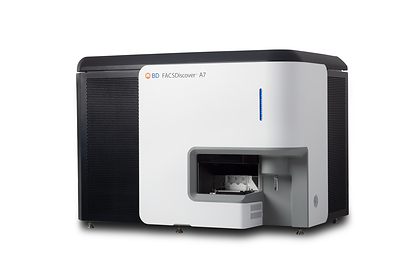
The new cell analyzer expands Waters’ category-defining FACSDiscover platform of flow cytometers, incorporating the same cutting-edge BD SpectralFX Technology present in the flagship BD FACSDiscover A8 Cell Analyzer, which supports up to five lasers and 78 fluorescence detectors to maximize the palette of colors. This technology enables scientists to analyze more than 50 characteristics of a single cell with consistent, high-quality data.
Together with FACSTruQ Technology, a notable product innovation that delivers next-generation instrument calibration with automated setup and quality control, the cell analyzer provides data consistency across instruments, users, and sites, achieving highly reproducible results with a less than 10% coefficient of variation across a palette of more than 50 dyes.1 Paired with the BD FACSChorus Software’s guided workflows and the integrated autoloader, the FACSDiscover A7 Cell Analyzer sets a new standard for experimental standardization in flow cytometry.
“The FACSDiscover A7 Cell Analyzer lowers the barrier to advanced spectral flow cytometry and will open up new possibilities for immunology research, enabling our core facility to help scientists uncover deeper biological insights with greater standardization and confidence,” said Cheryl Kim, Senior Director, Flow Cytometry Core, La Jolla Institute for Immunology. “We look forward to the FACSDiscover A7 Cell Analyzer being an integral instrument for our core, allowing our researchers to get the most out of spectral data to advance our important work of improving human health through the development of treatments and cures for immune system disorders.”
Steve Conly, Senior Vice President, Waters Biosciences, Waters Corporation, added, “The FACSDiscover A7 Cell Analyzer couples advanced spectral performance and leading standardization with a compelling price-to-performance balance, bringing spectral flow cytometry within reach of more researchers than ever before, for applications from biomarker discovery to drug development. Just two years after the world’s very first 50-color flow cytometry panel was developed on the BD FACSDiscover™ S8 Cell Sorter,2 the FACSDiscover A7 Cell Analyzer extends these transformative capabilities, helping labs meet their increasingly critical needs for reproducibility within our connected ecosystem of instruments, reagents, and informatics.”
The FACSDiscover A7 Cell Analyzer is now commercially available globally and available to order through local representatives. For more information, please visit waters.com and bdbiosciences.com/A7.
BD is a trademark of Becton, Dickinson and Company. Waters is a trademark of Waters Corporation or its affiliates. All other marks are the property of their respective owners.
About Waters Corporation:
Waters Corporation (NYSE: WAT) is a global leader in life sciences and diagnostics, dedicated to accelerating the benefits of pioneering science through analytical technologies, informatics, and service. With a focus on regulated, high-volume testing environments, our innovative portfolio harnesses deep scientific expertise across chemistry, physics, and biology. We collaborate with customers around the world to advance the release of effective, high-quality medicines, ensure the safety of food and water, and drive better patient outcomes by detecting diseases earlier, managing routine infections, and combating antibiotic resistance. Through a shared culture of relentless innovation, our passionate team of ~15,000 colleagues turn scientific challenges into breakthroughs that improve lives worldwide. For more information, please visit www.waters.com/about.
Disclaimer:
The BD Biosciences and BD Diagnostic Solutions businesses have been acquired by Waters Corporation (“Waters”). Becton, Dickinson and Company or one of its affiliates or subsidiaries (“BD”) remains the legal manufacturer of Biosciences and Diagnostic Solutions products until all required regulatory transfers are completed. During this interim period, BD maintains full responsibility for all regulatory obligations of the legal manufacturer. Product information provided here is supplied under BD’s regulatory authority. To learn more about the relationship between Waters and BD during this transition period, please see our detailed summary: www.waters.com/bdtransaction.
References:
1) Internal Waters data comparing the BD FACSDiscover™ A7 Cell Analyzer with the BD FACSLyric™ Flow Cytometry System and publicly available data for comparable instruments.
2) Konecny AJ, Mage PL, Tyznik AJ, Prlic M and Mair F. OMIP-102: 50-color phenotyping of the human immune system with in-depth assessment of T cells and dendritic cells. Cytometry Part A 2024; 105:430-436. DOI: 10.1002/cyto.a.24841
Contact:
Molly Gluck
Head of External Communications
Waters Corporation
+1.508.498.9732
molly_gluck@waters.com

 View original content to download multimedia:https://www.prnewswire.co.uk/news-releases/waters-sets-benchmark-for-standardized-spectral-flow-cytometry-with-commercial-launch-of-bd-facsdiscover-a7-cell-analyzer-302877244.html

14, Sep 2026
Cellebrite Initiates Plans to Redomicile in the United States
TYSONS CORNER, Va. and PETAH TIKVA, Israel, Sept. 14, 2026 /PRNewswire/ — Cellebrite DI Ltd. (NASDAQ: CLBT), a global leader in AI-powered Digital Investigative and Intelligence solutions for the public and private sectors, announced today that the Company’s Board of Directors has authorized Cellebrite to pursue a corporate reorganization, establishing a new United States corporation as the ultimate parent company, subject to shareholder and regulatory approvals.

Shiv Ramji, Cellebrite’s chief executive officer, said, “Redomiciling is a strategic evolution of our company structure. We believe redomiciling in the U.S. will better position us to drive growth across our key customer segments in our largest geographic market as well as with other large government customers outside of the U.S. Redomiciling will also increase Cellebrite’s appeal across a broader investor pool through inclusion in key indices.”
Cellebrite anticipates that the redomiciling will be completed by the first half of 2027, pending successful shareholder and regulatory approvals. Cellebrite plans to share additional details in the coming months, including those related to a special general meeting of shareholders, through additional filings with the U.S. Securities and Exchange Commission.
Caution Regarding Forward Looking Statements
This document includes “forward-looking statements” within the meaning of the “safe harbor” provisions of the United States Private Securities Litigation Reform Act of 1995. Forward looking statements may be identified by the use of words such as “forecast,” “intend,” “seek,” “target,” “anticipate,” “will,” “appear,” “approximate,” “foresee,” “might,” “possible,” “potential,” “believe,” “could,” “predict,” “should,” “could,” “continue,” “expect,” “estimate,” “may,” “plan,” “outlook,” “future” and “project” and other similar expressions that predict, project or indicate future events or trends or that are not statements of historical matters. Such forward-looking statements include, but are not limited to, the anticipated timeframe for completing the redomiciling and the anticipated benefits from redomiciling such as it will better position us to drive growth across our key customer segments in our largest geographic market as well as with other large government customers outside of the U.S and that it will increase Cellebrite’s appeal across a broader investor pool through inclusion in key indices. A number of factors could cause actual results or outcomes to differ materially from those indicated by such forward-looking statements. These factors include, but are not limited to: Cellebrite’s ability to keep pace with technological advances and challenges and evolving industry standards with respect to software, artificial intelligence, or device access, to adapt to changing market potential within our markets and to successfully launch new solutions and add-ons that meet or exceed customer needs; our material dependence on the acceptance of our solutions by domestic and international law enforcement, public safety, defense and intelligence agencies; real or perceived errors, failures, defects or bugs in our solutions; licensing of technology from third parties, including our dependence on maintaining those licenses or seeking alternative solutions; failure to maintain the productivity of sales and marketing personnel, including relating to hiring, integrating and retaining personnel; intense competition in all of our markets, including risks associated with pricing pressures from and loss of market share to competitors with greater resources than we have and increasing competition as a result of consolidation in the industry; the misuse of our solutions by our customers which may achieve suboptimal results or be perceived as incompatible with human rights; our ability to properly manage our growth as a business, and execute new offerings, developments and strategic opportunities, including joint ventures, partnerships and acquisitions; our dependence on our customers to renew their subscriptions and purchase additional subscriptions or services from us; conducting a low volume of our business via e-commerce; the use of artificial intelligence in our digital investigation platform; the availability of financing sources on reasonable terms or at all; our reliance on third-party suppliers for certain components, products or services, including risks relating to the availability of raw materials or components; challenges associated with large transactions, including with respect to longer sales cycles, as well as with developing, offering, implementing, and maintaining new solutions; risk of security vulnerabilities or defects, including cyber-attacks, information technology system breaches, failures or disruptions which are critical to our operations and maintaining the trust and confidence of our customers; risks associated with political, geo-political and reputational factors related to our business or operations, including Cellebrite operations in Israel and/or negative publicity, including with respect to the nature of our solutions; risks associated with our ability to obtain CFIUS approval for the acquisition of Corellium and with our ongoing compliance with national security agreements entered into with the U.S. government; risks that our intellectual property rights may not be adequate to protect our business or assets or that others may make claims on our intellectual property, claim infringement on their intellectual property rights, or claim a violation of their license rights, including relative to free or open-source-software components we may use risks relating to the regulatory constraints to which we are subject, including Israeli export laws, our compliance with such laws and related export licenses issued from the government of Israel; risks associated with different corporate governance requirements applicable to Israeli companies and risks associated with being a foreign private issuer; risks associated with our significant international operations, including due to our Israeli operations, fluctuations in foreign exchange rates, rising global inflation, and exposure to regions subject to political or economic instability, including the State of Israel; uncertainties regarding the impact of changes in macroeconomic and/or global conditions, including as a result of slowdowns, recessions, economic instability, political unrest, or outbreaks of disease, as well as the resulting impact on information technology spending and government budgets, on our business and other factors, risks and uncertainties set forth in the section titled “Risk Factors” in Cellebrite’s annual report on Form 20-F filed with the U.S. Securities and Exchange Commission (“SEC”) on March 3, 2026, and in other documents filed by Cellebrite with the SEC, which are available free of charge at www.sec.gov. You are cautioned not to place undue reliance upon any forward-looking statements, which speak only as of the date made, in this communication or elsewhere. Cellebrite undertakes no obligation to update its forward-looking statements, whether as a result of new information, future developments or otherwise, should circumstances change, except as otherwise required by securities and other applicable laws.
About Cellebrite
Cellebrite’s (Nasdaq: CLBT) mission is to protect communities, nations and businesses as a global leader in digital investigative and intelligence solutions. More than 7,000 global law enforcement agencies, defense and intelligence organizations and enterprises trust Cellebrite’s AI-powered software portfolio to make forensically sound digital data more accessible and actionable. Cellebrite technology allows customers to accelerate nearly 3 million legally sanctioned investigations annually, enhance sovereign security, elevate operational efficacy and efficiency and enable advanced mobile research and application security. Available via cloud, on-premises and hybrid deployments, Cellebrite’s technology enables its customers around the globe to advance their missions, elevate public safety and safeguard data privacy. To learn more, visit us at www.cellebrite.com and https://investors.cellebrite.com and find us on social media @Cellebrite.
Contacts:
Investors Relations
Andrew Kramer
Vice President, Investor Relations & Treasury
investors@cellebrite.com
+1 973.206.7760
Media
Jackie Labrecque
Director, PR and Executive Communications
jackie.labrecque@cellebrite.com
+1 771.241.7010
 View original content to download multimedia:https://www.prnewswire.co.uk/news-releases/cellebrite-initiates-plans-to-redomicile-in-the-united-states-302877229.html

14, Sep 2026
Bitmine Immersion Technologies (BMNR) Announces ETH Holdings Reach 5.96 Million Tokens, and Total Crypto and Total Cash Holdings of $15.8 Billion
Bitmine owns 4.9% of the total ETH coin supply of 122.0 million
Bitmine is 98% of the way to the ‘Alchemy of 5%’ in just 15 months
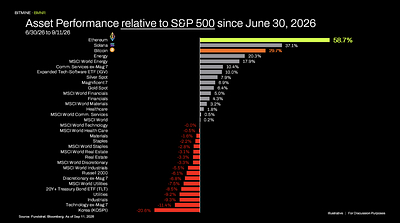
ETH is the best performing macro asset in Q3 of 2026 to date, outperforming the S&P 500 by 5,866bp
Tom Lee to deliver the keynote at KBW on September 30, 2026
Bitmine was added to the Russell 1000 Large-cap index on June 26, 2026
Bitmine’s Series A Preferred Stock is trading on the NYSE under the symbol BMNP
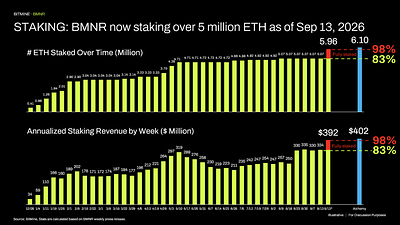
Bitmine has 5,067,309 staked ETH, representing $12.7 billion at $2,513 per ETH. MAVAN (Made in America VAlidator Network) is a premier Ethereum staking destination for BMNR and institutional investors
Bitmine owns $98 million of Eightco (NASDAQ: ORBS), now one of the only publicly listed equities in the world to provide investors indirect exposure to OpenAI
Bitmine Crypto + Total Cash Holdings & Marketable Securities + “Moonshots” total $15.8 billion, including 5.96 million ETH tokens, total cash & marketable securities of $549 million, and other crypto holdings
Bitmine remains supported by a premier group of institutional investors including ARK’s Cathie Wood, MOZAYYX, Founders Fund, Bill Miller III, Pantera, Kraken, DCG, Galaxy Digital and personal investor Thomas “Tom” Lee to support Bitmine’s goal of acquiring 5% of ETH
NORWALK, Conn., Sept. 14, 2026 /PRNewswire/ — (NYSE: BMNR) Bitmine Immersion Technologies, Inc. (“Bitmine” or the “Company”) a Bitcoin and Ethereum Network company with a focus on the accumulation of crypto for long term investment, today announced Bitmine crypto + total cash & marketable securities + “moonshots” holdings totaling $15.8 billion.
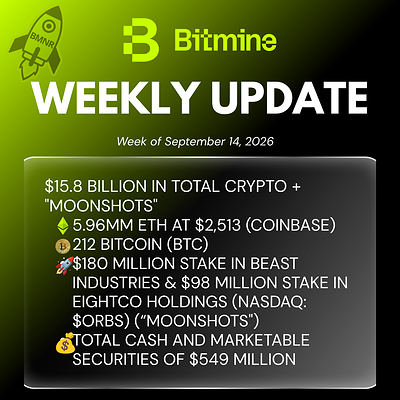
As of September 13, 2026 at 5:30pm ET, the Company’s crypto holdings are comprised of 5,956,378 ETH at $2,513 per ETH (per Coinbase NASDAQ: COIN), 212 Bitcoin (BTC), $180 million stake in Beast Industries, $98 million stake in Eightco Holdings (NASDAQ: ORBS) (“moonshots”) and total cash & marketable securities of $549 million. Bitmine’s ETH holdings are 4.9% of the ETH supply (of 122.0 million ETH).
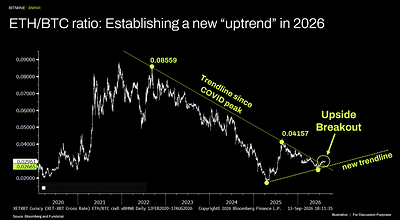
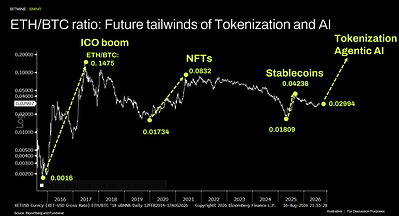
“The price ratio of ETH to BTC moved to the highest level since Jan 30th of this year and established a new uptrend, breaking the trendline in place since the COVID-19 highs. In our view, this reflects Ethereum’s strengthened position as the settlement rails for Wall Street tokenization and the increased realization that Ethereum may play a critical central role in managing agentic-AI. What is impressive is this strength in the absolute price of ETH and ETH/BTC taking place while global equities remain rangebound due to war risks and rising yields.” stated Thomas “Tom” Lee, Chairman of Bitmine.
Tom DeMark, founder of DeMark Analytics and a capital markets advisor to Bitmine is expecting ETH to make a sharp upward move in coming weeks. According to Tom DeMark, “In August, ETH moved sideways without a downside break and the 12-day metric expired, which implies a renewal of the upside move. We believe this further supports the continuation of the prior uptrend. We expect late August’s sharp one-day rally was a likely preview of the pending advance.”
“As we enter the final month of calendar Q3 2026, ETH is the best performing macro asset during the quarter, outperforming the S&P 500 by 5,866bp through last Friday. In fact, the top 3 performing assets since June 30th are ETH, SOL and BTC,” stated Lee. “We believe this sets the stage for institutions to add to their crypto holdings given the substantial outperformance of crypto versus other macro assets in calendar Q3 so far.”
“We believe there are multiple positive catalysts as we head into the final months of 2026,” stated Lee. “These include the upcoming CLARITY Act vote scheduled in mid-September. Additionally, Korean investors have again started buying crypto and rotating away from AI stocks. The 4-year cycle is bottoming within the next few weeks in our view. And this sets the stage for what we expect to be sizable institutional participation in buying crypto in the final months of 2026, especially given the tailwinds of tokenization and Agentic-AI.”
Tom Lee will also deliver the keynote at Korea Blockchain Week 2026 on September 30 at 11:20 a.m. at Walkerhill Hotels & Resorts in Seoul. The 25-minute keynote is part of Korea Blockchain Week, one of Asia’s leading blockchain and digital asset conferences. Additional information is available on the Korea Blockchain Week website.
“This ETH/BTC ratio has moved up during crypto bull cycles, driven by increasing use of Ethereum relative to Bitcoin. These prior cycles were fueled by ICOs (2017-2018), NFTs (2020-2021), and stablecoins (2025). In this upcoming crypto cycle, we see the ETH/BTC ratio rising, driven by Wall Street tokenizing on the blockchain and by agentic-AI using blockchains,” continued Lee.
“Over the past week, we acquired 27,180 ETH. Bitmine’s track record of consistent buying of crypto is unmatched by any public company in the world. Bitmine has bought ETH each and every week since the inception of the ETH Treasury Strategy on June 30, 2025,” stated Lee.
On July 16, 2026, Bitmine released the latest Chairman’s Message (link here) for July 2026. The title of the Message is “ETH is the cure for the Uncanny Valley of Wealth.”
Earlier in 2026, Bitmine launched MAVAN (the Made in America VAlidator Network), the institutional-grade staking platform. While MAVAN was originally developed to support Bitmine’s own Ethereum treasury, MAVAN has expanded to serve institutional investors, custodians, and ecosystem partners seeking best-in-class staking infrastructure. A portion of Bitmine’s ETH is already staked on the MAVAN platform.
As of September 7, 2026, Bitmine total staked ETH stands at 5,067,309 ($12.7 billion at $2,513 per ETH). “Bitmine has staked more ETH than other entities in the world. At scale (when Bitmine’s ETH is fully staked by MAVAN and its staking partners), the projected ETH staking reward would be $392 million on an annualized basis (using 2.62% 7-day BMNR yield),” stated Lee.
“Annualized staking revenues are now projected at $334 million. And this 5.1 million ETH is 85% of the 5.96 million ETH held by Bitmine. Bitmine’s own staking operations generated a 7-day yield of 2.62% (annualized),” continued Lee.
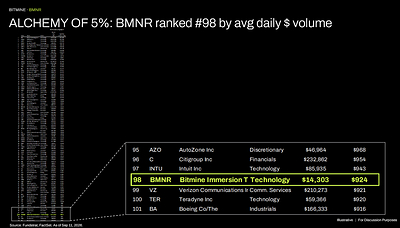
Bitmine is one of the most widely traded stocks in the US. According to data from Fundstrat, the stock has traded average daily dollar volume of $924 million (4-day average, as of September 11, 2026), ranking #98 in the US, behind Intuit Inc. (rank #97) and ahead of Verizon Communications (rank #99) among 5,704 US-listed stocks (statista.com and Fundstrat research).
Bitmine’s crypto holdings reign as the #1 Ethereum treasury and #2 global treasury, behind Strategy Inc. (NASDAQ: MSTR), which reportedly owns 845,080 BTC valued at approximately $71 billion. Bitmine remains the largest ETH treasury in the world.
Bitmine management believes the GENIUS Act and the Securities and Exchange Commission’s (SEC) Project Crypto are as transformational to financial services in 2026 as the US action on August 15, 1971, which ended the Bretton Woods system and took the U.S. dollar off the gold standard 55 years ago. This 1971 event was the catalyst for the modernization of Wall Street, creating the iconic Wall Street titans and financial and payment rails of today. These proved to be better investments than gold.
The Chairman’s message can be found here:
https://www.Bitminetech.io/chairmans-message
The Fiscal Full Year 2025 Earnings presentation and corporate presentation can be found here: https://Bitminetech.io/investor-relations/
To stay informed, please sign up at: https://Bitminetech.io/contact-us/
About Bitmine
Bitmine Immersion Technologies, Inc. (NYSE: BMNR), together with its subsidiaries (“Bitmine” or the “Company”), is a blockchain technology infrastructure company operating across institutional digital asset staking and validation services, bitcoin mining, and strategic digital asset management. As the world’s leading Ethereum Treasury company, it implements an innovative digital asset strategy for institutional investors and public market participants. The Company provides institutional-grade staking and validation infrastructure—through which it earns staking rewards and validation income—alongside bitcoin mining activities. Bitmine holds digital assets strategically, generating yield on those holdings to support liquidity and capital formation. Since 2025, the Company has expanded its blockchain infrastructure capabilities, including developing and deploying MAVAN, its institutional staking and validation platform. The Company’s activities further include investments in early-stage blockchain opportunities (“moonshot” investments) and ancillary mining, hosting, and consulting services.
For additional details, follow on X:
https://x.com/bitmnr
https://x.com/fundstrat
Forward Looking Statements
This press release contains statements that constitute “forward-looking statements” within the meaning of the Private Securities Litigation Reform Act of 1995, as amended. Forward-looking statements include all statements that are not purely historical and can generally be identified by terms such as “expects,” “projects,” “intends,” “plans,” “believes,” “anticipates,” “estimates,” “forecasts,” “targets,” “goals,” “may,” “will,” “would,” “could,” “should,” “view,” “see,” or similar expressions, or the negative of such terms, or other comparable terminology. This press release specifically contains forward-looking statements regarding, among other things: (i) the Company’s goal of acquiring 5% of the total ETH supply (the “Alchemy of 5%” initiative) and statements that the Company is 98% of the way to achieving this goal in 15 months; (ii) the Company’s digital asset accumulation and treasury strategy, including statements regarding continued weekly ETH acquisitions since the inception of the ETH Treasury Strategy on June 30, 2025 and the Company’s status as the largest ETH treasury in the world; (iii) the Company’s staking operations, including projected annualized ETH staking rewards of approximately $392 million at scale (assuming Bitmine’s ETH is fully staked by MAVAN and its staking partners using 2.62% 7-day BMNR yield), currently projected annualized staking revenues of approximately $334 million, and the 7-day yield of 2.62% (annualized); (iv) MAVAN’s expansion to serve institutional investors, custodians, and ecosystem partners seeking best-in-class staking infrastructure, and its intended position as a premier Ethereum staking destination for BMNR and institutional investors; (v) expectations regarding future ETH price performance and market movements, including Tom DeMark’s expectation that ETH will make a sharp upward move in coming weeks based on technical analysis and the belief that the August sideways movement implies a renewal of the upside move, and that a previous one-day rally was a likely preview of the pending advance; (vi) statements regarding ETH’s performance as the best performing macro asset in Q3 2026 to date, outperforming the S&P 500 by 5,866bp, and that this sets the stage for institutions to add to their crypto holdings; (vii) management’s belief that multiple positive catalysts exist heading into the final months of 2026, including the upcoming CLARITY Act vote scheduled for mid-September 2026, renewed buying by Korean investors and rotation away from AI stocks, the view that the four-year crypto cycle is bottoming within the next few weeks, and the expectation of sizable institutional participation in buying crypto in the final months of 2026, especially given the tailwinds of tokenization and agentic-AI; (viii) statements and expectations regarding the ETH/BTC ratio, including that the ratio has moved to the highest level since January 30th of this year and established a new uptrend, and that the ratio will rise in the upcoming crypto cycle driven by Wall Street tokenizing on the blockchain and by agentic-AI using blockchains, similar to prior cycles fueled by ICOs (2017-2018), NFTs (2020-2021), and stablecoins (2025); (ix) statements regarding Ethereum’s strengthened position as the settlement rails for Wall Street tokenization and the increased realization that Ethereum may play a critical central role in managing agentic-AI; (x) management’s belief that the GENIUS Act and SEC Project Crypto are as transformational to financial services in 2026 as the end of the Bretton Woods system in 1971 and that investments resulting therefrom will prove better than gold; (xi) statements regarding the Company’s investments, including that its investment in Eightco Holdings (NASDAQ: ORBS) provides investors indirect exposure to OpenAI and its $180 million stake in Beast Industries; and (xii) statements regarding the value of the Company’s crypto, cash, marketable securities, and “moonshot” holdings, including aggregate holdings of $15.8 billion and ETH holdings representing 4.9% of the total ETH supply.
These forward-looking statements involve substantial risks and uncertainties that could cause actual results to differ materially from those expressed or implied. Factors that could cause or contribute to such differences include, but are not limited to: the extreme volatility and unpredictability of digital asset prices, including ETH and Bitcoin, and the speculative nature of digital asset investments; the risk that historical ETH price movements, technical analysis indicators, ETH/BTC ratio trends, and relative performance versus other macro assets will not recur or are not indicative of future performance; the Company’s reliance on third-party pricing sources (including Coinbase) and reported market values in calculating the value of its crypto, cash, marketable securities, and “moonshot” holdings, and the risk that such values fluctuate materially after the date and time referenced in this release; changes in market conditions affecting the trading price and trading volume of the Company’s common stock and Series A Preferred Stock, and the risk that the Company’s inclusion in the Russell 1000 index does not produce anticipated benefits; the Company’s ability to successfully execute its digital asset acquisition strategy, continue its record of weekly ETH acquisitions, and achieve its ETH accumulation targets, including the “Alchemy of 5%” goal; the Company’s ability to finance its business operations, Ethereum treasury operations, and MAVAN expansion; operational, security, and technological risks associated with the Company’s staking and validation operations, including network failures, slashing events, cybersecurity breaches, and protocol changes; the risk that actual staking participation, yields, rewards, and revenues differ materially from the projected amounts described in this release, which are based on a 7-day yield and assume ETH is fully staked at scale; competition in the digital asset treasury, staking, and mining industries; the Company’s dependence on key personnel, including executive leadership and advisors such as Tom DeMark; regulatory developments affecting digital assets, blockchain technology, and staking activities in the United States and globally, including the timing and outcome of the scheduled CLARITY Act vote and the ultimate enactment, implementation, and interpretation of the GENIUS Act and other pending legislation and regulatory initiatives; actions by the SEC, CFTC, and other regulatory bodies affecting digital assets and related businesses; risks related to the Company’s investments in early-stage blockchain opportunities (“moonshot” investments), including the investments in Eightco Holdings (including the nature and extent of any indirect exposure to OpenAI) and Beast Industries; macroeconomic factors, including inflation, interest rates, Federal Reserve monetary policy, labor market conditions, war risks, rising yields, and general economic conditions affecting investor sentiment toward digital assets, including the behavior of Korean and other international investors; the accuracy of technical analysis predictions and management’s expectations regarding ETH price movements, the ETH/BTC ratio, Ethereum’s role in Wall Street tokenization and agentic-AI, and the impact of tokenization and agentic-AI applications on Ethereum; the unpredictability of cryptocurrency market cycles and the accuracy of expectations regarding future crypto cycles, including whether the four-year cycle bottoms as anticipated and whether institutional participation materializes; changes to the Ethereum protocol, including staking mechanics, validator requirements, and reward structures; the performance of third-party service providers, exchanges, custodians, and staking partners; risks related to the concentration of the Company’s assets in digital currencies, particularly Ethereum; and the other risk factors described in the Company’s filings with the SEC.
The forward-looking statements contained in this press release are based on information available to management as of the date of this release and reflect management’s current expectations, estimates, forecasts, projections, views, and beliefs concerning future events and circumstances. Actual results may vary materially from those expressed or implied by forward-looking statements based on a number of factors, including those described above and in the Risk Factors section of the Company’s Annual Report on Form 10-K for the fiscal year ended September 30, 2025 filed with the SEC on November 21, 2025, the Company’s Quarterly Reports on Form 10-Q, and the Company’s other filings with the SEC, as amended or updated from time to time. Copies of these filings are available on the SEC’s website at www.sec.gov and on the Company’s website at https://Bitminetech.io/investor-relations/. The Company cautions readers not to place undue reliance on any forward-looking statements, which speak only as of the date on which they are made. Bitmine expressly disclaims any obligation or undertaking to update, revise, or supplement any forward-looking statements to reflect any change in its expectations or any change in events, conditions, or circumstances on which any such statements are based, except as required by applicable law or regulation.
 View original content to download multimedia:https://www.prnewswire.co.uk/news-releases/bitmine-immersion-technologies-bmnr-announces-eth-holdings-reach-5-96-million-tokens-and-total-crypto-and-total-cash-holdings-of-15-8-billion-302877165.html

14, Sep 2026
Hisense Introduces RoamView, A Screen That Moves with the Way You Live
QINGDAO, China, Sept. 14, 2026 /PRNewswire/ — Hisense, a leading brand in global consumer electronics and home appliances, today introduced RoamView, the newest addition to its Lifestyle Series, designed to solve a simple challenge of modern living: the best place to enjoy a screen isn’t always where the TV is.

You may want to follow a recipe in the kitchen, catch up on a workout in the living room, or enjoy a movie in bed—but a traditional TV stays in one place, while a tablet can feel too small for a truly immersive experience. RoamView is designed to bridge that gap, giving users a screen that moves as freely as they do.
RoamView brings a new level of flexibility and portability to everyday viewing. Users can simply take it from room to room, then rotate, tilt or lift the screen to find the ideal viewing angle. With a long-lasting built-in battery, RoamView lets users enjoy their favorite content without being tied to a power outlet—whether relaxing, working, creating or connecting.
And because modern living is about more than watching, RoamView adapts to whatever the moment calls for. Capture ideas on Whiteboard, explore creative projects with a digital sketchpad, set the mood with Art Gallery, or turn any room into a karaoke stage with Karafun. When it’s time to unwind, 4K streaming brings entertainment to life with immersive picture quality. Powered by a high-performance processing platform with 8GB of memory and 128GB of storage, RoamView delivers smooth multitasking while giving users ample space to keep their favorite movies, shows, photos and other content close at hand.
Together with CanvasTV, which transforms digital art into part of the home, and DécoTV, which blends elegant design with premium viewing, RoamView further expands the Hisense Lifestyle Series—offering displays that adapt beautifully to people’s homes and the way they live.
About Hisense
Hisense, founded in 1969, is a globally recognized leader in home appliances and consumer electronics with operations in over 180 countries, specializing in delivering high-quality multimedia products, home appliances, and intelligent IT solutions. According to Omdia, Hisense ranks No. 1 globally in the 100-inch and over TV segment (2023-2026H1). As The Origin of RGB MiniLED, Hisense continues to lead the next-generation RGB MiniLED innovation. As the official sponsor of the FIFA World Cup 2026™, Hisense is committed to global sports partnerships as a way to connect with audiences worldwide.
 View original content to download multimedia:https://www.prnewswire.co.uk/news-releases/hisense-introduces-roamview-a-screen-that-moves-with-the-way-you-live-302877260.html

14, Sep 2026
HTX Advances Pakistan Market Entry Through Regulatory Engagement and Community Outreach
Exchange holds two community AMAs and an X Space with Pakistani users as it moves through the country’s new licensing framework
APIA, Samoa, Sept. 14, 2026 /PRNewswire/ — HTX, a leading global cryptocurrency exchange, last week held two community AMA sessions and an X Space with users and influencers in Pakistan. The events were part of a broader effort to build a long-term, regulated presence in one of South Asia’s fastest-growing digital asset markets.

The sessions were intended to introduce the platform to local users and to open direct channels with Pakistan’s crypto community. They follow a series of regulatory steps HTX has taken in the country over recent months, reflecting the exchange’s commitment to entering Pakistan through its formal licensing process rather than treating it as a short-term market.
Regulatory Progress Under the PVARA Framework
HTX is one of the first two global exchanges to receive a No-Objection Certificate (NOC) from the Pakistan Virtual Assets Regulatory Authority (PVARA). The certificate allows the exchange to proceed to the next stage of the compliance process, which includes anti-money-laundering registration, the establishment of a local Pakistani entity, and preparation of a full application for a Virtual Asset Service Provider (VASP) licence.
In late August, Pakistan formally issued its regulations for virtual asset services and opened the licence application mechanism, moving the country’s oversight of the sector into an implementation phase. HTX is aligning its work with the newly published requirements, continuing to advance the incorporation of its local company, the preparation of its formal licence application, and the build-out of its local compliance framework. The exchange is maintaining ongoing dialogue with the regulator and with local professional advisers to lay the groundwork for operating in the country under the applicable rules.
A Three-Part Approach to the Market
HTX’s work in Pakistan is proceeding along three fronts: regulatory compliance, local communication, and user service. The PVARA NOC forms one part of the compliance track. Community AMAs, user education, ongoing dialogue with local users, and outreach to prospective partners serve a different purpose: understanding what Pakistani users actually need from an exchange, from asset security to payment on-ramps and product coverage.
This week’s sessions were structured around that goal. Rather than making product announcements, they focused on questions raised by attendees, with HTX representatives addressing how the platform operates, how user assets are protected, and what the exchange’s regulatory status in Pakistan currently means in practice.
A Record Built Over Thirteen Years
Many of the questions raised in those sessions come down to a single one: whether HTX has earned users’ trust over time. On that measure, the exchange brings a history that few in the industry can match.
HTX has operated continuously since 2013. In an industry where platforms have appeared and disappeared within a single market cycle, it has remained in operation through several, adapting to changing conditions while continuing to serve users across the world. That longevity is not an accident of timing; it reflects an institution that has learned how to manage risk over the long term.
Transparency has been part of that discipline. HTX has published proof-of-reserves reports every month for 47 consecutive months as of September 2026, a practice it maintained through periods when no rule required it and when many of its peers chose not to. Users in Pakistan will find the same reports available to them as to users anywhere else, offering a verifiable account of how the platform holds client assets.
Beneath these commitments sits a mature product range spanning spot, derivatives and earn services, developed and refined over more than a decade. Taken together, HTX’s history, its transparency record and the depth of its platform demonstrate an exchange that Pakistani users can assess based on its track record rather than on its promises.
Next Steps
That track record is now extending to Pakistan. HTX said its priorities in the country for the coming period are to continue advancing its licence application, complete its local operational preparations, respond to the security and product questions raised most frequently by users, and refine its content and services on the basis of direct feedback from the Pakistani community.
The exchange added that further community engagement and educational activities will follow as its regulatory work in the country progresses.
About HTX
Founded in 2013, HTX has evolved from a virtual asset exchange into a comprehensive ecosystem of blockchain businesses that span digital asset trading, financial derivatives, research, investments, incubation, and other businesses.
As a world-leading gateway to Web3, HTX harbors global capabilities that enable it to provide users with safe and reliable services. Adhering to the growth strategy of “Global Expansion, Thriving Ecosystem, Wealth Effect, Security & Compliance,” HTX is dedicated to providing quality services and values to virtual asset enthusiasts worldwide.
To learn more about HTX, please visit https://www.htx.com/ or HTX Square , and follow HTX on X, Telegram, and Discord.
 View original content to download multimedia:https://www.prnewswire.co.uk/news-releases/htx-advances-pakistan-market-entry-through-regulatory-engagement-and-community-outreach-302877660.html