


28, Jul 2026
DXC Names Holly Grant President of LabX, Expanding the Unit’s Role as a Major AI Growth Engine
- Holly Grant named President, AI Innovation and Strategy & LabX, expanding her leadership across DXC’s AI-native product incubation work and AI Platforms Engine
- Expanded LabX brings together DXC’s expertise across leading AI platforms to design, build and deploy practical AI solutions at scale
- Open AI ecosystem gives customers flexibility to select the technologies that best fit their business, supported by DXC’s industry expertise and global delivery capabilities
- LabX expansion reinforces DXC’s Fast Track strategy, accelerating high-growth AI opportunities while DXC continues to strengthen and scale its core business
ASHBURN, Va., July 27, 2026 /PRNewswire/ — DXC Technology (NYSE: DXC), a leading enterprise technology and innovation partner, today announced that Holly Grant has been named President, AI Innovation and Strategy & LabX, DXC’s AI-native product incubator and engine for AI-native growth. Grant will continue to report directly to DXC CEO Raul Fernandez.

Grant’s appointment marks an expansion of LabX’s remit and broadens her leadership in advancing DXC’s AI strategy. As President, she will lead both LabX’s AI-native product incubation work and the commercial side of DXC’s AI partner platform strategy through the AI Platforms Engine, bringing together AI-native product development, platform expertise and delivery capabilities to help DXC build and scale practical AI solutions for customers alongside its strategic partners. Grant will also continue to lead strategy and innovation for DXC.
“Holly has been a driving force behind our AI strategy and has built LabX into an important source of innovation for DXC and our customers,” said Raul Fernandez, President and CEO, DXC Technology. “What she has built gives us a strong foundation for what comes next. As LabX expands, Holly will bring greater focus, speed, and accountability to some of our biggest AI growth opportunities. This also reinforces the operating model we have been building across DXC: a fast track to accelerate high-growth opportunities, alongside a core track focused on strengthening and scaling our mature business. She has the vision, and acumen to turn bold ideas into action with speed, and I am confident she will build LabX into an even more powerful growth engine for DXC.”
Launched in April, LabX was created to turn AI innovation into practical solutions that can be tested inside DXC and with customers before being scaled more broadly. That work will continue as LabX expands to include the AI Platforms Engine, bringing together DXC’s offerings across Amazon Quick, Anthropic’s Claude, and Microsoft Copilot. With the leading AI capabilities of some of DXC’s strategic partners, LabX will enable DXC to design, build and deploy new AI solutions, bringing the right technologies to customers based on their specific needs including through a dedicated workforce of tens of thousands of forward-deployed engineers, or FDEs who will be embedded directly in customer environments to accelerate agentic AI transformation.
“Our customers are no longer asking whether AI matters. They are asking who can turn it into meaningful business results,” said Holly Grant, President, AI Innovation and Strategy & LabX, DXC Technology. “That is the business we are building, and it goes to the heart of why DXC exists: to help enterprises design, run and scale the systems that are critical to how they operate and grow. By combining our deep industry knowledge with expertise across leading AI platforms, LabX will help customers move beyond pilot purgatory and deploy AI at scale across their core systems.”
The expanded remit of LabX will strengthen DXC’s ability to develop AI-native solutions and help customers navigate, integrate and build on leading AI technologies. LabX will operate through an open AI ecosystem, reflecting DXC’s view that customer needs will not be solved by a single model, vendor or interface. This approach gives customers the flexibility to select the technologies that best fit their business while drawing on DXC’s industry expertise, mission-critical technology experience and global delivery capabilities to implement them at scale. It also strengthens DXC’s ability to support customers in two ways: by delivering AI-native services and by helping them navigate and build on the AI platforms and technologies best suited to their needs.
Since joining DXC, Grant has helped shape DXC’s AI strategy and establish LabX as an AI-native product incubation capability, accelerating the development of enterprise AI solutions and strengthening strategic partnerships that drive innovation and business growth. She has also led enterprise strategy and strategic operations, helping advance DXC’s transformation and AI agenda across the business. Prior to DXC, Grant held executive leadership roles spanning strategy, operations and innovation, including Chief Operating Officer at Long-Term Stock Exchange (LTSE), where she helped scale the organization during a period of growth, building on a career leading strategic initiatives and operational excellence across high-growth technology companies.
About DXC Technology
DXC Technology (NYSE: DXC) is a leading enterprise technology and innovation partner delivering software, services and solutions to global enterprises and public sector organizations, helping them harness AI to drive outcomes at a time of exponential change with speed. With deep expertise in Managed Infrastructure Services, Application Modernization and Industry-Specific Software Solutions, DXC modernizes, secures and operates some of the world’s most complex technology estates. Learn more at dxc.com.
 View original content to download multimedia:https://www.prnewswire.co.uk/news-releases/dxc-names-holly-grant-president-of-labx-expanding-the-units-role-as-a-major-ai-growth-engine-302835636.html

- 0
- By Neel Achary

28, Jul 2026
Quantinuum to Report Second Quarter Financial Results on August 11, 2026
BROOMFIELD, Colo., July 27, 2026 /PRNewswire/ — Quantinuum Inc. (Nasdaq: QNT) (“Quantinuum”) today announced it will release its financial results for the second quarter (ending on June 30, 2026) after market close on August 11, 2026.
Quantinuum will host a conference call at 5:00 PM Eastern time that same day to discuss its financial results. The call will be available through a live webcast here.
An archived replay of the webcast will be made available on the Quantinuum Investor Relations website following the call and will remain available for one year.
About Quantinuum
Quantinuum is a leading quantum computing company offering a full-stack platform designed to make quantum computing deployable in real-world environments. The company has commercially deployed multiple generations of quantum systems built on the well-established QCCD architecture, which it has implemented with novel designs and capabilities to achieve the industry’s highest accuracy levels based on average two-qubit gate fidelity as of December 31, 2025. Quantinuum has active engagements with market leaders across pharmaceuticals, material science, financial services, and government and industrial markets. Quantinuum’s headquarters is in Broomfield, Colorado, with additional facilities across the United States, United Kingdom, Germany, Japan, Qatar and Singapore.
 View original content to download multimedia:https://www.prnewswire.co.uk/news-releases/quantinuum-to-report-second-quarter-financial-results-on-august-11-2026-302835670.html

28, Jul 2026
Uttarakhand Battles Heavy Rainfall, Char Dham Yatra Put on Hold
Dehradun, July 28: The Char Dham Yatra in Uttarakhand has been temporarily suspended after heavy rainfall and landslides disrupted several routes across the Himalayan state, prompting authorities to prioritise the safety of pilgrims.

Continuous rain has affected road connectivity in multiple areas, creating difficulties for devotees travelling to the sacred shrines of Yamunotri, Gangotri, Kedarnath, and Badrinath. Authorities have advised pilgrims to remain cautious and avoid travel until weather conditions improve.
The district administration and disaster management teams are closely monitoring the situation, assessing vulnerable areas, and working to clear affected routes to restore safe movement.
The suspension has affected thousands of pilgrims who were undertaking the annual pilgrimage, but officials said the precautionary measure was necessary in view of the risks posed by landslides and unstable weather conditions.
Uttarakhand has been witnessing intense rainfall, increasing the possibility of road blockages and disruptions in several hill districts. Authorities have urged visitors and local residents to follow safety advisories and rely only on official updates.
Officials said the Char Dham Yatra will resume once the routes are inspected and declared safe, ensuring a secure journey for pilgrims.
28, Jul 2026
R25, Utila and Yield.xyz Bring Vault Ecosystem to Institutional Treasuries
The integration establishes a secure, MPC-governed gateway for institutions to access a suite of curated real-world asset strategies built on R25’s vault infrastructure, starting with a 3-month emerging-market consumer credit vault.
SINGAPORE, July 28, 2026 /PRNewswire/ — R25, the on-chain vault infrastructure for the next generation of finance, today announced a strategic integration with Utila, the enterprise-grade digital asset operations platform, and Yield.xyz, the self-custodial yield API. This integration bridges R25’s expanding ecosystem of curated on-chain strategies directly with institutional-grade custody and governance workflows.
As institutional stablecoin holdings grow, treasury managers are increasingly looking to allocate across diverse strategies. However, fragmented approval processes and custody friction remain significant barriers. By integrating Yield.xyz’s standardized API connectivity with Utila’s multi-party computation (MPC) security, R25 enables institutions to securely deploy capital into non-custodial, self-executing vaults without altering their existing risk and compliance frameworks.
The inaugural offering available through this new institutional gateway is Axil Prime Credit (APC) – a three-month USDC vault providing exposure to emerging-market consumer credit. The APC strategy is professionally curated by Axil, an on-chain risk curation team leveraging deep portfolio curation and risk management expertise from BlackRock, HSBC, and HashKey.
“At R25, our ultimate goal is to power the next generation of finance by making expert-curated yields universally accessible through a standardized, programmable infrastructure layer,” said Sean Chung, VP of Business Development of R25. “While we continue to expand our connectivity, building a risk-resistant execution layer is critical for institutional users. By partnering with Utila and Yield.xyz, we are ensuring that institutional liquidity can flow into our ecosystem with the highest standards of MPC security and policy control.”
“DeFi adoption will depend on how effectively institutions can connect asset access with the governance standards already applied across their treasury,” said Bentzi Rabi, Co-Founder and CEO of Utila. “By combining R25’s curated vault infrastructure, Yield.xyz’s connectivity, and Utila’s MPC security and policy controls, this integration gives treasury teams a practical way to allocate capital to APC and future yield strategies within a controlled institutional workflow.”
The integration establishes a streamlined path for institutions to evaluate and access the APC vault today, and lays the groundwork for additional curated vaults to become available within the Utila environment and R25 ecosystem following relevant product and risk reviews.
About R25
R25 is the on-chain vault infrastructure for the next generation of finance. A platform where diverse strategies meet cutting-edge blockchain technologies, R25 provides the technological infrastructure for universal access to on-chain yield curated by experts.
About Utila
Utila is the leading stablecoin and digital asset infrastructure platform for fintechs and enterprises. Utila enables organizations of all sizes to securely build, manage, and scale digital asset operations across stablecoin payments, treasury, trading, tokenization, and beyond. The platform combines institutional-grade MPC wallets, granular policy controls, robust APIs, multi-chain support, payment and tokenization engine, and deep integrations with banking, compliance, exchanges, DeFi, and more. Trusted by 300+ industry leaders, Utila processes more than $25B in monthly volume and has secured over $200B in transactions to date. Learn more at utila.io.
About Yield.xyz
Yield.xyz is the unified access layer for onchain finance, enabling developers to integrate once and access over 3,000 opportunities across staking, lending, perpetuals trading, and onchain vaults on 80+ networks. Trusted by leading wallets and financial platforms including Ledger, Trust Wallet, Privy, Utila, DFNS, Crossmint, Turnkey, Tangem, and 100+ more, Yield.xyz powers production-grade onchain products with built-in support for secure transaction verification and fee-customizable revenue sharing. Yield.xyz abstracts complex integration work into simple API calls, enabling teams to ship scalable onchain products without rebuilding per-protocol infrastructure. To learn more, visit yield.xyz.
 View original content:https://www.prnewswire.co.uk/news-releases/r25-utila-and-yieldxyz-bring-vault-ecosystem-to-institutional-treasuries-302835324.html

28, Jul 2026
California Energy Commission, California Public Utilities Commission and Rajasthan Electricity Regulatory Commission Sign Landmark Memorandum of Intent to Advance Clean Energy Collaboration
ISGF Facilitated Strategic Partnership to Accelerate Renewable Energy Integration, Grid Modernization, Energy Storage and Transportation Electrification between California and Rajasthan
NEW DELHI, July 28, 2026 /PRNewswire/ — The California Energy Commission (CEC), the California Public Utilities Commission (CPUC), and the Rajasthan Electricity Regulatory Commission (RERC) have executed a landmark Memorandum of Intent (MoI) on 25 June 2026, establishing a strategic collaboration framework for advancing clean energy technologies, grid modernization, renewable energy integration, energy efficiency, transportation electrification, long-duration energy storage, renewable energy forecasting, and grid reliability.
The Memorandum of Intent marks a significant milestone in strengthening international cooperation between two global leaders in renewable energy deployment. California and Rajasthan, among the largest and most progressive states in their respective countries, share common ambitions of accelerating the clean energy transition while ensuring reliable, resilient, and affordable electricity systems.
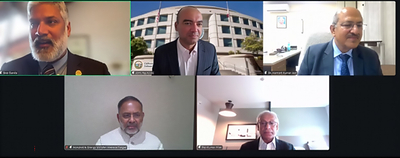
The virtual signing ceremony was attended by Hon’ble Energy Minister of Rajasthan Mr Heeralal Nagar, Mr Siva Gunda, Vice Chair of California Energy Commission; Mr John Reynolds, President, California Public Utilities Commission, Mr Hemant Kumar Jain, Member, Rajasthan Electricity Regulatory Commission; and Mr Reji Kumar Pillai, President, India Smart Grid Forum (ISGF) and Chairman, Global Smart Energy Federation (GSEF), along with senior officials from the participating organizations.
The collaboration aims to promote knowledge exchange, policy dialogue, technical cooperation, and the sharing of global best practices in key areas including Renewable energy integration, Grid modernization and resilience, Energy efficiency, Transportation electrification, Long-duration energy storage, Energy forecasting and grid planning and other Emerging clean energy technologies.
Speaking on the occasion, Hon’ble Minister for Energy, Rajasthan Government, Mr Heeralal Nagar, said, “Rajasthan is a leader in clean energy in India. We have strong sunshine and good wind, and we are using them to produce more and more solar and wind power. We are also adding battery storage and smart meters, and improving our power grid, so that clean power reaches our people in a steady and affordable way. California has done excellent work in this field, and there is a lot we can learn from each other. This agreement is an important step. It allows our two sides to share knowledge, ideas and experience — on solar and wind power, storage, electric vehicles and grid reliability. I believe this will bring real benefits to the people of both Rajasthan and California.”
Mr Siva Gunda, Vice Chair, California Energy Commission, said, “California and Rajasthan are demonstrating how subnational partnerships can accelerate the clean energy transition through practical collaboration. This Memorandum of Intent provides a strong foundation for sharing technical expertise on renewable energy integration, grid reliability, energy forecasting, transportation electrification, and long-duration energy storage. We look forward to learning from one another as we work toward reliable, affordable, resilient, and increasingly clean energy systems.”
President of California Public Utilities Commission, Mr. John Reynolds, commented, “California and Rajasthan are confronting many of the same challenges as we transition to cleaner, more reliable, and more affordable energy systems. This Memorandum of Intent creates an important opportunity for our institutions to learn from one another, share regulatory experience, and strengthen our collaboration in support of the people we serve.”
ISGF President, Mr Reji Kumar Pillai has commented, “Rajasthan today operates one of the most complex grids with nearly 80% of renewable energy. Out of 62 GW of installed capacity in Rajasthan, 42 GW is solar and 6 GW is wind. Managing a grid with such high level of variable RE generation sources is a major challenge and requires advanced digital technologies and enabling regulatory framework. This collaboration between California and Rajasthan is expected to be mutually beneficial and would be an ideal test bed for new technologies and policy interventions.”
Following the signing ceremony, the California Energy Commission acknowledged ISGF’s pivotal role in enabling this collaboration and expressed its appreciation for the continued partnership with Rajasthan and ISGF. The Commission also recognized the valuable support provided by the India Energy and Climate Center at UC Berkeley and the UC Davis India Center for Energy and Climate in advancing this initiative.
ISGF has been actively promoting international collaborations to accelerate the deployment of smart grids, renewable energy, electric mobility, and advanced energy technologies across India. This partnership further reinforces ISGF’s commitment to fostering global cooperation that supports India’s clean energy ambitions and contributes to building resilient, sustainable, and future-ready power systems.
About India Smart Grid Forum (ISGF)
ISGF is a public private partnership initiative of Govt. of India with the mandate of accelerating smart grid deployments across the country. With 170+ members comprising of ministries, utilities, technology providers, academia and research, ISGF has evolved as a Think-Tank of global repute on Smart Energy and Smart Cities. Mandate of ISGF is to accelerate energy transition through clean energy, electric grid modernization and electric mobility; work with national and international agencies in standards development and help utilities, regulators and the industry in technology selection, training and capacity building. Website: https://indiasmartgrid.org/

 View original content to download multimedia:https://www.prnewswire.com/in/news-releases/california-energy-commission-california-public-utilities-commission-and-rajasthan-electricity-regulatory-commission-sign-landmark-memorandum-of-intent-to-advance-clean-energy-collaboration-302834027.html

28, Jul 2026
Sharmila Wins Commonwealth Gold, Dedicates Medal to Mother
Glasgow, July 28: Indian para shot putter Sharmila Dhankhar brought pride to the nation by winning the gold medal at the 2026 Commonwealth Games in Glasgow, Scotland.

Pic Credit: https://x.com/PiyushGoyal
After her historic victory, Sharmila dedicated the medal to her mother, saying the achievement was the fulfilment of a cherished dream. Her emotional message added a special touch to the memorable sporting moment.
Expressing her joy, Sharmila said she was proud to win a medal for India and vowed to continue working hard to achieve greater success for the country in future competitions.
Her remarkable performance has become an inspiration for aspiring athletes and a proud milestone for Indian para-sports, reflecting years of dedication, determination, and hard work.
Sharmila’s golden achievement has added another chapter to India’s growing success on the international sporting stage.
28, Jul 2026
Centre Proposes Three-Year Pollution Certificate Validity for BS-VI Vehicles
New Delhi, July 28: Vehicle owners with Bharat Stage-VI (BS-VI) compliant vehicles may soon get relief from frequent Pollution Under Control Certificate (PUCC) renewals, with the government proposing to extend the certificate’s validity period to three years.
The proposed change aims to simplify compliance procedures, reduce paperwork, and make vehicle-related services more convenient for citizens while maintaining emission monitoring standards.
Officials said the move is being considered as part of broader efforts to improve ease of compliance and modernise the vehicle certification framework. BS-VI vehicles, which use advanced emission-control technologies, are designed to meet stricter pollution norms compared with older vehicle categories.
The proposal is expected to benefit millions of vehicle owners by reducing the need for repeated visits to authorised testing centres and lowering the administrative burden associated with certificate renewals.
The government is also working towards strengthening digital systems for vehicle emission monitoring to ensure better tracking, transparency, and enforcement of pollution control measures.
Automobile industry stakeholders have welcomed the proposal, saying longer PUCC validity could improve convenience for consumers while allowing regulatory agencies to focus on effective emission monitoring.
The proposal will undergo further examination before a final decision and official notification are issued.
28, Jul 2026
Space Startups Strengthening India’s Global Competitiveness: Piyush Goyal
New Delhi, July 28: India’s space sector is undergoing a transformative phase, powered by a new generation of innovators and startups that are driving technological advancement and strengthening the country’s global competitiveness, Union Commerce and Industry Minister Piyush Goyal said on Tuesday.
The minister said the government’s reform-oriented approach and increasing private sector participation have unlocked fresh opportunities for entrepreneurs, enabling India to build a vibrant and globally competitive space ecosystem.
Highlighting the rapid growth of space-tech startups, Goyal said Indian companies are making significant contributions across satellite development, launch technologies, space-based applications, and advanced manufacturing. These innovations, he noted, are enhancing India’s capabilities while opening new avenues for investment, exports, and high-value employment.
He said the convergence of policy support, innovation, and industry collaboration has positioned India as an emerging hub for space technology, with startups playing a central role in shaping the sector’s next phase of growth.
Emphasizing the importance of sustained investment in research and development, Goyal said continued collaboration among the government, industry, academia, and startups will be critical to accelerating innovation and expanding India’s presence in the global space economy.
The minister reaffirmed the government’s commitment to fostering an enabling environment for innovation-led enterprises, expressing confidence that India’s fast-growing space ecosystem will serve as a key pillar of the country’s economic growth, technological self-reliance, and global leadership in the years ahead.
27, Jul 2026
India Shines in Hangzhou as Esha Wins Gold and Manu Bhaker Secures Bronze
Hangzhou, July 27: Indian shooters delivered a strong performance at the ISSF World Cup in Hangzhou, with Esha Singh winning the gold medal and Manu Bhaker securing bronze in the women’s 25m pistol event.
Esha showcased exceptional composure and accuracy to finish on top of the podium, adding another major achievement to her growing international career. Manu Bhaker also impressed with a strong performance, earning a well-deserved bronze medal in the highly competitive event.
The success of the two Indian shooters highlights the country’s growing strength in shooting sports and continues India’s impressive run at international shooting competitions.
Their podium finishes have boosted India’s medal tally at the ISSF World Cup and brought further recognition to the country’s talented shooting squad.
27, Jul 2026
Setting a new benchmark in premium lifestyle living, Venus Group introduces ‘The Universe’ in Ahmedabad
Evolving lifestyle landscape through its transparent Box Price concept
AHMEDABAD, India, July 27, 2026 /PRNewswire/ — Venus Group, one of Ahmedabad’s most trusted real estate brands with a legacy spanning over 35 years, has unveiled its newest project, The Universe, a premium residential development in one of Ahmedabad’s most sought-after neighbourhoods, Nehru Nagar. Rooted in connectivity, thoughtful design, and transparent homeownership, The Universe presents a new way of life where everyday experiences are elevated, community feels closer, and luxury blends seamlessly into daily living.

The Universe brings together premium 4BHK residences and duplex penthouses in a centrally connected address. Rather than being defined by scale, the development focuses on how residents will live, offering light-filled homes, well-planned circulation, and intuitive spaces that make it easier for families to host, unwind, and connect.
At the heart of the master plan is a Central Green Spine that threads together landscaped gardens, community courts, and open recreational zones, encouraging safe, pedestrian-friendly movement across the development. This vision is complemented by a carefully curated suite of lifestyle amenities. These include a grand clubhouse, elegant arrival plaza, leisure lawns, a swimming pool, basketball and pickleball courts, jogging tracks, a fully equipped gym, children’s play areas and expansive open greens, creating a community designed around wellness, social connection and elevated everyday living.
Speaking at the launch, Rajesh Vaswani, Chairman, Venus Group, reflected on the responsibility that comes with building homes, saying, “A builder is someone entrusted with the biggest dream of a family’s life: their home. People place their lifetime savings, and sometimes even money they haven’t yet earned, in the hands of a builder. That trust is the greatest currency we have, and it is a responsibility we carry with every project we create.”
Carrying this philosophy into Venus Group’s next chapter, Vineet Vaswani, Director, Venus Group, said, “The Universe, spread across seven acres, has been created to offer a life without boundaries, where connectivity, community, and luxury come together in perfect harmony.” His vision reflects Venus Group’s continued focus on creating communities where thoughtful design and meaningful experiences shape everyday living.
Hosted by Sophie Choudry and Sachin Kumbhar, the launch evening brought together industry leaders, partners, and distinguished guests for what many described as one of Ahmedabad’s largest and most spectacular residential project pre-launch events. The official unveiling of The Universe project’s brochure by the Vaswani family, alongside eminent personalities including Esha Gupta, Mouni Roy, Anjana Sukhani, and Sonal Chauhan, among others, set the tone for a development that celebrates both Ahmedabad’s legacy and the promise of its future.
To help discerning homebuyers experience the vision behind The Universe, Venus Group has created a dedicated Sales Experience Centre. Designed to go beyond the traditional show apartment, the Experience Center allows visitors to explore the project’s story, thoughtfully curated spaces and lifestyle philosophy, offering visitors an immersive glimpse into life at The Universe.
The Universe is being introduced under Venus Group’s Box Price concept, a transparent home-buying approach designed to simplify the purchase journey through standardised pricing and greater clarity. Reinforcing the Group’s commitment to trust and transparency, the initiative reflects its belief that buying a home should be as straightforward as living in one.
RERA number: PR/GJ/AHMEDABAD/AHMEDABAD CITY/Ahmedabad Municipal Corporation/MAA17082/080726/311232
Homebuyers can experience the project firsthand at the Sales Experience Centre in Nehru Nagar or discover more by visiting the project website at venusinfra.in. For enquiries, call +91 7452074520.
 View original content to download multimedia:https://www.prnewswire.com/in/news-releases/setting-a-new-benchmark-in-premium-lifestyle-living-venus-group-introduces-the-universe-in-ahmedabad-302835184.html



