


21, Jul 2026
India’s Hockey Campaign Gets a Boost as Harmanpreet Singh Takes Charge for FIH Men’s World Cup
July 21: Indian hockey is set for another major international challenge as Harmanpreet Singh has been named captain of the Indian men’s hockey team for the upcoming FIH Hockey Men’s World Cup in Belgium and the Netherlands.
The experienced defender will lead a squad determined to make a strong impact on the world stage. With his proven leadership qualities, composure under pressure, and ability to deliver in crucial moments, Harmanpreet is expected to play a key role in guiding the team throughout the tournament.
Over the years, Harmanpreet has emerged as one of India’s most influential hockey players, particularly known for his penalty corner skills and defensive strength. His leadership has been instrumental in helping the team achieve notable performances in international competitions.
The Indian team has been preparing with a strong focus on fitness, tactical improvements, and building greater coordination among players. The squad combines experienced campaigners with young talents eager to make their mark at the global level.
The FIH Men’s World Cup will bring together the best hockey teams from around the world, providing India with a platform to compete for top honours and continue its rich hockey tradition.
With Harmanpreet Singh leading the side, India will look to deliver a confident performance and carry forward the nation’s hopes in one of hockey’s biggest international tournaments.
- 0
- By Neel Achary

21, Jul 2026
Centre Pledges Stronger Support for Farmers with Focus on Fair Prices and Global Market Access
July 21: The Centre has reaffirmed its commitment to improving opportunities for aquaculture and tobacco farmers by ensuring fair returns, strengthening market support, and expanding India’s presence in global markets.
Union Commerce and Industry Minister Piyush Goyal highlighted the government’s focus on creating a supportive ecosystem where farmers can benefit from better pricing, improved market connections, and increased export opportunities.
Aquaculture and tobacco farming continue to play an important role in supporting rural livelihoods and contributing to India’s agricultural economy. The government is working towards addressing sector-specific challenges while promoting sustainable growth and greater competitiveness.
Efforts are being made to strengthen supply chains, improve quality standards, and create better access to domestic and international markets. These measures are expected to help farmers receive greater value for their produce and encourage long-term growth in these sectors.
The minister emphasised that expanding exports and improving market opportunities will remain key priorities in supporting farming communities. A stronger export ecosystem will help enhance India’s global trade position while creating new income opportunities for farmers.
The Centre’s approach reflects its continued focus on farmer welfare, rural development, and building a more resilient agricultural economy. Through policy support and industry collaboration, the government aims to ensure that farmers are better equipped to meet future challenges and benefit from emerging market opportunities.
21, Jul 2026
NDA to Hold First ‘Mangal Milan’ Meeting During Monsoon Session
July 21: The National Democratic Alliance (NDA) is set to hold its first ‘Mangal Milan’ meeting during the ongoing Monsoon Session of Parliament, bringing together alliance leaders for discussions on coordination, legislative priorities, and strengthening cooperation among partner parties.
The meeting is expected to provide a platform for NDA leaders to exchange views on key political and parliamentary matters while ensuring better coordination among alliance members during the session. Leaders from various NDA constituents are likely to participate in the interaction and discuss strategies for effectively addressing upcoming legislative business.
The initiative reflects the alliance’s focus on maintaining regular communication and strengthening ties among its members. With Parliament in session, discussions are expected to centre around important national issues, government initiatives, and the legislative agenda ahead.
The ‘Mangal Milan’ meeting is also seen as an opportunity for NDA partners to reinforce unity and improve coordination on matters of common interest. Such interactions are aimed at ensuring a collective approach among alliance members while responding to emerging political and policy developments.
As the Monsoon Session progresses, the NDA is expected to continue its engagement with alliance partners to maintain a coordinated approach on parliamentary affairs and governance priorities.
21, Jul 2026
Chadivayal Elephant Camp to Become Tamil Nadu’s New Eco-Tourism Gem
July 21: Tamil Nadu is preparing to welcome a new eco-tourism attraction with the upcoming development of the Chadivayal Elephant Camp, offering visitors a closer connection with nature, wildlife, and conservation.
Located in a forest-rich environment, the camp aims to provide an enriching experience where tourists can learn about elephants, their care, and the importance of protecting wildlife habitats. The initiative is expected to appeal to nature lovers, families, students, and wildlife enthusiasts looking for responsible and meaningful travel experiences.
Beyond tourism, the project focuses on creating awareness about elephant conservation and the need to preserve fragile forest ecosystems. Visitors will have the opportunity to understand the role elephants play in maintaining ecological balance and learn more about efforts to protect these magnificent animals.
The eco-tourism initiative is also expected to benefit nearby communities by creating opportunities in tourism-related activities such as local services, guided experiences, and hospitality. By involving local people, the project aims to support sustainable development while protecting the region’s natural heritage.
The Chadivayal Elephant Camp represents Tamil Nadu’s growing focus on responsible tourism that balances visitor experiences with environmental conservation. Once developed, the camp is expected to become a popular destination for those seeking a peaceful and educational wildlife experience.
21, Jul 2026
Gujarat Police Expand Cyber Awareness Campaign
Gujarat, July 21: The Gujarat Police have strengthened their efforts to promote digital safety by conducting more than 5,000 cyber safety awareness programmes across the state, educating thousands of women and children about staying safe in an increasingly digital world.
The extensive outreach initiative aims to equip citizens with the knowledge and confidence to recognise and prevent cyber threats such as online fraud, phishing scams, cyberbullying, identity theft, fake social media accounts, and financial fraud. As internet use continues to grow, particularly among young people, the campaign underscores the importance of cyber awareness as the first line of defence against digital crimes.
The awareness programmes were held at schools, colleges, educational institutions, and community centres, where cyber experts and police officials interacted directly with participants. Through engaging sessions, practical demonstrations, and discussions, attendees learned how to safeguard personal information, create secure passwords, identify suspicious online activity, and use digital platforms responsibly.
Special focus was placed on empowering women and children, who are often targeted by online scams and harassment. Participants were encouraged to report cyber incidents promptly and were informed about the various channels available for seeking assistance and lodging complaints.
Officials said that preventing cybercrime begins with awareness, and informed citizens are better equipped to protect themselves and their families in the digital space. The campaign also highlights the Gujarat Police’s proactive approach to community policing by combining law enforcement with public education.
With cybercrime becoming an evolving challenge, the Gujarat Police’s continued outreach reflects a commitment to building a safer and more secure digital environment. By spreading awareness across communities, the initiative is helping people navigate the online world with greater confidence, caution, and responsibility.
21, Jul 2026
India Issues 1,331 Commercial Pilot Licences in First Half of the Year, Strengthening Aviation Workforce
July 21: India’s aviation sector continues to gain momentum, with the government issuing 1,331 Commercial Pilot Licences (CPLs) during the first six months of the year. The figures reflect the country’s growing investment in aviation training and its efforts to build a skilled workforce to support the rapid expansion of the civil aviation industry.
The increase in the number of licensed commercial pilots comes at a time when India’s aviation sector is witnessing robust growth, driven by rising passenger demand, fleet expansion by domestic airlines, and improved regional air connectivity. As airlines continue to induct new aircraft and expand their operations, the demand for qualified pilots has grown significantly, making pilot training and certification a key priority.
Government officials highlighted that the steady issuance of Commercial Pilot Licences demonstrates the country’s commitment to developing a strong talent pipeline capable of meeting the evolving needs of the aviation industry. The expansion of flying training infrastructure and improved access to pilot training programmes have also contributed to the growing number of licensed pilots entering the workforce.
India has emerged as one of the world’s fastest-growing aviation markets, with increasing air travel creating new employment opportunities across the sector. Alongside pilots, the industry’s growth is expected to generate demand for aircraft maintenance engineers, cabin crew, air traffic controllers, and other aviation professionals, further strengthening the country’s aviation ecosystem.
Industry experts believe that the availability of a larger pool of trained pilots will help airlines sustain their expansion plans while ensuring operational efficiency and safety. A steady supply of qualified aviation professionals is also expected to reduce dependence on foreign pilots and support the long-term growth of the domestic aviation sector.
The government’s continued focus on skill development, aviation infrastructure, and regulatory support is expected to play a vital role in meeting the industry’s future workforce requirements. As India’s aviation market continues to expand, the rising number of commercial pilot licences underscores the country’s preparedness to support one of the fastest-growing sectors of the economy.
20, Jul 2026
India Gets First Approved Dengue Vaccine as DCGI Clears Takeda’s QDENGA
New Delhi, July 20: In a significant milestone for India’s public health system, the Drug Controller General of India (DCGI) has granted market authorisation to Takeda Biopharmaceuticals India’s QDENGA (TAK-003), making it the country’s first approved vaccine for the prevention of dengue.

Representational Image
The vaccine has been approved for individuals aged 4 to 60 years and is expected to strengthen India’s fight against dengue, a mosquito-borne disease that continues to affect lakhs of people every year.
QDENGA is a live-attenuated tetravalent vaccine developed to provide protection against all four dengue virus serotypes. It is administered in a two-dose schedule, with the second dose given three months after the first.
One of the vaccine’s key advantages is that it can be administered regardless of whether a person has previously been infected with dengue, eliminating the need for pre-vaccination screening.
The approval comes at a time when dengue remains a major public health concern in India. Reported cases have increased sharply over the past two decades, with the country accounting for nearly one-third of the global dengue burden. Health experts believe the actual number of infections is significantly higher than officially reported.
According to Takeda, the approval is backed by an extensive global clinical development programme involving 19 Phase I, II and III studies with more than 28,000 participants from dengue-endemic and non-endemic countries.
The company’s pivotal Phase III TIDES (DEN-301) trial, which enrolled over 20,000 participants across eight dengue-endemic nations, showed promising results. The vaccine demonstrated 80.2 per cent efficacy against laboratory-confirmed dengue one year after the second dose and 90.4 per cent efficacy in preventing dengue-related hospitalisation after 18 months. Long-term follow-up also indicated sustained protection against severe dengue and hospitalisation.
The Indian approval was further supported by a Phase III clinical trial involving participants between 4 and 60 years of age, where the vaccine was found to be safe, well tolerated and capable of generating a strong immune response in children, adolescents and adults.
QDENGA has already received regulatory approval in 43 countries across Asia, Europe and Latin America. More than 32 million doses have been distributed through public and private immunisation programmes. The vaccine has also received World Health Organization (WHO) prequalification and is recommended by the WHO for use in dengue-endemic regions with high transmission.
Takeda said it will work closely with Indian regulatory authorities, healthcare professionals and public health agencies to facilitate the rollout and availability of the vaccine across the country in the coming months.
The approval marks a major step forward in India’s efforts to reduce dengue-related illness and hospitalisations, offering a new preventive tool against one of the country’s most persistent vector-borne diseases.
20, Jul 2026
President Murmu Pays Tribute to Moldova’s Historic Icon ‘Stephen the Great’ During Landmark Visit

Pic Credit: https://x.com/rashtrapatibhvn
July 20: President Droupadi Murmu paid homage at the iconic ‘Stephen the Great’ monument in Moldova, as part of her historic visit to the European nation.
The President laid floral tributes at the monument honouring Stephen the Great, a celebrated ruler and national figure of Moldova, acknowledging the country’s rich history and cultural legacy.
The visit marks the first-ever visit by an Indian President to Moldova, underlining the growing significance of India-Moldova relations and the shared commitment to strengthening bilateral cooperation.
During her visit, President Murmu is expected to engage with Moldovan leadership to explore new opportunities in areas such as trade, investment, education, technology, culture, and other sectors of mutual interest.
The tribute ceremony reflected India’s respect for Moldova’s heritage and further highlighted the importance of cultural understanding in building stronger diplomatic ties between the two nations.
The landmark visit is expected to provide fresh momentum to India-Moldova cooperation and create new avenues for collaboration in the future.
20, Jul 2026
Nathan Smith Named ICC Men’s Player of the Month for June 2026
July 20: New Zealand all-rounder Nathan Smith has been honoured with the ICC Men’s Player of the Month award for June 2026 following his outstanding performances on the international cricket stage.
Smith impressed with his consistent contributions with both bat and ball, playing a key role in New Zealand’s recent success. His match-winning efforts and all-round abilities earned him recognition among the top performers in world cricket.
The International Cricket Council (ICC) recognised Smith’s exceptional form, highlighting his impact during crucial matches and his ability to deliver under pressure.
The award marks another milestone in Smith’s growing international career and reflects his emergence as one of New Zealand’s most promising cricket talents.
Smith expressed his gratitude for the recognition and credited his teammates, coaches, and support staff for their encouragement and contribution to his success.
The ICC Men’s Player of the Month award celebrates outstanding individual performances and recognises cricketers who make a significant impact during each month of international competition.
20, Jul 2026
India’s Money Makeover: RBI Moves Closer to Introducing High-Security Plastic Banknotes
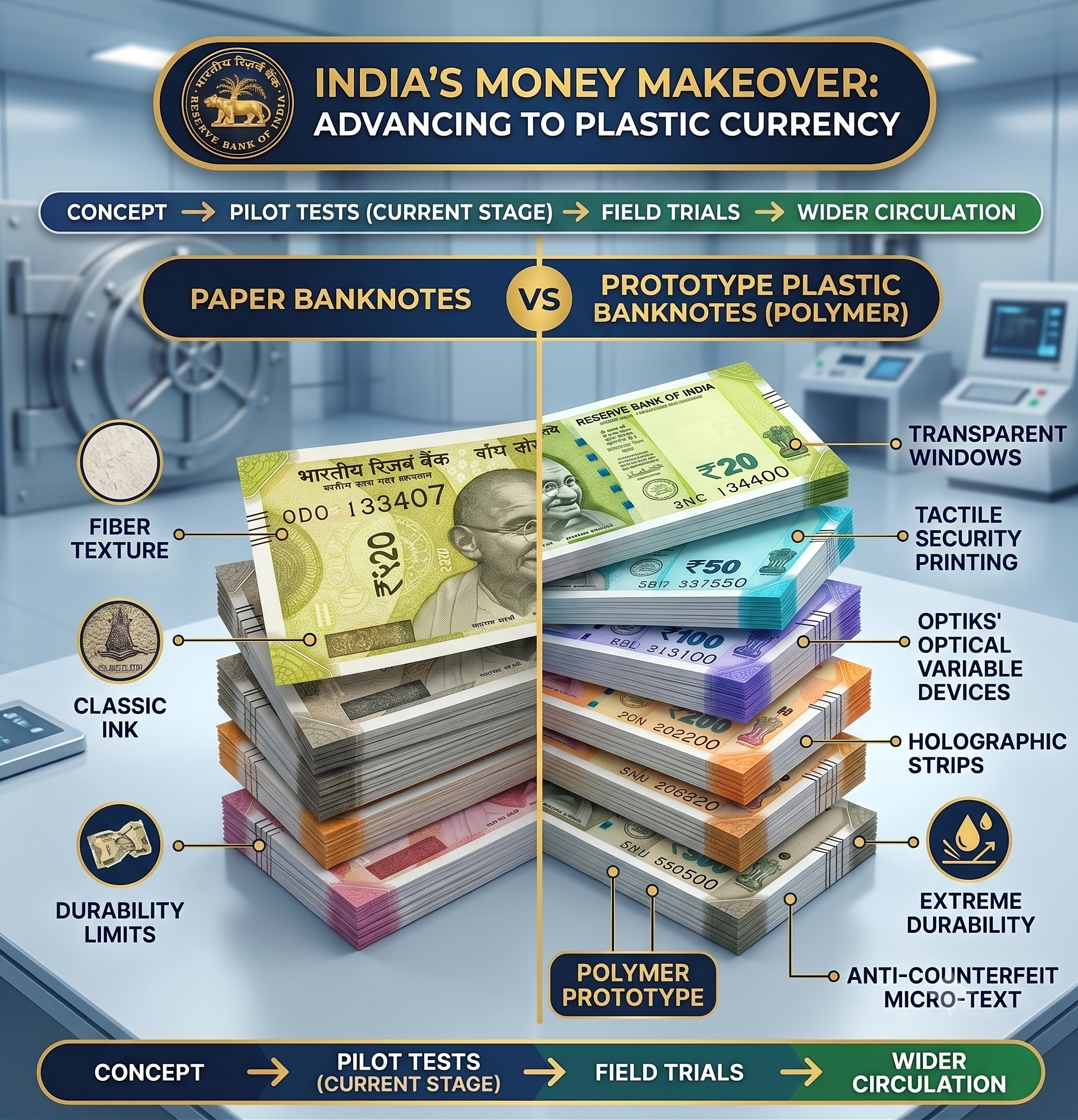
India’s currency system could soon witness one of its biggest transformations in decades as the Reserve Bank of India (RBI) takes significant steps towards introducing polymer-based banknotes, popularly known as plastic notes.
The move aims to replace traditional paper-based currency with a more durable, secure, and technology-driven alternative. The initiative gained momentum after the Bharatiya Reserve Bank Note Mudran Private Limited (BRBNMPL), a subsidiary involved in currency printing, invited global technology partners to help establish a polymer substrate manufacturing facility in India.
The development marks a major step towards building a domestic ecosystem for producing the specialised material required for polymer banknotes.
A New Era for Indian Currency
Most Indian banknotes currently use cotton-based paper embedded with multiple security features. Polymer notes, made from a specialised plastic film, offer greater durability and can withstand daily wear and tear more effectively.
Reports suggest that the initial phase may focus on lower denomination notes, including ₹10 and ₹20, with field trials planned to evaluate their performance under Indian conditions. However, the RBI has not yet announced an official launch date or final rollout plan.
Why Polymer Notes Could Change the Way India Uses Cash
The proposed polymer currency comes with several advantages:
Longer Life: Unlike paper notes, polymer notes are more resistant to tearing and damage, allowing them to remain in circulation for a longer period.
Water and Dirt Resistant: Their plastic-based material prevents damage caused by moisture, stains, and frequent handling.
Advanced Security Features: Polymer notes can include sophisticated anti-counterfeiting technologies such as transparent windows, optical elements, and advanced security markings.
Cost Savings Over Time: Although manufacturing costs may initially be higher, the extended lifespan of polymer notes can reduce the need for frequent replacement.
RBI Focuses on Domestic Production
Through the Expression of Interest (EOI), BRBNMPL is looking for companies with expertise in manufacturing security-grade polymer substrates. The objective is not only to source technology but also to develop India’s own manufacturing capability for currency materials.
The process includes strict security guidelines to ensure that the production of currency-grade materials meets national security requirements.
Learning From Global Examples
Countries such as Australia, Canada, New Zealand, and the United Kingdom have already adopted polymer banknotes due to their durability and enhanced security features.
More than 60 countries worldwide currently use polymer currency, making it an established technology in the global financial system.
No Demonetisation-Like Move
The possible introduction of polymer notes should not be confused with demonetisation. Existing paper currency will continue to remain legal tender, and old notes will circulate alongside the new polymer notes if the RBI proceeds with the rollout.
The transition, if approved, will be gradual and based on the outcome of trials and assessments.
India’s Next Step Towards Smarter Currency
The RBI’s move reflects a broader effort to modernise India’s currency infrastructure by combining durability, security, and technology. If successfully implemented, polymer banknotes could redefine everyday cash usage in India and mark a new chapter in the country’s financial journey.