


3, Feb 2026
US-India Trade Deal Seen as Neutral to Positive for Indian Refiners: ICRA
- 0
- By Neel Achary

3, Feb 2026
Hyatt Regency Delhi Presents a Kashmiri Food Festival at Cafe
New Delhi, Feb 03: Hyatt Regency Delhi introduces a thoughtfully curated Kashmiri Food Festival at Café, the hotel’s signature all-day dining destination. Taking place from 30 January to 8 February 2026, the festival brings the depth, refinement, and heritage of Kashmiri cuisine to the capital through a limited-period culinary showcase.
Rooted in traditional slow-cooking techniques and the nuanced use of aromatics such as saffron, fennel, dried ginger, and Kashmiri chillies, the festival highlights the region’s distinctive culinary identity. Presented as a multi-course buffet, the offering allows guests to experience the charm of Kashmiri cooking, from slow-cooked gravies and delicately spiced meats to time-honoured preparations that reflect the valley’s ceremonial food culture.
The menu has been curated in collaboration with Chef Rehman, a specialist in Kashmiri cuisine known for his commitment to preserving traditional methods and flavours. His approach ensures cultural accuracy while maintaining the grace expected in a luxury dining setting. “Every dish is rooted in memory, technique, and respect for tradition. This menu is an invitation to experience the fragrance and warmth of Kashmiri hospitality,” says Chef Rehman
Complementing the food experience are traditional beverage pairings, including Kashmiri Kahwa, alongside select coolers and lassi variants. The ambience at Café will be subtly enhanced to reflect the aesthetics of the valley, offering guests an immersive yet composed dining experience.
Positioned as a premium, limited-time offering, the Kashmiri Food Festival at Hyatt Regency Delhi is ideal for guests seeking an authentic regional experience presented with authenticity, elegance, and cultural integrity.
Details:
Venue: Café, Hyatt Regency Delhi
Dates: 30 January – 8 February 2026
Lunch: 12:30 PM – 3:00 PM
Dinner: 7:00 PM – 11:00 PM
3, Feb 2026
Digital Risks and Financial Pressures Shape Hyderabad’s Uncertainty Index
Hyderabad, Feb 03: India continues to face elevated uncertainty driven by financial pressures, health-related challenges, digital risks, and broader societal factors. With the national Index at 79, concerns around financial readiness, personal safety, healthcare costs, and long-term stability remain persistent despite economic growth.
Hyderabad records an Index of 76—lower than the national average but still above the South Zone benchmark of 71. Digital safety emerges as the dominant theme shaping uncertainty in the city. Residents rank personal data safety, security of online financial transactions, and vulnerability to online scams as their top three worries. These are followed by concerns about rising crime rates, growing pollution levels, and the impact of government tariffs on cost of living.
Infrastructure-related anxieties also feature prominently, including doubts about whether the city’s systems can keep pace with rapid population growth. Additionally, workplace stress, mental health issues, and the impact of global conflicts on prices contribute to a multi-layered uncertainty landscape.
City-level data shows strong linkages between financial protection and confidence. Uncertainty declines steadily as insurance coverage increases—dropping from 77 among residents with one or two policies to 64 among those with four or more. A similar pattern appears in investment ownership, where the lowest uncertainty is seen among individuals holding either one (Index: 69) or four-plus investment instruments (Index: 67).
Socio-economic segmentation indicates pronounced differences. Respondents from SEC B (82) and SEC C (83) report significantly higher uncertainty than those in SEC A (64), underlining the importance of financial buffers, resource access, and preparedness.
Across demographics, uncertainty levels remain broadly consistent, though women report slightly higher anxiety than men. Older residents—especially Baby Boomers and Gen X—show higher uncertainty than Millennials and Gen Z. Professionally, business owners and salaried individuals report nearly identical uncertainty levels. By life stage, married individuals with children indicate marginally higher anxiety than singles or married individuals without children.
Overall, Hyderabad’s findings mirror the national pattern where financial responsibilities, digital safety concerns, health preparedness, and lifestyle pressures intersect across life stages. The study reinforces that proactive planning and securing adequate protection remain essential for helping residents build confidence and reduce uncertainty over time.
3, Feb 2026
Budget 2026 Boosts Aerospace R&D and Deep-Tech Manufacturing
Shreepoorna S Rao, Founder & CEO, Arctus Aerospace
“Budget 2026 signals a clear shift in how India views aerospace and deep-tech manufacturing. The emphasis on R&D incentives, domestic component ecosystems, and easier access to capital for high-tech startups directly strengthens companies building complex platforms like high-altitude UAVs. What’s encouraging is the recognition that strategic sectors need long-term patient capital and testing infrastructure, not just subsidies. If executed well, this budget can materially accelerate India’s transition from being an importer of aerospace systems to becoming a global developer of critical aerial and Earth intelligence technologies”.
3, Feb 2026
Industry Leaders Weigh In on Union Budget 2026 at BCIC Meet
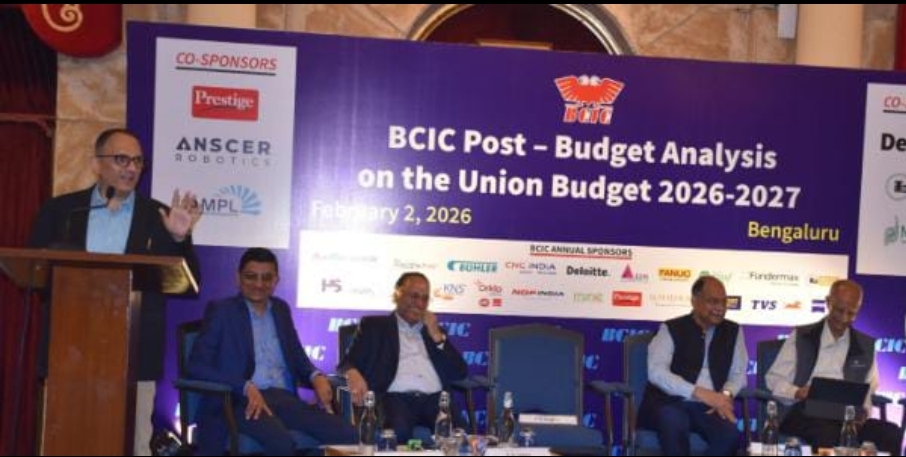
“Our recommendation is that tax incentives extended to foreign service providers must also be made available to Indian businesses serving overseas customers, so that domestic players can build scale and compete on equal terms.”
3, Feb 2026
Budget 2026 Boosts Emotional Wellbeing and Tech-Driven Healthcare, Says coto CEO
Tarun Katial, Founder & CEO at coto
“The Union Budget 2026 marks an important shift in how India is re-imagining healthcare and human development. By reinforcing preventive healthcare, holistic wellbeing and early intervention, the Budget creates space to recognise emotional and mental wellbeing as a foundational pillar of long-term health and quality of life.
The articulation of the government’s third core kartavya aligns with the vision of “Sabka Sath, Sabka Vikas” towards a Viksit Bharat, and its explicit focus on empowering vulnerable communities to access mental health and trauma care is a significant and timely acknowledgement of emotional well-being as an inclusion priority.
Equally important is the government’s forward-looking approach to technology, including the announcement of a high-powered committee to assess the impact of artificial intelligence on the services sector. This reflects a clear intent to enable responsible, technology-led innovation.
Together, these policy directions create an enabling environment for platforms like coto to expand access to emotional wellness through human-centred, digitally delivered and ethically designed solutions that support individual resilience and societal wellbeing.”
3, Feb 2026
What Remains Awake: Dream, Depth & the Fourth – Sonika Agarwal Solo Exhibition Preview
The preview of What Remains Awake: Dream, Depth & the Fourth (Jagrat · Swapna · Sushupti · Turiya), a solo exhibition by Sonika Agarwal, was held on Friday, 30 January 2026, at Kalamkar Gallery, Bikaner House, New Delhi. The event was attended by artists, curators, collectors, and members of the cultural community.
The opening was led by Ms. Uma Jain, Director of Dhoomimal Gallery, as Chief Guest. Special Guests included H.E. Ms. Mahishini Colonne, High Commission of Sri Lanka, and Shri M. Sovan Kumar, Regional Secretary, Lalit Kala Akademi.
The exhibition explores consciousness through four traditional Indian states of awareness—waking, dreaming, deep sleep, and the fourth state. Rather than representing these states directly, Sonika Agarwal interprets them through abstract forms, colour, and spatial composition.
Working across painting, sculpture, and installation, the artist moves beyond the traditional canvas. Her use of colour shifts with light and time, inviting viewers to slow down and engage deeply in today’s fast-paced world.
Curated under the guidance of Myna Mukherjee, the exhibition emphasizes inner reflection and awareness. Sculptural works add depth to the show, exploring themes of desire, silence, power, and compassion.
A self-taught artist with over seventeen years of experience, Sonika Agarwal has exhibited widely in India and internationally. She is a recipient of the National Stree Shakti Award from the President of India, and her works have been recently acquired by the Museum of Sacred Arts (MoSA), Belgium.
What Remains Awake encourages viewers to reflect on their own consciousness, offering a quiet, contemplative experience beyond the rush of everyday life.
3, Feb 2026
Reinventing a Legacy Brand in the Digital Age
For many heritage brands, history can feel less like a foundation and more like an anchor. In an era of rapid technological change and evolving consumer habits, sticking to “business as usual” often leads to irrelevance. To thrive, these iconic brands must execute a Legacy Pivot—a strategic shift that embraces a digital-first approach while honoring their heritage. By focusing on four key principles—utility, speed, design, and connectivity—legacy brands can evolve from local favorites into global digital leaders.
The Utility Shift: From Niche Products to Lifestyle Emotions
Legacy brands often struggle with shrinking niches. When a brand is strongly tied to a single product that no longer holds daily relevance, it must expand into broader lifestyle categories. The goal is to transform occasional purchases into daily interactions.
For example, a traditional greeting card company might expand into home décor and everyday stationery. The most significant transition, however, is moving from product-centric to emotion-driven marketing. Today’s consumers invest in the feelings and experiences a brand evokes, not just the products.
A tiered strategy can help: offering entry-level digital products for younger audiences while maintaining premium physical collectibles for dedicated enthusiasts. This ensures relevance across demographics.
The Velocity Shift: Redefining Distribution and Speed
In the digital era, “how fast” a brand delivers is as crucial as “what” it delivers. Legacy brands must move from traditional operations to agile, consumer-centric models.
Quick commerce, micro-warehouses, and “dark stores” can enable sub-30-minute deliveries. Meanwhile, phygital strategies position physical stores as experience hubs while digital channels handle fast transactions.
Building proprietary Direct-to-Consumer (DTC) platforms allows brands to eliminate intermediaries and retain full ownership of customer data—the modern “oil” fueling growth.
The Aesthetic Shift: Modernizing the Visual Narrative
“Brand fatigue” is a growing challenge for heritage brands. To stay relevant, brands must modernize visually and tonally, appealing to younger audiences without losing their identity.
This includes clean, aesthetic designs suited for social media and nostalgia-driven storytelling to engage older millennials. Strategic collaborations with influencers or “cool” brands can bridge generational gaps and borrow cultural capital.
The Connectivity Shift: Global Reach through Data and Tech
Digital transformation enables brands to expand globally without costly physical expansion. Data-driven personalization shifts marketing from mass campaigns to tailored experiences powered by AI and CRM insights.
Participation in open platforms, such as ONDC, ensures brands remain visible wherever customers search, capturing every moment of consumer intent.
The Transformation Matrix: From Legacy to Digital
This evolution changes every core pillar of business. Inventory shifts from slow-moving, product-specific stocks to fast-moving, lifestyle-oriented offerings. Stores no longer wait for customers—they deliver directly, sometimes within ten minutes.
Marketing transforms from nostalgic storytelling to aesthetics-driven dialogues supported by influencers. Most importantly, brands shift from local or community-based operations to borderless, global entities.
Reinventing a legacy brand doesn’t mean abandoning its history. It means translating enduring values into a digital language, ensuring relevance, resilience, and vitality for the next century.
3, Feb 2026
GCPL Welcomes MAT Credit Relief in New Tax Regime

Mr Sudhir Sitapati, Managing Director & Chief Executive Officer, Godrej Consumer Products Ltd.
“We particularly welcome the MAT credit set-off being allowed up to 25% of the tax liability under the new tax regime. This move improves cash flows and makes the new tax regime smoother for companies with accumulated credits, freeing up capital for reinvestment into growth and consumption-led categories”
3, Feb 2026
India–US Trade Deal Signals Strategic Reset: Nachiketa Sawrikar
By:- Mr. Nachiketa Sawrikar, Fund Manager, Artha Bharat Global Multiplier Fund
The India–US relationship, which many expected to strengthen during President Trump’s second term, reached a notable low point in June. For the global economy, strained ties between the world’s two largest democracies were far from encouraging. Against this backdrop, the new India–US trade agreement—reducing the average tariff rate to around 18% from the earlier punitive level of nearly 50%—marks a meaningful reset in bilateral economic relations.
For India, lower tariffs significantly enhance access to the US market for labour-intensive exports such as textiles, engineering goods and pharmaceuticals, supporting employment, manufacturing scale and export competitiveness. The revised tariff level places India broadly in line with ASEAN peers and represents the most favourable outcome realistically achievable under current global trade dynamics. For the US, the agreement opens avenues to expand exports of energy, agricultural products and advanced technologies, while reinforcing supply-chain diversification away from over-concentrated geographies.
Beyond tariffs, the deal signals a renewal of strategic trust. Trade policy is now better aligned with shared priorities including resilient supply chains, clean-energy collaboration, and technology partnerships in areas such as semiconductors and defence manufacturing. Indian consumers also stand to benefit as high-value US and EU products become more affordable, supporting domestic demand and purchasing power.
With the rupee having weakened by nearly 5% over the past six months, improved trade flows and renewed foreign investor interest could aid a partial currency recovery. As India’s relative attractiveness improves versus ASEAN markets, a reversal of recent FII outflows could further strengthen Indian equity markets. Overall, the agreement represents a balanced, win-win outcome for both economies.


