


4, May 2026
UDF Surges to Power in Kerala, Crosses Majority Mark in 2026 Assembly Polls!
Thiruvananthapuram,May 4 (BNP): In a decisive political development, the Congress-led United Democratic Front (UDF) has crossed the crucial majority mark in the Kerala Assembly Elections 2026, according to official trends from the Election Commission of India, signaling an end to a decade-long rule of the Left Democratic Front.
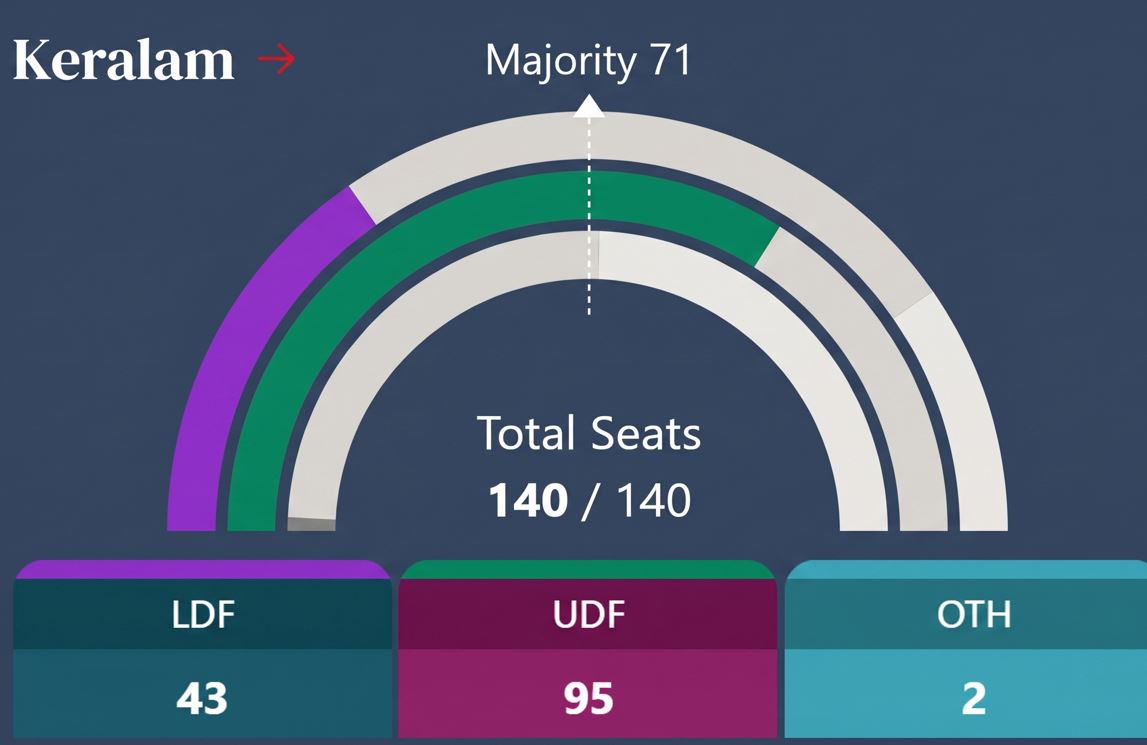
The UDF has surged ahead, leading in over 90 constituencies in the 140-member Assembly, comfortably crossing the majority mark of 71 seats. As counting nears completion, the alliance appears poised for a decisive victory, reflecting a significant shift in the state’s political landscape.
In a notable development, Chief Minister Pinarayi Vijayan is trailing in his stronghold Dharmadam, while Leader of Opposition V. D. Satheesan is leading in Paravur, further underscoring the changing electoral mood.
Reacting to the trends, Congress MP Shashi Tharoor described the outcome as a clear mandate for change after ten years of LDF governance. Emphasizing the party’s vision, he noted that the results reflect voters’ desire for a new direction and a different style of politics in the state.
Celebrations have erupted at Congress headquarters as party workers and leaders welcomed the strong performance, though senior leaders have urged caution until final results are formally declared.
If the trends hold, the UDF is set to return to power in Kerala, marking a significant political transition and potentially reshaping governance priorities in the state.
Further updates are awaited as the final results are confirmed.
- 0
- By Neel Achary

4, May 2026
BJP Crosses Majority Mark in West Bengal, Set to Form Historic First Government!
Kolkata, May 4 (BNP): In a dramatic political shift, the Bharatiya Janata Party (BJP) on Monday crossed the majority mark in the West Bengal Assembly elections, derailing Mamata Banerjee’s bid for a consecutive fourth term and marking a potential end to over a decade of All India Trinamool Congress dominance.
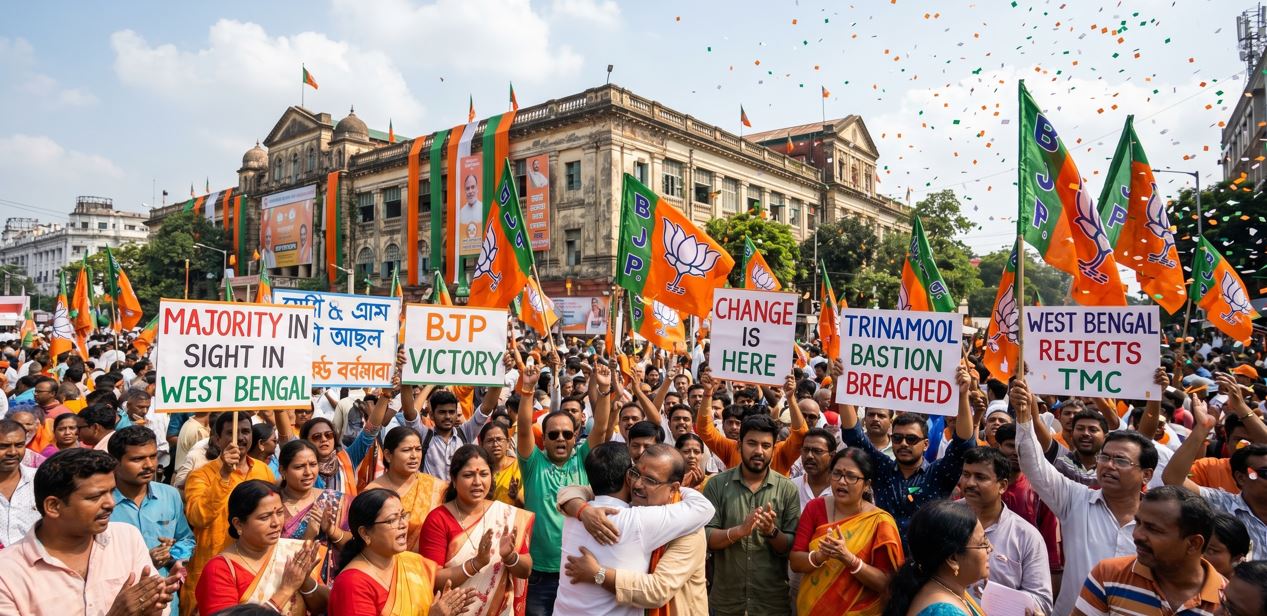
According to trends released by the Election Commission of India, the BJP is leading in 156 seats, comfortably surpassing the majority mark, while the Trinamool Congress is ahead in 86 seats. Its ally, Gorkha Janmukti Morcha (Bimal faction), is leading in one seat.
If these trends hold, the BJP is poised to form its first-ever government in the state—ending 15 years of Trinamool rule and following a prolonged 34-year tenure of Left Front governments, which had previously defined West Bengal’s political landscape.
Reacting to the party’s strong performance, Leader of Opposition Suvendu Adhikari expressed confidence, stating that the BJP would secure over 180 seats. He also took a swipe at the ruling party, underscoring the scale of the BJP’s surge.
The election also witnessed an unprecedented voter turnout. West Bengal recorded one of its highest participation rates since Independence, with 93.19% polling in Phase I and 91.66% in Phase II, taking the combined turnout to an impressive 92.47%.
For context, in the 2021 Assembly elections, the Trinamool Congress had secured a decisive mandate with 213 out of 294 seats and nearly 48% vote share, while the BJP emerged as the principal opposition with 77 seats and around 38% votes—marking a significant rise from its earlier performance. The Left-Congress alliance failed to open its account.
As counting continues, all eyes remain on the final outcome, which could redefine the political trajectory of West Bengal and signal a historic satta parivartan in the state.
4, May 2026
Tamil Nadu Polls 2026: Vijay’s TVK Surges Ahead, Signals Major Political Shift!
Chennai,May 4 (BNP): Tamil Nadu, long regarded as the citadel of Dravidian politics for over five decades, may be on the brink of a significant political shift as early trends from the 2026 Assembly election counting suggest an intense and unpredictable contest.
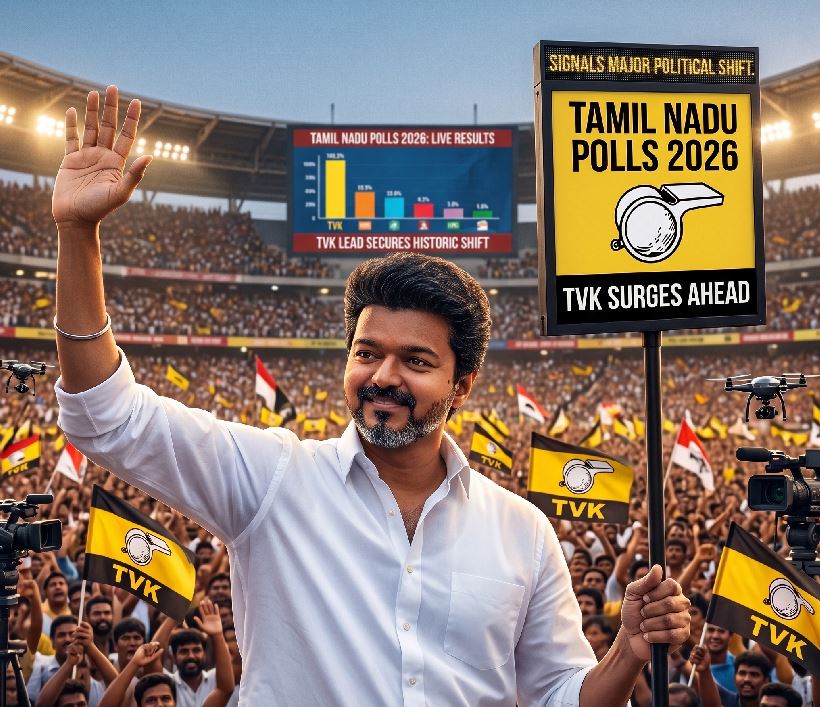
Traditionally dominated by the two major Dravidian parties—Dravida Munnetra Kazhagam (DMK) and All India Anna Dravida Munnetra Kazhagam (AIADMK)—the state is now witnessing a strong three-cornered battle. The ruling DMK, led by Chief Minister M. K. Stalin, faces a resurgent AIADMK in alliance with the Bharatiya Janata Party, alongside a formidable new challenger—Tamilaga Vettri Kazhagam (TVK), founded by actor-turned-politician Vijay.
According to the latest counting trends, TVK has surged ahead of the DMK in several constituencies, indicating a potential breakthrough moment for the debutant party. This unexpected momentum has added a dramatic twist to the electoral landscape, raising questions about the future of Tamil Nadu’s long-standing political order.
Pre-election exit polls largely projected a second consecutive victory for the DMK. However, Axis My India pointed to a strong “Vijay effect,” suggesting that TVK could emerge as a kingmaker by securing close to 100 seats in the 234-member Assembly, where the majority mark stands at 118.
As counting continues, all eyes remain on whether these early trends will translate into a historic mandate. If sustained, the results could mark a profound transformation in Tamil Nadu politics, breaking the decades-old binary and ushering in a new era of multi-polar competition.
4, May 2026
Swedish Clean-Tech Pioneer KonveGas Eyes Strategic Alliances in India
Delhi, May 04: Building on the momentum of its recent investment announcement at India Energy Week in Goa, Swedish clean-tech innovator KonveGas has confirmed its participation in the upcoming Bioenergy, Biofuels & Biomaterials (BBB) Summit 2026 at Yashobhoomi, New Delhi from 7th May 2026 to 9th May, 2026. This move signals a critical phase in the company’s official launch in the Indian market as it actively seeks strategic partners to localize its world-class composite storage technology.

As India and the European Union move toward the final ratification of the historic India-EU Free Trade Agreement (FTA), KonveGas is positioning itself at the forefront of this new economic corridor. The FTA is expected to catalyze unprecedented technology transfers, particularly in the high-growth sustainability sector, making the entry of specialized European firms like KonveGas both timely and strategically vital for India’s net-zero ambitions.
Bridging the Infrastructure Gap with Type 4 Technology KonveGas specializes in the design and manufacture of advanced Type 4 glass fiber composite cylinders, a technology that is up to 75% lighter than traditional steel and entirely corrosion-resistant. For an Indian market rapidly expanding its Compressed Bio-Gas (CBG) and Green Hydrogen infrastructure, these lightweight storage solutions solve a major logistical bottleneck: the high cost and weight of transporting gas across vast distances.
“India is not just a market for us; it is the future global hub for green energy innovation,” said Alexander Enulescu, Founder & CEO, KonveGas. He added “Following our successful engagement in Goa earlier this year, we are now moving from intent to action. Our presence at the BBB Summit is about finding the right Indian partners be it in manufacturing, distribution, or infrastructure to help us scale these solutions locally under the ‘Make in India’ spirit.”
Strategic Synergies at the BBB Summit The BBB Summit comes at a time when the Indian technology space is hungry for efficient storage and mobility solutions. With the government’s push for 20% ethanol blending and the National Green Hydrogen Mission, the demand for safe, durable and cost-effective storage has never been higher.
KonveGas’s participation at the New Delhi summit will focus on:
- The Mobility Revolution: Introducing lightweight cylinders for heavy-duty trucking, transit buses and maritime applications.
- Localized Manufacturing: Discussing joint venture opportunities to establish production lines in India’s industrial hubs.
- Decarbonization: Demonstrating how Swedish engineering can reduce the carbon footprint of India’s logistics sector by up to 70%.
The company is currently in the midst of its official Indian launch process and is inviting potential collaborators ranging from energy PSUs to private automotive giants to explore how Swedish composite technology can be integrated into the Indian supply chain.

3, May 2026
PR – Industrialist And Dollar Industries Limited Founder & Chairman Emeritus Shri Dindayal Gupta Passes Away
Kolkata, 3rd May, 2026: Renowned Industrialist and Founder & Chairman Emeritus of hosiery major, Dollar Industries Limited Shri Dindayal Gupta left for his heavenly abode today in Kolkata from age related ailments. His demise marks the end of an era for the company and the Indian hosiery and apparel industries at large.
A visionary leader and a guiding force behind the company’s remarkable journey, Shri Dindayal Gupta steered Dollar Industries Limited for over five decades with unwavering commitment, foresight and integrity. Under his leadership, the company evolved from modest beginnings into one of India’s leading manufacturers in the hosiery and apparel segment. Under his leadership, Dollar Industries grew to a Rs 1700+ crore conglomerate.
Born on 13th September, 1937 into a humble and large family in Manheru village, Bhiwani district, Haryana with limited means, Shri Gupta’s life was a testament to perseverance, resilience and the power of dreaming big. Migrating to Kolkata (then known as Calcutta) in 1962, he started manufacturing and selling hosiery products tailormade to the buyers’ budget and requirements from its inception. This was done through parallel development of manufacturing & finishing facilities, building a network of selling outlets & partner retailers and direct development of markets neglected by other companies.
As a young man, he had the determination to build something meaningful and thus layed the foundation of Dollar Industries Limited in 1972. His entrepreneurial spirit and relentless drive transformed the company into a household name, admired for its quality, innovation and strong market presence. Soon, Dollar became one of the first companies to supply and serve backward areas like Madhya Pradesh (now MP & Chhattisgarh), the Seven Sisters of North East India and the hill districts like Darjeeling in eastern Himalayas.
Apart from his illustrious business career, Shri Dindayal Gupta was actively associated with the Arya Pratinidhi Sabha, reflecting his deep-rooted commitment to social and community service. He was a key leader in multiple branches of Bengal Pratinidhi Sabha. He was also a former Vice-President of Sarvadeshik Arya Pratinidhi Sabha and an active member of Paropakarini Sabha of Ajmer, the key repository of the personal effects of Swami Dayanand Saraswati. He initiated and set up the Burns unit and related infrastructure at the Marwari Relief Society, Kolkata.
Shri Gupta was the Founding Father of Haryana Vidya Mandir, a school in Bidhannagar, North 24-Parganas, West Bengal, under the CBSE board. He was also involved in Gurukuls as co-founder and sponsor. He was the man behind the revival of his humble village school in Manheru.His steadfast and extensive contributions in this field of education prove his conviction that the opportunity to access education at all levels is the only true way to enable social development and the growth and prosperity of the nation.
He was also a key contributor to the growth and efficacy of social service organizations in the field of elderly support likeMaharshi Dayanand Yogashram Tripura & Sukhanand Foundation. His contributions extended beyond industry, leaving a meaningful impact on the society he served.
During his illustrious journey he has been bestowed with many awards and recognitions including the Lifetime Achievement Award from West Bengal Hosiery Association and the Sanmarg Business Award.
Shri Dindayal Gupta is survived by his wife and four sons and grandchildren, who are spearheading the Dollar Industries business empire.
2, May 2026
Incheon National University Researchers Find Solution for Reliable Excavator Tracking in Real-World Construction Environments
May 02: A recent study published in Automation in Construction by researchers from Incheon National University exploits a novel approach to improving excavator tracking performance under real-world conditions. By integrating deep learning-based instance segmentation with an automated, reliability-based multi-camera strategy, this study addresses one of the most persistent challenges in construction monitoring—frequent occlusions caused by dynamic site activities. In addition, the researchers propose a frame-level reliability estimation process that automatically identifies unreliable tracking results.

Despite significant advances in vision-based equipment tracking, frequent occlusions caused by multiple interacting machines continue to degrade tracking accuracy on construction sites. While previous studies have explored multi-camera approaches, they often assume that at least one camera maintains a clear view at all times. In practice, however, such conditions are rarely guaranteed. Even with multiple CCTV systems installed, simultaneous occlusions across cameras frequently occur, making it difficult to identify which camera provides the most reliable view at any given moment.
To fill this knowledge gap, a research team led by Professor Choongwan Koo from the Division of Architecture & Urban Design at Incheon National University, Republic of Korea, has recently proposed an automated, reliability-based multi-camera strategy for excavator tracking. This study was made available online on 9 October 2025, and have been published in Volume 181 of Automation in Construction on 1 January 2026.
According to Prof. Koo, “The primary practical contribution of this study is the development of a quantitative and automated framework for selecting the most reliable camera under simultaneous occlusion conditions in real-world construction environments.”
The proposed approach introduces a quantitative reliability framework based on occlusion regions (e.g., arm and body) and occlusion ratios. Unlike conventional methods that primarily focus on improving detection or tracking algorithms, this strategy enables direct assessment of tracking reliability at the frame level. Notably, this study identifies critical occlusion thresholds—0.7 for the excavator arm and 0.5 for the body—beyond which tracking performance significantly deteriorates. These thresholds offer clear and actionable criteria for practitioners to assess the quality of vision-based monitoring data.
Beyond methodological contributions, the proposed strategy also offers significant practical and economic benefits. By improving the continuity and accuracy of tracking results, the approach enhances the reliability of equipment operation logs, which are essential for carbon emission estimation and regulatory reporting. This, in turn, can help reduce administrative burdens and financial risks, such as penalties or revalidation costs. Furthermore, by leveraging existing camera infrastructure and evaluating reliability in real time, the proposed approach minimizes the need for additional camera installations, thereby reducing capital expenditure and avoiding complications related to power supply, networking, and site constraints. The automated camera selection process also reduces reliance on manual intervention, leading to lower labor and operational costs.
“Overall, our work provides a practical and scalable solution to improve the reliability and field applicability of vision-based construction monitoring systems, with potential extensions to productivity analysis, activity recognition, and carbon emission monitoring,” concludes Prof. Koo.
2, May 2026
University of Nebraska–Lincoln and Runza Restaurants Launch Limited-Edition Runza-Flavored Ice Cream
Nebraska, May 2: In a bold and unconventional culinary collaboration, University of Nebraska–Lincoln’s Food Processing Center has partnered with Runza Restaurants to introduce a limited-edition Runza-flavored ice cream, reimagining the iconic sandwich in a surprising frozen format.
The unique creation blends the signature spice profile of the classic Runza sandwich into a sweet cream ice cream base, offering a fusion of sweet and savory flavors. Developed under the leadership of April Johnson, product development project manager at the university’s Food Processing Center, the innovation aims to challenge traditional perceptions of dessert.
“It’s definitely a shock factor at first,” said April Johnson. “You take a bite and think, ‘What is this?’ and then it clicks — it tastes like a Runza sandwich.”
The product was developed following a challenge from Runza Restaurants to translate the essence of its signature sandwich — known for its blend of spices and comforting flavor into ice cream. While inspired by the original, the frozen treat contains no meat, instead incorporating elements like cabbage powder, spice blends, and soft dough inclusions to replicate the sandwich experience.
After multiple iterations and collaborative tastings, the final version was approved by Runza representatives, striking a balance between novelty and familiarity.
“We refined the recipe through continuous feedback until we reached a point where it truly captured the flavor identity,” Johnson added.
The limited-release ice cream debuted on May 1 across select locations in Lincoln and Waverly, following a teaser campaign on social media. The company anticipates strong curiosity-driven demand, though availability may be short-lived.
“We aren’t sure if this will last for four hours or four days,” said Becky L. Perrett, Director of Marketing at Runza Restaurants. “But we’ll be ready and flexible.”
The launch reflects a broader trend of experimental and conversation-starting food innovations, where unique flavor profiles drive consumer engagement.
With its blend of nostalgia, novelty, and bold experimentation, the Runza-flavored ice cream stands out as a creative milestone in food innovation — and a distinctly Nebraskan experience.
1, May 2026
April Gross GST Collection Hits INR 2,42,702 Crore, Up 8.7 pc; Highest-Ever Monthly Mop-Up!
New Delhi, May 1 (BNP): India’s gross Goods and Services Tax (GST) collection for April 2026 surged to a record ₹2,42,702 crore, registering an 8.7 per cent increase compared to the same month last year, signalling strong economic momentum and improved tax compliance.
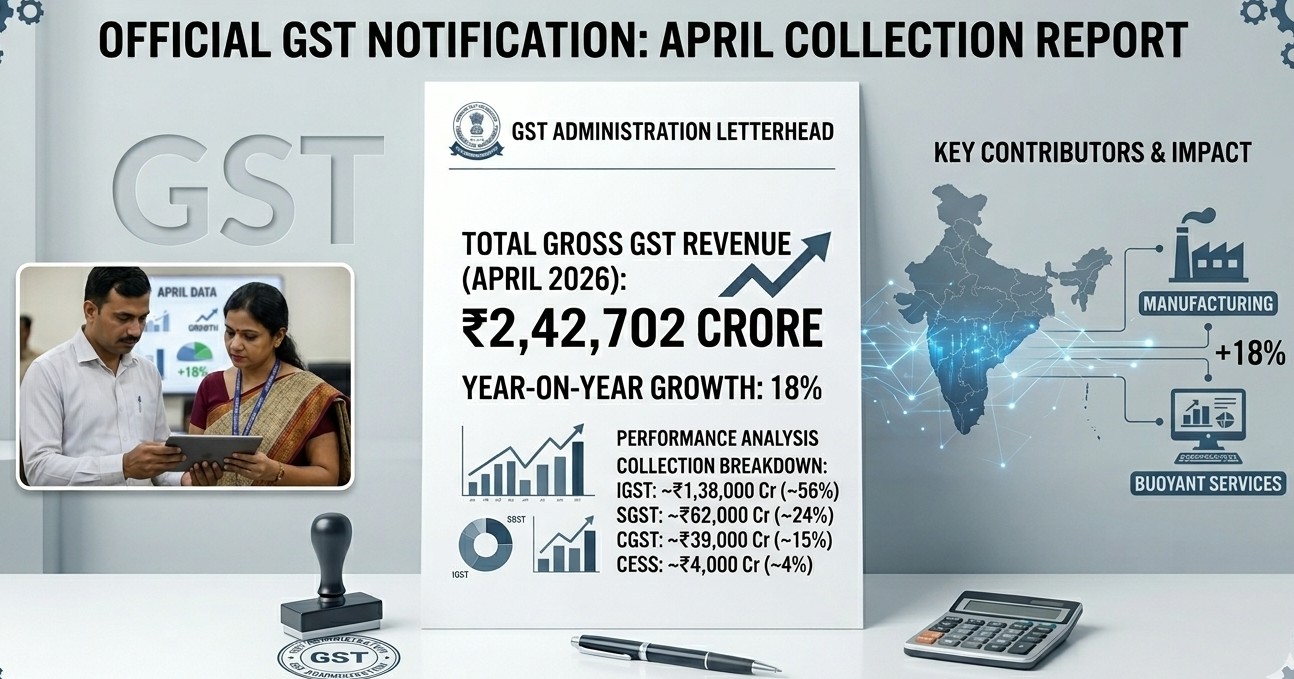
The April collection marks the highest-ever monthly GST mop-up since the nationwide indirect tax regime was rolled out in July 2017, highlighting sustained growth in domestic consumption, trade activity, and business transactions.
Officials said the robust tax numbers reflect the resilience of the Indian economy despite ongoing global uncertainties and geopolitical tensions impacting international markets.
GST collections are widely seen as a key indicator of economic health, as higher revenues generally point to stronger consumer demand, increased commercial activity, and better compliance among taxpayers.
The strong April figures also come at the beginning of the new financial year, raising optimism over government revenue trends and fiscal stability in the months ahead.
Economists noted that consistent growth in GST collections could provide additional fiscal space for infrastructure development, welfare programmes, and public investment, while supporting the government’s broader economic expansion agenda.
The record-breaking collection is expected to further strengthen confidence in India’s growth outlook and revenue position for FY 2026-27.
1, May 2026
Labour Day 2026 Explained: History, Importance, Theme and Wishes for Workers
New Delhi, May 1 (BNP): Labour Day, also known as International Workers’ Day or May Day, is being observed across the world on Friday, May 1, 2026, to honour the contribution, dedication, and achievements of workers across all sectors.
Celebrated annually on May 1, the day recognises the strength of the labour force and highlights the importance of fair wages, safe working conditions, dignity at work, and social justice for employees.

Why Labour Day Is Celebrated on May 1
The origin of Labour Day dates back to the labour union movement in the late 19th century, particularly the historic Haymarket affair in Chicago in 1886, where workers demanded an eight-hour workday. The movement became a symbol of workers’ rights and inspired countries worldwide to observe May 1 as International Workers’ Day.
In India, Labour Day was first celebrated in Chennai in 1923 by the Labour Kisan Party of Hindustan, making it a significant milestone in the country’s labour history.
Labour Day 2026 Theme
The global focus for Labour Day 2026 centres on workers’ rights, fair employment, social security, dignity of labour, and inclusive economic growth. Various organisations and labour groups are observing the day with discussions on job security, skill development, workplace equality, and employee welfare.
Significance of Labour Day
Labour Day serves as a reminder of the vital role workers play in building industries, economies, and nations. It also acknowledges the struggles and sacrifices made by generations of workers to secure rights and protections that many employees benefit from today.
The day is marked through rallies, awareness programmes, recognition events, and campaigns promoting labour welfare and workplace safety.
Wishes to Share on Labour Day 2026
- Happy Labour Day to all hardworking people whose dedication keeps the world moving.
- Wishing strength, success, and respect to every worker on this Labour Day.
- Salute to the hands that build the nation. Happy May Day 2026.
- Your hard work shapes the future. Happy Labour Day.
- May every worker receive dignity, fair opportunity, and prosperity.
Labour Day is more than a holiday—it is a tribute to millions of workers whose efforts power daily life and economic progress. As the world marks May 1, the occasion calls for renewed commitment to fairness, equality, and respect in every workplace.
1, May 2026
Mamata Banerjee Warns Against Tampering of Counting Process After Late-Night Visit to EVM Strongroom in Bhabanipur
Kolkata, May 1 (BNP): West Bengal Chief Minister and All India Trinamool Congress (TMC) supremo Mamata Banerjee early Friday issued a stern warning against any attempt to tamper with the vote counting process, hours after she made a late-night visit to an EVM strongroom in Bhabanipur alleging possible malpractice ahead of the May 4 counting.
Banerjee reached the Bhabanipur Assembly segment counting centre at Sakhawat Memorial School on Thursday night and remained inside the premises for nearly four hours along with her election agent. The strongroom houses Electronic Voting Machines (EVMs) used in the April 29 polling.
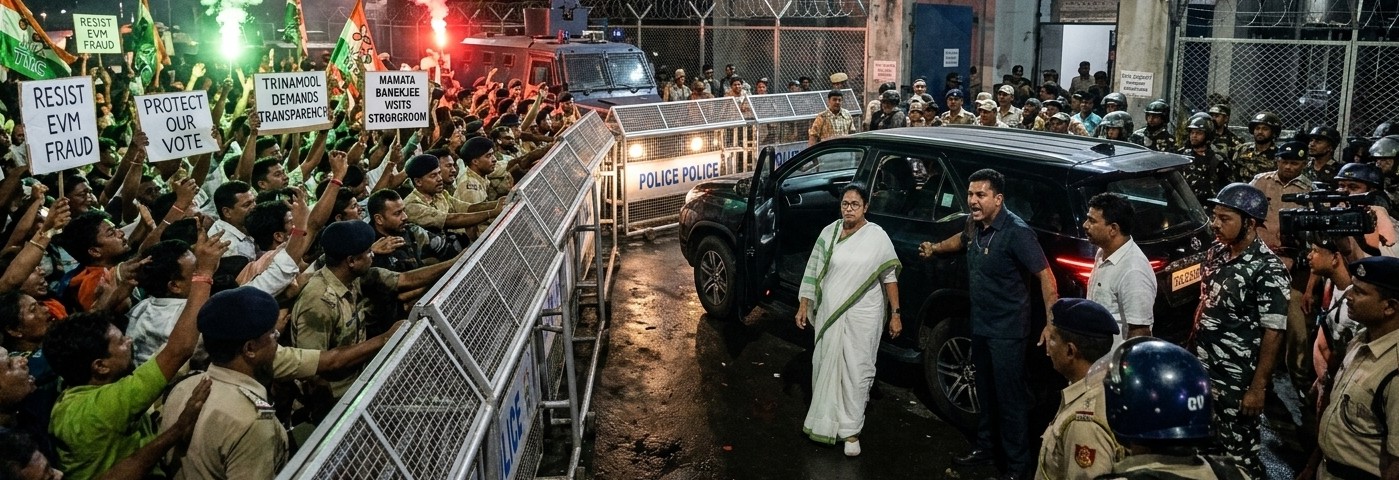
Emerging from the centre shortly after midnight, she stressed the need for strict transparency in the counting process.
“Either the candidate or one agent can stay upstairs. I have also suggested installation of CCTV cameras for the media,” Banerjee told reporters.
Emphasising the importance of safeguarding public mandate, she said, “People’s votes must be protected. I rushed here after receiving complaints. If there is any plan to tamper with the counting process, it will not be tolerated.”
She also alleged that central security personnel initially prevented her from entering the premises.
The development came amid heightened political activity in the state, with TMC leaders intensifying vigilance over strongrooms ahead of counting day.
Meanwhile, Kolkata Mayor and TMC candidate Firhad Hakim reached the venue but was unable to meet Banerjee.
“I came after learning that the chief minister had arrived. However, I could not meet her as she was already inside the premises exercising her right as a candidate to inspect the strongroom,” Hakim said.
In a parallel protest, TMC leaders Kunal Ghosh and Shashi Panja staged a sit-in outside Khudiram Anushilan Kendra in north Kolkata, alleging irregularities and possible tampering of EVMs stored there. The protest led to tense exchanges between TMC and Bharatiya Janata Party (BJP) supporters.
Earlier in a video message, Banerjee had urged party workers, leaders, and polling agents to maintain a 24-hour vigil outside all EVM strongrooms across the state.
The developments have added to the charged political atmosphere in West Bengal following a fiercely contested Assembly election, with all major parties closely monitoring arrangements ahead of the crucial counting day on May 4.