


16, Apr 2026
Chef Vikas Khanna Named in TIME 100 Most Influential People List
New Delhi, Apr 16 (BNP): Celebrity chef Vikas Khanna, popularly known as “Curry boy,” has been featured in the TIME 100 list of the world’s most influential people, marking a proud moment in his culinary journey.
Khanna said the recognition is significant for India and reflects how perceptions around Indian cuisine and culture have evolved globally. He noted that a term once used in a dismissive way has now become a symbol of pride for him.
Based in New York, Khanna runs the restaurant Bungalow, which presents Indian cuisine with a modern twist and has gained international attention.
He joins a diverse group on the TIME 100 list, which includes actor Ranbir Kapoor, Google CEO Sundar Pichai, YouTube CEO Neal Mohan, and several global leaders and cultural figures.

- 0
- By Neel Achary

16, Apr 2026
Pakistan Army Chief Visits Iran as Peace Efforts Intensify in Middle East
Tehran, April 16(BNP): In a crucial diplomatic move aimed at stabilising the Middle East, Pakistan’s Chief of Army Staff (COAS), Field Marshal Asim Munir, arrived in Tehran on Wednesday, leading a high-level political and security delegation.
The visit comes at a critical juncture as Pakistan steps up its role as a key mediator between the United States and Iran, with efforts underway to sustain a fragile ceasefire and revive stalled negotiations.
Field Marshal Munir, accompanied by Pakistan’s Interior Minister Mohsin Naqvi and senior officials, was received by Iranian Foreign Minister Abbas Araghchi. The delegation is expected to engage in high-level discussions focused on de-escalation and diplomatic coordination.
According to sources, the primary objectives of the visit include conveying a fresh framework from Washington aimed at breaking the deadlock following the recent Islamabad talks held on April 11–12. Another key focus is to ensure the continuation of the two-week ceasefire brokered on April 8, which is set to expire on April 22.
The visit also aims to lay the groundwork for a second round of high-level negotiations, which are likely to be hosted in Islamabad in the coming days.
The renewed diplomatic push follows weeks of heightened tensions in the region since late February. While earlier direct talks between US and Iranian officials extended over several hours, key issues—particularly Iran’s nuclear programme and the strategic Strait of Hormuz—remain unresolved.
Pakistan’s mediation efforts are being closely watched as regional and global stakeholders seek to prevent further escalation and work towards a sustainable peace framework.
16, Apr 2026
Iranian Oil Tanker with 2 Million Barrels Arrives Near Gujarat Without Buyer
New Delhi/Gujarat, April 16(BNP): In a curious development amid ongoing US restrictions on Iran’s oil exports, an Iranian tanker carrying an estimated 2 million barrels of crude oil arrived near the Gujarat coast on Tuesday without a declared buyer or destination.
According to ship-tracking data and industry sources, the vessel appeared unannounced, raising questions over its intended offloading and potential buyers.
The development comes even as India has recently resumed limited procurement of Iranian crude following a US sanctions waiver issued last month, which permitted the sale of oil that had already been loaded on tankers prior to the specified cut-off date.
However, sources indicated that Indian refiners are unlikely to lift the cargo from this particular tanker, as it is believed to have been loaded after the waiver deadline, making it ineligible under the relaxed sanctions framework.
The situation underscores the complexities of global oil trade amid geopolitical tensions and regulatory restrictions, with uncertainty continuing over the tanker’s final destination.
16, Apr 2026
New Study Ranks Hawaiian Monk Seal As Marine Mammal Most at Risk of Extinction from Plastic Pollution
3 in 4 Marine Mammals Most at Risk from Plastic Pollution Already Recognized as Vulnerable, Endangered or Critically Endangered
WASHINGTON (Apr 16) – A new study released in Conservation Biology today and co-authored by scientists at Ocean Conservancy, Arizona State University and Shaw Institute is the first to rank marine mammals based on their vulnerability to macroplastic pollution (any plastic piece larger than 5mm, roughly the width of a pencil eraser).
The study, A global ranking of the relative vulnerability of marine mammals to macroplastic pollution, found that Hawaiian monk seals, African manatees, Australian sea lions, vaquita porpoises, and Mediterranean monk seals are the five marine mammals most at risk of population declines from plastics ingestion or entanglement. When the results are assessed at the level of order instead of individual species, sirenians, which include manatees and dugongs, are the most vulnerable to plastic pollution.
The International Union for Conservation of Nature (IUCN) classifies 125 species as marine mammals, of which 8 were excluded from the study because they live primarily in freshwater habitats (like hippopotamuses) or live most of their life on land (like polar bears). Of the 117 marine mammals evaluated, more than 1 in 3 are red-listed as vulnerable, endangered, or critically endangered according to the IUCN; and of the 22 marine mammals in the highest-risk group, 17 are vulnerable, endangered, or critically endangered.
“All marine mammals are affected by plastic pollution, but we wanted to understand: which ones should we be most worried about? Which populations are most at risk?” said Dr. Erin Murphy, Ocean Conservancy’s manager of ocean plastic research and co-author of the study. “Knowing the answer to these questions can guide our efforts and add urgency where it’s needed most.”
To get their results, the researchers scored species according to 11 different traits reflecting the animals’ likelihood of exposure, relative sensitivity to plastics, and population resilience (the ability to bounce back from stressors); then ranked their vulnerability as high, medium-high, medium, medium-low and low.
The following specific species across mammal types and geographies landed on the highest risk list:
Hawaiian monk seal
African manatee
Australian sea lion
Vaquita (porpoise)
Mediterranean monk seal
West Indian (Florida) manatee
Indo-Pacific bottlenose dolphin
Sei whale
North Atlantic right whale
Hector’s dolphin
Indo-Pacific humpback dolphin
Dugong
Gray whale
North Pacific right whale
Irrawaddy dolphin
Atlantic spotted dolphin
Atlantic humpback dolphin
Risso’s dolphin
Common bottlenose dolphin
Baird’s beaked whale
Arnoux’s beaked whale
Indo-Pacific finless porpoise
“It is not surprising that Hawaiian monk seals emerged at the top of this list because they are curious fish-eaters that have been found tangled in fishing gear,” said Murphy. “They also have a small population located near the Great Pacific Garbage Patch, exposing them to a lot of plastic. Local organizations have been conducting targeted debris removal programs to help protect the Hawaiian monk seal, and studies have shown that this has helped the population rebound. This gives us a lot of hope for how to protect the species at the top of the list.”
Murphy, alongside Ocean Conservancy colleagues Dr. Britta Baechler and Nicholas Mallos, co-authored a complementary study published in November 2025 that quantified the extent to which a range of plastic types result in the death of seabirds, sea turtles, and marine mammals that consume them. Drawing on data from more than 10,000 necropsies, or animal autopsies, the study found that even relatively small amounts of plastics can be deadly when ingested: ingesting less than a sixth of a soccer ball’s worth of plastics kills one in two harbor porpoises, the smallest of marine mammal species. Out of approximately 7,000 marine mammals in the study that had plastics in their guts at their time of death, 72% had consumed fishing debris, 10% soft plastics, 5% rubber, 3% hard plastics, 2% foam, and 0.7% synthetic cloth.
“You can’t fix a problem you don’t understand and that’s why Ocean Conservancy is committed to not only solving the ocean plastics crisis through prevention and cleanup but also advancing research,” said Dr. Britta Baechler, Ocean Conservancy’s director of ocean plastics research. “And it’s been energizing to see the impact our research has made, from inspiring volunteers to influencing policymakers to take action.”
An estimated 11 million metric tons of plastics enter the ocean each year, the equivalent of one garbage truck’s worth every minute. In addition to conducting original plastics research, Ocean Conservancy advocates for solutions to plastic pollution that prevent it from reaching beaches and waterways in the first place. Ocean Conservancy has advocated for policies at the local, state, federal and international levels such as California’s SB54, Florida’s balloon release ban, the Farewell to Foam Act, the UN Plastics Treaty and more. Ocean Conservancy is also home to the International Coastal Cleanup® – the largest single day beach and waterway cleanup in the world, mobilizing hundreds of thousands of volunteers annually to remove millions of pounds of trash – and the Global Ghost Gear Initiative™, the largest international alliance dedicated to solving the issue of lost or abandoned fishing gear, also known as ghost gear, which is pound for pound the deadliest form of plastic pollution to marine life.
|
16, Apr 2026
Wood Mackenzie: Six-country international shale priority list for energy security as Middle East conflict drives supply diversification
LONDON/HOUSTON/SINGAPORE, April 16, 2026 – Middle East conflict has elevated strategic energy security priorities as countries seek supply diversification, international shale exploration can play a key role in meeting those goals, according to new research from Wood Mackenzie, titled “A hydrocarbon copy: the upstream industry’s return to international shale exploration”.
Six countries are advancing unconventional resource development to help address energy security objectives. Algeria leads for European supply diversification, while the UAE, Mexico, Australia, Türkiye, and Indonesia pursue domestic energy strategies through international partnerships and technology deployment.
Algeria’s proximity to European market
Algeria hosts vast reserves, and the Lower Silurian shale offers piped export potential. ExxonMobil and Chevron have exploration partnerships, though oilfield service bottlenecks require resolution.
Five additional countries target energy independence:
- UAE – Abu Dhabi National Oil Company is moving toward final investment decisions for unconventional gas supporting a 2030 self-sufficiency target. Drilling could exceed 300 wells per year.
- Mexico – Pemex set 2030 shale gas and tight oil targets amid US trade tensions.
- Australia –The Northern Territory Beetaloo gas project targets LNG backfill and east-coast market supply.
- Türkiye – Continental is working in the Diyarbakır and Thrace basins and advancing exploration at an accelerated pace compared to other companies’ earlier efforts.
- Indonesia – Regulators seek US participation in Sumatra basin tight oil. Targets include lacustrine sediments, once thought too challenging but proven viable by the Uinta basin in the US.
From Permian concentration to global re-engagement
A mix of subsurface and regulatory challenges slowed international shale progress in the 2010s, but the evolving Permian opportunity proved decisive. Companies ended global shale exploration and pivoted to West Texas for lower-risk, lower-cost growth.
Eight companies that once led global shale exploration—ExxonMobil, Chevron, Shell, BP, ConocoPhillips, Marathon, EOG, and APA—spent $230 billion acquiring and developing Permian positions between 2012 and 2025. Breakevens were driven down by more efficient operations and dramatically improved well recoveries, positioning the Permian lower on the global cost curve
US Lower 48 growth is slowing now though, and companies are looking elsewhere to leverage their unconventional skillsets.
A high-graded global search
Global shale exploration last decade also suffered from a lack of focus. Companies are now evaluating approximately 20 high-graded plays, compared with over 100 assessed last decade.
“Explorers know the countries to avoid,” said Robert Clarke, Vice President, Upstream Research at Wood Mackenzie. “Bans on hydraulic fracturing or unworkable fiscal terms will make certain projects impossible. Companies also have a better understanding of supply-chain risks, such as red tape that restricts the import of critical drilling and completion equipment.”
Two US shale specialists have made concrete moves. Continental Resources entered Argentina’s Vaca Muerta through multiple deals and formed an unconventional joint venture with Türkiye’s state oil company. EOG Resources made unconventional entries into Bahrain and the UAE. Some plays being studied are assets EOG evaluated during the first wave of global shale exploration. Majors, international oil companies and national oil companies are all participating.
Proof of scale and requirements for success
Argentina’s Vaca Muerta and Saudi Arabia’s Jafurah demonstrate achievable scale in plays outside North America. Combined, the projects will produce more than 2.5 million barrels of oil equivalent per day in the next decade and absorb $250 billion in future capital expenditure. Jafurah and Vaca Muerta prove that public companies, private investors and national oil companies can all participate.
“Countries seeking to commercialize projects must customize fiscal arrangements, terms for work programs and licensing,” said Josh Dixon, Senior Research Analyst at Wood Mackenzie. “Where there is alignment with national interest and the will to make these projects succeed, incentives for investment will follow.”
“The greatest advantage for global shale 2.0 is that there is no new US play on the scale of the Permian Basin to compete for future short cycle capital,” said Robert Clarke. “US shale drove growth over two decades nearly equivalent to the next ten countries combined—that’s the scale energy-thirsty economies abroad want to replicate. Technology has pushed costs down across all US shale basins. Where host governments align unconventional development with national energy security and provide fast regulatory timelines, investment and expertise will follow.”
16, Apr 2026
Insecticide in insect repellents impairs bumblebees’ ability to navigate
Even brief exposure to the insecticide used in mosquito repellents can significantly impair bumblebees’ ability to find their way back to the nest. The bumblebees’ ability to navigate back to the nest is vital to the survival of the entire colony.
In the summer, many people turn to mosquito repellents to reduce the insects’ buzzing and bites. One solution that has become increasingly popular in recent years is the Thermacell device, which releases vaporized, pyrethroid-based insecticide prallethrin into the air. There has been much discussion in recent years about the effects of this substance on nature and pollinators in particular, but research data has been limited.
Researchers from the University of Turku and University of Oulu in Finland studied how prallethrin impacts bumblebees’ behaviour. The results of the study show that even a brief exposure to the insecticide can significantly impair bumblebees’ ability to find their way back to the nest.
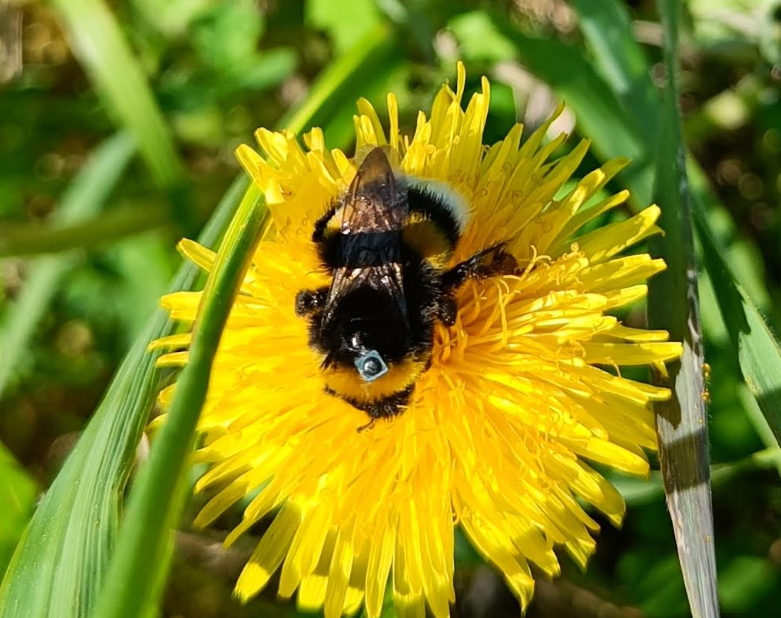
“For bumblebees, returning to the nest is no small matter, on the contrary, it is essential to the survival of the entire colony. If the workers cannot find their way back, the nest will not get any food,” says Senior Research Fellow Olli Loukola from the University of Turku.
Impact on navigation was clear, but exposure did not increase mortality
The researchers studied the behaviour of 167 buff-tailed bumblebees (Bombus terrestris). They were exposed to prallethrin for one, ten or twenty minutes with a repellent device meant for consumer use, after which the bumblebees were released a kilometre from their nest and their return was monitored for three days.
The results were clear. Of the bumblebees in the control group that were not exposed to prallethrin, 37% returned to the nest. The return percent of the bumblebees that were exposed to prallethrin for one minute did not differ from that of the control group. However, of the bees that were exposed for ten minutes, only 17% found their way back, and just 5% of the bumblebees that were exposed to the insecticide for twenty minutes returned to the nest.
For those individuals that managed to return, the time taken to do so was not prolonged. Furthermore, laboratory tests showed that exposure did not increase bumblebee mortality, suggesting that the effect is specifically related to impaired navigation ability rather than direct toxicity.
“Bumblebee colonies depend on workers collecting food, so if they cannot find their way back to the nest, the colony’s ability to obtain nutrition deteriorates. Over time, this can weaken the nest, reduce the number of new queens and, in the worst-case scenario, result in the death of the entire colony,” says Researcher Kimmo Kaakinen from the University of Turku.
Researchers recommend reassessing the ecological safety of mosquito repellents
In Finland, the use of Thermacell devices is permitted, but their use is restricted to the immediate vicinity of residential buildings, such as yards and patios. The devices must not be used indoors or in natural environments, such as forests or national parks.
“Prallethrin-based repellents are used in many countries primarily for convenience. In some situations, their use may be justified, for example, in the prevention of diseases spread by mosquitoes,” says Kaakinen.
According to the researchers, it is important to conduct a more detailed assessment of the effects of household insecticides on pollinators. They state that the study’s findings highlight the need to reassess the ecological safety of these products.
The research was conducted in collaboration between the University of Turku and the University of Oulu and the research article was published in the journal Biology Letters.
Read the research article: https://doi.org/10.1098/rsbl.2025.0749
16, Apr 2026
SIMBA Uproar 2026 Expands to Mumbai, Reinforcing Its Community-Led Culture Platform
Mumbai, April 16: SIMBA Uproar 2026 concluded its Mumbai edition on 11th April at the MMRDA Grounds, bringing together over 4000+ attendees for an immersive celebration of hip-hop, live performance and action sports.

Following a successful edition in Delhi, the platform expanded its scale in Mumbai with a strong focus on community-driven experiences and accessible live entertainment. This year introduced a single-tier, no-VIP format, creating a shared space where artists and audiences experienced the event together, without barriers.
The line-up featured performances by KR$NA, Sambata and Dhanji, alongside DJ sets by Ishani, Bobkat and OG SHEZ, delivering a dynamic mix of live music and high-energy soundscapes.
A major highlight of the event was the FMX stunt showcase, with professional riders performing choreographed aerial routines within a controlled environment that added a visually striking element to the festival. These segments were seamlessly woven into the overall experience, enhancing the scale and excitement of the event.
Beyond music, the festival featured interactive zones, cultural installations and experiential spaces, encouraging audience participation and creating a multi-dimensional environment.
Speaking on the Mumbai edition, Ishwaraj Singh Bhatia, said:
“Mumbai has been an important step in building Uproar as a culture-first platform. We’re constantly listening to our consumers and evolving the experience to make it more inclusive, accessible and rooted in the communities we engage with.”
The Mumbai edition also reflected key learnings from earlier showcases, with an increased focus on accessibility, audience flow and overall on-ground experience. With strong turnout and audience engagement, SIMBA Uproar 2026 continues to establish itself as a growing platform within India’s evolving youth and culture landscape.
The property is set to further expand its footprint with future editions and community-led experiences across cities.
16, Apr 2026
Odisha’s Manisha Padhi Becomes First Woman ADC to Governor, Makes History in Armed Forces
Bhubaneswar, Apr 16 (BNP): Squadron Leader Manisha Padhi from Odisha’s Ganjam district has made history by becoming the first woman officer in India to be appointed as Aide-de-Camp (ADC) to a state Governor, marking a significant milestone for gender representation in the Armed Forces.

Pic Credit: https://x.com/Defence_Squad_
Her appointment as ADC to the Governor of Mizoram reflects a breaking of long-standing barriers in military protocol roles, traditionally held by male officers, and highlights the growing inclusion of women in key leadership responsibilities within the defence services.
The historic moment gained further visibility when she participated in the swearing-in ceremony of Governor Dr Hari Babu Kambhampati at Raj Bhavan in Bhubaneswar on January 3, 2025, symbolising her active role in high-level constitutional and ceremonial duties.
Selected from a Ministry of Defence shortlist, she took charge of the ADC position in Aizawl on November 29, 2023, after being chosen over other eligible officers, underscoring her professional capability and merit-based selection.
Hailing from Berhampur in Ganjam district, Squadron Leader Padhi comes from a defence-oriented family. Her father, a retired Honorary Flying Officer, played an important role in inspiring her journey towards the armed forces.
She completed her engineering education at C.V. Raman College of Engineering in Bhubaneswar before joining the Indian Air Force after clearing the Air Force Common Admission Test (AFCAT). Commissioned in December 2015 under the 46 Short Service Commission (Women) Ground Duty Course, she specialised as an Air Traffic Controller (ATC), a role that demands precision, discipline, and quick decision-making.
Her journey from a small town in Odisha to a prestigious ceremonial and operational role in the Air Force stands as an example of growing opportunities for women in uniformed services and the evolving face of leadership in India’s armed forces.
16, Apr 2026
Chief Secretary Anu Garg Chairs Review Meeting on Odisha Governance Priorities
Bhubaneswar, Apr 16 (BNP): A high-level secretaries’ review meeting was held on Wednesday at Kharavel Bhavan, chaired by Chief Secretary Anu Garg, to assess departmental performance for March, review ongoing governance initiatives, and strengthen digital monitoring systems through the ‘Uplabdhi Portal’.

Pic Credit: https://x.com/_anugarg
The meeting was attended by Development Commissioner-cum-Additional Chief Secretary Deoranjan Kumar Singh, along with senior officials including Additional Chief Secretaries, Principal Secretaries, Commissioners, and departmental Secretaries. Koraput Collector Manoj Satyawan Mahajan joined virtually and presented a detailed update, while IAS probationers of the 2024 Odisha cadre batch participated as part of their administrative training exposure.
At the outset, the Chief Secretary reviewed key departmental achievements recorded in March and evaluated progress across sectors through performance-based indicators. She stressed the importance of real-time monitoring and data-driven governance using the ‘Uplabdhi Portal’ to improve accountability and efficiency in implementation.
She appreciated the Skill Development and Technical Education Department for Odisha’s strong performance in the India Skills 2025–26 competition and commended officials for the successful completion of the “Ganati-Manati” exercise related to the Ratna Bhandar of the Shree Jagannath Temple.
The meeting also reviewed the citizen outreach programme “Ame Janiba Ama Budget,” aimed at enhancing public awareness of budget provisions. It was decided to continue and further strengthen such initiatives. The Finance Department and Information & Public Relations Department were acknowledged for effectively taking budget-related information to the grassroots level.
Officials informed that participation on the i-GOT Karmayogi Bharat platform under the “Sadhana Saptaha” initiative has increased from 95 per cent to 98 per cent. The Chief Secretary appreciated the Gopabandhu Administrative Academy for its role in improving training participation across departments.
The Department of Odia Language, Literature and Culture was also praised for the successful statewide observance of “Odia Pakhya,” along with other departments that contributed to its smooth execution.
The meeting concluded with directions to further strengthen digital governance, improve inter-departmental coordination, and enhance performance tracking through the Uplabdhi Portal to ensure more efficient service delivery across the state administration.
16, Apr 2026
PNG Expansion Gains Momentum with 4.4 Lakh New Connections
New Delhi, Apr 16 (BNP): The Government of India has stepped up efforts to expand access to Piped Natural Gas (PNG) as part of a broader strategy to promote cleaner energy usage and reduce reliance on conventional fossil fuels, according to the Ministry of Petroleum and Natural Gas (MoPNG).
Under the ongoing expansion programme, around 4.40 lakh PNG connections have been commissioned since March 2026. In addition, nearly 4.88 lakh new consumers have registered for PNG connections, reflecting strong and growing adoption across regions.
The rapid scale-up is being supported by a structured policy framework aimed at improving execution efficiency and accelerating infrastructure rollout under the City Gas Distribution (CGD) network.
A key enabler of this progress is the Natural Gas and Petroleum Products Distribution Order, 2026, which introduces time-bound guidelines for infrastructure development and streamlines implementation across authorised geographical areas.
Officials noted that the initiative is part of India’s long-term clean energy transition strategy, aimed at improving household access to cleaner fuel alternatives while strengthening the country’s energy distribution network.
The continued expansion of PNG infrastructure is expected to play a crucial role in reducing dependence on more polluting fuels and supporting India’s broader environmental and energy security goals.


