


15, Sep 2026
Equilend Unveils New Brand Identity, Reflecting Its Role as the Connective Force in Securities Finance
NEW YORK, Sept. 15, 2026 /PRNewswire/ — Equilend, the platform connecting the global securities finance market, today announced a refreshed brand identity that reflects how far the company and the industry it serves have evolved.

At the center of this evolution is Equilend’s rollout of a connected platform across securities finance. Rather than separate tools and workflows, Equilend is bringing trading, workflow automation, data & insights, and digital solutions together through a common orchestration layer, providing clients seamless access to the capabilities they need across the trade lifecycle.
The new tagline, “Connecting Securities Finance,” reflects Equilend’s role in connecting the people, technology, data, and workflows that power the securities finance market. Building on that foundation, Equilend continues to invest in its core platform technology, including the release of Spire 3.0, with full front-to-back office capabilities, and the launch and go-live of 1Source, the DLT-based single source of truth. Recent acquisitions of Trading Apps and Finadium, along with a strategic investment in Digital Prime Technologies, reflect Equilend’s continued commitment to expanding its platform and creating lasting value for clients and the broader securities finance marketplace.
“For more than two decades, Equilend has been the trusted thread connecting the securities finance market. Over the last 18 months, we’ve been quietly building a more connected platform – bringing trading, workflow automation, data, and digital solutions together as one. Our new brand reflects that evolution and our continued commitment to connecting securities finance and moving the industry forward,” said Rich Grossi, CEO of Equilend.
The new identity is live today across Equilend’s website and channels. It will be showcased at Equilend’s EMEA Client Day on September 16th in London and North America Client Day on September 29th in New York.
About Equilend:
Equilend is a global financial technology firm offering Trading, Workflow Automation, Data & Insights, and Digital Solutions for the securities finance industry. With offices in North America, EMEA and Asia-Pacific, Equilend operates across various jurisdictions worldwide, adhering to the highest regulatory standards.
The company is committed to excellence and innovation and is consistently recognized for its contributions to the industry. Equilend is Great Place to Work Certified™ in the U.S., UK, Ireland, and India and has been awarded Trading System of the Year, Americas Data Provider of the Year, and Asian Data Provider of the Year in the Securities Finance Times Industry Excellence Awards 2026.
For more information, please visit www.equilend.com
Media Contact: media@equilend.com
 View original content to download multimedia:https://www.prnewswire.co.uk/news-releases/equilend-unveils-new-brand-identity-reflecting-its-role-as-the-connective-force-in-securities-finance-302878264.html

- 0
- By Sai Krishna

15, Sep 2026
Circana Enhances Unify+ with AI-Powered Analysis Builder for Faster, More Intuitive Reporting
Redesigned authoring experience in the Unify+ solution generates presentation-ready charts and written insight summaries, with export to PowerPoint, Excel and PDF
CHICAGO, Sept. 15, 2026 /PRNewswire/ — Circana, LLC, a leader in turning consumer data into growth, today announced Analysis Builder, a new AI-powered enhancement to the Unify+™ solution. Analysis Builder gives Unify+ users a faster and more intuitive way to create, customize and share market analyses, removing much of the manual work between a data pull and a finished report.
“AI is transforming how businesses turn data into action, and Circana is focused on making that transformation practical, scalable, and valuable for our clients,” said Stuart Aitken, president and chief executive officer for Circana. “With Analysis Builder, we’re making it easier for users to uncover insights faster, make more confident decisions, and unlock growth in an increasingly complex marketplace.”
Analysis Builder in Unify+ puts the power of AI directly into the hands of every client. It streamlines how users create, customize, and share analyses, helping to reduce time spent building reports and increasing time spent acting on what the data reveals.
New AI-Powered Capabilities
The enhancement introduces AI-powered capabilities designed to accelerate analysis and decision-making:
- Visualization Gallery: Generates pixel-perfect, presentation-ready visuals with the click of a button, available online or for export to PowerPoint, Excel, or PDF.
- AI Insights: Uses an insights agent with AI-powered capabilities to unlock data-driven headlines and insight summaries in seconds, along with query functionality that allows every user to customize the AI analysis to their individual report needs.
“Analysis Builder reflects our continued focus on making insights easier to access, understand, and act on,” said Robert Bird, executive vice president and general manager of Liquid AI for Circana. “By combining a more intuitive Unify+ experience with advanced AI capabilities, we are helping clients spend less time building reports and more time applying insights to the decisions that drive growth.”
Analysis Builder will be available globally to clients in early Q4 2026.
About Circana
Circana is a leader in providing technology, AI and data to fast-moving consumer packaged goods companies, durables manufacturers, and retailers seeking to optimize their businesses. Circana’s predictive analytics and technology empower clients to measure their market share, understand the underlying consumer behavior driving it, and accelerate their growth. Circana’s Liquid Data® technology platform is powered by an expansive, high-quality data set and intelligent algorithms trained on six decades of domain expertise. With Circana, clients can take immediate action to future-proof and evolve their growth strategies amid an increasingly complex, fast-paced, and ever-changing economy. Learn more at circana.com.
Circana Media Contact
Shelley Hughes
Email: shelley.hughes@circana.com
312-731-1782
 View original content to download multimedia:https://www.prnewswire.co.uk/news-releases/circana-enhances-unify-with-ai-powered-analysis-builder-for-faster-more-intuitive-reporting-302877978.html

15, Sep 2026
Treon IQ: The New Industrial AI That Automates Operational Understanding and Recommends Actions
DALLAS, Sept. 15, 2026 /PRNewswire/ — Treon Inc. today announced Treon IQ, a next-generation industrial AI capability that brings situational understanding to the company’s market-leading Treon Connect Prescriptive Maintenance cloud platform. Instead of spending valuable time investigating dashboards, correlating data, and determining next steps, maintenance organizations can rely on Treon IQ to continuously analyze operational conditions, diagnose issues, identify optimization opportunities, and recommend actions. By transforming asset intelligence into continuous operational understanding and guided execution, Treon IQ helps teams resolve issues faster, improve consistency, and operate with expert-level insight across sites, fleets, and facilities.
Bringing Industrial Understanding to the Next Level
Industrial maintenance workflows remain heavily dependent on human-led analysis and decision-making. While asset monitoring and fault detection have become largely automated, understanding what is happening and what should be done next still relies on human expertise. The result is often slow, costly, inconsistent, and difficult to scale.
Building AI systems capable of performing these tasks autonomously is equally challenging. Developing in-house diagnostic and recommendation models requires vast amounts of data, training, and computing resources. Horizontal AI layers depend on third-party sensor data, limiting their reasoning capabilities, while general-purpose large language models (LLMs) often lack the industrial context required for reliable operational decisions.
Introducing Treon IQ
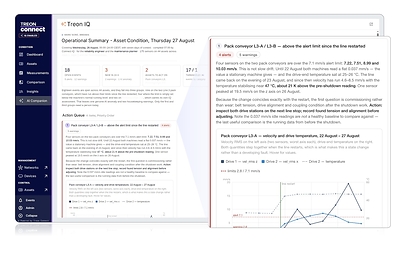
Treon IQ extends the Treon Connect platform with an AI engine that automatically transforms asset data into continuous situational understanding.
The solution analyzes data from real-time and historical asset intelligence and other sources such as CMMS and ERP systems. It detects and diagnoses issues, uncovers optimization opportunities, explains root causes, and generates actionable recommendations for fast and consistent resolution.
Treon IQ combines the company’s proprietary anomaly detection technology, next-generation deep-learning diagnostic models, and carefully selected LLMs into a unified framework. High-precision wireless sensors within the vertically integrated Treon Connect platform provide deep visibility into asset behavior, creating a stronger foundation for accurate diagnostics and recommendations than horizontal AI approaches that lack in-depth asset intelligence.
Instead of relying on alerts, vibration data, and condition-monitoring dashboards, Treon IQ introduces an AI-powered companion that provides maintenance managers with a continuously updated operational briefing summarizing site status, active issues, optimization opportunities, and prioritized actions, eliminating the need to spend valuable time investigating data and dashboards.
From Asset Intelligence to Operational Understanding
As a result, Treon IQ delivers accurate, reliable, and scalable operational understanding while maintaining optimized computing resources and predictable costs. By automating analysis, diagnosis, and recommendations, companies can improve consistency, accelerate resolution, and provide maintenance teams with expert-level guidance every day.
“Industrial AI should do more than detect anomalies. It should help maintenance teams understand what’s happening and confidently decide what to do next,” said Joni Korppi, CEO of Treon. “With Treon IQ, maintenance managers no longer need to start their day chasing alerts and investigating dashboards. Instead, they can begin each day with a complete understanding of their operational situation, key priorities, and the plan for the day, delivered automatically through an AI-powered companion in Treon Connect.”
Availability of Treon IQ
An early-access version of Treon IQ is now available for Treon Make and Treon Flow customers, including tailored AI-powered companion functionalities for maintenance managers. Additional features will be introduced as new capabilities become available.
Treon IQ Demonstrated at IMTS 2026
Treon is introducing and demonstrating Treon IQ for the first time at IMTS 2026, taking place September 14-19, 2026, at McCormick Place in Chicago, showcasing how an AI-powered companion transforms a maintenance manager’s work from investigating dashboards to understanding operational situations and confidently deciding what to do next.
About Treon
Treon is a global leader in AI-driven Smart Industry solutions, helping businesses improve productivity, operational visibility, and long-term sustainability. Its fully integrated predictive maintenance solutions combine advanced AI analytics, a mobile-first user experience, automated workflows, and wireless vibration monitoring delivered as a managed service with scalable subscription pricing. Treon operates in Finland, France, and United States, serving more than 200 customers worldwide across manufacturing, material handling, and logistics hubs. Learn more at Treon.
 View original content to download multimedia:https://www.prnewswire.co.uk/news-releases/treon-iq-the-new-industrial-ai-that-automates-operational-understanding-and-recommends-actions-302878972.html

15, Sep 2026
Chandigarh University Aerospace Students to Develop Unmanned Aerial Vehicles (UAVs) for Border Surveillance in Collaboration with Industry
Chandigarh University Felicitates Noted Engineer RK Jain with Bharat Nirman Samman Award on Engineers Day
CHANDIGARH, India, Sept. 15, 2026 /PRNewswire/ — Chandigarh University celebrated Engineers’ Day with the launch of ‘Build Summit 2026’, the maiden edition of the first-of-its-kind technological summit themed ‘Innovating for Bharat’, bringing together student innovators and eminent experts from energy, mobility, semiconductors, cybersecurity, agritech, and infrastructure domains.
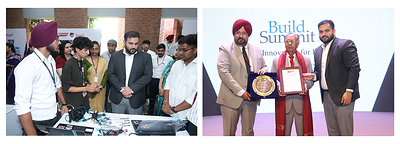
This Summit provided a dynamic platform to engineering students to showcase their creativity, technical expertise and teamwork through range of hands-on challenges and demonstrations, including Technology Exhibition, Hackathon, RC Off-Road Robo Race, Aerial Ops–Drone Challenge, to celebrate the spirit of engineering excellence, innovation and problem solving.
The dignitaries who graced the launch of Build Summit 2026 included Dr Arun Kumar Nayak, former Head of the Nuclear Controls and Planning Wing, Department of Atomic Energy (DAE), Jai Inder Singh Sandhu, Managing Director, Chandigarh University, Gursharan Singh – Senior Vice President, Backend Operations – Micron Technology, Swapnil Jain – Co-Founder, Ather Energy, CB Ojha, Chief Engineer, Engineering Department (PWD), UT Chandigarh, Pramod Kumbhar, CTO and President – PRAJ Matrix R&D Centre, Nagendra Pansare, Senior GM – Product Development, Mahindra Farm Machinery Division, Mohali, Teja Chintalapati, Principal Manager – Cyber Innovation, Data Security Council of India, Subhash Kalidindi, Director, Nanofabrication, Srsti Quantum and Yogita Potaliya: AVP – Contracts, Cube Highways and Transportation Assets Advisors (P) Ltd.
On the occasion, noted Engineer Er, RK Jain, former Chief Engineer, PWD Haryana, was felicitated with Bharat Nirman Samman Award on Engineer’s Day.
As a part of the Build Summit, byteBuilt 1.0 — a dynamic 24-hour innovation hackathon organized by Chandigarh University in collaboration with ‘byteXL’ to ignite the spark of creativity and innovation among Computer Science Engineering students, was attended by 41 teams of 135 students representing 16 universities across India including Chandigarh University, Mohali, Jaypee University of Information Technology, SRM University, KIET Ghaziabad, Lovely Professional University, GD Goenka University, Gurugram, Chandigarh University, Uttar Pradesh, Panjab University, Mahatma Jyotiba Phule Rohilkhand University, Bareilly, Narasaraopeta Engineering College (Andhra Pradesh), St Mary’s Group of Institutions Guntur for Women (SMGG), Andhra Pradesh, Mahendra Engineering College (Tamil Nadu), ITM (SLS) Baroda University (Gujarat), Shobhit Institute of Engineering and Technology, Meerut, Chitkara University and Universal SkillTech University, Maharashtra.
The first prize in byteBuilt 1.0 was secured by Chandigarh University’s team MediSphere. MediSphere is an integrated Al-powered healthcare platform designed specifically for educational campuses. It connects students, doctors, pharmacies, parents, and emergency services on one secure platform. The solution enables instant symptom assessment, emergency SOS support, smart medical records, doctor connectivity, and medicine delivery for faster and more connected healthcare. The second prize was bagged by Dabang Coders of Panjab University while the third prize was also secured by Chandigarh University’s team CodeBliss.
In Aerial Ops –Drone Challenge, the first prize was won by Harry Tanwar, second by Arush Singh and third by Navjosh Singh and Anurag. These three winners will now work on developing UAVs for border Surveillance in collaboration with Johnnette Technologies Private Limited.
In RC Off-Road Robo Race, the first, second and third prizes were won Techab, Viksit Velocity and Baba Group respectively. These winners will work on developing autonomous vehicles in collaboration with the industry.
A highlight of Build Summit was the technology exhibition named ‘Innovision’ in which over 50 innovative projects of Chandigarh University students, related to AI and Intelligent Systems, Drones, Aerospace, Robotics, Sustainable Mobility, Healthcare, MedTech, Agri-Tech, Cybersecurity, Blockchain, Infrastructure, Advanced Materials and/ Nanotechnology were displayed. AeroClairr displayed Made-in-Bharat autonomous drone platform, HydroDrive displayed and HydroHybrid displayed Solar-Charged Hydrogen Hybrid Vehicle, HydroGelRx displayed Hydrogel-Based Controlled Drug Delivery System, StrataCC displayed 5G Edge AI for Intelligent Network Traffic Management, RegenABS displayed Regenerative Braking & Anti-Lock Braking for Electric Vehicles.
In his keynote address, Dr Arun Kumar Nayak, former Head of the Nuclear Controls and Planning Wing, Department of Atomic Energy (DAE) said, “For the first time in the country’s history, our Prime Minister Narendra Modi has given us a very big dream of transforming India into Viksit Bharat by 2047. We dream of taking India to a $35 trillion economy but If we do not innovate, India cannot make this transformational jump. Engineers and scientists are the ones who can develop new technologies, create solutions and transform the country. We need such ecosystem that can drive India’s transformation. A nuclear-powered Viksit Bharat can start from a university like Chandigarh University. I propose that Chandigarh University take the lead in establishing a Centre for Nuclear Studies to groom young engineers to build and operate nuclear power plants, develop critical technologies and contribute to India’s energy mission and export potential.”
Gursharan Singh, Senior Vice President, Backend Operations, Micron Technology said, “We are living through one of the most exciting periods in engineering history, with artificial intelligence, advanced manufacturing, automation and digital technologies transforming the world. Yet, technology is ultimately about people. As engineers, we must ensure that the technologies we create solve meaningful problems, improve lives and contribute positively to society,”.
Jai Inder Singh Sandhu, Managing Director, Chandigarh University said, “The Build Summit symbolises the importance of building solutions with the tools and resources at hand to address real-life challenges. For a Viksit Bharat, we have the vision and competent leadership; what we need is infrastructure and the energy, ideas and innovation of our youth. I hope this galaxy of experts inspires students to look beyond engineering as a discipline and focus on building things, solving real-world problems and creating innovations that can contribute to taking the university and the Build Summit initiative to the next level.”
Swapnil Jain Co-Founder, Ather Energy said, “In the last decade, we have seen a major transformation in India—from being a country of assemblers to a country of builders. The golden opportunity for young engineers is to build, take risks and create value. Strong industry-academia collaboration can help bridge the gap between real-world problems and innovative solutions. I am glad to see Chandigarh University taking this step towards creating a nation of builders.”
CB Ojha, Chief Engineer, Engineering Department (PWD), UT Chandigarh said, “As Artificial Intelligence, robotics, automation, renewable energy and digital technologies transform the way we live and work, engineers must ask not only can we build it, but also should we build it, how should we build it and for whom. The future of engineering must therefore be guided by sustainability, inclusivity, resilience and public service,”.
About Chandigarh University
Chandigarh University is a NAAC A+ Grade University and QS World Ranked University. This autonomous educational institution is approved by UGC and is located near Chandigarh in the state of Punjab. It is the youngest university in India and the only private university in Punjab to be honoured with A+ Grade by NAAC (National Assessment and Accreditation Council). CU offers more than 109 UG and PG programs in the field of engineering, management, pharmacy, law, architecture, journalism, animation, hotel management, commerce, and others. It has been awarded as The University with Best Placements by WCRC.
Website address: https://www.cuchd.in/
 View original content to download multimedia:https://www.prnewswire.com/in/news-releases/chandigarh-university-aerospace-students-to-develop-unmanned-aerial-vehicles-uavs-for-border-surveillance-in-collaboration-with-industry-302879010.html

15, Sep 2026
Perk Brings Its Spend Platform to U.S.: NYSE Content Update
NYSE issues a pre-market daily advisory direct from the trading floor.
NEW YORK, Sept. 15, 2026 /PRNewswire/ — The New York Stock Exchange (NYSE) provides a daily pre-market update directly from the NYSE Trading Floor. Access today’s NYSE Pre-market update for market insights before trading begins.
Ashley Mastronardi delivers the pre-market update on September 15th
- Perk is looking to accelerate its growth in the U.S.
- Announcement comes after the launch of Perk Spend in Europe, where up to 40% of new deals are for the combined Travel and Spend offering.
- Perk’s research found that one in four U.S. companies still have no formal look for managing spend.
- Nikita Miller, Perk’s Chief Product Officer, will join NYSE Live to discuss how the solution is bringing control and flexibility to finance leaders.
- ServiceNow President Amit Zavery will join NYSE Live.
- The company says that its AI Control Tower, Context Engine, and Shift Zero solutions solve the biggest questions customers have.
- ServiceNow (NYSE: NOW) is looking to guide enterprises through the new tech ecosystem, where AI agents are moving from answering questions to taking action.
- The U.S. 10-Year Treasury yield surpasses 5% and hits highest level since 2007.
- The move comes as the Federal Reserve commences its two-day meeting, with a decision on interest rates due Wednesday.
- As of 8 a.m. ET, ICE Brent Crude is trading at $106 a barrel amid the ongoing conflict in the Middle East.
Opening Bell
Ingram Micro (NYSE: INGM) marks their 2026 Capital Markets Day
Closing Bell
Jackson Financial (NYSE: JXN) celebrates five years of being listed on the NYSE
For market insights, IPO activity, and today’s opening bell, download the NYSE TV App and check out the NYSE YouTube: TV.NYSE.com and YouTube.com/@NYSEofficial


 View original content to download multimedia:https://www.prnewswire.co.uk/news-releases/perk-brings-its-spend-platform-to-us-nyse-content-update-302879075.html

15, Sep 2026
IIFL Finance Becomes First Non-PSU NBFC to Execute ₹25 Crores Tokenised Bond Transaction
- Landmark transaction executed on Metropolitan Stock Exchange of India under SEBI’s Regulatory Sandbox framework, with Trust Investment Advisors Private Limited as Sole Arranger and Advisor
MUMBAI, India, Sept. 15, 2026 /PRNewswire/ — IIFL Finance Limited (“IIFL Finance” or “the Company”) today announced the successful completion of a ₹25 crores tokenised bond transaction, becoming the first Non-PSU Non-Banking Financial Company (NBFC) in India to undertake a transaction of this nature. The transaction was executed on the Metropolitan Stock Exchange of India (MSEI), which provided the bidding platform for the deal, with Trust Investment Advisors Private Limited acting as the Sole Arranger and Advisor. The bonds will be listed on the National Stock Exchange of India (NSE).
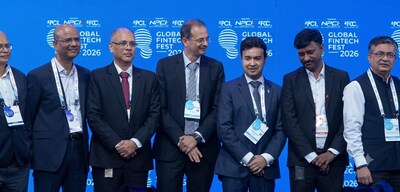
The transaction was undertaken under the Securities and Exchange Board of India’s (SEBI) Regulatory Sandbox framework for tokenisation of securities, marking a significant milestone in the evolution of India’s digital debt capital markets.
Tokenisation enables securities to be represented digitally using blockchain and distributed ledger technology (DLT), offering the potential for greater efficiency, transparency, and speed across debt market processes. By successfully executing this transaction, IIFL Finance has demonstrated the growing adoption of technology within India’s corporate bond market and reinforced its position among NBFCs adopting innovative, technology-led solutions in debt capital markets.
The transaction represents another step towards building a more technology-enabled and innovative debt capital market ecosystem in India, aligning with the broader industry shift towards digitisation of financial market infrastructure.
IIFL Finance’s transaction comes amid growing regulatory and policy momentum around securities tokenisation in India. At the Global Fintech Fest (GFF) 2026 in Mumbai, Reserve Bank of India (RBI) Governor Mr Sanjay Malhotra and Securities and Exchange Board of India (SEBI) Chairman Mr Tuhin Kanta Pandey jointly launched a national tokenised corporate bond pilot combining blockchain/distributed ledger technology with the RBI’s central bank digital currency (CBDC) for securities settlement.
SEBI Chairman Mr Tuhin Kanta Pandey, discussing the regulator’s broader tokenisation push, has said SEBI initiated a pilot to explore distributed ledger technology (DLT) for corporate bond tokenisation, noting the shift “could create greater possibility of more liquidity and instantaneous settlement” in the bond market.
Mr Govind Modani, Chief Treasury Officer at IIFL Finance said, “As the first Non-PSU NBFC to participate in India’s emerging tokenised bond ecosystem, we are embracing new-age technology to make capital-market transactions more efficient, transparent and future-ready. The tokenized bond initiative gives us an opportunity to participate in building the financial infrastructure of tomorrow, while gaining valuable experience in blockchain-enabled issuance and settlement.”
About IIFL Finance Limited
IIFL Finance is one of India’s leading financial services companies, offering a comprehensive suite of products, including gold loans, business loans, home loans, microfinance, and other secured lending solutions. With a strong presence across urban and rural India, IIFL is committed to empowering individuals and businesses through accessible and affordable credit solutions.
Photo: https://mma.prnewswire.com/media/3009001/R_Venkataraman.jpg
 View original content:https://www.prnewswire.com/in/news-releases/iifl-finance-becomes-first-non-psu-nbfc-to-execute-25-crores-tokenised-bond-transaction-302878956.html

15, Sep 2026
Bank of India unveils 12 digital banking initiatives at Global FinTech Fest 2026
New offerings span Omni Neo mobile banking, premium cards, digital currency, self-service banking and FinTech collaboration
MUMBAI, India, Sept. 15, 2026 /PRNewswire/ — Bank of India showcased its growing digital capabilities at the Global FinTech Fest (GFF) 2026, held from September 9–11, 2026, unveiling 12 initiatives spanning payments, cards, digital currency, self-service banking, compliance, customer engagement and fintech collaboration.
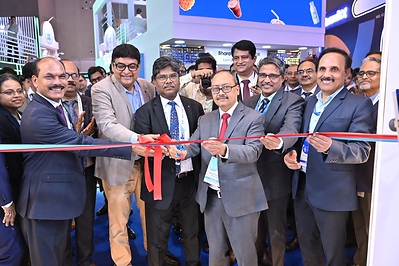
The Bank’s booth was inaugurated by Shri Rajneesh Karnatak, Managing Director & CEO, Bank of India and senior executives from Bank & representatives from the Bank’s technology and fintech partners.
The initiatives reflect Bank of India’s focus on making banking more convenient, secure, inclusive and accessible while strengthening its capabilities in emerging areas such as artificial intelligence, programmable digital currency and data-led customer engagement.
Speaking on the occasion, Shri Rajneesh Karnatak, Managing Director & CEO, Bank of India, said, “India’s financial-services ecosystem is entering a new phase in which innovation must deliver meaningful improvements in accessibility, security and customer experience. The initiatives presented by Bank of India at GFF 2026 reflect our commitment to combining the reach and trust of a public-sector bank with emerging technologies and strong ecosystem partnerships. As we advance our digital transformation, our focus will remain on developing solutions that are inclusive, scalable and relevant to the evolving needs of our customers.”
Mobile based digital payments
The Bank presented four initiatives developed around India’s rapidly evolving digital-payments infrastructure.
UPI Help 2.0 provides customers with a single authenticated interface to view their UPI transaction history, raise and track complaints, and manage mandates linked to their Bank of India accounts, irrespective of the UPI application through which the mandates were created. BOI has integrated this feature in Omni Neo Mobile App and now BOI customers can view and manage mandates created on BOI account on the Omni App. Another important feature in UPI help is transaction replay facility. This allows user to re-initiate an earlier UPI transaction, performed on any UPI app, from Omni Neo app where BOI account is linked.
Bank also launched UPI Tap & Pay on PoS for BOI customers. This facility enables customers to make contactless UPI payments by tapping an NFC-enabled smartphone on a supported point-of-sale terminal. BOI customers can enable Tap & Pay feature on their Omni Neo mobile app and make it as default app for Tap & Pay transaction. When they make any purchase below Rs. 5000/- then merchant will initiate a UPI collect request and customer has to simply tap the phone on PoS machine and transaction will be successful.
Another key launch for mobile banking was the Unified Ticketing Platform, developed by NPCI Bharat BillPay Limited, is designed to enable interoperable QR-based ticketing across metro, bus and other public-transport systems. Through the integration, Bank of India customers will be able to book tickets for local transport and tourist destinations through the Bank’s Omni Neo mobile application as participating transit and tourism operators join the platform.
Bank of India launched IMPS bulk payment in collaboration with NPCI in GFF 2026. This facility allows customers to send payment request in bulk and the system shall process the transactions and share response file with customers in one go. This shall be very helpful to their corporate customers through internet Banking. This facility is developed on bank’s Centralised Digital Payment Switch (CDPS).
Programmable CBDC for purpose-bound transactions
Under its digital-currency portfolio, Bank of India formally launched user-level Programmable Central Bank Digital Currency functionality. The solution enables digital tokens to be issued with embedded usage conditions such as merchant-category restrictions, geographical limits, expiry periods and specified acceptance criteria.
The system supports secure token issuance, transfers and merchant payments, with real-time checks to ensure that transactions comply with the configured conditions. Potential applications include targeted subsidies, relief payments, purpose-bound benefits and other Direct Benefit Transfer programme.
Programmability can help ensure that funds are used for their intended purpose while improving transparency, auditability and operational efficiency.
Leading Bank of India’s card product portfolio at GFF 2026 was the Terra Mastercard World Credit Card, a contactless international credit card designed for customers seeking premium travel, lifestyle and global-payment benefits. The card can be used across ATMs, point-of-sale terminals and e-commerce platforms.
Terra offers benefits across travel, entertainment, dining, mobility, wellness and digital subscriptions. These include domestic and international airport lounge access, accelerated reward points on eligible transactions and preferred categories, and offers from PVR INOX, Swiggy, Uber, Netmeds, Paytm Flights, Yatra, JioSaavn, Tata CLiQ Fashion and Tattva Spa, subject to applicable terms and conditions. The card is being offered with no issuance fee and an annual membership fee of ₹990 for the principal card and ₹750 for an add-on card.
Alongside the Terra Credit Card, Bank also launched, Unified AgentNxt Partner Integration, which provides a common framework through which the Bank can engage and manage multiple approved technology service providers. By standardising partner onboarding, operations, reporting and governance, the platform is expected to simplify ecosystem management and enable the Bank to scale customer acquisition, assisted banking, merchant services, financial inclusion, payments and collection initiatives more efficiently.
Next-generation self-service banking
In association with Hitachi, Bank of India showcased a proof of concept for an Android-based Cash Recycler Machine that brings multiple self-service banking facilities onto a single software-driven platform.
Along with conventional ATM and cash-recycler services, the machine supports UPI-based interoperable cardless cash withdrawals, Green PIN generation and real-time debit-card issuance. Customers can initiate the card application and authentication process at the machine and receive a personalised physical debit card instantly.
The proof of concept will enable the Bank to evaluate customer experience, technology integration, operational requirements and the potential future deployment of next-generation self-service banking infrastructure.
Fintech, compliance and customer-engagement platforms
Bank of India also presented technology-led platforms designed to improve compliance, customer engagement, product discovery and fintech collaboration.
ALPHA PLUS is a technology-enabled compliance platform designed to automate compliance functions such as Regulatory Inspection Management, Regulatory Correspondence Tracking, Compliance Advisory, Circular Repository Management, Deviation Reporting, Penalties Tracking, etc.
BOI launched FinTech Connect Portal which provides a direct channel through which fintech companies can register their capabilities and submit proposals to the Bank. Applications can be made without a fee and will be evaluated on merit, with each submission receiving a reference ID and identified internal owner. The portal is intended to create a central repository of fintech capabilities and make engagement with prospective partners more transparent and structured.
The Bank also showcased Markytics, an in-branch cross-selling and visitor-engagement platform. At GFF, the platform enabled proximity-based visit tracking, relevant product discovery, lead generation, session bookings, visitor reminders, feedback collection and rewards management. Its dashboard provides Bank teams with insights into visitor activity, product interest, dwell time and conversion trends.
The platform can support the cross-selling of retail, commercial, digital-banking and fintech offerings by identifying customer interest and creating contextualised leads for relationship managers.
Bank of India additionally presented E-Kosha 2.0, a Tone Tag-enabled conversational banking proposition that allows customers to engage with the Bank through voice. Designed to make digital banking simpler and more inclusive, E-Kosha can provide guided access to banking information and services without requiring customers to navigate complex screens.
The platform has the potential to be deployed at branches, Business Correspondent locations and other high-footfall touchpoints. It can progressively be expanded to cover account services, payments, transfers, loans, insurance, investments, customer service and product discovery.
Together, these initiatives demonstrate the Bank’s approach of combining internal capabilities with ecosystem partnerships to translate emerging technologies into practical banking applications.
Bank of India leadership contributes to key industry discussions
Bank of India’s senior leadership participated in discussions examining the future of AI, credit, compliance, cybersecurity, operational resilience and international fintech collaboration.
Shri Rajneesh Karnatak, Managing Director & CEO, participated in the session titled “End-to-End AI in Credit,” sharing perspectives on the application of artificial intelligence across the credit lifecycle.
- Shri P. R. Rajagopal, Executive Director, participated in the discussion on “AI-powered Early Warning Systems: Protecting Portfolios and Driving Growth,”;
- Shri Subrat Kumar, Executive Director, joined a discussion on “Hyperpersonalisation in Banking at Scale.”;
- Shri Pramod Kumar Dwivedi, Executive Director – “Co-Designing Responsible AI: BFSI, Regulators and the Future of Financial Innovation”;
- Shri Satyendra Singh, CGM & CIO – “Autonomous Banking: From Ambition to Accountability”;
- Shri Ashok Pathak, CGM – “India–UK FinTech Growth Corridor”;
- Shri Ashutosh Mishra, GM & CTO – “From Access to Ownership: Where Financial Institutions Build Their AI Edge” and “The Always-On Core: Solving for Resilience, Residency, Sovereignty & Multi-Cloud in the Agentic Era”;
- Shri S. Gowri Shankar Rao, CFTO – “Trust. Connect. Convert: The ROI-Driven Customer Journey”; and
- Shri Kuldeep Pal, CISO – “The SOC Capacity Crisis: Can AI Solve Cybersecurity’s Growing Gap Between Threats and Talent?”
Over the three-day event, the Bank’s booth welcomed various dignitaries from government bodies and regulators and hosted live demonstrations for customers, fintech companies, technology partners and other stakeholders.
Bank of India’s participation at GFF 2026 reinforced its commitment to building a future-ready, inclusive and secure banking ecosystem and delivering on its promise of Relationship Beyond Banking.
 View original content to download multimedia:https://www.prnewswire.com/in/news-releases/bank-of-india-unveils-12-digital-banking-initiatives-at-global-fintech-fest-2026-302878906.html

15, Sep 2026
XGRIDS Unveils Lixel L3 at INTERGEO 2026, Setting a New Benchmark for Spatial Capture with Validated 5 mm Accuracy
MUNICH, Sept. 15, 2026 /PRNewswire/ — XGRIDS, the spatial intelligence company, today introduced Lixel L3, its flagship high-accuracy spatial scanner with validated 5 mm relative accuracy, demonstrated against measured ground truth in a documented test.
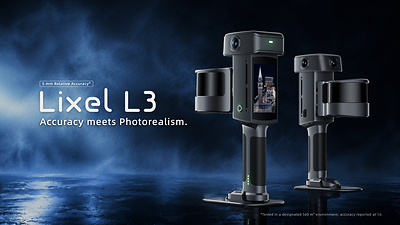
The L3 fuses a high-accuracy LiDAR, a true-color vision system, an integrated RTK, and a built-in display into one system, uniting geometry, color, positioning, and delivery in a single capture workflow. Captured data can be processed locally and turned into 3D outputs for downstream applications, with L3 typically covering around 100 square meters in 10 minutes for high-accuracy data and photorealistic 3D models, making it well suited to large, complex sites.
Verified 5 mm Accuracy
Lixel L3 achieves 5 mm relative accuracy and approximately 2.5 cm real-time absolute accuracy. Its integrated SLAM system maintains stability throughout the scan, while real-time vision-aided localization and leveling optimization help control accumulated drift during longer scanning sessions.
“5 mm relative accuracy only matters if it holds up in the field and the data can go straight into BIM,” said Sunny Liao, Director of International Sales and Marketing at XGRIDS. “Customers can capture, process and export locally and the data is ready for the workflow.”
Photorealistic Spatial Capture
L3 combines high-accuracy spatial sensing with a 1/1.3-inch CMOS 4K HDR imaging system, capturing color and surface detail alongside precise geometry. From a single scan, L3 produces true-color point cloud, detailed mesh and photorealistic 3DGS models. As 3DGS transitions into mainstream production—highlighted by Autodesk introducing support for 3DGS in 3ds Max and Trimble integrating it into SketchUp—XGRIDS’ proprietary LCC2 format is among the early 3DGS formats supported by established software platforms, bringing photorealistic physical assets directly into AEC, film and entertainment, and virtual production workflows.
Built for Field Crews
Designed for fieldwork, L3 features a 4.3-inch display for scan status, trajectory and coverage. Map fusion aligns multiple scans without preset control points, while privacy protection can blur faces and license plates.
XGRIDS Lixel L3 brings next-level accuracy and photorealism together, elevating the standard for how physical environments are captured, reconstructed, and put to work. As 3DGS moves into mainstream production and spatial data becomes a foundational layer for digital experiences, XGRIDS is building the infrastructure that connects physical reality with the digital world.
 View original content to download multimedia:https://www.prnewswire.co.uk/news-releases/xgrids-unveils-lixel-l3-at-intergeo-2026-setting-a-new-benchmark-for-spatial-capture-with-validated-5-mm-accuracy-302878820.html

15, Sep 2026
KuCoin Wealth Broadens Access to Professionally Managed Strategies with New RWA and Crypto Multi-Strategy Products
PROVIDENCIALES, Turks and Caicos Islands, Sept. 15, 2026 /PRNewswire/ — KuCoin, a leading global crypto platform built on trust, today announced two new professionally managed products under KuCoin Wealth. All-Weather Multi-asset strategy – Principal Protected, KuCoin Wealth’s first RWA-focused product with exposure to traditional asset classes, provides access to a diversified range of strategies with an emphasis on capital preservation. Crypto Assets Multi-strategy focuses on digital assets, combining multiple investment approaches designed to pursue returns across changing market conditions.

Professional investment strategies have traditionally involved limited availability, high minimum commitments and complex onboarding requirements. Through KuCoin Wealth, the new offerings make these strategies accessible to a broader base of eligible users, with minimum subscription amounts starting at 100 USDT. The launch advances KuCoin Wealth’s efforts to narrow the access gap between professionally managed investment strategies and digital asset investors.
The two products offer distinct approaches:
- All-Weather Multi-asset strategy – Principal Protected applies an all-weather allocation framework across equity long-short, quantitative and commodity trading adviser strategies, among others. The product follows a conservative approach focused on capital preservation, while dynamically adjusting its allocation to pursue returns across different market environments. The manager of the underlying strategy has historically managed more than US$1 billion in assets across its strategies.
- Crypto Assets Multi-strategy combines fundamental investment, quantitative trading, trend, arbitrage and event-driven strategies across digital assets. By diversifying across asset categories and return sources, the product aims to reduce reliance on a single strategy or market direction.
Together, the products provide users with access to diversified return drivers designed to reduce dependence on broader crypto market movements and pursue more resilient, risk-adjusted portfolio outcomes across market cycles.
KuCoin Wealth currently offers fixed-term investments and quantitative strategies for high-net-worth and professional users. With these additions, KuCoin Wealth expands into RWA-focused multi-asset allocation and professionally managed crypto strategies, further narrowing the access gap between exchange-based wealth products and traditional investment markets. Learn more.
About KuCoin
Founded in 2017, KuCoin is a leading global crypto platform built on trust and security, serving over 45 million users across 200+ countries and regions. Known for its reliability and user-first approach, the platform combines advanced technology, deep liquidity, and strong security safeguards to deliver a seamless trading experience. KuCoin provides access to 1,500+ digital assets through a broad product suite and remains committed to building transparent, compliant, and user-centric digital asset infrastructure for the future of finance, backed by SOC 2 Type II, ISO/IEC 27001:2022, ISO/IEC 27701:2019, ISO 22301:2019 and ISO/IEC 42001:2023 certifications. In recent years, we have built a strong global compliance foundation, marked by key milestones including AUSTRAC registration in Australia, a MiCA license in Europe, and regulatory progress in other markets.
Learn more at www.kucoin.com.
Disclaimer
The information is for corporate PR purposes only and does not constitute endorsement or investment advice.

 View original content to download multimedia:https://www.prnewswire.co.uk/news-releases/kucoin-wealth-broadens-access-to-professionally-managed-strategies-with-new-rwa-and-crypto-multi-strategy-products-302877493.html

15, Sep 2026
Philips OneBlade and Red Bull take self-expression to new heights in Cappadocia, Turkey
In a breathtaking display, Red Bull athlete Marco Waltenspiel and his distinctive moustache achieved a world’s first in wingsuit hot-air balloon slalom, soaring between seven hot-air balloons at 200 km/h, to celebrate the freedom to be yourself and follow your passions.
AMSTERDAM, Sept. 15, 2026 /PRNewswire/ — Royal Philips (NYSE: PHG) (AEX: PHIA), a global leader in health technology, has teamed up with Red Bull and athlete Marco Waltenspiel to complete an extraordinary wingsuit slalom against Cappadocia’s famous balloon-filled skyline. It marks a new Philips OneBlade and Red Bull project, celebrating individuality, self-acceptance and doing things your own way.
Marco Waltenspiel is known for pushing the limits of wingsuit flying and doing so with his distinctive moustache and unmistakable look. Bringing his unique style to the aerial obstacle course, he jumped from 2,800 meters and turned the sky into a slalom trail through balloons at different heights, shaving seconds off each split-second decision as wind conditions changed around him. Reaching speeds of up to 200 km/h, his fellow Red Bull athlete Marco Fürst flew alongside him to capture the spectacle from the sky. (Watch here)
“At Philips OneBlade, we believe there is no ‘right’ way to show up. We want to give people the freedom to shape their look on their own terms and express every side of who they are. Marco’s breathtaking feat in Cappadocia brings that spirit to life: bold, individual and unmistakably him. Through our partnership with Red Bull, we celebrate people who challenge convention, pursue what feels true to them and inspire others to do the same, “comments Shumit Mongha, OneBlade Business Leader.
Marco Waltenspiel, Red Bull athlete said on the Cappadocia jump: “For me, the small rituals really matter. They help me to feel grounded and prepare myself for each challenging jump. But beyond personal preparation, this jump was also about teamwork and trust. It was a challenge to bring everything together, and every detail had to align perfectly. I felt great on the day, & when the right moment finally came, we trusted each other, relied on our instincts, and soared through the sky. It was an incredible feeling.”
Philips OneBlade is made for people who want the freedom to create their own style. Whether trimming, edging or shaving, it offers a versatile way to shape and maintain facial hair, from a clean look to a statement moustache, and everything in between.
About Royal Philips
Royal Philips (NYSE: PHG) (AEX: PHIA) is a leading health technology company focused on improving people’s health and well-being through meaningful innovation. Philips’ patient- and people-centric innovation leverages advanced technology and deep clinical and consumer insights to deliver personal health solutions for consumers and professional health solutions for healthcare providers and their patients in the hospital and the home.
Headquartered in the Netherlands, the company is a leader in image-guided therapy, diagnostic imaging, ultrasound, monitoring, enterprise informatics and personal health. Philips generated 2025 sales of approximately EUR 18 billion and employs approximately 63,700 employees with sales and services in more than 100 countries. News about Philips can be found at www.philips.com/newscenter.





 View original content to download multimedia:https://www.prnewswire.co.uk/news-releases/philips-oneblade-and-red-bull-take-self-expression-to-new-heights-in-cappadocia-turkey-302876597.html



