


3, Sep 2026
Professional Investors Convinced AI ‘Breakthrough’ Is Close
Almost all believe increased computational power will drive breakthrough on AI capabilities this year
AI productivity gains should drive around 22% of global growth this year, Robocap research finds
Sept 03: Professional investors are convinced increased computational power will lead to a breakthrough in AI capabilities this year, new global research1 with institutional investors and wealth managers managing assets of $513 billion from leading fund manager Robocap shows.
The study with senior executives at insurance asset managers, pension funds, family offices and wealth managers found almost all (96%) believe that the expected 10 times increase in computational power being applied by the big five US model developers to current AI models will deliver a breakthrough in what AI can achieve.
That will translate into increased global growth this year, the research from Robocap, the leading investor in robotics, automation and AI, found. On average professional investors surveyed believe productivity gains from AI this year will account for 22% of global growth.
In three years’ time the percentage of productivity gains and global growth attributable to AI will increase to an average 30%, the study found. Around one in five questioned believe the increase could be 40% or more.
The impact of increased AI capabilities will be felt first by marketing and sales, the survey found, with 31% predicting the sector will be the first in line for disruption followed by services such as law, finance, accounting and tax which was ranked first by 29%.
The research with firms based in the UK, US, UAE, Saudi Arabia, Singapore, Hong Kong, Germany and Switzerland found around one in five (20%) highlighted IT as first in line while 9% pointed to transportation and 7% to healthcare and 6% to industrials and consumer goods.
Real estate and utilities are seen as the sectors likely to be disrupted last by AI and robotics. Around 28% said real estate would be among the last to be disrupted followed by 20% choosing utilities and 11% selecting materials.
Jonathan Cohen, Founder and CIO at Robocap, said: “The advance in AI capabilities over the past few years has been phenomenal as major model firms have increased the computational power used to train their models year on year.
“This year it is estimated that the computational power being applied by the big five American model developers to train their next model will actually be up to 30 times more relative to the compute power current model and investors are convinced that the world is on the verge of a breakthrough in terms of AI capabilities considering weekly progresses.
“That is translating into real world effects with the productivity gains from AI making major contributions to global growth which are expected to increase over the coming years.”
The Robocap UCITS Fund, which is a thematic equity fund focusing on pure-play robotics, automation and AI listed stocks globally, was launched in January 2016 and is managed by a London based specialist team. It has delivered compound annualised net returns (CAGR) of 15.38% and a net return of 359.95% since its inception.
- 0
- By Neel Achary

3, Sep 2026
WhatsApp Brings Everyday Bill Payments Under One Roof in India
New Delhi, Sep 3: WhatsApp has expanded its digital payment services in India with a new Bill Payments feature that allows users to manage and pay household and utility bills directly through the messaging platform.
The new service is powered by the Bharat Connect network and provides access to 22,722 billers across 30 categories. Users can pay a range of regular expenses, including electricity, water, gas, FASTag, insurance premiums, credit card bills and loan repayments.
The feature is designed to make routine payments simpler by reducing the need to move between different apps. Users can select a bill category, choose their service provider, enter the required account details and complete the payment through the available options.
WhatsApp is also offering tools to help users manage recurring payments. They can keep multiple accounts under the same biller, view previous transactions and access frequently used billers more easily.
The Bill Payments service is being rolled out gradually across India and will become available to Android and iOS users over the coming weeks.
The launch strengthens WhatsApp’s growing role in India’s digital payments ecosystem, following the introduction of services such as UPI payments and mobile recharges. The move also reflects the broader shift towards bringing everyday financial services into platforms that consumers already use regularly.
3, Sep 2026
Healthcare’s Next Competitive Advantage: Leaders Who Know How to Harness AI
Sep 03: Healthcare has always evolved with scientific breakthroughs. However, its biggest transformation is being driven by something different; not a new treatment or medical device, but intelligence embedded into every layer of the healthcare ecosystem.
From AI-assisted diagnostics and virtual care to predictive hospital operations and personalised patient engagement, healthcare organisations are reimagining how care is delivered. Yet as technology advances at unprecedented speed, one question is becoming increasingly urgent: Who is prepared to lead this transformation?
The challenge is no longer about adopting AI. It is about integrating it responsibly into business strategy, clinical workflows, operations, finance, and patient experience. As healthcare becomes more connected and data-driven, leadership itself is being redefined.
The pace of change is already evident.
-
85% of healthcare leaders are already exploring or have adopted Generative AI capabilities.Source: McKinsey
-
64% of healthcare organisations implementing Generative AI report they have already achieved or expect to achieve a positive return on investment.Source: McKinsey (2025)
-
India’s healthcare industry is projected to reach US$37 billion by 2030, fuelled by rising digital adoption, expanding healthcare infrastructure, and continued investment in health technology.Source: BCG
These figures point to more than growing technology adoption, they signal a redefinition of healthcare leadership itself.
Traditionally, healthcare managers built their careers around clinical expertise, operational excellence, or hospital administration. Those capabilities remain essential, but they are no longer sufficient. Today’s leaders are increasingly expected to evaluate AI investments, lead digital transformation initiatives, optimise healthcare delivery through data, navigate evolving regulations, manage multidisciplinary teams, and make strategic decisions that balance patient outcomes with organisational performance.
In many healthcare organisations, digital transformation has moved beyond being an IT initiative. It is now a boardroom priority with direct implications for quality of care, operational resilience, financial sustainability, and long-term competitiveness. As a result, management education is also evolving to prepare leaders for this broader mandate.
Recognising this shift, IIM Lucknow has introduced the Executive Programme in Healthcare Management in the AI and Digital Era, an 11-month programme designed to help healthcare professionals strengthen their capabilities across healthcare strategy, operations, finance, leadership, and digital transformation.
Rather than treating AI as a standalone subject, the programme integrates emerging technologies with core healthcare management disciplines, reflecting the way transformation is unfolding across hospitals, healthcare providers, and health-tech organisations today.
The programme explores key areas including:
-
Healthcare economics, governance, and policy
-
Strategic leadership and organisational transformation
-
Financial management and capital allocation in healthcare
-
Operational excellence, Lean, Six Sigma, and healthcare supply chains
-
Digital health, healthcare analytics, and decision intelligence
-
Generative AI, Agentic AI, and intelligent automation
-
Patient-centric innovation, design thinking, and digital marketing
Participants also benefit from an applied learning experience featuring:
-
100% live online lectures delivered by IIM Lucknow faculty
-
A faculty-guided capstone project focused on real-world healthcare challenges
-
The Campus Chapter—a three-day immersion at the IIM Lucknow campus
-
Peer learning opportunities through live interactions with healthcare professionals
-
Hands-on exposure to industry-relevant AI and digital tools, including ChatGPT, Gemini, and Canva
-
IIM Lucknow Executive Education Alumni Status upon successful completion
Importantly, the curriculum reflects a reality many healthcare organisations are already experiencing: successful digital transformation is not simply about implementing new technologies. It requires leaders who can connect AI with strategy, operations, finance, governance, and patient outcomes while leading organisational change with confidence.
Looking Beyond Technology
As healthcare continues to evolve, the conversation is gradually shifting away from whether AI will transform the sector. That question has largely been answered. The more important question is whether healthcare organisations have enough leaders capable of translating technological possibilities into measurable organisational impact.
The future of healthcare will be shaped not simply by better algorithms or smarter systems, but by leaders who can combine strategic thinking, management expertise, and digital fluency to build more efficient, resilient, and patient-centric healthcare organisations. IIM Lucknow’s Executive Programme in Healthcare Management in the AI and Digital Era reflects this changing leadership mandate, equipping professionals with the interdisciplinary capabilities needed to navigate one of the most significant transformations the healthcare industry has witnessed. For healthcare leaders looking to stay ahead of this shift, investing in future-ready management capabilities today could become one of the most important decisions they make for tomorrow.
2, Sep 2026
Asset Managers Are Betting Big on AI in Risk Management, Clearwater Analytics Research Reveals
BOISE, Idaho, NEW YORK, CHICAGO, LONDON and HONG KONG, Sept 2– New research from Clearwater Analytics, drawn from its “GenAI and the Data Divide” study, finds asset managers are extending AI agent into risk management, with almost three quarters (73%) expecting the pace of AI integration into risk management to accelerate in the next three years. That’s a lower number than the near-unanimous confidence firms show in AI generally, and that gap is the story. Even in the one function where caution runs highest, most firms still expect AI’s role to keep growing.
“Nearly every firm surveyed (93%) already treats AI agent integration as important or critical to their operations, and 95% say it’s important to meeting their investment management goals over the next three years,” said Souvik Das, CTO at Clearwater Analytics. “Risk management is where you’d expect that consensus to be hardest to find. That so many firms still expect AI’s role there to grow reveals intentional direction by firms who’ve actually tested it and trust what they’re seeing.”
Investing in the Foundation, Not Just the Technology
The investment backs up the conviction. More than four in five managers expect AI spending to increase by at least 50% over the next 12 months, with 62% anticipating rises of between 50% and 99%, and a further 22% expecting increases of between 100% and 299%. Just under 5% expect spending to stay flat or decrease.
For an industry that allocates capital with precision, firms have decided AI is core infrastructure for risk management. But the investment is running ahead of the foundation it depends on, and that gap is exactly what separates the firms getting this right from the ones still catching up.
Taken together, these findings describe an industry moving AI into the center of its competitive proposition, building the function that plays a defining role in whether they can be trusted with a client’s capital.
“One would expect the most cautious part of the business to move the slowest on something new. This data says the opposite. Firms are leaning into AI in one place they can least afford to get wrong,” continued Das. “Risk management is where a firm’s data has nowhere to hide. A slow report is forgivable. A risk signal built on bad data isn’t. Seventy-nine percent of firms call their data complete, but only 56% call it accurate, and that gap is what decides whether a risk signal can be trusted. The firms closing it are the ones making sharper decisions, with better information than they’ve had before.”
1, Sep 2026
ISM 2.0: How India’s Semiconductor Ambition Could Transform Its Manufacturing Economy
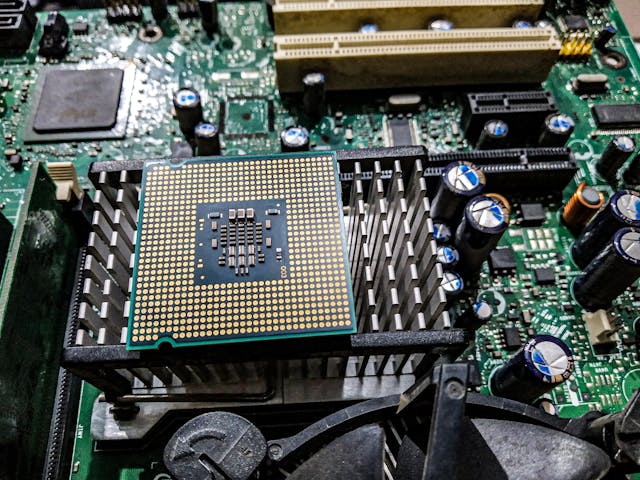
The race to build a strong semiconductor industry is no longer just about technology. For India, it is increasingly about jobs, investment, manufacturing strength and economic security.
With the launch of the second phase of the India Semiconductor Mission, or ISM 2.0, the government is seeking to build an ecosystem that goes far beyond chip factories. The programme, with an outlay of around Rs 1.27 lakh crore, covers everything from chip design and fabrication to packaging, equipment, materials, research and skilled manpower.
The timing is significant. Semiconductors have become the backbone of the modern economy. Almost every major technology product — from smartphones and cars to computers, telecom equipment and artificial intelligence systems — depends on chips.
For India, developing the ability to make more of these critical components at home could reduce supply-chain risks while creating a new engine of industrial growth.
From Designing Chips to Making Them
India already has a strong reputation for semiconductor design and engineering talent. Many global technology companies rely on Indian engineers for chip design and related research.
The bigger challenge has been developing manufacturing capabilities on a comparable scale.
ISM 2.0 attempts to close that gap. Instead of concentrating only on semiconductor fabrication plants, the programme looks at the entire chain required to make the industry work.
That includes the factories where chips are produced, the facilities that package and test them, and the companies that supply specialised equipment, chemicals, gases, wafers and other materials.
This matters because a semiconductor factory cannot operate in isolation. It needs a network of suppliers, engineers, researchers, logistics providers and technology companies around it.
Building that network could create a much wider economic impact than the construction of individual chip plants.
A New Investment Opportunity
The scale of the proposed investment shows why semiconductors are becoming an important part of India’s industrial strategy.
The government expects ISM 2.0 to attract around Rs 4 lakh crore in cumulative investment and support semiconductor production worth about Rs 2 lakh crore. It also aims to generate nearly Rs 1 lakh crore in exports during the scheme period.
If these targets are achieved, the impact could spread across several parts of the economy.
Construction companies could benefit from new industrial projects, while manufacturers of equipment and specialised materials could find new domestic customers. Logistics, engineering, power, water management and industrial services could also see increased demand.
For Indian businesses, this creates an opportunity to become part of a supply chain that has traditionally been dominated by a small number of global manufacturing centres.
Why Jobs Matter
Semiconductors are often associated with highly automated factories, but the industry still requires a large pool of specialised professionals.
India will need engineers, technicians, researchers and managers with expertise in chip design, manufacturing, testing, packaging, equipment and materials.
The government expects the programme to create around 50,000 to 60,000 direct jobs, with additional employment likely to come from supporting industries.
The bigger opportunity could be the creation of a specialised talent base that remains in demand across the technology sector for years.
For young engineers and technology professionals, the growth of the semiconductor ecosystem could open career opportunities in areas that have traditionally been concentrated in countries such as Taiwan, South Korea, Japan and the United States.
The Ripple Effect Across Industries
The importance of semiconductors becomes clearer when looking beyond the technology sector.
Modern automobiles use chips for everything from safety systems and navigation to electric powertrains and driver-assistance technologies. Consumer electronics depend on increasingly sophisticated processors and memory components. Telecom networks require advanced semiconductor equipment, while artificial intelligence is driving demand for high-performance computing chips.
A stronger domestic semiconductor ecosystem could therefore support growth across several industries simultaneously.
It could also strengthen India’s electronics manufacturing ambitions by making the domestic supply chain more resilient.
Opportunity for Indian Start-ups
One of the most promising aspects of ISM 2.0 is its focus on semiconductor start-ups and chip designers.
Developing a new chip can be expensive and time-consuming, making it difficult for young companies to compete with established global players.
Government support and co-investment mechanisms could give Indian start-ups the financial space to develop their own chip technologies and intellectual property.
If even a small number of these companies successfully scale up, India could begin producing home-grown semiconductor technologies for applications ranging from automobiles and telecom to defence and artificial intelligence.
Building Greater Economic Security
The global semiconductor shortage in recent years demonstrated how a disruption in one part of the world can quickly affect factories and consumers thousands of kilometres away.
For India, building domestic capabilities is therefore not simply about replacing imports. It is about reducing exposure to supply shocks and ensuring that critical industries have access to essential components.
A stronger domestic ecosystem could give Indian manufacturers greater certainty while also making the country more attractive to international companies looking to diversify their supply chains.
The Challenge Ahead
The opportunity is significant, but building a semiconductor industry is not easy.
India will need reliable infrastructure, uninterrupted power and water supplies, specialised talent, strong research capabilities and efficient logistics. The country will also have to compete with established semiconductor hubs that already have decades of manufacturing experience and deeply developed supplier networks.
The success of ISM 2.0 will ultimately depend on how effectively approved projects are executed and whether India can create an environment in which semiconductor companies can operate competitively over the long term.
More Than a Chip Industry
India’s semiconductor ambition is ultimately about much more than manufacturing chips.
It is about creating a new industrial ecosystem that connects technology, manufacturing, research and skilled employment. It is about encouraging Indian companies to move higher up the technology value chain and giving global manufacturers another reason to invest in India.
If ISM 2.0 delivers on its objectives, the semiconductor industry could become an important contributor to India’s next phase of economic growth.
The opportunity is clear: build the chips, develop the talent, strengthen the supply chain and create businesses around them. The bigger goal is to turn India from a major consumer and designer of technology into a country that can increasingly design, manufacture and export the technologies that power the global economy.
1, Sep 2026
AAEON to Kickoff 12th Annual SIDO Lyon Exhibition with Live AI Analytics Demos
Explore the AAEON platforms that are accelerating industrial transformation at SIDO Lyon 2026
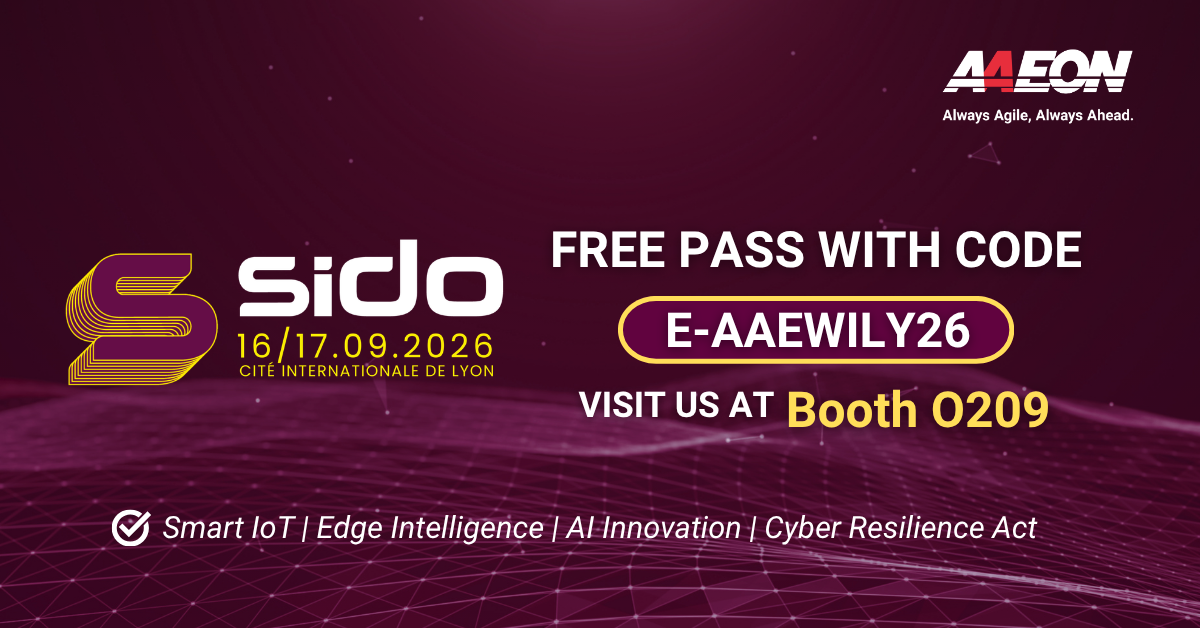
Taipei, Taiwan – Sept 01: AAEON, a leading provider of industrial IoT and AI Edge solutions, will be exhibiting a range of live demonstrations featuring both new and upcoming products at Booth #O209 of SIDO Lyon from September 16 to September 17, 2026.
Date: September 16 – September 17, 2026
Booth: #O209
Venue: Lyon Convention Centre, Lyon
This year’s edition of SIDO Lyon is expected to host over 300 exhibitors, as well as featuring a diverse range of conferences, workshops, talks, and roundtables on topics ranging from autonomous robotics to cybersecurity.
At Booth #O209, AAEON will showcase exciting additions to its product lines utilizing technology from premier partners, as well as live demonstrations that illustrate the elite capabilities of AAEON platforms.
Among its demonstrations, AAEON will present an Al video analytics solution with remote device management and embedded cybersecurity capabilities able to support secure and scalable edge Al deployments. Running on the new UP WCL Edge with Intel Core processors (Series 3) (formerly Wildcat Lake), the solution utilizes technology from AAEON partners Balena, Network Optix, and Exein.
AAEON’s second live demonstration, using the BOXER-8652AI from the company’s line of Compact Fanless Embedded AI System featuring NVIDIA Jetson Orin series modules, will show how Al analytics applications can be used for smart city deployments such as traffic management. Leveraging real-time video inference based on CUDA/TensorRT, the application features video analytics solution Isarsoft Perception, showing how real-time traffic insights can help create smarter urban mobility infrastructure.
Highlighting AAEON’s growth in the RISC computing sphere, in collaboration with Savoir-faire Linux, AAEON will host a live demonstration featuring the Qualcomm Dragonwing IQ9075-based HPC-Q9M and the NXP i.MX 8M Plus-driven SRG-IMX8P, showcasing LF Energy SEAPATH for virtualized and high-availability smart grid infrastructure. Visitors can also explore the new Qualcomm Dragonwing QCS6490-powered uCOM-Q6490, which features an 8-core Qualcomm Kryo 670 CPU built on Arm v8 Cortex technology with 12 TOPS of AI performance through the chip’s integrated Qualcomm Hexagon 770 NPU.
Notable platforms featuring new Intel technologies among AAEON’s static demo lineup will be the upcoming GENE-PTH6, which is built on Intel Core Ultra Series 3 processors (formerly Panther Lake), as well as the recently released Intel Core processors (Series 3)-powered UP WCL Edge.
AAEON’s portfolio of solutions powered by NVIDIA technologies will also be represented at Booth #O209, with the BOXER-8649AI, an IP67-rated Fanless Embedded AI System powered by NVIDIA Jetson AGX Orin.
Meanwhile, the MAXER-5000, one of AAEON’s first products equipped with new NVIDIA Jetson Thor series modules, will also be on show.
Visitors are encouraged to join AAEON at Booth #O209, where representatives will be delighted to discuss the products and provide details of the demonstrations on display. For more information about the SIDO Lyon, or to register to attend, please visit the official exhibition website and be sure to use the code E-AAEWILY26 to obtain a free visitor’s pass.
1, Sep 2026
Apple Enters New Era as John Ternus Succeeds Tim Cook as CEO
New Delhi, Sep 1: Apple has begun a new chapter in its leadership with John Ternus taking over as Chief Executive Officer, succeeding Tim Cook after more than a decade at the helm of the technology company.
Pic Credit: Pexel
Ternus assumed the position on September 1, bringing an end to Cook’s tenure as CEO, which began in August 2011 after Apple co-founder Steve Jobs stepped down.
Cook has moved into the newly created position of Executive Chairman. In this role, he will focus on engagement with policymakers around the world and continue to support the company on selected strategic matters. Ternus has also joined Apple’s board of directors.
Ternus brings extensive experience in Apple’s product development and engineering operations. He joined the company in 2001 as part of its product design team and was appointed senior vice president of Hardware Engineering in 2021.
Over the years, Ternus has played a role in the development of several of Apple’s key products, including the iPhone, iPad, AirPods and Mac. His hardware engineering team has also contributed to the company’s latest product launches.
The leadership transition comes after a period of significant expansion for Apple. During Cook’s tenure, the company’s market value increased substantially, rising from around $350 billion in 2011 to approximately $4 trillion.
Apple’s annual revenue has also expanded from about $108 billion when Cook became CEO to more than $400 billion. The company’s services division has emerged as another major growth engine, generating more than $100 billion annually through businesses such as the App Store, Apple Music and Apple Pay.
Ternus takes over at a time when artificial intelligence is rapidly changing the technology industry. The growing competition in AI presents one of the biggest strategic challenges for Apple as it seeks to keep pace with rivals while protecting its position in premium consumer technology.
A key priority for the new CEO will be strengthening Apple’s AI capabilities while maintaining the ecosystem that connects its hardware, software and services.
Ternus will also be expected to guide the company through its next phase of product innovation, manage intensifying competition and identify new opportunities for growth.
His background in hardware engineering gives him deep experience with Apple’s product development process. The challenge now will be to combine that expertise with a broader technology strategy as AI, cloud services and connected devices increasingly shape the global technology market.
The change in leadership marks the end of one of Apple’s longest CEO tenures and the beginning of a new phase under Ternus, with investors and consumers watching closely for how the company evolves its products, services and AI strategy.
31, Aug 2026
No Smartphone, No Internet: PhonePe Takes UPI to India’s Feature Phone Users
New Delhi, Aug 31: Digital payments are moving beyond the smartphone era as PhonePe has introduced UPI 123Pay for feature phones, allowing users to make UPI transactions without requiring mobile internet.

The service is aimed at expanding access to digital payments among India’s large feature-phone user base, particularly people in rural and semi-urban areas where smartphone ownership or reliable internet connectivity may still be limited. PhonePe estimates that the service can reach more than 200 million feature-phone users across the country.
The new platform uses an SMS-based technology architecture, allowing transactions to work even in areas with limited 2G connectivity. Users can transfer money, make payments to merchants and check basic account information without depending on mobile data.
Feature phones equipped with cameras will also support QR-code payments, giving users another convenient option for completing transactions at participating merchants. The service can additionally provide access to account balances and transaction history.
PhonePe has partnered with handset makers including Nokia, HMD, Lava International and Itel Mobile to make the service available on selected feature phones. The company is expected to expand the network of supported devices over time.
To make the platform easier for first-time digital-payment users, PhonePe has also introduced a voice-first, AI-powered support service offering step-by-step assistance in English and 12 Indian languages.
The initiative could have a wider impact on India’s financial inclusion drive by reducing the dependence on smartphones and high-speed internet for everyday payments. It could particularly benefit consumers, small traders and merchants in areas where connectivity remains a challenge.
For the broader digital economy, extending UPI access to feature phones could bring more consumers into formal digital transactions and provide small businesses with additional ways to receive payments.
The move also reflects the continuing evolution of India’s digital-payment ecosystem, where technology is increasingly being adapted to serve users across different devices and connectivity levels.
By taking UPI beyond smartphones, PhonePe’s latest initiative could help narrow the digital divide and bring millions of under-connected users closer to India’s expanding cashless economy.
31, Aug 2026
Food-safe NXD tupH® surface protection from NORD DRIVESYSTEMS
Aug 31: With NXD tupH® from NORD DRIVESYSTEMS, users of hygiene-sensitive applications in food & beverage and primary packaging industries can benefit from the strengths of aluminium drive solutions. The food-safe surface treatment provides aluminium with properties that make the material comparable to stainless steel in terms of hygiene and corrosion resistance.
With NXD tupH®, NORD DRIVESYSTEMS has developed an effective and food-safe surface protection especially for aluminium housings. The respective gear units, smooth motors and decentralised frequency inverters become particularly corrosion-resistant and withstand extensive cleaning procedures in food processing industries over the long term. NXD means “NORD eXtreme Duty”; tupH combines the English terms “tough” and “pH-value”.
Test prove chemical resistance
NXD tupH® combines a special surface treatment with a high-performance sealer. The result is a non-porous surface that can be cleaned hygienically and neither flakes off nor corrodes after numerous cleaning cycles. NXD tupH® has proven its chemical resistance in a long-term test, including the use of Ecolab cleaning agents. NORD drive components with NXD tupH® surfaces are furthermore food-safe in accordance with the requirements of the FDA, EU and Switzerland as well as the MERCOSUR states. They are suitable for food-contact applications in the fields of food & beverage and primary packaging.
Economical alternative to stainless steel drives
With this, NORD provides users with an economical and powerful alternative to stainless steel drives. Drive solutions with aluminium housings are more lightweight and allow for compact design. Since aluminium dissipates heat well, a higher power density and lower surface temperatures can be achieved. With NXD tupH®, aluminium housings now also become chemical-resistant, making the drive solutions durable and increasing the system availability in wash-down applications.
The surface protection from NORD does not require any special design and thus no separate warehousing and installation costs. The manufacturer applies its surface treatment to existing components. This way, it can use the options of its modular products for the drive system design, and supply tailor-made NXD tupH® drive systems completely from a single source.

The food-safe NXD tupH® surface protection makes NORD drive systems with aluminium housings more resistant to cleaning chemicals
NXD tupH®-treated complete solutions from a single source
NXD tupH® is available for all NORD aluminium products with a smooth surface, including the integrated DuoDrive gear unit / motor system, the energy-efficient IE5+ smooth motors as well as NORDBLOC.1® helical in-line gear units and NORDBLOC.1® helical bevel gear units. Furthermore, with NORDAC ON PURE, a decentralised frequency inverter with NXD tupH® surface will be available soon. Solution provider NORD can thus supply complete drive systems with food-safe surface treatment from a single source.
28, Aug 2026
SK Telecom Launches AI Data Center Infrastructure Company ‘SK Horizon’ and Secures Investments from KKR and IMM
SEOUL, Korea, Aug 28 — SK Telecom (NYSE: SKM, hereinafter “SKT”) today announced that it will split its wholly owned subsidiary SK Broadband into a surviving company (SK Broadband) and a newly established company (SK Horizon). In connection with the spinoff, SKT has entered into a definitive agreement with funds managed by KKR, a leading global investment firm, and the IMM Investment-Stonebridge consortium (the “IMM consortium”) for a combined KRW 3.08 trillion equity investment in SK Horizon.
The surviving company will focus on innovation in its fixed-line, media, and enterprise businesses, while the newly established company will aim to expand Korea’s leading AI data center (AIDC) infrastructure. Based on the book value of net assets, the spin-off ratio has been set at 0.8351323 (approximately 0.84) for the surviving company and 0.1648677 (approximately 0.16) for the newly established company.
SK Horizon, whose name reflects its ambition to “open new horizons” in the AIDC sector, will be responsible for expanding its infrastructure to a total capacity of 318 MW, encompassing eight data centers already in operation – Seocho, Ilsan (2 locations), Bundang, Gasan, Centum, Yangju and Pangyo – and new AIDCs currently under construction, including those in Ulsan and Guro. It will also pursue the phased expansion of its submarine cable infrastructure, which is essential for global AI businesses.
SKT plans to strengthen its AIDC operational expertise through SK Horizon and expand into a range of AI infrastructure businesses going forward. In particular, its streamlined decision-making structure is expected to enable the company to more effectively secure funding for key business areas, including through external investment.
Kim Seong-soo, CEO of the surviving company SK Broadband, is expected to concurrently serve as CEO of the new company, SK Horizon. The appointment will be finalized through a resolution of the Board of Directors following the completion of the company’s establishment early next year.
Securing trillion-won-scale investment from KKR and the IMM consortium demonstrates the strength and future potential of the AIDC business
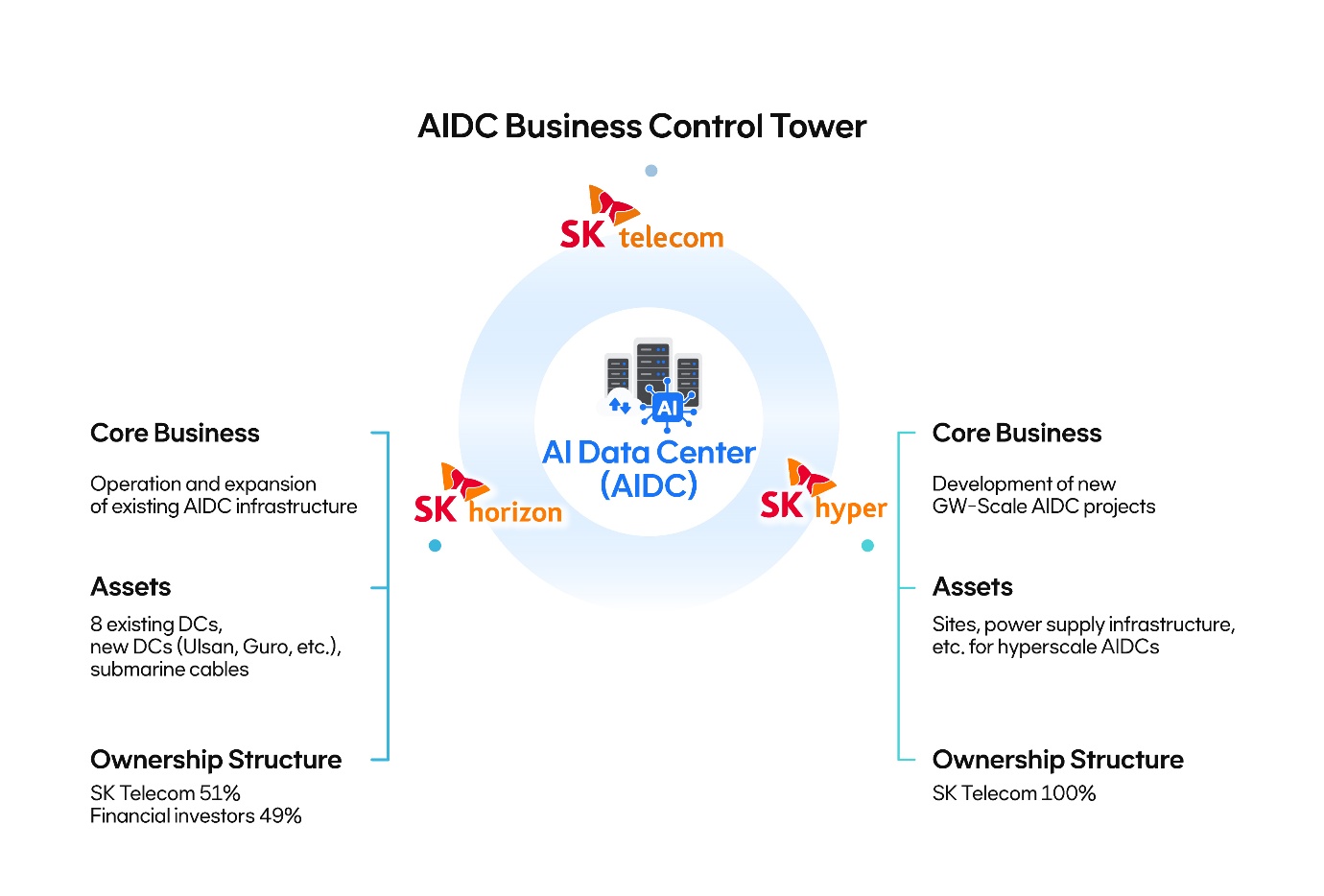
Alongside the spin-off, SKT announced that it has entered into a definitive agreement with funds managed by KKR and the IMM consortium for a combined KRW 3.08 trillion equity investment in SK Horizon. As investors in the newly established company, KKR and the IMM consortium will provide capital to support SK Horizon’s expansion as an AI data center infrastructure platform. Upon completion of all phases of the investment under the transaction, KKR and the IMM consortium will hold 29% and 20% stakes in SK Horizon, respectively, while SKT will retain management control as the largest shareholder with a 51% stake.
KKR is one of the most active infrastructure investors globally, with over USD 100 billion in infrastructure assets under management and more than USD 70 billion invested across digital and power assets. KKR is making this investment primarily from its Asia Pacific infrastructure strategy.
The IMM Investment-Stonebridge Consortium comprises two leading South Korean investment firms, IMM Investment and Stonebridge Capital. IMM Investment, founded in 1999, is a leading South Korean alternative investment firm with over USD 7.5 billion in assets under management across venture capital, growth equity, and infrastructure. Stonebridge Capital, founded in 2008, is a leading South Korean private equity firm with approximately KRW 3.6 trillion (USD 2.5 billion) in cumulative assets under management, investing in market-leading companies in structurally growing sectors.
SKT fully set for AIDC expansion with SK Horizon and SK Hyper
With this governance restructuring, SKT has completed the establishment of a full-scale AIDC business structure together with SK Horizon and SK Hyper, a specialized company established last July.
SKT will oversee the Group’s overall AIDC business, setting business strategies and directions and collaborating with global big tech companies. Building on its expertise and capabilities in data center operations, SK Horizon will be responsible for expanding infrastructure, including existing key AIDCs and submarine cables.
SK Hyper will focus on business development for new AIDC projects, with 5 GW of capacity targeted for phased opening in 2029 and expansion toward a total capacity of 15 GW in 2035.
Meanwhile, the surviving company, SK Broadband, plans to strengthen the competitiveness of its fixed-line, media, and enterprise businesses through AX-driven innovation in products and services, while sustaining solid growth. It also plans to accelerate future growth by actively identifying new business models.
With the aim of completing the spin-off and establishing the new company in the first quarter of next year, the necessary procedures, including an extraordinary general meeting of shareholders and government approvals, will be carried out.
“This governance restructuring is a proactive measure aimed at strengthening expertise and enabling faster execution in the AIDC business,” said Kim Seong-soo, CEO of SK Broadband. “As an AIDC infrastructure company, we will continue to scale up SK Horizon and grow it into Korea’s leading data center operator.”
“We are pleased to support SKT as it establishes SK Horizon and expands its AI data center infrastructure platform in Korea,” said Keith Kim, Partner at KKR. “SK Horizon brings together an established operating platform, capacity under development and a strong strategic partner. Korea’s advanced digital ecosystem and growing demand for AI capacity provide a strong foundation for SK Horizon’s next phase of growth.”
“AI data centers and submarine cables will be among the core infrastructure assets shaping Korea’s digital sovereignty and industrial competitiveness going forward,” said Kim Byung-hun, Head of Infrastructure at IMM Investment. “By investing in SK Horizon on the back of long-term capital from Korea’s leading institutional investors, the IMM Investment-led consortium aims to build a sustainable growth structure that combines the capital strength of our global partner with the stability of domestic capital.”


