


30, Jul 2026
MENA Fintech Association Convenes Inaugural SHIFT B2B & Commercial Payments Sub Committee Roundtable & Launches The State of B2B Payments Report
Industry leaders identify awareness, not technology, as the primary barrier to B2B payment digitization in MENA
July 30 | Dubai, UAE — The MENA Fintech Association (MFTA) convened the inaugural roundtable of its SHIFT – B2B & Commercial Payments Sub Committee, bringing together senior leaders from payment networks, banks, fintechs, acquirers, corporate payments providers, investors, and industry experts to examine the state of B2B payments across the Middle East and North Africa.
Held under the Chatham House Rule and chaired by Swapna Rege, Chair of the MFTA SHIFT Sub Committee, the session culminated in the publication of “The State of B2B Payments in MENA,” a report capturing the group’s insights and recommendations, and serving as the foundation for the Sub Committee’s future workstreams.
Participants acknowledged meaningful progress over the past decade, including banks embedding card solutions into broader corporate relationships, more sophisticated expense management tools, and faster SME digital financial inclusion driven by digital banks. Even so, participants reached strong consensus that the greatest barrier to commercial payment adoption is market awareness and ecosystem engagement, not technology. A recurring theme was that commercial card portfolios often sit within retail banking rather than transaction or corporate banking, leaving relationship managers under-incentivized to sell card solutions and disconnecting the product from the teams that own corporate treasury relationships.
Key themes included the need for dedicated, incentive-driven sales coverage, drawing comparisons to agent-led models used during India’s digitization efforts and historic American Express acceptance campaigns; deeper engagement with acquirers, who remain critical but under-engaged in driving supplier acceptance; and closer partnerships with ERP and enterprise technology providers, both as integration points for embedding card capabilities and as distribution channels for reaching corporate buyers.
Akshay Chopra, Co-Chair, MFTA SHIFT Payment Working Group, commented:
“This roundtable confirmed what many of us have suspected for some time the rails for commercial payments in MENA already exist. The real work now is building the awareness and ecosystem alignment needed to put them to use.”
The group also addressed two common myths slowing adoption: that acceptance costs near two percent are prohibitive for suppliers, when in practice this is often lower than a supplier’s cost of capital on receivables outstanding 60 or more days once financing costs and manual reconciliation are factored in; and that new verticals require bespoke products, when in many cases basic card enablement simply hasn’t been rolled out yet.
As next steps, the Sub Committee agreed to launch ecosystem-specific working sessions with corporate banks, acquirers, technology providers, fintechs, and corporate treasury leaders; develop a regional best practice playbook covering how commercial payments should be structured, priced, and mandated across banks, acquirers, and corporates; and explore a “State of B2B Payments” briefing for central banks and policymakers.
Clyde Rosanowski, Co-Chair, MFTA SHIFT Payment Working Group, commented:
“Supplier acceptance is where the next wave of B2B payments growth will come from. When suppliers understand the working capital and reconciliation benefits, acceptance follows our job is to make that case clearly and consistently.”
Swapna Rege, Chair of the MFTA SHIFT – B2B & Commercial Payments Sub Committee, commented:
“Commercial payments represent one of the most significant untapped opportunities within the financial services industry. As digital transformation accelerates across the region, success will depend not only on technology, but on stronger ecosystem collaboration, market education, and coordinated industry action. This inaugural roundtable represents the beginning of an important journey to help shape the future of B2B payments across MENA.”
The Sub Committee’s findings will now feed into MFTA’s broader regional agenda, with leadership underscoring the importance of this work to the Association’s mission.
Nameer Khan, Chairman of the MENA Fintech Association, commented:
“B2B payments represent one of the largest structural opportunities in our region’s financial ecosystem. The insights from this roundtable reinforce MFTA’s commitment to convening the right stakeholders, from banks to acquirers to technology providers, so the industry can move from awareness to action.”
- 0
- By Neel Achary

29, Jul 2026
The Sound of Productivity: How Audio Shapes Focus at Work

Emilio Roig – Marketing Manager, Audiodo
July 29: In today’s always-on working culture, productivity is typically framed around flexibility, digital tools, time management strategies and ergonomic setup. Organisations invest heavily in collaboration platforms, workflow software and hybrid policies all designed to optimise output.
Yet one of the most influential – and often overlooked – factors affecting performance can be sound.
The environment we work in, whether that’s a shared co-working space, open-plan office or home setup, and the acoustic conditions within that environment can have an impact on concentration, cognitive load and overall wellbeing. In short, the right sound environment can support productivity, whilst unmanaged noise can undermine performance.
The Cognitive Cost of Noise
Modern workspaces are rarely silent. Even with the rise of hybrid working, employees report that background conversations, virtual meetings and environmental noise can cause distractions and make it difficult to sustain attention.
Research has found that exposure to intelligible background speech can significantly reduce performance on tasks involving working memory and reading comprehension (Halin et al., 2021). The reason is simply neurological: our brains are hard-wired to prioritise speech. Even when a conversation is irrelevant it automatically captures attention.
This constant redirection of focus increases cognitive load and over time, that additional mental effort can contribute to fatigue and reduced efficiency – particularly in knowledge-based roles where sustained concentration is critical.
In other words, noise is not simply an annoyance.
Reducing Fatigue in Hybrid Environments
While unmanaged noise can increase cognitive load, silence is not necessarily the answer.
Research has shown that controlled, predictable sound can positively influence mood and task engagement. Listening to self-selected music, for example, has been associated with improved focus and emotional state, leading to greater immersion in tasks and more sustained concentration (Küssner, 2020).
With this in mind, it is no coincidence that many employees turn to headphones to create their own focus zone. However, there is another key factor that is often overlooked – hearing is highly individual.
A recent report from the World Health Organisation highlighted the increasing prevalence of subtle hearing variations across the working population. Even minor differences in frequency sensitivity can affect how clearly audio is perceived. When sound is not optimised for the listener, the brain works harder to interpret detail and balance which often results in listening fatigue.
In a working world where employees may spend hours on calls or virtual meetings, this strain can become significant.
The Role of Personalised Sound
This is where personalised sound technology is emerging as part of a broader movement towards adaptive technology.
Rather than treating audio as a one size fits all solution, software developers such as Sweden-based Audiodo are using hearing profiling to create an individual audio calibration which is then applied directly within compatible devices. Rather than simply increasing volume to overcome distractions, it fine-tunes frequencies to match the listener’s unique sensitivities in each ear. By tailoring sound to the individual, personalised audio can reduce unnecessary listening effort and help to support clearer, more comfortable communication throughout the working day.
Reducing listening fatigue is not just about comfort – it can have an impact on mental endurance, meaning cognitive capacity remains available for analysis, creativity and decision-making.
A Smarter Approach to Productivity
As organisations continue refining hybrid models and investing in employee wellbeing and performance, the acoustic dimension of work deserves greater attention.
Cognitive wellbeing and the ability to sustain focus, manage mental load and avoid burnout is increasingly a part of modern workplace design. From lighting to air quality, companies are examining environmental factors that can shape performance – and audio deserves equal consideration.
With research in workplace acoustics and cognitive psychology showing that intelligible background speech can reduce task performance and increase mental fatigue, while controlled or self-selected audio can support engagement and sustained attention (Jahncke et al., 2021; Halin et al., 2021), the future of productivity may not lie in eliminating sound altogether; but in managing it strategically and recognising that each employee hears and works differently.
By acknowledging the power of sound in cognitive performance and looking to embrace technologies that adapt to the individual, organisations can create environments where focus is supported, energy is preserved and productivity feels sustainable rather than forced.
In an increasingly competitive landscape, that may prove to be a sound investment.
29, Jul 2026
AAEON Launches MIX-Q870A1, a Modular Mini-ITX with 65W Intel Core Ultra 200S Series Support
AAEON’s new MIX-Q870A1’s Arrow Lake processing, PCIe Gen 5 with bifurcation, and diverse storage architecture is designed to elevate the potential of Mini-ITX builds.
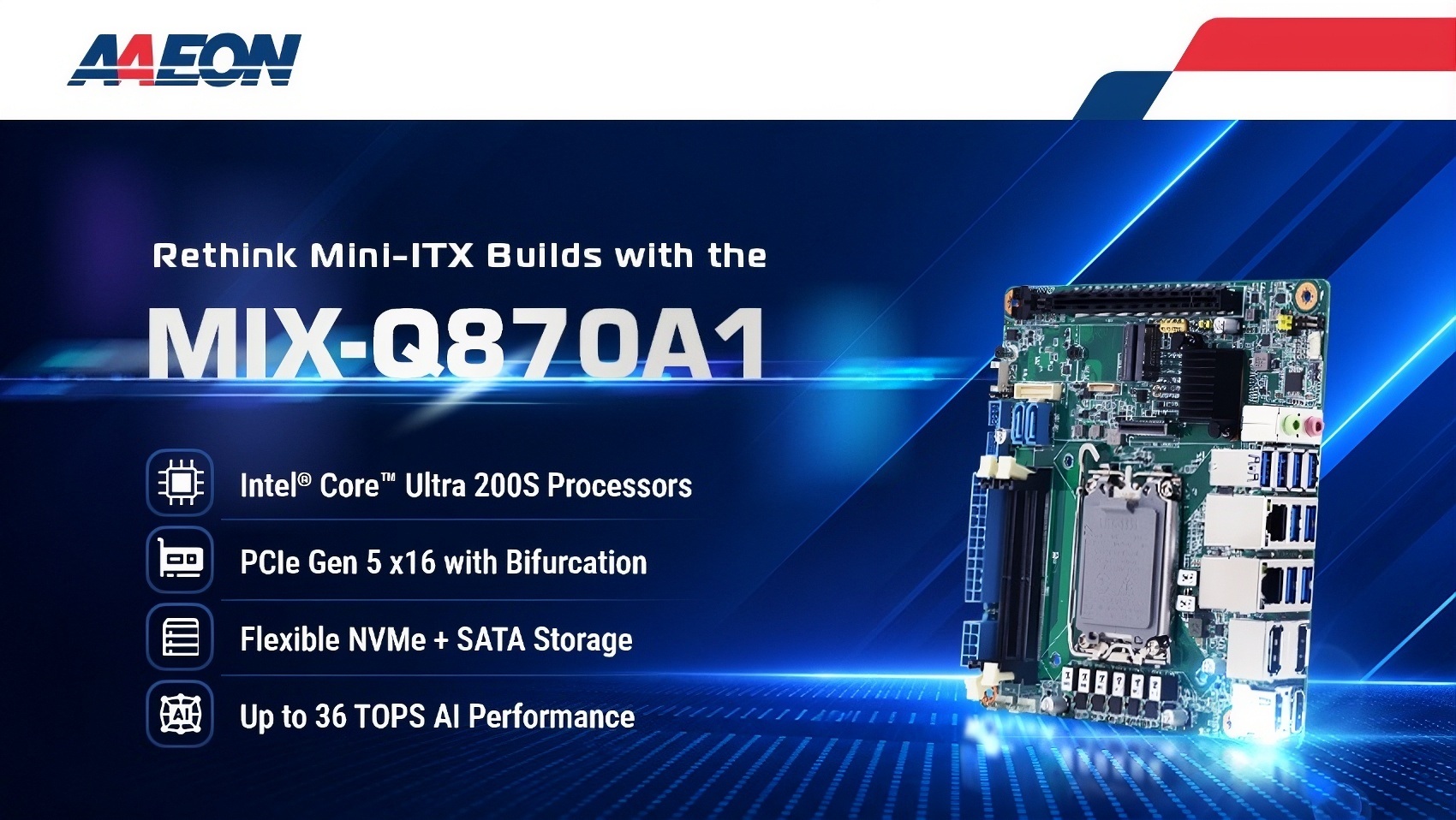
Taipei, Taiwan – July 29: AAEON (Stock Code: 6579), a leading producer of industrial motherboards, has announced the release of the MIX-Q870A1, a sophisticated Mini-ITX motherboard supporting up to 65W Intel Core Ultra 200S Series LGA 1851 socket-type processors (formerly Arrow Lake).
Compatible with a broad selection of SKUs from the second generation of Intel Core Ultra processor range, the MIX-Q870A1 can leverage the platform’s integrated NPU and Xe LPG Graphics for AI acceleration for a total of 36 TOPS alongside optimized multi-tasking and multi-core performance.
A particularly notable inclusion among the MIX-Q870A1’s specifications is its 16-lane PCIe Gen 5 slot with bifurcation, which can be split into x16, x8/x8, or x8/x4/x4 configurations through a dedicated jumper. This addition provides a modular foundation for the installation of expansion cards based on project need, meaning that even when equipped with a GPU to bolster the AI acceleration offered by the board’s Intel Core Ultra platform, the remaining lanes of its PCIe slot can be used to accommodate additional modules like NVMe SSDs, NICs, frame grabbers, or fieldbus interface cards.

For storage, the MIX-Q870A1 is equipped with an M.2-1A 2280 M-Key and M.2 2242 M-Key slot, with the former offering a four-lane PCIe signal for NVMe and the latter reserved for SATA. The board also hosts two dedicated SATA 6Gb/s ports with RAID 0, 1 support. Rounding off its expansion capabilities is an M.2 2230 E-Key slot for Wi-Fi or additional NVMe storage.
The MIX-Q870A1 gives users a variety of display options, including two HDMI 2.0 and two display ports as part of its rear I/O, both for 4K resolution at 60Hz, with the HDMI also providing digital audio. Joining HDMI and DP stack ports on the board’s rear I/O is eight USB 3.2 Gen 2 ports and both 1GbE and 2.5GbE LAN ports (Intel Ethernet Connection I219-LM and Intel Ethernet Controller I226-V, respectively). Internal connectors include an 8-bit programmable digital I/O, a USB header for two USB 3.2 Gen 1 interfaces, and a 40-pin LVDS/eDP connector, both of which offer 1920 x 1080 resolution at 60Hz.
OS support for the MIX-Q870A1 includes Windows 10/11 (64-bit) and Linux Ubuntu 24.04.
29, Jul 2026
SK Telecom Unveils A.X K2, Driving AI Adoption in Industry and Daily Life
SEOUL, Korea, July 29 — SK Telecom (NYSE: SKM, hereinafter referred to as “SKT”) today unveiled its proprietary AI foundation model ‘A.X K2,’ supporting AI transformation across everyday life and industrial fields.
Starting today, the 688-billion-parameter A.X K2 model is available through the open-source community Hugging Face. Building on the 519B A.X K1, it delivers enhanced mathematical and scientific reasoning, Korean-language knowledge, and long-context reasoning capabilities.
Across 14 benchmarks, A.X K2 posted an average performance gain of 32.2 percentage points over A.X K1. The model delivered particularly strong gains of approximately 83.9 percentage points in long-context understanding and agent-related evaluations.
SKT also applied its proprietary Sparse Gated Attention (SGA) architecture to A.X K2. The architecture selectively references the most relevant information as the model processes long contexts, helping maximize accuracy and operational efficiency in industrial environments.
A.X K2 demonstrated performance on par with or superior to Qwen 3.5-397B and DeepSeek-V4-Flash — both released within the past six months— on math benchmarks (AIME26, Apex) and Korean-language (KMMLU-Pro, CLIcK) benchmarks.”
Supporting AI Transformation Across Manufacturing, Public Sector and Beyond with A.X K2
SKT plans to expand the application of A.X K2 across industry and everyday life. The company conducted four rounds of post-training to verify the model’s response quality, stability, and operational efficiency, and is identifying use cases across various sectors, including manufacturing, defense, and bio.
Manufacturing AI: SKT is embedding operational know-how from industrial sites into manufacturing-specialized AI agents powered by A.X K2. In the second half of the year, the company plans to deploy demo versions at steelmaker KG Steel’s cold-rolling line in Dangjin, followed by field trials. Similar trials will also be conducted across auto parts manufacturer KONEC’s casting and machining processes.”
Defense AI: In collaboration with the Ministry of National Defense under the Sovereign AI Foundation Model project, SKT has developed three quantized models based on A.X K1. Given the defense sector’s need for the highest levels of security and data sovereignty, the models apply quantization technology to reduce memory usage and increase processing speed. The Ministry and SKT plan to deploy the models across units under the Army, Navy, Air Force, and Marine Corps.
Bio AI: SKT’s proprietary foundation model is also being considered for applications in bio. The company is applying AI to the development of targeted therapies for intractable cancers with SK Biopharmaceuticals, recently helping reduce the early-stage drug research period — typically one to two years using conventional methods — to five months.
Enterprise AI Agents: For enterprise productivity, A.X K2 powers A. Biz, enabling users to generate newsletters, gather and analyze information, and create reports. SKT also provides a lightweight version of A.X K2 for SK hynix’s internal tools to support document drafting and information management tasks.
SKT is also supporting the domestic AI ecosystem by providing A.X K1 in API form to participants in programs led by the Ministry of Science and ICT and to three startups — namely Purselly (Marketing), REmited (Commerce), and Devall Company (Finance) — selected for the Ministry of SMEs and Startups-led open innovation program.
A lightweight version of A.X K2 has also been integrated into SKT’s AI service, A. (A-DoT), expanding its use into everyday applications. A.X K2 powers the “AI Suggestions” feature in A. Phone, which recommends schedules and to-do items based on users’ call conversations. The model is also used in A. Note’s content summarization features.
Unveiling Vision and Audio Models to Scale Manufacturing AI and Service Adoption
Centered on A.X K2, SKT has built a derivative lineup — including a vision-language (VL) model based on a vision encoder and a speech model based on an audio encoder·decoder — to meet diverse industry needs.
A.X K2 VL Light-Preview and A.X K2 Audio Language Model (ALM) were developed by SKT, while A.X K2 Raon-Speech was developed in collaboration with Krafton, building on SKT’s A.X K2 Light model.
A.X K2 VL Light-Preview (21B): Combines image and text understanding to support enterprise workflows involving reports, manuals and field imagery. Potential applications include analyzing image-based documents such as receipts and academic papers, identifying risks in legal documents, and interpreting industrial piping.
A.X K2 ALM (22B): Designed to recognize and analyze audio from customer consultations, meetings and field environments. SKT is evaluating its use in contact center voice calls.
A.X K2 Raon-Speech (21B): Planned for use in Krafton games to enhance voice-based interactions between players and AI.
Going forward, SKT plans to scale the successor to A.X K2 to the trillion-parameter range to secure global competitiveness. The company has been expanding its parameter scale to match that of leading global players, and introduced 500B-plus large-scale models in the first phase of the Sovereign AI Foundation Model Project.
“We have advanced a range of capabilities in parallel to enable broad use across everyday life, offices and manufacturing sites,” said Kim Tae-yoon, Head of Foundation Model Office at SKT. “We will continue expanding the adoption of A.X K2 across industries to help drive Korea’s AI competitiveness.”
28, Jul 2026
GMSL2 Repeater Doubles Rugged Camera Link Reach to 30 Meters on Large Autonomous Machines
Compact Washdown-Ready Device Regenerates the Signal and Needs No Separate Power Supply
July 28: Hsinchu, Taiwan – oToBrite, a provider of automotive-grade Vision AI and camera solutions for unmanned vehicles, off-highway machines, and robotics, today introduced the GMSL2 Repeater, a compact device that doubles rugged camera-to-SoC transmission to 30 meters on large machines. A single repeater regenerates the GMSL2 signal at the midpoint of the link, doubling the roughly 15-meter reach of a standard GMSL2 connection without changing the camera architecture or the location of the compute unit.
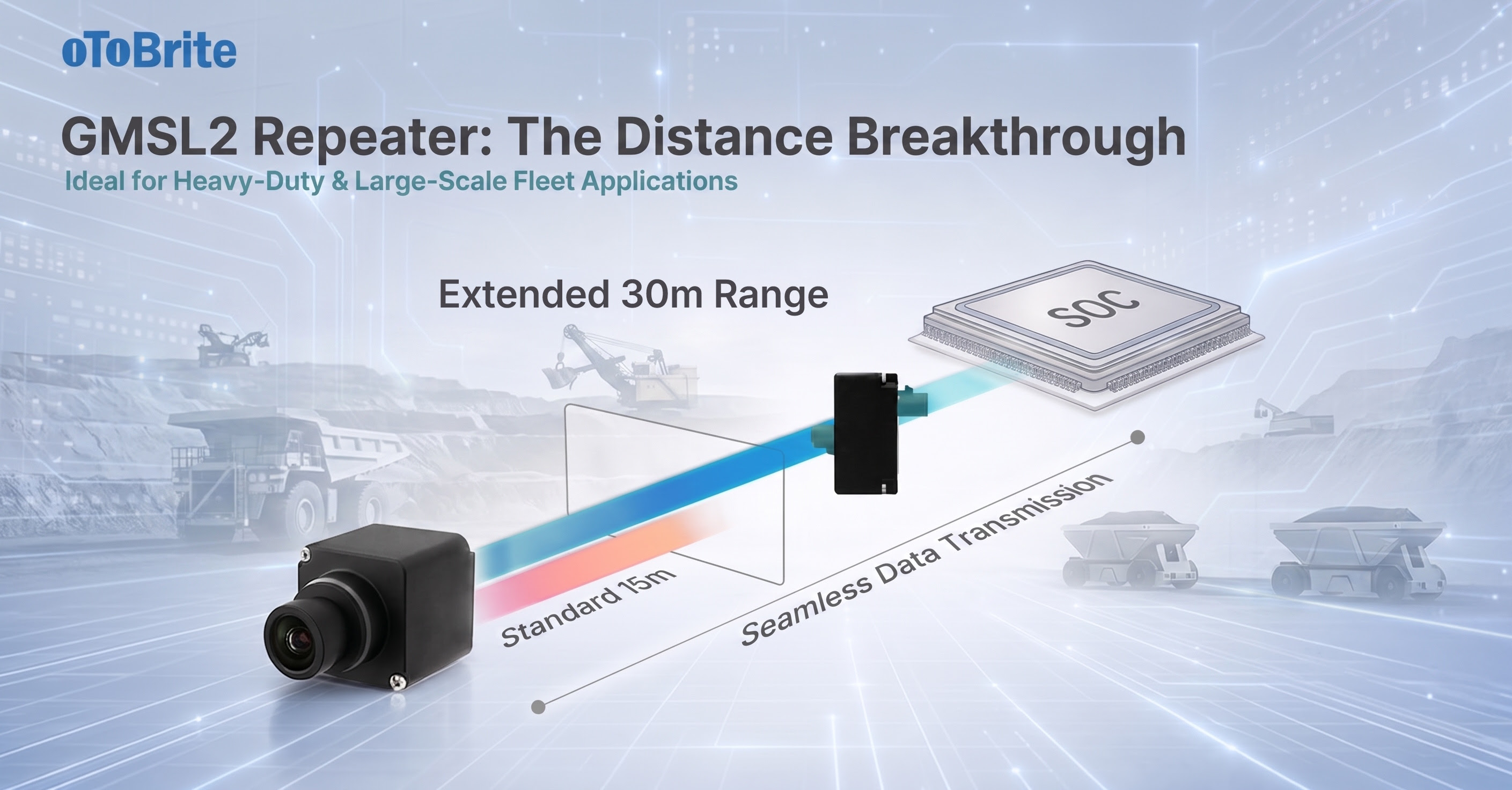
Large machines place cameras far from the compute unit. Trailer-rear, boom-arm, harvesting-head, and perimeter cameras routinely sit outside the reliable range of a standard GMSL2 link over automotive cabling. Reaching those positions has required either relocating the compute unit or redesigning the cable architecture. The GMSL2 Repeater removes both steps.
Signal Regeneration Extends the Link to 30 Meters
The repeater installs inline between the camera and the host. It recovers the incoming GMSL2 signal in full, then retransmits a clean copy across a second link. This full recovery, rather than analog signal boosting, extends the link to a full 30 meters and adds under 1 microsecond of latency. The device has one GMSL2 input and one GMSL2 output on FAKRA Type Z connectors, runs at 6Gbps, and draws power over the same coax as the camera, requiring no separate power supply.
IP69K Rating and a Compact Body for Permanent Outdoor Use
The GMSL2 Repeater measures 34.6 by 36 by 19 millimeters and installs permanently on the machine. It carries an IP69K rating when its FAKRA connector is mated to a cable connector rated to the same standard, supporting high-pressure washdown. The device operates from minus 40 to 85 degrees Celsius and draws up to 1.3 watts, excluding camera power.
Backed by a Decade of Automotive and Autonomy Programs
For more than a decade, oToBrite has supplied automotive-grade cameras and Vision-AI systems for production vehicle programs and autonomous machine fleets, working with global automotive, off-highway, and robotics companies across the United States, Japan, and Europe.
Applications Across Heavy Machinery and Autonomous Platforms
Primary applications include heavy construction, mining, agricultural, and forestry equipment, along with long-haul trucking. Outdoor autonomous mobile robots and unmanned ground vehicles are a further application as those platforms grow larger and move into harsher environments.
A Single Source for the GMSL2 Camera Chain
The repeater extends the reach of oToBrite’s GMSL2 cameras, which the company offers from 1 to 8 megapixels along with plug-and-play adapter kits that connect them to NVIDIA Jetson platforms. That lets a system builder source the cameras, the compute connection, and the long-distance link for a large machine from a single automotive-grade supplier.
Availability: August 2026.
Full specifications and the datasheet are available at https://www.otobrite.com/product/gmsl-repeater/category#gmsl2-repeater.
Key Specifications
Interface: GMSL2, one input and one output
Connectors: FAKRA Type Z
Data rate: 6Gbps
Power: 10.5 to 17 volts DC over Power over Coax, 1.3 watts maximum, excluding camera power
Operating temperature: minus 40 to 85 degrees Celsius
Storage temperature: minus 40 to 95 degrees Celsius
Ingress protection: IP69K when the FAKRA connector is mated to an IP69K-rated cable connector
Dimensions: 34.6 by 36 by 19 millimeters
Added latency: under 1 microsecond
Extended reach: 30 meters with a single repeater, validated over 24 hours with zero frame loss
28, Jul 2026
TRAI Data Shows Strong Growth in India’s Digital Connectivity
New Delhi, July 28: India’s digital connectivity continued to strengthen in June, with the country’s total telecom subscriber base rising to 1.35 billion, while broadband subscribers crossed 1.08 billion, according to the latest data released by the Telecom Regulatory Authority of India (TRAI).
The increase reflects the continued expansion of telecom services and internet access across the country, supported by growing smartphone adoption, improved network infrastructure, and rising demand for digital services.
TRAI said the steady growth in subscriber numbers highlights India’s rapid progress in expanding communication networks and improving internet accessibility in both urban and rural areas.
Industry experts noted that the expanding telecom and broadband ecosystem is expected to accelerate digital inclusion, support businesses, strengthen online education and healthcare services, and drive the country’s digital economy.
The latest figures also underline the telecom sector’s growing role in enabling innovation, improving connectivity, and supporting India’s vision of a technology-driven and digitally empowered nation.
28, Jul 2026
Global Study: Fund Managers Say AI Will Transform Asset Management Operations Within 12 Months
BOISE, Idaho, NEW YORK, CHICAGO, LONDON and HONG KONG, July 28: A global study of 178 senior fund manager executives released today by Clearwater Analytics finds a decisive shift in the asset management industry: the majority of fund managers now expect AI to deliver major or transformative change across critical front-, middle-, and back-office functions within the next year.
The study, “GenAI and the Data Divide,” finds 62% of fund managers expect AI to transform how firms generate and summarize data, 58% expect it to transform decision-support and portfolio recommendations, and 57% expect a transformative impact on predictive modeling and stress-testing. Adoption is accelerating alongside it: 95% of firms raised their AI budgets in the past year, and 85% plan to raise them by at least 50% more over the next 12 months.
But the study also identifies what will determine which firms actually capture that transformation. A 23-percentage-point gap exists between how firms rate the completeness of their data versus its accuracy. While 79% believe their data is complete, only 56% consider it accurate. This gap is emerging as a key differentiator between firms seeing measurable returns from their data and those still waiting for theirs to realise value.
A Year of Operational Transformation
The research reflects a significant consensus among investment professionals regarding where AI will deliver the most profound impact over the next 12 months.
Leading the charge is the automation of content and data synthesis: 62% of fund managers expect AI to facilitate a major or transformative change in creating standardized written outputs and condensing complex data into concise summaries.
The industry’s reliance on predictive modeling is also set for an AI-driven overhaul. 57% of survey respondents anticipate a transformative impact on how their firms analyze historical and current data to forecast outcomes and evaluate stress-test scenarios, for example. Close behind, 58% of fund managers expect AI to revolutionize decision-support systems, specifically in proposing potential actions or parameter changes such as portfolio rebalancing based on specific objectives and constraints.
Souvik Das, CTO of Clearwater Analytics, said: “Our data shows that the global investment community is no longer just curious about AI. They are deploying it to solve the most labor-intensive aspects of asset management. By automating the heavy lifting of data synthesis and scenario modeling, firms are reclaiming thousands of hours that can now be redirected toward alpha-generating activities.”
Tactical Success in Day-to-Day Operations
The study also provides a status report on the effectiveness of AI tools currently in use. Far from being a theoretical benefit, AI is already delivering measurable tactical advantages in day-to-day tasks:
· Natural Language Interaction: 73% of fund managers surveyed describe their use of AI natural language agents as “effective” for querying data-intensive investment platforms, risk management, and reconciliation.
· Deep-Dive Analysis: 62% of respondents find AI agents effective for delving into complex topics such as regulatory compliance, with nearly half (47%) describing these tools as “very effective.”
· Workflow Automation: The push toward straight-through processing is gaining momentum, with 63% of managers successfully using AI to automate repetitive workflows such as daily report generation.
· Multi-Agent Orchestration: 62% of firms report success in using AI to trigger operations based on specific data thresholds or schedules, indicating a move toward more sophisticated, autonomous system behaviors.
Solving the Data Dilemma
Data quality has always been the industry’s hardest problem. This study shows fund managers now understand why it matters more than ever.
70% of fund managers surveyed say deploying AI has sharpened their focus on data management, with 8% calling the shift in attention “dramatic.” Two thirds (66%) of fund managers now feel their AI tools are effective at managing the unique challenges of alternative data, an historically difficult area to scale.
That progress on alternative data is real. But as noted above, it hasn’t closed the gap that matters most. Only 56% of firms rate their data as accurate or reliable, against 79% who call it complete. AI is sharpening firms’ attention on their data. It has not yet solved the trust problem underneath it.
“What’s striking is that AI adoption is forcing fund managers to confront the fundamentals of data management in a way nothing else has,” added Souvik Das. “The confidence we see in managing alternative data is particularly telling. It suggests that firms that invest in AI are also the ones investing hardest in getting their data right, and that the two have to move together. This is a fundamental shift in the industry’s awareness of complexity.”
The Divergence in Adoption
While the majority of the industry is bullish, the study also highlights a growing gap between leaders and laggards. In several categories—including software delivery and workflow coordination—roughly 12% to 18% of managers still expect “minor or little impact” from AI. This divergence suggests that while the technology is ready, the internal infrastructure and cultural readiness of firms vary significantly.
27, Jul 2026
Introducing PcVue 17
Optimize Energy. Maximize Performance. Secure the Infrastructure
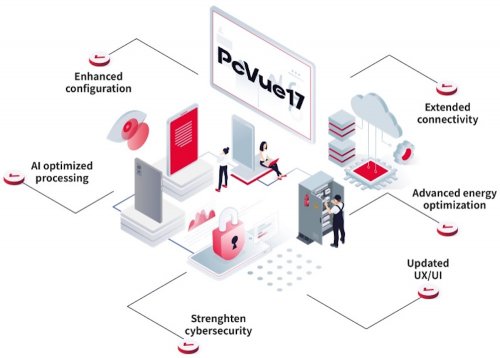
ARC Informatique, publisher of the SCADA/BMS PcVue platform, announces PcVue 17, a major release addressing critical systems challenges: energy efficiency, operational performance, and cybersecurity.
Driving Energy Flexibililty
PcVue 17 improves the energy efficiency of buildings and industrial processes. By centralizing data from multiple sources within a unified ecosystem, it actively optimizes energy demand through optimized control scenarios that can include AI-based forecasting, thus avoiding consumption peaks and reducing energy costs.
Intelligent Assistance for Performance
PcVue 17 introduces intelligent assistance that enables users to configure workflows and orchestrate complex processes through low-code interfaces. By combining AI processing and real-time data analysis, it allows to automate routine tasks and accelerates decision-making across both systems and teams.

On the engineering side, PcVue 17 helps you design faster and be more efficient with enriched object libraries, and flexible modeling capabilities.
Certifications for Critical Infrastructure Cyber-resilience
Backed by IEC 62443-4-1 and IEC 62443-4-2 certifications, ensuring secure development processes and robust product security for industrial automation systems, the platform not only offers high performance, but also remains secure and resilient to cyber threats, thus ensuring operational confidence for critical infrastructures.
27, Jul 2026
X721 announces the success of its inaugural mission, designated M001
This marks a major milestone in the development program aimed at reaching the stratosphere by 2028
Mérignac, July 27, 2026 – X721 Enterprise announces the success of its inaugural mission, M001. During this mission, the Heliblade demonstrator officially validated its outdoor test flight, following a prior series of successful tests. This major milestone confirms the maturity of the design and is part of an ambitious development program aimed at reaching the stratosphere by 2028.
Classified as an experimental drone, the Heliblade demonstrator falls into the HALE (High Altitude Long Endurance) and HAPS (High Altitude Pseudo-Satellite) categories.
This first test flight, M001, took place in Nouvelle-Aquitaine on Friday, July 24, at 7:45 a.m. (CET). The flight consisted of two phases, with an initial level flight at 15 meters, followed by a second at an altitude of 35 meters.
This demonstrator is a Heliblade “Model 11” (named in honor of the Blériot XI, a light monoplane produced starting in 1909), consisting of two ultralight wings with a total wingspan of 18 meters and a mass of less than 4 kilograms.
This successful test flight was conducted for and with the support of the French Air and Space Force and the Directorate General of Armaments (DGA).
Unlike conventional stratospheric platforms, the Heliblade relies on an innovative architecture featuring ultralight rotating wings. Its flight stability and structural rigidity are ensured by harnessing centrifugal forces—a novel technological approach that opens new opportunities for the public and private sectors worldwide.
On this occasion, Pierre-Eric Lys, CEO & Chief Engineer of X721, stated:
“Today, centrifugal forces won a small battle against gravity… and I must say we’re quite pleased with the result.
This first flight is a very special moment for the entire team. Just a few minutes ago, the Heliblade was nothing more than a prototype, the result of several years of research, simulations, and testing. On this day, it has become an aircraft by showing its ability to fly in a controlled manner.
Of course, we remain cautious: a successful first flight is just one step. There will still need to be a lot of testing and improvements before we have a fully operational system. But today, we have crossed a major technological barrier.”
The Advantages of the Heliblade
Its design is based on three principles: simplicity, agility, and lightness.
The success of the Heliblade demonstrator paves the way for a new generation of stationary platforms operating within the air-space continuum.
This new flying object will use, in its stratospheric version, ultra-light wings without spars, centrifugal force, and solar electric propulsion powered by high-tech batteries, offering structural rigidity, stability, and exceptional maneuverability.
By 2030, X721 aims to establish the Heliblade as the benchmark ultralight flying vehicle for Very High Altitude (VHA) operations.
By late 2030, it will be capable of performing prolonged stratospheric flights and eventually carrying up to 10 kilograms of payload, including cameras, sensors, or telecommunication systems.
The Heliblade is designed as an ultralight aircraft capable of being deployed anywhere in the world. Weighing less than 70 kilograms, it is easy to transport, allowing rapid deployment in almost any environment.
Key Specifications
- Quickly operational worldwide
- Deployment in less than 72 hours
- Wingspan: 50 meters
- Weight: Less than 70 kilograms
- Stratospheric ascent time: Approximately 9 hours (depending on weather conditions)
- Endurance: Several weeks to several months
- Operational temperature range: -40°C to -80°C
Proximity to Earth Enables
- Observe images or detect objects with four times the resolution using the same technology as current satellites, but without revisit time constraints.
- Listen to or intercept frequencies, analyze electromagnetic signals (communications and radar emissions), monitor the radio environment, and collect strategic data in real time.
- Communicate and act as a relay platform between fixed and mobile points on Earth, in the air, and in space.
Here, there is no need for massive infrastructure or hypergrowth; instead, the focus is on a sustainable and thoughtful economy.
Building on these advances, X721 aims to become a new player in the decarbonized digital revolution—one free from space debris.
X721 has established its French subsidiary, X721 France, in Mérignac, Nouvelle-Aquitaine.
X721 France plans to collaborate with companies specializing in:
- Solar power systems
- Electronic systems
- Artificial Intelligence (AI)
- Composite materials
- High-speed data transmission
- Other advanced aerospace technologies
A recruitment campaign aimed at both civilian and military professionals will be launched in France starting August 2026.
The success of Mission M001 takes both X721 and the Nouvelle-Aquitaine region to new heights.
X721 seeks to build business partnerships worldwide with organizations that can host the Heliblade within their facilities and support its operational and commercial development. The company aims to connect the various air and ground platforms that support modern civilization.
Looking further ahead, the technology could also support future space exploration, particularly missions within the Martian atmosphere.
According to Jean-Jacques Dordain, Chairman of the Board:
“By combining experience and inventiveness, technology and practice, X721 is well-positioned to bridge the missing link between the upper atmosphere and very low orbit—wherever and whenever there is a need to understand the reality on the ground.”
25, Jul 2026
India-Focused Fund Flows Show Early Signs of Stabilisation Amid Global AI Trade
New Delhi, July 25: India-focused investment flows are showing early signs of stabilisation as global markets navigate shifting trends driven by the rapid growth of artificial intelligence (AI) and changing investor priorities.
Market observers said investor sentiment towards India is gradually improving, supported by the country’s strong economic fundamentals, resilient domestic demand and growing opportunities across technology, manufacturing and emerging sectors.
The global AI-driven investment wave has influenced capital allocation patterns, with investors reassessing opportunities across markets. Despite these shifts, India continues to remain a key destination for long-term investors due to its growth potential and expanding digital ecosystem.
Experts noted that improving market confidence, policy support and structural reforms could further strengthen India’s position in global investment flows.
The stabilisation in fund movements signals renewed investor interest and reflects growing confidence in India’s economic outlook amid evolving global market conditions.


